
 by
by Walter Kunkle, 13 July 2026
WEDNESDAY
I was dressed like a man credibly accused of sex tourism as I boarded the plane that would take me to Columbus on Wednesday morning, June 17. A man I passed in the aisle told me I had an awesome shirt. For the reader: my outfit was cool: white pants—a silky shirt with a dragon on it. I told him my wife picked the outfit out and he reacted with incredulity. But some of us have cool wives.
I was off to cover Origins Game Fair for Armchair Dragoons, as I had done now for three consecutive years. But unlike the years before, a spear of ennui had pierced my psyche. Perhaps it was anxiety about my work, or about a particular game I am trying to develop commercially. Or perhaps it was the grits I’d eaten at Ben’s Chili Bowl that morning, which were so bad that they were making me question my intuition.

most images can click to enlarge
It wasn’t all bad: my friend Austin, who I had known since kindergarten and who lived in Columbus, would be attending the show with me this year. This was joyous news. Austin and I had kept the friendship up over the long term. Though we have differentiated now, back in the glow of our boyhood, we both looked and acted so alike that teachers would mistake us for one another. As fate would have it, Austin and I both work ridiculous jobs. I design games for the government, and he works for the company that makes those little smiley-face-frowny-face buttons that you see in airport bathrooms.

We met at the convention center and endured the line which always feels like it’s an hour long. There was a separate line for GMs this year, I had been told. When I reached the end of the registry line, the orange shirts told me that I actually couldn’t get my media badge here—that “they” had taken all the media badges away, and that I had to proceed to a second desk on the opposite side of the cavernous hall. I perhaps too graciously set this large inconvenience aside and frog-marched across the convention center to a secluded second desk, where a trio of seemingly lonely GAMA employees eventually gave me my badge.
Austin and I took to the gaming hall. We stopped by the Dragoons booth where I was able to introduce Austin to my editor, Brant. Brant told Austin that my articles, by this point, had become famously self-indulgent. I replied that if you are going to indulge anybody, it might as well be yourself. To my relief, Brant spared himself of the indignity of asking me to cover the Origins Awards this year, which in turn spared me the indignity of pretending that I would go.
Seeing Origins and all its sprawl through a fresh set of eyes was invigorating. We were particularly drawn to the impressive tables of 3D-printed terrain in the rear of the hall for the Battletech Grinder event. The floor setup for Armored Predators: Europe Ablaze also caught our eye, and we found ourselves registering for events that hyped us up spontaneously, just based purely on the set-pieces we could see being set up. I had learned by now that the best way to experience Origins was to not overload your schedule. Instead—you should leave a bunch of open room on your calendar and sign up for stuff as it catches your eye, or based off word of mouth from other attendees.


There wasn’t much to do on Wednesday, and with the vendor hall not yet open, we drove out to Austin’s place on the far woody outskirts of Columbus to eat burgers. Austin has a cool wife too, and a young son, Simon, who is always enraptured by whatever it is I’m doing. As I talked with Austin and his wife, I watched Simon play a little dice game that was suitable for kids. The game was called First Orchard from HABA’s My Very First Games line. The ceiling for enjoyment of First Orchard has to be around 2-3 years old. But Simon could play it with some direction, and it was clear he understood how the game worked and which die results were good or bad.

In First Orchard, you lay out four orchard tiles, each of which corresponds to a pile of four brightly painted wooden fruits: pears, blueberries, and red and green apples. Each turn, you roll a large d6. For four of these results, you pick a fruit from a corresponding orchard and put it in your little basket. The die also has a basket symbol, which lets you pick a fruit of any color you want. But the final face of the die is the hated crow. The crow is a little bastard who, every time his result is rolled, walks (or swoops?) one space menacingly down a garden path toward the player. When he reaches the end of that path, the game ends—a couched metaphor for the futility of our labors in the face of mortality.

The most important skill this game can teach a young kid is how to lose—a lesson many adult wargamers have never internalized. As more orchards empty out, the die has more faces that lead to a blank result. This means that you are almost always re-rolling a lot toward the end, which adds a lot of tension for a little kid as the crow starts moving faster and faster.

Before long, it was time to head to my AirBnb. Longtime readers will know of my tradition of staying in the cheapest lodgings (tenements) imaginable. A two-mile walk from the Convention Center brought me to an austere but functional duplex house, the front room of which was furnished with a TV and a weird faux-metal table. The floors of the stairwell landings were all made of plywood that had been spraypainted millennial grey. The rooms all had girl names, mine was the keypad-locked “ANNA” room on the third floor. The sheets on the bed were some sort of space-age plastic-y fiber that retained 200% of your body heat while you slept, cooking you in your own juices. If the house burned down, the firefighters would pull these sheets from the ashes—white as the driven snow. I am guaranteed to come back here next year because the price is incredible.
This is the latest article in our series of articles covering Origins 2026 and you can find a carousel linking all of them across the bottom
THURSDAY
I didn’t sleep particularly well. I took a shower and then headed for the Convention Center to finally get some gaming in. I walked by stores on N High St with named like “Lash Nympho” and “Cartel Palace.” My schedule this Thursday was somewhat light—I had the National Security Decision-Making Game: Cold War in the evening, which Austin insisted we go to after reading about my experiences there a few years ago. I wanted to use today to knock out several interviews Brant had wanted me to do, so that my time otherwise would be devoted to gaming during the “primetime” of the show.
Many of the gaming groups were sequestered in private rooms off the showfloor this time around. Given that each Origins seems to get larger and larger, there seemed to be more and more of this space utilized every show, and there was always something hidden away in one place or another. Rogue Judges was one such gaming group. I walked into their room in the A block of the showfloor, and the amount of gaming tables they had set up in their rather modest space immediately impressed me. I saw two tables set with the lavish miniatures and bold red tiles of boss-battler Grimcoven published by Awaken Realms (this game was very popular this year). But my eyes were drawn to a table with a familiar green box that called to me. I was looking at none other than my old friend, Betrayal at House on the Hill 2nd Edition.
A nice dude named Robert noticed my immediate recognition of the game. He asked if I was a fan. Reader, I adore Betrayal at House on the Hill. Every devoted hobbyist has one or two “weak spot” games that they will make endless excuses for out of sheer love. Betrayal occupies one of these spots for me (the other is probably Warhammer Fantasy). My own weather-beaten copy of this Avalon Hill gem has seen dozens of plays across many friend groups. Its rules are obtuse, many of the haunts are outright stupid, and there are times when you question whether it’s even really fun to play. And yet there is so much love in this game—from the writers who wrote little “biographies” on each of the 12 playable characters, to the online community, which has augmented the haunts over time and built new ones. Robert shared my love for the game, which was why he was GMing it here.
Robert, as it turned out, a rep for Rogue Judges, and he reacted sportingly when I explained to him that he had fallen into my trap and had become my interview subject. Rogue Judges, like many of these gaming groups, is decades old by this point. Robert, who has GM’d with many of these show groups, said that Rogue Judges has his eternal loyalty as the best one to GM for because of their behind-the-scenes organizational chops. “They do everything for their GMs,” he told me, in a tone of voice that told me that he had been burned before. He has even seen the organizers for Rogue Judges buy games for GMs who don’t have a copy of what they want to run. Robert and I talked more about the minutiae of Betrayal, and the various expansions for the game before I bid him farewell.
The showfloor this year was “protected” by metal detectors that you had to walk through every time you wanted to enter. In defense of this security policy, the detectors took basically no time to go through and only held people up minimally, and the guards would basically just quickly look in your bag before waving you away. But this of course meant that the “security” was basically useless—empty theatrics designed to check some box on a legal liability form. As such, this was a policy almost tailor-made to piss nearly everyone off. Everyone I talked to had an opinion on the metal detectors that they were quick to spout off with little to no prompting in the slightest.

I entered the vendor hall, which had been closed yesterday. The gaming hall is extravagant every year, but the vendor hall is truly an assault on the senses. I can only spend a limited amount of time in there before I start feeling lost and disoriented. I didn’t see anything that grabbed my eye just yet, but I bought a copy of Kabuto Sumo as a gift for Austin and his wife, and for their little boy—when he gets older—because he likes bugs. I saw some incredible sculpts from Beldolor Miniatures, who I know by this point to look for every year. The sculptor, who I got the chance to talk to, has a fascination with stags and antlers that is very apparent in her work. I ended up buying a little resin stag that I hoped I could use in a miniature project.

“Weird history” was very on-trend this year. Newcomers Airships and Empires and Catalyst Games’ Leviathans were being demoed—both of which had very similar designs to the riveted hulls of a much older title: Dystopian Wars. I have never seen Dystopian Wars at any of these shows, and I probably never will. I get the sense that these newer, sleeker airship games are eating its lunch. But chief among all the weird History offerings was Warlord Games’ Konflikt ’47. The majority of their booth space was devoted to lavish dioramas of this weird World War II minis game. The grognardier historical stuff was still present in their booth—but noticeably diminished in profile. The wave of “Weird history” has crested and broken many times over the hobby gaming space. Maybe it’s because I am getting older, but I have less appetite for it. Sure, maybe it gets more people into historical miniatures. But it feels somewhat lowest-common denominator, leaning into the laziest tropes. What is Italian will inexplicably become Roman—the Japanese will get mechs and samurai, the Russians will ride bears. However, I understand that it’s probably less embarrassing to lead your lovingly-painted Waffen SS troops from house to house if they’re epic werewolves or Frankensteins or whatever.

Brant had wanted me to check out the games being run by the Aerodrome group, and since I knew them as the guys who I had played Wings of Glory with a couple shows ago, I was happy to oblige. I sat down at a table overlooking the coast of Belgium. I recognized Glen, the feared ace who had gifted me my own Spad XIII the last time I played. Wings of Glory scratches a great itch for me. The game feels like a more skill-based X-Wing, and the aircraft you are all flying are much more symmetrical in terms of the abilities they have. I was on the Allied side, and our mission was simple—to escort two large cloth-winged bombers from one end of the board to the other while dogfighting a half-dozen German planes.

A Santa-like Brit in goggles named Tim was on the enemy side opposite me, as was the feared and sharp-eyed Glen. I had taken my trusty custom Spad XIII out of its box. The GM told me to fly the model but not the steering deck that came with it, as it wasn’t suited very well to this scenario. Though I perhaps wanted to push back on this, they were the experts, not me, and I wasn’t going to insist on running my super special Mary Sue plane if it was going to hurt my team. I would leave it to my flying to do that.

I decided at the outset of the game that I would try and kill the offendingly British Tim in honor of this nation’s 250th anniversary. Unfortunately, Tim was quite good and I was never really able to get a decisive shot on him. There was a gentleman on the German team next to me who was very loud and had a habit of spitting everywhere. I’ll call him “White,” because he flew a very pretty white plane. At some point in our game, without me realizing it, my primary motivation became not to protect the bombers at all, but just to kill White—such is the power of table presence.

With no friendly aces in my neck of the woods, the three players most involved in my board half—besides myself—were my friendly bomber pilot, Tim, and White. White was not a very good pilot. He kept trying to tail the slow, ponderous bomber to get shots on it, but because his tiny plane moved faster than it, he kept ending up almost ramming into it every turn and not getting to shoot as a result. In Wings of Glory, a faster plane can’t tail a slower one indefinitely—there is a skill involved in learning when to set up your shots, peel off, and come back from another angle. Anyway, I think White ended up without a shot on the target bomber for like 10 activations—some ridiculous number like that. But Tim was a different story, and he would deal out absurd amounts of damage to the big plane from its blind spot as it creaked across the sky, and then he would dodge elegantly out of reach.

Ultimately, White didn’t even give me the satisfaction of killing him. The bomber adjusted its altitude slightly and White (of course) rammed into it, banishing both planes to firey oblivion. A fusillade of spit showered me as White’s plane went down, and he howled and clapped like a seal. If I had a regret this game, it was focusing so much on White—who could barely even get a shot on the bomber even when he wasn’t almost being rammed by it—instead of Tim—a true threat who needed to be shot down very quickly. There were very few enemy planes who could threaten our bomber from the remote spot we were in, and if Tim had been shot down before he had so badly damaged the craft, White ramming into him probably wouldn’t have killed him.

As it turned out, Tim had won a raffle for a random plane as part of the event, but he explained to the table that he actually had the largest collection of Wings of Glory planes in the world, with some 3,000 models, and that he would rather give it away to someone else. As no one expressed immediate interest, I ended up getting the plane—a German Albatross C.III with a dragon painted along its side. It flies slower than some of the smaller planes, and has a weaker damage deck, but since it’s a two-seater it has a machine gun that can fire behind it as well as its front gun.

Since you have read this far, I figured I would pitch you on the best game I played at the show, as well as the only game I ended up buying. The game I’m talking about is Allplay’s Gruntz, and it’s a surprisingly engaging chess-like whose cute art belies its depth. In Gruntz, you deploy a versatile force of infantry, armor, motorized, and air units in a one-on-one duel. Units naturally counter other enemy units, and every deployment of a non-infantry asset is a big tactical commitment, as when these units die, they die permanently. The early game is usually a bit of a knife fight to disable the enemy’s more dangerous capabilities before you can actually reliably put infantry on objectives to score points of your own.

The true genius of Gruntz, though, is its magnetized pieces. Your tanks and trucks can fit magnetic attachments: anti tank guns, troop transports, or anti-air guns that change how they play. The game provides each side with more attachments than there are vehicles to fit them on, meaning that asymmetry between the two teams develops naturally. This magnetic bit is the secret sauce that keeps the game incredibly replayable—having your anti-air gun on an armored chassis rather than a mobile truck changes a lot about its battlefield role. Air power, as well, can be wielded to devastating effect, as I learned in many games with Austin over the course of the week.

Because Austin was a dear friend and meant the world to me, I allowed him to drag me to the National Security Decision Making Game (NSDMG) run by Merle Robinson. This particular game was Cold War themed. I think these games are run poorly, and I decided after my experience last time that I would probably not go back to one. If you have never been part of a tabletop exercise for a professional audience before, you might think that the NSDMG is really neat. But if you have been a part of one, you’ll find that what’s on offer here falls critically short in every regard. There are too many facilitators, none of whom can really give a straight answer when it comes to directing the players through what they actually need to do. Nonetheless, I must make one grudging concession to Merle’s crew: the games are great to write about. As the Soviet role cards were dealt out to Austin and myself, I knew he and I were going to get up to some bullshit.

Like last time, the problems started pretty much immediately before the game was underway. We were dealt Soviet role cards, and then, two minutes later they took them away from us without explanation—dealing out different role cards. Both of these were still Soviet-aligned. Austin got two—I, along with everyone else, got one. Eventually, one of the facilitators came back and took Austin’s unused one. For those unused to NSDMG proceedings, the game is essentially a giant Model UN, and your role card tells you who you are as well as any secret objectives you may have. Your completion of these objectives isn’t really relevant to who will “win” or “lose” the game—these will be five or so players picked by the game organizers because they like how they behave—“sharks,” as one facilitator called them.

Merle’s rambling and long-winded presentation didn’t actually explain anything about how the game worked to a new player (another commonality from last time), and I had to explain to Austin that the game was basically filling out a series of permission slips to do stuff. We met in the Soviet cell with the General Secretary Brezhnev player, who assigned us all job titles to fit along with our faction roles. The player-on-player dynamics that emerge are the most interesting parts of these games, and here was where they began to take form. So that this following section is not confusing to you, I have made this graphic to show how characters in the Soviet bloc related to one another. The Americans, for our game, were irrelevant.

I, a radical reformer, watched wide-eyed as my naïve reformist General Secretary handed every military and KGB role to insane Stalinist hardliners who were opposed to her policies. Austin’s whackjob Shelepin faction of Stalinists was made KBG head, and I was deputized under him as Director of Subversion. This fulfilled one of my character goals immediately—my faction apparently were these weird Third-Worldist, “global revolution” types. I was definitely not a hardline Stalinist, but in a breakout discussion, I threw in with the other hardliners because even an idiot like me could see where this train was going. I had a better chance of accomplishing my goals if I wasn’t dead.
A loud fellow I’ll call “Blueshirt” was our Western Theather Commander. He was also a blood-crazed Stalinist. Blueshirt had played in these games many times before, and, in hindsight, this should have been my signal to rally the other players just kill or demote him immediately. I wanted to spread Communism into neighboring Finland. Sounds good, said Blueshirt, provided we could use that as pretext for an invasion. I didn’t care as much about the invasion as I did the spread of Communism internationally. But any decision I made, I was told, had to be run by the rapporteur who was representing Finland. I went to the big board to decode which rapporteurs were playing which countries. Finland wasn’t on there—in fact, pretty much any country we were interested in interacting with wasn’t on there. Merle picked a facilitator impromptu to act as the Finnish rapporteur.
The guy Merle picked for Finland is one I previously had short, and acrimonious contact with in a previous game, where he served as the rapporteur for my Chinese team. I knew as soon as Merle picked this dude that our ambitions in Finland would turn into a disaster. This particular facilitator is a bit of a curmudgeon, and I’d wager he would be more at home sniffing his farts out of a wine glass than facilitating a game for other people’s enjoyment. He was unclear about what I was trying to do (arm Finnish student groups) and he said I would need to smuggle spies into the country across its borders (any Soviet spies would already be there). We argued about the minutiae of my plan for what felt like 10 minutes. I got terse with him. “At the end of the day,” I said to him, “do I need your consent for what I, in my capacity as KGB Subversion Director, decide to do in Finland at all?” He explained to me that my efforts likely wouldn’t meet with much success.
While I was trying to cultivate Global Revolution, the Kruschevite Idealogue came up with a plan to “spark a Communist revolution in Greenland.” I told him this was a silly idea and he was probably wasting people’s time trying to get signatures on it. The Idealogue had a tendency to butt in on private KGB-related conversations, perhaps believing his role gave him some sort of supervisory authority. Within the Hardliner clique, Austin and Suvlov were level heads and seemed to keep a good grip on the wheel, but Blueshirt was becoming a bit of a wildcard and seemed to be a bit inclined to military adventurism. I was determined that if we were going to coup anybody and cut them out of their job, it should be the Idealogue for the crime of being annoying. There were Americans in the game acting in opposition to us, but none of my clique were particularly interested in talking with them. The sedentary facilitator who directed our Russian cell and who sat next to our General Secretary all game broke up a KGB conversation to chastise us and say that we had to constantly “guard” GenSec to prevent American roles from wandering over or speaking to her. I asked why he couldn’t do that, as he was a facilitator. That wasn’t his job, he said, or something to that effect.
For all the criticisms I will pile on Merle’s game, Merle himself was the most helpful facilitator there. I was able to talk with him about three potential avenues for me to achieve my sinister Third Worldist aims, and he was helpful crafting individual courses of action for me to take in Algeria, Africa, and Italy rather than immediately shutting me down. I was able to pitch these ideas directly to our General Secretary, who I was beginning to like. She had a way of paying attention to every policy that was put in front of her, and was discriminatory in what we were collectively doing. Of course, my own clique wanted her gone—no getting around that—but I began to believe that she might be able to be saved.
By an hour of play, Austin and I were looking for any excuse to have the Idealogue killed, and had gotten the verbal consent of a half-dozen decisionmakers to sign off on it should it come across their desk. The General Secretary was preparing for a big conference with the Americans on nuclear disarmament. Right before she was due to leave, the Idealogue approached me and Austin—the two people running the KGB—and said that perhaps he should be made General Secretary. As I already had an order written in my back pocket for the Idealogue’s detainment and execution, this couldn’t have come at a more welcome time. I briefed General Secretary on this treachery and she quickly signed off on his arrest and left for the conference. But when it was revealed the General Secretary was going to meet with the Americans, Austin told me, he knew now “that the cause of Communism was being fatally weakened from within.”
We frog-marched the Kruschevite Idealogue off to a show trial in front of the hardliners. Yuri Andropov, President of the USSR, was also swept up in this for some reason and was probably going to be executed as well, though he was reacting more calmly than Kruschev. Blueshirt began loudly proclaiming “can we just kill the General Secretary?” He blamed her for the unfolding debacle in Finland. For a half-hour, I debated with Blueshirt and tried to subtly get the hardliners to see the merits of our reformist, but pretty competent, General Secretary, who was probably keeping the wheels on the whole USSR.
Andropov testified against the Idealogue, who was stripped of his rank—his title was given to the Suslov faction. The wheels of the palace coup were starting to turn against me at that point. The hardliners wanted to assert control of the whole country. It felt like I was struggling vainly against a boulder rolling downhill. Why not let it fall? If General Secretary Brezhnev was so competent, why give all the coup-proofing roles to Stalinists who hated her? And why the hell hadn’t she come back from the conference for what felt like an hour? I sensed a looming disaster for the Soviet Union. The idea of a new General Secretary was batted around. “How about Andropov?” someone said, and none of us hated the idea, so we released our Comrade from his cell and toasted to his ascension to the head of the Soviet Union. I relaxed my muscles, and I let the boulder roll downhill. No sense putting a target on my back.
They arrested the General Secretary as soon as she got off the plane in Moscow. I asked the foreign minister how the conference had ended up going. “Badly,” he had said—nothing had gotten done. “It’s a good thing it went badly,” I joked, “if you had worked something out with the Americans, we probably would have executed you.” The Foreign Minister and the guy from Eastern Theater Command ended up smuggling the General Secretary out of the USSR and all three of them fled to exile in the US. At Gensec’s trial in absentia, Kruschev, our former Idealogue who was now a devout Stalinist, banged his shoe on the desk and denounced Brezhnev’s revisionism. I overheard two of the facilitators, a short fellow and my Finnish nemesis, talking about me while I was standing right next to them. “Things aren’t gonna go his way—he’s a jerk,” I heard the Finn say. Right on both counts, but as they say on the playground: it takes one to know one.
Finland, which we had now openly invaded once Blueshirt got Andropov’s sign-off, was a dumpster fire, but we were all amassing titles like nobody’s business. Blueshirt got made MoD; I assumed command of both Western and Eastern Theater forces, and Austin was made Foreign Minister and was still allowed to keep his KGB Chief job. It was a great system—for us—but Andropov was a figurehead General Secretary—signing off on everything without reading it. Blueshirt pushed him around a lot and was beginning to dictate more and more policy from the MoD desk. The US moved to DEFCON 2 in response to events in Finland. In response, we invented a Soviet version of DEFCON and moved to level 2 on that as well. As things began to fall apart, Austin and I drafted an order to coup Blueshirt in the hopes of stabilizing the USSR, but the game ended by that point. During the debrief, the facilitators, who were baffled that we would try to invade Finland, asked Blueshirt why he had gone all in on it. He showed everyone the objectives on the back of the card the facilitators had given him, the top one of which read “invade Finland.” Whoops!

I was burnt out when the game wrapped up. Merle and his gang did ask that anyone who had feedback on how the game could be run better to speak with them afterwards, but since I didn’t have all night, I decided I would just write about it. The strength of NSDMG is that it is absurd, and that absurdity comes through player interactions and makes it, for what it’s worth, a good storytelling vehicle. The facilitators gate those player interactions with rules. This would be fine, except that the rules are never explained except when you run afoul of them, and the most common response from a facilitator when you want them to sign off on something is that it’s not their job and another facilitator has to do it. Many of them can’t even tell you who. With a full day ahead of me tomorrow, I went back to my place, crinkled my sheets over my head, and drifted off.
FRIDAY
Austin picked up a breakfast sandwich for me as we scampered to our Friday morning endeavor: the spectacular Hunt for Red Orktober event at the SGG booth. I had wanted an interview with SGG anyways, so this rather conveniently put me over in their neck of the woods. For those who have come to Origins before, the offerings from Superior Gaming Group, or SGG, are impossible to miss. They run Hunt for Red Orktober, the OGRE megagame, Warhammer 40,000: Titan Battles, and the always crowded Sky Pirates.

Red Orktober is a spectacle every year. A giant kitbashed submarine and servicing derrick take up a whole table, and space marines and Orks fight over it. It was the only 40K narrative event here, and the table isn’t of the same quality you’d see somewhere like Nova Open ,but I have always admired it for its ambition. I won’t write too much about Red Orktober here—save that by the end of the game I had a sense that the forces of the opposing Space Marines and Orks were a fair bit unbalanced in favor of the Space Marines’ side. The game was still a blast and a very fun start to the morning, but my interview with Patrick, the facilitator, was more interesting.

Patrick and the rest of SGG, he told me, were leaving Origins—this would be their final year here. They had made the decision after dealing with hassles coordinating with GAMA, particularly regarding the scheduling of their events. I could tell Patrick was upset about this and wanted to vent. When I told him, during the game, that I was interested in an interview, I was quickly inundated in a flood of conversation that threatened to sweep me out of the game entirely. SGG, as it turns out, was a family affair, run by the patriarch Doug (who typically ran the Ogre megagame every year) and his sons. But with Doug getting older, and the nuisances from GAMA piling up, the family were having a harder and harder time each year justifying spending all the money to come to the show. The relationship with the showrunners, Patrick told me, had been a lot better in the past. But this year, what with all the new staff GAMA had apparently hired, something finally broke.
Though perhaps this reflects poorly on me, I almost didn’t believe Patrick. Complaining about GAMA is sort of a timeworn tradition among Origins vendors and attendees. It’s almost like a joke—an old married couple snapping at each other. Earlier yesterday, an older guy told me there had been no paper towels in one of the men’s rooms. “GAMA,” I solemnly said and shook my head. In the light of this news, I found it hard to imagine an Origins without Red Orktober; without Sky Pirates. The fact is: there is a magnetism to Origins that keeps me, and other people, coming back year after year. One Space Marine victory, one blown up sub, and two piles of dead Orks later, Austin and I departed the SGG space until later that afternoon when we were slated to come back and play Sky Pirates.

We stopped by the Mantic Games booth in the vendor hall, because I was hoping to play some Kings of War. I was met with a bit of anticlimax: there would be no Kings of War demo this year. The demo players for both the Mantic Games booth and the Ohio War Kings booth were unable to make it to the show this year. I saw a lot of shelf space at Mantic devoted to their sci-fi game Firefight, and it brought a smile to my face to see the company I had grown to appreciate was still sticking to its roots: flagrantly ripping off Games Workshop properties. But the booth’s table space was devoted to a new miniatures game: Halo: Flashpoint. The booth boss, whose name escapes me, told me that Mantic had won the miniatures rights to the entire franchise, and that the game was quickly looking like it would become their best seller.
As someone with a few decades in the miniatures hobby by this point, I have some reason to doubt the longevity of IP tie-in games. I had seen Skyrim and a ton of other Modiphius offerings come and go. Even good ones, like X-Wing, I’ve seen run aground. The problem these games run into is always the same, regardless of how good the rules are. Because you’re working with an IP, modelers have limited creative license to invent their own units or monsters. Players will always want the thing they recognize from the video game, but that tends to be a somewhat shallow pool when you try wading through it, and from there you have nowhere to go. Nonetheless, I like Mantic and hope they ride the Halo lightning for as long as they can, if only so I can keep playing Kings of War.

After we came back from a big sushi lunch, Austin and I went back to the show hall for our appointment playing Sky Pirates—the last game of the Sky Pirates ever played at Origins, if Patrick was to be believed. On our way in, we saw an incredible miniatures game being set up near the Dragoons booth—a walled African city at the convergence of two rivers, besieged by a much larger force. A poster for an old Lawrence Olivier movie sold the setting instantly: Khartoum—where in 1885 the Nile turned red and Charles “Chinese” Gordon met his end. I registered for an open slot in this game the following day instantly.

If you have attended Origins before, you have seen Sky Pirates. But you may not have played it, because it is only one table and it’s pretty much instantly booked back-to-back every year. A cage-like PVC pipe rig surrounds three floating islands cut out of XPS foam. Dangling from the roof of this cage were five colorfully painted airships, each of which sported a gaudily-painted captain and two crew members standing on its deck. A system of knotted ropes allows each player, who is in command of a single ship to control its angle of approach and its elevation—a spectacular commitment to 3D gaming that I have seen no other miniatures game attempt. The game is a free-for-all, which I think is probably a wise choice given the cerebral nature of planning out your moves in three dimensions. The system is entirely d6-based homebrew pulled from a madman’s fever dream.

I settled on a beautiful yellow and red vessel loitering around the mid-board, which I christened The Dalliance. I have a simple strategy in any free-for-all game—hide out and wait for people to get weaker before committing myself to an engagement. Austin flew a stubby blue and black gunboat to my rear, and to my immediate front, two stout enemy vessels: a green boat with a red stripe, and a powder-blue ironclad, looked poised to duke it out.

Sky Pirates is a system where your height advantages you: boosting the range of your shots against players lower than you while simultaneously keeping you out of range of dangerous boarding actions. In fact, it wouldn’t be much of a stretch to say that you should attempt to climb as high as possible, as soon as possible, because climbing is much slower than descending. The guns on your ships don’t really have “arcs,” rather, shots are simply measured hull-to-hull, a sensible decision given how difficult it would be to line up a broadside in a 3D sandbox. The musketmen on your deck can take potshots at enemy crew as well, though these are so short-range and inaccurate that they’re unlikely to do anything.
I thought it would be cool to chart a low course through the middle islands of the board, using them as cover from players who were climbing in altitude, and because I wanted to try out some fancy flying. I descended and snaked through the islands, though I did not go unnoticed by the players in front of me, who saw me as an easy target and were not content to let me hide. By putting myself so low, I was unable to shoot back at jokers who were taking potshots at me from much higher up.
Austin, meanwhile, boarded the sea-green enemy vessel that had been tailing him, killing one of the enemy crew members in close combat. This boarding action lasted quite some time, as close combat in this game between crew members is fairly indecisive most of the time. The old-timer flying the ship Austin had boarded managed to escape the melee and sneak one of his remaining crew back onto Austin’s empty ship, grabbing control of it while still maintaining control of his own vessel. This meant that he could control the guns of both ships.

I was near this engagement now, and because I was juicing for action I fired on Austin’s now-commandeered ship, bringing her down in a rain of fire. I also shot a cannonade into the focus of the melee itself—the sea-green ship—damaging it. The old-timer who had jacked Austin’s ride did not appreciate me butting in in such a fashion, and The Dalliance ate a raking salvo from both him and my pursuers behind me. Movement order was clockwise around the board, but because the same person went first and the same person went last every time, this lent a big advantage to the later-moving ships. A simple rotating first player puck would have been an easy fix for this. With my ship on a precarious 1 HP, I docked on a nearby island and hastily disembarked.

I had hopped off my ship just in time. A shot from my red-striped pursuer cratered my hull, and the wreckage of my ship tumbled from its cliffside mooring, leaving my three crew stranded. Considering the rate at which pirates were dying in these skies, I didn’t think this was too bad a fate, all things considered. Austin finally killed the last of the enemy crew, but his newly-commandeered ship wasn’t long for this world, either. As it skimmed barely two feet over the heads of my frightened crew, one of the remaining ships shot it down. I rolled symbolic evasion rolls for my men—the bowsprit of Austin’s wreck splintered off and crushed my captain’s skull, though my other two crewmen survived.

I really liked Sky Pirates, though Austin and I felt our energy slipping away towards the tail end of the game. Not wanting to jump right into a third “rolling to hit shitfest,” we cancelled our appointment at the Battletech Grinder that evening and resolved to just walk the show floor. Almost on a whim, we found ourselves gravitationally pulled into the Crokinole learning event.

Inwardly, I had taken curious note of the growing Crokinole presence at Origins for years. The game is a dexterity-based flicking game dating back to the 1800s—very similar to a miniaturized tabletop version of curling. A Navy vet in a wheelchair named Ron taught our small group, consisting of me, Austin, and a cosplayer/streamer who went by RemyReplay. Reader, as a somewhat young wargame enthusiast, there are many times when I have to pal around with people much older than myself. Over the course of our interactions, these people may get the impression, based off my behavior, that I think they are cool. Of course, they’re mistaken. But Ron was very cool. He struck Austin and I as the mythical “epic boomer,” and his Crokinole prowess and teaching ability were both Yoda-like. He told us if we were interested in buying a wooden Crokinole board that we should hurry before they sold out. Austin was honestly considering it. If I had a car, or a place to store one, I might have too.
Crokinole was, to be honest, a very healing game. The richness of it sharpened my observational senses again—like a shot of espresso. Perhaps it was like this in prior years, but it seemed to me that were a lot more “heckin’ chungus” games on display here than in the past. You know the ones. Millennial cringe seemed to have a longevity among geeks that I could not explain, and we were now well past its sell-by date. Like most socially well-adjusted people, I find this stuff incredibly grating, and it’s not a stretch to say that I would vote into power any totalitarian government that promised to get rid of it.

What was it about nerds, I wondered, that made them cling on to the old—the familiar—in such a way? Dead memes, dead aesthetics—and the warm sludge of familiar and friendly IPs that promised to never change too quickly—if they changed at all. It seemed to me then to all be part of a reactionary, preservative instinct. Was it any wonder that the Gamergate neurosis had been dug up from this same peat bog? A thousand years from now, dogs will be doggos and snakes will be danger noodles.
SATURDAY
Austin took leave of me today for family responsibilities. As I had none of those, the richness of Khartoum, the only event I had booked for the day, lay spread out before me in my mind like a sumptuous feast. The game began at 9:00 AM sharp. I arrived well earlier than that, my anticipation goading me along the two-ish miles to the convention center on foot. The GM was a man named Carey who wore a red fez, and he explained that the ruleset was a highly modified version of The Sword and the Flame miniature gaming rules for recreating Victorian conflicts.

Right off the bat, I sided myself with the Mahdist forces laying siege to the British-led Egyptian garrison of Khartoum. There were something like 500 miniatures at this table—all hand-painted by Carey himself, and because of this, the game had a cinematic appeal that very few of the others at Origins could hope to match. I was the youngest there by a fair bit, but I wasted no time organizing the Mahdist team. No one wanted the job of Mahdi because it involved having a big unit of cavalry (the Mahdi’s guards) standing still and not dying the whole game (or else we would lose). So I stepped up to the plate, despite the reservations of one of my trusted adjutants, Emir Paul, that I seemed perhaps too reckless for the role.

The city itself lay at the junction of the Blue and While Niles, and the dark brown patch on the board represented a muddy flat that could be traversed, with difficulty, on foot. The unpredictable flooding of the rivers had washed away the city’s high walls on our left flank, and the starving Egyptians there manned a makeshift wall, with a small interior floodwall serving as a fallback for any defenders. Twin fortress hardpoints dominated the left and right flanks of the city. The approaches to the walls had been surrounded by a dry moat, barbed wire, and landmines. On a high wilderness outcropping across the Nile from the city, on our far left flank, our forces manned two smoothbore cannons, with which we hoped to shell the town. On the far side of the Nile, closer to our right flank, the Egyptians had piled cannons and infantry onboard a rickety paddle steamer to turn it into a makeshift gunboat.

The Mahdist forces had a 3:1 or 4:1 numerical advantage over the enemy, though our troops were hot dogshit. I split command of our infantry formations as evenly as possible among my emirs. The most capable of these, I judged, was Emir Sam, who I positioned on our far right flank. I held the center right, and Emir Paul the Doubter held the center. To his left was Emir Luke, who I trusted to overcome the weaker leftmost walls of the city, and the timid and agreeable Emir Michael manned the ridge guns, as well as the three canoes full of our riverine forces who could come in on a later turn.
The Sword and the Flame is a very simple beer and pretzels ruleset for rank and flank miniature combat. A typical 20-man brick for our side was composed of five riflemen in its front rank, five spearmen in the rear rank, and ten swordsmen, of whom one of which was a “leader” for the whole unit. A standard deck of playing cards determined who would get hit or killed whenever the unit took fire—with red suits killing models and black suits dealing out wounds which could potentially be fatal. Drawing the dreaded red ace meant an instant kill on a leader, artillery piece, or vessel. Your movement distance for each unit is the random sum of 3d6 every turn.
The Egyptians were well-equipped with rifled cannons and gatling guns, and manned a very formidable city. As we advanced, Carey imposed a rule that affected our C2 cohesion on the first turn of the game, staggering our line somewhat. When the turn entered the shooting phase, we learned how much damage the overlapping Egyptian fields of fire were capable of. Scores of holy warriors dropped dead as they advanced, their comrades trampling over their bodies as they pushed forward.

Of my lieutenants, Paul, owing to his thankless central positioning, caught the worst of it. It was only one turn in, and we had been thinned considerably. Sam and I quickly realized a problem, not with The Sword and the Flame, specifically, which was alright, but with this scenario. Because our forces started already arrayed around the city, with no chance for us to redeploy, we had breadth, but no depth—no reserves. Our forces were spread at the start equally shallow everywhere. In a situation such as this, with no men behind us, we were each left with limited tactical runway—the best option was to charge blindly forward as fast as possible and just hope you made contact with the opponent before the guns swept your men off the field.
Emir Paul was not one for hope. He made it known quite early on that there was no way this event was going to last the blocked-off 6 hours if the all Egyptian shooting phases looked anything like the first one. I extolled my comrades to have faith. We need only reach the walls, I said, and let the beleaguered Egyptian dogs taste our sabres. But truthfully, Paul was right—there wasn’t much we could do—our one way forward had been decided for us.

It was Luke’s forces on our far left flank that saw combat first—hopping over dud landmines to reach the Egyptian riflemen manning the city’s shoddy makeshift wall. Combat in The Sword and the Flame is intended to be both cinematic and decisive. Your units rank up and all deal out hits to one another. Pivotally, infantry do not lock into combat over several turns. Instead, as soon as two opposing units make contact, they keep fighting that same turn until one of them has either broken and fled or is dead to the last man. Our numbers here favored us, but the walls gave an advantage on combat rolls to the numerically inferior defenders. Luke’s Mahdist warriors shattered the Egyptians on Khartoum’s left wall, with the survivors retreating back to the flood wall. On my right, Sam’s forces were being torn apart by machine gun fire. The dreadful and capricious red aces were dropping our leaders left and right, and our forces were beginning to disintegrate.

We could not tie up the Egyptians fast enough. It occurred to me that the game’s random movement was a huge punishment to the side who actually had to do any moving to begin with, while the Egyptians could just sit still. Spears thrown from Paul’s infantry killed a gatling gunner, but the units of ours that were reaching the walls were too hobbled by the oppressive firepower of the Egyptians to hold long in combat. We had been bested. At the start of the fourth turn, the facilitator rolled a morale check for our side, which had lost 100 or more models by that point. The result of this check, he decreed, was that our forces would freeze up for the turn and couldn’t move or charge. We all conceded rather than weather another turn of Egyptian shooting.

It was inevitable, perhaps, that an expectation I had built up so highly in my mind would leave me disappointed. I would have liked to see a more dynamic scenario run in the same system. My time spent at Origins was catching up to me, and my loss wearied me. I checked out a games consignment event with Brant that afternoon before knocking off to a little alcove to write for the rest of the day. The event wasn’t really worth it for me—any game that people might have actually wanted to buy that was in good condition was listed there at basically full MSRP.
I did spend some time that evening playing Blood on the Clocktower, a social deduction game in the vein of Mafia. It was good fun, and viable for all ages, as evidenced by the number of families that brought their kids to play. My team ended up winning, in spite of the townsfolk voting to execute me on Day 3 due to some confusion about who I was.
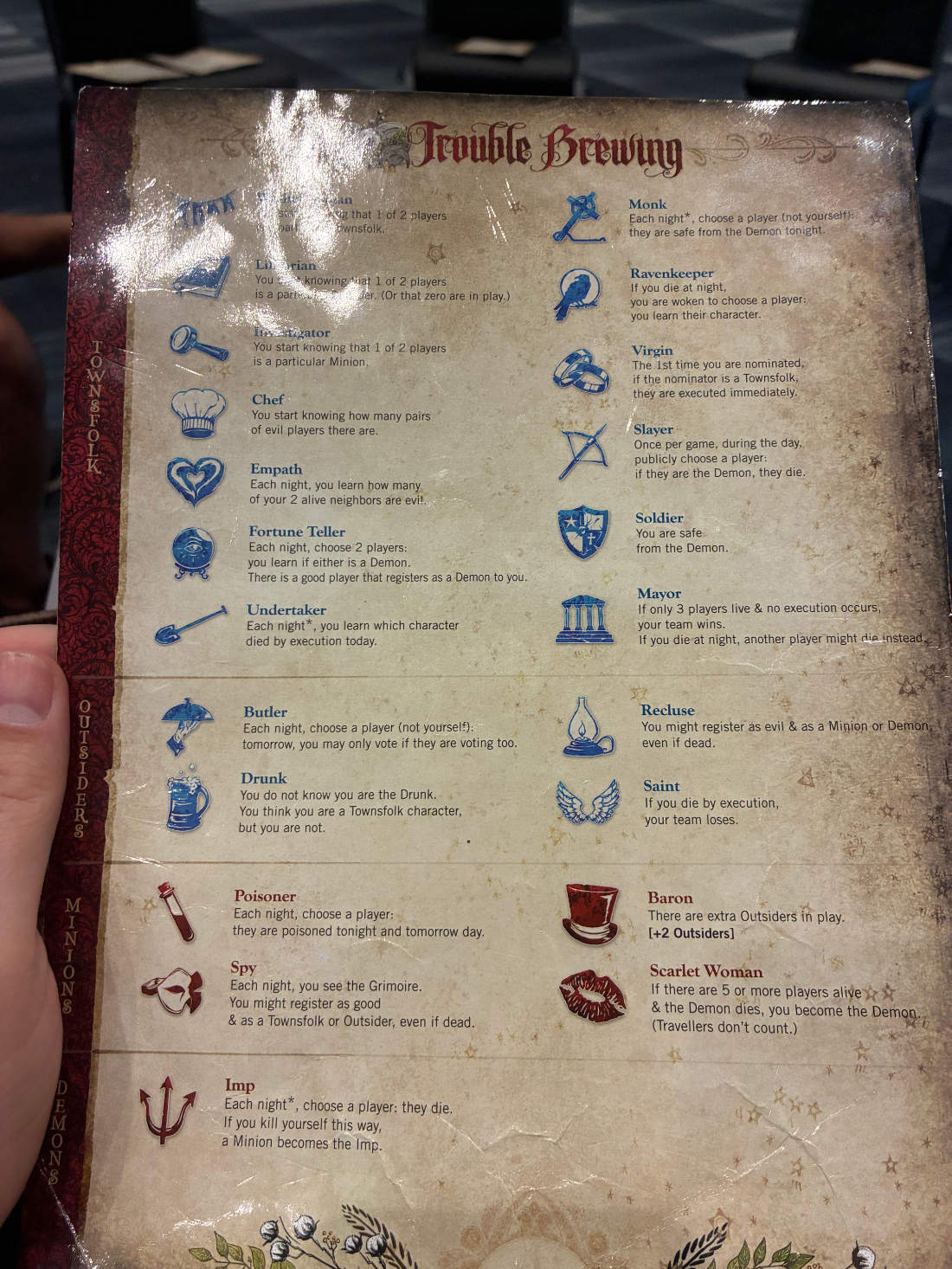
I shuffled off to my AirBnb to get started writing this article. The wifi in the place didn’t really work all that well. One of the router names was “ItsAllTransitoryBro.” I dwelt on this for a bit, watched the old movie Khartoum (1966) with some friends, and rested.
SUNDAY
As I walked in for the final day at Origins, I found myself surprised by how much of the show still seemed to be intact, and how many vendors were willing to hawk their games right up until the closing bell. This year games tied to “Cyberpunk” had practically subsumed Origins. I saw a card game, an RPG, a miniatures game, and a huge amount of floor space and advertisements. The ads for these were inescapable, and confronted you in every space you were in. There was an irony in the ubiquity of these ads—in the megacorps thrusting themselves into a place with its own scrappy character—a character, I realized, that could be lost as the years go by. I instinctively felt that if I vandalized these ads, wetwork police-for-hire would rappel down from the ceiling of the Greater Columbus Convention Center and shoot me in the head. A warrior’s death. But I had a cool wife waiting for me back home. The youth must take up the torch.
Right as I walked in, I noticed a dude in a flatbrim carrying one of the foam islands from SGG’s Sky Pirates. It had been severed from its PVC mounting, and he was carrying it out the door into the streets of Columbus. I think it was the island the men of the Dalliance had landed on, though I couldn’t be sure. So it really had been the last Sky Pirates. Patrick had been right. A sense of finality struck me. In a very intimate way, I was witnessing the ignoble death of a member of shrinking set of games: creative games that could never have made any money, but that were designed, above all else, to be played. The Sky Pirates of the world were dying—their corpses dragged behind Cyberpunk’s chariot.
Shortly after this happened, I lost my notebook. I searched for it a bit to no avail, though the convention center staff were quite accommodating to me. I had a nice talk with RemyReplay, who dropped by while I was writing. She was dressed as Chi-Chi from Dragonball (I think). We tried to get in on a Crokinole game but all the boards had been sold. Ron wasn’t kidding about how popular they would be. Something about the absence of my notebook put me at ease. It felt like a very perfect ending to my visit. I had lost Khartoum. I had lost Sky Pirates and seen Origins seemingly lose SGG in turn. I had lost my comb this morning, and I had now lost my notebook, just as I had lost my life in Blood on the Clocktower yesterday when the villagers voted to execute me—the humble Poisoner.
As I sat and ate Goldfish with Corinne and James Sterrett, I wondered what the future of the show would be. I felt like I, and perhaps Origins, was losing something that I was having a hard time articulating. A game with a little wooden raven teaches loss to the smallest among us, and teaches it well.
I know the wave of Halo and Cyberpunk will, one day, roll back. It’s nuts to think that everything will remain the same as I left it year after year. That I can “own” anything as ephemeral as a feeling, or a moment in time, instead of just being taken along for the ride. It’s all transitory, after all.
I know that in the face of the ground moving under you, you can plant your feet. You can stay in the long 2014. You can be the epic bacon Millennial, your presence offensive to all but a shrinking cadre of fellow unbearables. But I also know that you’ll break every bone in your body preventing the boulder from rolling downhill. The choice that lies before all of us is the choice between going crazy—cutting off our connection to everything—or choosing, in spite of it all, to be happy.

All of the Origins 2026 Articles
Origins Details ~ Wargame HQ Events ~ War College Events ~ Wargaming at Origins ~ Exhibitor Spotlights ~ Origins History ~ Q&A ~ Final Countdown
Opening Day ~ The Game Hall ~ More Gameplay ~ Above the Convention ~ Minis Wargaming ~ Wargame HQ Partners ~ Wargame HQ Spotlights
Exhibit Hall ~ Cosplay ~ Love and Loss ~ Everything Else ~ AAR ~ Forum Thread
Thank you for visiting the Regiment of Strategy Gaming and riding with The Armchair Dragoons.
Rather than list a bunch of social media links, the easiest thing to do is to check out our LinkTree, which connects you to all of our various locales around the web.
You can also support The Armchair Dragoons through our Patreon, and find us at a variety of conventions and other events.
Feel free to talk back to us either in our discussion forum, or in the comments below.


Hi! It’s me, Patrick!
It occurs to me to offer a bit more context to some of what happened. We did indeed give away the islands for Sky Pirates, to anyone who wanted to care for them. So a few of them went to volunteers for the convention, because they’re always great. The game had been getting slowly more decrepit for years, because as much as we patch up the paint and make repairs every year, time takes its toll no matter the will of Man.
I’d also like to say that Sky Pirates wasn’t built first and foremost to be played, but because we wanted to, and because it would be cool. We do actually still have some of the islands in storage, since we made more of them than we could practically use just because that’s how many we felt like making. I still don’t know what we’ll do with them, but we will probably dispose of them in some way so we have room for the next collection of projects.
Two out of three modules of the Red Orktober board were also discarded at Origins, though we removed everything we could from them. Don’t worry, we kept the submarine and the crane. I might have been willing to part with a board I’ve put hundreds to thousands of hours into buildng, painting, rebuilding, repainting, and maintaining, but the submarine and the crane I designed and built for it are not so easily given up.
I’d love to say there’s plans for some dramatic or triumphant return of these games that people clearly loved(the love that we felt from everyone was one of the things that kept us going.), but while the models are safely and securely stored, we don’t currently have any plans to resurrect these projects anywhere. They’re probably going to end up displayed in our workspace, just as inspiration for our future projects.
If you to find us again, we’re still involved with Adepticon, running their Open Gaming area. We have enough on our plate, so we don’t actually run any games of our own there. While we’d love to have the time and the volume in our trailer to bring stuff to run, we are perfectly happy just helping everyone else have fun playing whatever they want.