The earliest set of science fiction miniatures rules I ever acquired was Striker by Frank Chadwick (GDW, 1981) which I took in as part of my Traveller roleplaying game (RPG) obsession. Striker is a set of miniatures rules designed for the 15mm range that not only includes combat rules but also a unit and vehicle design system. Unfortunately, poor young gamer me never acquired any miniatures for Striker and was stuck playing with cardboard chits or other paper cutouts (do you remember Laser Tank from Judges Guild?). Over the years I acquired several other science fiction miniatures rule sets, some good and some not so good. The most recent set I acquired, thanks to the generosity of Collins Epic Wargames and The Armchair Dragoons, is Polyversal: Sci-Fi Miniatures System (Ken Whitehurst, Collins Epic Wargames, 2022). Polyversal is an easy to learn, easy and quick-playing, bring-your-own miniatures set of rules with a quick but robust unit design system that deserves both praise and play.
Photo by RMN (click image to enlarge)
Mini-less box
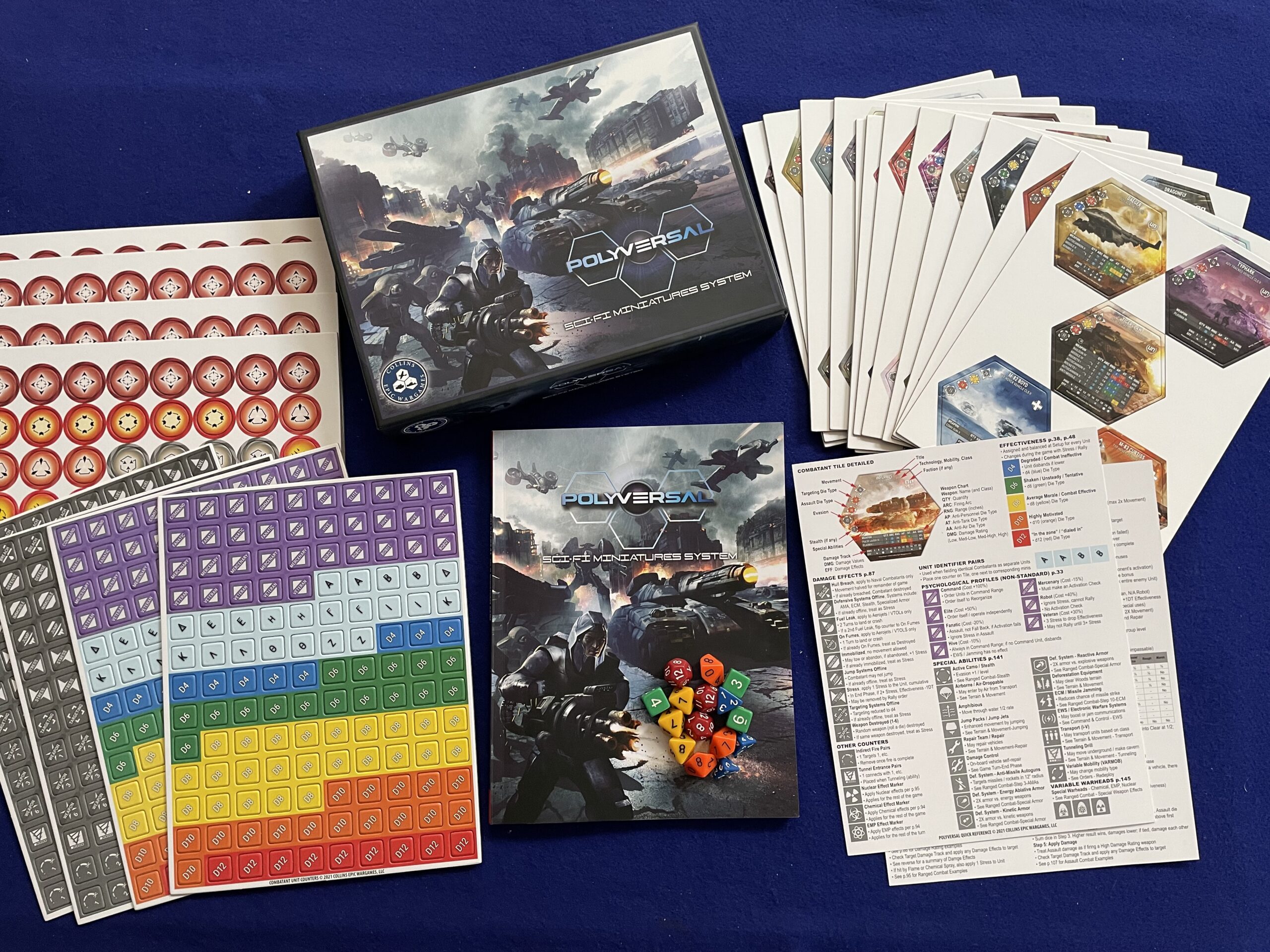
My copy of Polyversal is the core game box along with five expansion sets. The core rule book is 172 full-color pages printed on slightly glossy paper. Usefully, the box also comes with two copies of the two-sided Quick Reference printed on heavier glossy cardstock. Also included are countersheets with Orders Tokens, Combatant Unit Counters, and Combatant Damage Effects and Other Counters. The expansion sets include Combatant Tiles for various units which I will explain below. While some players may not like that Polyversal ships with no miniatures, that is because there are no “official” Polyversal miniatures (Polyversal, Miniatures, p. 24). The lack of “official” miniatures is by design—Polyversal is, very simply, a “bring-your-own-minis” wargame.
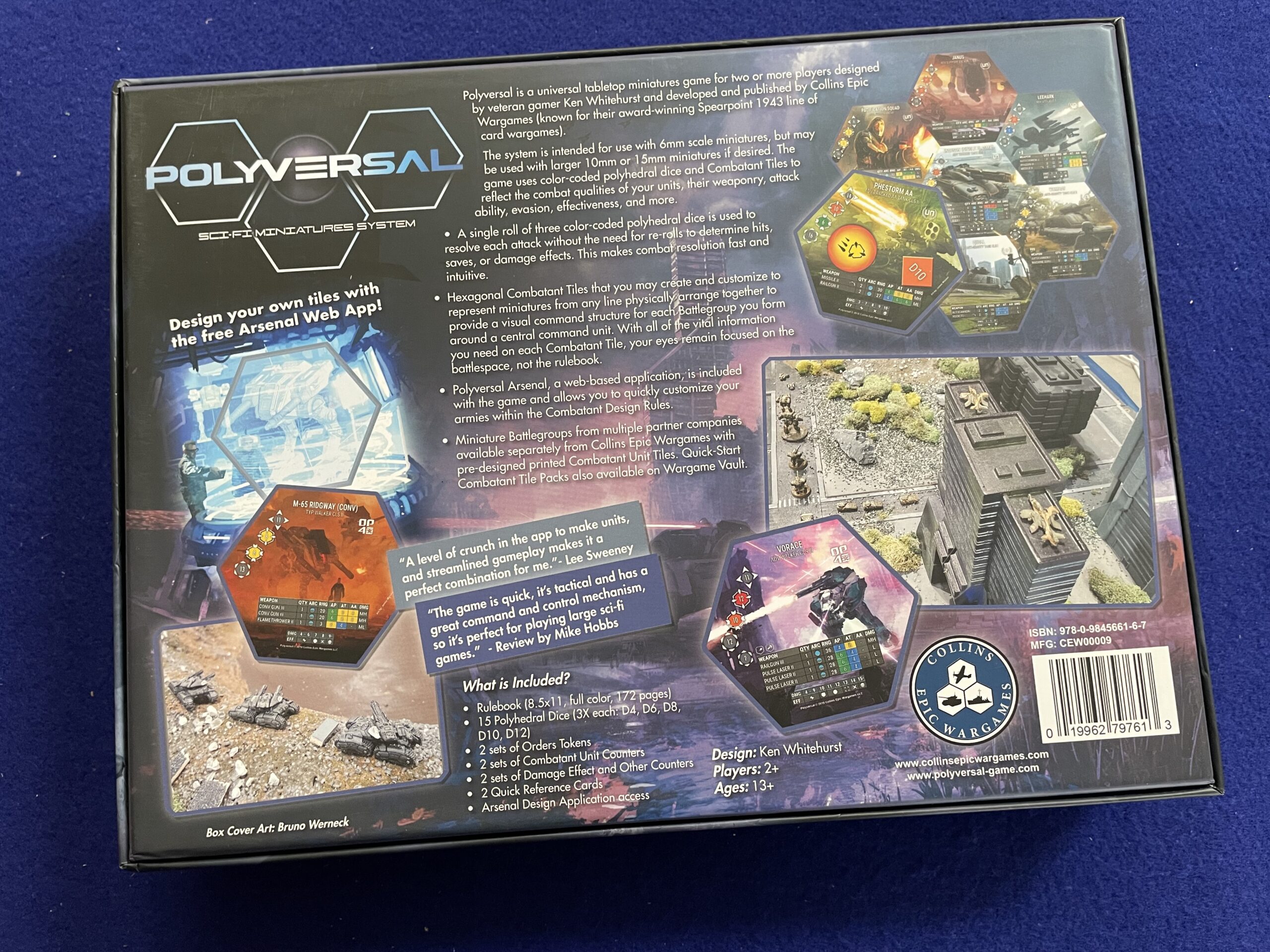
Box back (photo by RMN)
Core box plus expansions (photo by RMN)
“Grand unified theory”
Thank you for supporting the Polyversal game system. It is the culmination of over a decade of dreaming and experimenting by a gamer who, perhaps like you, has collected science-fiction miniatures rules for many years.
Polyversal was not designed to sell miniatures from a single company. It was designed to get the most spectacular combinations of miniatures to the table, and to bring fellow gamers together around a single ‘grand unified theory’ of 6mm sci-fi gaming. (Polyversal, Designer’s Notes, p. 22)
As noted in the core rule book, Polyversal is designed for 6mm (1/300th scale) miniatures though other scales can be used (p. 23). Instead off building a rules set around a product line of miniatures, Polyversal instead offers a set of highly playable rules and a combatant design system centered around three key terms:
Key Term: Combatant. A single, unique type of model or stand of infantry or cavalry used in Polyversal. Each Combatant is represented by a miniature on the tabletop battlefield. Each Combatant’s statistics are represented by a Combatant Tile.
Key Term: Unit. A Unit is formed by one or more identical Combatants. Tracking for the unit is handled by the Combatant Tile.
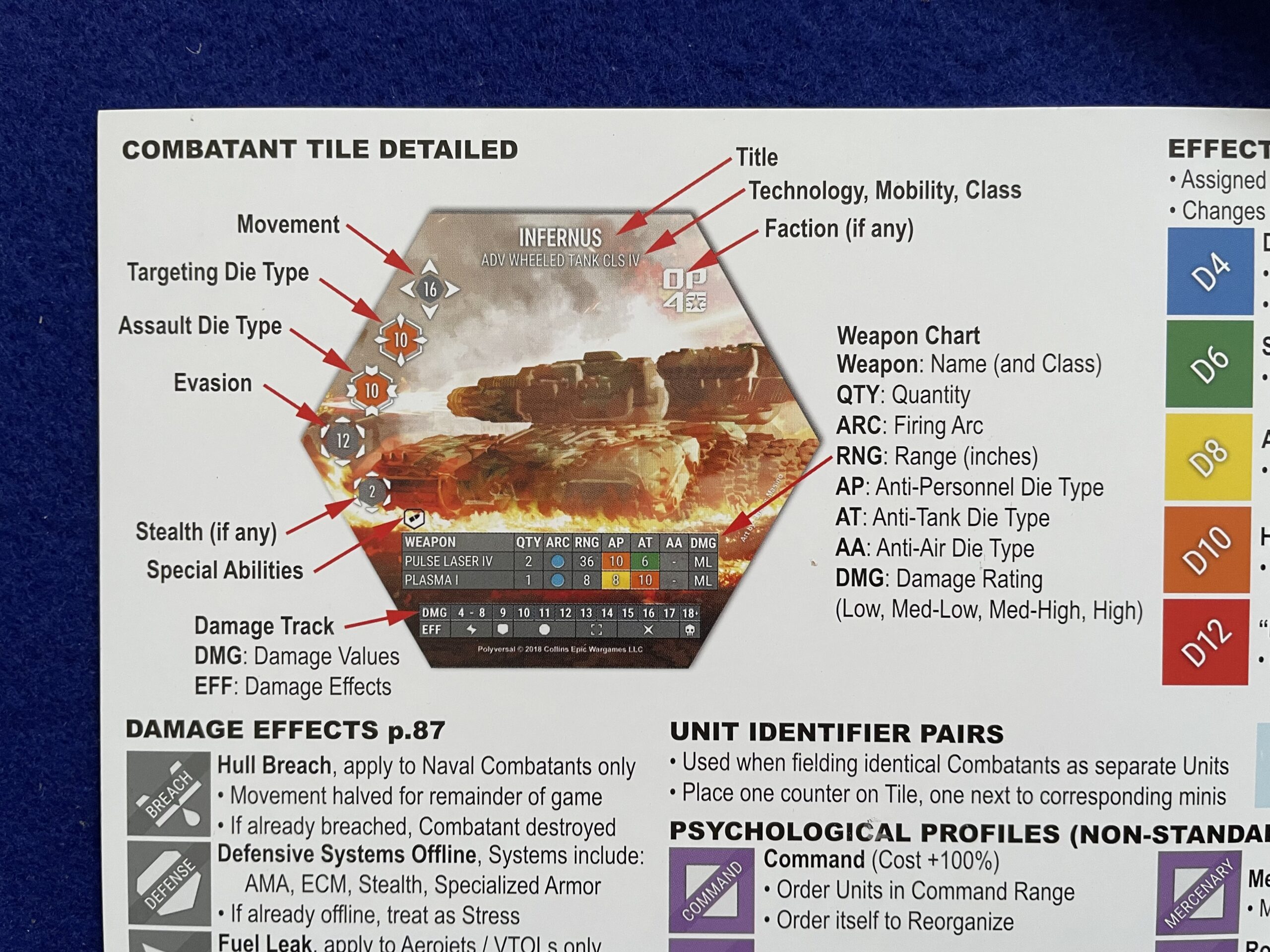
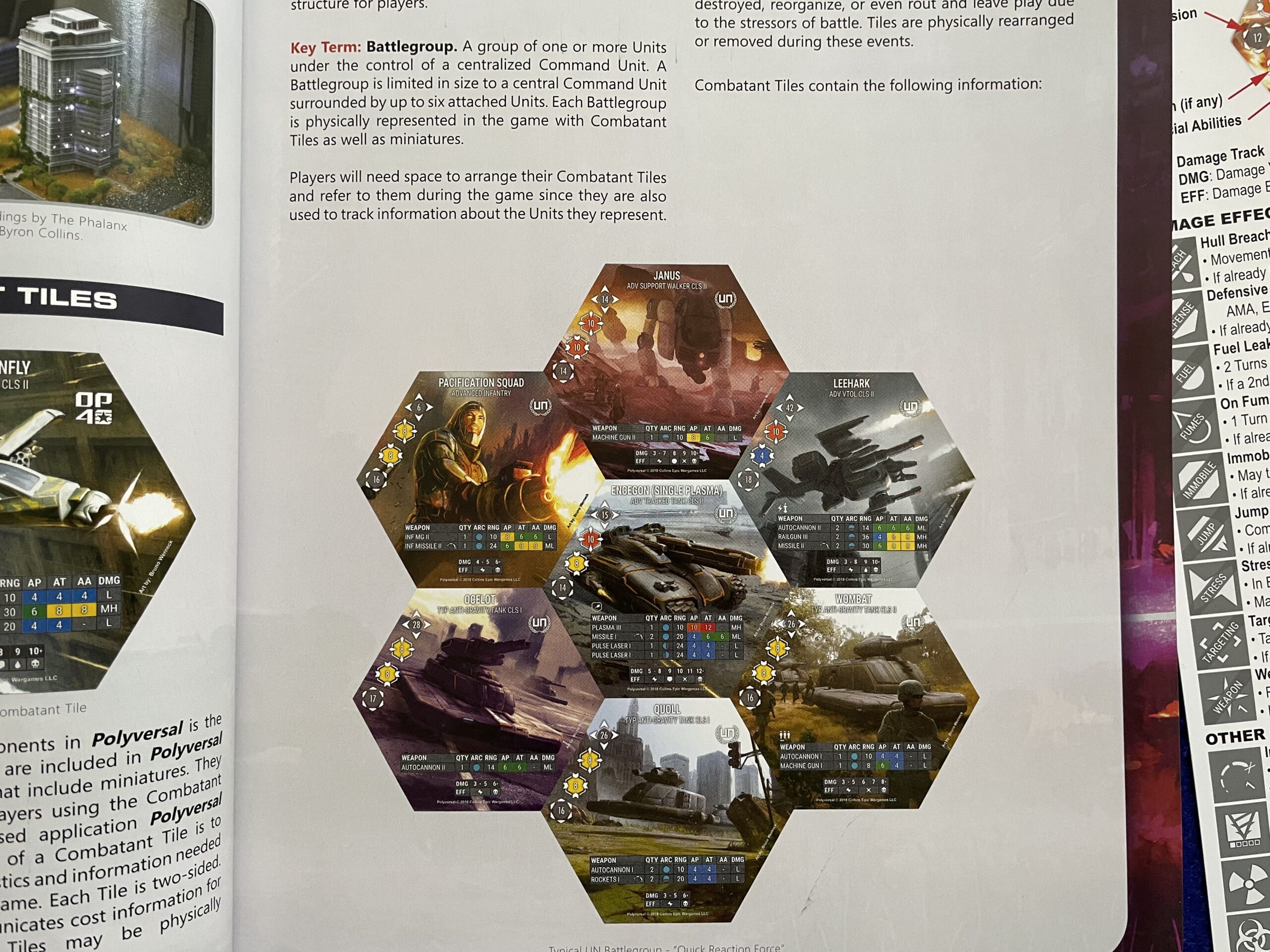
Key Term: Combatant Tile. In Polyversal, a hexagonal Combatant Tile is a two-sided game piece that represents a Unit of one or more identical Combatants, and how the Combatant performs in the game. These tiles are used to provide a visual command structure, track various things like orders, and help players determine the point costs for fielded forces. (p. 25)
Photo by RMN
Courtesy RPGGeek
Polyversal uses polyhedral dice (d4, d6, d8, d10, d12) that are color coded Blue, Green, Yellow, Orange, and Red, respectively. Savvy readers likely realize that those are most of the colors of the spectrum (ROYGBIV) though seemingly used in reverse order.
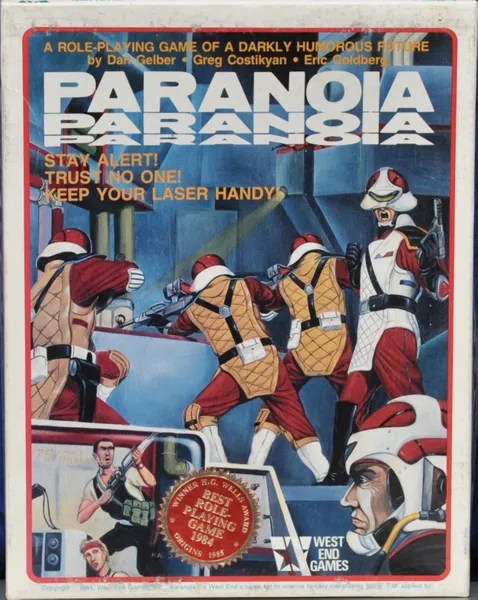
[How did YOU learn the colors of the spectrum? I remember art and science classes in elementary or middle school that discussed the spectrum but, honestly, the way I remember the color spectrum is the security clearance levels in the Paranoia roleplaying game from West End Games in 1994. Proof that games DO teach useful knowledge!]
A game mechanism that helps set Polyversal apart from other science fiction wargaming rules is a fourth key term: Battlegroup.
Key Term: Battlegroup. A group of one or more Units under the control of a centralized Command Unit. A Battlegroup is limited in size to a central Command Unit surrounded by up to six attached Units. Each Battlegroup is physically represented in the game with Combatant Tiles as well as miniatures. (p. 27)
Battlegroups are foundational to other core game mechanisms in Polyversal, most importantly those for Command and Control and Orders.
Photo by RMN
Buying playability
The rules for setting up a game of Polyversal not only guide you to building your forces, but also act in subtle ways to limit the size of that force and maintain playability. When selecting units the rules offer limits; for example, by the rules an Infantry-class unit can have up to 10 Combatant units whereas a Colossal Vehicle Unit (think Ogre) is limited to one Combatant unit. (p. 33). Taken in combination with the “Psychological Profile” (i.e. skill level) and “Effectiveness” (a measurement of the ability to perform under Stress) of a unit players can build a force that is tailored to their desires. Add on top of that the rules for Battlegroups and the size of games are naturally limited—which encourages playability. Yes, Polyversal is a point-buy army system but one that is highly tailorable to the desires and whims of the players.
[The Polyversal core rulebook states, “There are 18 scenarios included in the Scenarios section…” (p. 32) but there is no “Scenario Section” in the rulebook. Even the polyversal-game.com website lists scenarios included in the digital copy as “Once available.” I guess they never published? After a bit of poking around the Collins Epic Games website I came across a link to a single Beta scenario you can see at least one example of a Polyversal scenario.]
Basic versatility
A game turn of Polyversal is a simple five-phase process:
Issue Orders.
Determine Initiative.
Activate Units Within Command Range or Pass (Phases 2 & 3 repeat until all Units within Command Range an all Elite Units activate or players pass).
Activate Units Out of Command Range.
End Phase (p. 42)
Orders in Polyversal are placed on Elite Units, Command Units, and any Units within the Command Range of the Command Unit; units Out of Command Range continue using their last valid order but must pass an Activation Test to take an action.
Initiative in Polyversal is a simple Effectiveness test modified by Stress (pp. 42-43). The core phases of a game turn in Polyversal are Phases 3 and 4 when units activate.
Key Term: Activation. Activating a Units is the process of revealing and executing the order issued to it. Each available Activation grants the ability to execute the given order of a single Unit. (p. 43)
Activating Units in Polyversal is dependent upon the Effectiveness, Psychological Profile, Battlegroup Organization, and Command Unit. The interplay of these factors is simplified into die rolls or how Battlegroups are “arranged” and are driven by rules for Orders and Command Range. In the chapter for Command & Control in Polyversal there are also simple rules for Electronic Warfare Systems (EWS) Units that can either Jam or Boost the abilities of Command Units (pp. 51-52). A simple way to reflect electronic warfare on the battlefield where the effect is more important than the kit.
Movement in Polyversal is simply a matter of comparing the Movement Class of the Unit with the Terrain (p. 66). Rules for transporting units (pp. 67-70) or towing (pp. 70-71) or “Jumping” (p. 72) are also provided. Units in Polyversal even have the ability to tunnel (p. 72). None of the rules are complex—another nod to playability.
Poly shoots a firecracker
As is common in most wargames, Polyversal broadly divides combat into two forms: Ranged and Assault. Ranged Fire is either Direct or Indirect. In keeping with the core design theme of Polyversal, the Ranged Combat Sequence is a simple five-step process. Once a Target is selected (Step 1), the usual checks for Line of Sight, Range, and Firing Arc are made (Step 2). The Roll to Hit (Step 3) requires players to roll three dice (Targeting Die, Effectiveness Die, and Weapon Die) which are found on the Combatant Tile. The die type (step) rolled may be modified by factors such as cover. In Step 4: Check target Evasion the sum of the three dice rolled to hit are compared to the target’s Evasion Value which itself may be modified by factors such as Stealth. If the Roll-to-Hit exceeds the modified Evasion Value the target is hit and Step 5: Determine and Apply Damage is executed. Using the die rolls from the Roll-to-Hit Step a Damage Rating is determined. This, honestly, is the “most complicated” rule in Polyversal:
First, look at the FIRING weapon to see its DMG (Damage Rating) which is Low (L), Medium-Low (ML), Medium-High (MH), or High (H).
The Damage Rating dictates how to read three roll-to-hit dice.
Low (L). “Damage is the lowest individual die roll. If there is a tie, add the lowest individual die rolls together.” (p. 86)
Medium-Low (ML). “If the three dice show different results, Damage is the middle die roll. If all three results are the same, add them together. If two results are the same and a third is different, add all instances of the lower result together.” (p. 86)
Medium-High (MH). “If the three dice show different results, Damage is the middle die roll. If all three results are the same, add them together. If two results are the same and the third is different, add all instances of the higher result together.” (p. 86)
High (H). Damage is the highest individual die roll. If there is a tie, add the highest individual die rolls together.” (p. 86)
The Damage number is compared to the Damage Track on the Combatant Unit Tile for the effect.
Assault Combat in Polyversal follows the same basic format as Ranged Combat except it takes place when its are in direct contact and is a contested die roll where each the higher Roll-to-Hit result is the winner.
[Truthfully, the rules for combat are not that complicated; the fact they might seem to be the most complicated rules in Polyversal is an indication at just how playable the rules set actually is. See the combat example further below for how easy combat can be!]
If you build it they can play
Polyversal is a fully-customizable miniatures system, The Combatant Design system allows you to create a Combatant Tile for every miniature in your collection. Whether your collection includes men on horseback, early 21st century armor, futuristic walkers or anti-gravity tanks, this design system allows you to customize a Combatant Tile for each unique model in your collection for use in Polyversal. Based on the options you select for each design, they system will generate a points cost to balance relative strengths among all potential designs. (Polyversal, Combatant Design, Overview, p. 114)
The Combatant Design system in Polyversal take up 58 pages, a full one-third of the rule book. Using a 10-step process, players design a Combatant Tile for use with their chosen miniature. basically, the Combatant Design system is a series of choices or table look-ups. Let’s see how close I can get to designing the a legendary Panzer hover tank from Hammer’s Slammers.
[Note: the processbelow is literally done in conjunction with my first reading of the rules so the quality of the result may vary; nonetheless I see it as a worthy example of the power, or perils, of the design system. So here goes!]
DETERMINE CLASSIFICATION. Vehicle, Class III: Heavy.
DETERMINE ARMOR. Vehicle Armor, Heavy Armor (Armor Value 4).
CHOOSE TARGETING SYSTEM. “Satellite-linked / Intelligent Fire Control” d12.
DETERMINE ASSAULT CAPABILITY. “Proficient: Standard military Infantry, Light Cavalry, Vehicles better equipped for close combat” d8 (Not sure how the anti-personnel belts on a Hammer’s Panzer are factored).
CHOOSE WEAPON SYSTEMS.
Main Gun
Determine Weapon Category and Class: Vehicle Weapon, Laser IV (though Hammer’s Slammer is a “Powergun” that seemingly would be akin to the Plasma Gun in Polyversal, the Combatant Design system specifies that they have a relatively sort range which is NOT a Powergun!)
ASSIGN SPECIAL ABILITIES. Defensive Systems (Special Armor – Energy Ablative), Electronic Countermeasures (ECM)/ Missile Jamming, Electronic Warfare System (EWS).
DETERMINE DAMAGE TRACK: Determined by look-up tables and displayed in a template.
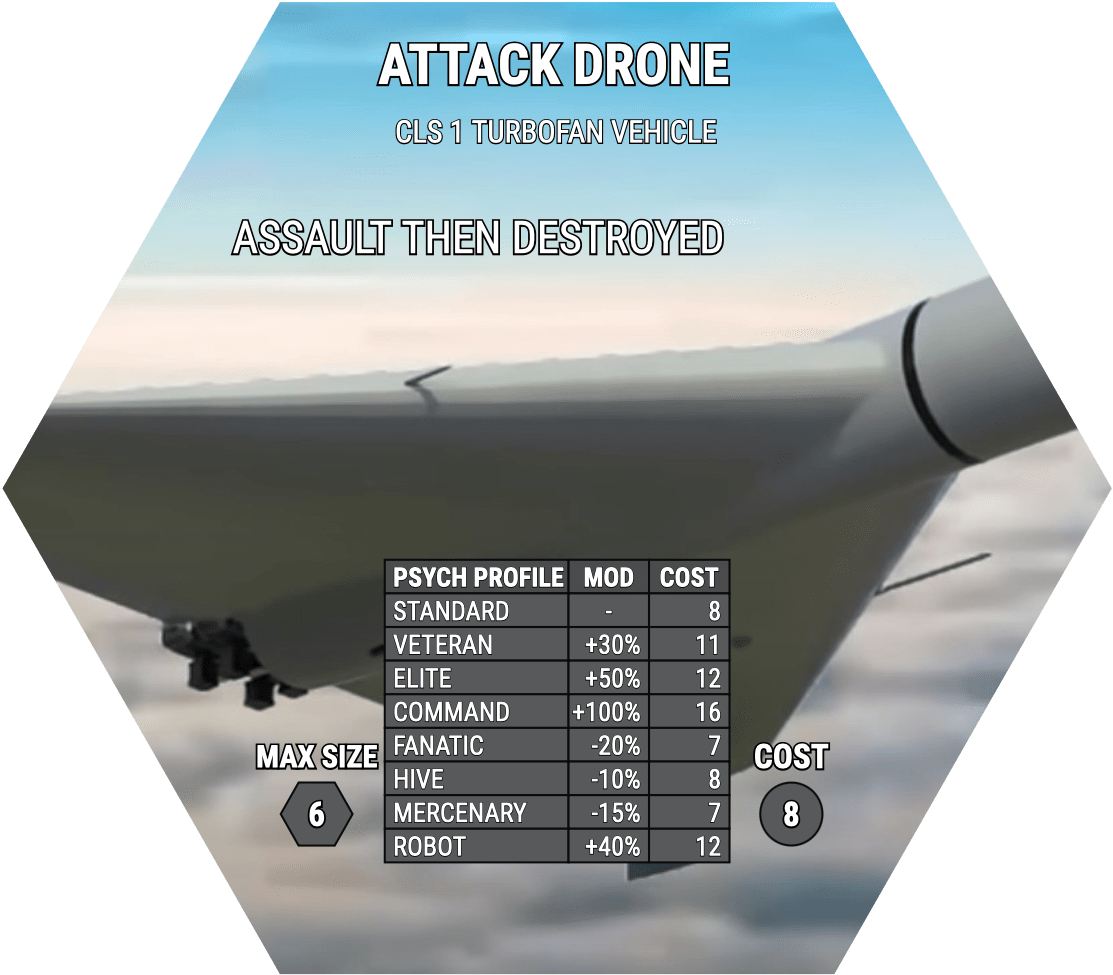
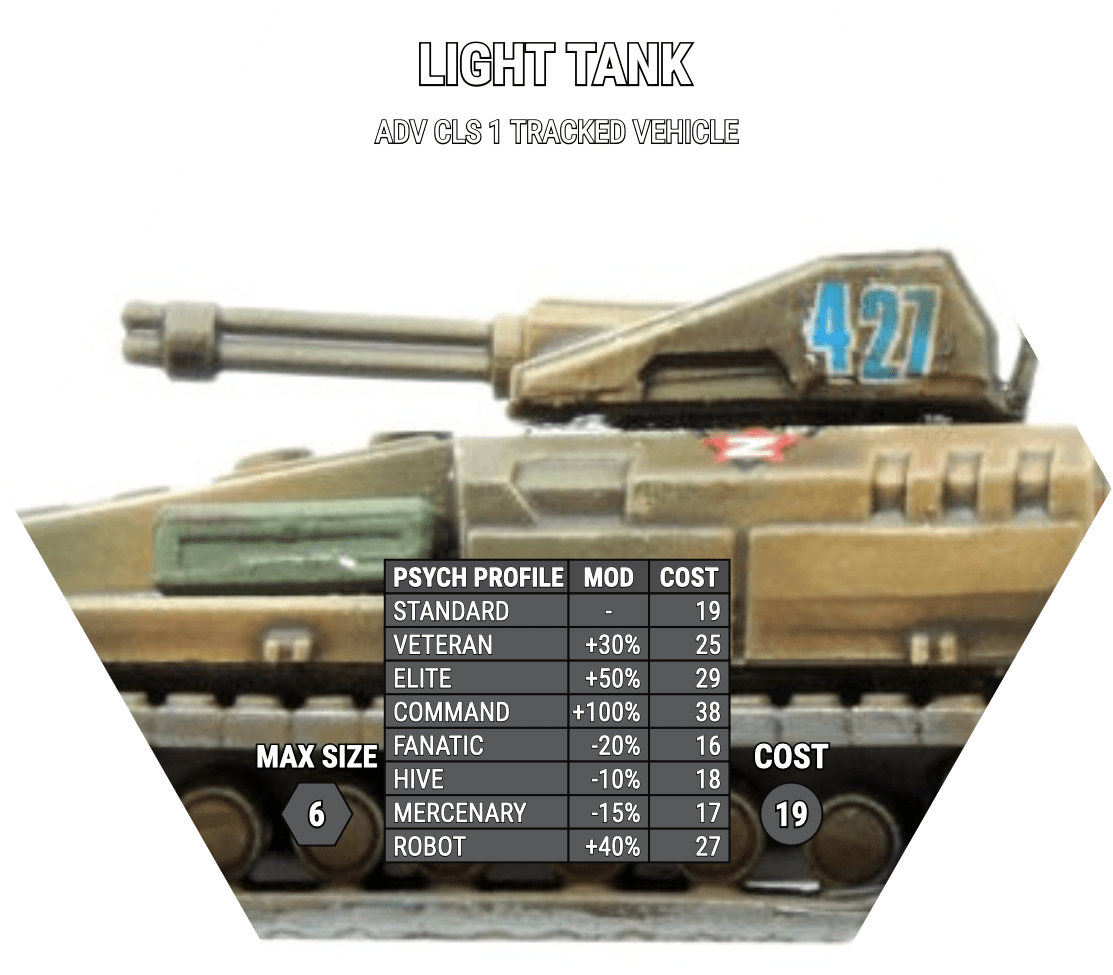
Note that in Setup, the Psychological Profile of the unit acts as a cost multiplier (Command +100%, Elite +50%, Fanatic -20%, Hive -10%, Mercenary -15%, Robot +40%, Standard No Modifier, Veteran +30%) (pp. 33-37).
Although Hammer’s Slammers are mercenaries, the Mercenary description of page 36 is not descriptive of the Regiment which certainly deserves the Elite descriptor instead (p. 35). This makes each hover tank a total of 78 points. Each tank platoon in the Regiment has 4 tanks (312 points).
Referring again to the Setup rules, the Effectiveness of each unit is assigned with d8 being standard. I feel that assigning a line Panzer platoon the next higher Effectiveness rating, d10, is reasonable as this leaves the highest Effectiveness, d12, for special units such as the ‘White Mice’ in the Regiment.
The d10 Effectiveness means that 4-tank platoon has a “balance” factor of +3; when setting up a game the balance between forces must be maintained unless an imbalance factor is specified by (or designed into) the scenario. (See Setup, Step 3D: Assign Effectiveness, pp. 38-39).
A similar design process—though only six steps— is used to design buildings in Polyversal—though I wish they called them “structures” instead.
[I am generally happy with my first pass at vehicle design. It took me longer to type the design than to actually make it and I see some areas of needed refinement to my design. Collins Epic Wargames has an online design application, Polyversal Arsenal, that can assist in your design efforts. The resulting Combatant Tiles using Arsenal are shown below and are different (as in a far higher cost) for reasons I do not yet understand. I strongly recommend using Polyversal Arsenal as it makes designing new Combatant Tiles very fast and easy. It can even print up sheets of Tiles for your games.]
Combatant Tile front (tile image front courtesy hammers-slammers.com)
Combatant Tile back (tile image back courtesy nextbigfuture.com)
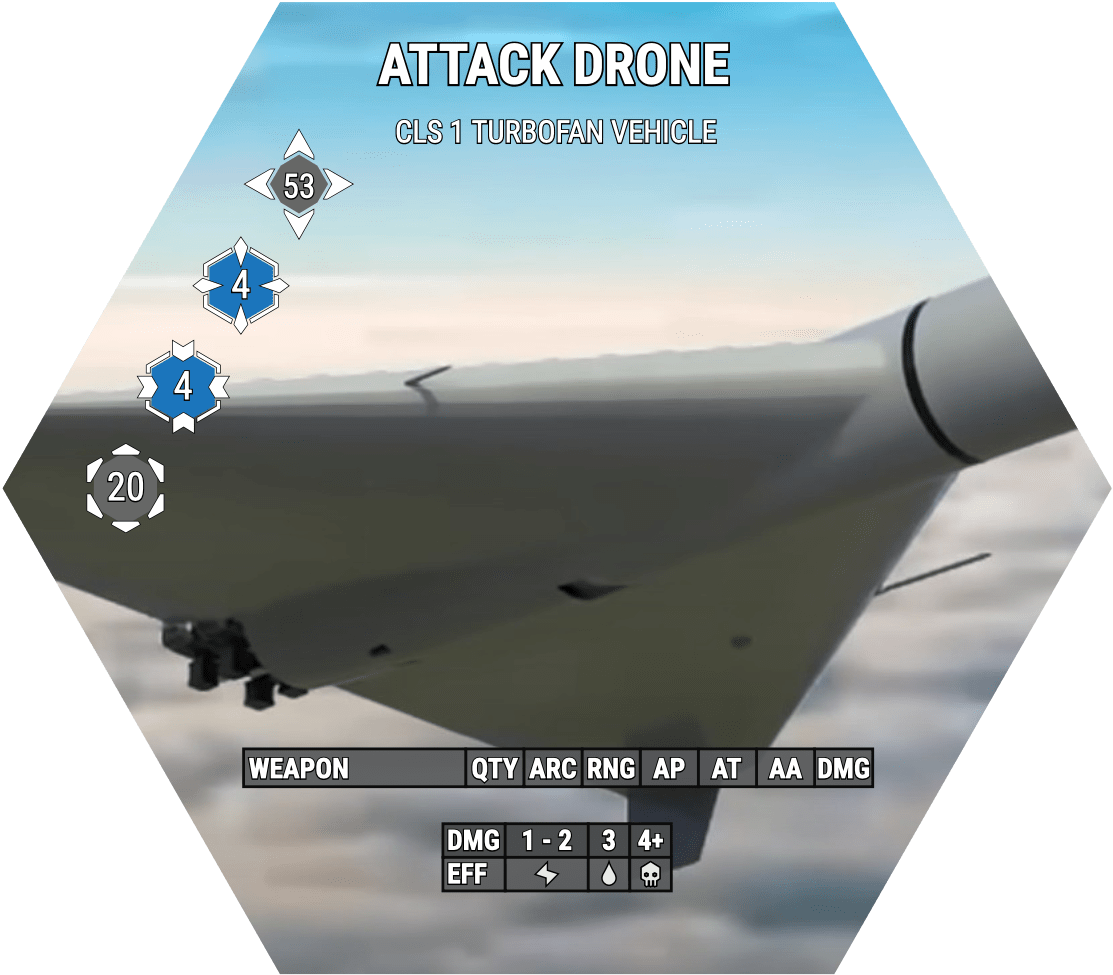
The Combatant Design system in Polyversal strongly focuses on combat units and vehicles but not individual weapons or other equipment. For instance, the core rulebook has no rules for drones. Or does it?
Tile image courtesy 19fortyfive.com
[The Attack Drone above was quickly designed in Polyversal Arsenal. It requires several “special ability” rules not in the rulebook. I suggest, “EFFECTIVENESS die always GREEN d6. Uses ROBOT Psych Profile but cost equals STANDARD value. May conduct one ASSAULT attack and is automatically destroyed regardless of attack result. Final cost is reduced by 75% to reflect single use.” While those rules are not in the Polyversal rulebook they allow players to leverage the existing design system while keeping to the spirit of the game system.]
He’d locked his main and cupola guns on the same axis. His left hand rotated the turret clockwise with the gunnery screen’s orange pipper hovering just above the projected crest of Sugar Knob. When the dark bulk of a Yokel tank slid into the sight picture, needlessly carated by the artificial intelligence, Wager thumbed his joystick control and laced the trees with cyan bolts from the tribarrel.
A bolt flashed white on the screen as it vaporized metal from the Yokel tank. Wagner stamped on the pedal to fire his main gun.
“Rolling Hot”
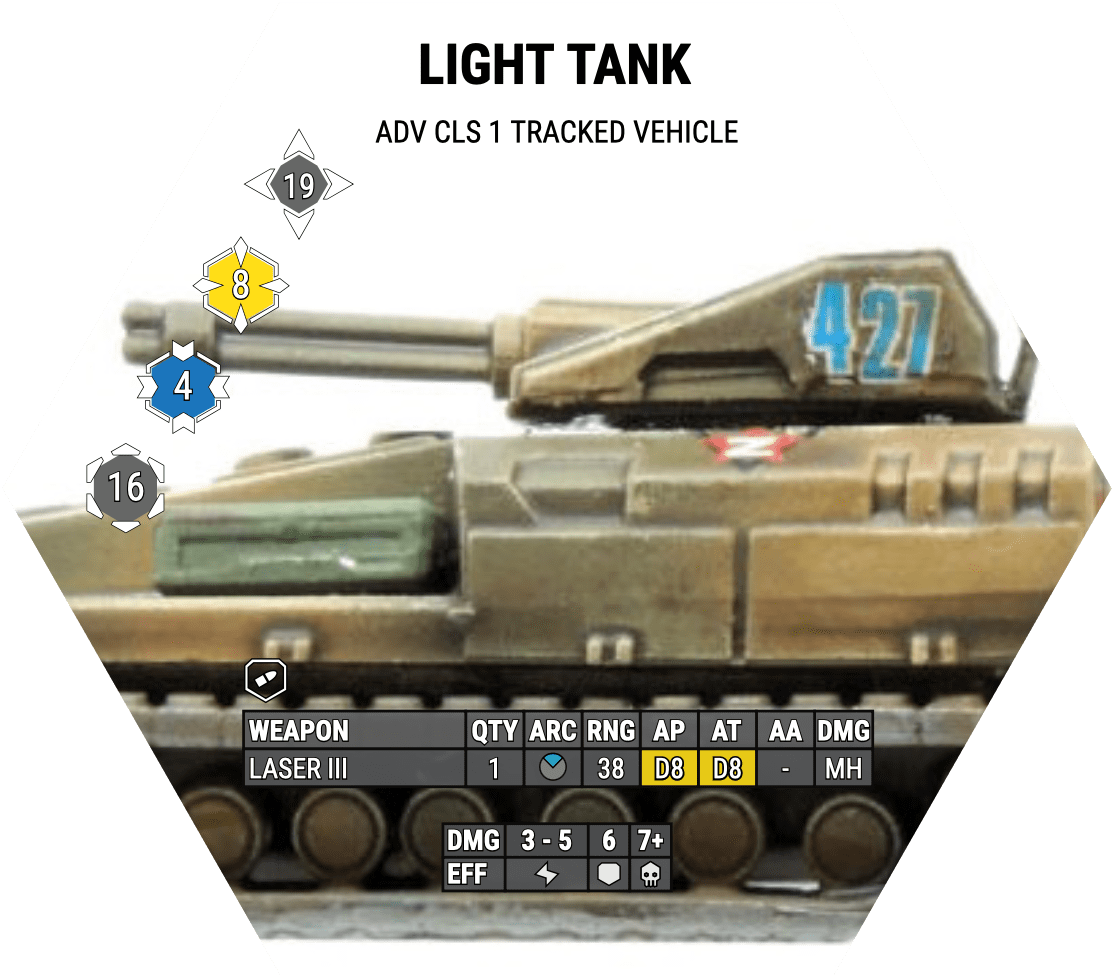
Here is a quickly made light tracked tank that we can use in this combat example:
Tile image courtesy hammers-slammers.com
For the purposes of this combat example the Slammer’s blower is assumed to have an Effectiveness of ORANGE d10 and the Yokel light tank has an Effectiveness of YELLOW d8. The Hammer’s Slammers tank also has a valid Overwatch order. Thus, as the Yokel tank activates and pops over a ridgeline, the blower takes it’s shot…
SELECT TARGET. The blower selects the light tank as the target.
CHECK LINE OF SIGHT, RANGE, FIRING ARC. All valid.
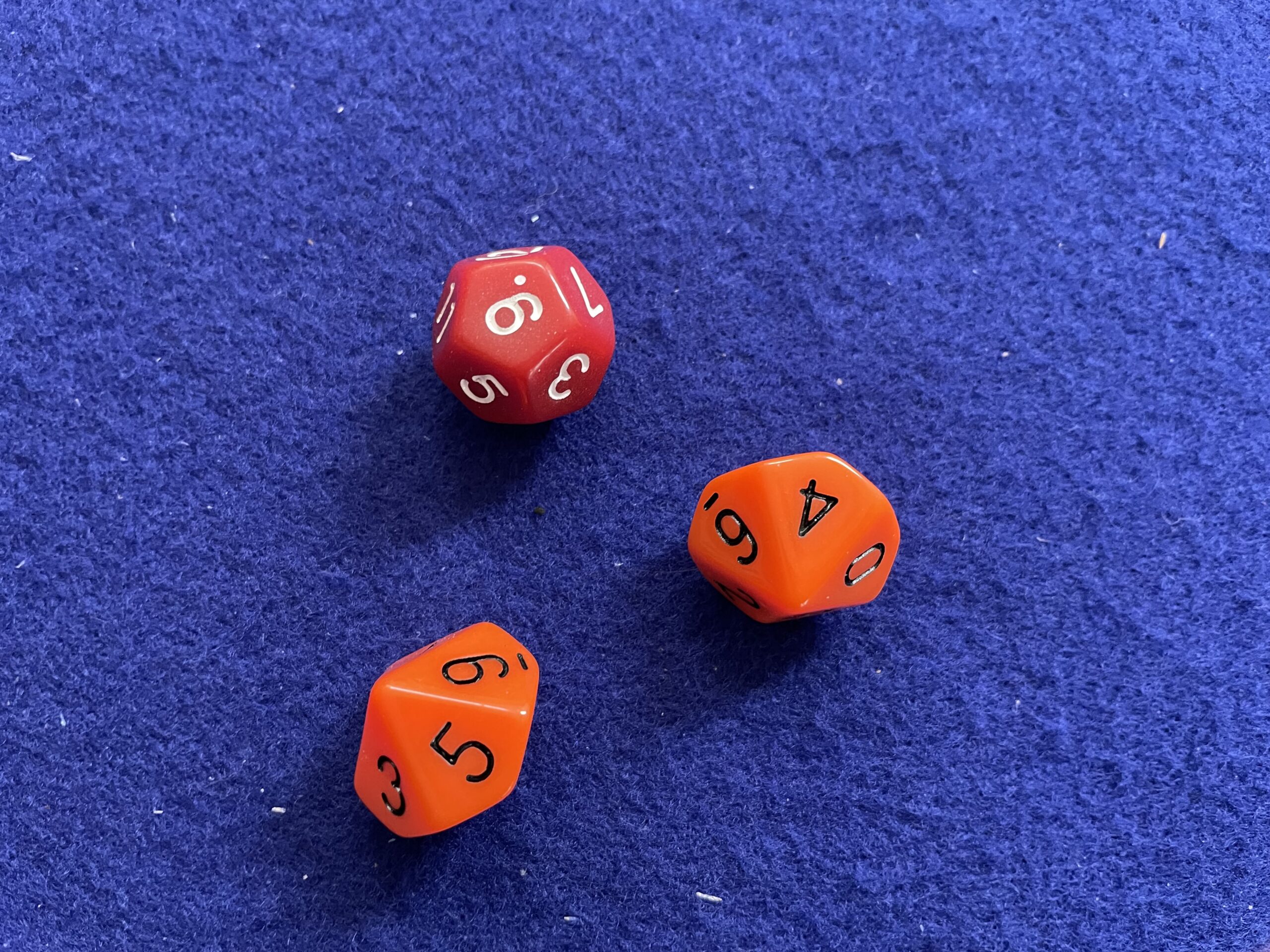
ROLL TO HIT. The blower rolls Targeting Die d12, Effectiveness Die d10, and Weapons Die d10. The rolls are [9], [4], and [5].
CHECK TARGET EVASION. The sum of the die rolls is 18 which is greater than the light tank’s Evasion value of 16 = HIT.
IF HIT, DETERMINE AND APPLY DAMAGE. The Laser IV main gun scores H (High) Damage; Damage Value = 9 (highest die roll). The Damage Track on the Light Tank Combatant Tile shows 7+ = Destroyed. The light tank vaporizes.
That’s “rolling hot!” (photo by RMN)
Many mini rules
Polyversal is but the latest set of science fiction miniatures wargame rules to enter my collection. I am happy to say it stacks up against the competition very nicely.
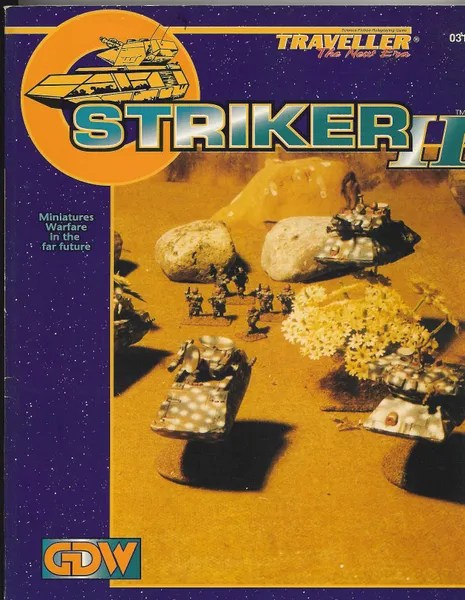
In my experience with science fiction miniatures wargames rules over the past nearly 50 years, I observed designers striving to balance playability with the “realism” of whatever setting the rules are part of. My earliest set of science fiction miniatures wargaming rules, Striker, used a variant of the combat system in the Traveller roleplaying game with a heavy emphasis on command and control to show combat across a wide range of technological levels past, “present,” and (hypothetical) future.
Courtesy BoardGameGeek
Striker is a set of rules for science fiction ground combat using 15mm miniature figures. Each player will command a force ranging from a platoon to several companies, consisting of from a few dozen to over a hundred men, plus artillery, armored vehicles, and aircraft. The rules are intended to be easy for the beginning player to understand while at the same time providing a comprehensive and detailed treatment of ground combat from the beginning of the 20th century to the far future. (Publisher’s blurb via BGG)
Alas, we all know that since 1982 there have been many other science fiction miniatures wargame rules sets, a few of which I acquired over time. One constant across each new design is a quest for balance between “realism,” playability, and a unit design system. Here are a few titles that I acquired across the years:
Courtesy BoardGameGeek
Dirtside II (Jon M. Tuffley & Mike Elliott, Ground Zero Games, 1993) was (quite possibly) my first experience using polyhedral (“step dice”) in a wargame vice bog-standard 2d6 or d10/d100; it also was 1/285th scale (modern day 6mm). Good, though simple, unit design system.
Courtesy BoardGameGeek
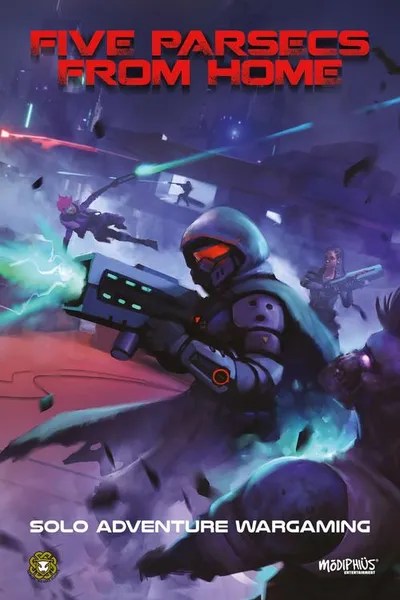
Star Wars Miniatures Battles (2nd Edition) from West End Games (1993) is a set of 25mm skirmish-rules usable independent of or along with West End Games Star Wars RPG. What I remember best is that, in this game, Stormtroopers actually have a good chance to hit at what they aim at though weapons ranges are ridiculously short (which, admittedly, is in keeping with the source material where every battle is up close).
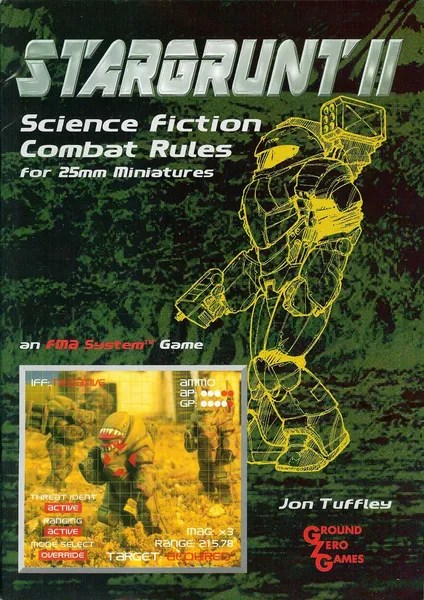
Stargrunt II (Jon M. Tuffley, 1996) is the 25mm skirmish-scale counterpart to Dirtside II. Polyhedral dice and a simple unit design system (highly compatible with Dirtside II).
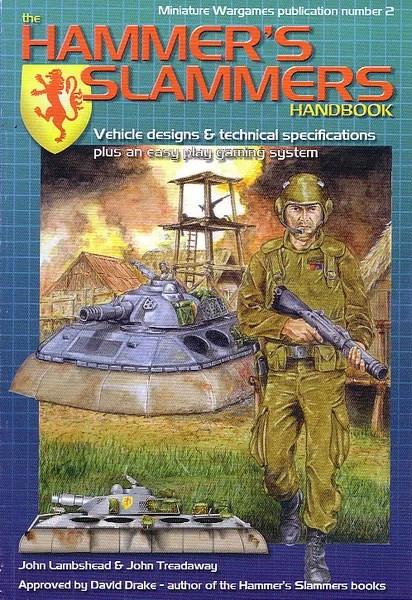
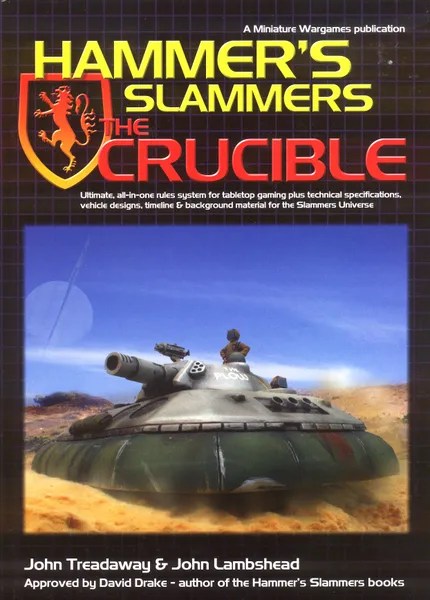
Hammer’s Slammers: The Crucible (John Treadaway & John Lambshead, Miniatures Wargames Pireme Publishing Ltd., 2010) is effectively an updated and expanded Hammer’s Slammers Handbook rules set that is “optimized” for 25/28mm but includes conversions for use with 6mm and 15mm scales; the rules still favor playability but also find a way to introduce some crunch for “realism.” Design system included. Hammer’s Slammers: The Crucible is usually my preferred set of science fiction miniatures gaming rules.
Mutant Year Zero: Zone Wars (Free League Publishing, 2024). A skirmish-scale wargame with 32mm miniatures. Lives up to the billing: “Zone Wars is a fast and furious game of tabletop skirmishes set in the Mutant: Year Zero universe. Zone Wars is all about embracing mayhem and emergent narrative to create a fun and fast-flowing experience” (Publisher’s blurb, BGG).
Polyversal-tility
At this point, given I did not discuss any setting beyond that found in David Drake’s Hammer’s Slammers, you dear reader likely assume that Polyversal is setting-less. That is not strictly true. The core rulebook for Polyversal starts out with a chapter called “Storyline” which details the Polyversal setting. The storyline surely explains some of the decisions behind the naming or designs of units in the expansions, but is it needed for play? Absolutely not. Although mildly interesting, the storyline in the core rulebook is but one of an infinite number of settings that Polyversal can support.
Polyversal is, as promised, truly a “grand unified theory” of game rules. Polyversal is an excellent combination of command rules, a quick-play combat system, and a crunchy-enough yet quick design system enabling players to bring virtually any military science fiction setting to their tabletop.
[As much as I love the Polyversal game system I am a bit concerned over the future of the game. As noted above, long-promised scenarios are lacking. The last uploads to digital sellers like WargameVault was in 2021. The polyversal-games.com website has somewhat recent activity, such as photos from Adepticon 2024. More recent activity seems focused on a branch of Polyversal supporting Battletech (hopefully with better mech minis than I experienced long ago). That said, the core game mechanisms and Combatant Design system are readily available and supported by the free web-app Polyversal Arsenal. To be honest, Polyversal might be the rules system that convinces me to invest in a 3D printer to make my own 6mm or 15mm miniatures. I assure you, should I start that journey, I will share my adventures along the way with you.]
Thank you for visiting the Regiment of Strategy Gaming and riding with The Armchair Dragoons.
Rather than list a bunch of social media links, the easiest thing to do is to check out our LinkTree, which connects you to all of our various locales around the web.
You can also support The Armchair Dragoons through our Patreon, and find us at a variety of conventions and other events.
Feel free to talk back to us either in our discussion forum, or in the comments below.
One thought on “Polyversal-tile Miniatures Wargaming”
Thanks for the detailed look and happy you enjoyed Polyversal! As for the future of the game, I’m currently quietly developing 3 battlegroup expansions in partnership with Death Ray Designs and currently about half complete with my first ever sci-fi novel in the Polyversal setting. Thanks again!

 by
by 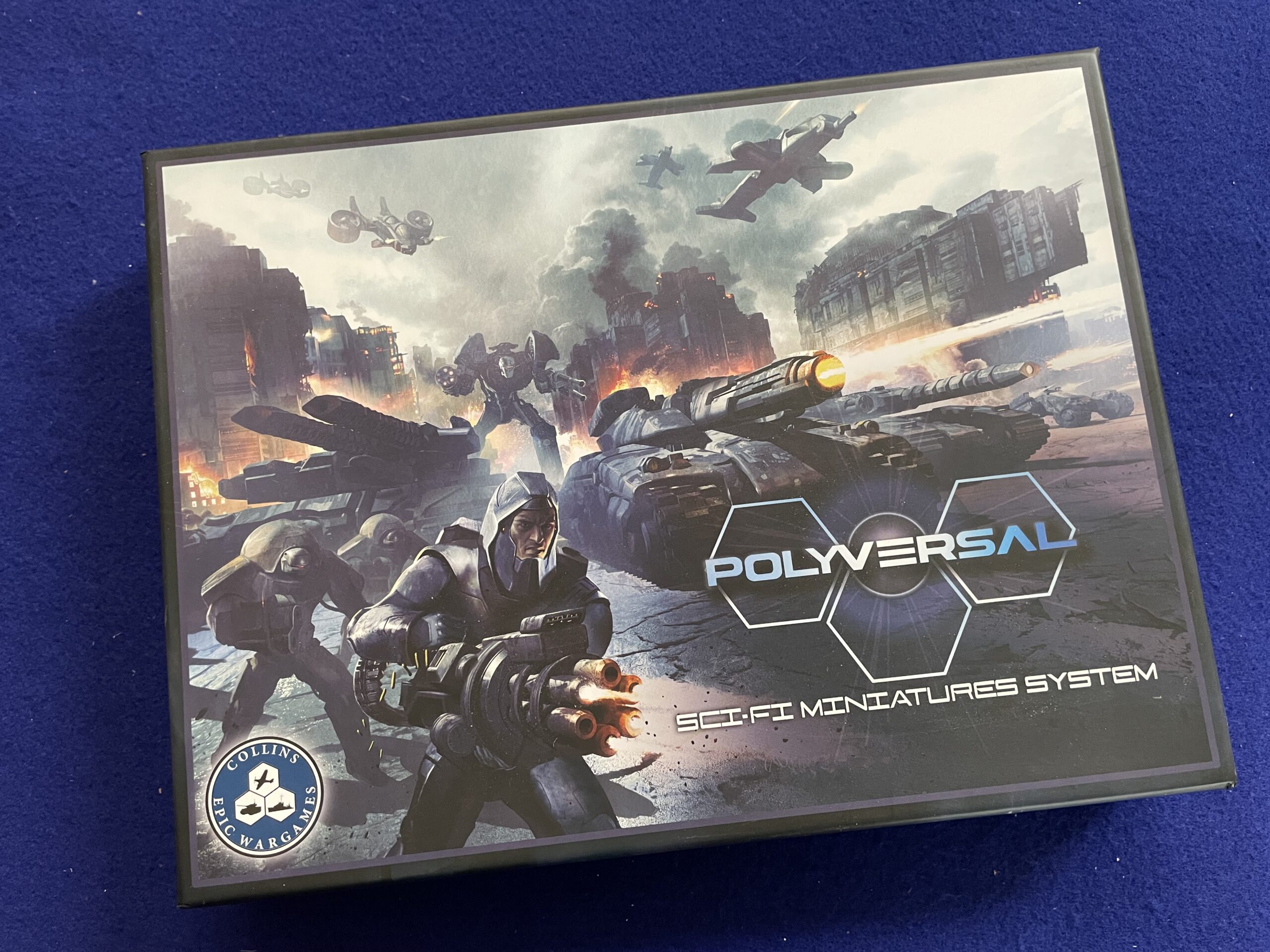









Thanks for the detailed look and happy you enjoyed Polyversal! As for the future of the game, I’m currently quietly developing 3 battlegroup expansions in partnership with Death Ray Designs and currently about half complete with my first ever sci-fi novel in the Polyversal setting. Thanks again!