
 by
by Aaron Danis, 7 January 2026
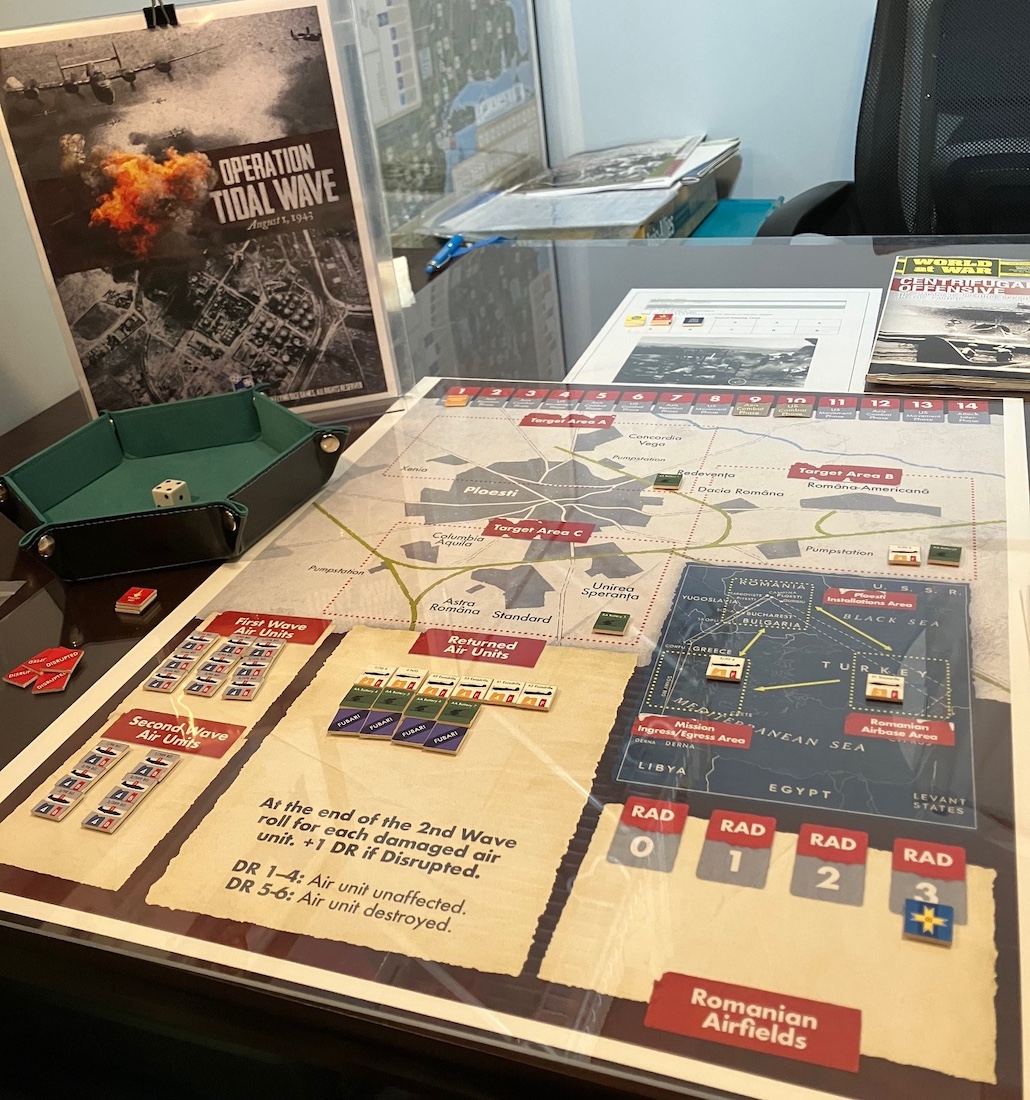
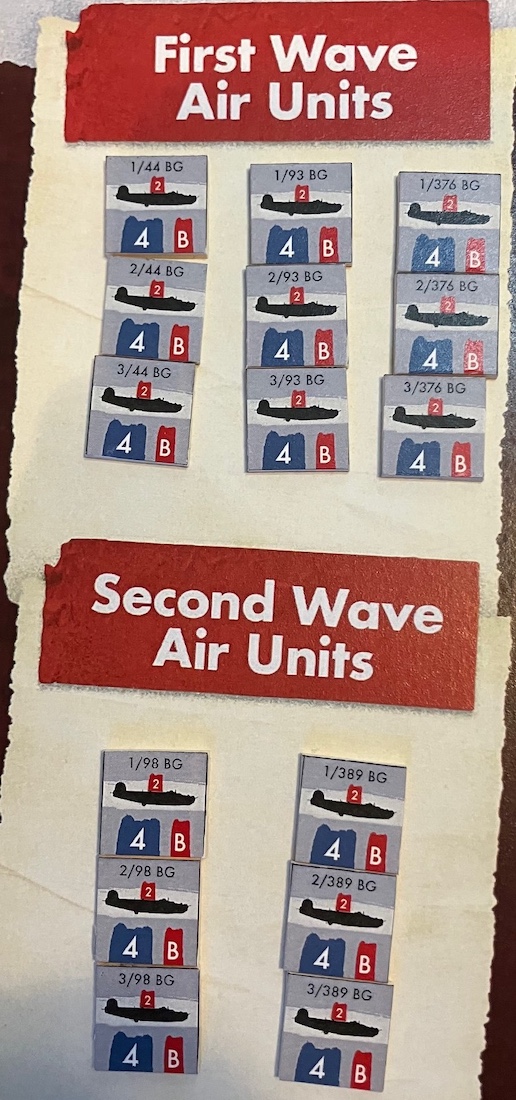
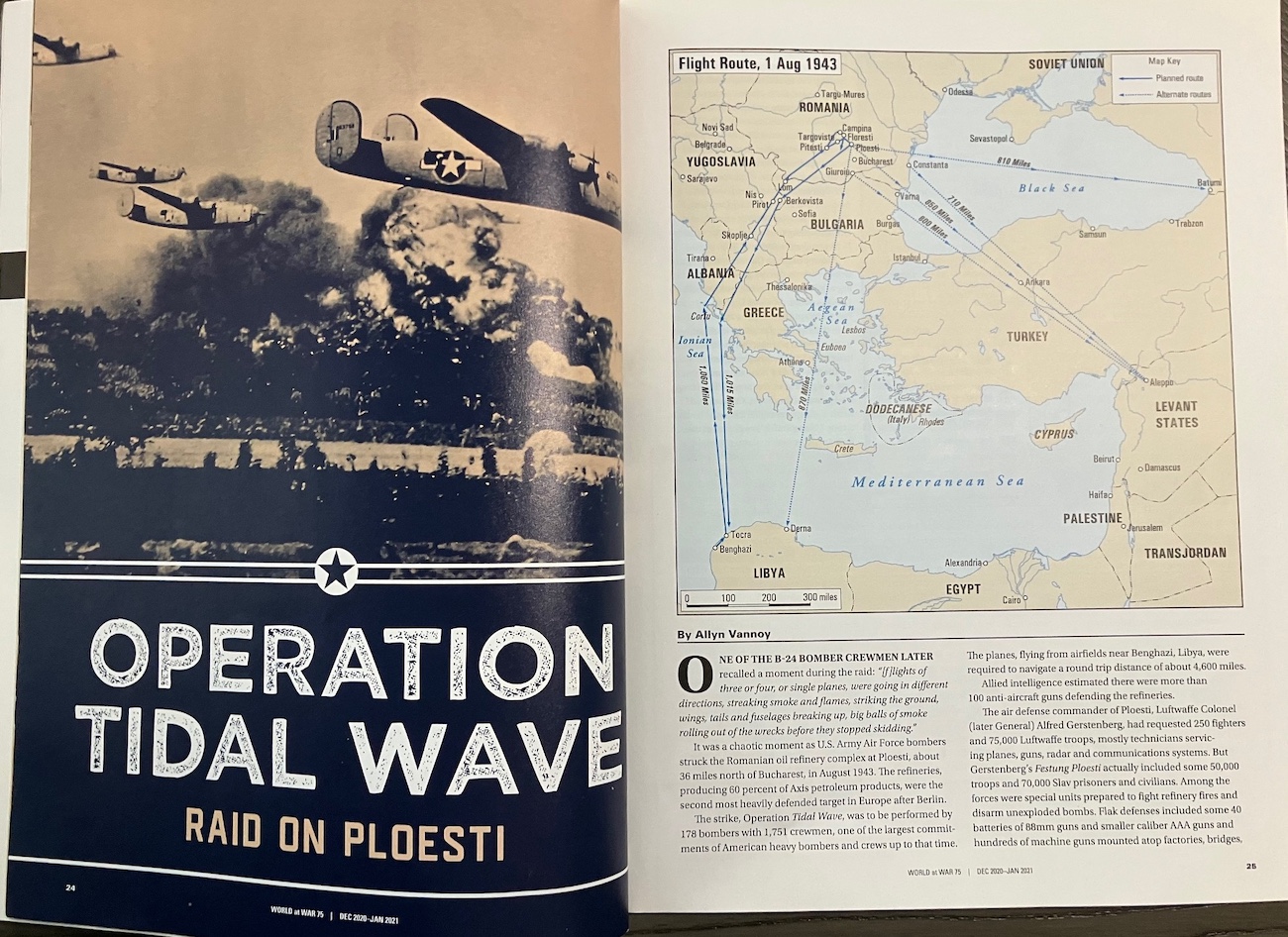
Prolific game designer Paul Rohrbaugh, the head of High Flying Dice Games, sent me a review copy of his new solitaire game Operation Tidal Wave: The Raid on the Ploesti Oil Refineries August 1, 1943, which is the only stand-alone game I could find on the topic1. This low-level raid (flown at 200-800 feet, but some bombers flew as low as 50 feet) using five B-24 Liberator bomber groups from the US Eighth (44th and 93rd Bomber Groups) and Ninth Air Forces (98th, 376th and 389th Bomber Groups) was an attempt to succeed where high-altitude bombing had failed: to destroy the Romanian oil refining capacity that was supporting the German war machine2. The player takes on the role of the U.S. air commander, and the rules/dice control the German and Romanian defensive response through a series of 14 action phases for each of the two waves of attacking U.S. bombers.

“American air crews displayed extraordinary courage in the raids, but the Germans placed more antiaircraft batteries around the Romanian facilities than any other area except Berlin. These defenses inflicted heavy damage on the U.S. planes that attacked Ploesti in the first massive raid on 1 August 1943. Of the 177 Liberators sent to Ploesti, 54 were shot down. The raid cost 532 lives. The destruction was facilitated by what has been called the Luftwaffe’s “greatest achievement” of the war in codebreaking, the decipherment of U.S. messages that tipped off the Germans to the raid and permitted them to take away the element of surprise.”
Robert Goralski and Russell W. Freeburg, Oil & War3
click images to enlarge
The game consists of two 11″ by 17″ maps that overlap in the middle, a sheet of 80 double-sided counters and markers (mine came already neatly cut and bagged in ziplocks), two Player Aid Cards (one with tables and one with hit and victory point [VP] tracks), and an 8-page rulebook (of which only 5.5 pages are rules), all in a ziplock with a color cover sheet. You will need to provide a six-sided dice, although play moved along faster with 2 dice. Play time is about 45 minutes once you are proficient in the rules, which is only slightly longer than the real-world time over target for the raid pilots.4
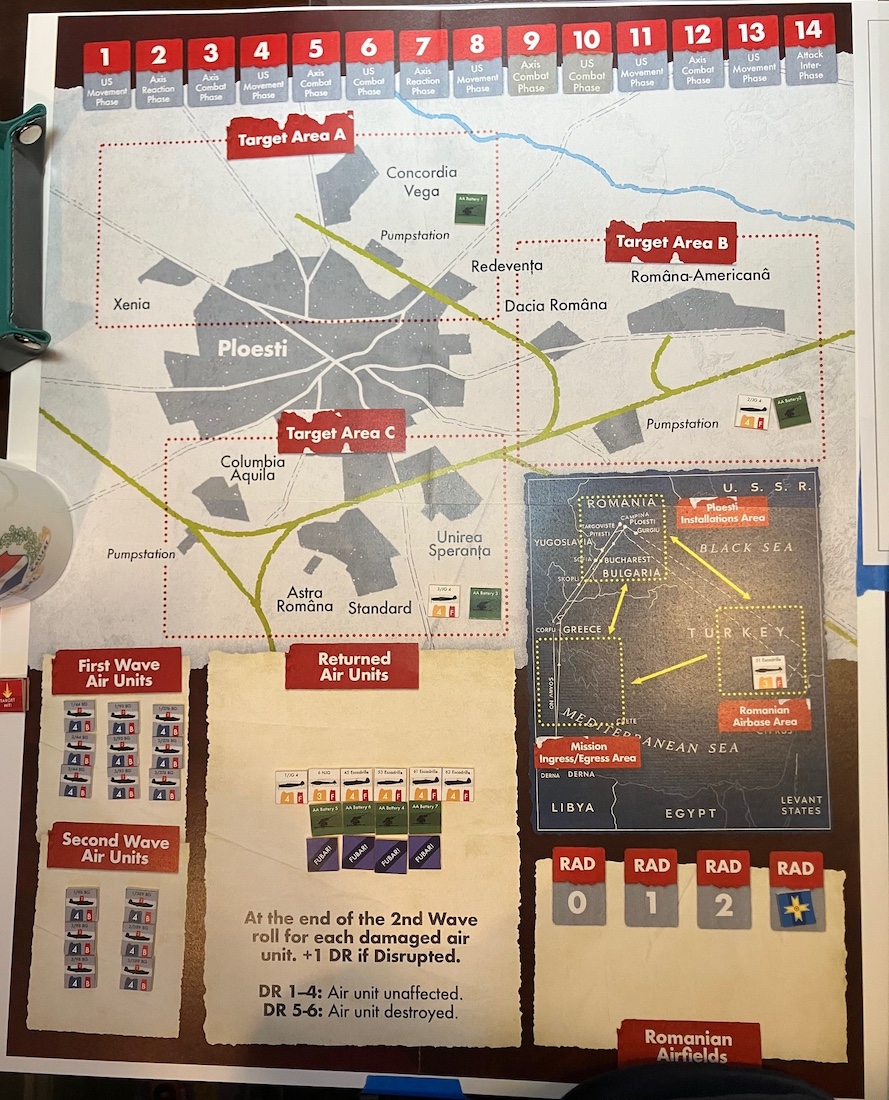
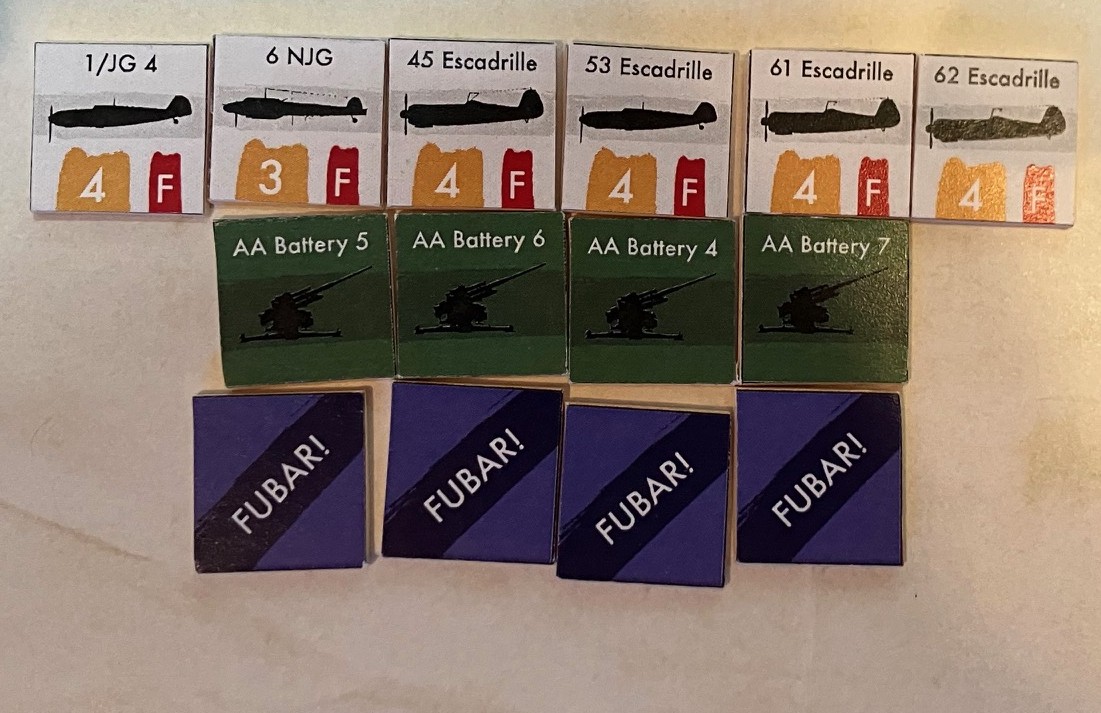

Set up is straight forward. The U.S. player places one axis Anti-Aircraft (AA) gun marker in each of the 3 target areas. He roles a die to determine the Romanian Air Defense (RAD) posture, starting at 2 or 3. Also, based on that die roll, he draws that number of counters representing Axis air and anti-aircraft gun units or FUBAR markers5 to deploy defensively on the map based on further die roles. The remaining Axis units and FUBAR markers are placed in a cup to possibly be drawn later in one of two Axis Reaction Phases. Hit and VP markers are set to zero, and the First Wave marker is put on Phase One on the phase track.
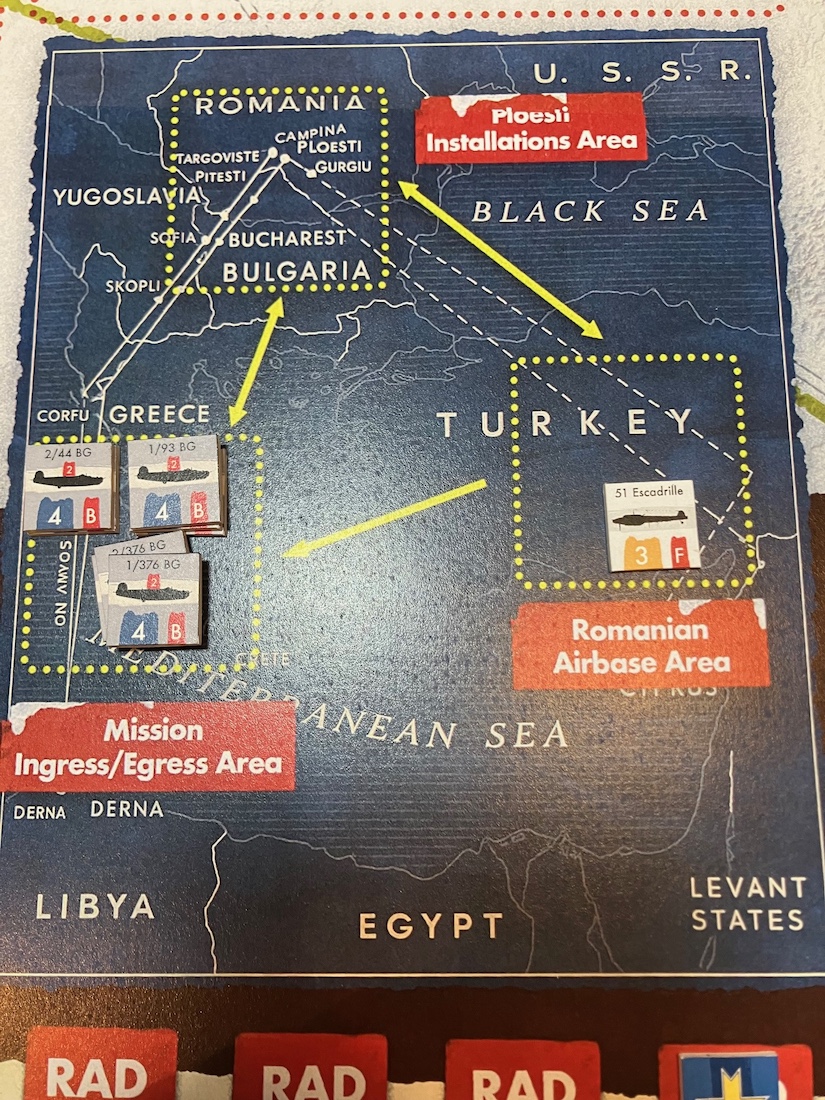
Play starts with the U.S. player rolling to see how many of his first wave aircraft will get temporarily lost and end up joining the second wave. In Phase 1 they move into the Ingress/Egress area enroute to their targets. He then moves to Phase 2, the first Axis Reaction phase, and rolls to see what happens. This can be nothing or more Axis Air/AA/FUBAR units are drawn from the cup and deployed on the board according to a die roll. Axis units can be deployed to the ingress/egress zone and combat will occur. The first of 4 Axis Combat phases is next. Combat is simple for both sides, based on comparing a die role to the combat factors printed on the counters. In that Axis phase both AA and air units can attack bombers, either disrupting or reducing them a step. Concentrate your fighters and AA to destroy bombers (and gain VPs), not simply disrupt them.

In Phase 4, the U.S. play moves his aircraft into the target map, and deploys his bombers as he sees fit on Target Areas A-C. I found that concentrating your bombers into the target areas with the weakest defenses works best, as each bomber gets two bombing attacks before they head back to base. I didn’t use any bombers to suppress/destory AA units (there are no VPs for doing so), and the bombers are more vulnerable to disruption and step losses while doing it. The American player is trying to score a minimum of two bombing hits in all 3 target areas (or you lose VPs), and additional hits above those are tracked as U.S. VPs. Bombers also can conduct defensive fire against fighters, and again I would concentrate fire against a fighter until it is eliminated. You get a VP for every 2 fighters eliminated.
The phases alternate until the first wave of US bombers deploy through the ingress/egress area and return to base. The process starts over when you flip the Phase marker to Wave Two and repeat the phases. In Wave 2 the U.S. player will need to attack any target areas where he did not achieve at least two hits in Wave One. These may be better protected areas and risk higher casualties. I tried getting my two hits on the first bomb attack then move back to less defended targets to rack up more bombing hit points on the second run. Then its time to head home to Libya and assess the damage to the groups.
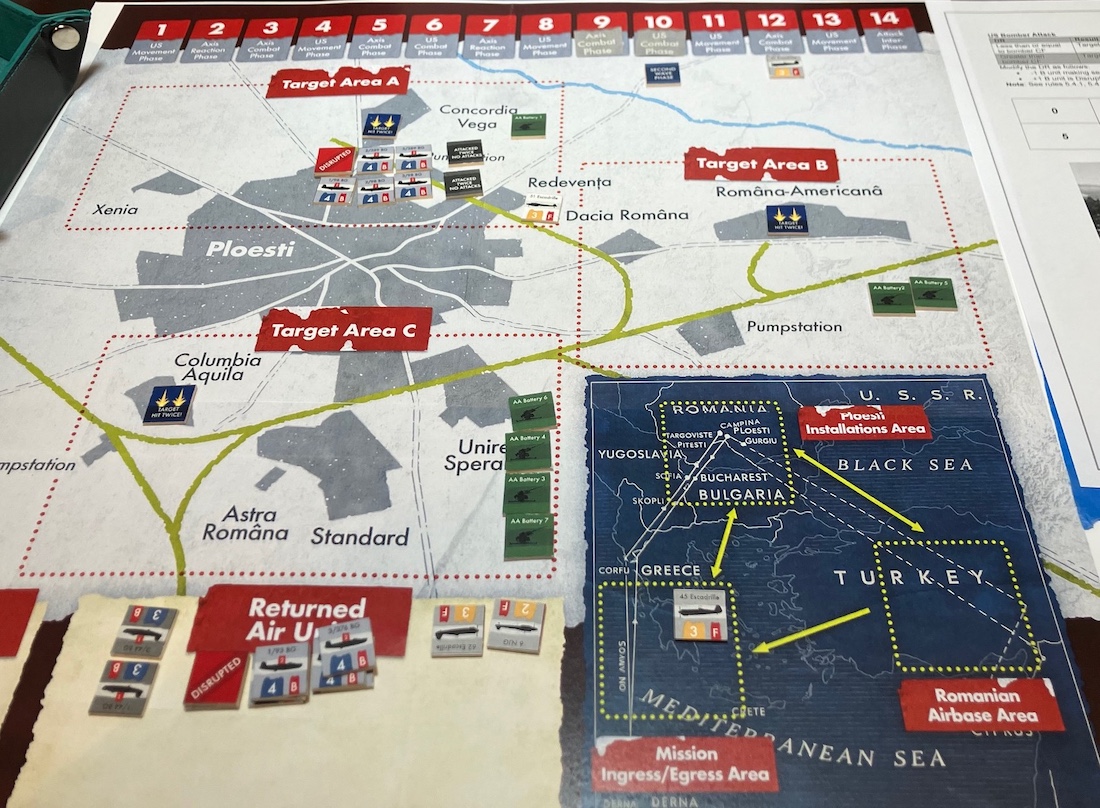
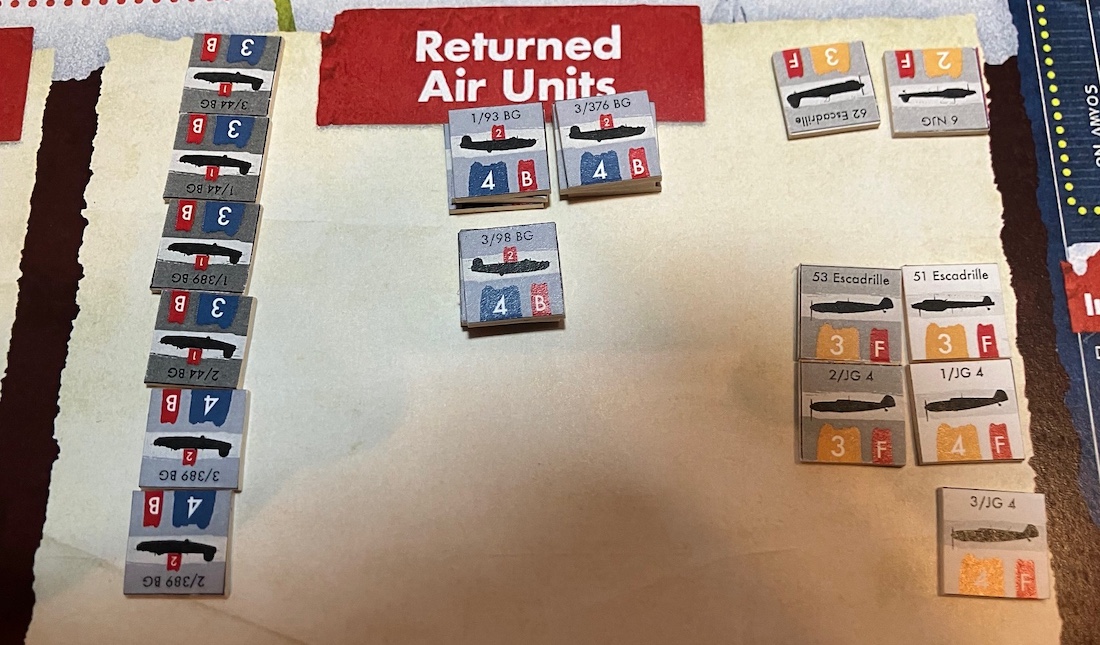
As I mentioned, the U.S. player scores points based on total number of bombing hits, every two Axis fighter units destroyed, and loses points if a Ploesti target area has no or only one hit. You also lose points for every 2 damaged or 1 destroyed bomber. You have to roll for every damage or disrupted bomber that returns to Libya to see if it sustained too much damage to be airworthy, so you will take additional losses because of that.
In most games, I ended up with between 1-13 VPs, which is a minor U.S. victory. In my last game, I achieved a major victory with 19 points thanks in part to FUBAR chits and bad die rolls piling up for the Axis.
Assessment: Overall I found the game to be a satisfying solitaire representation of this rarely-represented air battle. There is a fair amount of die-rolling to drive the Axis response, but I adjusted to it after a few play-throughs. American decision-making centers around min-max strategies of throwing the most bombers at the weaker defended target areas and making sure you do enough to get the minimum two hits on each target area. This means some squadrons are going to suffer casualties in one or two strongly defended areas. As stated earlier, I learned to avoid doing AA suppression strikes because it increased the damage risk to the suppressing aircraft for no victory points. It is better to score target hits. Shooting down enemy fighters is a “free” action that can garner you points (and protect the bombers), just mass on one fighter unit at a time to destroy it.
This game is one you can take on the road with you and play in your hotel room. You could even have someone play the Axis with a few minor rules modifications to give them more agency. Paul clearly enjoys his work designing games such as this, and adds pictures and quotes like the one below from his research materials, and this way honors the sacrifices of those who fought.
“As long as your bombs hit the targets none of you could come back and the mission would still be a success. The target must be destroyed to win the war. Coming back is secondary.” – Grim pre-raid assessment of the Ploesti raid by one of the mission briefers, recalled by tail gunner TSgt. And flight engineer, Fred E. Anderson.
For a living rules addendum and a minor map patch for the action phase timeline, see the game’s Consim forum page. Paul also answers game questions there.

You can chat about this game in the Modern World section of our discussion forums
Thank you for visiting the Regiment of Strategy Gaming and riding with The Armchair Dragoons.
Rather than list a bunch of social media links, the easiest thing to do is to check out our LinkTree, which connects you to all of our various locales around the web.
You can also support The Armchair Dragoons through our Patreon, and find us at a variety of conventions and other events.
Feel free to talk back to us either in our discussion forum, or in the comments below.
Footnotes
- In the new edition of War Diary, #30, editor Roy Mathewson stated that designer Allyn Vannoy’s second design for War Diary games, Ploesti: Bombing Romania, 1945, should be released in early 2026. No other details were provided.
- Oil & War, 241. Romanian oil production at Ploesti had peaked in 1936 and was on a downward trend by mid-war.
- Robert Goralski and Russell W. Freeburg, Oil & War: How the Deadly Struggle for Fuel in World War II Meant Victory or Defeat, Marine Corps University Press, 2021, 241-242.
- Jason Dawsey, Over the Cauldron of Ploesti: The American Air War in Romania, The National WWII Museum, August 12, 2019, accessed 3 January 2026.
- FUBAR – Fouled Up Beyond All Recognition…usually something bad happens for either side.


Aaron, excellent review on an important topic. Rohrbaugh does hit under-examined episodes — I like his Civil War naval games. This looks like an important one to acquire, so thanks for the heddzupp!
I’m off to the MarCorU site to track down your ref. What ‘World at War’ issue featured the article you mention?
Thanks much, TimSmith