
 by
by Brant Guillory, 8 January 2026
My love of the Modern Battle quads is well-documented on our podcast. We’ve played them at our monthly Triangle Wargame Day. We’ve had them on the schedule at The Fall Assembly, and we built an entire weekend at Buckeye Game Fest out of quad games, including both of the ModQuads, back in 2025.
So what are these games and why do I enjoy them?
First things first: The Modern Battles and Modern Battles II quadrigames were released in the mid-70s by SPI at a time when quads were in fashion. Blue & Gray, Blue & Gray II, Napoleon’s Last Battles, Island War, Westwall, Thirty Years War, Crimean War, and more were all released in a 5-year frenzy, and some were later reprinted by TSR. In the past decade, there’s been bunch of reprints (Decision Games’ Blue & Gray Deluxe) and homages (Brief Border Wars and Brief Border Wars 2) and a renewed sense of “hey these were pretty cool!”
The Modern Battles series were distinct among the rest in that most of the quads were from a specific conflict, or a theater within a larger conflict, whereas the ModQuads covered much more ground. They mixed hypothetical with historical, and even included a speculative scenario or two within some of the games. Most of the ModQuads were also released as single standalone folios, but those aren’t the easiest to find.


click images to enlarge
| The 8 games of the Modern Battles I & II series | |
Modern Battles:
|
Modern Battles II:
|


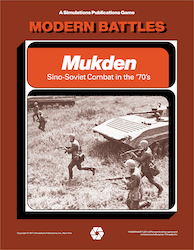
| Many of the quads had what was known as a “fifth wheel” game – a game using basically the same system, released in an issue of S&T Magazine. ModQuad I did not have a fifth wheel game. ModQuad II did, with the Berlin ’85 game, which used the same system but collapsed the standard/exclusive rules into a single ruleset for the magazine. It was later released in a slim standalone box. |  |
The games were mostly battalion-level counters, with some exceptions. Airpower was largely abstracted as air support points available for different kinds of missions. Artillery had different combat factors depending on whether it was being used to support attackers or defenders. CRTs were odds-based, with different CRTs for “mobile” or “active”; the latter was much bloodier.
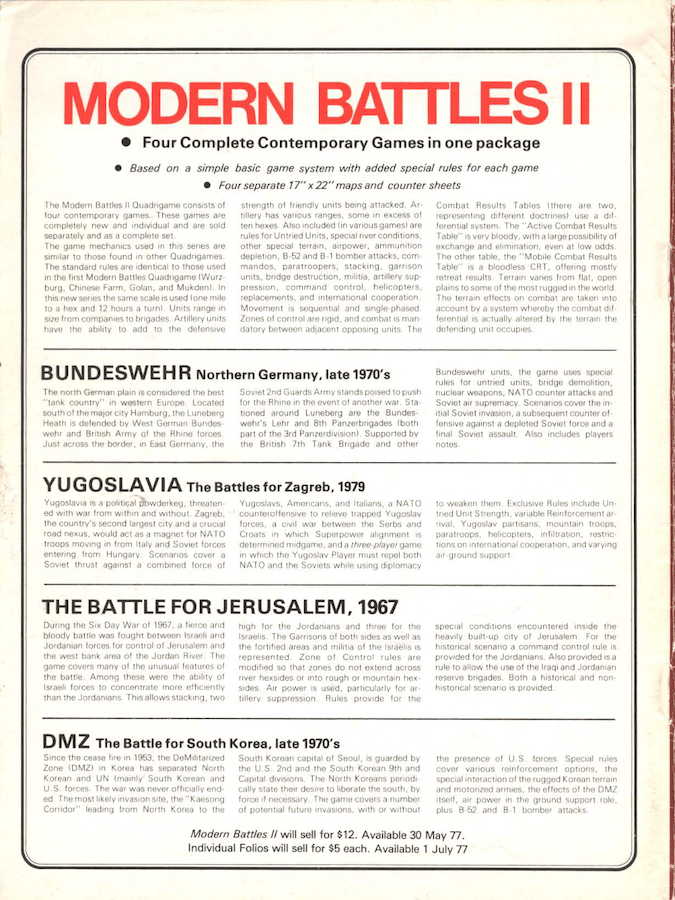
There were both cosmetic and mechanical differences between the two sets, also. While the maps are largely consistent, the counters in the first set used silhouettes, which the second used standard NATO symbols. ModQuad II also used the ‘untried units’ mechanic from SPI’s Panzergruppe Guderian, except for the Battle for Jerusalem, which had historical unit performances against which to benchmark the units.
While the “contemporary” action of the hypothetical games now “happened” 45-50 years ago, at the time they were released, these were all current conflicts on the hot stove, ranging from a light simmer to a rolling boil.
Reimplementations
Since their original release, Decision Games have had several related games through their different channels.
There were 2 issues of S&T that each included 2 games, for a total of 4 titles, packaged as “Cold War Battles” and scaled very similarly to the ModQuads
- S&T #235 included Budapest ’56 and Angola ’87
- S&T #263 included Pentomic Würzburg and Kabul ’79, marking the first time we saw a “remake” of a previous quad game in the series.
Separately, Decision also released a number of folio games with a standard ruleset that’s a clear evolution of the ModQuad systems, which included some remixed older titles alongside some brand new conflicts. This new ruleset was the “Fire & Movement” system and also used for WW1 & WW2 games in the Decision folio family
- Golan: The Last Syrian Offensive: Reimplementing the earlier Golan game with battles in the ’73 Yom Kippur War
- Naktong Bulge: Breaking the Perimeter: The “oldest” battle of the modern series, with a conflict in the Korean War
- DMZ: The Next Korean War: Updates the 70s-era game to the new millenium
- Showdown: The Coming Indo-Pakistani War: a 90s/00s-era contemporary game
- Lebanon 82: Op. Gaillee: Another new conflict, which hadn’t yet touched off when the originals were released, but would’ve been quite realistic if it had
What they do well
The ModQuads and their descendants are quick-playing, single-sitting games. They live in a space between high tactical games and lower operational level games. While the scope and scale are largely operational in the real estate covered and the formations used (mostly 1-2 divisions on each side), many facets of operational-level warfare (especially logistics, but also tac air, radars, civilian populations, and corps-level support assets) are either abstracted out or completely ignored. They give the players a good sense of the scale of the conflict in the ground they cover, and the spacing of the forces on the battlefield.
They are largely lightweight rules but offer some robust combat actions and an opportunity for wide maneuvers across the map.
What they don’t do well
As noted above, there are a number of operational considerations that are either abstracted or ignored, which is done for the sake of simplicity but costs the player some fidelity at the scale where the games are situated. The locking ZOCs between combatants and the bloody nature of some of the CRTs makes for some rapidly-accumulating piles of dead units on the side of the map. Artillery is a bit fiddly, with a mixture of firepower values depending on the mission given to the artillery, which is oddly granular given how many other facets of the battlefield are largely aggregated – reconnaissance, aviation support, lack of C2 considerations.
The magazine coverage of the original quad
US Ambassador Phil Kosnett’s article from Fire & Movement #9 on the second quad.

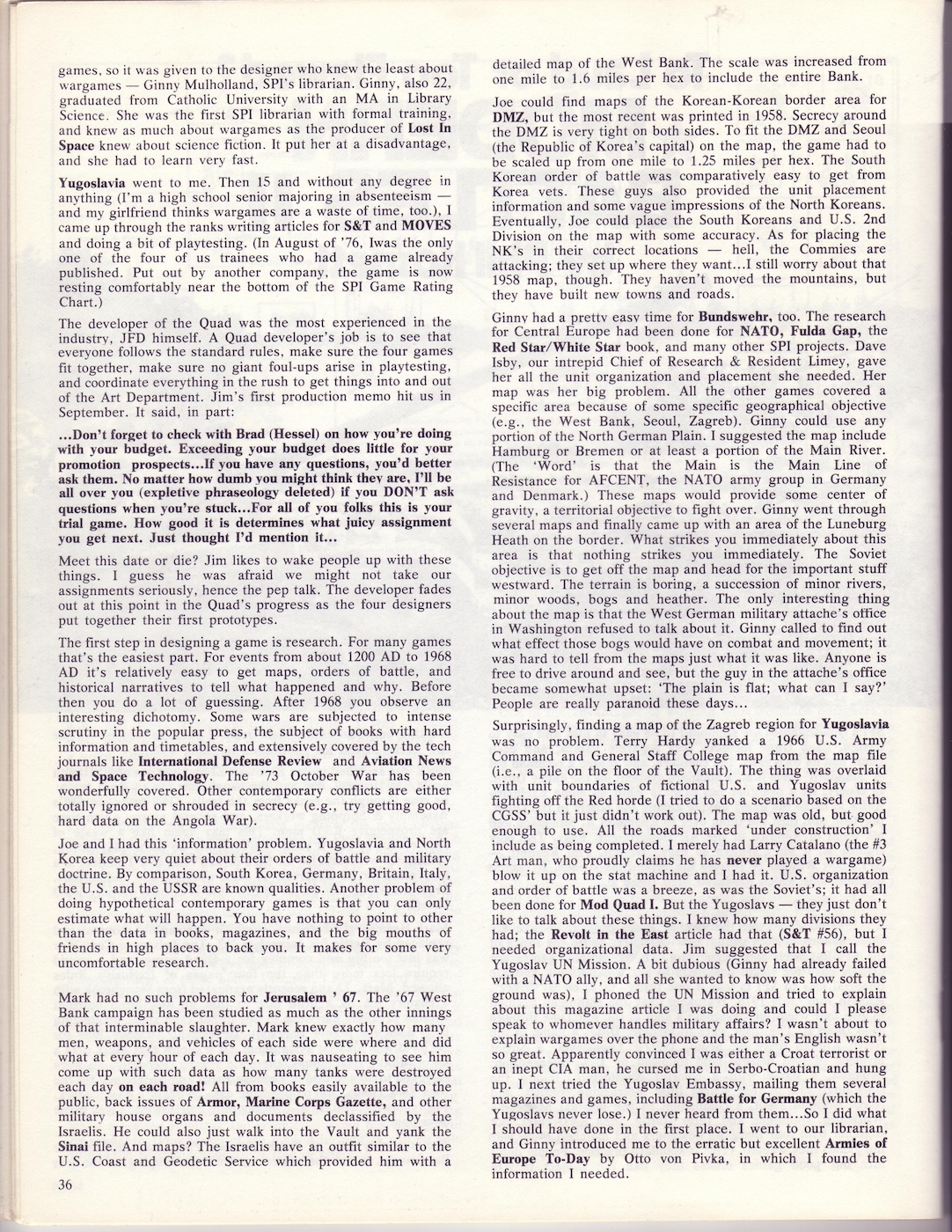
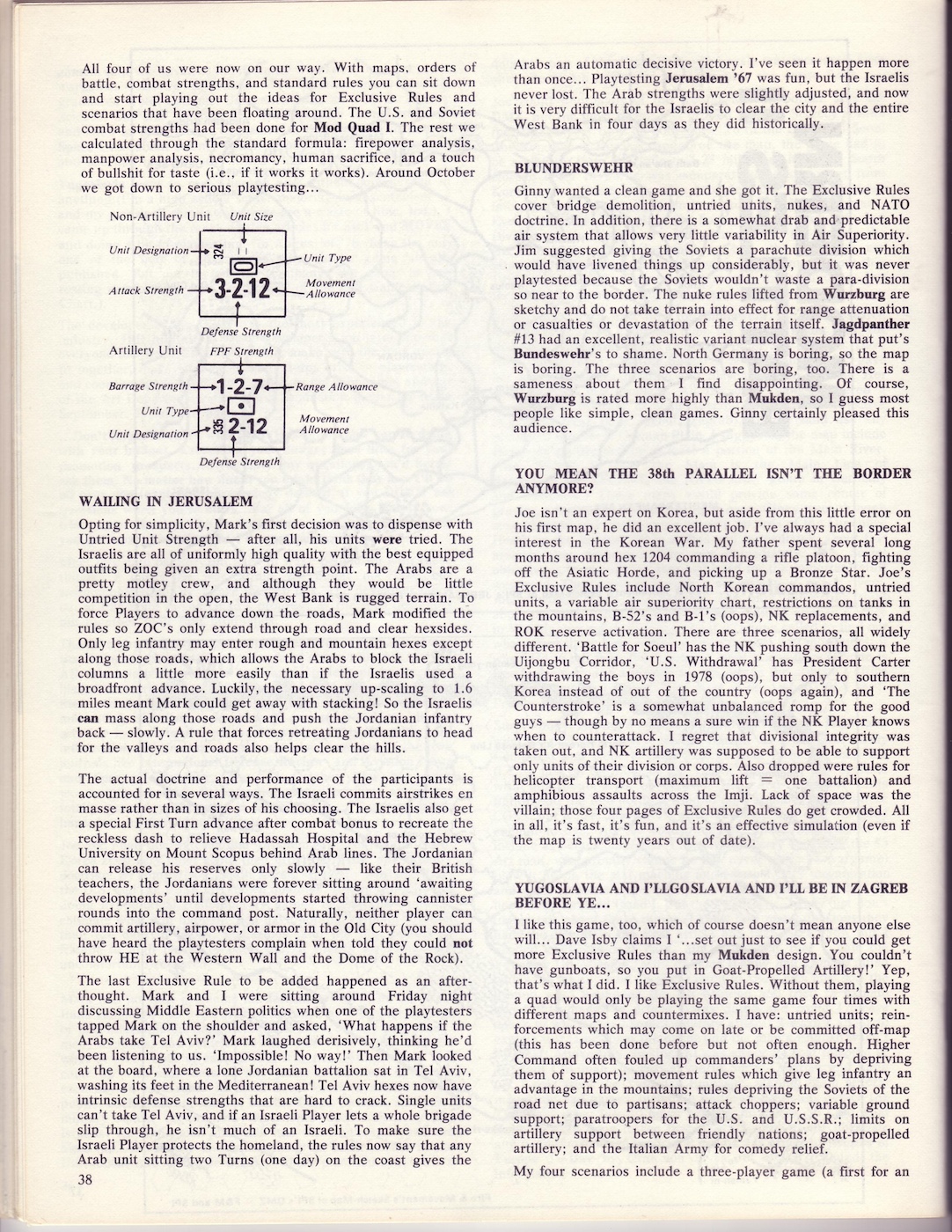
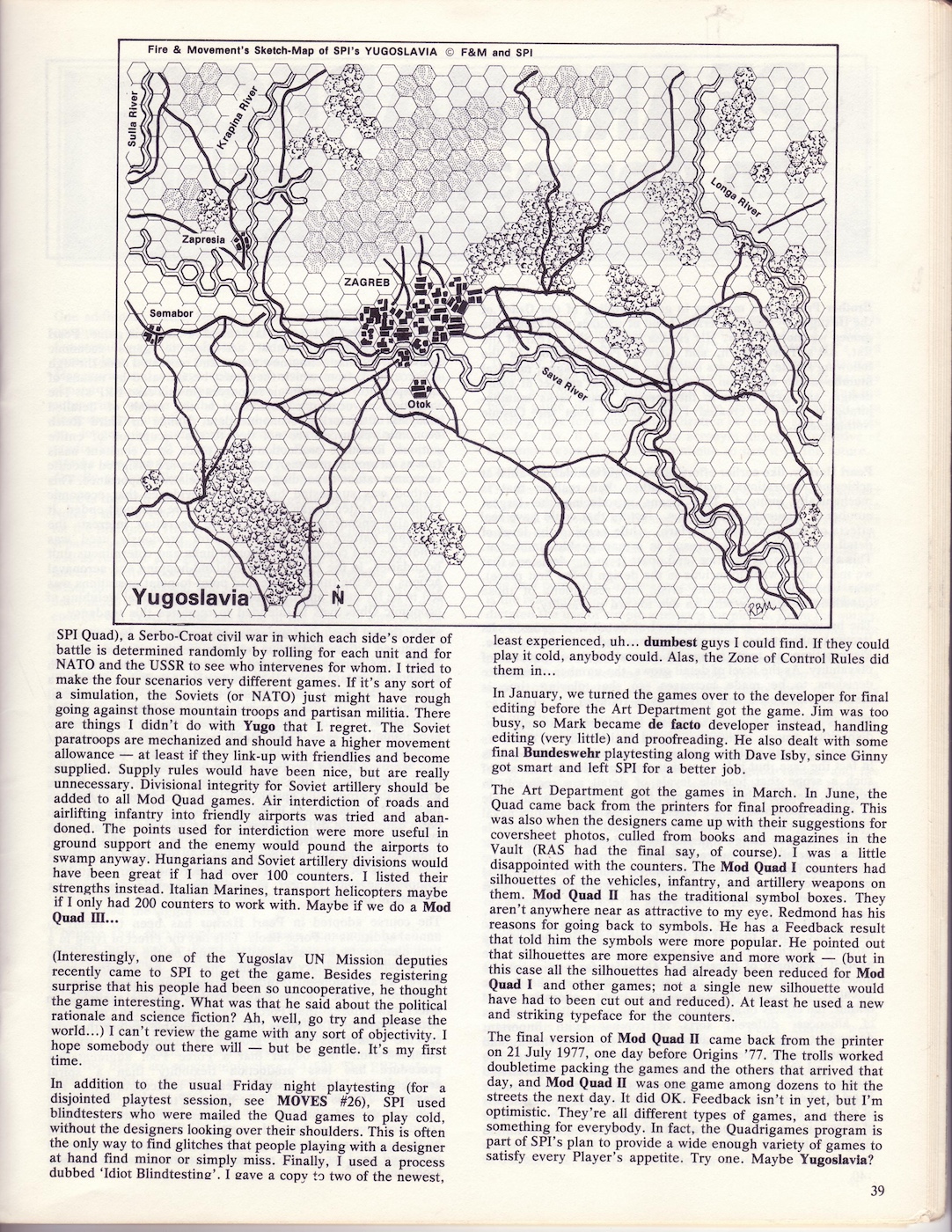
click images to enlarge
There were a couple of rather interesting twists in some of the games, as well
- Würzburg offered some challenging terrain for both sides to navigate, but artillery management is a unique challenge
- Mukden gives you Soviet paratroopers trying to drop behind the Chinese and despite the city at the middle of the map has very little urban combat
- Golan complicates the already-abstracted air battle by incorporating SAMs on the Syrian side
- Chinese Farm is in a quad with actual Chinese forces, none of which appear in this game
- Battle for Jerusalem is the only game in the series where specific hexes have their own built-in defense factors
- DMZ answers the question of “how do you put human wave attacks on wargame counters”
- Bundeswehr is one of the best – a CWGH game with no Americans, bridges wired for demolition, tactical nukes, fast-moving Soviets, and all designed by one of the first women to put her name on a wargame
- Yugoslavia had the US and Soviets “meet in the middle” at Zagreb, and depending on the scenario the Yugoslavians are either fighting the Americans, fighting the Soviets, fighting them both, or1 fighting each other in a scenario that prophesied a Serb vs Croat Yugoslavian civil war.
 While there were obviously the ‘mandatory’ CWGH battles that every ‘contemporary’ conflict study would be expected to include, the ModQuads spread their wings across pretty interesting mix of topics.
The 3 different Arab-Israeli battles were all pulled straight from then-very-recent history. Of the 3 CWGH games, only Würzburg would be considered a “traditional” NATO vs Warsaw Pact game, with both Bundeswehr and Yugoslavia offering some very challenging twists on the genre. Even if you include Berlin ’85 as one of the ‘family’ you still have a CWGH game that avoids being “more of the same” since it’s an entirely urban fight across a variety of national lines. The remaining games included one that was expected to pop off at any minute (DMZ) and one that no one really knew enough to know how fanciful it might be (Mukden) but which we subsequently learned might not have been all that far-fetched after a few Sino-Soviet border shootouts.
Looking for something modern, but with a curveball? Want a basic system that you can use for a bunch of different theaters of war? The ModQuads might be your thing. They were certainly worthy of hitting tables between their original release and the fall of The Wall.
Thank you for visiting the Regiment of Strategy Gaming and riding with The Armchair Dragoons.
Rather than list a bunch of social media links, the easiest thing to do is to check out our LinkTree, which connects you to all of our various locales around the web.
You can also support The Armchair Dragoons through our Patreon, and find us at a variety of conventions and other events.
Feel free to talk back to us either in our discussion forum, or in the comments below.


Dunnigan wrote way back when that another reason he liked the Quads was that the small games were good training for designers beginning with SPI: Kosnett, Costikyan and Herman to name three.
SPI produced 16 Quadrigames between 1975 and 1979, but not everything that was proposed actually saw the light of day.
I put together a partial list of 47 Quadrigames that were proposed in the Feedback sections of Moves and S&T but were never published for one reason or another.
Because proposals often appeared several times or in a similar section of MOVES, I have grouped them by historical era.
https://brtrain.wordpress.com/2021/11/14/updated-quads-that-never-were/
There was a Modern Battles III proposed in S&T 62 and MOVES 33 and would have included four from among these ten hypothetical battles: Cuba 1962; Norway; Uganda; Bangladesh; Viva Bolivar (hypothetical South America); Canal Zone; Montreal (separatists I guess); Cyprus; Sahara; Quemoy/Matsu.
The Norway situation got the full treatment in Nordkapp (S&T 94 issue game) but none of the others were picked up.
you can put ’em your design queue!
Well, I did do Cyprus in Brief Border Wars quad #1. PS: sorry about the repetition, I cannot tell if something I posted made it in or not.
after you post something, you sometimes need to refresh the page to see it appear
Berlin 85 might have been a fifth wheel but it was a good one.
I loved the crazy detail of the map and the situation.
But I was always displeased with the Modern Battles quad system being used in the middle of a large city.
https://brtrain.wordpress.com/2023/11/27/variant-operation-zugstoss-for-berlin-85/
The variant here makes some updates and changes to that game, as well as changes that could be made to all of the Modern Battles quad games with little or no overhead.
https://brtrain.wordpress.com/2023/11/27/variant-operation-zugstoss-for-berlin-85/
This variant for Berlin 85 also has some rule changes that could be applied to any of the MB Quad games, or even the modern day Decision Games folio games.
Agree…I loved these games. I have it in my head that Decision Games is contemplating a deluxe reprint of these two quads a la the Blue and Gray quads set that I reviewed. I may have seen it offered in one of their many surveys.
I almost forgot…I have the Mosul and Kaliningrad New World Order Battles set from Decision Games Modern War #27, and that was preceded by Kiev/Ulan Bator in MW#22. Same scale as the Modern Battles Quads, but Joe Miranda put more chrome on them and they don’t share as many common rules.
I didn’t know Berlin ‘85 would be considered a fifth member of the ‘quad’ – loved poring over that map of Berlin!