
 by
by RockyMountainNavy, 23 March 2026
This post is a long-overdue second attempt. You see, after picking up Modern War: A Complete Squad-Level Roleplaying Game (Zozer Games, 2023) and the supplement Modern War: Crisis Creator – Campaign Building Rules (Zozer Games, 2024) I had great visions of using the Crisis Creator supplement as a wargame campaign framework. It seemed so simple in concept; I could use Crisis Creator as a modern campaign framework for use in either a modern warfare wargame or roleplaying game (RPG) campaign. My lesson learned: the Modern War RPG core rulebook and Crisis Creator supplement are fine RPG products but as a wargame campaign builder they deliver what I feel is a less-than-optimal result. That outcome is not a reflection on the quality of the RPG—which is excellent—but a reflection of my misuse of this RPG for wargaming purposes. Then again, a newly published wargame, Battlegroup Clash: Baltics from Sapper Studio (2026), may present an option.
Long-time readers of my article here at The Armchair Dragoons or at my personal blog will likely (hopefully?) remember that I am a fan of Adventure Wargames which are wargames with roleplaying game (RPG) elements. I am talking about titles such as Five Parsecs From Home: Solo Adventure Wargaming or Forgotten Ruin: The Adventure Wargame both from Mōdiphiüs Entertainment. Both games are effectively skirmish-scale wargames with lite RPG elements. Then there are the military roleplaying games like Behind Enemy Lines from FASA (1982) up to Twilight: 2000 4th Edition from Free League Publishing (2021). Recently, I took in Modern War: A Complete Squad-Level Roleplaying Game (Zozer Games, 2023) and the supplement Modern War: Crisis Creator – Campaign Building Rules (Zozer Games, 2024).
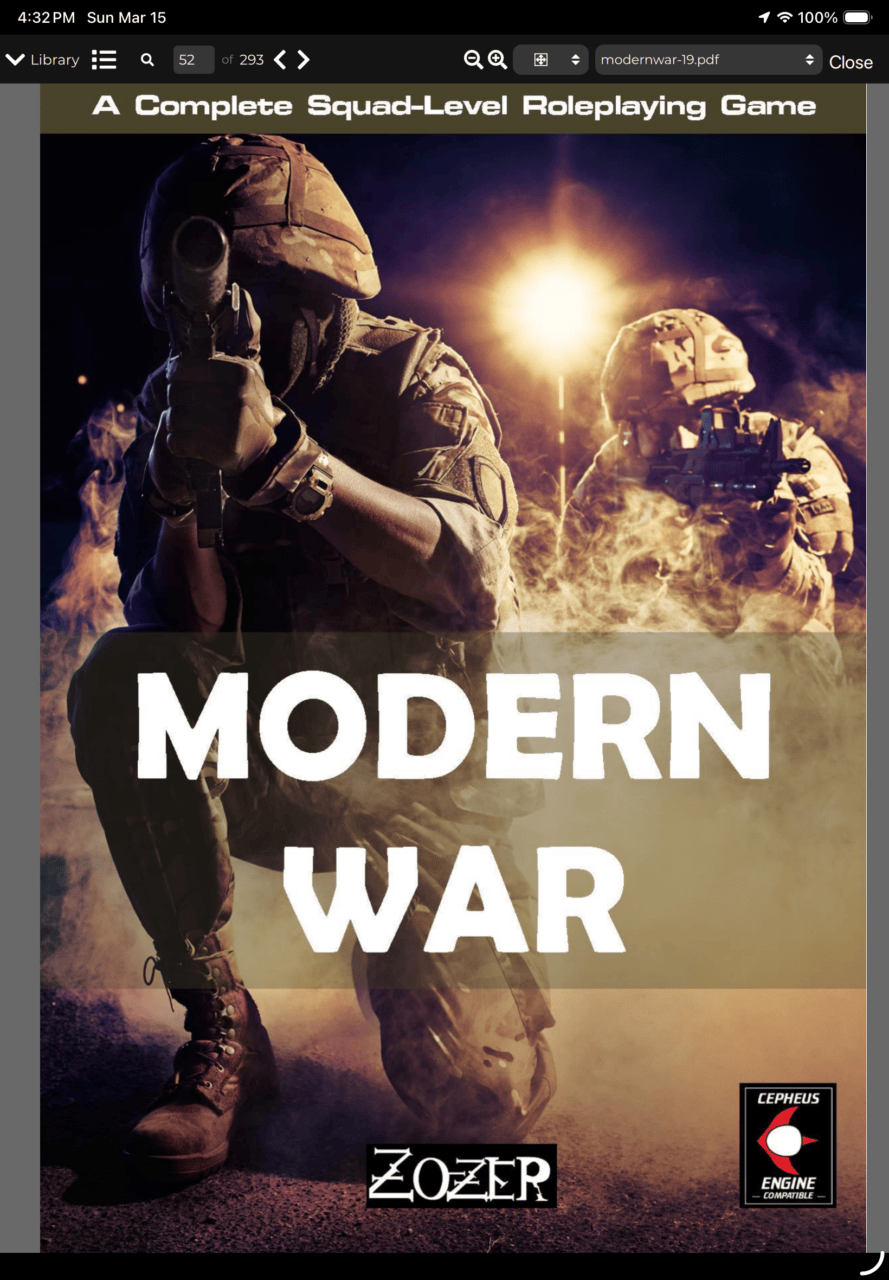
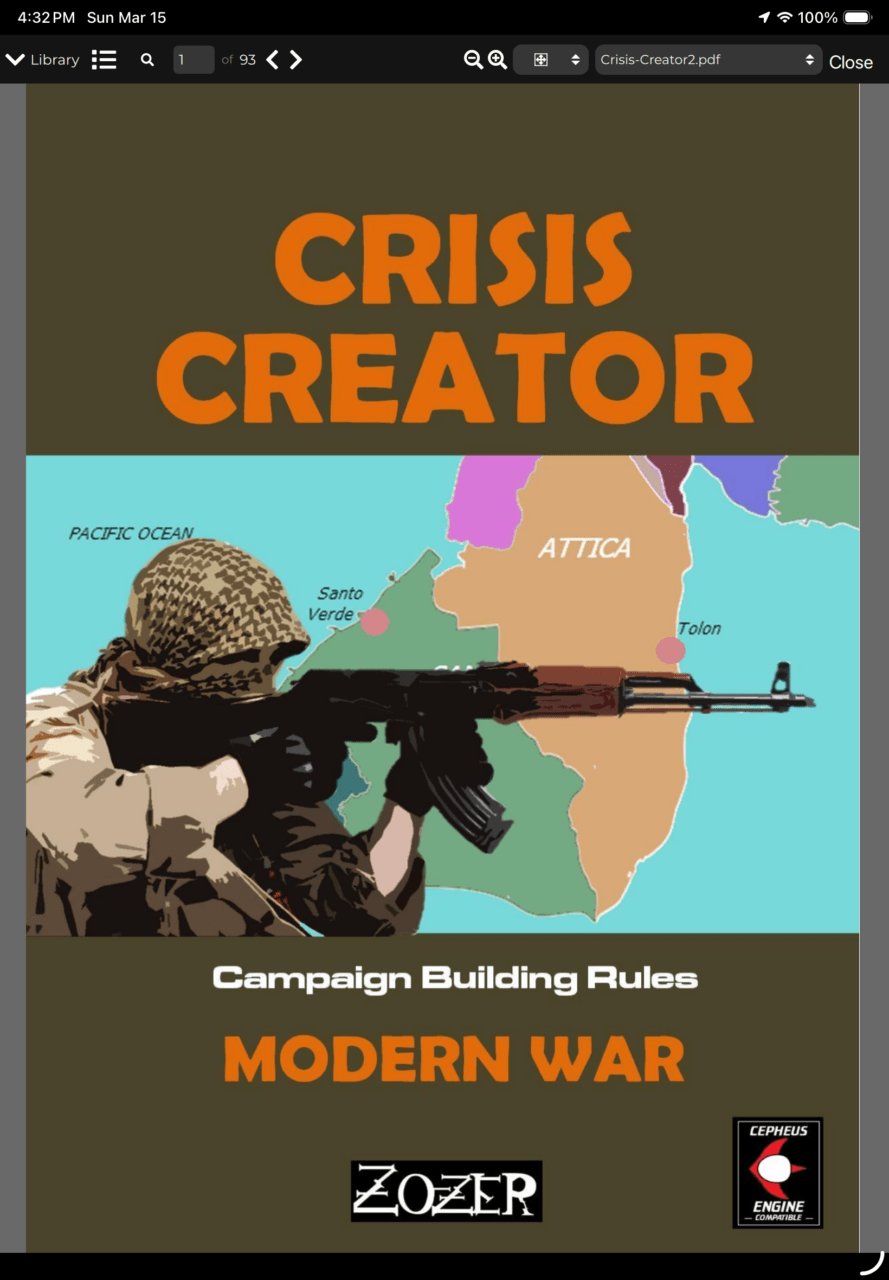
A squad-level RPG…
Modern War (MW) is an RPG built upon Cepheus Engine, a 2d6-based game system derived from the Open Game License version of the Traveller RPG. As the “Initial Briefing” for Modern War relates:
Modern War is a complete squad-level game that open up roleplaying for a wide-range of modern military-themed settings… . With almost 70 military vehicles, 90 firearms, and comprehensive military careers, the game can be set anytime in the past thirty years: 2019, 1999, 1989 – no matter. But it can also be used for almost any science-fiction or horror cross-over setting that you can imagine. (MW, p. 8)
To myself, part of the appeal of Modern War is that creation of the setting is left up to the players. As Modern War tells us:
THE FUTURE, THE PAST… THE FANTASTICAL
There are plenty of roleplayers who do not want to refight the wars of recent years, to ‘play war’ when they or their friends, or members of their family, have been there and done that for real. That’s quite understandable. Well, this book is a military tool kit. It is a doorway for modern adventure, and with its roots in the science fiction RPG called Cepheus Engine, Modern War lends itself well to cross-over science fiction gaming, alternate history gaming, horror gaming or even time travel. (MW, p. 12)
Of that list, I focus in on “alternate history gaming” which I see a euphemism for wargaming. Modern War acknowledges that it very well can be used to recreate recent conflict like Iraq or Afghanistan but when doing say the rules call for…:
Caution. Recreating the reality of these raw and emotive conflicts is fraught with problems. Anyone who has served in those wars, or who has family or friends who have fought, or simply who have seen too much of that reality in books, magazines articles or on TV – will rightly refuse to take part. I’ve spoken to some of those veterans who also roleplay. For many, it is distasteful and disrespectful. You and your players may not have any problem at all using those wars as a backdrop, and that is perfectly fine. But we instead recommend building your own war – rather than retreading one from the TV news. (MW, p. 13).
…with a county and crisis builder…
The rules for creating your own modern war are found in the chapter titled, “Building Your War” in the core rulebook for Modern War. The option is given to either choose one of several fictional wars presented or to build your own. That is where the Crisis Creator (CC) supplement comes into play.
Crisis Creator is, “a framework to help create fictional countries set in the modern world before plunging them into crisis” (CC, p. 7). The fictional countries are created through a series of questions and die roll…and a bit of some artwork. If you are familiar with the Traveller RPG or Cepheus Engine world generation sub-game then some of this might look strikingly familiar.
[Although not explicitly stated in Crisis Creator, there technically are two country-building systems. The “Country Creation” chapter is what I call a narrative approach and a second chapter, “Mapping,” presents a more detailed map-based process. One does not need to do both, though personally I like the narrative portion to help create the crisis whereas the map-based procedure gives me a visualization of the crisis area.]
At this point in my first attempt at ModernWar/Crisis Creator review I launched into a 3000+ word step-by-step recap of how one creates a fictional country and associated maps for a campaign. At the end of that process I indeed had my fictional country and crisis for a campaign…and yet was a bit lost.
…for a wargame?
After a fair amount of work—about 2 hours of effort—I realized that what I failed to account for was the effort needed to take a Crisis Creator RPG campaign and turn it into a campaign game that a wargame can use.
I mean, what I created with Crisis Creator was not bad. My fictional country was about the size of Georgia and densely populated. Economically it was not powerful (“widespread poverty”), led by a dictatorship, and the three ethnicities (at least in language) lived in a country plagued by corruption, xenophobia, intense distrust between ethnic groups, and intensive internal propaganda. The country, located in East & SE Asia, was landlocked and mostly mountainous jungle with a temperate zone where the majority of the population resided. The crisis itself was the fall of the dictator (supported by the few wealthy families and Russia) to a military junta supported by an emergent middle class that was backed by the United States (to much criticism from Europe). The United States decided to militarily intervene in support of the junta as they push back against the dictator’s forces. The country creation process delivered me not only a narrative of the country but a map and even a flag.
What I really discovered is that Crisis Creator is wonderful at framing the political, economic, and physical terrain of your fictional country. Unfortunately, when it comes to the military forces—the part arguably of most interest to a wargamer looking otherwise flesh out a few battle scenarios—the Modern War core rulebook and Crisis Creator supplement both come up short of what I desire.
A great part of the problem I have porting a Crisis Creator outcome to a wargame is the matter of scale. Modern War is a squad-level RPG. Per Marine Corps Reference Publication (MCRP) 3-10A.4, Marine Rifle Squad, dated 7 August 2020, “The rifle squad totals 13 Marines and is led by a squad leader. Its Marines are divided into three similarly outfitted fire teams of four Marines each, led by fire team leaders (refer to figure 1-1).”

An RPG party playing Modern War likely will be maybe 4-5 players (at best) that almost certainly will want to play something like the Squad Leader and a single fire team or part of one with non-player characters—NPCs—rounding out the fire team. As a point of comparison; in Five Parsecs from Home, “The default campaign crew size is 6 crew members” (FPfH, p. 63).
As Modern War points out, “…the focus of this game is on infantry operations at the squad level – small scale, short range, short duration missions that aid in a much larger war effort “ (MW, p. 51). That, my fellow grognards, is befitting of a skirmish-scale wargame—at best.
After all the effort one puts into using Crisis Creator to map a country—where each hex is roughly 100 km across covering about 8,700 sq. km, Crisis Creator then calls for building an AOR [Area of Responsibility] map which is a 5 km x 5 km grid. This again is great for an RPG adventure that may traverse terrain as the party travels but for a 15 or 28mm skirmish wargame with individual soldiers where a 3’ x 3’ table represents—at best—a 1 km x 1 km battlefield the Crisis Creator map is way larger than needed—or is useful.
Wargamer reassessment
At this point I took a step back from the Crisis Creator results and tried to see what—if anything—I could salvage for a wargame campaign above the skirmish level. What I found was a hodge-podge of information—all somewhat useful for a squad-level RPG or skirmish-scale wargame—but difficult to use in a larger-scale scenario.
Military Forces (CC, pp. 14-15): This section details the typical equipment available for different military tiers (similar to tech levels); think small arms and vehicles. This section is, in effect, your Quartermaster list.
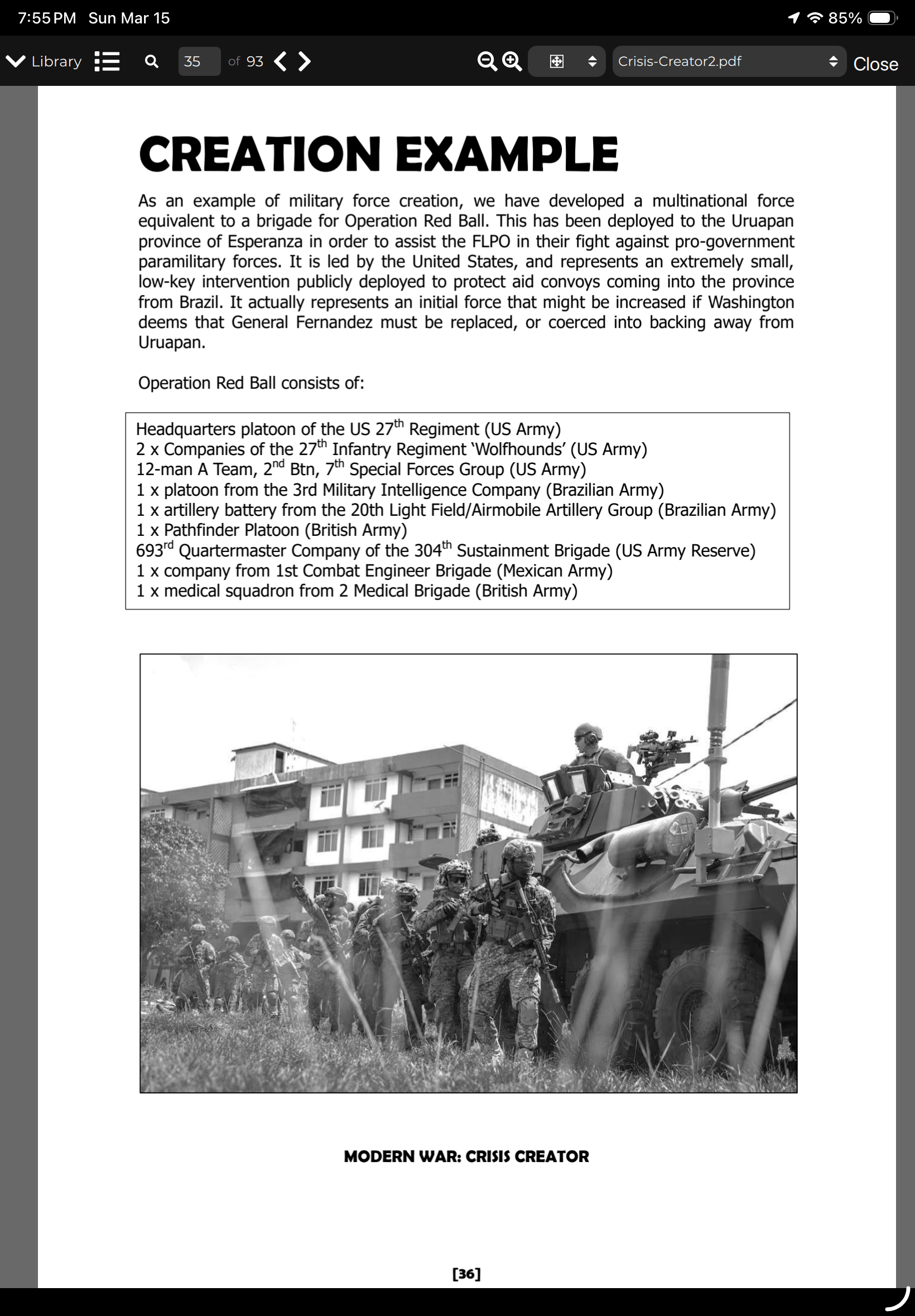
Overt Military (CC, pp. 33-35): This section is the larger unit your squad fits into; the Crisis Creator rulebook directs, “The Game Master should decide whether the total deployed force is either a full brigade (of about 5,000 troops) or a battalion-sized Battlegroup or Task Force (of about 1,000 troops)” (CC, p. 33). The information provided explains the different elements of a Battalion or Brigade but does not guide you to creating your own. Indeed, the Creation Example on page 36 that shows, “a multinational force equivalent to a brigade” (CC, p. 36) with no further unit breakdown or Table of Organization and Equipment (TO&E) provided. That makes it a bit hard to build into a wargame.
As much as I want to I have a hard time clearly seeing a connection between Modern War, Crisis Creator, and wargame campaigns and scenarios like I originally imagined. Do not get me wrong: the Modern War RPG core rulebook and Crisis Creator supplement are fine RPG products but as a wargame campaign builder they deliver what I feel is a less-than-optimal result. That result is in no way a reflection on the quality of the RPG or the writing of the designers or publisher—all of which is excellent—but more a reflection of my poorly managed expectations of being able to use these RPG titles for wargaming purposes.
From Crisis to Boots
While my expectations are a bit dashed, I still cling to some hope. As I surveyed the various wargames in my collection I looked hard at modern wargames at that smaller scale. Here are a few examples of wargames that seemingly could leverage the background from the Crisis Creator process:
- Skirmish-scale: Boots on the Ground Deluxe by Sean Cooke from Worthington Games (2024). Perhaps the most directly compatible given Boots on the Ground is a skirmish-scale wargame with individuals; the background situation built in Crisis Creator almost certainly could find use for scenario or campaign framing.
- Tactical: Goose Green from MultiMan Publishing (2023) is a Tactical Combat Series (TCS) wargame with turns representing 20-30 minutes each, a map scale of 125 yards per hex, and units range from sections to platoons again can leverage the background.
- Grand Tactical: Littoral Commander is, according to the designer, designed around base units at the platoon and section level and seemingly would fit with Crisis Creator.
Leveraging Crisis Creator, however, for the above wargames is not simply a matter of drop-in-and-play. While Crisis Creator can easily be used to create a campaign background, the lack of smaller unit specifics makes creating a scenario not as straightforward an application of the creative output as I would prefer.
Baltic hope
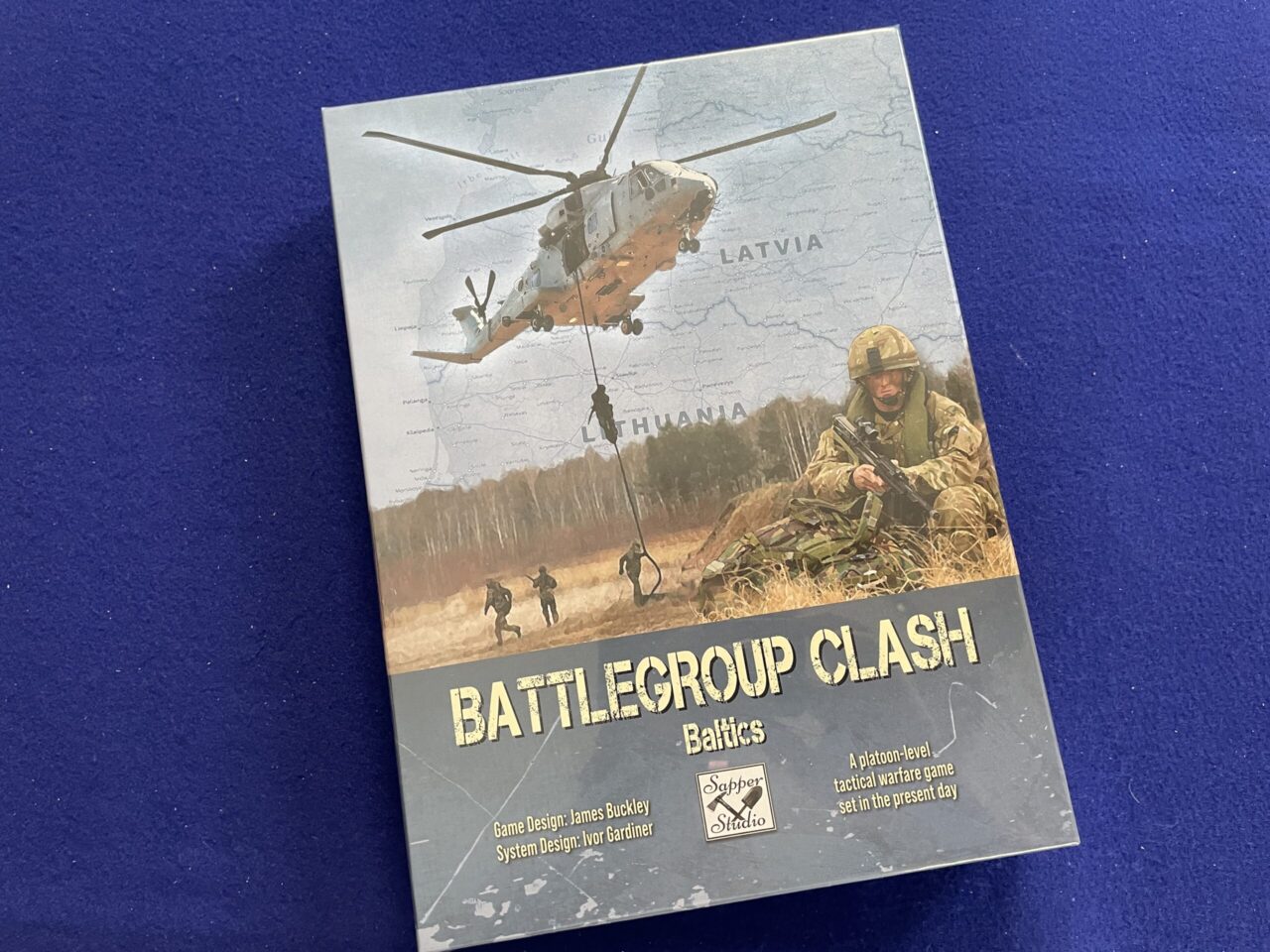
As luck would have it, a new wargame recently arrived in my collection that just might fit with Crisis Creator after all. Battlegroup Clash: Baltics is the new release by designer James Buckley from Sapper Studios (2026). As the Overview in the rulebook relates:
Battlegroup Clash: Baltics (BC:B) is a two- to six-player tactical combat game simulating a series of hypothetical near future land battles in Estonia between NATO and Russia.
… .
The scope of BC: B is Company-level. Unit sizes are no larger than a Platoon. The largest scenario involves a NATO Battlegroup facing off against a Russian Motorised Rifle Battalion. The setting is the Baltics, reflecting this region’s status as a potential flashpoint between NATO and Russia in the coming years. Turns reflect real-time periods of 15-30 minutes, with a Scenario having five or six Turns. (BC:B, rulebook, p. 3)
“Force Elements” (aka units) in BC: B are, “Platoon (PL) (3 dots) or Section (SECT) (1 dot)” (BC: B, p. 5). The map is hexless but each 1 cm = 100 meters and major grid squares are 1,000 m by 1,000 m (BC: B, p. 8).
Battlegroup Clash: Baltics is at heart a wargame that is basically a battalion-on-battalion fight with units that are Platoons or Sections (aka Squads) played on a map where distances are in hundreds of meters—not that incompatible with the results from using Modern War: Crisis Creator.
So maybe, just maybe, Crisis Creator can help build a campaign and scenarios for a game using the Battlegroup Wargame System (BGWS). Or, maybe, I do not know enough about Battlegroup Clash: Baltics to have a truly informed opinion. I guess this means I must learn Battlegroup Clash: Baltics soonest to see what I can do beyond-the-box.
You can chat about this game in the Modern World section of our discussion forums
Thank you for visiting the Regiment of Strategy Gaming and riding with The Armchair Dragoons.
Rather than list a bunch of social media links, the easiest thing to do is to check out our LinkTree, which connects you to all of our various locales around the web.
You can also support The Armchair Dragoons through our Patreon, and find us at a variety of conventions and other events.
Feel free to talk back to us either in our discussion forum, or in the comments below.


