
 by
by RockyMountainNavy, 16 February 2026
Five Parsecs From Home: Tactics was a 2024 supplement in the Five Parsecs From Home series of “Solo Adventure Wargaming” from Mōdiphiüs Entertainment. When I wrote my commentary on Tactics I described the BLUF as:
The latest release in the Five Parsecs From Home (5PFH) line of solo adventure wargaming, Five Parsecs From Home: Tactics, moves the product line closer to becoming a full-fledge set of miniatures rules for playing future skirmish battles solo while also laying the foundation for development into a complete roleplaying game (RPG) system. (“Wargame SITREP 24-44 / TTRPG Roll 24-30 ~ Almost RPG fighting Five Parsecs From Home in big TACTICS (Modiphius, 2024)”)
That transition of Five Parsecs From Home from a skirmish wargame to an Adventure Wargame, i.e. a wargame with RPG elements, ostensibly continues in Expansion 1: Field Commander’s Guide for Tactics. Unlike Tactics, however, the Field Commander’s Guide moves the pendulum between wargame and RPG firmly back to the wargaming side.
In 2025, Mōdiphiüs Entertainment released Expansion 1: Field Commander’s Guide for Tactics as a digital-only supplement. As the ad copy relates:
The Field Commander’s Guide is the first expansion for Five Parsecs From Home: Tactics and gives you 80 pages packed full of new options usable in a variety of play styles, with options for solo players, pick-up play, and scenario-driven play.
This digital release also includes several comprehensive rule systems that offer optional and expanded ways to play. (Ad copy)
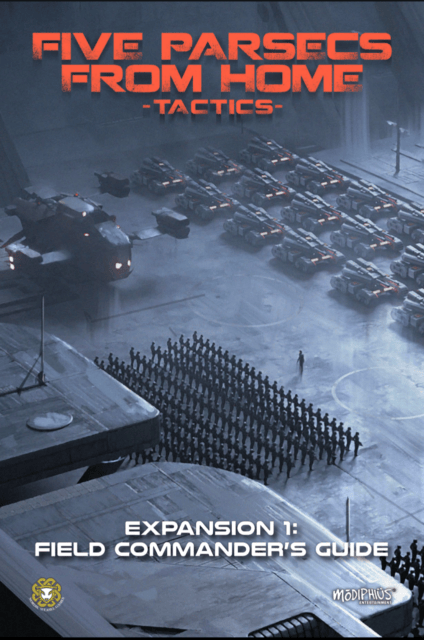
[Interestingly, the copyright date in the front matter of Expansion 1 is 2022. Why? Perhaps this is a compilation of material previously released by Nordic Weasel, the original developer of Five Parsec From Home?]
Taking from the ad copy, Expansion 1: Field Commander’s Guide includes the following sections:
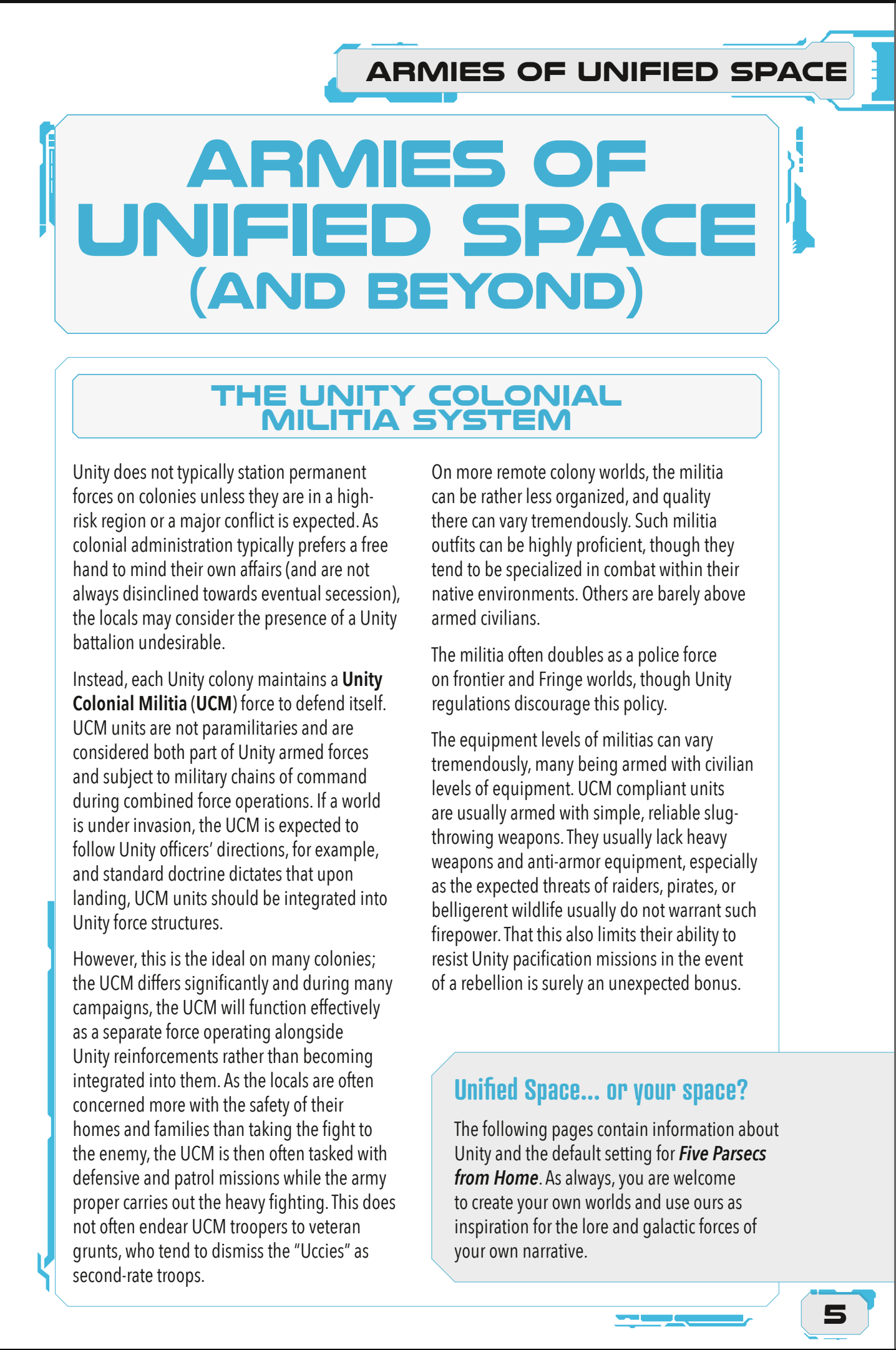
- Armies of Unified Space rules for building armies from the Unity Colonial Militia System, The Horde, The Swarm, and The Soulless.
- New Tech such as the Multi-Gun, Overload Rounds, Bio-Kill Shells, and Shimmer Suits, plus cybernetic and biological enhancements, and vehicle modifications.
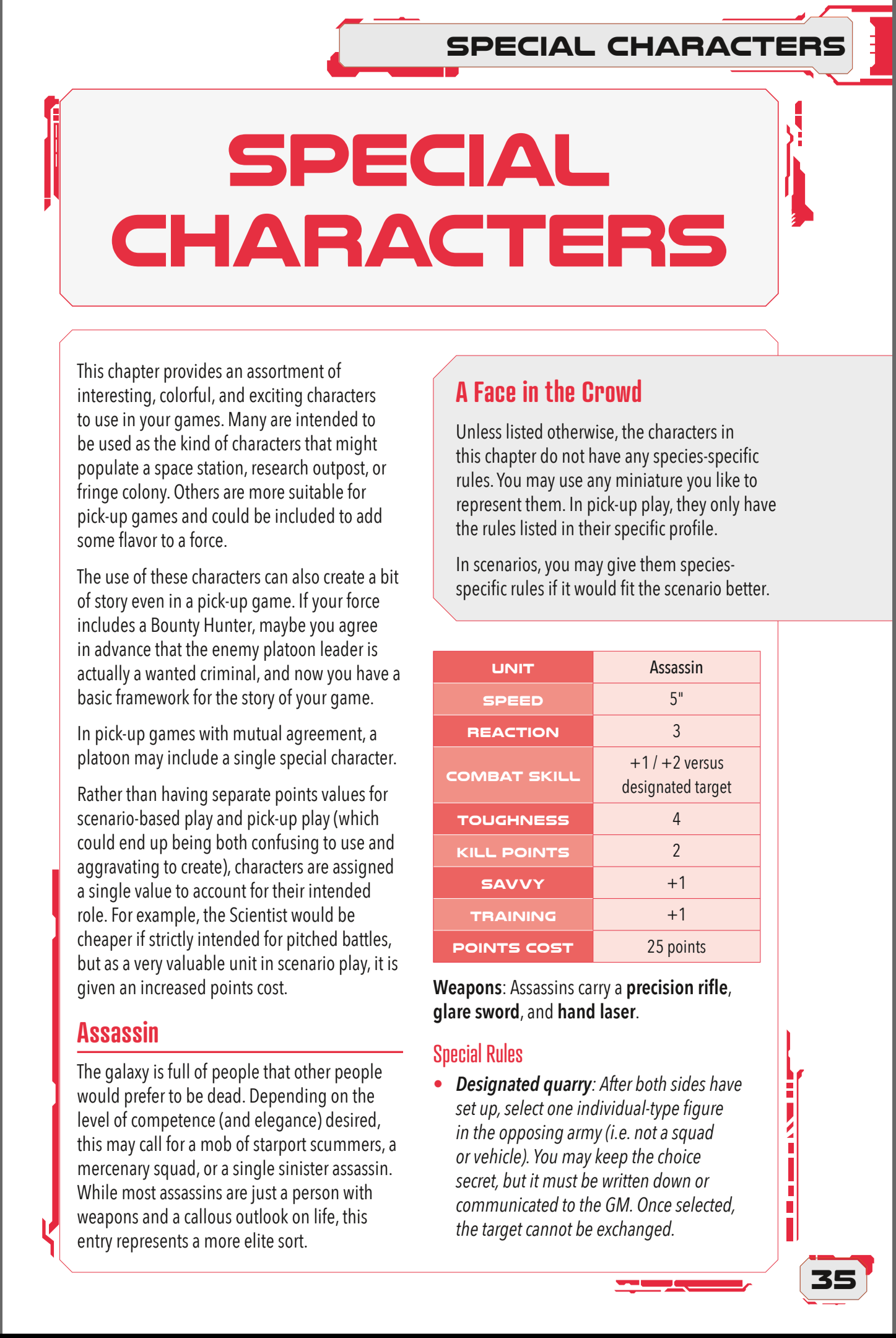
- Bot Infantry and Special Character unit rules, including the Terror Bot, M4 Heavy Infantry Bot (aka “Troll”), Assassin, Scientists, and more.
- New Creatures, including the Alurian Stalker, the Giga-Rachnid, and the Strangle Tree.
- New systems include The War Generator, which establishes circumstances surrounding armed conflicts, plus Force Events and Battlefield Conditions, which represent the unpredictable nature of combat.
- A system for Mercenary Campaigns on the fringes of space where you have to be prepared for anything.
- Plus 10 Pick-Up Scenarios and Competitive Play Rules!” (Ad copy)
Skirmishing…
The first several sections of the Field Commander’s Guide—specifically “Armies of Unified Space,” “New Tech,” “Bot Infantry,” and “New Creatures”—offer additional armies, weapons, or threats for the “default setting” of Five Parsecs From Home. These sections are most useful to players that use Five Parsecs From Home as a skirmish wargame system. Players that are into designing their own skirmish battle scenarios will almost certainly also find usefulness in the “Force Events” (i.e. random events) and “Battlefield Conditions” (unusual circumstances or conditions) rules that help customize battles. There are plenty of different options; so many that they might even “break” the game as the designer acknowledges: “With numerous moving parts, it is, of course, possible that some combination of items and scenarios will end up breaking the game in some fringe case” (p. 27). In my final analysis, however, these “skirmish” additions in the Field Commander’s Guide are reasonable and even a bit exciting.
…with non-player characters…
The Special Characters chapter in the Field Commander’s Guide is representative of the move of Tactics toward a more RPG-like experience. Special Characters are a single, special figure added to your squad. What do you think about having an Assassin, or a Bounty Hunter, added to your crew? What is that Bystander doing there? Is that Hired Gun really dependable? That Nomad Tracker can be a real pain in the rear, yes? Who let that Scientist, or that Techie, come along? And when will that Security Guard finally take a break?
…in a generation campaign…
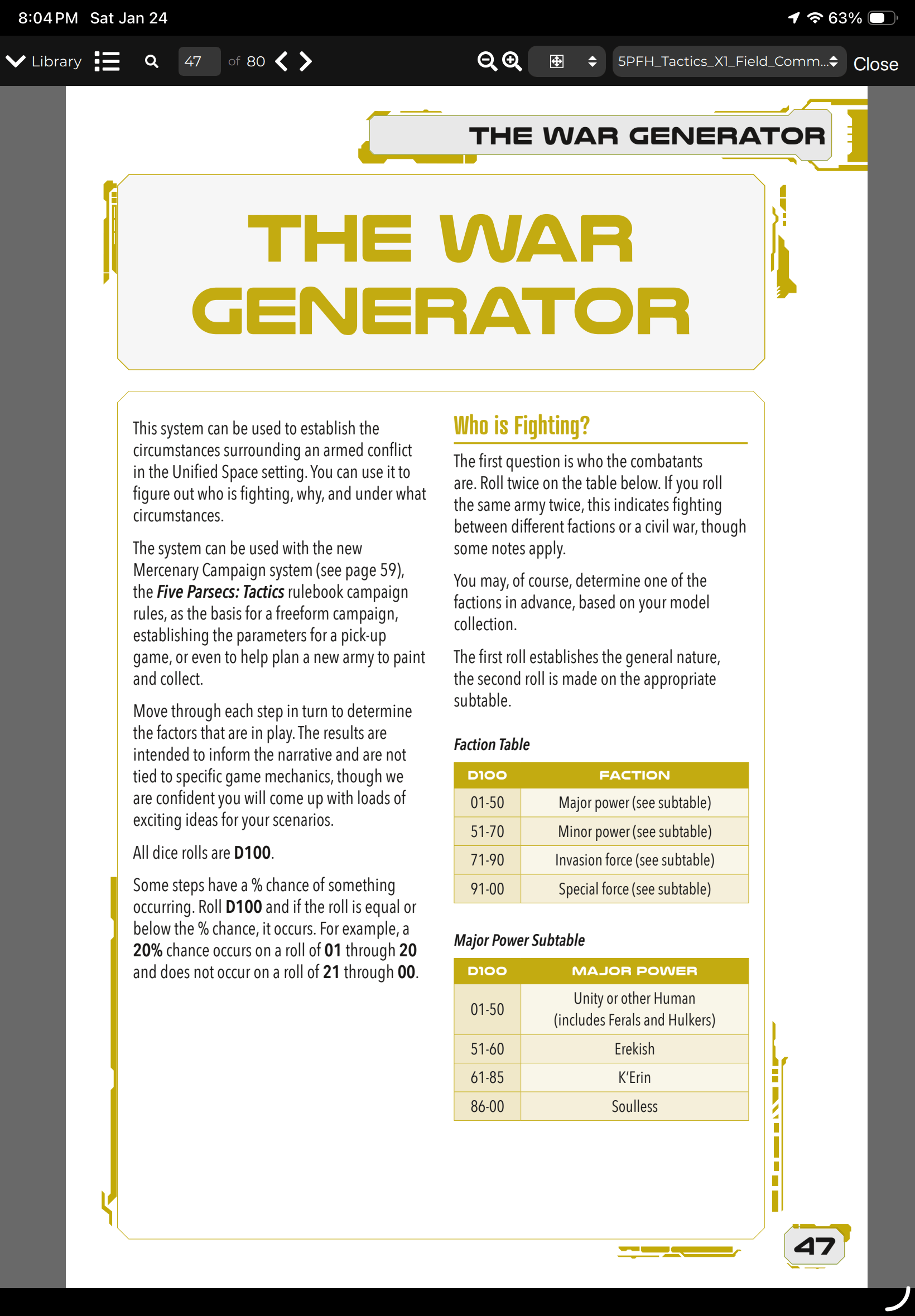
The more interesting sections of the Field Commander’s Guide—and ones that seemingly lend themselves to RPG adventuring—are “The War Generator” and “Mercenary Campaigns.” As the introduction to “The War Generator” explains:
This system can be used to establish the circumstances surrounding an armed conflict in the Unified Space setting. You can use it to figure out who is fighting, why, and under what circumstances. (p. 47)
Using percentile dice (d100), the Generator first tells you Who is Fighting as defined by a Major or Minor Power and an Invasion or Special Force. The Generator then helps define a Location and Relative Strength of Forces as well as any Special Advantages a side may possess. The Location leads to a World Type which will drive the terrain of the battlefield. The Reason for Conflict in turn drives victory conditions.
Sorta.
While The War Generator in the Field Commander’s Guide sounds comprehensive, the actual information produced is…difficult to use? For example, here is the result of a pass I conducted through the Generator:
- Who is Fighting
- Side 1
- Faction [19] = Major Power
- Major Power Subtable [89] = Soulless (“A purely synthetic species, the Soulless function as a cohesive network that is capable of detaching individual ‘programs’ when needed.” (p. 14))
- Side 2
- Faction [65] = Minor Power
- Minor Power Subtable [52] = Keltrin (“humanoid rodents” found in Five Parsecs From Home: Tactics, p. 163)
- Side 1
- Location
- [62] = World of Army 2 (Keltrin); ongoing conflict
- Relative Strength of Forces
- “The result refers strictly to forces available in the war and possible to be committed, not overall forces available on the galactic level.” (p. 49)
- [38] Moderate: Capable of contesting a nation
- Special Advantages
- Side 1 – [32] = 1 Advantage
- Special Advantage Table [42] = Heavy fire support
- Side 2 – [60] = 2 Advantages
- Special Advantage Table [25] = Local support
- Special Advantage Table [04] Commando troops
- Side 1 – [32] = 1 Advantage
- Chance of Outside Interest (15%) – [28] = No outside interest
- World Type [57] = Jungle
- Reason for Conflict [25] = Destruction of enemy capabilities
Some of the information created by The War Generator certainly can help build a skirmish battle scenario, particularly the two battling sides and the location as well as special support (i.e. “Advantages”). Frankly, however, the rest seems like too much higher-level detail than one needs for a skirmish battle. Now the comment on page 47 makes sense: “The results are intended to inform the narrative and are not tied to specific game mechanics, though we are confident you will come up with loads of exciting ideas for your scenarios.” Uh…thanks Mōdiphiüs for the vote of confidence but I am not quite understanding why this section is in the Field Commander’s Guide…unless we are making an RPG campaign…which we aren’t…right?
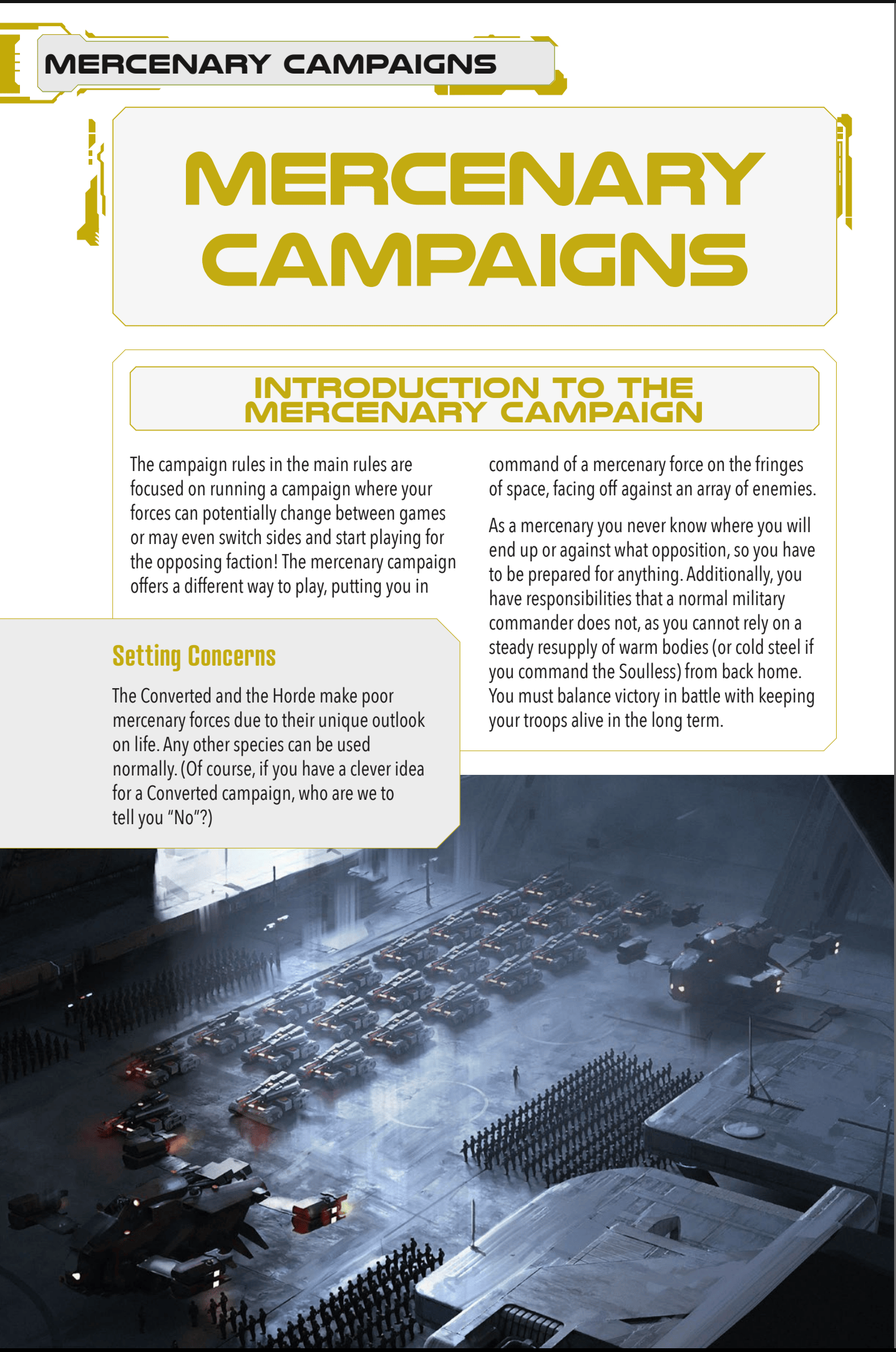
The Field Commander’s Guide also introduces a new Campaign type, the Mercenary Campaign..
[The “default” campaign in Five Parsecs From Home, as found in the Third Edition rulebook, is that of a crew moving from planet to planet and searching for a patron at each location for a job to earn money to keep moving. Bug Hunt added a new campaign type, unnamed in the book but safely assumed to be…Bug Hunt.]
In the Field Commander’s Guide, a Mercenary Campaign, “offers a different way to play, putting you in command of a mercenary force on the fringes of space” (p.58). The description goes on to warn:
As a mercenary you will never know where you will end up or against what opposition, so you have to be prepared for anything. Additionally, you have responsibilities that a normal military commander does not, as you cannot rely on a steady resupply of warm bodies (or cold steel if you command the Soulless) from back home. You must balance victory in battle with keeping your troops alive in the long term. (p. 58)
As is common in Five Parsecs From Home, a series of random generation tables give you a unit type and name. My example gave me a Company-sized unit named “Stubborn Scouts.” [Sad trombone sound]
The Mercenary Campaign is played out over the course of Campaign Turns. The rules call for the use of Evolving Objectives in a Battle scenario (see core rulebook, p. 80) and secondary objectives (core rulebook, p. 82). Battles are usually fought against random enemy forces (again, core rulebook, p. 62). Procedurally, the Mercenary Campaign is wrapped around the standard campaign system with the addition of determining, before the mission, Mercenary Support and Mercenary Preparations. After the battle is where some real interesting challenges occur; casualties must be detailed and lost/damaged equipment assessed. Munitions Points, a sort of currency, is earned and used to acquire new gear. You also have the option to Refit elements of your Mercenary force while earning experience. Most importantly, losses need be replaced, but the newcomers are green and inexperienced.
Now all that sounds great but the Mercenary Campaign is near certainly an Adventure Wargame and not an RPG campaign setting. Thus, the movement of Tactics back towards a “balanced” adventure wargame where the skirmish wargame elements are balanced against RPG is seen.
…with points and competition over adventure…
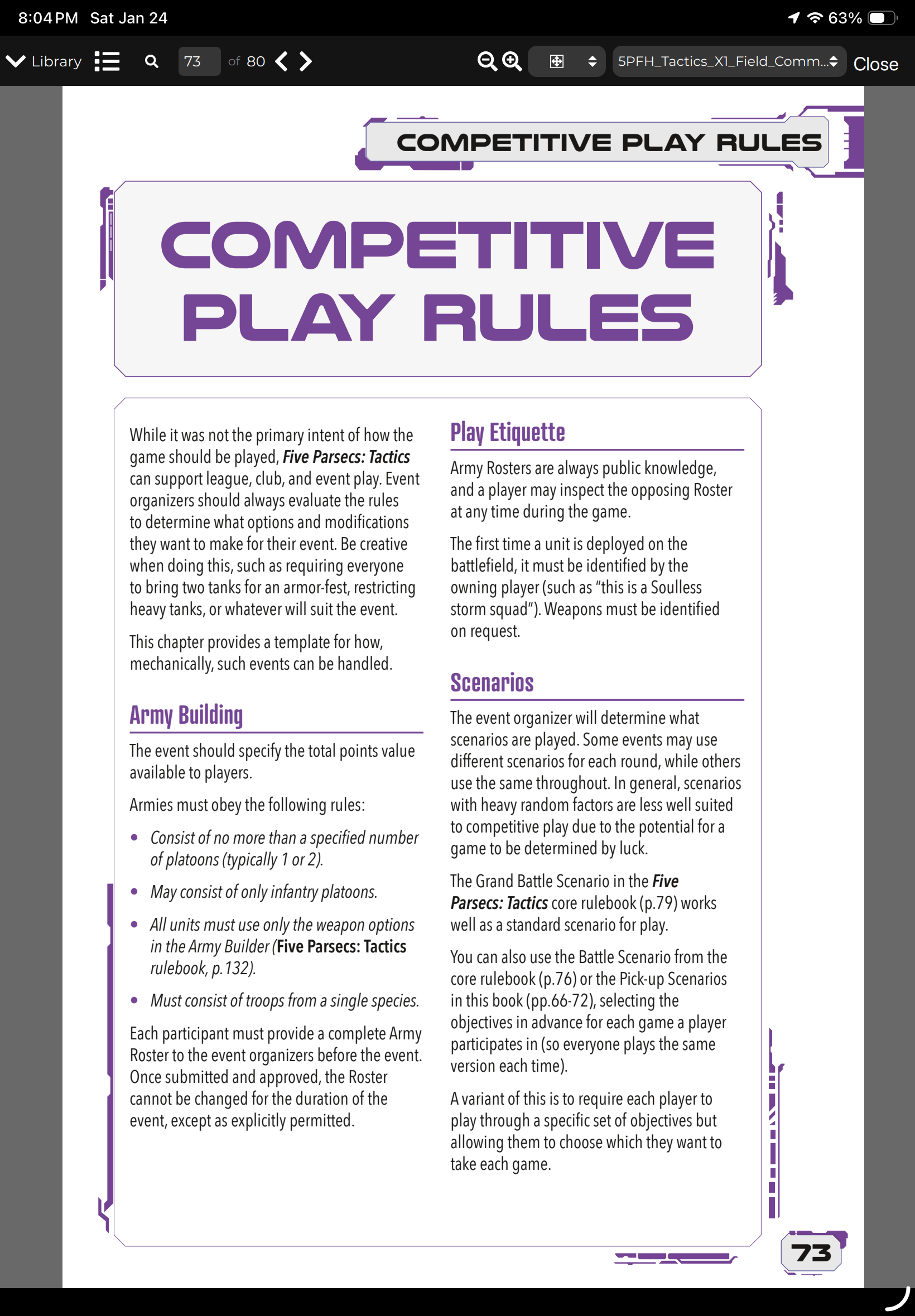
The chapter “Pick-Up Scenarios” in the Field Commander’s Guide clearly shows the pivot of Tactics away from RPG and strongly towards a more wargame-like system. Pick-Up Scenarios are just that; no campaign setting, no backstory, just put forces on the table and fight. It actually plays well with the last chapter, “Competitive Play Rules” that almost certainly will be familiar to most any Warhammer 40K fan that lives and breathes Army Building.
…all in an Adventure Wargame
As Expansion 1: Field Commander’s Guide shows, Five Parsecs From Home is both a wargame and a kinda RPG. Unlike the original Tactics supplement which took the series towards a more RPG-like game, this Field Commander’s Guide expansion brings it back towards a more skirmish-type wargame with very light RPG elements. If nothing else, the Field Commander’s Guide shows the core versatility of the Five Parsecs From Home game system which can range the gamut from a points-based, Army Building skirmish wargame to a light adventuring RPG with heavy combat elements. It all depends on what YOU want to play.
Thank you for visiting the Regiment of Strategy Gaming and riding with The Armchair Dragoons.
Rather than list a bunch of social media links, the easiest thing to do is to check out our LinkTree, which connects you to all of our various locales around the web.
You can also support The Armchair Dragoons through our Patreon, and find us at a variety of conventions and other events.
Feel free to talk back to us either in our discussion forum, or in the comments below.


Somehow the 5 Parsecs never fell into my lap as good as both Chevauchee and Knyghte, Pyke & Sworde which, if we discount the theme, delivered “the thing with the rules that matter and quick to go to the table without convolution”.
Five Parsecs and Five Leagues are both great, I argue 5Leagues does it better, but require a lot of briefing and debriefing for little reason other than “you are the GM of your own adventure”.
Maybe I’m not explaining well. Anyway, excellent write up.
There seems to be a bit of confusion here. Tactics was the book that took the adventure wargame and turned it into a skirmish game, not the other way around. FEG is thus a logical expansion to Tactics and not a reversal.
Hmm… What I am trying to communicate in the post is that FIVE PARSECS FROM HOME is an Adventure WARGAME; that is, a wargame with RPG elements. In and of itself I see the core FPFH as relatively balanced between wargame and RPG. In TACTICS, the balance shifted in favor of wargame (“as you say, “turned it into a skirmish game”). The FIELD COMMANDER’S GUIDE, in my opinion, shifts that balance ever-so-much back towards the RPG (thus my “reversal”). I can see how the Expansion can be viewed as a continuation of the shift towards wargame started in TACTICS but, taken as a whole, I feel it actually moves the game back towards the original equilibrium between wargame and RPG found in core FPFH. Regardless, I strongly recommend playing FPFH with as many—or none—of the expansions one likes!