
 by
by Paul LaFontaine, 15 February 2026
Four players participated in the fifth Print n Play game. The scenario was a historical battle fought during the Franco-Prussian War as the siege of Paris began. Seeing they were about to be surrounded, the French commanders launched an attack on the last part of the encirclement that was not closed.
Players Soldiersteve and Gareth commanded the French (Blue) forces, players AaTeWe and Sean Lambert commanded the German (Red) Forces.
All players and umpire had physical sets at their locations and the umpire reports were images using visual pointers allowing the players could keep the situation on their own maps.
This is another of a series of Kriegsspiel AARs very similar to the events in our Wargame HQ at the Origins Game Fair. You can find the original article here.
Everyone had their materials ready and the opening was a few minutes only.
AaTeWe and Sean Lambert were victorious, bottling up Soldiersteve and Gareth’s breakout attempt. It was a complicated problem to solve for the French as they were attacking a portion of the line while outnumbered with troops recently put in uniform and poorly trained.
The game was conducted on the base Print and Play map versus a historical map, with the same command problems and order of battle handed to each team. Players reported this technique was successful.
The Problem
In this problem the French force is outnumbered and the forces inexpereienced as they are recently conscripted. They must choose the right place to hit the German line. The German problem was covering a large front and understanding where the French were concentrating.
French (Blue) Briefing
Your capital lies east of the map. Altbruck has a strong redoubt that is part of a network of forts protecting the capital. The road to Eichenrode is the last road available to leave the capital – enemy armies have completely surrounded the capital. The noose is tightening as an enemy column moves into position on the Lauten, Bergenthal Kleindorft road. If they move up that road and seal off the access to the west, your capital lays completely under siege. Your mission is to buy time for the capital and relief forces that are on the way. You are to hold Altbruck, drive off one enemy division (two infantry blocks) or keep any enemy from exiting off the north edge of the map.


Starting places. You can place your artillery divisions (2 batteries each token) with any starting unit.
most images can click to enlarge
German (Red) Briefing
The enemy capital lies east off the map. Altbruck is a strong redoubt that is part of a network of forts protecting the capital. The road to Eichenrode is the enemy’s last road available to leave the capital – your armies have completely surrounded the capital. Your force is closing the noose around the enemy as your column moves into position on the Lauten, Bergenthal Kleindorft road. Once you complete your movements, the enemy capital lays completely under siege.
Your mission is to move one Division (53, 57, 64 or 67) to Weisen, secure the route through Lautern, Bergenthal and Kleirndorf and repulse any enemy who may try and prevent you from accomplishing those two missions. You deliver decisive results if you capture the redoubt at Altbruck.


Starting Positions (53, 57, Cav and Artillery in column moving).
0800
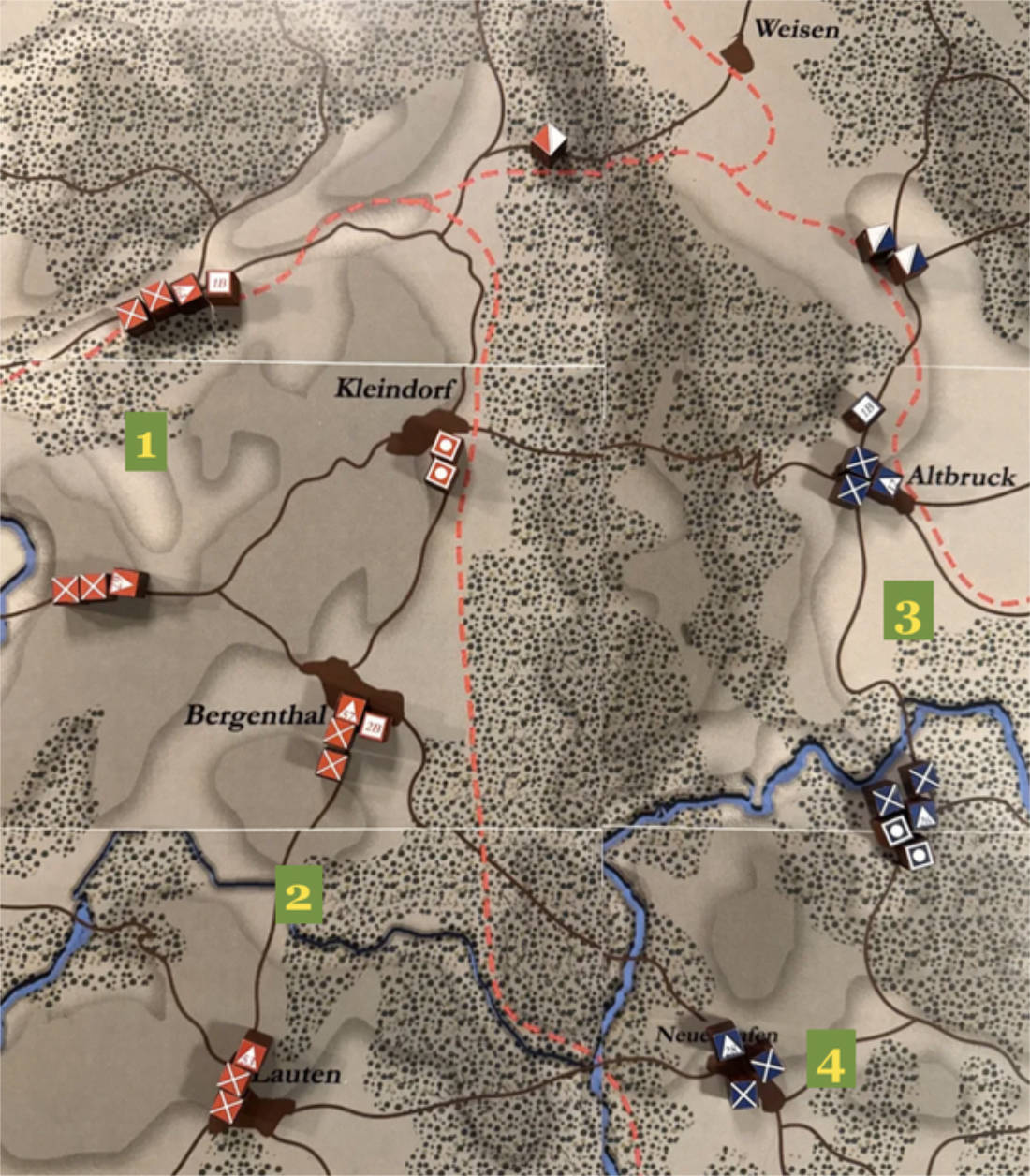
Sean Lambert (1) commands the German 64th and 66th Division (historically the Prussian V Corps), AaTeWe (2) commands the 53rd and 57th (historically the Bavarian II Corps). Gareth (3) commands the 12th and 26th French Divisions and Soldiersteve (4) the 28th. The French cavalry is moved to Soldiersteve’s control at setup.
0900
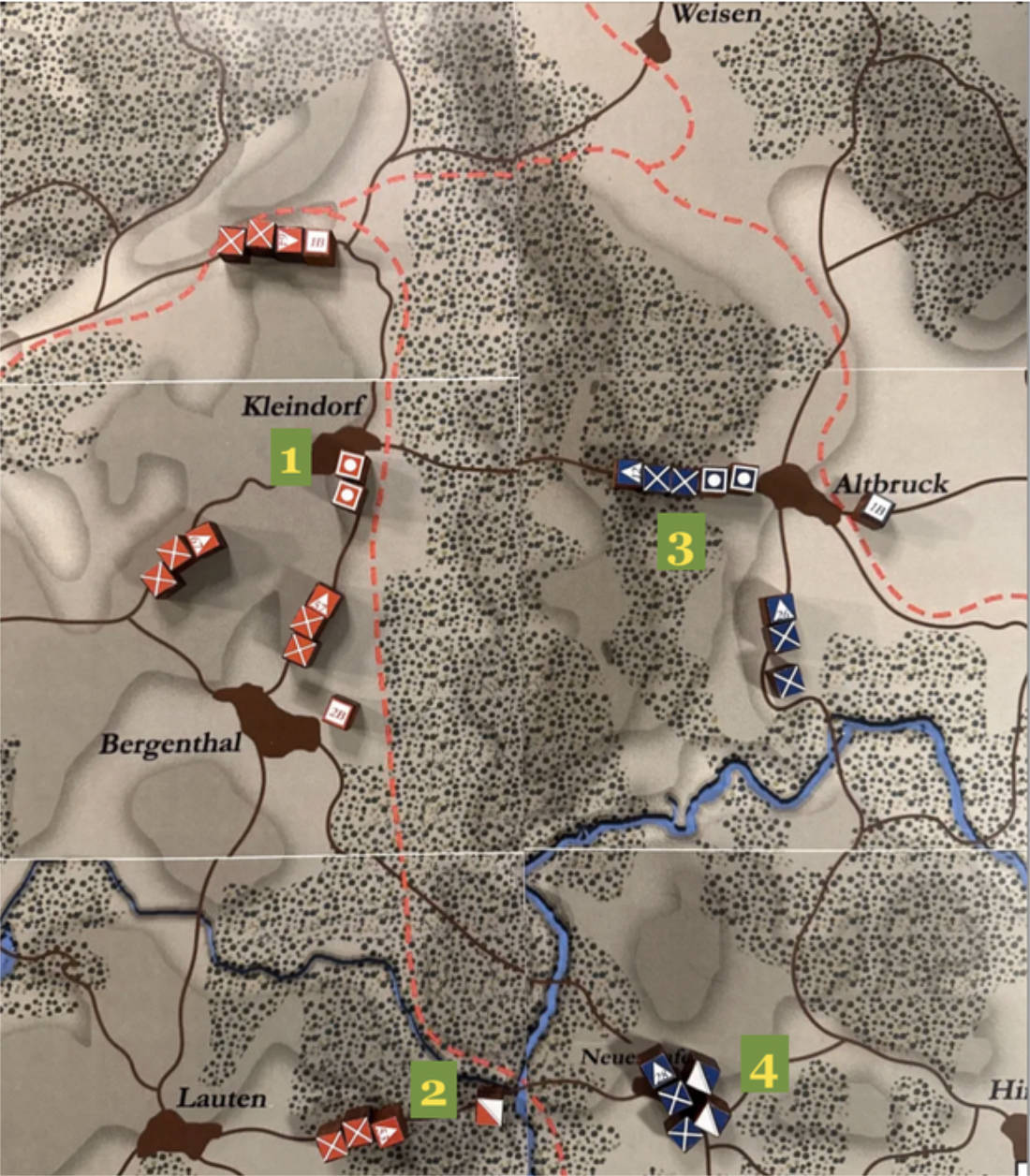
Turn 1, the German command begins concentrating three divisions and the artillery at Kleindorf (1), giving control to Sean Lambert. AaTeWe (2) moves to the river. Gareth (3) begins movement to Kliendorf. Soldiersteve (4) screens at Neuenhafen.
1100
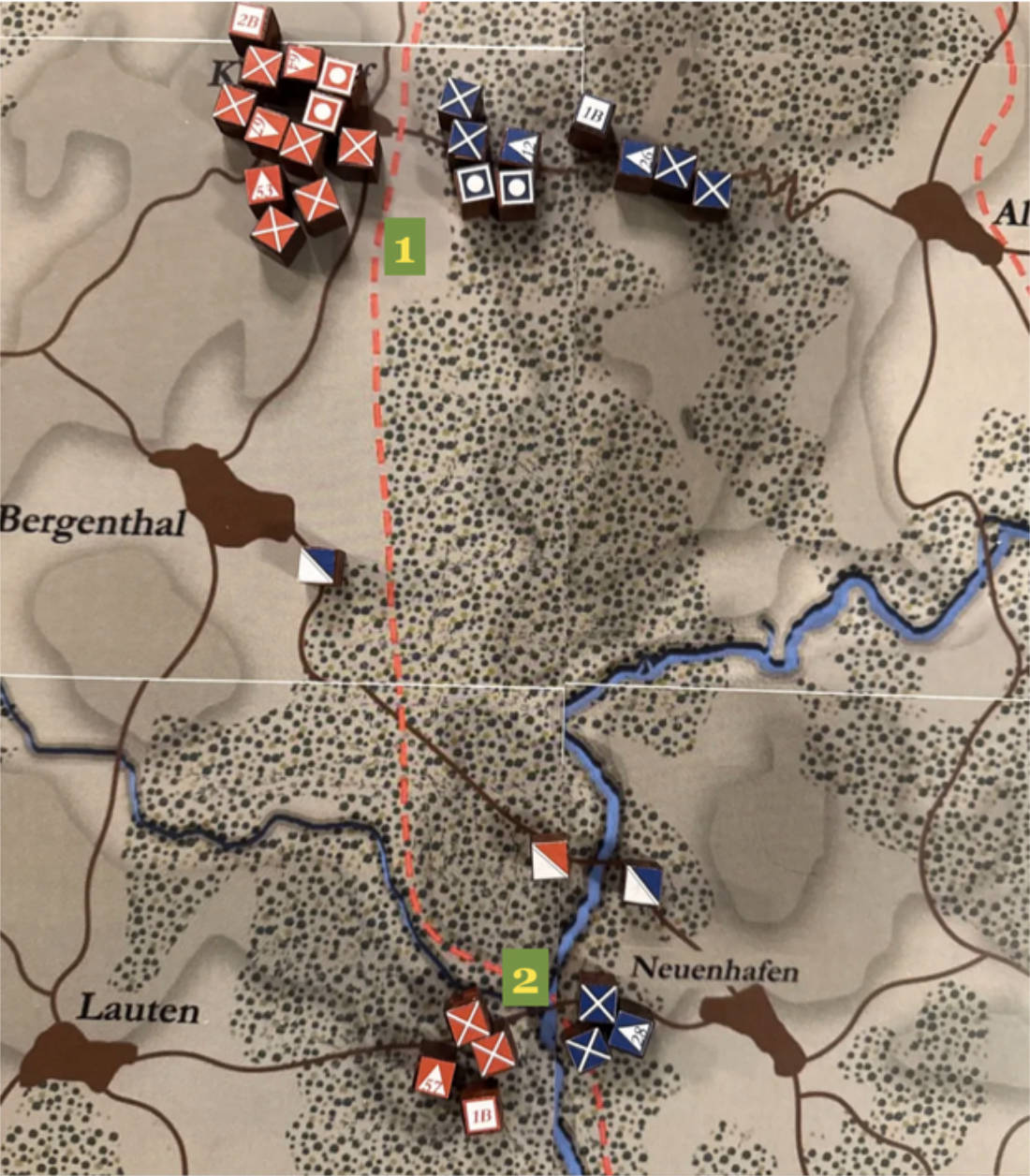
Two turns later, Gareth faces off with Sean Lambert (1) at Kleindorf. A defensive position and 2 brigades to attack 3 makes an assault impractical. Soldiersteve and AaTeWe face off over the river in the south, and skirmish with cavalry. Soldiersteve learns that Bergenthal has no enemy forces in it but there is not much he can do.
1200

While most of the forces adjust or continue to skirmish, Sean Lambert moves the 64th Division north toward his northern objective of Weisen (1). As the Germans were closing the noose around Paris, they had to reach Weisen to complete their assigned role of providing an unbroken line around the capital.
1500

Several turns later, Sean Lamber becomes cautious about getting caught in the woods (1) and being at a disadvantage. Gareth begins to move a division north (2) to Weisen. The main bodies continue to face off at Kleindorf (3) without engaging. AaTeWe and Soldiersteve get into a firefight in the south which pushed the Germans back to Neuenhafen.
1800

Sean Lambert carefully moves his division through the woods while Gareth moves the 26th Division northward (1). The main body and southern forces continue to standoff.
END OF SCENARIO

Sean Lambert launches an attack at Weisen with experienced Red troops and it beats back the inexperienced Blue soldiers. The cordon is complete, the Blue forces are forced back to hteir defending their capital and the attempt at breakout is over.
Historical Outcome
This is the Battle of Chatillion, the last attempt to forestall the Prussian siege of Paris. On 19 September, 1870. The French command knew opposing the combined German Army was hopeless, but they sent a newly formed French XIV Corps to try and disrupt the final stage of the encirclement.
Helmuth von Moltke writes in his history of the campaign: “The enemy evidently were anxious to remain masters of the important heights in front of the fortifications of Paris, and it was still early in the morning when divisions of the Fourteenth Corps (French) marched out of the neighboring wood of Meudon. Supported by a strong force of artillery, which set the farm-buildings of Petit-Bicetre on fire, they drove back the German posts ; but at Villacoublay the Fifth (Prussian) presently came up to Abbaye aux Bois to support the Second Bavarian Corps.

Moltke again: “The left flank brigade of the Bavarians had crossed the columns marching on Versailles in the valley of the Bievre ; but the sound of fighting on the field of battle induced General von Dietl to advance with his detachments, which had come up singly, on both sides of the high road to Bicetre. By charging at the same time with the Prussians, who were still fighting in the Bois de Garenne, they succeeded in repulsing the French at Pave-blanc. Meanwhile the enemy, by half-past eight, had formed a front of fifty guns, and three regiments of foot advanced to renew the attack on Petit-Bicetre and Bois de Garenne. They were received with a destructive musketry fire, and not even General Ducrot’s personal influence could persuade the troops, who were young recruits, to go forward. The Zouaves posted at the farm of Trivaux were finally thrown into such confusion by the German shell that they fled wildly back on Paris.”

Conclusion
This was a difficult problem for both sides as lack of information and broad objectives forced both decisive and careful moves. Soldiersteve mentioned in the AAR that his concern was more for letting the Red force approach the capital in the east than attacking aggressively. The Blue commanders also guessed that the Red would all start south versus being spread out. They had hoped to pin down the Red force in the south while Gareth raced and beat the opponent to Kleindorf, cutting the line
This was a test of using a different map to give the players a feel for the historical command problem. With Print and Play, each map printed costs resources. More plays per map makes the format more inviting. The players felt this was a successful use of a standard map and a historical scenario. The map was the Print and Play Base Map, the scenario and OOB were drawn from Bruce Weigle’s 1871 ruleset.
I think with repetitions we are seeing players show up with their set and the map, ready to go. This leads to very fast starts. The overview is simple, the questions answered quickly and play begins almost immediately. This is a fast, enjoyable way to play.
The 11 turns were conducted with four players at 7 minutes a turn, which is fast enough to create time pressure. As an umpire, the speed is sustainable with a precise layout of the table and pieces. In person the umpire would walk to a map and point. On Discord screens with arrows are necessary which takes the same time as the walking around.

Special thanks to Soldiersteve, AaTeWe, Gareth, Sean Lambert and celebrity guest Rebelsqurl for joining! Come next session and enjoy using your own set to play Krieggspiel.
We’ll see you out there.
If you’d like to join one of Kriegsspiels you can pop into this part of our forum for more
and you can also find out about the International Krieggspiel Society here
Thank you for visiting the Regiment of Strategy Gaming and riding with The Armchair Dragoons.
Rather than list a bunch of social media links, the easiest thing to do is to check out our LinkTree, which connects you to all of our various locales around the web.
You can also support The Armchair Dragoons through our Patreon, and find us at a variety of conventions and other events.
Feel free to talk back to us either in our discussion forum, or in the comments below.

