
 by
by RockyMountainNavy, 15 October 2025
How do you learn a new wargame? Can you do it in a week? Fortuitously, an opportunity to get By Swords & Bayonets by designer Allen Dickerson from GMT Games to my gaming table coincided with a chance to play the title at a small gaming convention, Fall Assembly, hosted by The Armchair Dragoons Regimental Commander Brant. That kicked off an urgent program to learn By Swords & Bayonets enough to play it for Fall Assembly. Looking at that process gives us a chance to look not only at the physical game but also my thoughts on learning a new wargame in a rushed week preparing for face-to-face play of By Swords & Bayonets.
Old is New
The American Civil War (ACW) is not my most favored genre of wargaming so I initially passed on a review copy of By Swords & Bayonets by designer Allen Dickerson from GMT Games that was generously offered to The Armchair Dragoons. After a second call, however, I volunteered. My change of heart to take on By Swords & Bayonets was driven in large part by the ad copy from GMT Games:
By Swords and Bayonets is a two-player, regimental level wargame and the ninth installment in the award-winning Great Battles of the American Civil War series. Its focus is on small(er)-scale battles of the ACW and will serve as an ideal introduction for players new to the series. By reducing the size of the contending forces, players can more easily learn the detailed, layered rules and subsystems of the GBACW series without fear of being overwhelmed by the size of the battles themselves. (GMT Games ad copy)
The most important phrase that jumped out of me in the ad copy for By Swords & Bayonets was “an ideal introduction for players new to the series” because, well, that described me! Elsewhere on the GMT Games page for By Swords & Bayonets they advertise, “One battle (Rappahannock Scenario) has a one-turn introductory scenario.” Not long after the game arrived at Casa d’ Rocky, tickets for games to play at The Armchair Dragoons Fall Assembly went live and a session for By Swords & Bayonets was offered. I grabbed a ticket and got to work studying the game.

4x Battles
As designer Allen Dickerson notes in the Designer’s Notes, By Swords & Bayonets is a kind of “starter pack” for new GBACW players. Units in By Swords & Bayonets are regiments/batteries with 50 soldiers or one gun per Strength Point. Ground scale is ~140 yard per hex and one turn is one hour of time. There are four battles and five scenarios included:
- Big Bethal (Virginia), 10 June 1861 – A very early battle of the American Civil War with many untested commanders and troops.
- Mill Springs (Kentucky), 19 January 1862 – A rare winter battle that kept Kentucky in the Union.
- New Bern (North Carolina), 14 March 1862 – Coastal warfare complete with gunboats.
- 2nd Rappahannock Station (Virginia), 7 November 1863 with a 2-turn introductory Historical scenario and a five-turn Afternoon scenario – Urgent twilight assault on earthworks.
As expected in a series game, By Swords & Bayonets comes with a Series Rule Book as well as a Battle Book that covers all four battles. Unlike many series wargames where it is often recommended to read the Series Rules first, here players—and especially new players—will want to read the Battle Book first as it gives a useful perspective on what to expect going forward:
The goal of this project is that, by limiting the size of the forces involved, By Swords & Bayonets can serve as a manageable introduction to the rules and mechanics of the Great Battles of the American Civil War (GBACW) game system. Players new to the system can come to grips with the layered, nuanced rules set without being overwhelmed by the sheer size of the battles themselves. Also, experienced players who seek to help newer players learn the game system will have a palette of interesting tactical situations with which to illustrate system mechanics and strategies. (Battle Book, 1.0 Introduction).
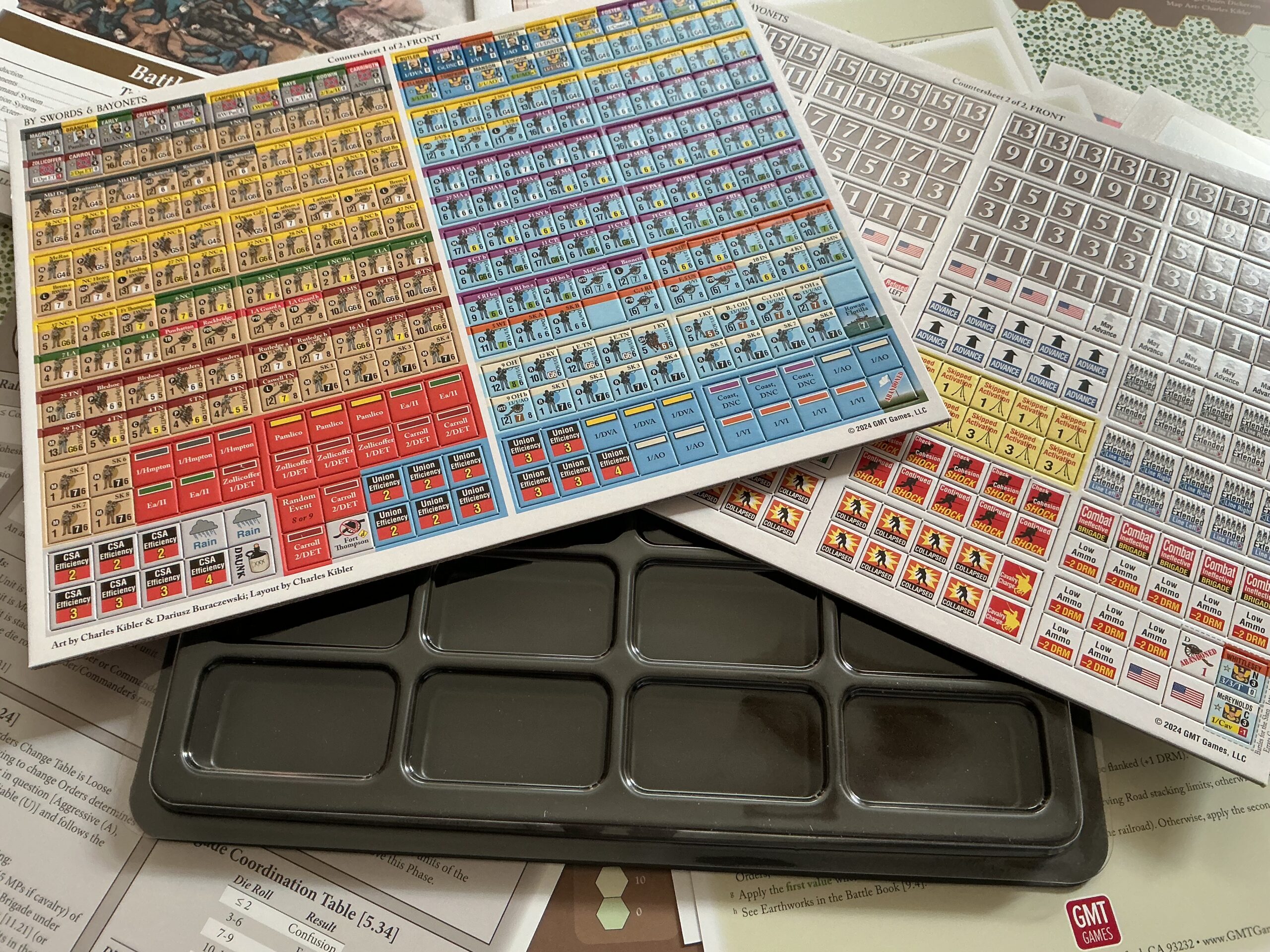
Each of the four battles in By Swords & Bayonets gets its own paper 22”x17” map which are printed double-sided on two map sheets. Each battle also gets its own unit counters and Terrain Effects Chart and 2nd Disorder Charts printed back-to-back. Each battle has a Union or Confederate Organizational Card (again, back-printed). Shared components are the Series Rule Book, the Battle Book, an Example of Play book, markers, and Player Aid Cards. Individually no battle is larger than what one likely would find in a slim magazine wargame. As an added bonus GMT Games threw in a 20-compartment counter tray to help you organize.



Learning BS&B
I started learning By Swords & Bayonets the Monday before the Fall Assembly weekend. Like I do for most any game I first laid out the components to familiarize myself with the items. I also decided that I was going to play the introductory scenario at least once before leaving for the convention.
Fortunately, I picked up the Battle Book first to read the Designer’s Notes before jumping into the Series Rules. This was a good thing since I discovered that By Swords & Bayonets does not use some of the Series Rules, in particular the Efficiency and Command Rules at the Corps Commander level (Designer’s Notes). This lead me to read the rules exceptions/modifications at the beginning of the Battle Book and the Specific Rules for the 2nd Rappahannock Station scenarios. This seemingly unorthodox start to learning By Swords & Bayonets greatly helped me as I was able to approach the Series Rules with knowledge of what sections to not get bogged down in.
Intro to 2nd Rappahannock Station
To facilitate my quick learning timeline of By Swords & Bayonets I set up the introductory 2nd Rappahannock Station Historical Scenario (24.2) so that I could refer to the physical game while reading the rules. The first thing I realized about the scenario is that it is two turns, not one as the ad copy claimed. As already mentioned, I started with the Battle Book and reading the Special and Specific Rules. I then went onto the Series Rules to really learn how to play By Swords & Bayonets.

I now understand why By Swords & Bayonets is rated by GMT Games as 7-out-of-10 for complexity. The Command System (4.0) in By Swords & Bayonets it challenging to understand even without Corps Commanders; I think I eventually figured it out it took several hot moments. [Later note – Ignore the Corps Commanders rule in By Swords & Bayonets and focus on Division and Brigade Order Changes.] Likewise, The Activation System (5.0) in the Series Rule Book is written for larger battles and multiple formations. In By Swords & Bayonets each side usually has elements of a Corps vice multiple Corps on the field of battle; the challenge is to understand how activations work for those smaller units. [nvb – Again, focus on the Division and Brigade Orders.]
This was also the point in my learning that the Examples of Play Booklet in By Swords & Bayonets became invaluable. The 32-page Examples of Play Booklet is divided into two main sections: a play-thru of the Big Bethel battle from By Swords & Bayonets and other specific examples using situations drawn from across the GBACW series. Given that the introduction scenario is 2nd Rappahannock Station the use of Big Bethel was a bit puzzling but, as we shall see in a moment, it was most helpful. The examples of play greatly enhanced my learning of the game system supporting By Swords & Bayonets.
With only two turns to play the 2nd Rappahannock Station Historical Scenario is something of a bum-rush. The Union must quickly close on the earthworks and assault the defending Confederates who are trying to hold the position. Although the scenario is short, players will gain experience using most of the basic core game mechanisms such as Orders, Move, and Combat (Artillery, Fire, and Shock).
After devoting Monday to a learning evening, my Tuesday evening first play-thru of the 2nd Rappahannock Station Historical Scenario of By Swords & Bayonets was rough. In many ways it was not a play-thru but more of an experiment as much time was taken referring to the Series Rule Book, the Battle Book, and the Examples of Play. I reset the game at least twice in the first turn to back up and start over again. The fact I restarted a few times is not necessarily an indication of confusion; this is how I usually learn a wargame with a mixture of the visual and tactile movement of chits on the map along with the cerebral processing of rules. I will say, however, that not having the Sequence of Play on any player aid required constant flipping to page 4 of the Series Rule Book was very annoying. [I ended up making my own double-sided Player Aid before I left for Fall Assembly.]

A second play-thru Wednesday evening went much, much more smoothly as I started grokking not only how individual game mechanisms work but also how they can be strung together to execute something approaching tactical play. Though pressed for time before departure I got a third run-thru on Thursday in order to build just a bit more familiarity with the rules and to work on tactics (like creating fire lanes for artillery early in an Activation to allow firing before moving infantry in for Shock attacks).

[I also vowed to find some new dice for my copy of By Swords & Bayonets since the pair in my copy seemed weighted towards rolling [0], [1], or [2] at ever opportunity.]
As I went out the door to Fall Assembly on Friday I felt comfortable that I had learned at least a basic grasp of the rules for By Swords & Bayonets and was looking forward to my game on Saturday.
Fall Assembly
The Fall Assembly event offering for By Swords & Bayonets advertised two simultaneous scenarios: Big Bethel and Rappahannock Station. Having played 2nd Rappahannock Station for learning before I travelled I looked over the scenario for Big Bethel. I also discovered that the chapter “Bethel Church” was the first entry in the “Major Blunders” section of Webb Garrison Jr.’s Strange Battles of the Civil War that sat on my bookshelf. I read the short book chapter while looking over the game map and paying particular attention to the command and control problems—which are well-reflected in the Specific Rules for the scenario.
By Swords & Bayonets was my first Saturday ticketed event starting at 10am. Although I played late Friday in a World at War ’85 Team Game hosted by designer Keith Tracton that ran from 5pm to 10pm-ish, I nonetheless arrived early Saturday morning at the VFW Post convention site early (first games kicked off at 9am) after a hearty breakfast at Another Broken Egg Cafe in Morrisville, NC in anticipation of a long day of gaming ahead. [I booked a full Saturday schedule with By Swords & Bayonets from 10am-2pm, Lock n’ Load Publishing’s Dawn’s Early Light from 2pm-4pm, and a Plague of Dracula demo/play from 6pm-10pm.]


Although I arrived a bit early I was happy to see Rich, our host for By Swords & Bayonets, already setting up the Big Bethel and Rappahannock Station scenarios. Rich was hosting By Swords & Bayonets and admitted he had played several GBACW games before but this new title only a few times; he too was still learning the game. Rich strongly recommended that I play in the Big Bethel scenario as he thought it was the better learning game of the two. As 10am rolled around we discovered that instead of four players there were just two, Alex and myself. Alex had played By Swords & Bayonets with Rich a few times (do I sense a conspiracy?) and had even played Big Bethel before. Nonetheless, we jumped in and diced off for sides with Alex taking the Union and myself the Confederates.
In the Big Bethal scenario for By Swords & Bayonets the Union command relationships are changed for the sake of game play. Historically, the Union field commander, Brigadier General Pierce, “took ill” an hour before the battle and remained off-map. As the Play Balance note in the Battle book states:, “The onus is on the Union to take the earthworks position, and they don’t really have enough troops, or a command structure sufficient for the task” (Battle Book, p. 7).

As both Alex and myself are somewhat novice players, our pace of play was, shall we say, deliberate. The Big Bethal scenario in By Swords & Bayonets is a six-turn affair and Alex and myself got through a teach from Rich and three turns in about three hours of play—the back of the box says we should of been able to play a complete scenario in about 4 hours. At the end of the allotted time for By Swords & Bayonets the Confederates (barely) held the bridge over Wythe Creek in the middle of the map but the Union was across Wythe Creek at the ford to the east. I feel that, if we played to the end, Alex likely could eject my Confederates from sufficient earthworks hexes to gain a narrow victory. That is, however, if both of us avoided sudden death from the Brigade Combat Ineffective condition at the end of a turn!


Part of the reason for our slow play of By Swords & Bayonets was unfamiliarity with the rules as we often had to pause play to check on rules questions. We also played slower because both Alex and myself took some time to translate our actions into events using the game mechanisms. I strongly feel that to get comfortable with the rules for By Swords & Bayonets it likely will take at least three and maybe as many as five good plays. Designer Allan Dickerson in the Designer’s Notes acknowledged that learning By Swords & Bayonets may be challenging so I do not feel too bad:
GBACW is, for most, a pretty “heavy game system” with 40+ pages of core rules, and Battle Books that almost always include a heaping helping of what has come to be known as “Bergian chrome”. Richard Berg loved to add special rules to each game to give it a special flavor and to indulge his love of rules writing for its own sake. (Battle Book, p. 27)
Quick learn to play
As Rich, Alex, and myself discussed in a post-game wrap-up, the rules for By Swords & Bayonets demand careful attention from players during play. Through play it became clear that as well as you learn the Series Rules the real flavor of a battle comes from the exceptions found in the Special or Specific scenario rules. All of which means that as well as you might learn the core game, there are many “one-battle” rules to be learned—and remembered— for each battle. We also discovered that in By Swords & Bayonets, more so than many other games we play, the Player Aids are your best friend when executing Actions; players must, MUST always refer to the Player Aids as there is much to learn and too much to be forgotten during play (see my previous comment on Series vs. Special vs. Specific rules). Rich, Alex, and myself know we made errors in play as we went. I have to say that as I write this section two days after the battle play I am still discovering other mistakes that we made but missed at the time.
I can see (and I think Rich and Alex would agree) that By Swords & Bayonets is a good game system that builds exciting narratives in play but demands constant attention to detail. The rules set shines well in these smaller battles but—personally—even if I build familiarity with these smaller battles I recognize that I am likely not ready for a GBACW title covering a larger battles because I almost certainly will be overwhelmed by, 1) the Special and Specific Rules and, 2) the scale and sheer volume of interactions that inevitably comes with those larger battles. On a very positive note, the smaller scenarios in By Swords & Bayonets make for good convention games; a three- or four-hour block almost certainly will be filled with good play from a game that builds a decent play narrative and looks appealing on the table.
[For example, our Battle of Big Bethal in By Swords & Bayonets developed much differently than the historical action. Alex took his Zouvres—the only Union unit not rated as ‘Green’ and complete with those fancy pants shown on the unit counter—and sent it straight into the teeth of my Confederate defense instead of swinging it to the east to cross the ford as they did historically. For my part, I set a lone gun in my forward-most earthworks hex that somehow ‘single-gunedly’ held off several Union regiments for two hours and faced a multi-regimental Shock attack before finally being captured. Importantly, at no point did the rules create dramatically unrealistic situations, i.e. gamey actions not representative of legitimate tactics.]
All of which is to say that I really enjoyed my rapid learning to playing week of By Swords & Bayonets. Designer Allen Dickerson and GMT Games delivered a great set of four smaller battles that showcase the rules for the Great Battles of the American Civil War series. In the Designer’s Notes, Dickerson stated that By Swords & Bayonets was intended to help players, “come to grips with the layered, nuanced rules set without being overwhelmed by the sheer size of the battles themselves” (Battle Book, 1.0 Introduction). With respect to that effort I must commend Allen Dickerson and the GMT Games team for their success. If you are a veteran player of the GBACW series there is almost certainly useful learning to be had from playing these smaller battles. If you are, like I was, new to By Sword & Bayonets and have no familiarity with the game system then these smaller battle scenarios are a great way to learn the game.
Author’s Player Aid Card (PDF)
Works Referenced
- Dickerson, Allen (2025) By Swords & Bayonets. GMT Games.
- Garrison Jr., Webb (2001) Strange Battles of the Civil War. Bristol Park Books.
Thank you for visiting the Regiment of Strategy Gaming and riding with The Armchair Dragoons.
Rather than list a bunch of social media links, the easiest thing to do is to check out our LinkTree, which connects you to all of our various locales around the web.
You can also support The Armchair Dragoons through our Patreon, and find us at a variety of conventions and other events.
Feel free to talk back to us either in our discussion forum, or in the comments below.


Great run down on the learning approach to this excellent game.
In addition to grokking through the manuals and playing the tutorial, I believe it helps immeasurably if you also learn from an already experienced player as a mentor/teacher. The GBACW system is really not as complex as it first appears.
Also, the “big battle games” lend themselves to team play, which makes them very approachable.
Good writeup will use this before delving into S&B. Is your play aid available for download?
it’s now attached at the end of the article