
 by
by Paul LaFontaine, 25 January 2026
Seven players participated in this Battle Decisions Kriegsspiel of a battle from the Punic Wars. Carthaginian commander Hasdrubal faces off against two Roman consuls. Anthrillianled the Romans, and was joined by his legion commanders, Arlink and FlyingVee. Rebelsqurl was Hasdrubal and had Lewis++, Infermy and Scoty were his commanders.
Four players and the umpire had physical sets at their locations, three players used Tabletop Simulator as their battle boards. The umpire reports were images with only numbers and shapes indicating scenes of the action and the players kept their own maps to develop their picture of the situation. The map use was the Battlefield Decisions Base map.
This is another of a series of Kriegsspiel AARs very similar to the events in our Wargame HQ at the Origins Game Fair. You can find the original article here.
The Roman plan was to advance the legions deliberately while holding the cavalry in reserve, allowing Anthrillian to observe how the situation developed before committing his mounted forces at a decisive moment. The Carthaginian plan, by contrast, was to conceal their cavalry and elephants while pushing forward with their main body in order to develop the situation through direct pressure. With superior numbers, the Carthaginians had the luxury of forcing contact and shaping the engagement through forward movement. The Romans, lacking that numerical advantage, were compelled to rely on timely and effective use of their cavalry to influence the battle.
Historically, the Romans employed their cavalry aggressively to drive off the Carthaginian horse and then strike the Carthaginian flank, rolling up the formation and deciding the battle. In Anthrillian’s more conservative approach, that decisive use of cavalry never materialized, allowing the Carthaginians the time and freedom to collapse the Roman flank instead. As a result, and unlike the historical outcome, the Carthaginians were able to carry the day and emerge victorious.
The Problem
The problem for the Roman force is that it is smaller, but it possesses a larger cavalry contingent. The Roman commander must use the mobility of his cavalry to maneuver the Carthaginian army into a poor position. Conversely, the Carthaginian commander’s central task is to prevent this outcome by denying freedom of maneuver and protecting against being displaced or unbalanced by Roman mounted action.
Roman (Blue) Briefing
Your force of 32,000 infantry, organized into four legions, and 2,000 cavalry formed into four detachments, faces an enemy force slightly larger than your own. The enemy has taken the field ahead of you and is using the river to the east as an anchor for their position.

click images to enlarge
Your OOB:
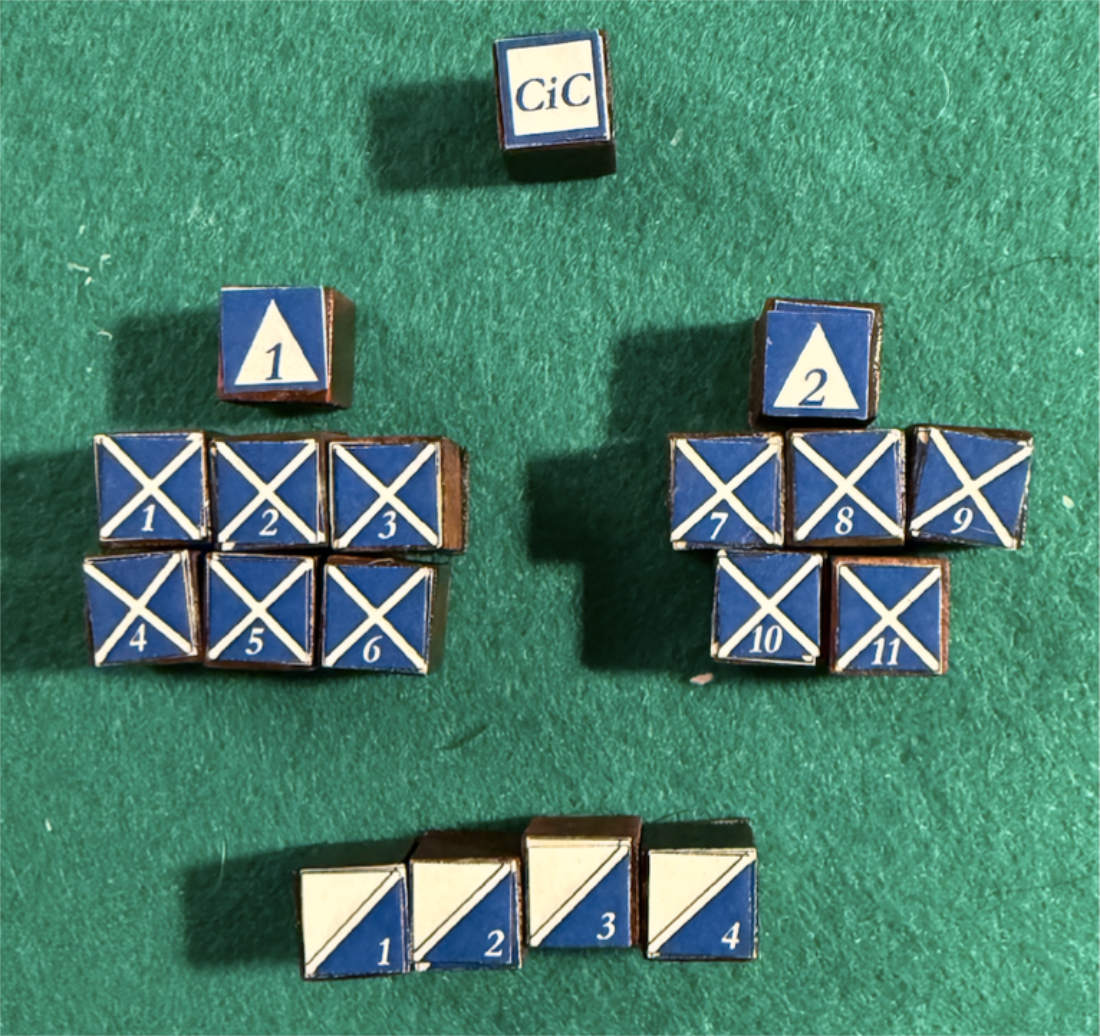
You must defeat this force in order to drive them from your homeland.
Carthaginians (Red) Briefing
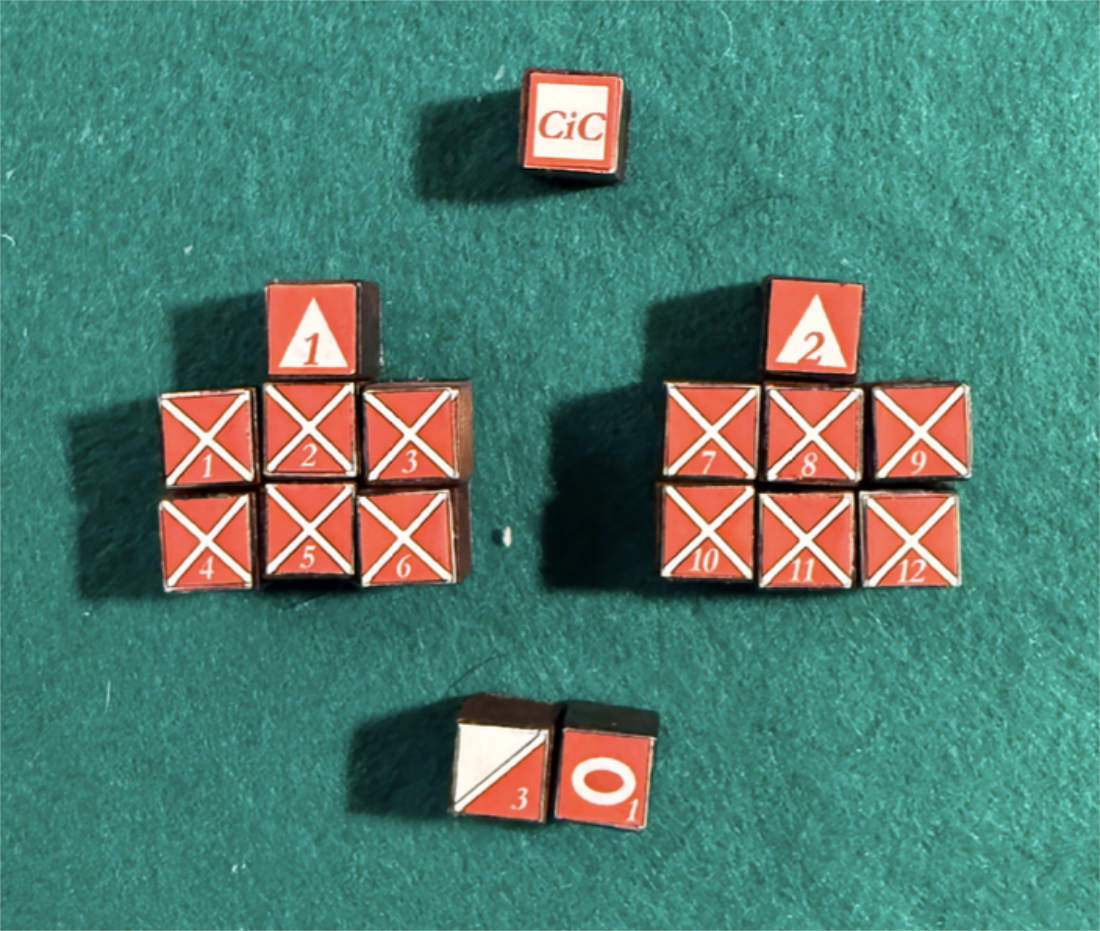
You command a force drawn from many nationalities, consisting of 36,000 infantry, a small cavalry contingent of 500 saddles, and a special grouping of 15 elephants. Having invaded enemy territory, you now face a scratch army assembled to stop your advance. This opposing force is slightly smaller than your own but possesses a larger cavalry contingent, and you must defeat it decisively and drive it from the field.
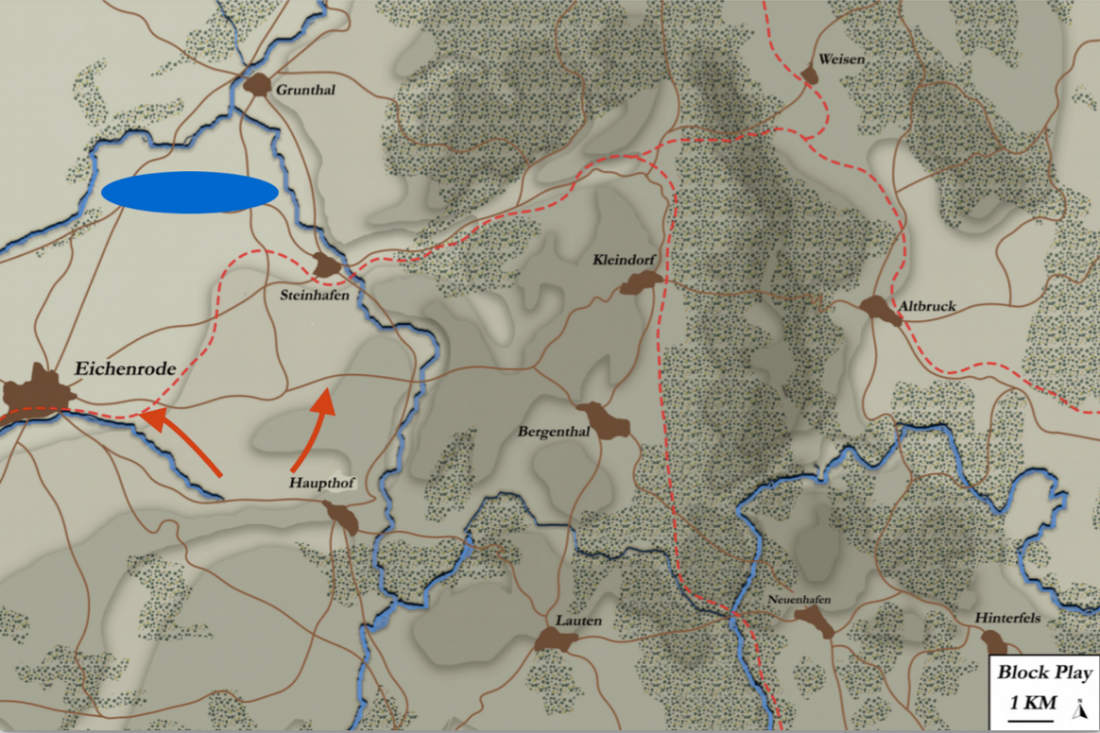
Your OOB and entry points:
Turn 1
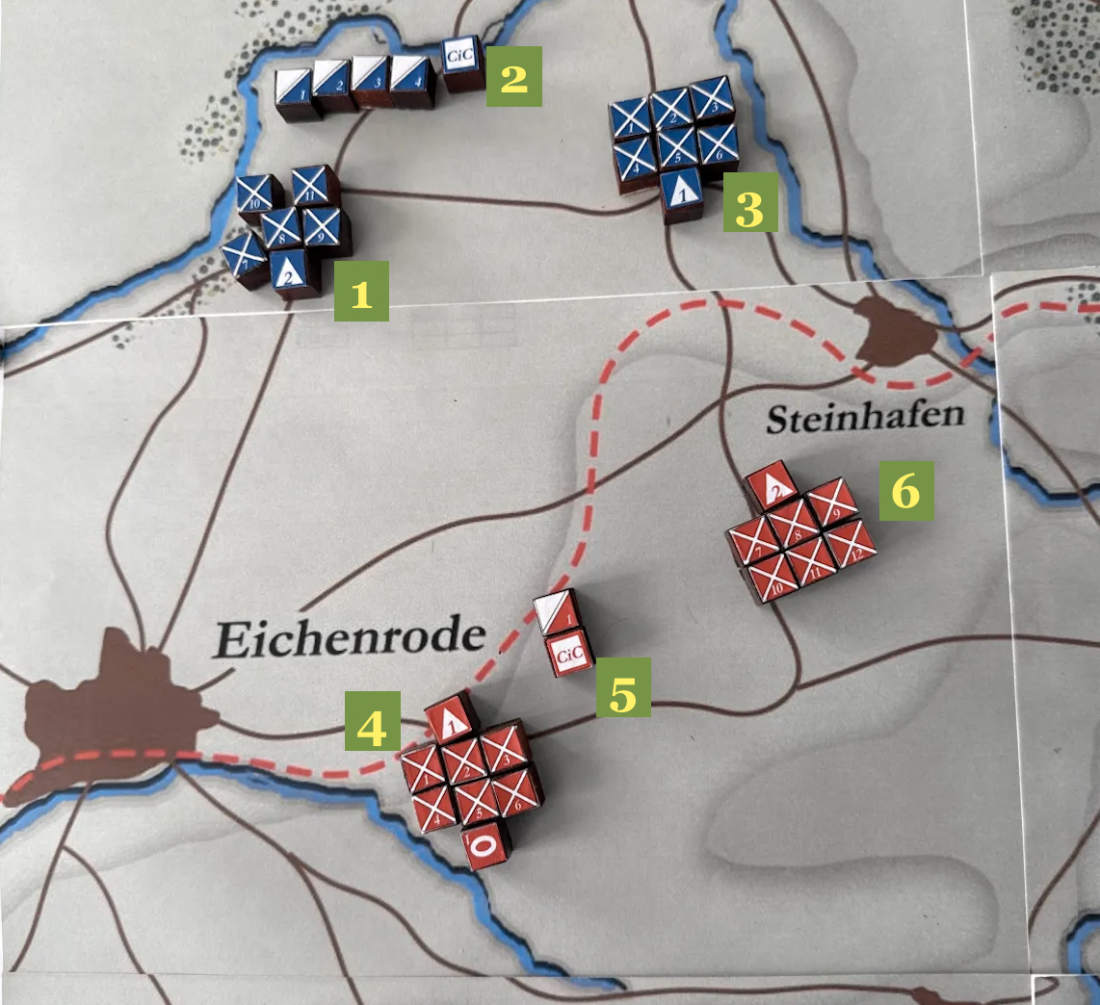
Anthrillian deployed his smaller infantry force to the west (1) under the command of FlyingVee , while his larger infantry formation took position in the east (3) under Arlink’s command, with Anthrillian retaining direct control of the 2,000 cavalry (2). On the Carthaginian side, Lewis++ was assigned the western flank (4) along with the elephants, while Rebelsqurl held the cavalry under his personal command in the center (5). In the east, Infermy and Scoty commanded a combined infantry force (6) composed largely of Gauls. With these dispositions set, both sides paused to take the measure of each other before beginning their advance.
Turn 2
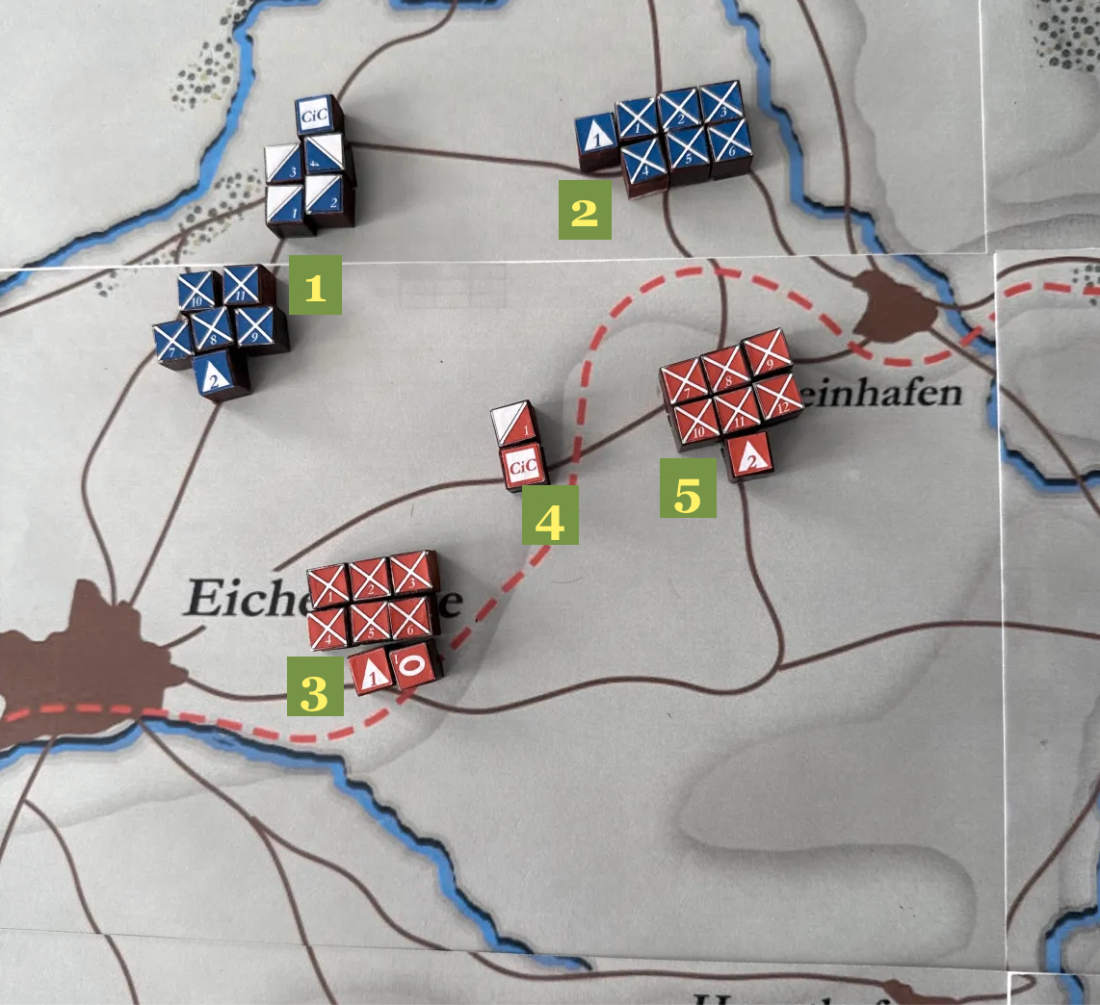
FlyingVee began advancing toward the enemy on a southwestern (1) axis, with Anthrillian and the Roman cavalry following in support. In the east, Arlink anchored his defense on the river (2) and waited for an attack to develop. Lewis++ moved forward (3) to assess the size and disposition of the enemy to his northwest, while Rebelsqurl also advanced (4) to gain a clearer view of the unfolding situation. Scoty and Infermy established defensive positions near the village (5), prepared to respond if the Roman legions attacked. Both sides adopted a generally conservative posture as the battle developed.
Turn 3
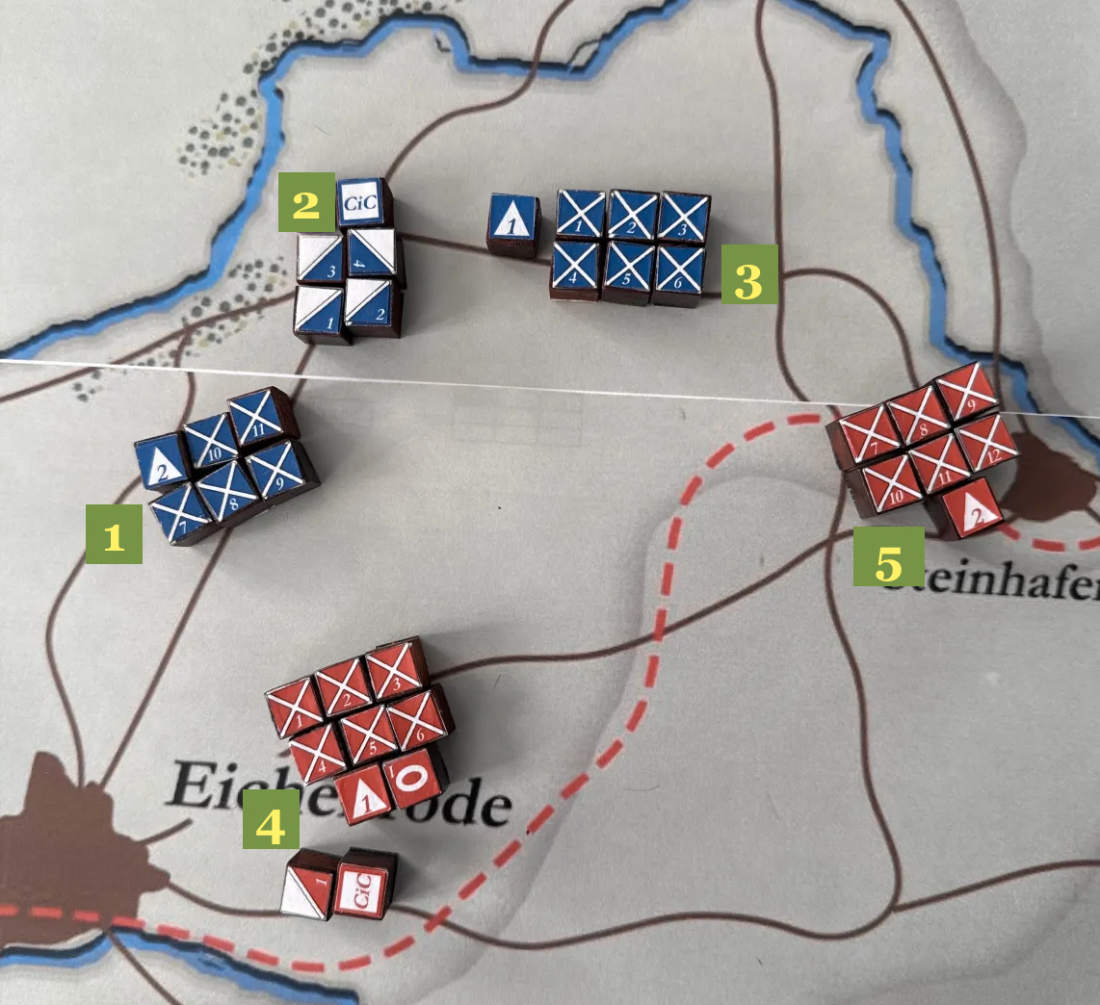
FlyingVee pushed south in battle formation (1), facing the Carthaginian forces to his southeast, while Anthrillian held the cavalry back (2) to allow the situation to develop. Arlink judged that the pressure on the right was becoming excessive and turned his formation west (3) to march toward the position of the CIC. Rebelsqurl took the Carthaginian cavalry south and then west (4), moving around toward the flank where Lewis++ was holding the elephants in reserve. The infantry under Scoty and Infermy in the east maintained their defensive posture (5). At this stage, it appeared that decisive action would develop in the west.
Turn 4

Lewis++, commanding the Carthaginian western wing, adopted a defensive formation as Rebelsqurl drove the cavalry forward to strike the enemy flank (1). At the same time, FlyingVee launched the Roman attack. The elephants were drawn up into a reserve position (2) on the eastern edge of Louis’s formation. The timing was nearly ideal for the Carthaginians, allowing them to absorb the Roman assault while simultaneously delivering a flank attack. To the north, Arlink coordinated with Anthrillian on follow-on actions (3), while in the east Infermy and Scoty began to open their formation(4) in an effort to close the gap between their position and the Carthaginian forces engaged on the western flank.
Turn 5
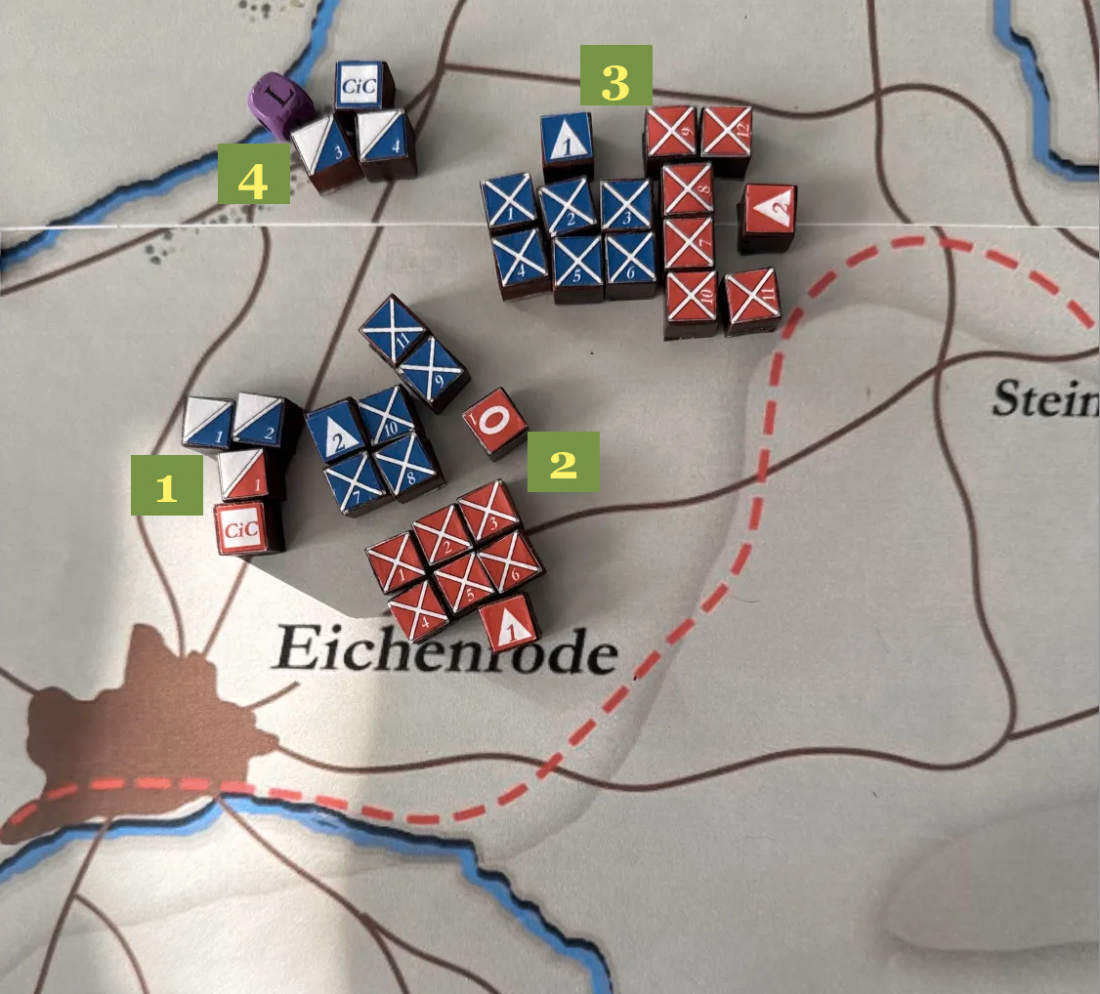
Anthrillian releases a thousand cavalry to the southwest (1) to drive off the enemy horsemen harassing FlyingVee’s flank, and Rebelsqurl, outmatched nearly two to one, is forced to withdraw. Lewis++ then commits the elephants (2), which crash into the Roman line, throwing even the disciplined legionaries into disorder and driving them back as cohesion begins to break down. As Arlink shifts south in the east, Scoty and Infermy launch a well-timed attack (3) that strikes directly into Arlink’s flank, a decisive and skillful move by the newer players that inflicts significant damage on the Roman formation. Anthrillian now faces a critical decision point with his remaining thousand cavalry(4): whether to send them south to stabilize that fight or to commit them east to counter the shattered flank.
Turn 6
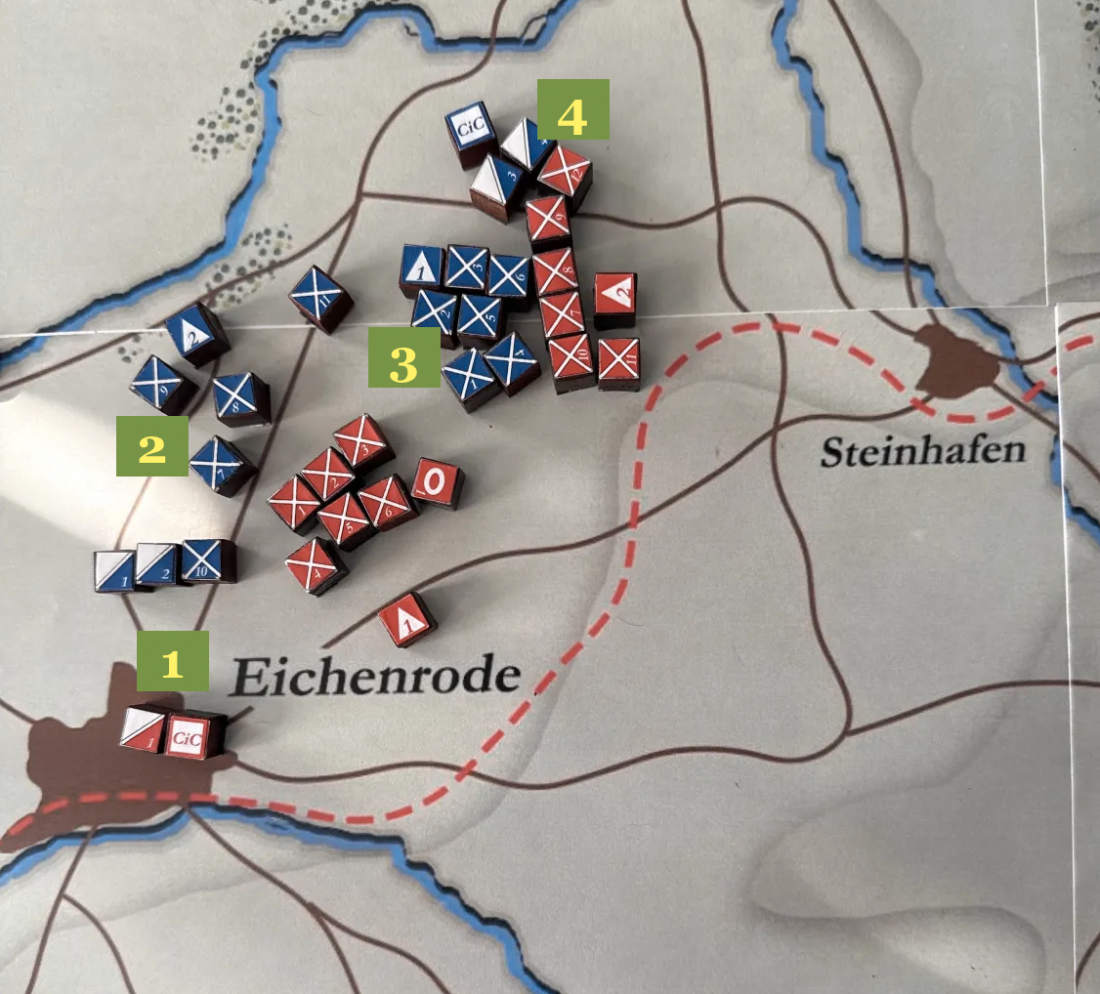
Anthrillian’s cavalry, supported by half of a Roman legion, drives off Rebelsqurl’s cavalry (1) and inflicts heavy casualties on the Carthaginian horse. Despite this success, the elephants in the east and the weight of the Carthaginian center attack overwhelm the legions under FlyingVee, forcing them to lose cohesion and withdraw to the rear (2). In the east, Arlink turns to meet the Carthaginian assault (3), and Anthrillian commits the final Roman cavalry reserve (4), which strikes the Carthaginian line and succeeds in stabilizing the situation.
END OF SCENARIO
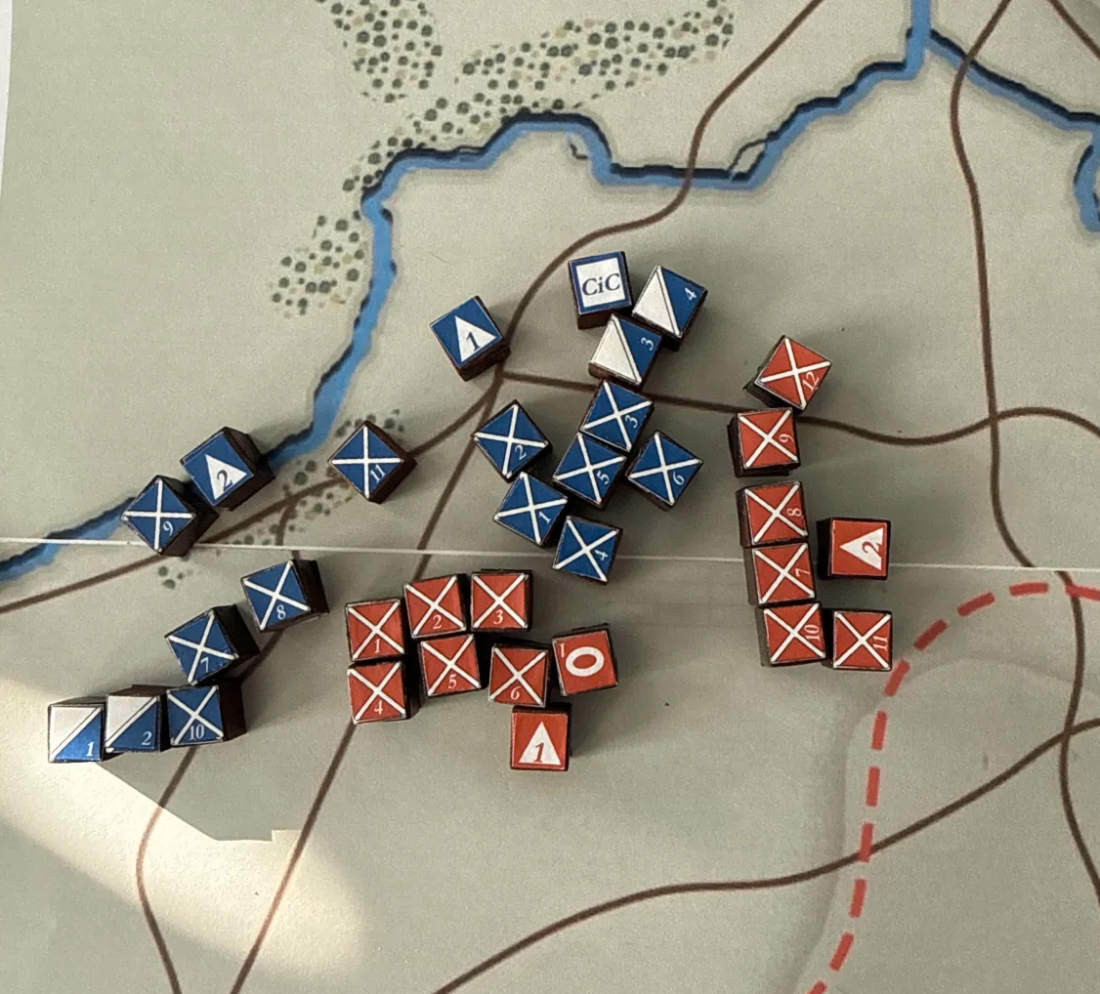
The scenario concludes with the Roman army collapsing and fleeing the field. Roman cavalry attempts to screen the retreating legions, but as is often the case in ancient warfare, the force that breaks contact is the one most roughly handled. The Carthaginians have carried the day. Hasdrubal emerges victorious and will soon be able to join his brother Hannibal as they continue to contest Roman control of Italian territory. This outcome represents a clear reversal of history, driven by a different employment of cavalry and by the successful defense conducted by Rebelsqurl, Lewis++, and the Carthaginian forces on the western flank, which shattered half of the Roman army and altered the course of events in this scenario.
Historical Campaign
The battle opened with the Roman left under Marcus Livius charging the Carthaginian right, followed by the Roman center’s advance. The outnumbered Carthaginian cavalry clashed with Roman horsemen while the Carthaginian right and center held firm. War elephants broke through Roman lines, spreading chaos and confusion across the battlefield.
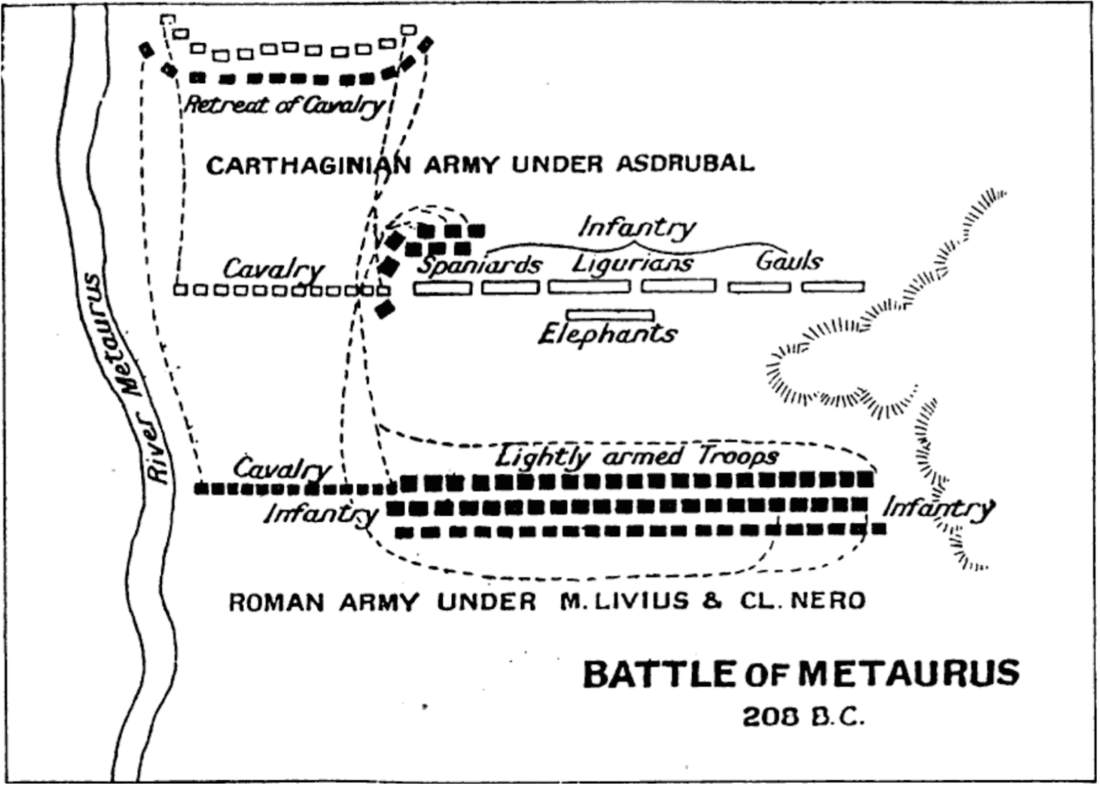
Claudius Nero on the Roman right struggled against terrain blocking his path to the Gallic forces on Hasdrubal’s left. Recognizing the futility of this approach, he took half his men and led them behind Roman lines to the far left, crashing into the Carthaginian right flank with devastating force. The Hispanic troops on Hasdrubal’s right collapsed under this two-pronged assault from Livius in front and Nero on their flank, forcing them and the Ligurians in the center to fall back. The elephants ran amok killing friend and foe alike while Hasdrubal rallied his troops wherever he appeared.
The Gauls now faced encirclement from three directions—Porcius Licinius from the front, Marcus Livius from their right, and Claudius Nero from the rear. Roman cavalry completed their rout of Carthaginian horsemen, triggering a general retreat of Hasdrubal’s army. Six elephants were killed by their own drivers to stop their rampage while the remaining four were captured.
Hasdrubal, seeing the battle lost and unwilling to be taken captive, charged into Roman ranks on horseback with his Hispanic guards and died fighting. Though praised by ancient historians for doing all he could as a general before meeting a glorious death, his loss left the surviving Ligurians and Gauls without leadership. At least 10,000 troops who escaped or never engaged formed briefly as an organized body before dispersing without a commander.
Conclusion
The central challenge of this scenario was for the Roman commander to break from the traditional historical conception of the Roman legion and employ the cavalry in a way that could unbalance the Carthaginian line. The Carthaginians held a numerical advantage and possessed both elephants and cavalry, making Roman cavalry the decisive arm. Anthrillian managed his forces well and positioned them competently, but he employed the cavalry in a largely defensive role. Without an aggressive use of its speed and striking power to create a local advantage, the Roman army lacked the means to disrupt the Carthaginian formation and alter the course of the battle.
This scenario highlighted two of the core strengths of the Kriegsspiel format. With seven players in the game, subtle but powerful differences in perspective emerged, as each commander was limited to partial information and a narrow physical viewpoint. Communication was restricted to short messages, analogous to riders carrying verbal reports between headquarters, and each player could see only the portion of the battlefield their forces occupied. When Rebelsqurl moved his cavalry to the west, for example, he completely lost visibility of events in the east. At the same time, Arling, commanding Roman forces on the eastern flank and uncertain about developments elsewhere, chose to march west to link up with the main body. These kinds of decisions arise naturally in this format and closely echo the historical reality of command under imperfect information, where leaders must balance force protection with the pursuit of broader objectives.
This scenario ran somewhat more slowly in terms of turn length for a variety of reasons, but overall the average turn time of eleven minutes remained within an acceptable range. Several participants were brand new players, and they needed time to adjust to the rapid cycle of receiving reports and issuing orders, which appropriately slowed play. The mechanics of coordinating seven players also added some friction. The initial setup took slightly longer as participants ensured their physical sets were ready and available. Even so, the group completed six turns in sixty-six minutes, maintaining the intended eleven-minute rhythm, and the core battlefield decisions were made in a way that preserved the tension and stress characteristic of a Kriegsspiel. Player feedback was positive, and the physical format, supported by Discord, appears to scale effectively to games with up to seven players.
The Kriegsspiel format was developed in the nineteenth century and came into its own in the middle of that century as the Prussian General Staff used it to train officers and model operational problems. When the format is applied to ancient warfare, there is often concern that the smaller scale, greater visibility, and more constrained maneuver of the period might make it less suitable. In practice, however, the limited information available to players about large portions of the battlefield and the necessity of making critical decisions about where to support the effort translated well to the ancient context. The same pressures of uncertainty and commitment applied, making this period just as playable as any other. We hope you take advantage of how well this format works for ancients and how enjoyable it is to play.
We’ll see you out there.
If you’d like to join one of Kriegsspiels you can pop into this part of our forum for more
and you can also find out about the International Krieggspiel Society here
Thank you for visiting the Regiment of Strategy Gaming and riding with The Armchair Dragoons.
Rather than list a bunch of social media links, the easiest thing to do is to check out our LinkTree, which connects you to all of our various locales around the web.
You can also support The Armchair Dragoons through our Patreon, and find us at a variety of conventions and other events.
Feel free to talk back to us either in our discussion forum, or in the comments below.


