
 by
by Guest Column by Sam Flintlock, 16 October 2025
“Everything is Politics”.
I’m sure you’ve heard this one, generally from people who believe they are in fact more profound than the reality. It is of course, largely a semantic argument. Everyone knows that when people use the term “politics” they don’t mean the totality of everyday life. At best, it’s like stating “we are all made of molecules”. Technically true, but not a useful analytical tool.
So the focus of this article is a bit narrower. While I’m not going to spend time trying to narrow down a strict definition, I’m going to look at games that I would see as having political settings or political aims or, in most cases both.
Why do this? Largely, because I think it’s interesting. We’ve always had political games and yet they’ve gone mostly overlooked as a genre, at best being lumped in with wargames. And while there’s a way in which I think that makes sense, political simulations being a simulation of conflict, it feels time we recognised them in their own right and discussed them on their own merits. This article, hopefully, can at least scratch the surface of what is interesting about them.
A question that always arises when discussing political games is that of whether they have an agenda.
And some games are very overt about exactly that. The excellent Bloc by Bloc is unapologetically revolutionary in its outlook, with the players working in a semi coop fashion as revolutionary factions trying to liberate the city against the common enemy that is the police. (It’s distributed by the venerable anarchist publishers AK Press). It’s also a very good game and manages to avoid being polemical. Impressively, it both manages to be serious about its political outlook without taking itself entirely seriously. It works better as a board game than a piece of propaganda to recruit people to anarchism.
 That’s probably for the best, as anyone who’s played Class Struggle can tell you. A roll and move game, Class Struggle is a serious attempt by a university professor to make a board game to teach people Marxism. Sadly, it’s less fun than attending a 9 am lecture by a Marxist University professor with almost no real strategic decisions Even more fringe we have Trot Wars from the Proletarian Democracy Education Committee. Made by a bunch of jaded lefties, it’s a penetrating satire of Trotskyist organising practices with a target audience of maybe 12 people, all of whom will find it hilarious.
 Games with a right wing agenda are perhaps rarer. Phil Eklund is well known for his rather eccentric libertarian politics and his extensive rambling essays justifying them in his games. (I’m not sure if objectivism and rambling essays automatically go together, but that’s certainly the way to bet). For a lesser known example, Middle East Smackdown is perhaps one of the most clear cut examples. In it, the US is at war with Iran and Syria and should automatically win due to its military supremacy but they can win by manipulating the liberal media and the Democrats to cut funding and undermine the war effort. It’s not bad mechanically, but much like Class Struggle from the other end of the polemical spectrum it lays its politics on with a sledgehammer rather than a trowel.
It would seem that games with political agendas can still be fun regardless where you fall politically, but polemical games are harder to get right and risk feeling like being shouted at by a drunk man.
 What is of interest however is what games get considered political and what don’t. Labyrinth: War on Terror is a fantastic game; one of the best that GMT have produced. It also sometimes gets portrayed by some of its fans as apolitical or objective. This is in a game not only based on the War on Terror, but one that takes US military objectives as largely justified. Bad governance falls to the even worse “Islamist Rule”. Good governance makes it more likely a country will become an ally to the US and less likely that they will spawn Islamist plots. While incidents like Abu Ghraib are acknowledged, they are mainly seen as a public relations disaster for the US rather than judged morally. To be fair, the designer Volko Ruhnke makes no bones about the game having an ideological slant:
“Good governance” is one such Western term of art used in the game. It includes not only efficiency but also accountability–that is, some form of representative government. Such government is far from the idea of the caliphate espoused by al-Qaeda.
As you note, the jihadists would not be using the term “Good” for such a government, so in using the Western term “good governance” and the term “good” to mean effective and accountable (as opposed to deriving its power from God in the eyes of extremist Salafi jihadists), the game is using non-neutral terminology, I acknowledge.
For what it’s worth, I also acknowledge that, personally, I am not a neutral in the stuggle between the West and violent Islamist extremism.“
Notably, this response comes from a review where fans of the game were being highly critical of someone for daring to suggest the game was inaccurate in its simulation of the War on Terror. Perhaps its unfair to observe that discussions of wargames as simulations of conflict don’t normally draw quite so much ire. It’s hard not to conclude that the controversy here is about the implied critique of American foreign policy.
Especially when we compare it to the reaction in some quarters to War on Terror the Boardgame. Ooo, was there controversy. So much controversy. Way more than you get in games where you, say play the Nazis. An interesting one this. It can’t be the cynical or satirical way the game treats its subject matter. We’ve seen that before.


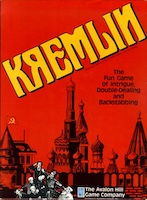
There wasn’t similar outrage with Junta (which satirises death squads in Latin American countries) or Kremlin (which satirises 60s and 70s Cold War Russia and has you “purge” your opponents and send them to labour in the Siberian salt mines). And the fact that both are set in the Cold War era is likely key here. It’s not just that they’re safely historical. They satirise regimes that are safely distant and even antagonistic to Western foreign policy. It does seem at least probable that’s the red line for some of War on Terror’s critics. Making fun of things is one thing, but LEAVE GEORGE BUSH alone. I’m not accusing those who would do this of hypocrisy, but only because that would imply a level of self awareness I don’t believe they have. They do this because they have the critical faculties of a baked bean.
The question of how to tackle controversial issues isn’t confined to political games, although perhaps its one of the board game genres where the subject is more fraught. Generally, there are two ways you can go.
 You can drop the controversial parts and change them to something else. Perhaps the best known of this design technique is the Eurogame Puerto Rico a game about colonialism in an area with slavery, which chooses to have “colonists” who are brown coloured disks that work plantations for free but definitely aren’t slaves. Honestly, I am not a fan of this approach. If you’re going to have a historical setting, have a historical setting. Don’t pretend the bad bits weren’t there and certainly don’t insult my intelligence by pretending that plantation workers are all colonists. We should accept that many Eurogamers don’t care about theme (at least mostly, there’s a fair few that will claim that and then also complain about the over-saturation of zombies. A complaint I share, but it’s not a mechanical complaint). The best solution might be to just stick to “safe” non historical and not political themes. Probably building cathedrals for a frowny king, because that one never fails to get the Eurogamer heart pumping apparently.
This isn’t to be clear, a call for banning of those games. I own a game where you’re one of the Columbine school shooters (don’t bother seeking it out, it’s shit) so my offence level is pretty high. But I am in favour of taking games seriously and taking games seriously means that criticism and even mockery is part of that process.
 For me, a game that tackles controversial subjects much more convincingly is Founding Fathers (the Rick Heli game, not the Jolly Roger game of the same name). When it comes to its flavour text for statesmen, it takes a dryly cynical “warts and all” approach to their historical record, which as a bitter and hate filled individual appeals to what remains of my shrivelled up soul. But what really works for me is that it just presents historical issues like slavery and even the legalisation of lynching as is, with a bit about the historical background and the mechanical effects. It avoids editorialising those issues entirely. Somehow, that works far better as a way of exploring the reality of history or at least has for every group I’ve played it with. It’s impossible to oppress the American Indians or refuse to abolish slavery without being aware of what you’re doing in terms of the game’s narrative. Several players report back that it makes them feel “dirty” when they do something like this for tactical advantage. And by bravely not giving significant mechanical rewards for abolishing slavery the game forces players to confront whether they want to play tactically as a moral decision, rather than solely a game one. I can honestly say it’s stirred more serious conversations than any other game I’ve played.
These are just some of the questions and issues that political boardgames raise. And I’m sure that there are bits here a reader will disagree vehemently with. (Please spellcheck your death threats and condemnations properly). And that is part of why I love the genre so much. They give us the framework for these important disagreements and discussions to arise through their very nature. They’re perhaps the least ‘safe’ gaming option outside of certain LARPs. (There was a Nordic LARP where they decided to tackle the issue of torture by waterboarding each other. Jesus.) It’s not that they’re not fun; if you like negotiation and backstabbing you’ll frequently find some of the best of those elements in this design space. You can play them just for fun and it works. But they allow you to take the games more or less seriously than that as you wish.
Thank you for visiting the Regiment of Strategy Gaming and riding with The Armchair Dragoons.
Rather than list a bunch of social media links, the easiest thing to do is to check out our LinkTree, which connects you to all of our various locales around the web.
You can also support The Armchair Dragoons through our Patreon, and find us at a variety of conventions and other events.
Feel free to talk back to us either in our discussion forum, or in the comments below.


“Bias” may be a better framing than “agenda” when scrutinizing political and historical games. Bias can present itself overtly in polemical games or more subtly through mechanisms. Everything from player roles, which factions matter, victory conditions, what events/people are represented on pieces or cards can speak to these biases.
Thanks for the feedback. I think it’s fair criticism that I’ve overly conflated “bias” and “agenda”. I think the article contains examples of both. The designers of Puerto Rico I think would fairly object to having it suggested that they were following a conscious agenda in design; I certainly am not accusing them of deliberately aiming to make a pro slavery game! But at the other end, I think the designers of Bloc by Bloc might take similar issue with it being implied that the political messaging of that game isn’t an integral part of the full package. I’m not sure “bias” quite covers it in those cases.
I greatly enjoyed your article! I have played a few political games but they never seem very popular in my groups. I’m not as well versed in the nuance, so this is a legitimate question. Where does Twilight Struggle fit in? Many boardgames are probably more familiar with TS than other games presented here. And finally, do you have a copy of “Up against the wall, MF”?