
 by
by Jame Sterrett, 23 January 2026
In 2025, GMT republished Vance von Borries’ East Front Series [EFS] game Barbarossa: Army Group North [BAGN] after 24 years. Weighing in at almost 5 pounds, including 4 full sized maps, 1 half sized map, 7 scenario maps, 1,400 counters, a small library’s worth of setup and play aids, and a quarter century’s worth of rethinking and improving the game system, is BAGN destined to conquer your table, or to be a doorstop?
GMT rates BAGN as a 7 out of 9 complexity; the rules run for 60 pages, and then the Play Book serves up another 15 pages of rules before you get to the 9 scenarios themselves, some of which also require the further 10 pages of naval rules. The system is shot through with special case rules such as 10.44(a) points 3 and 4, which restrict the Axis’ use of motorways during non-dry weather to only motorized, supply, and artillery units. An in-line Designer’s Note explains that German policy did this to keep these roads clear for vehicle traffic. The note neatly explains reason for the rule, and the combination highlights the “detailed simulation” philosophy of von Borries’ design.
If you are looking for a light and simple game, turn away now. If you want a detailed simulation of the challenges both sides faced in 1941, BAGN will deliver.

click images to enlarge
Learning BAGN initially looks daunting, not least due to the number of special rules. In particular, my opponent and I were initially thrown by calculating road movements costs, which depend on how a unit will leave the hex it is entering. This ensures that units don’t get a free ride over difficult terrain by entering by road and then exiting without using a road. Paying the movement cost for the exit route solves this loophole!
However, until you get used to it, the process for calculating movement costs on routes can feel weirdly recursive as you count the cost to enter on a road, then update that cost if you depart from the road. Until you get your head around this and other special cases, the system seems unwieldy.

Fortunately, BAGN comes with an excellent bite-sized introductory scenario; the entire scenario setup and map fits on a single 8.5×11 page. My opponent and I spent 3 hours setting up and playing the introductory scenario; then we spent another 6 hours setting up and playing the 5-turn, one-map scenario for the first 10 days of Operation Barbarossa in Army Group North’s sector.
The introductory scenario helped us understand the system, and even though the campaign opener scenario has far more units and terrain, after the first turn or so of it, we were sailing through the system with ease.

The full campaign scenario needs 4.5 maps. They are organized link to the other EFS games, and thus they aren’t arranged in a rectangle. You’ll need a quite sizeable table to fit them: the full map arrangement for BAGN takes up nearly 5 x 6 feet. Fortunately, BAGN also has half a dozen small scenarios with their own much smaller maps.
These small scenarios showcase excellent design: each one presents a nasty problem for both sides, and our initial reaction to them was often “how am I supposed to win this?” for both sides. Lacking the table space for the full campaign doesn’t mean you won’t be able to get a lot of Barbarossa gaming from BAGN.

Also helping you through all this are the plethora of play aids.
For 4-page folding cards, you get:
- 2 Expanded Sequence of Play cards
- 2 terrain and combat cards
- 1 unit, supply, and movement phase reference card
- 1 card of miscellaneous other issues such as victory points, replacement rates, and railroad conversion rates
At the merely single-page size you also get:
- a reference on super-heavy artillery firing against fortifications
- the naval charts and tables
- one page for each side to track air unit status and unit rebuilding
- a two-sided Turn Record Track for the 95 turns
Initially it’s a lot to juggle. However, each of these is also very well thought out.
The Expanded Sequence of Play is 4 pages long because it spells out exactly what can happen in each step.
The 2 terrain and combat cards contain the movement and combat tables you’ll commonly use, and run to 4 pages because each chart or table includes a summary of the relevant rules and procedures.
The Turn Record Track would fit on one side of a page, except each turn box is packed with notes about the historical and probable weather, scenario start and end dates, and the timing of various critical special rules.
It’s a lot, but it’s very well thought out and extremely helpful in play. Somewhere in the first play session we shifted from “Oh no, so many charts!” to “Cool! Almost everything we need is in the charts!”

BAGN also does an excellent job of representing Barbarossa. Simpler systems often overlook the myriad challenges the Axis forces had to overcome in the campaign, presenting a cakewalk mysteriously ended by mud, snow, and Siberians.
In reality, Barbarossa was the hardest campaign the Wehrmacht had yet fought, costing them more losses per thousand per day than any prior campaign (and the close runner-up was the invasion of Poland). Even in the “easy” opening weeks of Barbarossa, dogged Soviet resistance compounded logistics problems and caused German commanders significant trouble. BAGN represents both sides’ challenges well.
The German forces need to move fast and hard. In the early going, they can probably win any battle they choose to fight; but even the poor quality early Soviet units can disrupt their plans, the supply of ammunition and fuel to fight effectively keeps getting thinner and thinner, and even though the loss ratio is massively in their favor, the Germans can’t afford the casualty rate the Soviets inflict.
It’s no comfort to them that the Soviet forces are generally going to get better, the supply lines will get longer, and weather will start to slow your movements as well. BAGN is no easier for the Soviets, trying to hold together coherent resistance despite stupendous losses against a more agile foe.

The asymmetric Sequence of Play also plays a role. The Germans start with a movement phase for all units, then conduct combat, then a second movement phase in which only motorized and cavalry units get to use half their movement points. Thus the Germans can concentrate all their forces for combat, and then the mechanized units can conduct some exploitation.
The Soviets begin with a movement phase in which motorized units move at full, cavalry moves at half, and some leg units can be enabled to move at full if there is a Soviet HQ nearby. Then the Soviets conduct combat, followed by a movement phase for all their units, though motorized units move at half. As a result, the Soviets have a harder time concentrating their non-motorized forces for combat, constantly putting their forces behind the OODA loop in the game and elegantly making their forces less agile than the German forces.
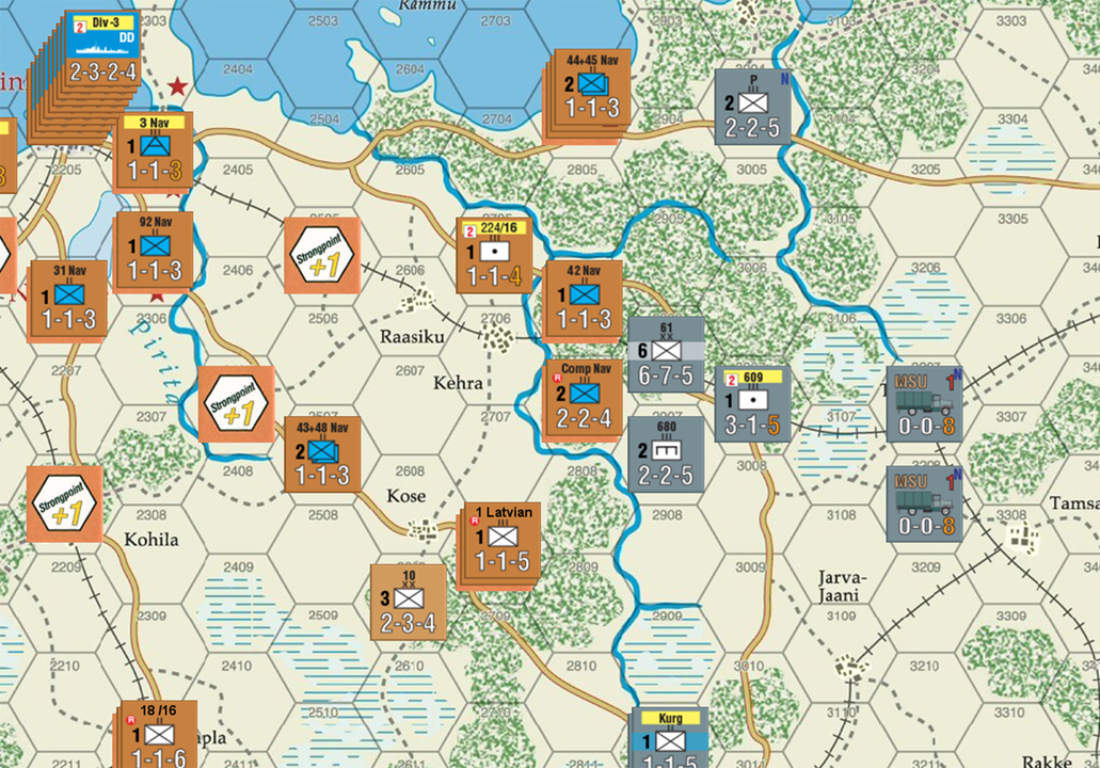
Combat normally proves straightforward. Building an example from the Siege of Tallinn scenario (using screenshots from VASSAL for clarity), the Germans want to punch through the fortified Soviet 42nd Naval Battalion to gain access to the bridge just west of the 42nd.
61st Infantry will attack.
All the units involved in a given attack must be supplied by spending a supply point (or suffer various penalties including a +2 modifier on the die roll), which will be provided by one of the Mobile Supply Unit [MSU] counters.
61st Infantry will be supported by the 609th Artillery Regiment. Each artillery unit firing in offensive support requires a supply point, to be provided by the second MSU.
The Soviet defenders call on the 224/16 Artillery Regiment for support, which will require the expenditure of a supply point if Limited Artillery Supply conditions are in effect and they roll badly on a chart.
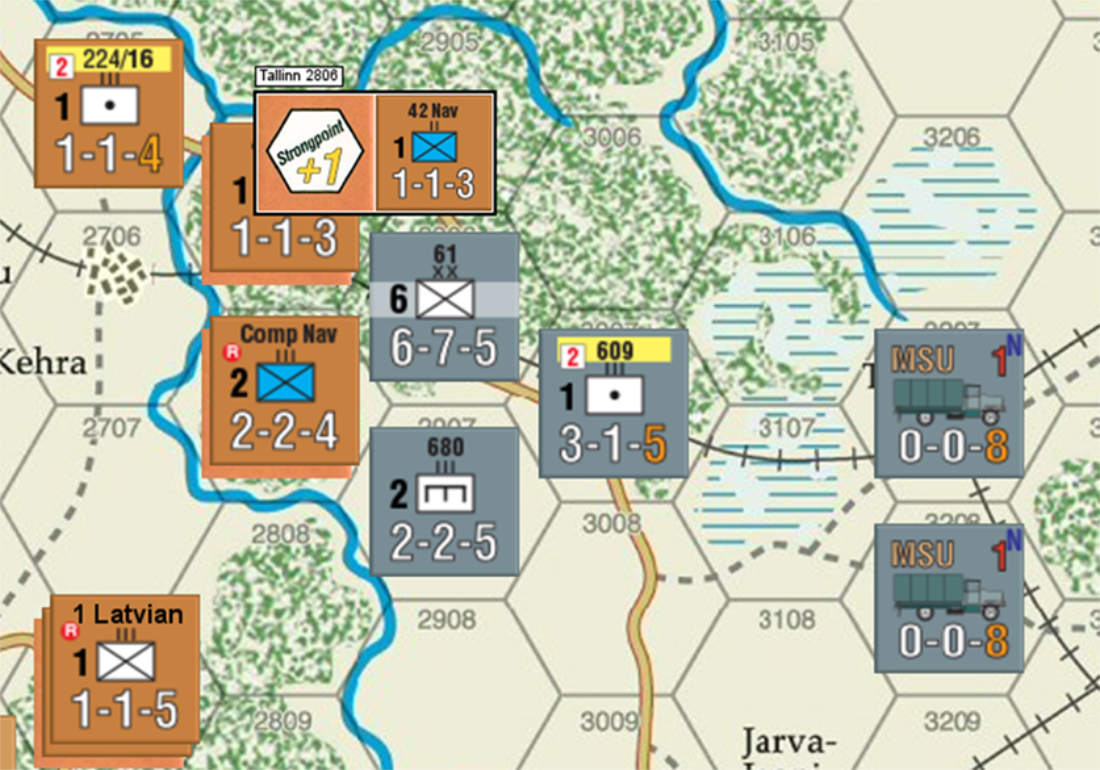
The defenders are in the Woods, which we were surprised to find has no combat effect.
Adding the artillery strengths to their respective supported units, the Germans have 9 to the Soviets’ 2, for a 4:1, where a roll of 8 would yield a 2-hex Retreat result for the Soviets.
However, the Soviet Strongpoint puts a +1 on the die to a 9: a 2-hex retreat for the Soviets still, but a step loss for the Germans.
The asterisk inflicts an extra step loss on the attacker if certain conditions are met, such as not having Attack Supply, or, as here, the attack is against a fortification, so this attack would cost the Germans 2 of the division’s 3 steps, a successful attack in terms of terrain but a costly one in terms of forces.
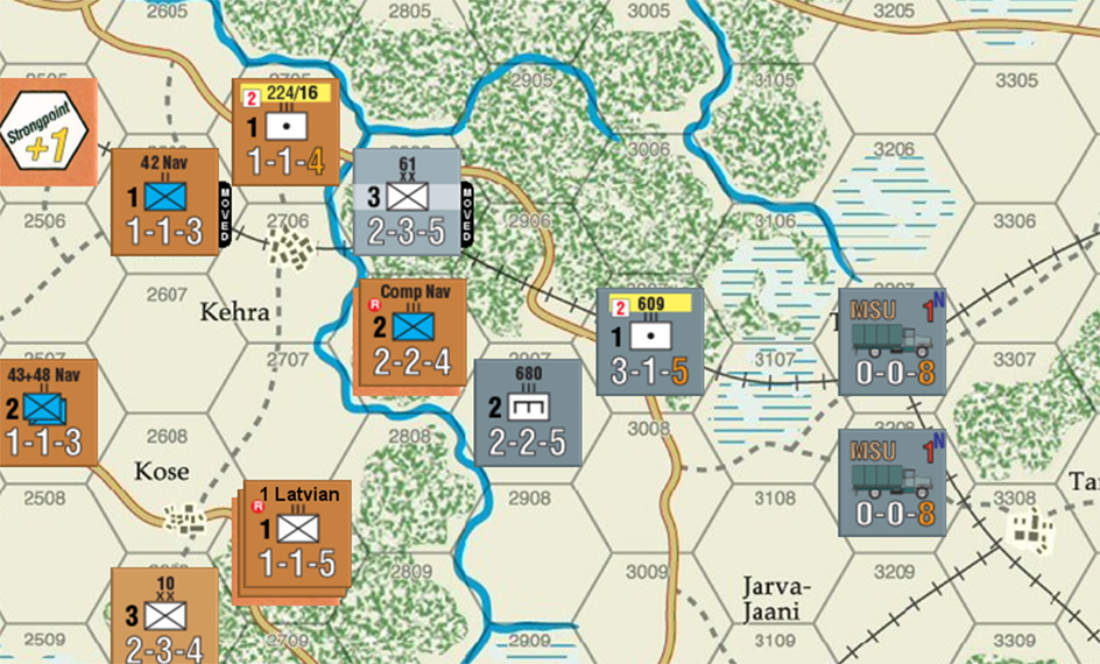
A variety of other factors could come into play in combat, ranging from die roll modifiers from close air support, to the use of engineers. Both sides can also declare an attack as “No Retreat” or “Maximum Retreat” before the dice are rolled. No Retreat stops retreats at the cost of an extra step loss, while Maximum Retreat adds an additional hex of retreat but also allows your opponent to choose the retreat path. The defender chooses these secretly by placing chits near the combats, including dummy chits for deception, after which the attacker declares their choices openly.
The closest game system to BAGN and the entire Eastern Front Series [EFS] is MMP’s Operational Combat Series [OCS]. Both use a 5 mile per hex scale and unit sizes generally run from battalions to divisions, though where OCS turns are 3.5 days, BAGN turns are 2 days. Both aim to present the complexities of operational warfare, but the series diverge in their aim and thus in their approach. EFS announces its focus up front, and its focus has been almost exclusively on 1941 (Crimea heads into 1942.) Its design consequently uses more special rules to reflect the specifics of its tight focus.
From the outset, OCS intended to cover operational warfare over at least all of World War 2, and the baseline OCS system has few special cases. However, focus again plays a role. OCS puts more detail into its logistics and air war systems than EFS does, and consequently they play at about the same pace given a similar scenario scope.

Like the large OCS Eastern Front games, BAGN isn’t for the faint of heart. EFS is a complex system that will require study to learn and thought to play well. In exchange, it will prove very rewarding to those who want to gain a better understanding of the dynamics of Barbarossa in the Army Group North sector.
The author’s MA thesis on “Soviet South-Western Front Operations, June-September 1941” can be found online here
The opinions and conclusions expressed herein are those of the author and do not necessarily represent the views of the US Army Command and General Staff College, US Army, or any other government agency.
You can chat about this game in the Modern World section of our discussion forums
Thank you for visiting the Regiment of Strategy Gaming and riding with The Armchair Dragoons.
Rather than list a bunch of social media links, the easiest thing to do is to check out our LinkTree, which connects you to all of our various locales around the web.
You can also support The Armchair Dragoons through our Patreon, and find us at a variety of conventions and other events.
Feel free to talk back to us either in our discussion forum, or in the comments below.


Great review; I dove into the campaign to learn the system and without any deep knowledge of the history beyond “the Soviets retreated a long way”, and so much of my play has been “how to do this not particularly well” — but James’ comments resonate well with my thoughts about how to play better. Also, I’ll footstomp how comprehensive the charts are.
But what I need to know — what I’ve made zero progress learning on my own — what in the world am I supposed to do with the naval stuff, for either side?
Great review!