
 by
by Mike Colello, 21 September 2026
It seems like The Thirty Years War has become all the rage. Compass Games has released No Peace for Thirty Years!, VUCA Simulations has released Thirty Years of Misery, and now GMT Games has released Cuius Regio: The Thirty Years War. Cuius Regio is a game designed by Francisco Gradaille. Francisco also designed Plantagenet: Cousins’ War for England, another title from GMT.

click images to enlarge
Cuius Regio is a two-player game where one player will lead the Holy Roman Empire (the Imperials) and the other will lead the forces that fought against them (the Protestants). Cuius Regio is set at the operational level and, according to the designer, is heavily inspired by The U.S. Civil War (GMT) and the Great Campaigns of the American Civil War series (MMP).
In the box
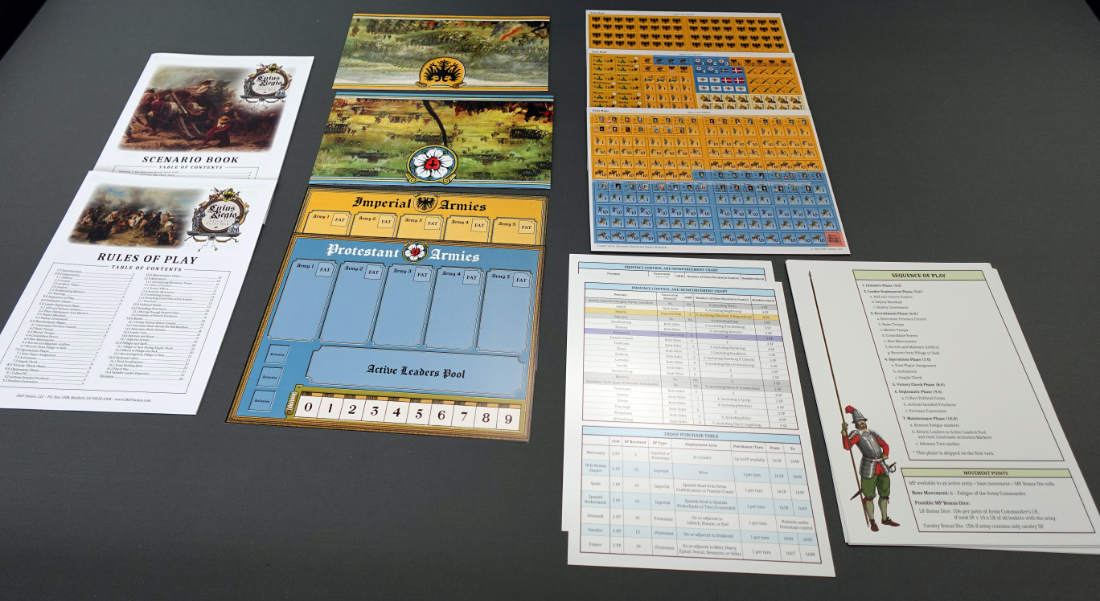
Cuius Regio arrives in a standard GMT 2” box. The components included are:
- Two 34” x 16” map sheets
- Three counter sheets
- Two player aid cards
- Two force mats
- One rulebook
- One scenario book
- Two dice (2d6, one black, one white)

Game Components
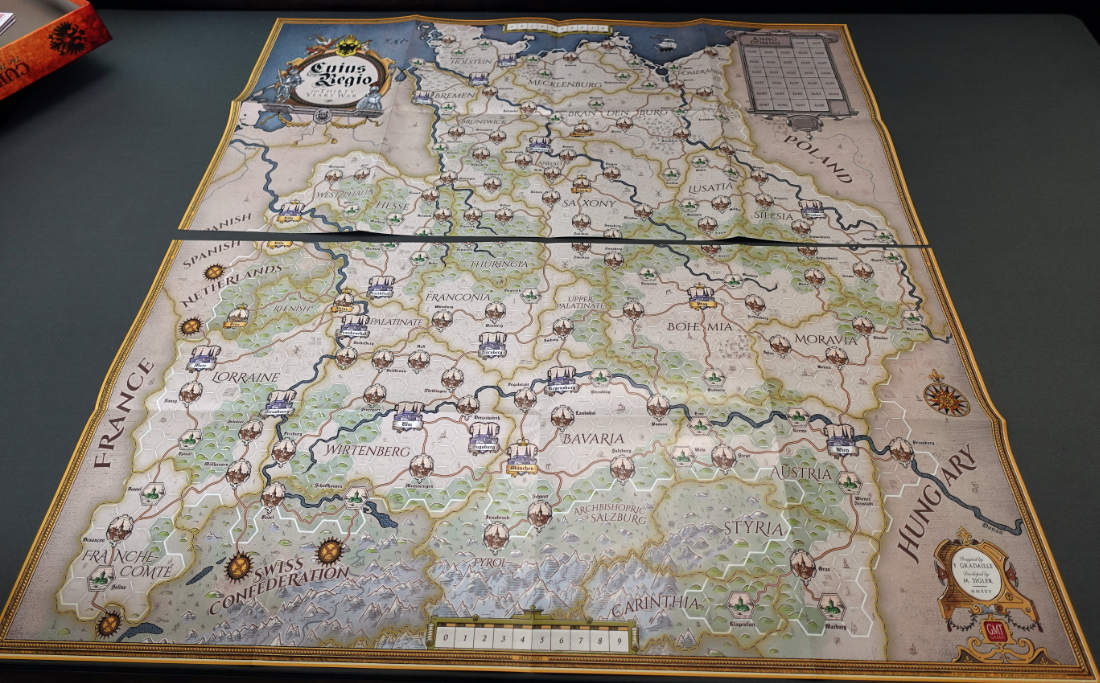
The artwork on the map looks nice. The only complaint I might have about the map itself is the size and the fact that it comes in two sections. That’s borderline nitpicking, though, as it really doesn’t take up much more space than a regular 22”x34” inch map.

Gameplay in Cuius Regio
Each game turn in Cuius Regio represents one year. A turn consists of seven phases that are conducted in order:
- Initiative Phase
A die roll determines which player will be first in each phase. - Leader Deployment Phase
In this phase, players manage their available pool of commanders. - Recruitment Phase
Determine province control and raise troops. - Operations Phase
The primary campaigning portion of the turn. Players alternate activating armies.
This phase ends with a supply check. - Victory Check Phase
Check if the scenario victory conditions have been achieved. - Diplomatic Phase
Collect Political Points and attempt to change the alignment of neutral or enemy-controlled cities in specific provinces through diplomacy. - Maintenance Phase
The turn concludes with housekeeping. Fatigue markers are removed and leaders return to the Active Leaders Pool.
The Operations Phase is the heart of the game where players alternate activating and moving armies commanded by leaders on the map. An army’s move is limited by the commander’s Leadership Rating and current Fatigue Level. Each time you activate an army a point of fatigue is added to the stack. If the Fatigue Level reached 5, the army can’t activate again that turn.

Maneuvering on the map is critical to winning the game. Armies project a Primary Zone of Control (PZOC) and even a Secondary Zone of Control (SZOC) if it contains cavalry units. These ZOCs can hinder enemy forces by causing them to spend extra movement points and by blocking key roads which can prevent reinforcements from arriving.
The three types of units that are in the game are:
- Infantry – The base unit, the counter indicates the Strength Points (SP) of the unit. Each SP represents about 500 – 1000 men.
- Cavalry – Your mounted troops, each counter also has a number that indicates SP. Cavalry can exert a secondary SOC, can move faster if alone, and increase an army’s ability to resupply.
- Artillery Trains – These units represent heavy guns and are used to take control of Major and Great cities without a control check.

Armies can use Reaction Movement to respond out-of-turn whenever an active enemy force moves into or out of one of its Zones of Control (ZOC) or occupied hex. When triggered, the moving army stops and the defending player selects their reaction force. The reacting force then makes a check; the Reaction Move Leadership Check. If successful, the reacting army moves one hex in any direction using no Movement Points or increasing its fatigue. However, if it is unsuccessful, the army remains where it is and may gain fatigue.

Battles are triggered when an active or reacting army enters an enemy-occupied hex. If the attacker has five times the SP of the defender, an overrun occurs. If the attacker does not have enough SP for an overrun, combat occurs. Combat resolution compares the total SPs of both sides to determine an odds modifier. The modifier is then combined with the commander’s leadership rating, any Artillery Trains, terrain defense, and fatigue level. Players roll dice on the Battle Results Table to determine SP losses, gain extra fatigue, and if a retreat or rout occurs. Finally, a check is made to determine if any commanders suffer a casualty.
The game map includes terrain types that affect movement cost, combat modifiers, and logistical capacity. The types of terrain included in Cuius Regio are Clear terrain, Hills, Roads, Rivers, and Cities. Cities come in three types- Minor, Major, and Great. Cities serve as supply bases and provide 5, 10, or 15 supply points.

In addition to maneuvering on the map, political strategy is just as important to winning a game. You will receive Political Points (PP) by controlling major cities. Players can spend PP to recruit new units and deploy leaders. You can also use PP to try to convert provinces on the map to your side during the Diplomatic Phase of the game. Supply is also important as at the end of the campaign season, armies must be able to supply themselves from their occupied hex. Enemy ZOCs and pillage areas can halve that number!
So, with all the new Thirty Years War games hitting the shelves, is this one worth your attention? I will tell you that after playing a couple of the smaller scenarios, I really, really want to play the full game. I mentioned earlier that the game is inspired by The U.S. Civil War and the Great Campaigns of the American Civil War series, and it shows when playing the game. Maneuvering your armies to try to get around your opponent or to avoid their reaction can be exciting. And the games supply system and political strategy are the icing on the cake.
So, yes, I do highly recommend this game if you have any interest in the Thirty Years War or even if you like the games it is inspired by.
You can chat about this game in the Age of Gunpowder section of our discussion forums
Thank you for visiting the Regiment of Strategy Gaming and riding with The Armchair Dragoons.
Rather than list a bunch of social media links, the easiest thing to do is to check out our LinkTree, which connects you to all of our various locales around the web.
You can also support The Armchair Dragoons through our Patreon, and find us at a variety of conventions and other events.
Feel free to talk back to us either in our discussion forum, or in the comments below.


