
 by
by RockyMountainNavy, 3 November 2025
It was with much anticipation that I recently purchased—each for $2 or less—several sets of miniatures air combat rules from wargamevault.com. They are Fly, Fight, Win: Danger Zone from OTM Games (2025) as well as four titles from the Wasatch Front Historical Gaming Society (WFHGS) out of Salt Lake City, Utah. Those four titles are: Typhoon: Modern Air Combat (2009), Angels & Bears (2010), Phantoms & Intruders (2025), and Deep Strike (2025?).
Maverick: “I feel the need…”
Maverick, Goose: “…the need for speed!”
I make it no secret that designer Lee Brimmicombe-Woods’ Wing Leader series from GMT Games is my favorite air combat wargame. I also am a great fan of designer J. D. Webster and his World War II Fighting Wings series. When it comes to wargames on modern air combat, I am also a big fan of Webster’s Air Power series as well as Gary ‘Mo’ Morgan’s Flight Leader (Avalon Hill, 1986). Heck, I even like the air combat model in the Harpoon series of naval miniatures games from Admiralty Trilogy Group. One problem with all those wargame models, however, is that each game model is moderately to deeply complex to manipulate. Years ago I acquired the digital download for Air War: C21 (2nd Edition, 2008) available thru wargamevault.com. Air War: C21 is a rather “lite” set of miniatures air combat rules which makes play go very fast—but at a severe penalty in simulation fidelity.
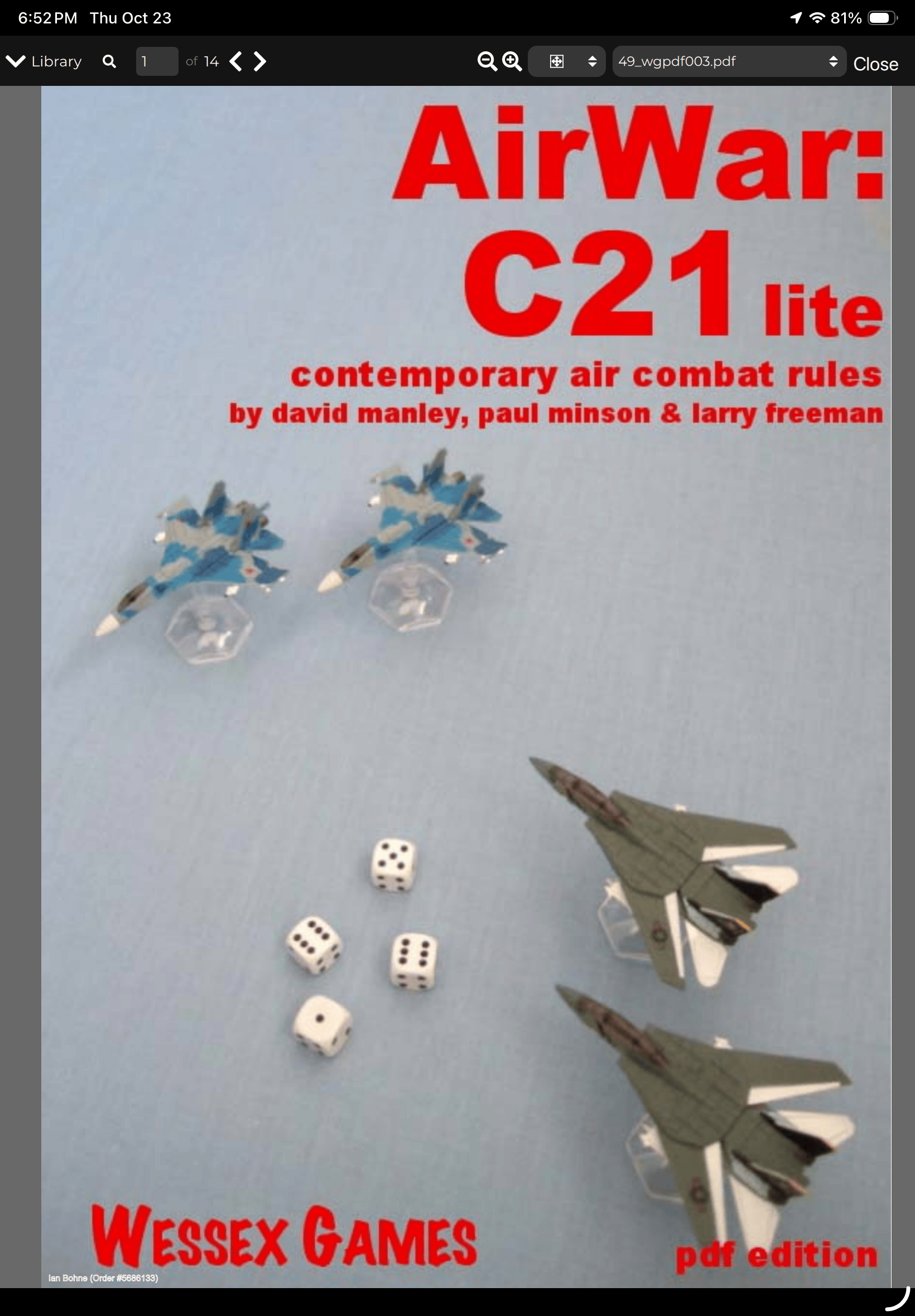
Charlie: “Lieutenant, why didn’t you tell me that you were a famous MiG insulter?”
Starting with the oldest set of rules we have Typhoon: Rules for 1/144th Modern Air Combat. As the ad copy on wargamevault.com relates:
Typhoon is a set of low complexity modern air combat miniatures rules. The rules cover maneuver, detection, then missile or gun combat where large numbers of aircraft can be used and a battle completed in a short amount of time. Stats are given for most aircraft from the late 80s to present day. (Ad copy)
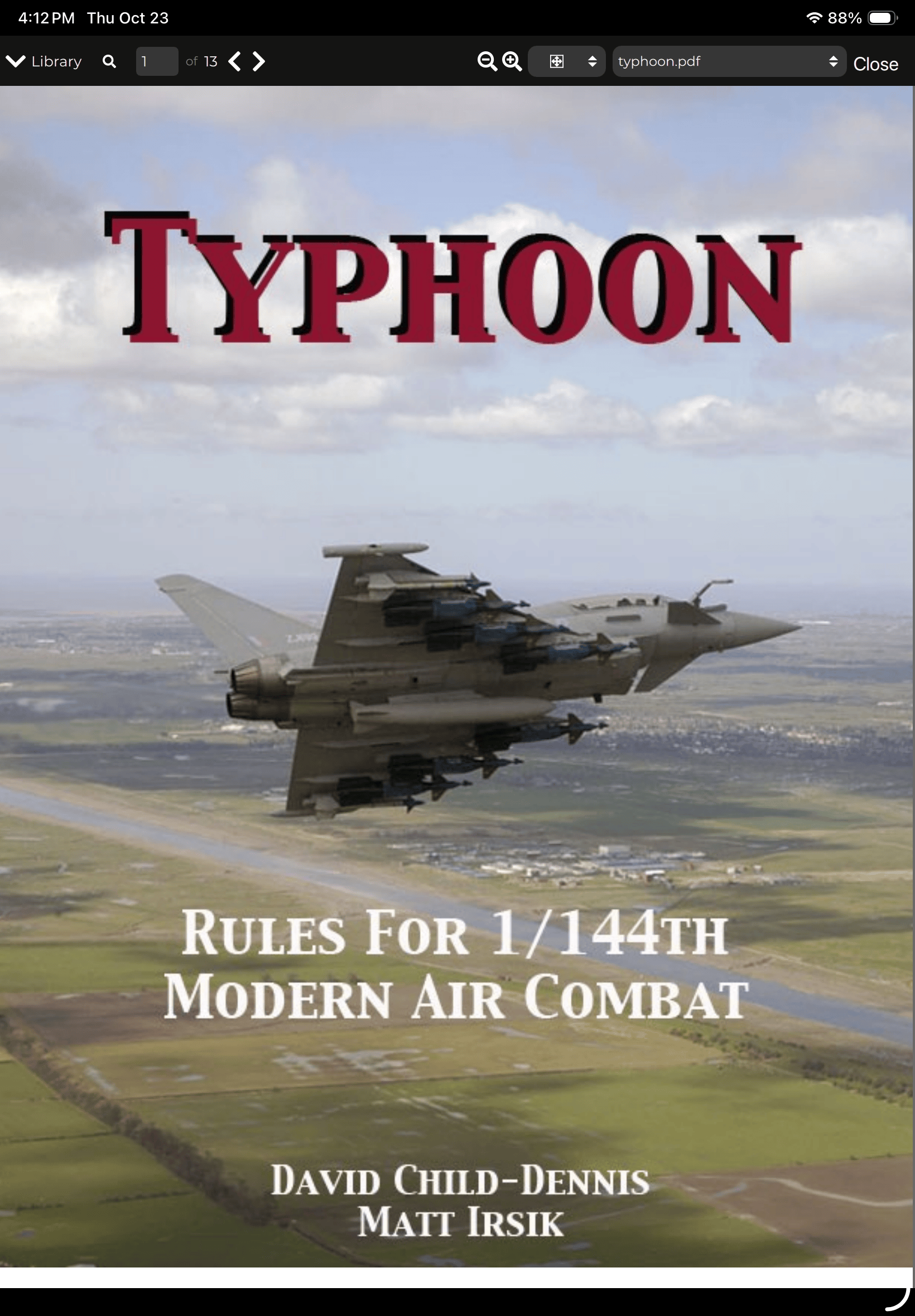
The choice of 1/144th scale is…interesting. Personally, 1/144th is my scale-of-choice for building model aircraft but for a miniatures game that is—if you pardon the expression—”Yuge!” There is also a (not so small) matter of cost; each 1/144th scale model kit costs at least $10 these days. Want to build a squadron or two? Need to get a Senate Appropriations Bill passed…good Luck with that!

Technically, the rules for Typhoon say that you can use 1/300th or 1/600th scale models too. That is because—regardless of the scale of your models—1″ equals 100 mph. As far as the rules go, well, I consider Typhoon a low fidelity simulation. The rulebook for Typhoon is a mere 13 pages, five of which are tables, charts, or markers. Aircraft must move and can turn, sideslip, or climb and dive. The only acrobatic maneuver is a loop. Altitude is handled as bands of “levels.” Detection is a simple d6 ± modifiers for radar, electronic warfare equipment, and ground or airborne control. All missiles in Typhoon are “all -aspect” and can be fired from any angle. Gunnery combat uses a Deflection Template with easy modifiers.
In my opinion, Typhoon is a useful club game where players can bring their own finished models to the table and “battle it out” with a group that is likely much more interested in how a model looks than how the player dogfights. Indeed, this is pretty much what the designer writes:
Typhoon will hopefully bridge the gap between ultra-realistic, complex rules and those gamers who just want to throw a few jets on the table and play a quick, fun game. This set of rules is in no way the definitive word on the subject, but rather they are a good introduction into the world of modern jet combat that can be learned and played quickly. (Typhoon, p. 12)
Maverick: “I can’t shoot this son of a b*tch. Let’s see if we can have a little fun with him.” [flies above MiG upside down]
The ad copy for Angels & Bears: Modern Air and Naval Combat 1980-1989 promises:
Angels & Bears is a low complexity set of rules covering Modern air and naval combat in the 1980s. The rules allow for air to air, air to surface, and surface to surface combat using miniatures where large battles can be fought in a relatively short amount of time. (Ad copy)
The fact that Angels & Bears has a picture of an EA-6B Prowler on the cover (unfortunately not my beloved VAQ-137 Rooks) makes this an instant favorite. Cover favorite, that is.
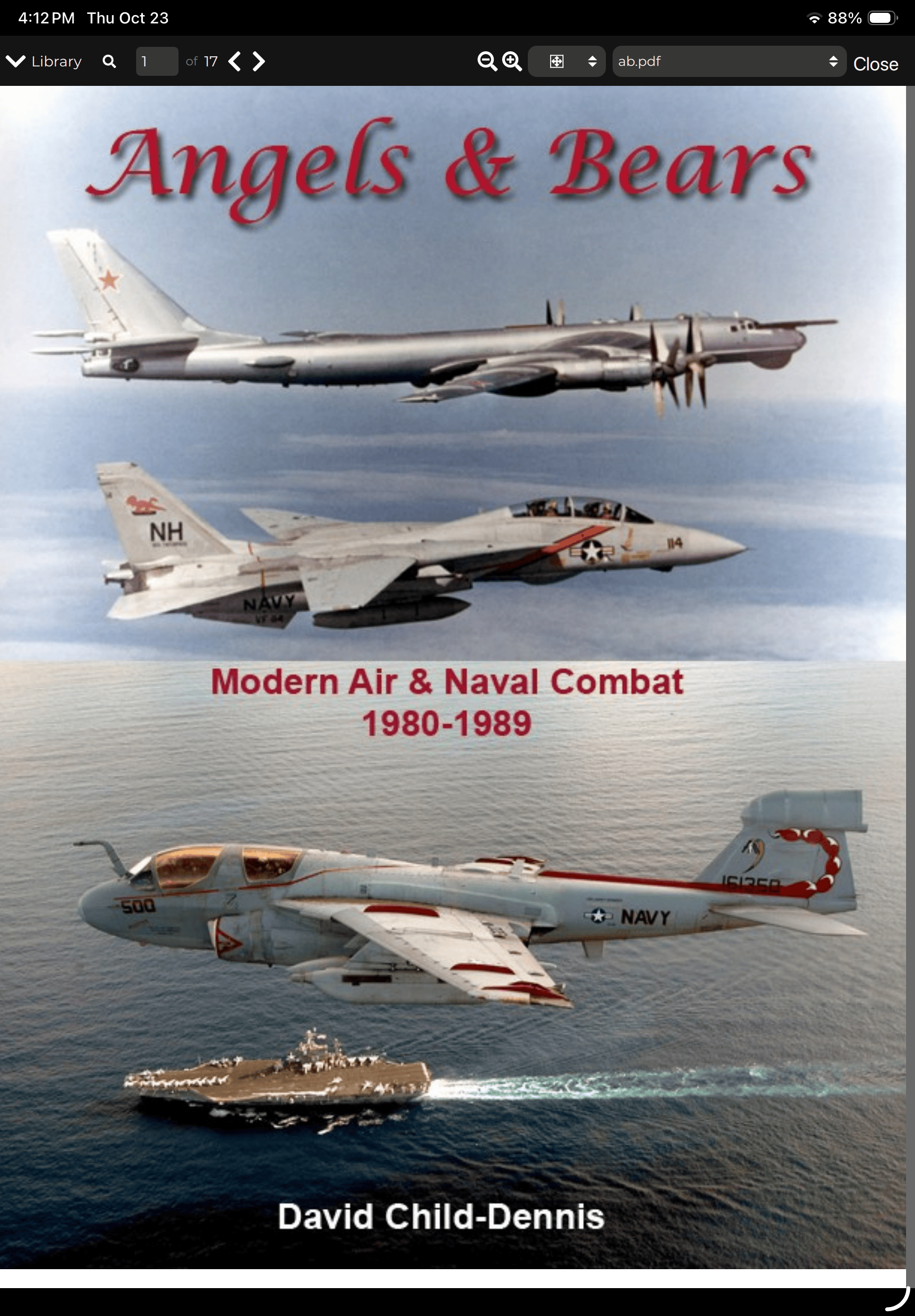
Angels & Bears uses the same core game engine that powers Typhoon. With the addition of ships the game recommends using 1/300th or 1/600th scale aircraft models though 1/144th is supported by doubling all measurements. Angels & Bears also recommends 1/2400th or 1/3000th scale ship models.
While the rules for Angels & Bears shares the same core game engine as Typhoon, there are some changed and extra rules to account for the ships. The rulebook is 17 pages with only two pages of charts/tables (where is the aircraft data annex?). Whereas I see Typhoon as very low fidelity/low complexity I see Angels & Bears as just slightly more complex (Low-Medium?) with a similar increase in simulation fidelity. This appears to be the design intent given what designer David Child-Dennis writes:
Modern naval and air combat is a very complex subject and has been presenting difficulties to gamers for a long, long time. Taken separately, they are subjects with a lot of depth unto themselves, but when combined they can become almost unplayable. Harpoon 4 does perhaps the best job of integrating air and surface combat, detection, ASW, anti-air warfare, and more, but there is a steep learning curve and the person preparing the scenario must do an incredible amount of work to prepare for the game. Angels & Bears attempts to use an established air combat system for miniatures (as used in Air War- Korea and Air War- Vietnam) and mated a surface combat system to it. The result is hopefully a fast playing modern combat simulation that will attract gamers who have to this point been put off by the complexity of trying to game this type of warfare. Angels & Bears will not be the last word on the subject, but hopefully it will get people to try this period out and have some fun with it. (Angels & Bears, p. 17)
Title Card: “On March 3, 1969 the United States Navy established an elite school for the top one percent of its pilots. Its purpose was to teach the lost art of aerial combat and to insure that the handful of men who graduated were the best fighter pilots in the world. They succeeded. Today, the Navy calls it Fighter Weapons School. The flyers call it: TOP GUN.”
The most recent set of air combat rules released by WFHGS is Phantoms & Intruders: Miniatures rules for air to air and air to ground combat in the 1960s, 70s, and 80s. This product is a bit different from the previous rules as this title is a reimplementation of the Avalon Hill wargame Mustangs from 1991…but for modern jets:
Phantoms is a miniatures based version of the Avalon Hill board game Mustangs, with a low to medium complexity rating. Aircraft maneuver on a hex grid using stands with altitude sticks (easy to make) with markers denoting their maneuvers for the turn. Intruders is a complete air to ground module that adds SAMs, AAA, and various missions for strike aircraft. This deluxe version also includes the 2008 and 2009 updates with additional markers. There are dozens and dozens of pre-made aircraft charts covering most jets from the 1960s to the 1980s, allowing you to play out almost any historical or hypothetical combat during that time frame. (Ad copy)
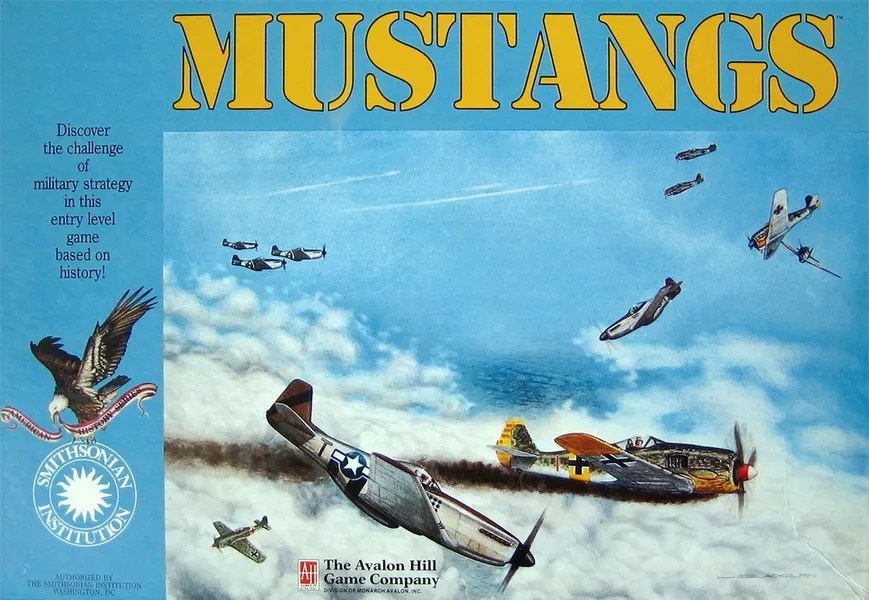
Although Phantoms & Intruders is listed as a 2025 publication on wargamevault.com, this 159-page product is actually a compilation of several other WFHGS titles produced at different times. Phantoms: Air Combat in the Missile Age is labeled “Revision 1 Fall 2005” and at 19-pages constitutes the “core” rules for air combat. Intruders: A Phantom Supplement is labeled as “Updated: 05/12/03” and provides the air-to-ground and ground-based air defense rules. It also includes rules for “Solitaire Air to Ground Combat” as well as “Air to Air Solitaire Combat” (Intruders, p. 14). The Phantom: 2008 Update from Spring 2008 introduces attacks against naval targets and several campaign settings and scenarios. That is followed by about 78 pages of tables and data annexes for aircraft and the like. Next comes the Phantoms 2009 Update which appears to be all data and no new rules.
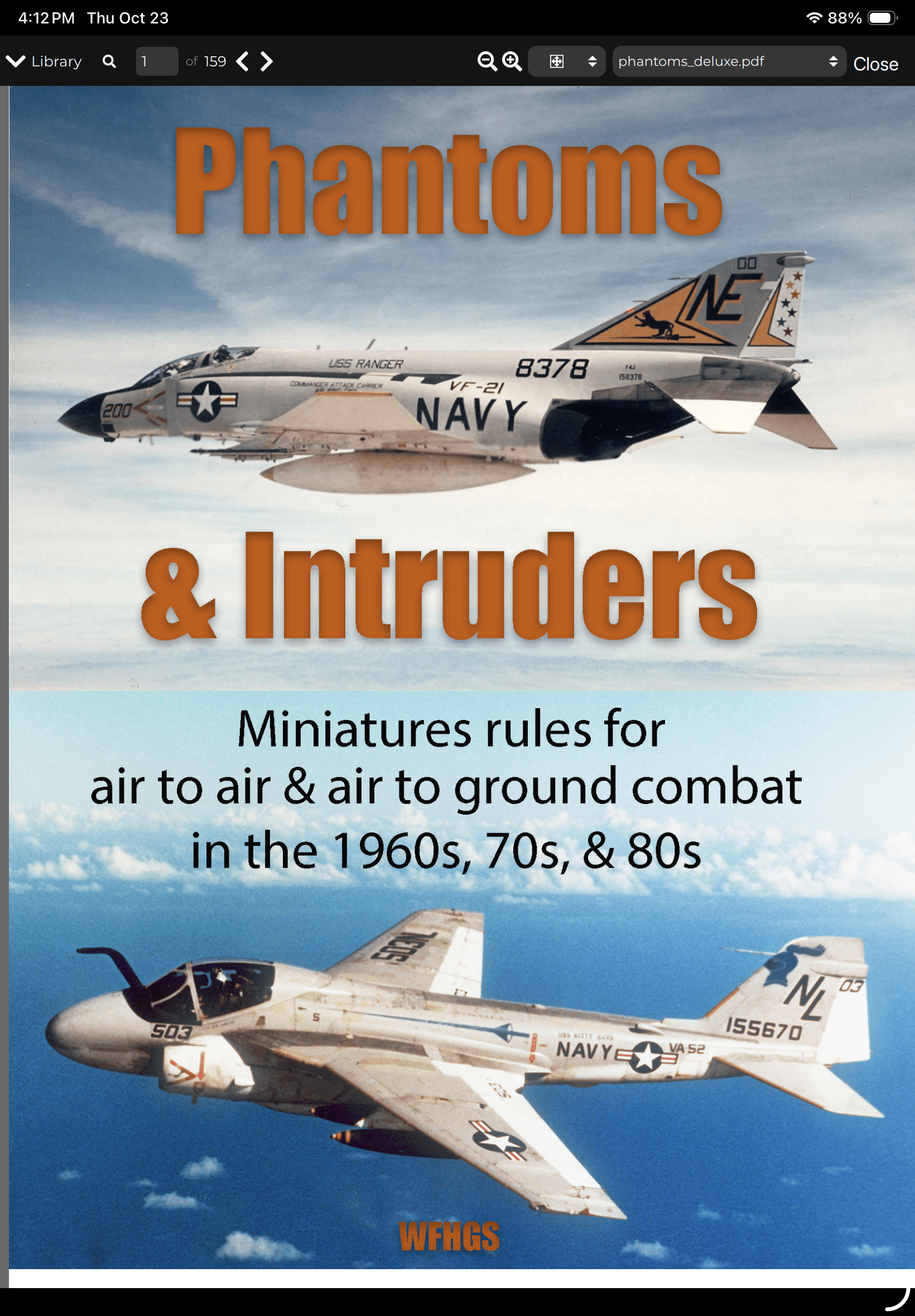
While the content of Phantoms & Intruders is more complete than Typhoon or Angels & Bears the new rule set is likewise more complex. While certainly not as complex as J.D. Webster’s Air Power series, Phantoms & Intruders goes beyond “just dogfights” and supports player flying “missions” in a manner more akin to Lee Brimmicombe-Woods’ Downtown series of air campaign games from GMT Games.
Matt Irsik, who contributed material to Phantoms, obviously came to the game via the fan support route. His comments help us understand the intent behind Phantoms:
After years of playing Air Superiority and The Speed of Heat [both part of J.D. Webster’s Air Power series], our group felt it was impossible to play modern jet combat as a group because of the complexity. We then came across Phantoms and haven’t looked back. Our group has successfully had up to eight players with a total of around 20 jets complete a scenario in under four hours. Phantoms is enjoyable, realistic within historical tolerances, and you can have new gamers playing in a matter of minutes. (Phantoms, p. 20)
The Designer’s Notes for Intruders list eight topics that the designer feels makes the “Mustangs/Phantoms” system work so well:
-
- AAA Effectiveness
- Further AAA Notes (includes topics like Barrage fire and AAA against nap-of-the-earth flyers)
- SAMs
- Toss bombing
- Aircraft point cost
- Mission generator
- Load Outs/Weapons
- Vietnam Specific Rules (such as no beyond-visual-range engagments; i.e. visual ID before firing). (Intruders, p. 16)
It is obvious from the various Designer’s Notes and introductions to the several products that Phantoms & Intruders almost certainly started out as a “club game” before the internet helped spread the title. That is certainly not a bad thing and—from what I understand—quite a common game development route for miniatures wargames.
Maverick: “How come I never heard that before?”
Viper: “Well, that’s not something the State Department tells dependents when the battle occurred over the wrong line on some map.”
Deep Strike: A Modern Period Air Campaign System is a rules set not for air combat but for an air combat campaign. As the ad copy explains:
Deep Strike is an air combat module that can be used with any Modern era miniatures gaming campaign. Basically, each side gets a number of airbases in the region where your campaign is taking place. Both sides then allocate air units each turn to provide close air support, escorts, CAP, and deep strikes against opposing airbases. Rather than arbitrarily assigning air support during your miniatures campaign, Deep Strike allows you to game out air operations in the region which will affect the overall shape of your campaign. (Ad copy)
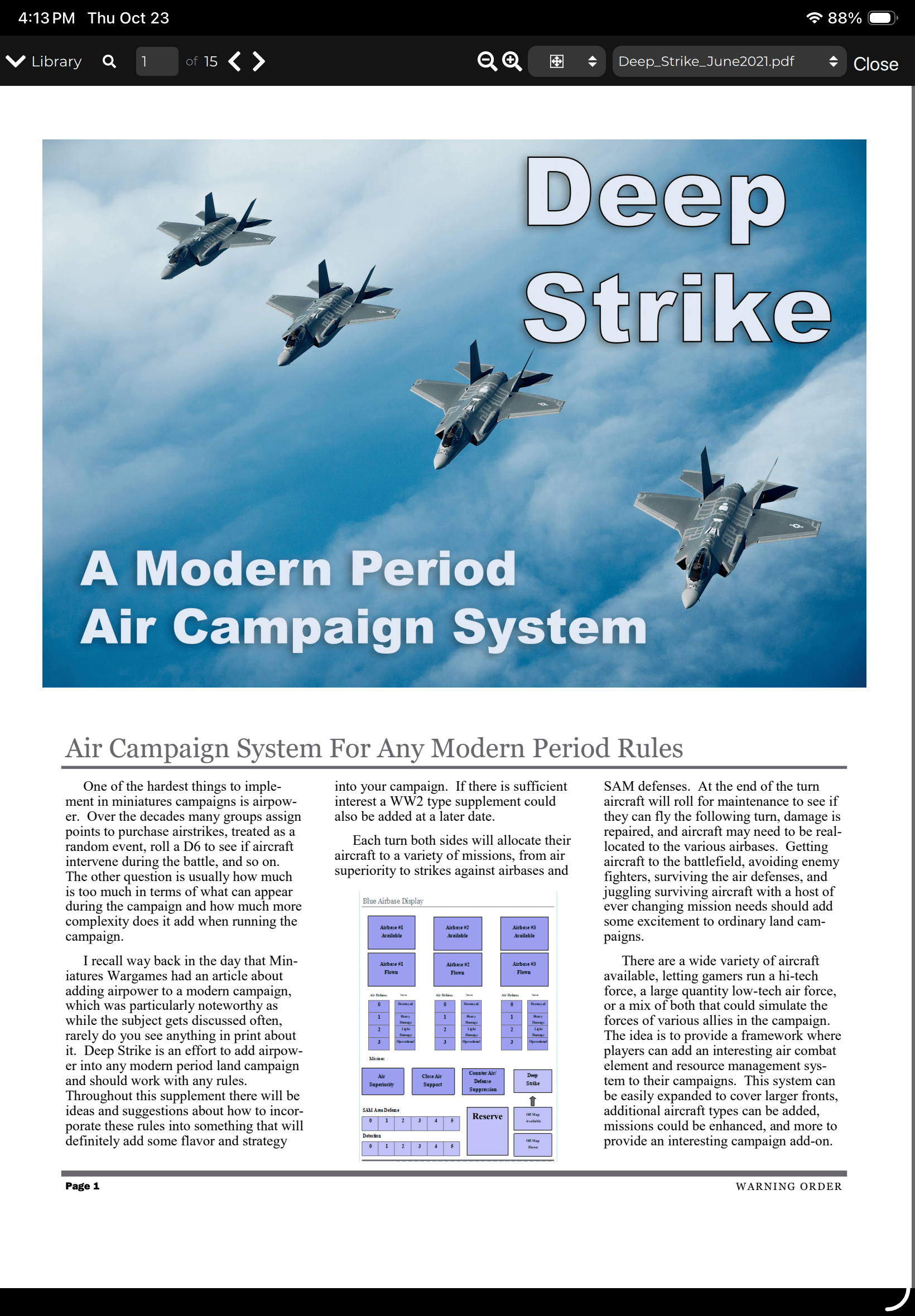
Deep Strike is lifted directly from the pages of the Warning Order magazine also published by WFHGS. This…game module looks like it was inspired by—or intended to replace—almost any modern wargame that uses squadrons of aircraft. Players play the role of what I saw in the early 1990’s where each carrier air wing had an Air Resource Coordinator (AREC) who assigned aircraft to different missions throughout a series of combat cycles. Deep Strike is certainly not a dogfighting game; indeed, combat here is the classic “battlelines” of combatants dicing it off against each other. At 15 pages the rules are similar to air rules in the Next War series from GMT Games and broadly comparable—both in terms of scope and complexity—with the wargame NATO Air Commander (Brad Smith, Hollandspiele, 2018).
In the Designer Notes for Deep Strike, the acknowledgement that this is not a “complete” game is found in the very first sentence:
As you can probably see from reading the rules, the generic aircraft counters, etc., this is more of a “gem kit” than an actual published campaign system that would be included in a set of miniatures rules. After playing games like Red Storm, Elusive Victory, and Downtown [Note: All part of Lee Brimmicombe-Woods’ Downtown series] you quickly realize that ther is more to the battlefield than you would otherwise see in most miniatures rules.
…
This module is an attempt to get gamers thinking about the big picture. If you don’t try to take on the enemy’s air assets, damage their infrastructure, and try to get a least parity in the skies, your ground formations aren’t going to last long! (Deep Strike, p. 8)
Cougar: “G*d dammit, Mustang! This is Ghost Rider 117. This bogey is all over me. He’s got missile lock on me. Do I have permission to fire?”
Another set of rules I acquired but from a different publisher is Fly, Fight, Win: Danger Zone – Fighter Combat in the Cold War from OTM Games. The ad copy sounds promising:
Fly Fight Win: Danger Zone is a hex-based, miniatures rules set for aerial combat from the early Vietnam War through Desert Storm. The game emphasizes the importance of speed, altitude, and pilot skill in the chaos of air combat. It includes statistics for many frontline fighters and a pilot advancement system for campaign games. All games in the Fly Fight Win series are designed for playability but retain sufficient detail to recreate plausibly historical outcomes. Most scenarios can be played in around 90 minutes. There are several rules changes from Afterburner, thus the new title. (Ad copy)
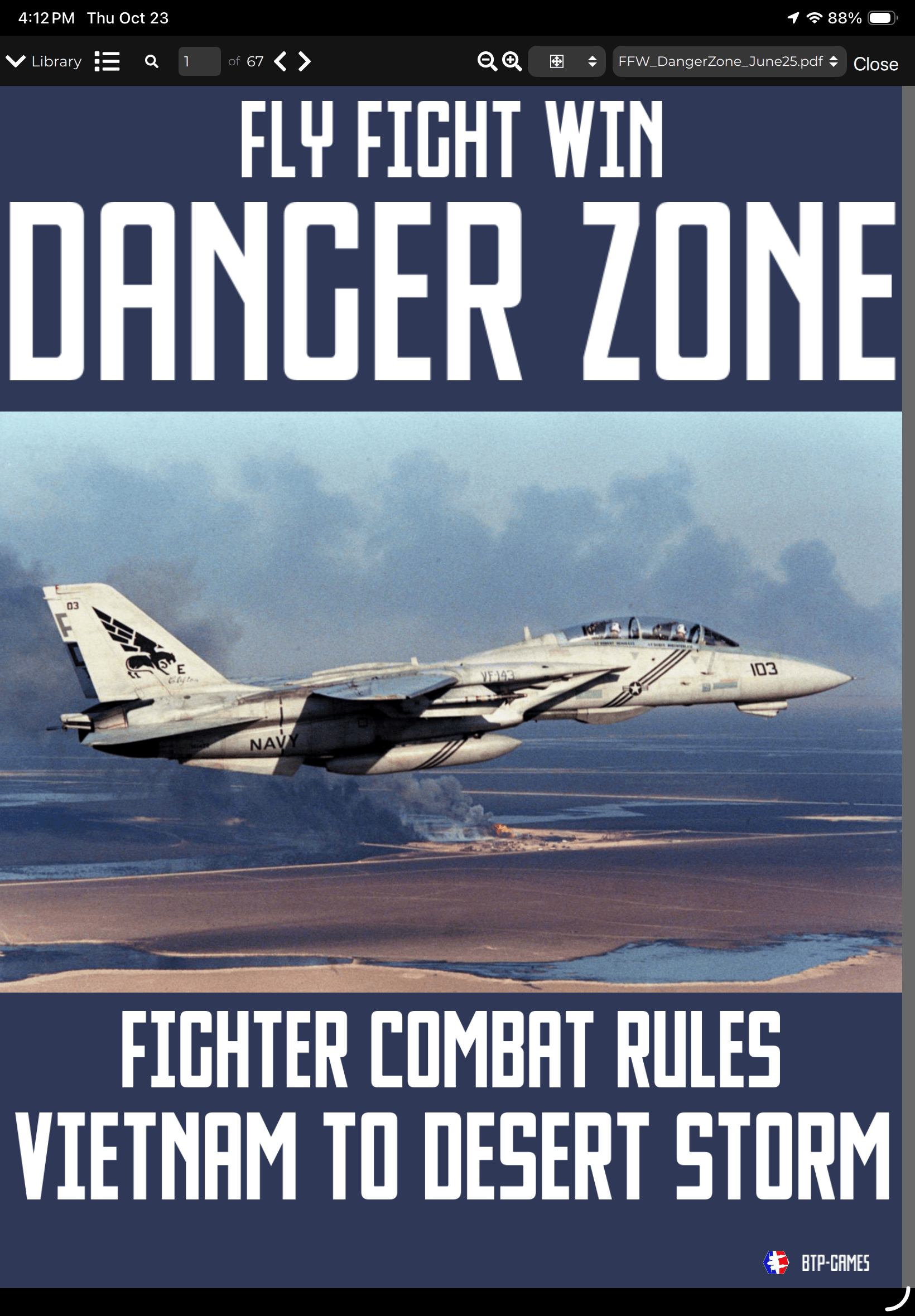
Fly, Fight, Win: Danger Zone is the modern(ish) setting of the Fly, Fight, Win series. In fact, the second subtitle is, “Fighter Combat Rules Vietnam to Desert Storm.” Though Danger Zone is 70 pages it, like all the Fly, Fight, Win titles, is a free download.
Like Phantoms & Intruders discussed above, Fly, Fight, Win: Danger Zone is also derived from the Avalon Hill Mustangs system. The core rules are the first 24 pages followed by scenarios and data tables. While both Fly, Fight, Win: Danger Zone and Phantoms & Intruders are derived from Mustangs, both have a unique take and are truly separate derivatives from that core game; knowledge of one title does not automatically equate to mastery of the other. Of the two Mustangs cousins, I have to give an edge to Fly, Fight, Win: Danger Zone for product appearance. As far as the rules go, however, I see them both equally well done and playable. Given the extremely low cost of either title, I see little harm in recommending you download both and decide for yourself which is your preference.
Viper: [discussing Maverick] “Let me ask you something. If you had to go into battle, would you want him with you?”
So… which set of modern air combat rules do I recommend. Unhelpfully, I am going to deflect and answer, “Whatever fits your desire.” These miniatures rule are very much low-to-medium fidelity games highly suitable for playing with a large group in a club or even at a convention. I recommend you look at Phantoms & Intruders or Fly, Fight, Win: Danger Zone for a mid-complexity experience and Typhoon/Angels & Bears for a lower fidelity—but perhaps more quickly playing—game.
Likewise, if you are looking for an air campaign game that is integrated into your air combat rules, you likely cannot go wrong with the campaign settings in Phantoms & Intruders or Fly, Fight, Win: Danger Zone. If you are, like I sometimes am, a “game experimenter” then the “game kit” of Deep Strike likely can satiate your creative appetite.
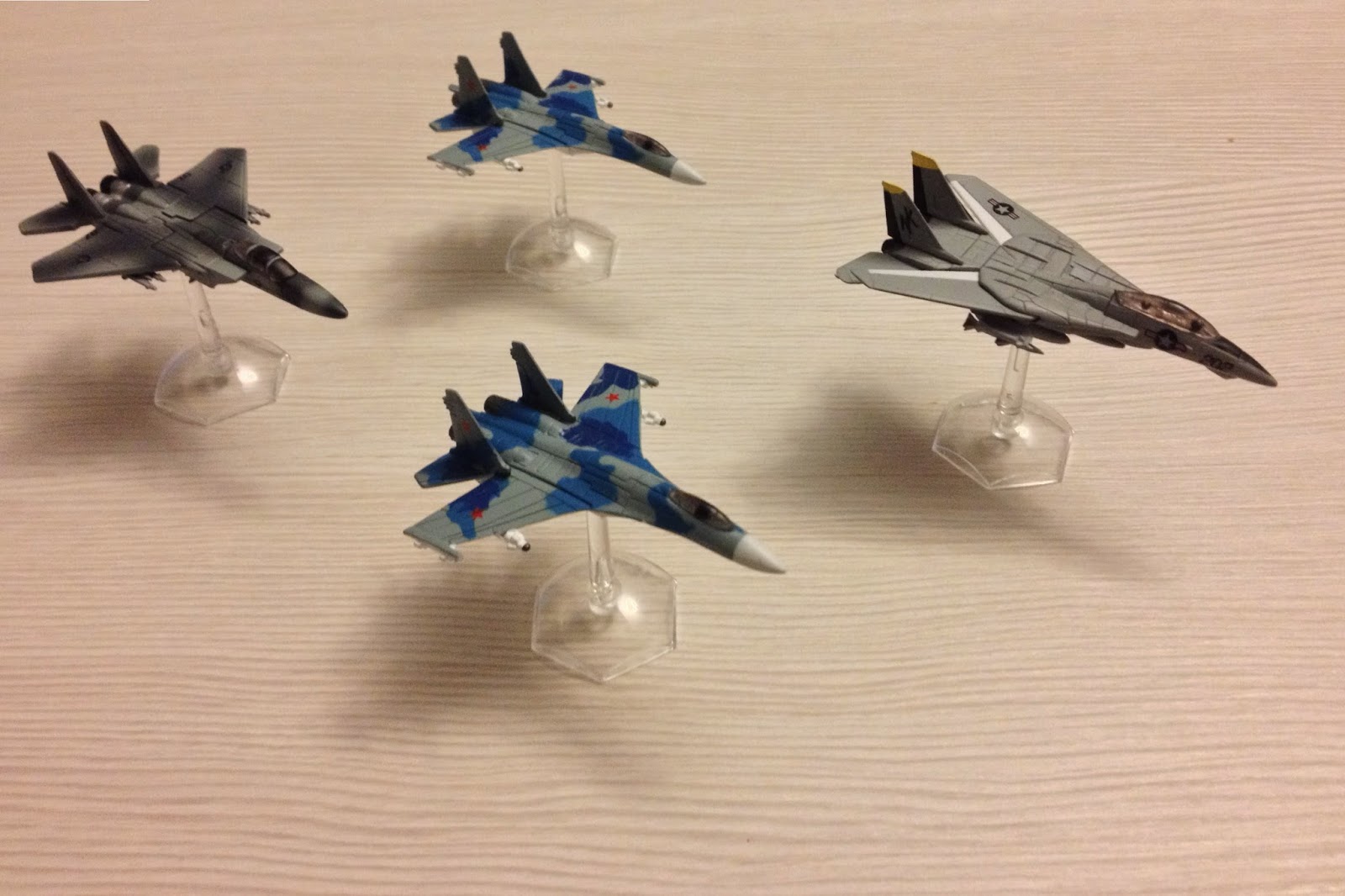
For those wargamers out there that worry about entering the endless (bottomless?) cycle of buying and painting (or not painting) miniatures there are inexpensive alternatives. Publisher Paper Forge offers low-cost sets that are basically print and play. For example, see these sets of 1/1200th scale aircraft and other scale ships.

If you are like me and have several thousand (hundred thousand?) Lego pieces laying around from your kid’s childhood (or are, ahem, also like me a card-carrying AFOL1) by making a small effort you can “piece together” your own aircraft.

My thanks goes out to the members of the Wasatch Front Historical Gaming Society and OTM Games for bringing their miniatures rules to the wider wargaming community. Much like Dungeons & Dragons started with a club decades ago, these smaller club or club-like rules have great potential for delivering enjoyable play to large groups…at a very low cost for entry.
Feature image courtesy taleofminianddice
You can chat about this game in the Modern World section of our discussion forums
Thank you for visiting the Regiment of Strategy Gaming and riding with The Armchair Dragoons.
Rather than list a bunch of social media links, the easiest thing to do is to check out our LinkTree, which connects you to all of our various locales around the web.
You can also support The Armchair Dragoons through our Patreon, and find us at a variety of conventions and other events.
Feel free to talk back to us either in our discussion forum, or in the comments below.


I was looking at my shelf after I read this, and I have several old Galoob Micro Machines aircraft from my childhood. Tomcat, Hornet, Phantom, Fighting Falcon, Harrier, Valkyrie, Fishbed, Hercules, and Stratofortress. All are about the same size, but to game with them would be a great deal of fun.