
 by
by Paul LaFontaine, 23 August 2026
We took another run at Shiloh with a historically accurate map and more pieces representing the accurate number of brigades for both sides. We focused on the first day, April 6th, 1862. I am preparing for a visit to the battlefield with a group where we will play a Kriegsspiel, and this was testing the concept of whether this was even playable as a Kriegsspiel based on the nature of the battle.
The problem of Shiloh is difficult terrain, coordinating a mass of forces in a small area and the need for a rapid outcome. These ingredients are not conducive to a Krieggspiel, where the charm of a scenario for the player is to be given choices that are discreet and understandable.
Shiloh is a marquee battle in the American Civil War and one of a series of such battles that should be experienced and studied. But if it’s not playable as a Kriegsspiel, it makes it difficult to justify bringing it to the table. I wanted to explore whether there were discrete decisions that could make it an interesting outcome. This was a live session with three players using Discord and physical pieces in the hands of remotely connected participants.
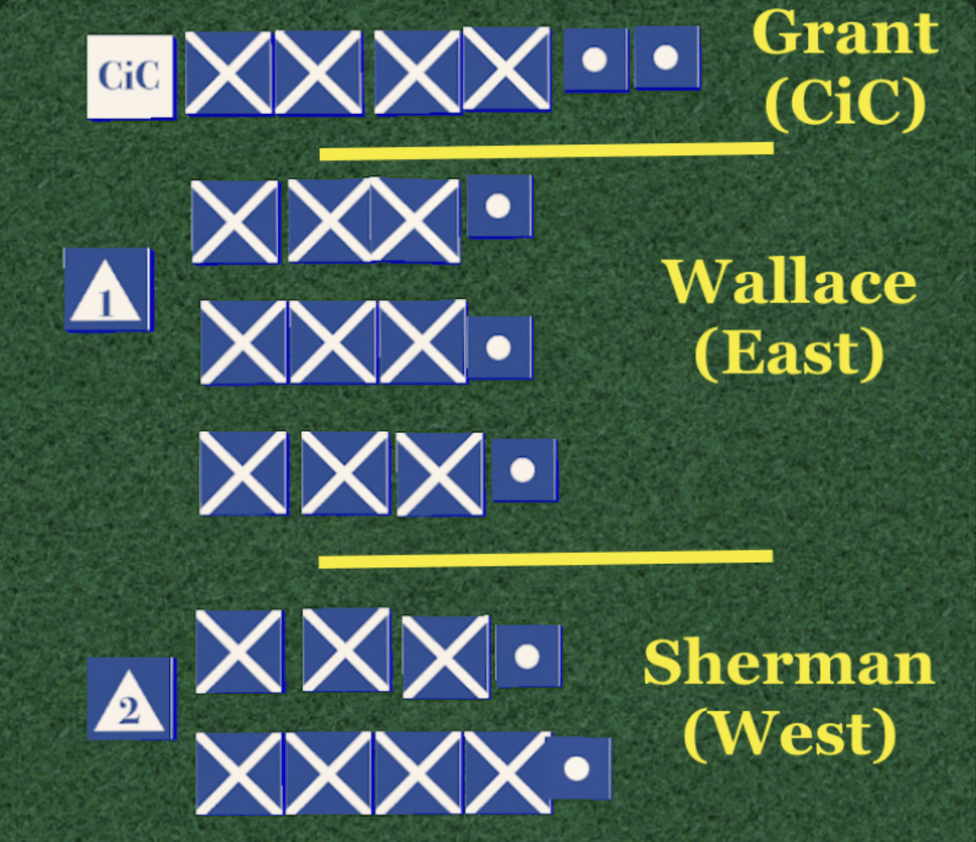
I had set up a scenario with four command tables. The two Union tables were the east and west wings of the Union forces on day one, represented by Sherman (Seabass) and W.H.L.Wallace (Lewis++).
most images can click to enlarge
Four players had RSVP’d but one did not show, so we have Rebelsqurl command all Confederate forces.

If we examine the options both commanders had at Shiloh, we may think that the Union did not have options at the very beginning as the popular concept was that they were attacked and surprised. All the decision making appears on the Confederate side. But our players had a chance to show us that every assumption can be challenged.
This is another of a series of Kriegsspiel AARs very similar to the events in our Wargame HQ at the Origins Game Fair. You can find the original article here.
Historically, the Confederates had to drive the Union forces back on Pittsburg Landing and defeat them before the Army of the Ohio arrived the next day. On day one, the Confederates had sixteen brigades to the Union’s thirteen and were attacking across very difficult ground. The Union had three additional brigades under Lew Wallace coming from Crump’s Landing north of the action. Time was of the essence.
Timothy Smith, in his excellent book “Shiloh: Conquer or Perish,” describes the battlefield as an hourglass, with the neck of the glass at the intersection of the Hamburg-Purdy Road and the Eastern-Corinth Road.

The slopes and thick undergrowth make the areas outside this hourglass shaped area very difficult to navigate, and virtually impossible to maneuver in. This awareness impacts how you umpire those parts of the terrain, and complicates the attack options for the Confederates.
The original Confederate plan was to focus at Pittsburg Landing in the east, where the Union had weaker units. The Union had inexperienced units on that side of the line.

Our players pushed along two avenues with an emphasis in the west.

The Union players, breaking from history, pulled back to the Tilghman Branch immediately, abandoning their camps to take a stronger line. Historically the Union brigades stood in battle line in front of their camps. In our scenario the players abandoned the camps to move to a stronger position.
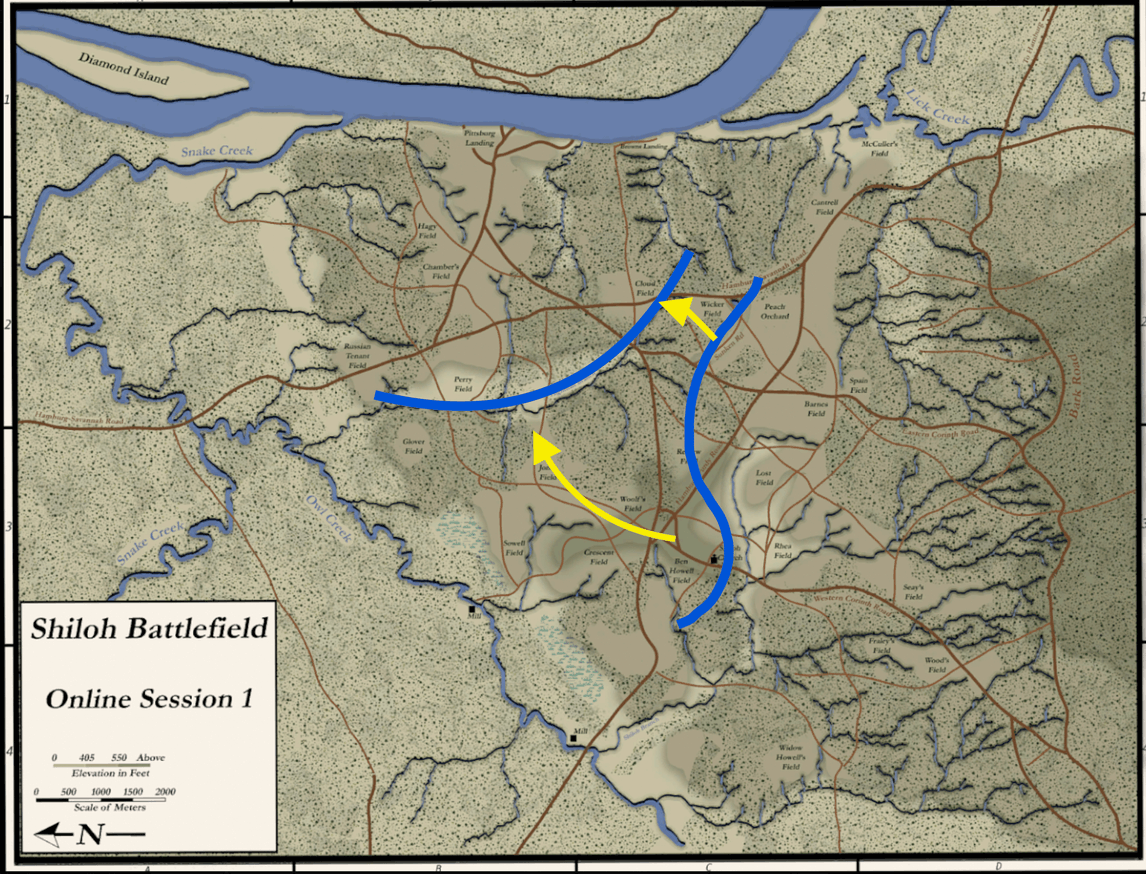
This allowed the Confederates to get closer to the Landing without being engaged. The action started at 0600 with a Confederate start along the two approaches to set up their push. The Union immediately begins pulling back.
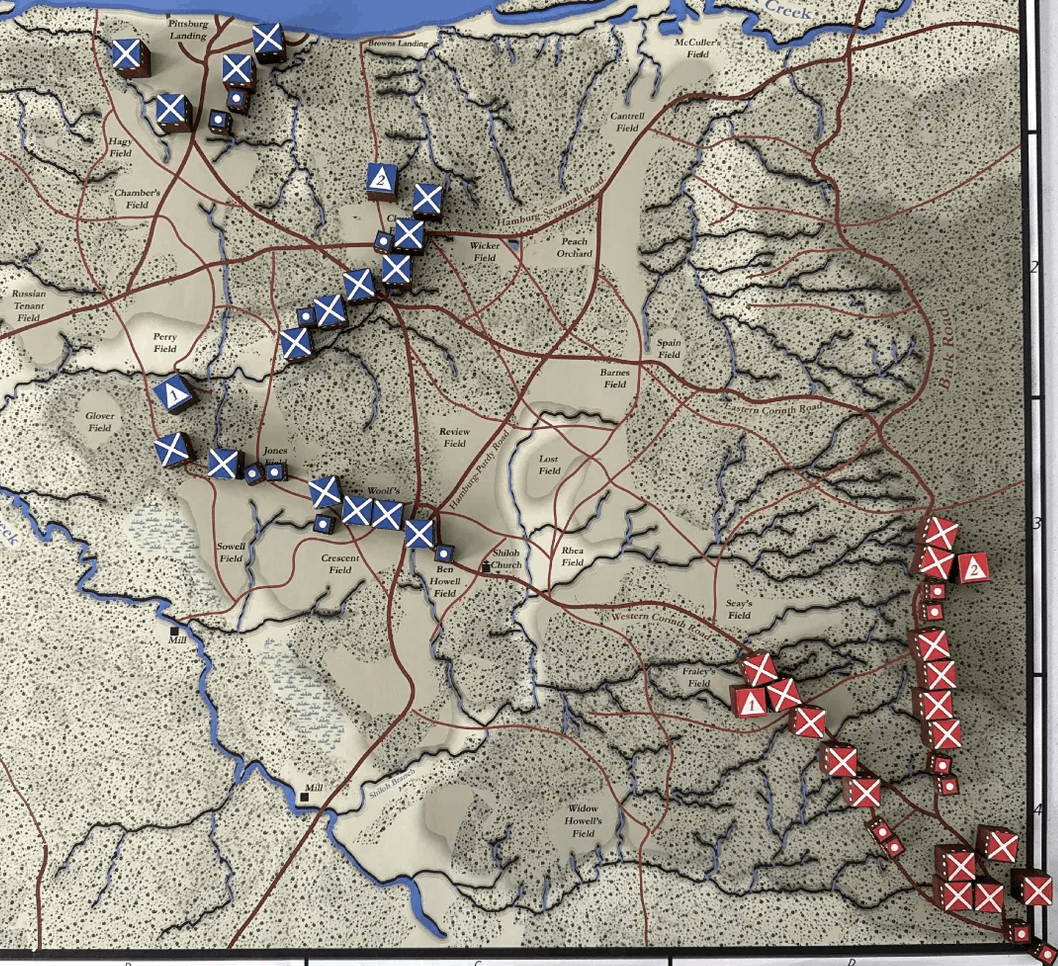
By 0900, the Confederates were through Shiloh Church (1) and headed to the Sunken Road (2). Lewis++ had positioned three brigades on the flank of that position to try and take advantage of a change to disrupt the Confederates. It has an unintended consequence later.

Historically, the first contact at Shiloh Church started at 0700, and the battle was generally in motion well before 0900.
In game, an initial contact at 1030 told the Confederates where the Union line had reformed, and the culminating attack could be set up. At 1200 the Confederates attack and drive back the three brigades that had been set on that flank (1). This creates weakness on that end of the line.
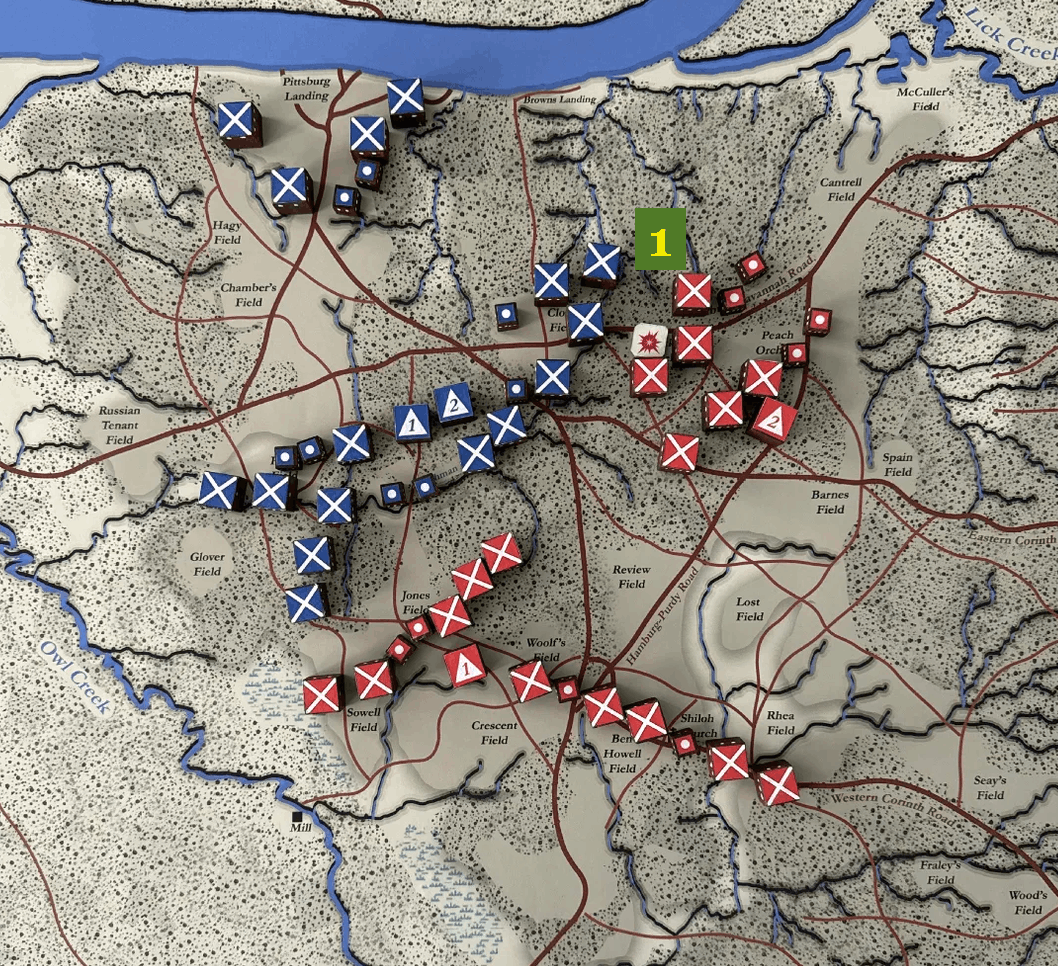
By 1500 the attack is general all along the line, with Confederates coordinating an all out effort. A strong concentration of artillery at (1) and (2) helps punch through the Union line.
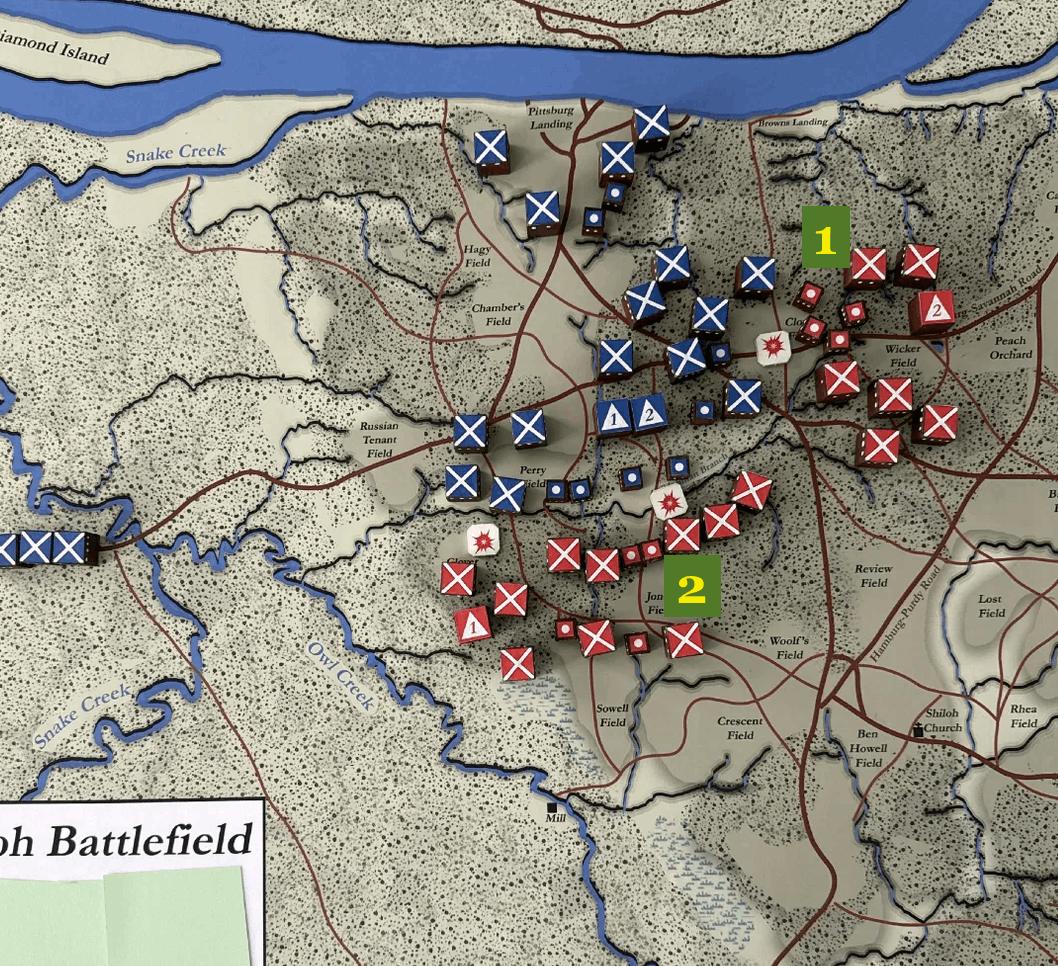
If we compare the game’s outcome to the historical situation, we can see the Union is pressed farther back in the game at this point. Historically, at 1500 Grant was establishing a grand battery on the third line to defend Pittsburg Landing while Prentiss and Hurlbutt (composited into “Wallace” in our game) were defending the Sunken Road, known to history as the Hornets Nest. In our game, the culminating attack with a relatively fresh Confederate force was going in where the historical second line was established.
By 1630, the inexperienced regiments in the “Wallace” group commanded by Lewis++ are being pushed out of position, and the union line is compromised. The Confederates have enough fresh brigades to push the attack all the way into Pittsburg Landing.
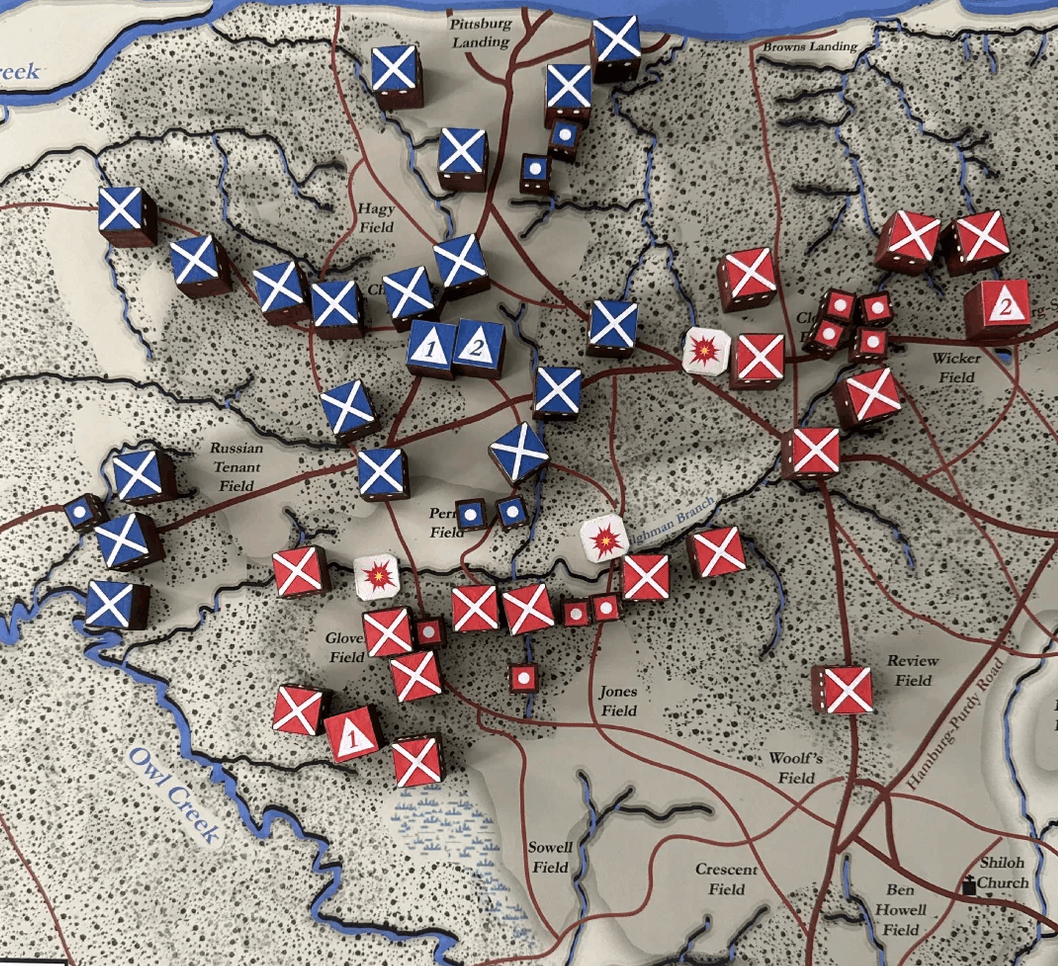
The game is called. It is a Confederate victory today.
Conclusion
In the AAR, we discussed the fact that Rebelsqurl did not have the debilitating effects of a disparate and confused command group as the Confederates did historically. As “one brain” he could coordinate the attacks more effectively than his counterparts. However, his maintaining of momentum was skilled play, and he earned the win.
Lewis++ pointed out that his flank effort at the end of the Sunken Road had the inverse effect of what he wanted. It ended up weakening the line. Seabass remarked that he was having trouble understanding where units were in the woods and though his end of the line held, it made his command problem more complicated.
The game being used is Battle Decisions: Kriegsspiel from Catastrophe Games.
Generally, the Union needed to trade space for time historically, and they need to in these simulations. The Union giving up so much space initially kept them from being able to take advantage of the terrain and exhaust the Confederates early. The Union must use the ridge near Shiloh Church and the Sunken Road to weaken the initially larger Confederate force.
What of Lew Wallace? Historically the three brigades and its supporting artillery under Lew Wallace had a miscommunication with Grant and did not arrive until the next morning to reinforce the Union defence. When that force arrived the following day, it did its duty. But Grant never fully forgave Wallace for being tardy. In the game, I used some randomness to determine if Wallace were to arrive earlier. He was on his way and was an hour out, earlier than the historical, but too late to deliver the Union a better outcome.
Can Shiloh be gamed via Kriegsspiel? Yes. If the players had no choice but to follow the historical script there would be no game to play. The Union players showed they could break from history and experiment with a different approach. Coordinating across a battlefield with a large number of obstacles leaves room for mistakes and alternate outcomes.
To umpire this well the terrain has to play a strong role in inhibiting movement and communication. The woods in the area are thick and line of sight problematic. There are many stories of the battle where commanders were separated from their commands through just being lost in the woods. This battle cannot be played without the element of confusion present.
Overall, a great scenario played by experienced players. Thanks to them for joining in and I look forward to testing more battles for their playability. We’ll see you out there.
If you’d like to join one of Kriegsspiels you can pop into this part of our forum for more
and you can also find out about the International Krieggspiel Society here
Thank you for visiting the Regiment of Strategy Gaming and riding with The Armchair Dragoons.
Rather than list a bunch of social media links, the easiest thing to do is to check out our LinkTree, which connects you to all of our various locales around the web.
You can also support The Armchair Dragoons through our Patreon, and find us at a variety of conventions and other events.
Feel free to talk back to us either in our discussion forum, or in the comments below.


