
 by
by Michael Eckenfels, 23 August 2026
When we left off last time, I was walking us through the disast-errr, I mean, the intricate set-up for what will be my Presidency. I make jokes, but the game is fun and a lot of that fun comes from managing or juggling said disasters, whether of my own making or the game’s. We shall see. Let’s continue with the story!

most images can click to enlarge
Based on the world’s current status and the USA’s presence on certain Strategic Tracks, we get to place some National Intelligence Counters on the world map. These will help us a lot when (if) dealing with Regions and their various problems, including our own. There are more than a few, though, out there that are challenging right off the bat.

Just from this screen, you can see there’s a lot going on in the Middle East, Central/South Asia, and Africa alone. All of them are a hair’s breadth from some Major Crisis and are hosts to a bevy of Terror Groups, Rogue States, Unstable States, not to mention suffering the inroads of diplomacy from Russia and China.

Africa, for one, is an unstable place. Their Regional Alignment is 5, which is how friendly they are to the US; it sits at a 5, which isn’t great, but from the 4 and 3, you can see it could be much worse. China has an Influence Marker here, there is an ongoing Civil War, there are two Unstable States, and three Terror Groups (two Level 1s and one Level 2). Terror Groups start at 1, and if they grow to 4, they can then become Rogue States. When they’re Terror Groups, you have more options that are…let’s say less invade-y to deal with them, such as special forces or drone raids. Once they go Rogue State, the only way to end them is to go to war with them. Why? Because too many Rogue States will end the game. They can also do bad things to Regional Stability, which can be bad to the overall game.
If you’re noticing a pattern here – namely, dealing with threats when they’re minor as opposed to letting them become full-blown problems – you’re starting to get a feel for what you need to deal with.

The Middle East is about as fun as a nightclub with guns and knives and explosions. This place is honestly a mess in this game; we have two US Military Footprints here, which does little to help with our Regional Alignment (which is 5 and trending downwards because the Middle East isn’t exactly BFFs with the US right now in the game). Russia has an Influence Marker here, there is a Civil War ongoing (when is there not, though – if there isn’t then wow, something is going right in this game), plus two Unstable States and four Terror Groups. Oof. Not to mention Iran, which is not a great influence on peace and stability here (note the Regional Stability is on 4, the next-to-last place on that Track). And finally, the Regional Crisis Levels Track shows it’s at 3; one more step and it’s off the deep end into a Major Crisis.
Before we go full panic mode here, keep in mind that we are Very Close with Israel, which will give us some good options to help mitigate the problems in this Region. It won’t be enough, but it’s something.

In Central/South Asia, this is where our forces are engaged in Afghanistan. Both China and Russia have Influence here and you can see the other counters. We have quite a few troops dedicated to this area, but not enough as we saw in the last chapter of this series.
Ultimately, back to the actual focus for this, I’m putting the Focused National Intelligence marker here on Central/South Asia. I really want to end this war as soon as possible – too many Wars on the map and it’s game over.

Now we go to the part of the Turn where we can Improve Strategic Capabilities. We were able to do that earlier thanks to my Military skill, and now we get to do it again, hopefully. This is only because our Economy is rated at a 6; at this level (5 or higher), we will get TWO chances to improve.

What to choose, what to choose…there’s a lot here we can do, but ultimately again, my first choice is advancing our Cyber Warfare Track.

Note the charts; we roll a d10 and on a 1-5, it’s a Success, but on a 6-10, it is a Failure and we waste that attempt. However, our Secretary of Defense’s Military rating gives us a -1 to our roll.

And of course I rolled a 6, which just barely gets us a Success (that -1 comes in handy!).

Our Cyber Warfare rating goes up to 3, just above the 2 for both China and Russia. Just like that, we’ve managed to get ahead of both of them, which will be useful later on, I hope.

Next, I want to try to improve our Space Warfare Track. We are currently on the 1 space there, tied with Russia, but China is one space ahead of us. This is the only other Track here where were are behind either country, so this seems to be the next logical choice.
Again, I get a Success on a d10 roll of 1-5, with a -1 thanks to the Secretary of Defense’s -1 Military rating.

Not quite so lucky this time as I rolled a 7. We missed out on improving our Space Warfare standing, this time. That -1 modifier lowered us to a 6, which just misses a Success.
Next up, we need to set focuses for the POTUS (President of the US) and Cabinet.

These Focuses are essentially attempts to improve ratings for various things, such as our Economy or Public/Press Relations. We can do six of these, with the topmost one having the best chance of improving and the bottommost one having the least chance of improving.


I decided that Addressing Domestic Crises first is best since we have one lingering there. Note the text in the blue space under ‘Success Effect’ to the right; you can see what this will do, if successful. And you can see the chances of that on the POTUS/Cabinet Focus Priority counter itself; this first-ranked one has a 1-5 chance of succeeding whereas the last one in space 6 will only succeed on a roll of 1.
We’ve done a lot of set-up to this point. Now, it’s time to start making some decisions. Hopefully good ones.

There are a lot of possibilities, here. I have five people who can do things, including myself as POTUS, the Vice President, and my three Cabinet hires, and in this segment I get to point at one of them and say, in effect, “you. Go do a thing. Please don’t muck it up.” Each has their own menu of Master Actions depending on who they are: the Chief of Staff and VP handle Domestic business, the Secretary of State works the world, the Secretary of Defense handles the parts of the world that can (and probably will) shoot back. And I, POTUS, can reach into any of those buckets myself, plus a few things only a President can do.
This is the latest episode in a running playthrough of Mr President from GMT Games & Exia Labs; you can find the links to all published episodes at the end of article, with new installments each Sunday
This is the central tension of the whole game, and while it may seem somewhat manageable at the start of any game, there are always more things that need doing than there are people to do them, and more segments that need people than I have patience for. Every “who acts next” is a small confession of priorities. Pointing at my Secretary of Defense means I’ve decided the thing on fire this instant is more urgent than the thing merely smoldering over on the domestic side. Nobody acts for free; everybody acts instead of someone else.
Right now, though, few of these pressures have arrived yet. The world is, despite looking dangerous, somewhat quiet for now. No crises, no smoke, no aide sprinting down a corridor with a folder. Just me and my little roster of five, standing around the Oval Office, fully staffed and entirely unbothered, like a team photo taken before the season starts and everyone still believes they’re going to win it all.
So I get to make this first choice in a state I will look back on with enormous fondness: calm, unhurried, and operating under the sincere delusion that I have enough people to go around. I’ll savor it. It does not last.

The country comes pre-loaded with that Domestic Crisis sitting in the continental US, a problem that predates my swearing-in and was apparently left in the desk drawer by the previous occupant along with a note that said good luck.

So I do the sensible thing and send in the man I hired for exactly this. Eric Massey, Chief of Staff, the domestic specialist, the 1 in a field of zeroes, the pick I spent three paragraphs justifying to myself earlier. This is his moment to prove the arithmetic. Addressing a Domestic Crisis (Domestic Master Action #2) tries to knock the Domestic Crisis Level back down and make a full-blown Domestic Failure less likely; this is the kind of failure that spawns Lingering Domestic Issues and bleeds Public Approval, and which every President is trying to stay well away from.

The action calls for a roll, and this is where the afternoon’s careful staffing pays off in cold numbers. My modifier is -3, and on this roll, as with most of them, lower is better. I want to come in at or under the target. Where does the -3 come from? It’s the payoff for choices I’ve already made and forgotten I made. My Domestic Focus attribute is shaving points off this kind of roll, the situation stacks a bit more in my favor, and it all lands on the die before I even touch it. This is the game’s way of rewarding a President who staffed the right department and happened to be built for the work.

I roll a 2. With the -3 hung on it, that’s a resounding, unambiguous success. For once, it’s not a squeaker win, not a “well, technically,” but the kind of result where the crisis simply goes away and everyone in the room pretends they were never worried in the first place.
I’ll take the win and, more importantly, I’ll take the vindication. Massey earned his 1 on his first outing. Domestic Focus earned its place on my little list of attributes. And I get to walk out of my first real decision as President having actually fixed the thing that was broken when I arrived – which, I suspect, is a feeling the game intends to make increasingly rare.

Since the Chief of Staff has acted for now, I cannot choose him again. I need to select who is going to go next, which is guided by whatever task it is I want to complete next.

Looking at the map, there’s more than a few things to mitigate right now. I turn to Henry Hanes, my Secretary of State. Central/South Asia is a mess right now, not just because of our ongoing war there but for a variety of reasons. The ‘Trending Anti-US’ marker is not going to help, so I feel like getting some underpinnings of support going, even a little, can go a long way.

Henry’s Diplomatic skill of 1 gives me a -1 DRM; I get a 4, which rounds down to 3, which is a success. Somehow, he manages to calm some things down, and that Trending Anti-US marker goes away.
The thing about Regional Alignments, like a lot of things in this game, is it takes two successes to move something in a direction. Likewise, it takes two fails to move it down. If I tried this again and succeeded, I’d place a ‘Trending Pro-US’ marker on this space, and then it would take yet another success to actually move the marker up one space.
As you can see, a lot of things have a momentum of their own that is gargantuan and it takes quite a bit of effort and time to move things the way you’d like them to go. And on top of that, there’s never any guarantees it will ever go your way.
So what’s next?

Improving my relations with Congress seems like a good idea. Later on when I’m trying to push legislation through there, having good relations will help a lot. I go ahead and spend an Action Point, lowering my total from 17 to 16, to get a -1 DRM.

With a 3 rolled, that’s a success and my Relations with Congress marker moves up from 5 to 6. Unlike Regional Alignments, this does not need two successes to move it, thankfully.

Now it’s time for my next Action, and it’s up to either me or the Secretary of Defense. It’s about time I stepped up and tried to get something done.
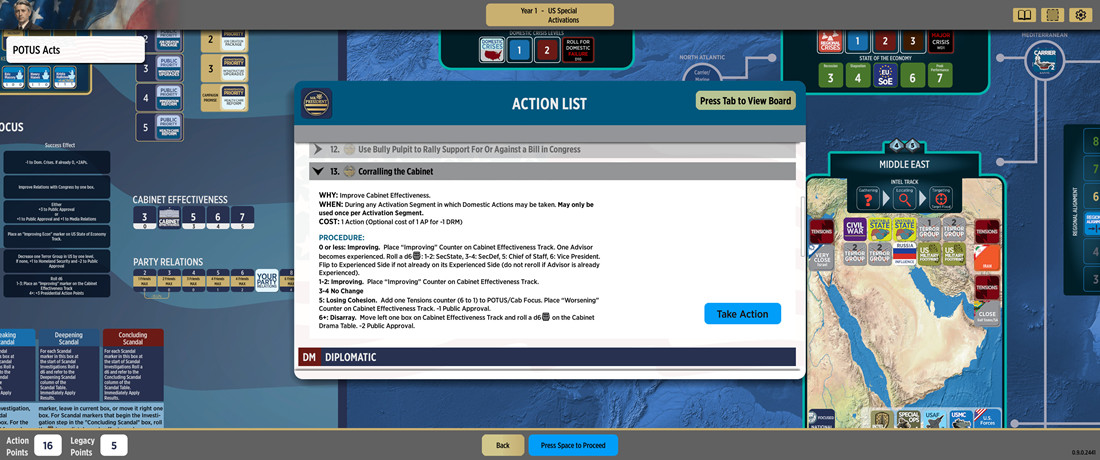
Corralling the Cabinet is a good choice here, as it will improve my Cabinet’s Effectiveness. Right now, it’s sitting at a 4, one spot above the bottom, and they need some encouragement to get good.

I rolled a 2, which is a Success – well, I did spend another Action Point, reducing my total now to 15 Action Points, so I can get that sweet -1 DRM. This success means the game puts an “Improving” counter on our Cabinet Effectiveness marker on that Track. Like Regional Alignments, this ship doesn’t move on a dime either.

Next up is my Secretary of Defense. I’d mentioned before that this war in Central/South Asia is at something of a stalemate, so I need to send more strength to the region. The best way to end this is to win it instead of half-arseing it.

There is a USMC unit in the area, which the SoD can move. (Hahaha, ‘sod.’ Ahem.)

That Marine unit is moved to Central/South Asia, which adds 3 more Combat Strength to the Region. It’s not a lot but it’s better than nothing.
Next up, things become a little more…interesting. Either China or Russia will now Act. Whichever one does not Act right now, will do so later. And lucky us, it’s Russia.

A lot happens, here. The board game walks you through everything you need to check to see how they do, and honestly, I prefer the tactile environment of that. The computer game here moves pretty quickly at times and if I click accidentally, I miss something. I will do my best to ensure I don’t miss anything here, though.
The first thing is, the game checks to see of the Russkies win. Considering how early it is in the game, this is not going to happen. At least, not now. The screenshot above indicates a few things that need to happen for Russia to win, and more importantly, for us to lose.

The current Posture of Russia is 2; it can be either 1 or 2, and 2 is bad because it makes them more aggressive. The Tension counters don’t help, but at least things can’t get much worse, here. They’re sitting on a heap of anti-US feeling and an Economy that’s not in the greatest of shape.
Keep in mind this is vaguely in the timeframe before Russia invades the Ukraine in real life. The game does a great job of simulating the world but it does not always fall exactly as things have historically, so we don’t know what will happen.

Their Relations with the US do not change; at least they don’t get worse. We’re one step away from Cold War 2.0, and it would be good for this not to happen.

Mr President AAR – No One Asked Me To Be President
PART 1 ~ PART 2 ~ PART 3 ~ PART 4 ~ PART 5 ~ PART 6 ~ PART 7 ~ PART 8 ~ PART 9 ~ PART 10 ~ PART 11 ~ PART 12
Thank you for visiting the Regiment of Strategy Gaming and riding with The Armchair Dragoons.
Rather than list a bunch of social media links, the easiest thing to do is to check out our LinkTree, which connects you to all of our various locales around the web.
You can also support The Armchair Dragoons through our Patreon, and find us at a variety of conventions and other events.
Feel free to talk back to us either in our discussion forum, or in the comments below.


