
 by
by RockyMountainNavy, 7 September 2026
I am—proudly—a grognard wargamer. I absolutely enjoy playing wargames designed using the classic “hex & counter with die rolls on an odds-based CRT [Combat Results Table].” That is not to say that I ignore other wargame design mechanisms. To the likely surprise of some critics historical conflict simulation aficionados, I am a wargamer that seeks to explore a wide variety of game systems. This includes wargames with cards (oh…the horror!). Today I look at two card-play wargame systems: Point Blank: V is for Victory from Lock ’n Load Publishing and Combat Commander: Europe from GMT Games with a particular focus on two recently reprinted expansions: Combat Commander: Mediterranean, 3rd Printing and Combat Commander: Resistance!, 2nd Printing. Spoiler Alert: I generally like what I see, but with a few caveats.
BLUF
Let me cut to the chase: Combat Commander: Mediterranean and Resistance! and Point Blank: V is for Victory are interesting tactical, squad-scale wargames of World War II infantry combat that use cards—but each in different ways. Regardless of the different design approaches, each game builds an enjoyable, surprising—and even occasionally frustrating—narrative in play. Each deserves time on your gaming table.
Ad-ing up the contenders
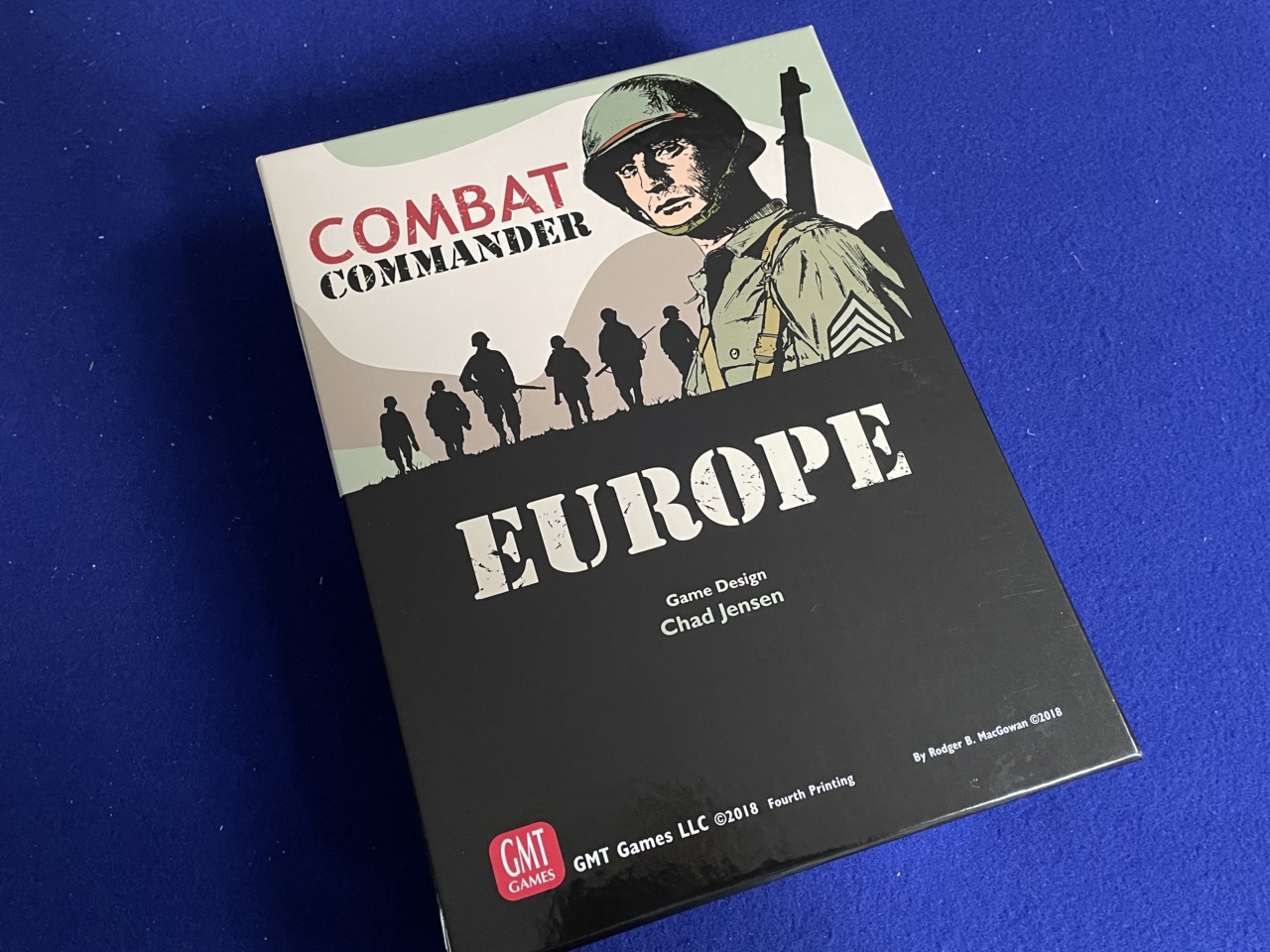
Two recent releases from GMT Games are the primary drivers for writing this piece. Combat Commander: The Mediterranean is Volume II of the Combat Commander-series and is now on its newly released Third Printing. Combat Commander: Mediterranean is not a stand-alone game; you need Combat Commander: Europe in order to play. As GMT Games explains in the ad copy for Mediterranean:
CC:M’s main theme is the addition of three new “nationalities” to the Combat Commander family:
- Britain & the Commonwealth
- France & the Allied Minors
- Italy & the Axis Minors
Combat Commander: Resistance! recently released its Second Printing. This game is a bit different from Combat Commander Volumes I (Europe) or II (Mediterranean) as is seen in the ad copy:
Combat Commander: Resistance! expands upon CC:Europe and CC: Mediterranean by adding partisans and their war behind the front lines. This fourth volume of the Combat Commander Series [Volume III was Combat Commander: Pacific which I discussed for The Armchair Dragoons previously] features special rules and components for fighting with Partisan forces against the Axis nations of Europe.
Taking a step back for a moment, consider the ad copy for Combat Commander: Europe which advertises:
Combat Commander: Europe is Chad Jensen’s award-winning card-driven board game immersing players in tactical infantry combat in the European Theater of World War II. One player takes the role of Germany while another player commands either America or Russia. These two players will take turns playing one or more “Fate” cards from their hands in order to activate units on the mapboard for various military functions [my emphasis].
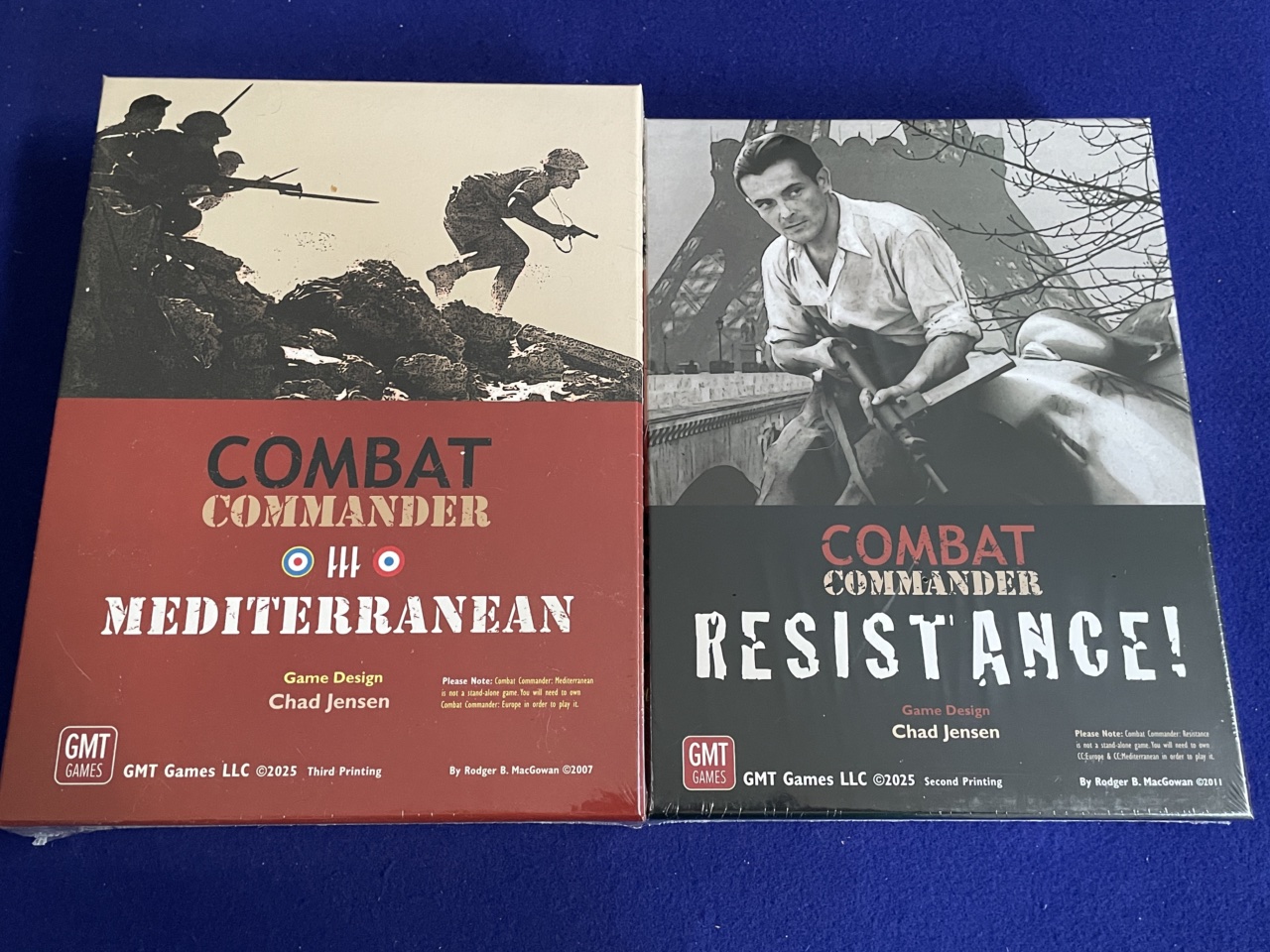
Point Blank: V is for Victory, 2nd Edition was released by Lock ’n Load Publishing in 2022. The back cover of the Core Rules explains what Point Blank is:
Point Blank is a World War 2 squad level card game where players maneuver forces to attack or defend objectives defined in scenarios. Game components are represented by cards consisting of squads, Vehicles, Support Weapons, and leaders. Counters are included with the game and are used to mark player forces with information about the condition or state of the unit.
The forces are powered by Action Card drawn from a common player Action Card deck. Cards are drawn into a hand by the player and used in an impulse faction to maneuver or fire the forces. The units (forces) maneuver on an abstract game board that will contain Terrain and Objective cards. The game board has some static positions in place at the beginning of a game but the majority of the remaining game board is developed as the players move their forces around on the battlefield toward their objective.
To be clear, Point Blank is the series rules while V is for Victory is the game-specific module. In much this same manner Combat Commander is the series rules with various modules; of relevance to our discussion today being Mediterranean and Resistance!.
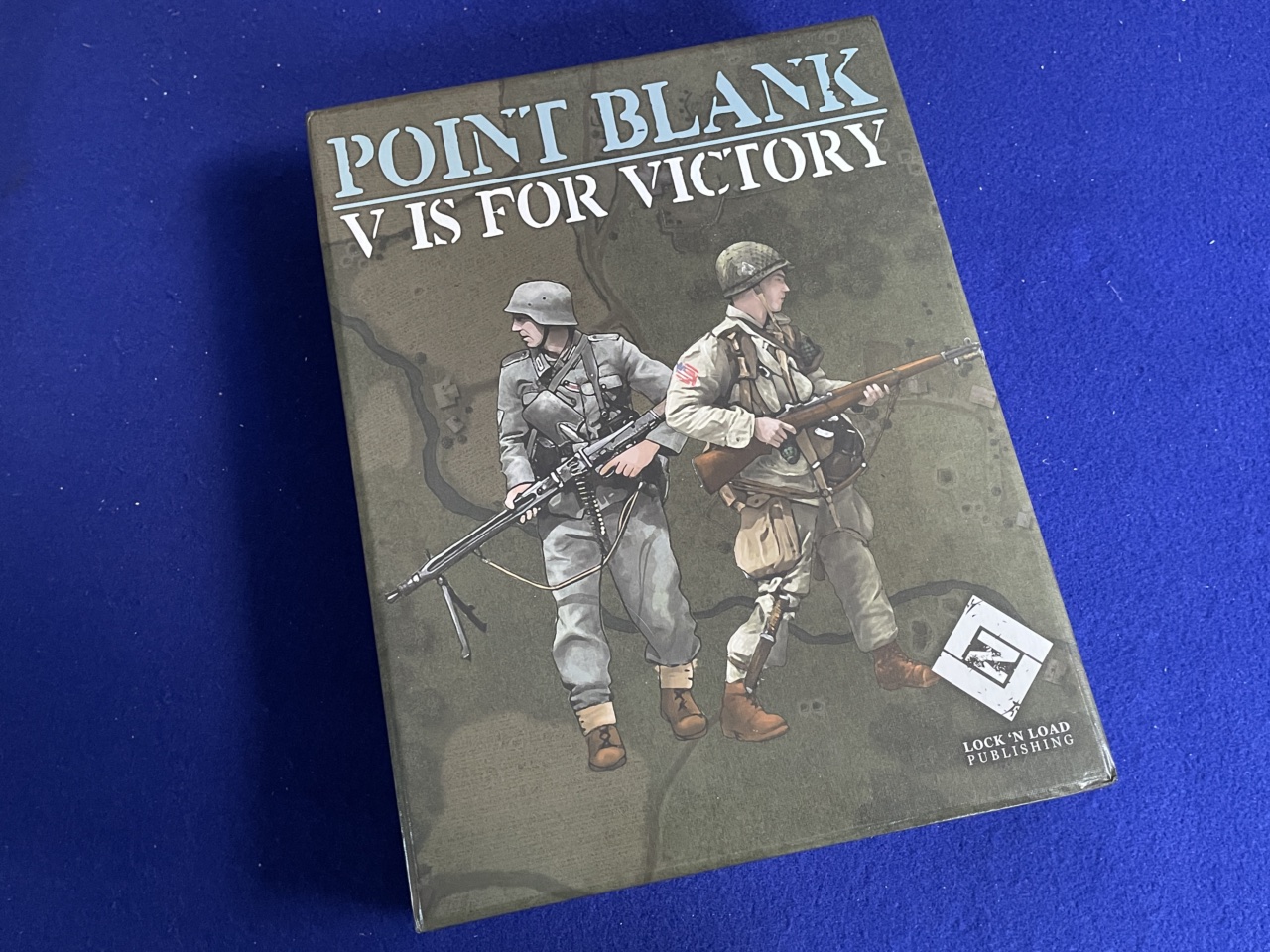
Ace of Clubs (Mediterranean) and Ace of Hearts (Resistance!)
The Design & Development Notes in the Playbook for Combat Commander: Mediterranean provide useful details on how this volume of the series is different from the first. Given the fact that Fate Cards mechanically drive the game, it seems obvious that variations in the Fate Deck could be used to differentiate between Factions. I hate to see card-counting in a wargame but in some ways that skill is what players need when playing the different Factions in Combat Commander: Mediterranean. In particular, the Design & Development Notes has these mentions:
- “As far as the British & Commonwealth Fate Deck is concerned, it has some interesting pluses and minuses. It has two fewer Fire Orders than average (16) but sports six Marksmanship Actions—so you will be taking fewer shots but of generally higher quality. This reflects the British emphasis on personal marksmanship as well as their particular form of steadfastness under fire. The renowned British honor, courage, and dash on the battlefield is represented by having one extra Recover Order in the deck (10 instead of the nominal 9) while also being able to generate more Heroes and suffer fewer Cower and Prisoner of War Events than the other factions.”
- “…this faction [France] is assigned the unfortunate discard capability of only 1 card per Turn; the lowest in the game….”
- “If you find yourself as the scenario defender, however, don’t panic just yet; you do have quality units and a decent Fate Deck…note that most of the French Command Confusion Orders share their card with Sustained Fire Actions—so fire your MGs often and hold that trigger down!….”
- “The French Fate Deck is a bit weaker as far as artillery goes; it has little smoke-making capability; it has little chance of getting air support; and it will generally see a higher incidence of weapons breaking when firing. It also has a high number of Command Confusion Actions, though most of these are paired with Rout Orders: so if there’s a broken unit in play—enemy or friendly!—play the Rout just to cycle that weak card if nothing else…Despite the minor drawbacks, the rest of the deck is quite robust when compared with other nationalities.”
- “The Italian player will be saddled with a discard capacity of only “2”—the second worst after the French & Allied Minors….”
- “The Italian Fate Deck is the weakest amongst the Factions and should be played with care and thought. Your useful orders and Actions are scarcer then for your opponent. You have one fewer Move Order (“we’re staying put!”) and one fewer Rout Order (who runs from the Italian Army?). You dislike Melee with your units’ smaller Firepower and fewer Ambush Actions. Your weapons will jam more often (6x Jammed!) and your sharpshooters will miss more often (only 5x Sniper!). Your Events are more likely to cause an Italian unit to Suppress or become a P.O.W. while giving them fewer chances to become Veteran or to generate a Hero.”
- “In CC, Italian Squads and Teams will tend to have a higher standard Morale on their unbroken side but less-than-average Morale while Broken. This—coupled with a high rate of Cower and Prisoner of War Events in their Fate Deck—reflects the Italian soldier’s propensity for ducking out of a fight once the brown stuff hits the fan….”
- “The Italians had some of the worst-designed weapons of WWII and this is reflected in their CC arsenal….This is part of the reason for the Italian Fate Deck’s high number of Jammed! results; that and their chronic lack of ammunition—a functioning gun is a useless gun with no more bullets to feed it.”
- “Playing the Finns—…To help reflect their quality within a faction geared for quite the opposite I have allowed a player commanding a Finnish OB to discard up to one card even if he has given one or more Orders during the same Turn! Fans of the card game Up Front will recognize this ability for what it is; powerful, versatile, flexible. This ability is coupled with the minor drawback of getting one fewer Orders than a similarly-sized OB. These two special rules taken together help reflect the Finnish soldiers unique trait of “sissu”—roughly translated as individualism and initiative.”
Indeed, reading the complete Design & Development Notes by designer Chad Jensen and co-designer John Foley, one quickly realizes that Combat Commander is very much a hand-management game not that much unlike many deck-building boardgames.
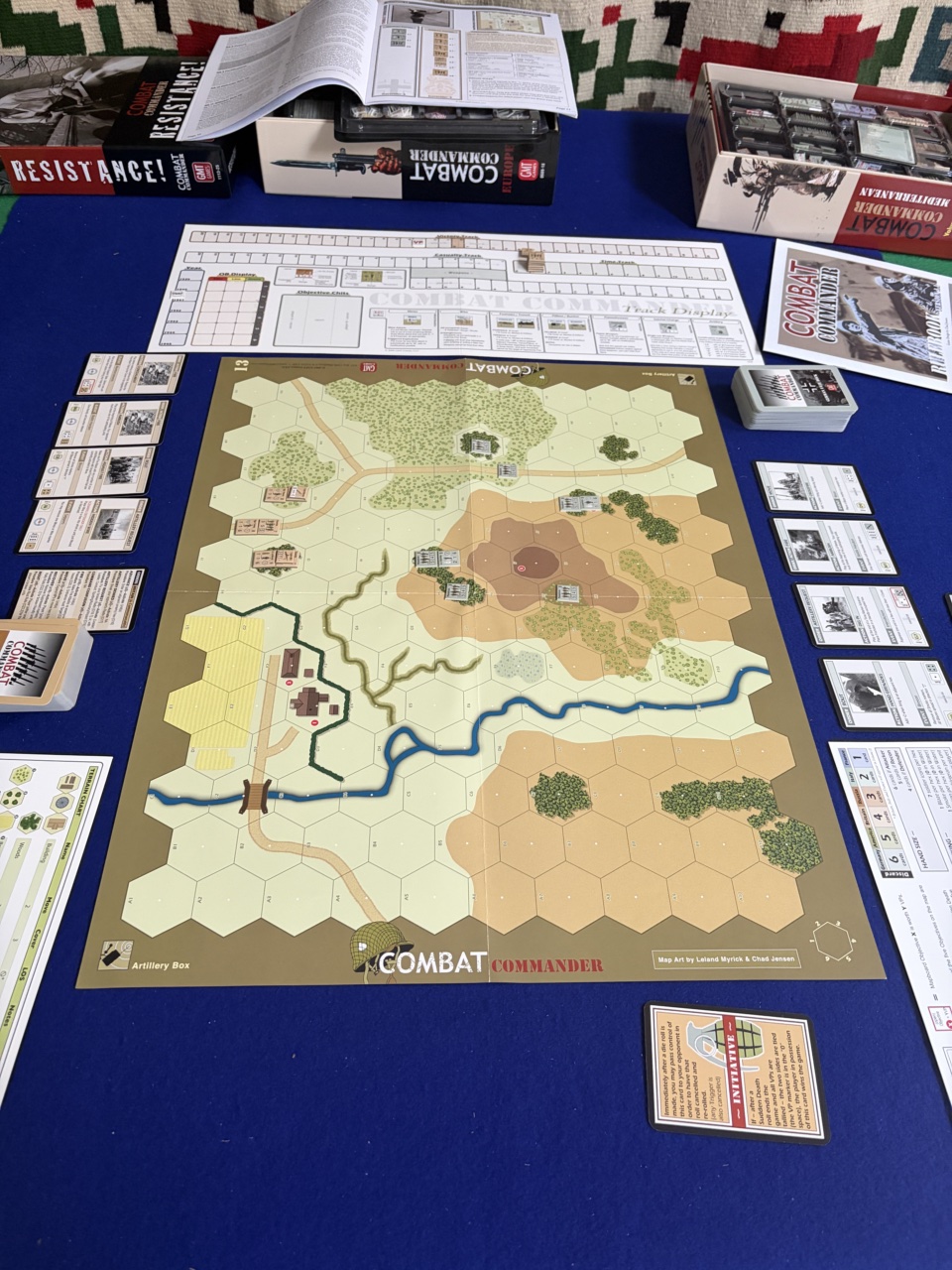
In the “Design & Development Notes” from John Foley for Combat Commander: Resistance! he notes the heart of Combat Commander is, “the narrative experience of combat” and the challenge was to tell the story of armed resistance with, “a telling narrative in scenario form.” He goes on to note,
From a design perspective, the game engine is not able to represent some of the types of resistance in a form that provides two players the opportunity to explore unit tactics and command in some kind of meaningful way. (Playbook, p. 9)
What Combat Commander: Resistance! delivers in a short 12 page Playbook (of which only five pages are new rules) are rules for the structure, stats, and weapons for Partisan Factions. (R1-R4). There are also new rules for more partisan-like combat, especially Irregular Melee (R5), Sewers (R6), new orders Infiltrate (R8) and Muster (R9). New Actions are Knife (R10), No Quarter (R11), and Trap (R12). Three new Events round out the Factions: Inexperienced (R13), Patriotism (R14), and Stealth (R15).
Given the stated limitations of the game engine, scenarios in Resistance! look at, “temporary liberation of areas, guerrilla warfare and (in the case of trapped forces) breakouts with detachment and company-sized forces… (Playbook, p.9).
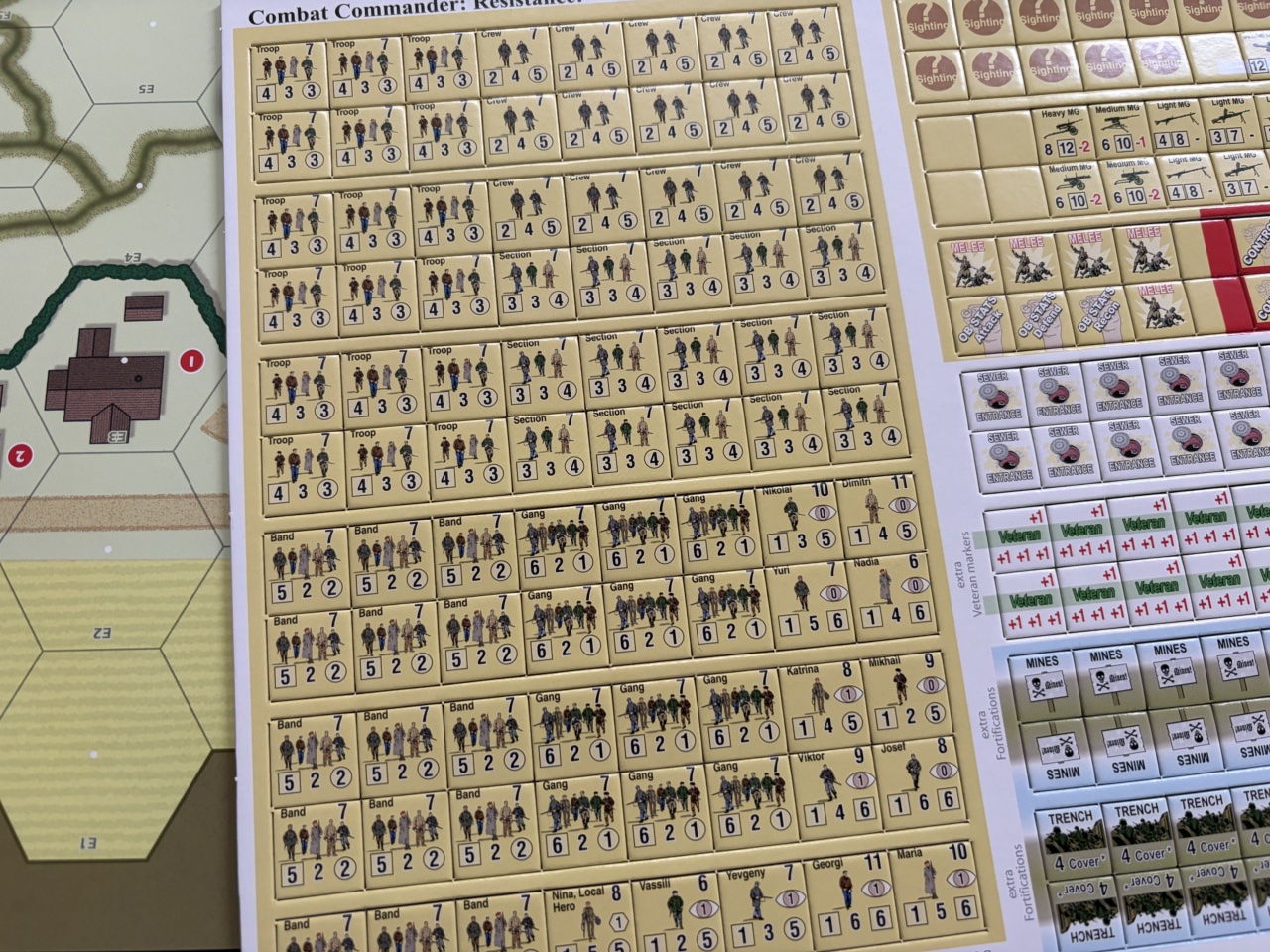
Diamond cards
Specific to the games discussed here—and please forgive me for what I am about to say—Combat Commander: Mediterranean and Resistance! come off to me like Squad Leader...but with cards. No, not Advanced Squad Leader but the original John Hill Squad Leader. I mean that in the most flattering way imaginable; Squad Leader is an excellent wargame coming from the “design for effect” school of game design. In Combat Commander one has, what is at heart, a hex & counter wargame but instead of initiative numbers or morale or experience determining the order in which things happen, Fate Cards drive decisions as to what the player can try to make happen. Your squad may be lined up with that perfect shot…but the wrong Fate Card is in your hand. This makes Combat Commander very much a game of “making do with what you can;” you know, more like war really is. The Mediterranean volume introduces forces that many players likely overlook in the rush to be all-things German vs. Americans. Resistance! throws very different challenges the player’s way: can you stand up (enough) against a regular force with your hearty (and maybe a bit hungry) band of irregulars and strike a blow for freedom?
Ace of Spades (Point Blank: V is for Victory)
V is for Victory is a rules and scenario module for Point Blank that has 22 scenarios based on real historical battles from between June and December 1944. There are also rules for DYO (Do Your Own) scenarios and a Campaign with three scenarios. Forces are German, American, British, Canadian, and French Resistance. Battlefields range from a simple 3×5 grid (DYO Meeting A) or a 5×3 grid (DYO Meeting C) and can get as large as 5×9 (Long Rail Coming, Frozen Blood at Bütgenbach).
Personally, Point Blank: V is for Victory was a more difficult game for me to get into. While I recognize that the game is using many different cards to build a narrative, the process in doing so was a bit too abstract for me. Yes, I see the narrative but it takes a bit more cognitive activity to make the connections between all the abstractions. All too often the story that developed was along the lines of, “Hey, my unit moved into [draw a card] clear terrain. Now they are sitting ducks out in the open. Well, that sucks!” Maybe I just need to play more. Or maybe this game is just a bit too abstract for my liking. Your mileage may vary.
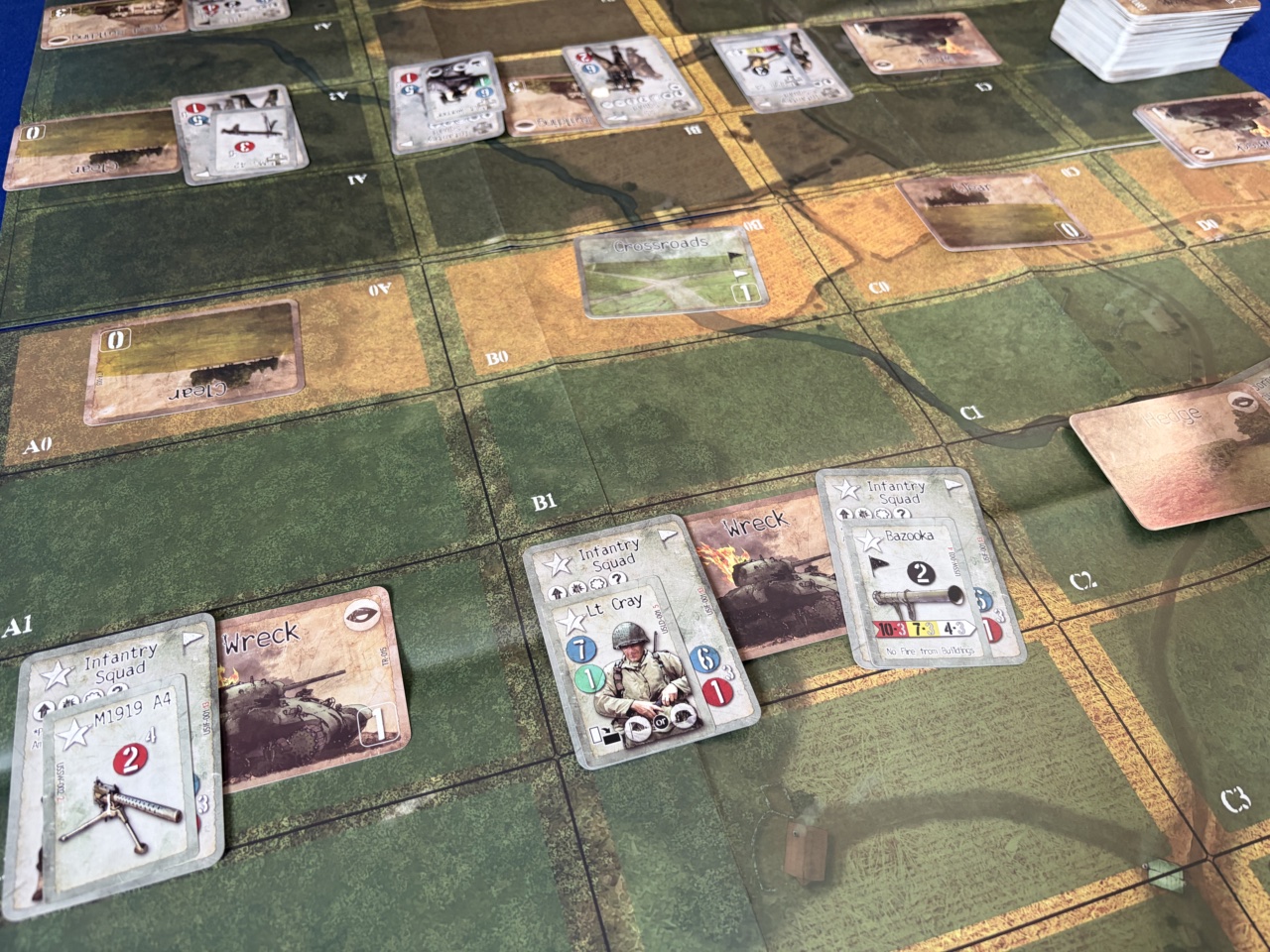
Place your bet
So which one to play? Good question…and there is no right—or wrong—answer.
First, I will repeat: neither Combat Commander: Mediterranean or Resistance!, nor Point Blank: V is for Victory, are tactical combat simulations. In the Design and Development Notes for Resistance!, John Foley outright stated the obvious that Combat Commander is about, “the narrative experience of combat.” The same can be said of Point Blank: V is for Victory.
Ultimately, what sets Mediterranean and Resistance! apart from V is for Victory is, unsurprisingly, the cards. In a Combat Commander wargame such as Mediterranean or Resistance! the cards—in a very card-driven game fashion—drive the action in the game. In V is for Victory, on the other hand, the cards literally are the game…no hex and counters or die rolling here!
When playing a more classic wargame—one often without cards—players certainly can “write a story” with the game but, at least in my experience, the story is dominated by tactical actions, i.e. “First Squad fires at the German machine gun team.” In many wargames there is little that units cannot do and the variables in the story delivered by the game tend to revolve around die rolls.
Many wargames give players an incredible amount of control over their units. That is, perhaps, why I tend to enjoy wargames with good—and admittedly at times complicated—command and control rules. Wargames can enforce command and control limitations with rules or factors…or cards.
These card wargames—Mediterranean, Resistance!, and V is for Victory—use cards to allow or empower a unit to act in some manner. A unit can be lined up for that perfect shot but unless a Fire Order is in hand the unit cannot take that final shot. Or the unit is moving to try to flank the enemy but runs into a…marsh. In the real world the best laid plans never survive contact with the enemy. In a Combat Commander or Point Blank wargame on your gaming table the perfect strategy is inevitably going to be upended by—literally—the luck of the draw.
And this is not necessarily a bad thing….
You can chat about this game in the Modern World section of our discussion forums
Thank you for visiting the Regiment of Strategy Gaming and riding with The Armchair Dragoons.
Rather than list a bunch of social media links, the easiest thing to do is to check out our LinkTree, which connects you to all of our various locales around the web.
You can also support The Armchair Dragoons through our Patreon, and find us at a variety of conventions and other events.
Feel free to talk back to us either in our discussion forum, or in the comments below.


