
 by
by Zachary Grant, 18 February 2026
In the past, I don’t think I focused enough on the wargames that are available about the battle. In order to change that, for this installment of Wednesday War Stories, instead of writing about the Battle of Eylau, I decided to focus on some of the wargames about the Battle of Eylau.
Having contributed a couple Wednesday War Stories in the past, I tried to provide background information leading up to the battle, then describe the battle, and sometimes what happened after the battle. The challenge is there are plenty of sources to get better descriptions of the battle than from me. For example, you all can use your favorite search engine to find information from the Napoleon Series website about the Battle of Eylau, or you can get descriptions of the battle from books, such as Petre’s Napoleon’s Campaign in Poland 1806-1807.
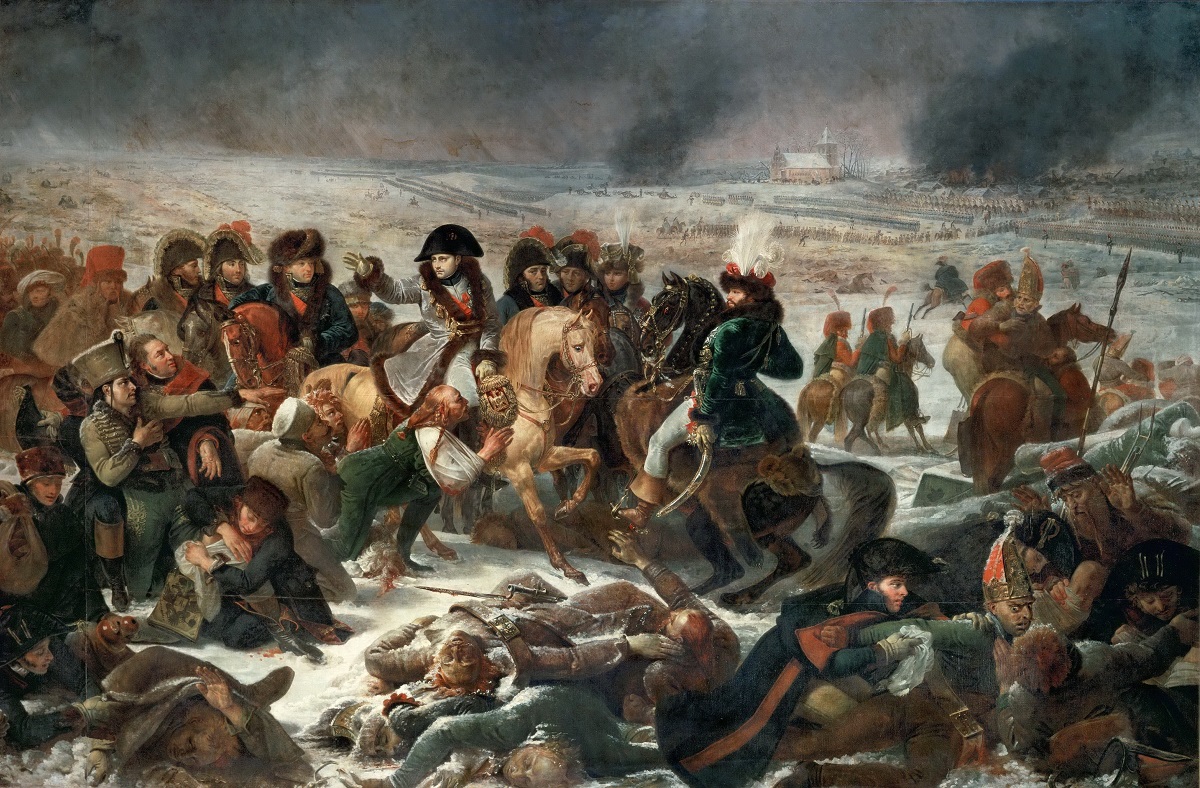
click images to enlarge
Wait, what’s that? You’re not familiar with the Battle of Eylau? Okay, here a short description, which I’m paraphrasing from Wikipedia:
Background
After defeating the Prussians in the fall of 1806, Napoleon turned his attention to the Russians who, in the winter of 1807, were advancing their army into Poland.

Battle
The French and the Russians met near the village of Eylau and fought for two days. By the evening of 7 February, the French captured Eylau with both sides suffering many casualties. On the 8 February, the main battle commenced. A snow storm occurred during the second day, which hampered both sides. A French attack was stopped by the Russians, with the French taking heavy losses. The snow storm played a role in this, causing the French to lose their way and to be attacked by both French and Russian artillery. Napoleon, in order to save the situation, ordered a massive cavalry charge which allowed more French forces to get into the fight and push the Russians back. The late arrival of a Prussian corps slowed the French attack, allowing the Russians and the Prussians to retreat as the day ended.
After the battle
Ney famously said, “Quel massacre! Et sans résultat!” Translated this means, “What a massacre! And without a result!” The French captured Eylau and it cost them a lot of men and resources. The Russians and Prussians suffered heavy losses too. In the end, on 14 June, Napoleon defeated the Russians at Friedland and the Treaties of Tilsit were signed.
See how easy that was?
Oh, before I forget, the Armchair Dragoon’s own Jim O. has been fighting the Battle of Eylau using Sam Mustafa’s Blücher (2015) on Saturday Night Fights this month. Here is part one of their game and here is part two.
Now, onto some of the wargames about Eylau!
The Wargames
There are 16 wargames that have Eylau in their title at BoardGame Geek, (BBG); however, I’m confident there are more games about this battle than are on this list. This list doesn’t include miniature wargame scenarios, and some games, like 1807: The Eagles Turn East (1994), do not have the name Eylau in the title at all, and yet it is a wargame about the Eylau campaign. Nor does it include Wargame Design Studio’s Campaign Eylau-Friedland (2019). I am not going to comment on all the possible games out there. I will focus on the board wargames with which I’m familiar. If you have recommendations, either list them below in the comments, on the Armchair Dragoons’ forums, or their other social media places.
I am not attempting to review the games. Just like describing the battle, there are a lot of places where you can find information about these games. I will highlight what I think makes the game interesting and provide a few pictures for your enjoyment. I think the most logical place to start is with Kevin Zucker’s games and I have three of them.

1807: The Eagles Turn East (1994)
Let’s begin with 1807: The Eagles Turn East (1994) from Clash at Arms Games. This is volume II of the Campaigns of Napoleon series created by Kevin Zucker. It is an operational level wargame. This series is commonly referred to as the “Campaigns of Napoleon System – 1x” system. The game scale is 3.2 km, or about two miles per hex, each strength point is 1,000 men or 16 artillery guns and a turn is 2 days (Zucker, 1994).
The game has a standard set of rules for the operational system, an exclusive rules book for this particular game and a study folder which provides an excellent treasure trove of historical information about the entire Eylau campaign. There are three maps in the game at 22 x 34 inches. When all three maps are placed together, the game surface is over 5 feet in length!
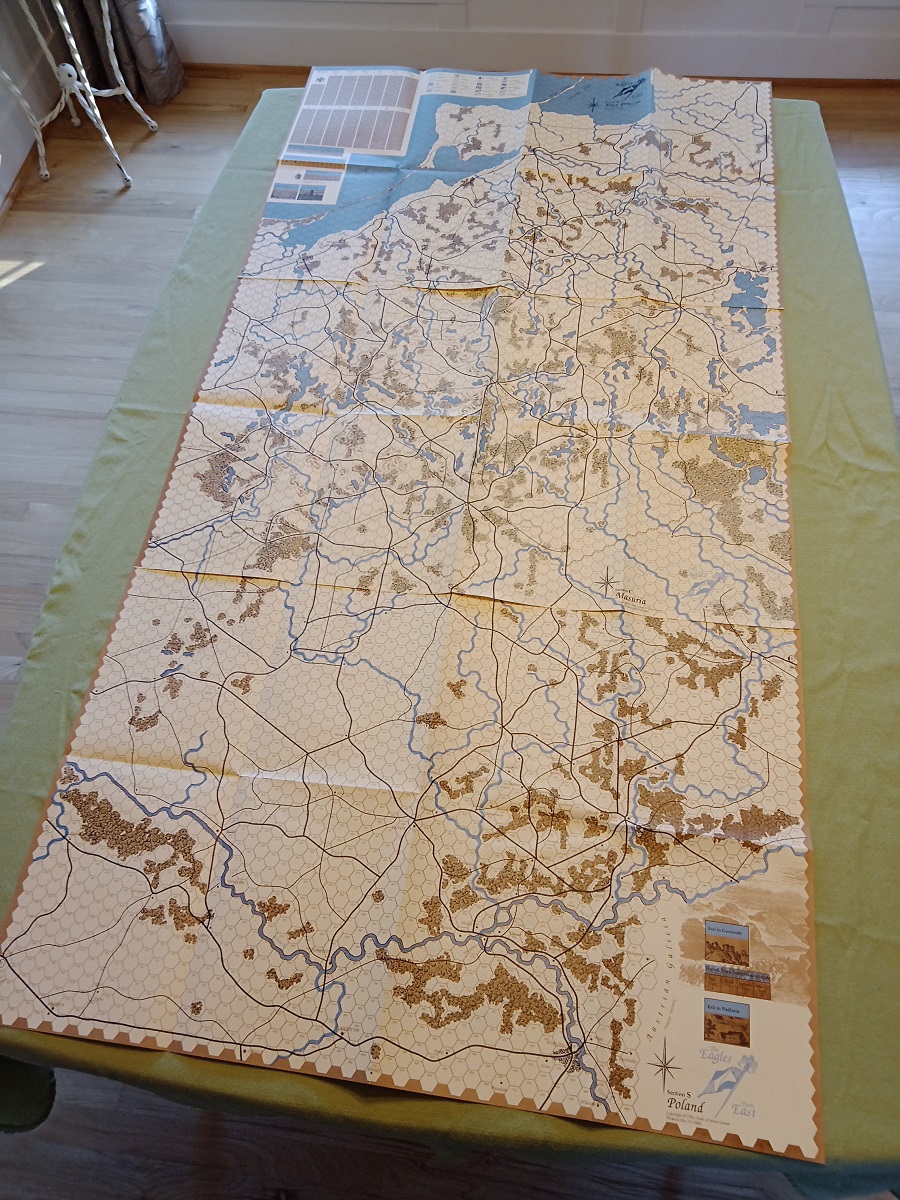
If you are not familiar with how Zucker represents unit forces and strengths, here’s how it works. Instead of representing each battalion, regiment, or division as stacks of counters a mile high on the map, à la Operational Combat Series games or Advanced Squad Leader, only the leaders and vedettes, or scouts, are on the map. Let’s turn to the standard rules for an exact description:
“Combat Units remain throughout the game on the Organization Display according to their nationality. The Leader they are assigned to, and the strength of the units are shown by the spaces they occupy on the Display. They remain on this display as long as they have at least one Strength Point. If at any time they drop to zero, they are immediately removed from the game. … Leaders may either be on the game map, or the Organizational Display depending on whether they are subordinate to another Leader or acting as a Force Leader” (Zucker, 2, 1994).

Zucker (1994) highlights the four main concepts of the game:
- March attrition: the further you march your forces the higher the chance of losing force strength by men dropping away due to fatigue, injury or illness.
- March by command: this is an automatic way of moving forces; however the units must meet certain criteria, such as not being in an enemy zone of control.
- March by initiative: a force can move only if their leader passes an initiative check.
- Combat: losses suffered during the course of a battle.
This system works very well. During gameplay the leader counters are flipped to their reverse side, so the players only see the nationality flag on the counter. Your opponent doesn’t know which counter represents which leader, nor what sort of force they are commanding. Zucker also uses outposts, or vedettes, to represent small groups of cavalry that the players can use to disguise their forces. Is that a real force swinging to the west of Eylau, or is it just a group of vedettes?
This game has three battle scenarios: The battle of Pultusk/Golymin, Eylau, and Friedland. It has three campaign scenarios for each of those battles. The individual battles use one map, while the campaigns use them all. The campaign scenarios can include supply and foraging rules to add an extra element of managing your forces.
If you can get this game, or have a chance to play it, I recommend you do so. There are copies available from Enterprise Games and Noble Knight Games, so it is possible to get a copy if you wish to purchase it.
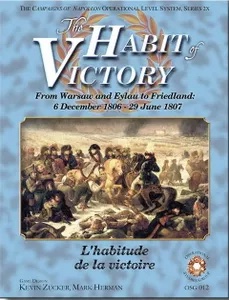 The Habit of Victory (2007)
The next Zucker game about the Battle of Eylau is The Habit of Victory (2007) from Operational Studies Group, (OSG). This is Zucker’s Campaigns of Napoleon series 2x system, so the game scale is larger than the 1x system; however, it isn’t exactly twice as large. Hexes represent 6 km, or 3.75 miles, each turn represents 3 days and 1 strength point is the equivalent of 3,000 men or 42 pieces of artillery (Zucker, 2007).
This game includes the standard rules for the 2x system and an exclusive rulebook for this campaign. Instead of using three separate maps which can be combined into one large map, Habit of Victory (2007) has one map at 22 x 34 inches. This greatly reduces the amount of game space you need and makes playing the game more manageable.
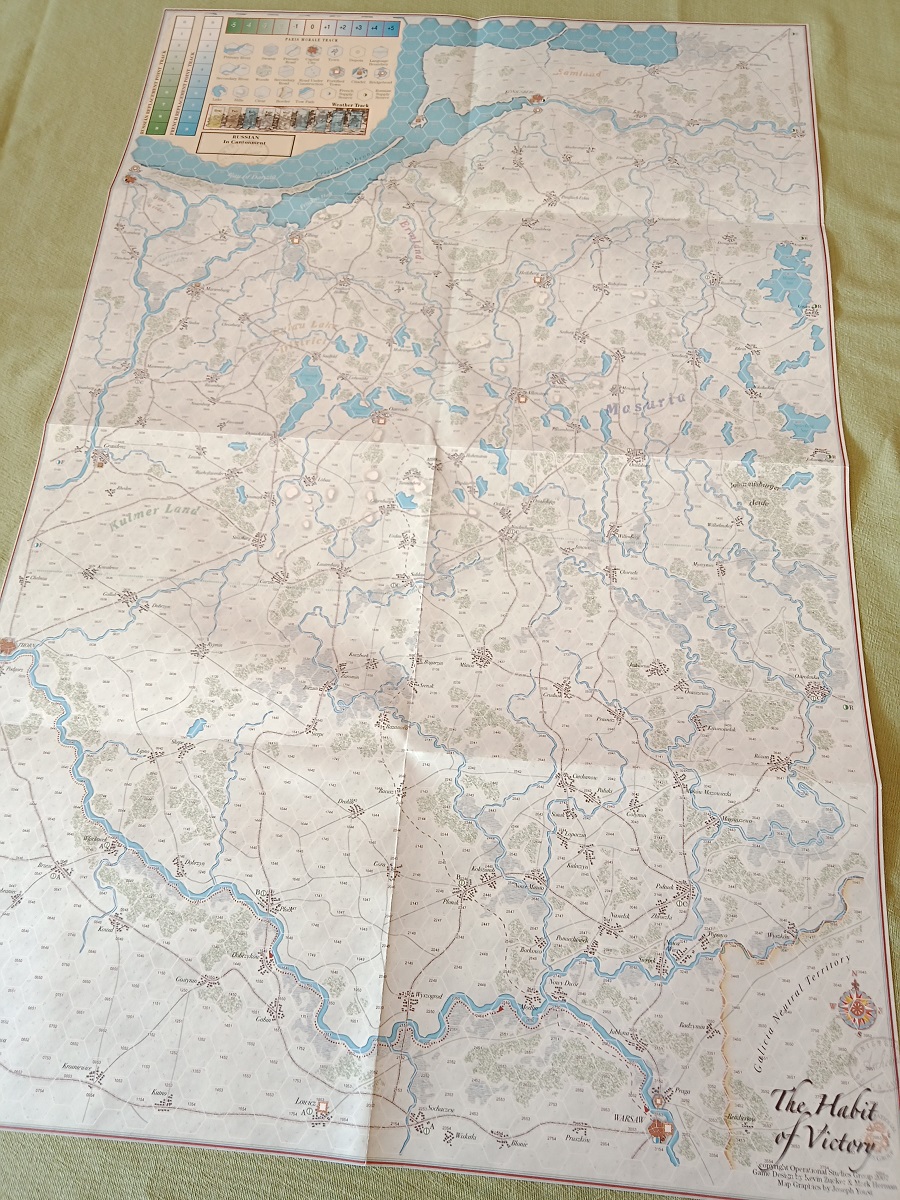
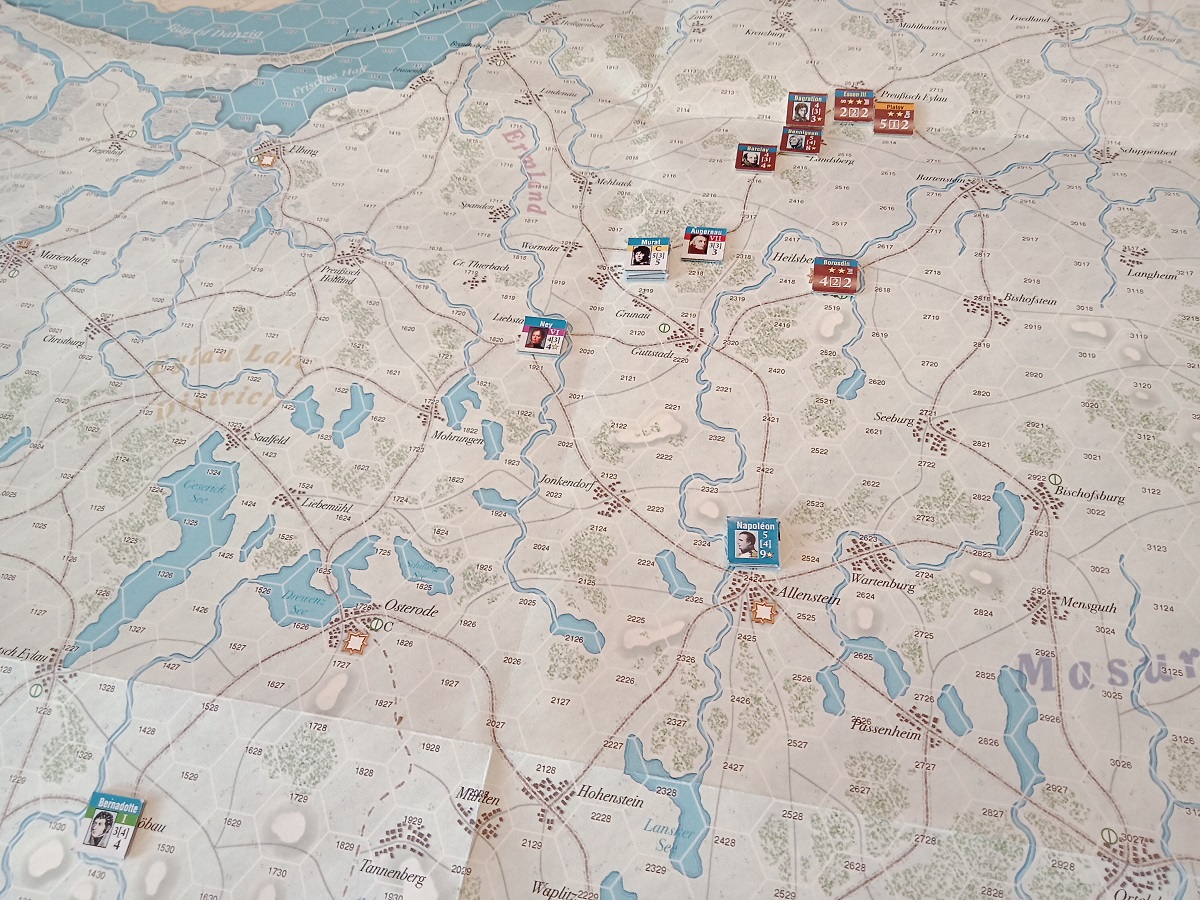

The 2x system is very similar to the 1x system. Only force leaders appear on the map and their forces are represented on an Organization Display kept hidden from your opponent. This game also has vedettes. The four main concepts of the game system are still part of the 2x system, and the necessary changes to the system to deal with the larger scale are handled in the exclusive rule book. The biggest difference between this game and 1807: Eagles Turn East (1994) is the introduction of cards.


Each player starts the game with a hand of cards. Cards are played during the movement phase to determine movement allowances. There is an attrition table at the bottom of the card to determine force loss caused by movement. Cards have event instructions on them too. The events don’t always take effect and when they do, they help add to the feeling of chaos and the fog of war. Zucker designed Habit of Victory (2007) to use the cards; however, he provides a way to play the game without them. He specifically states that OSG will not answer questions on playing the game without the cards.
Weather played a key role in the Battle of Eylau and there are rules for weather in this game and in 1807: The Eagles Turn East (1994). Because they are operational level games and the weather rules are random, it could be your battle doesn’t include any inclement weather. The weather rules hamper force movement and combat when it is rainy, muddy and snowing.
This is another excellent game. The addition of the cards makes for a different experience and adds a nice amount of uncertainty. Although this game isn’t new, it isn’t that old either and getting a copy from the usual places shouldn’t be too difficult.
 The Coming Storm (2010)
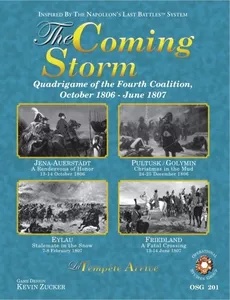
The final Zucker game we will look at is The Coming Storm (2010), from Operational Studies Group. It is based on Zucker’s Napoleon’s Last Battles (1976). Instead of being an operational level game, this is a grand tactical game. The scale is 525 yards per hex, one hour turns and 400-800 soldiers per strength point (Zucker, 2010). The battles represented in this game are Jena-Auerstadt, Pultusk/Golymin, Eylau and finally Friedland.
There are four maps in the game, one for each battle, at 22 x 34 inches. Gone are the Organization Displays kept to the side of the map, which contain the forces the leaders command. All the counters, leaders and combat units are on the map while playing. There are rules to hide unit strengths; however, it isn’t quite the same as the operational games. Now you see stacks of units instead of just the force leaders on the map. Vedettes are in this game, so you can screen your forces and scout enemy positions with them.


The main difference between The Coming Storm (2010) and Napoleon’s Last Battles (1976) are the cards. Just like the Habit of Victory (2007), The Coming Storm (2010) has cards which provide movement information. Because the game is no longer operational, the cards lack attrition tables. There are instructions on the cards that allow a player to take actions such as redeploying a force in road march column, or increasing a leader’s command rating for either a short or long period of time.


This wouldn’t be a game about Eylau without rules for winter weather. Weather is randomly determined by a six sided die roll and can vary from rain, mud and fog, to snowstorms. Depending on what the inclement weather is, there are varying negative impacts, from reduced unit strength, increased movement costs and blocked lines of sight.
If you like Zucker’s games, you’ll enjoy The Coming Storm (2010). If you’ve never played one of his grand tactical games, you should. This is a good game that will help you understand what happened during the battle and hopefully entertain you while you play.
 Eagles of the Empire: Preussisch-Eylau (1999)
We’ll conclude with a very different game, Eagles of the Empire: Preussisch-Eylau (1999) published by Avalanche Press. This game is designed by Brien J. Miller. It is his third game in the Eagles of the Empire series. The scale is a grand tactical game, with one inch equaling approximately 500 yards, a game turn is one hour and one strength points is about 1,300 – 1,500 soldiers or 400-600 cavalry (Miller, 1999).
The map measures in at 23 x 18 inches. Miller dispenses with using hexes and instead uses what he calls a geomorphic map. In essence, it is like an area movement map that he created based upon maps that showed the elevations of the battlefield (Miller 1999). Instead of a uniform hex grid, there is a hodge podge of varying shapes of different sizes across the map.
The counters are also different. Cavalry and artillery counters are the standard square shape; however, infantry divisions are a rectangular shape, the size of two square counters side by side. The game is designed so that the counters must fit within the different geomorphic shapes on the map. If the longer infantry division extends outside the shape, that isn’t allowed. Each space on the map is limited to a certain amount of strength points. There are a few spaces that allow more strength points and they are limited in number. Finally, all spaces have what is called a “Dense” limit. If you have strength points equal to or greater than that amount, the units are more easily hit by artillery bombardments.


Commanders play an important role in the command and control of the units. It is very possible to have commanders and units that are out of command which limits their movement, their ability to attack and prevents them from being adjacent to the enemy.
Like the other games, there are rules for the cold February weather. Snow squalls might appear during the weather phase of each turn. Units in a snow squall suffer all sorts of penalties, such as reduced movement, cavalry are unable to charge, command radiuses are reduced, artillery can’t fire, and lines of sight are blocked. You get the idea.
This is a very good game. I like the geomorphic map and I like how the counter must fit within the geomorphic spaces. This alternative approach to the Battle of Eylau is one you should seek out if possible. A quick online search shows there are reasonably priced copies available via Noble Knight Games.
So there you have it, four games about the Battle of Eylau. There are many other games about this battle, so if you’ve played them, let us know what you think!
References
Miller, B. J. (1999). Eagles of the Empire: Preussisch-Eylau. Avalanche Press.
Zucker, K. (1994). 1807: The Eagles Turn East. Clash of Arms Games.
Zucker, K. (2007). The Habit of Victory. Operational Studies Group.
Zucker, K. (2010). The Coming Storm. Operational Studies Group.
Thank you for visiting the Regiment of Strategy Gaming and riding with The Armchair Dragoons.
Rather than list a bunch of social media links, the easiest thing to do is to check out our LinkTree, which connects you to all of our various locales around the web.
You can also support The Armchair Dragoons through our Patreon, and find us at a variety of conventions and other events.
Feel free to talk back to us either in our discussion forum, or in the comments below.


Zachary, nice write-up. I decided a last summer to focus on the games in my write-ups. I didn’t know Zucker had done 3 games on one battle!
Thank you! I’m glad you liked it.
The board game Eylau-1807 Solitaire from Worthington Publishing is coming beginning of next year (2027)