
 by
by Paul LaFontaine, 29 Jul 2026
Through a long form Kriegsspiel, playing in person Kriegsspiel sessions at Historicon and reading up on the subject, I was able to use a single historical battle to learn about command fixation. By playing and umpiring in multiple sessions of Second Bull Run from the American Civil War, I could compare the session outcomes with the historical battle and derive a clear lesson.
Kriegsspiel Master Umpire James Horton invited me to play in his 200th game, celebrating his long and storied career as umpire in the International Kriegsspiel Society. It was an all-star group, as many of the experienced members who had played with James throughout his Kriegsspiel career to honor his achievement. A veritable who’s who of online Kriegsspielers. This was a play-by-post game in which we exchanged orders and received battle reports via Discord over a period of several weeks rather than playing live.
I chose to play the Union. I was elected (or volunteered by others through everyone else declining) to be the Commander-in-Chief, which meant I would play Major General John Pope, the commander who lost the Second Battle of Bull Run. I am always careful when taking command of a historical side that lost the battle. Such scenarios usually contain inherent disadvantages that reflect the historical reality. Although James told us that this scenario was intentionally ahistorical and would include several twists, we still had to recognize that the Union had lost the actual battle.
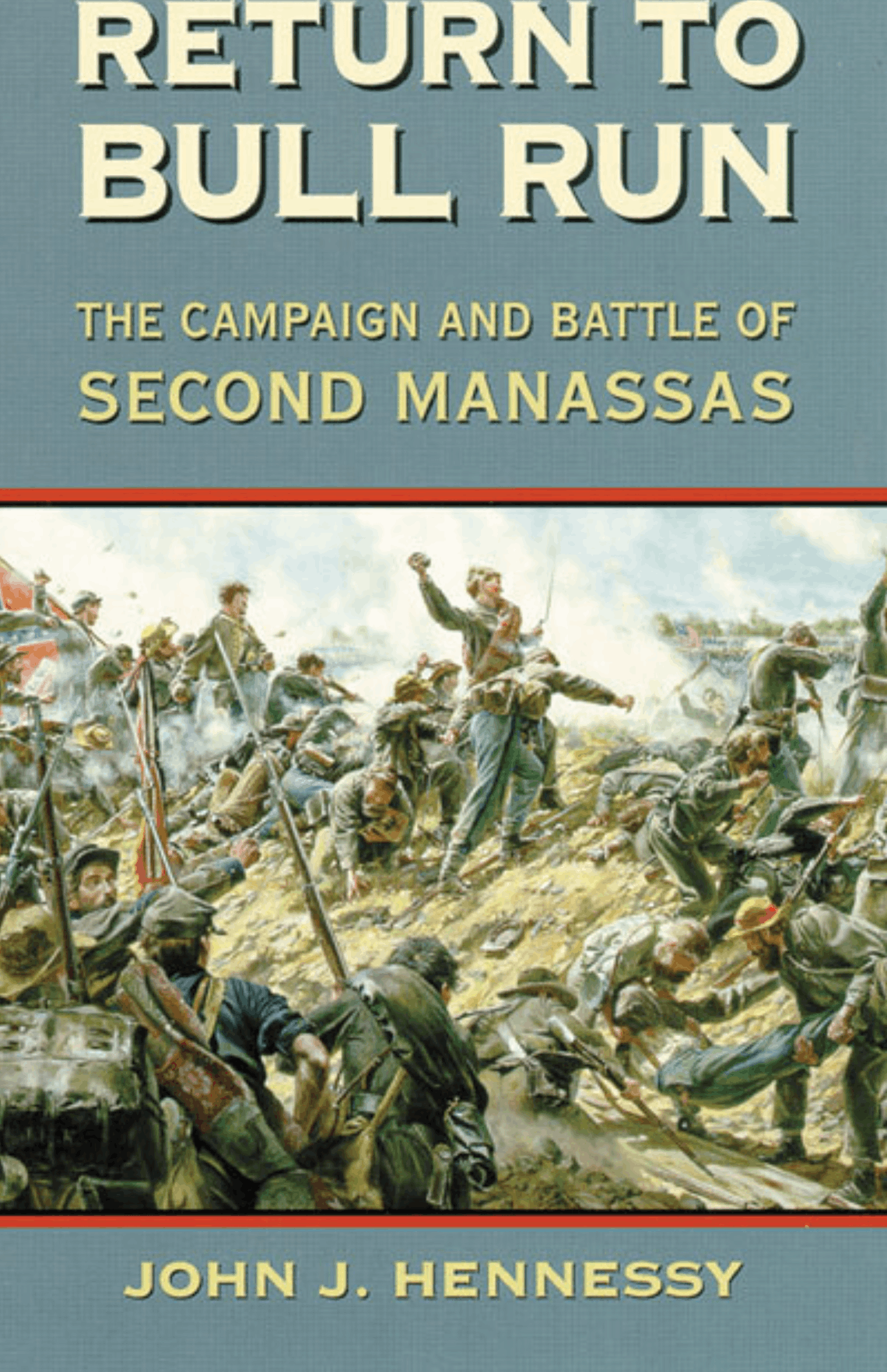
I asked an experienced Kriegsspiel player, Carter, who was on the our team, to recommend a book on the battle. He is a Civil War enthusiast with deep knowledge of the period and has run many games covering both the war as a whole and individual battles. He recommended Return to Bull Run by John J. Hennessy. I acquired and read the book as rapidly as I could.
click images to enlarge
This is an excellent book because it focuses specifically on the campaign that led to this battle and the details of the battle itself. The background it provides establishes the context for the fighting, offers a clear understanding of the personalities involved, and presents the events in a logical progression that makes the action easy to follow. It proved to be a great resource and an excellent recommendation.
We knew that the scenario James presented was not entirely historical. In fact, there were enough differences that we could see it was designed to recreate the uncertainty of the opening phase of the battle. We were only told of the Confederate force coming from the north. There was no information about the remainder of the Confederate army.
From reading the book and through our discussions during the planning process, I understood that Pope had become fixated on the northern Confederate force, commanded by Stonewall Jackson. This ultimately led him to overlook the arrival of another Confederate force from the west, with disastrous consequences.
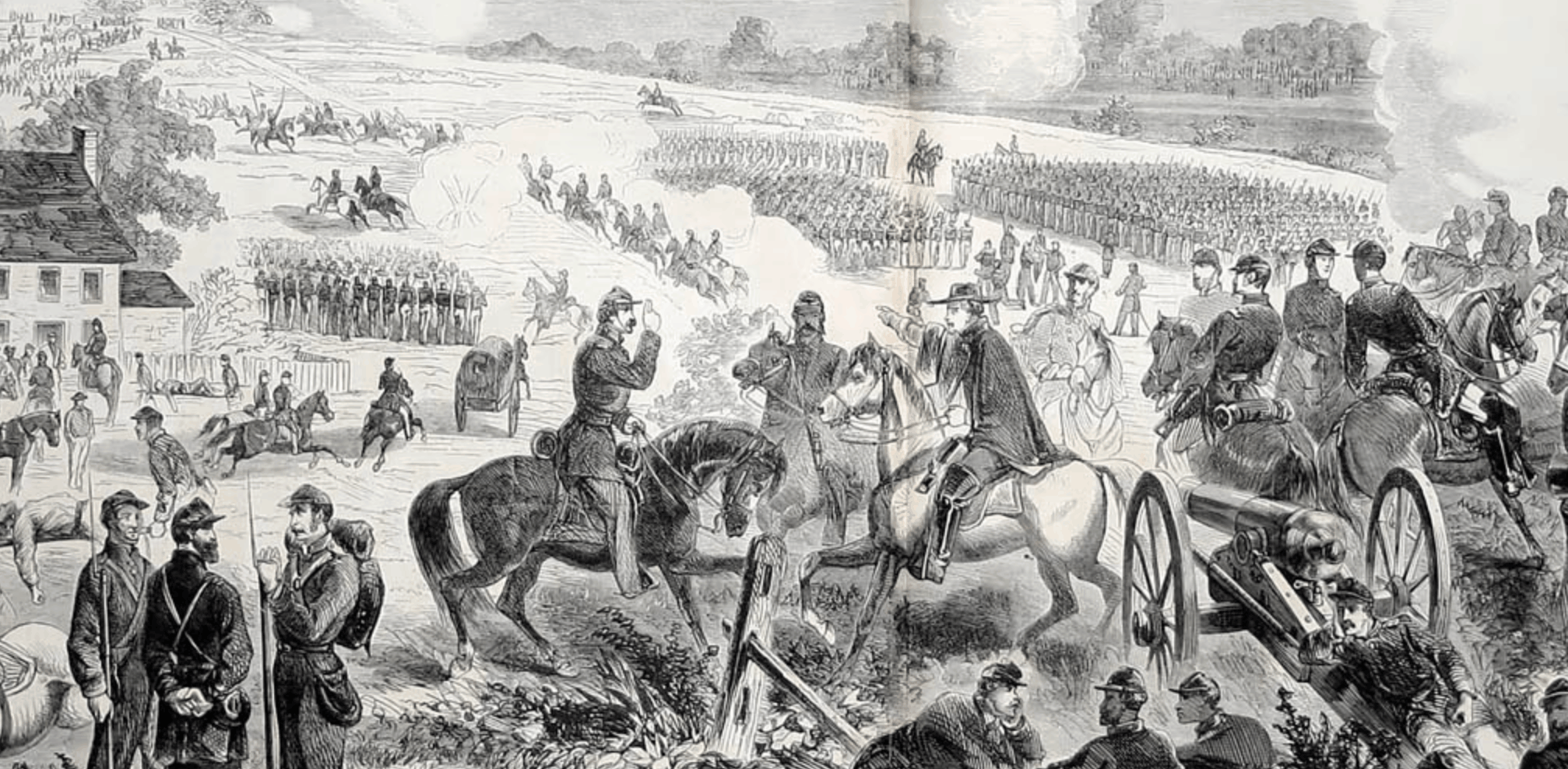
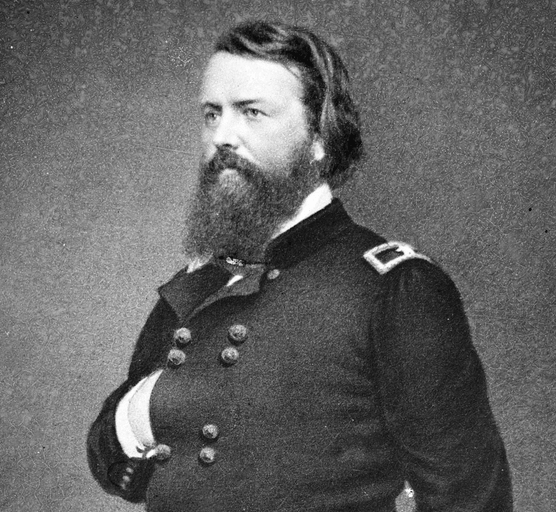
Pope had achieved success in the Western Theater and was called east to replace Major General McClellan, who remained a highly popular commander within the Union Army. McClellan and many of those loyal to him did everything in their power to obstruct Pope. He was expected to act aggressively, and felt compelled to produce a significant result.
His personality did not help. He was described by contemporaries as disputatious: confident in his own abilities, outspoken in expressing his views, and possessed of enough ego to believe he could solve the problem. Upon taking command, he made several public assertions about never retreating. Those statements ultimately played a major role in trapping him in a position where he felt he had to achieve victory through aggressive action or suffer a loss of reputation.
There was an interesting parallel between the historical situation and the one we faced in the game. As commander-in-chief, I was leading a team of very experienced Kriegsspiel players. Treating them as beginners or adopting the sort of attitude for which Pope was known would almost certainly have alienated people who were at least as knowledgeable about the game as I was. As a result, I consciously created a collaborative planning environment and gave instructions with a light touch. These were players who knew their business in Kriegsspiel.
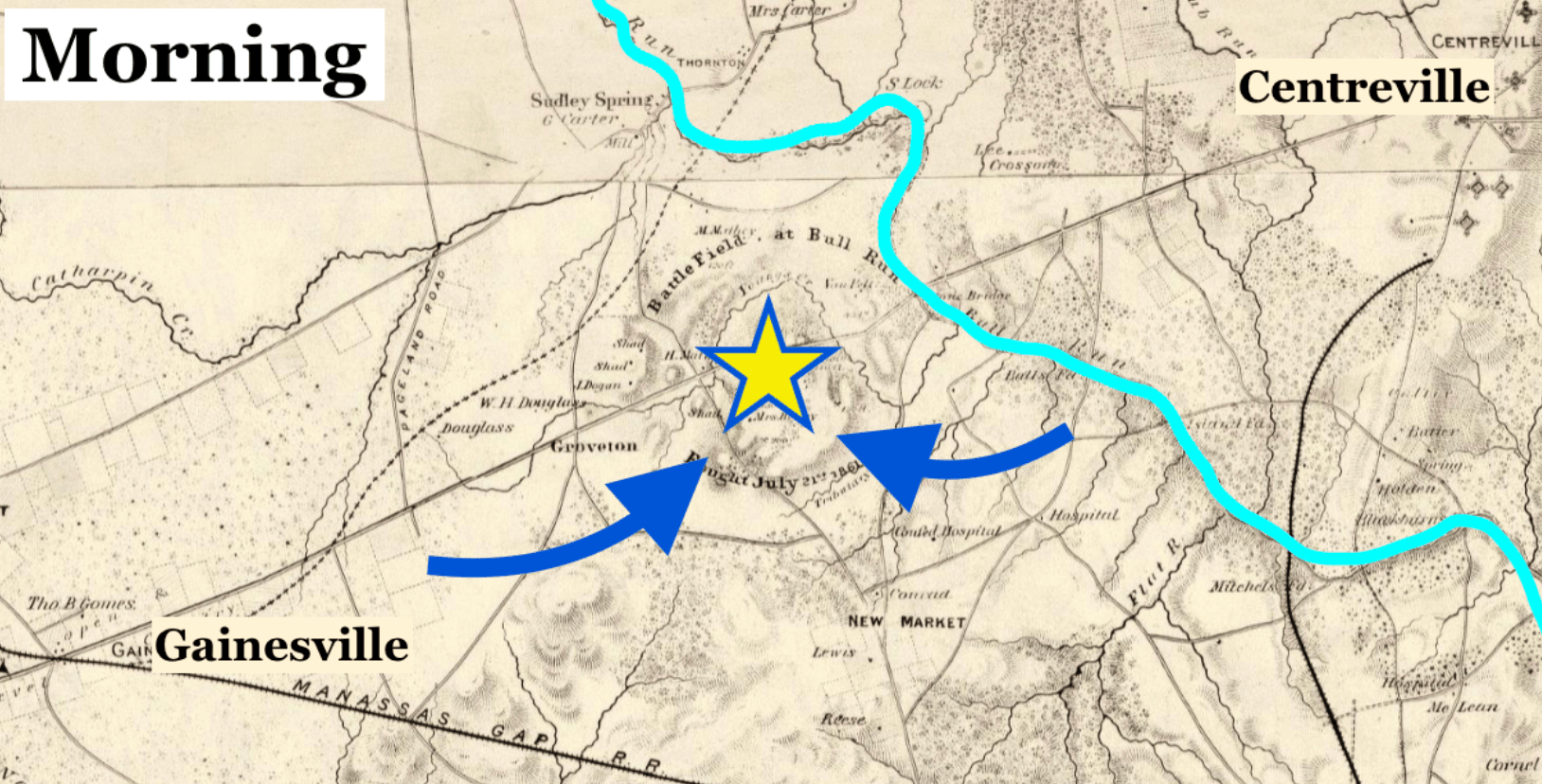
We developed a plan intended to bring our two forces together that could address threats from both the north and the west. Our initial deployment placed one force advancing from the east and the other from the west, based on the assumption that the Confederates would first appear from the north and later from the west, behind our western force. We chose the area near Groveton to link our forces.
Another amusing parallel, entirely by accident, was that our European players were assigned to the corps commanded by General Sigel, whose command in the Union Army was known as the “German Corps,” famously where many of its members only spoke German. The player portraying Sigel was from Germany. His subordinate commanders were played by members from Finland and other European countries, though not exclusively.
I was positioned with the eastern force and had no direct contact with the western force as the scenario began. Buford’s cavalry advanced and soon encountered Confederate cavalry directly to our front. From the way the enemy cavalry attempted to delay our advance, I believed that the Confederates intended to delay the eastern force in place while concentrating their main effort against our western force in an attempt to defeat it.
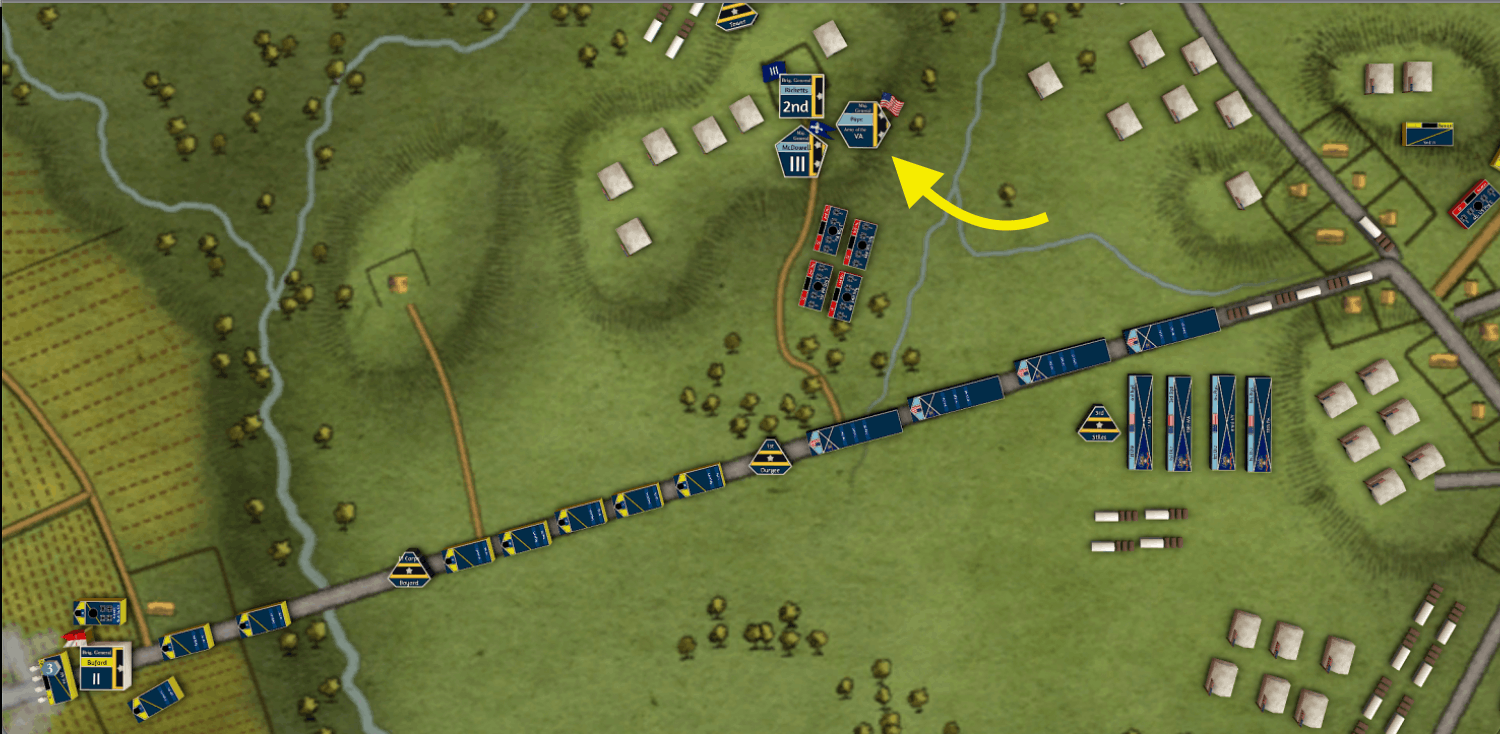
As the situation developed, the Confederate force from the north pushed south. Our division commanders moved to contain this threat, while our eastern Corps commander, Hotron, playing McDowell, continued bringing his remaining forces onto the field.
I remained with the eastern force because I needed to ensure my command group remained secure from any roving Confederate cavalry. While I did, my objective remained moving west to ensure the junction between our two forces was completed in order to confront the Confederates as a unified command.
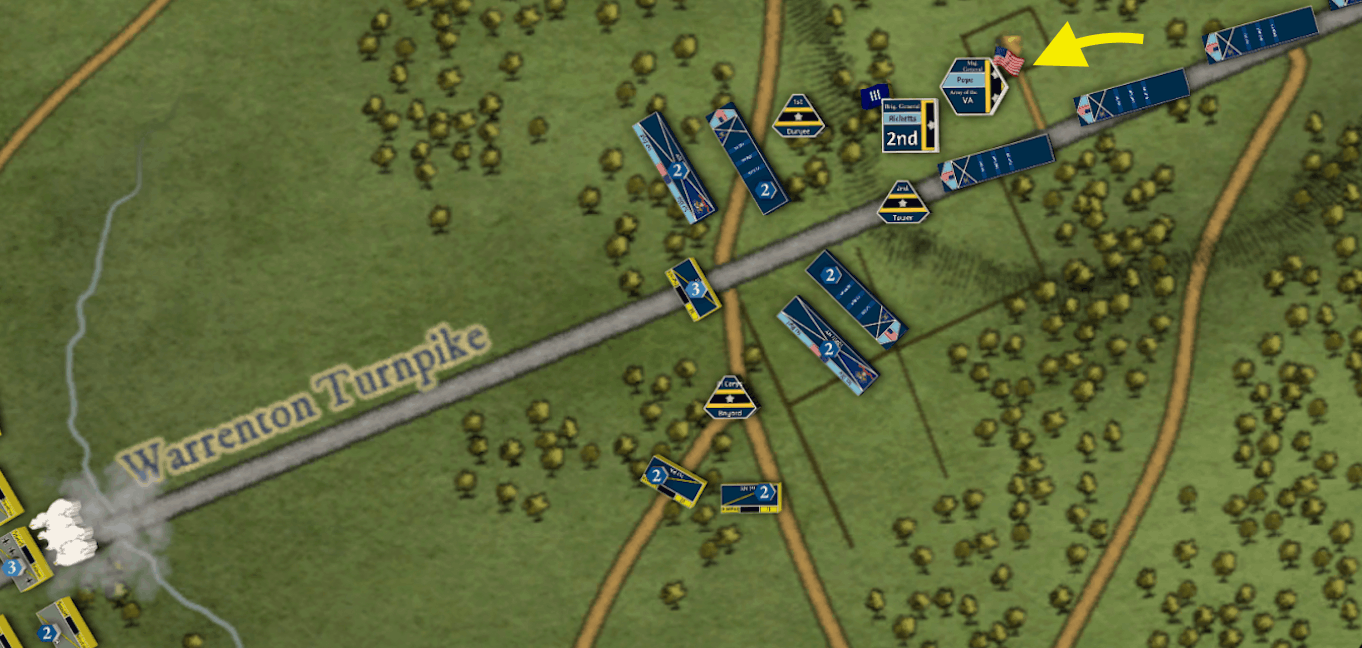
The Confederate force to the north was significant enough, and our own forces there strong enough, that I was tempted to let our eastern Corps focus there and defeat that northern force before the enemy force from the west could join the battle. This was precisely the fixation that had gotten Pope into trouble historically.
During the actual battle, Pope encountered Stonewall Jackson in the north and spent the first day attacking and defending against counterattacks. On the second day, he continued pressing against Jackson while paying little attention to the west, despite receiving multiple warnings that Confederate forces were approaching from that direction. Determined to defeat Jackson, secure a Union victory, and reinforce his reputation as an aggressive commander, Pope remained focused on the northern fight. That fixation allowed Confederate General Longstreet to bring his corps onto the field from the west and launch the decisive attack that rolled up the Union flank and drove Pope’s army from the battlefield.
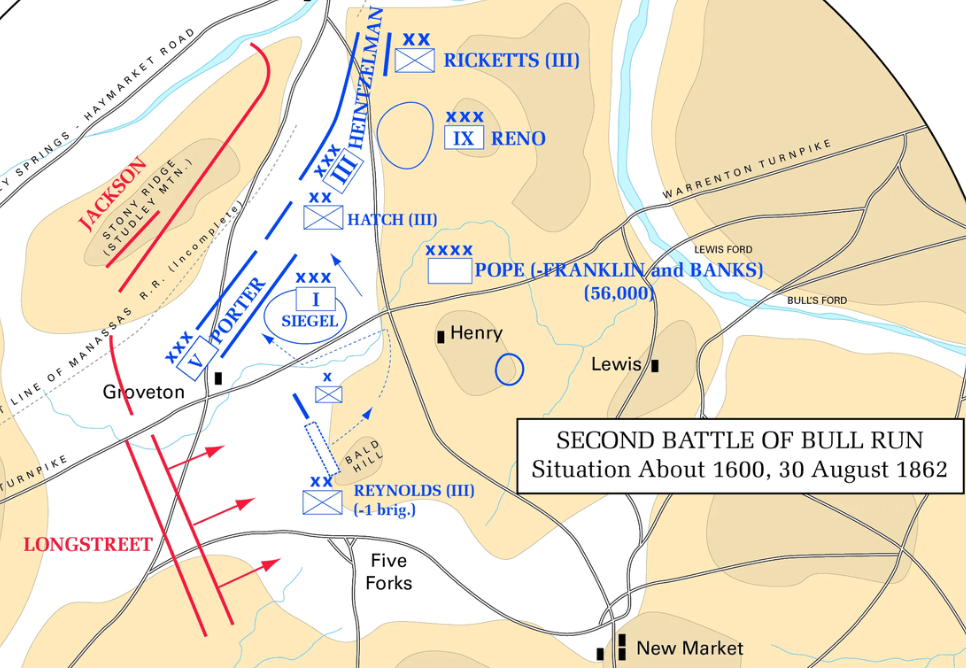
I wanted to avoid repeating that mistake. Throughout the game, I deliberately kept my attention focused on moving west while trusting my subordinate commanders to handle the fighting in the north. I also instructed the eastern Corps commander that as soon as the Confederate force from the west was confirmed, he needed to ensure that sufficient forces were available to turn west and complete the junction between our commands.
The situation in the west became secure enough I moved in that direction to try and find Sigel’s forces and complete the junction between the two wings of the army. My expectation was that I would ride west, locate Sigel’s headquarters, inform him of McDowell’s position, and enable him to maneuver accordingly.
Instead, I received an unpleasant surprise. As I moved west, I discovered that I was actually behind the Confederate forces. They had marched between our western and eastern Corps, leaving Sigel isolated on the far side of the Confederate line. Those commanders remained out of contact.
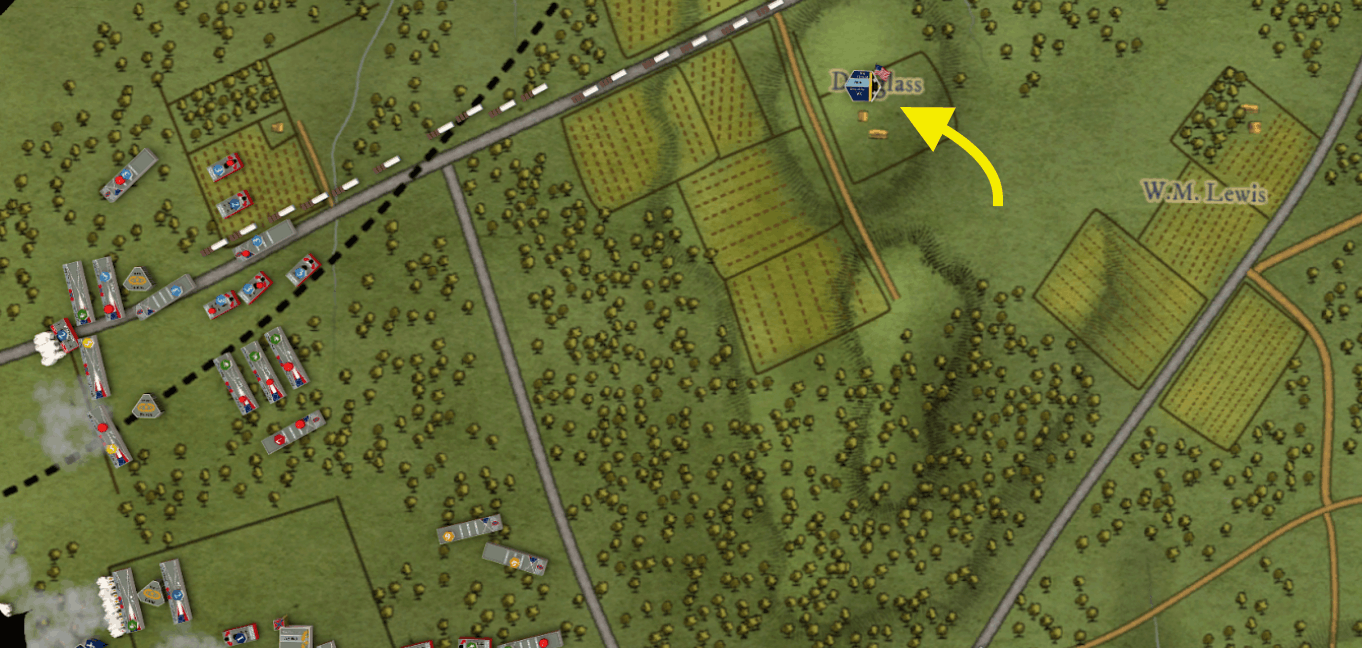
I was in a precarious situation. I had avoided Pope’s historic mistake of fixating on the northern fight by trusting my fellow players there and shifting my attention west. Yet I now faced a problem even greater than Pope’s. My army had been split into two isolated forces, leaving us to fight two separate battles.
The only viable course of action was to balance our forces so that we could prevail in both engagements and still hold the field at the end of the day. I knew that our eastern command under Hotron had more troops available than the Confederate force to the north, so I asked him to send whatever he could spare west to strike the Confederates in the rear.
My hope was that the remnants of Sigel’s force in the west, combined with a fresh force arriving from the east, would dislocate the Confederates enough to create a significant problem for them. By this point, it had become clear that their intention was to defeat our army in detail, beginning with our western force before turning against the eastern force. If we could prevent the destruction of the western command by allowing it either to survive or escape while inflicting heavy casualties on the Confederate force in the west, we might yet recover from what had become a highly chaotic situation.
Hotton and his subordinate commanders were experienced players, and he immediately understood the situation. He marched west with his staff (yellow arrow) while sending a division under Reynolds, played by Thanik, to our aid. Advancing with urgency, Thanik struck the Confederates rear, allowing Sigel’s force an opportunity to disengage and move south (blue arrow).
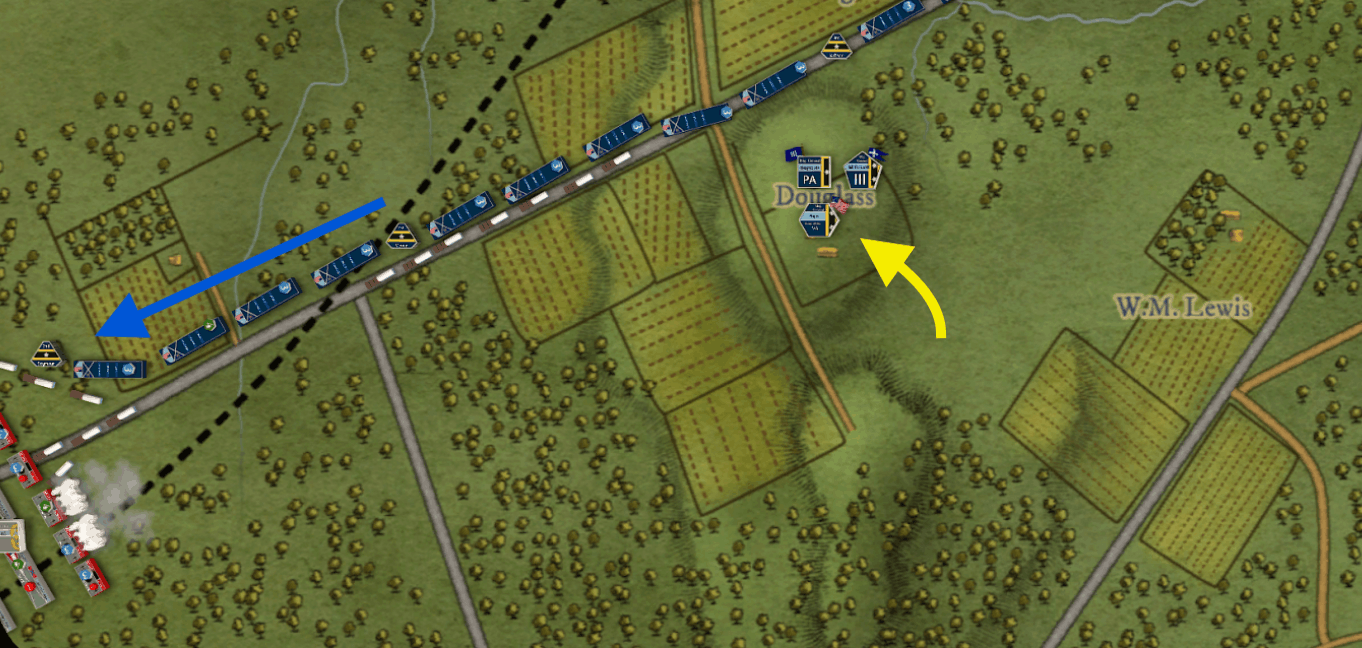
It is important to note that, throughout this period, we had no contact with Sigel. There were no communications to or from his command, and we had no knowledge of what was happening on his side of the battlefield. We learned only afterward that, once they gained a brief respite, Sigel’s force marched south and then east to rejoin the main command. This decision was made entirely independently, but it allowed the force to survive and preserve its strength for future operations.
As the scenario drew to a close, Umpire James awarded us a marginal victory because we held the field at the end of the battle. The Confederates had failed to destroy our western force, and the rapid actions of Hotron and his subordinate commanders, together with an effective holding action in the north, kept the Confederates at bay. As a result, we retained control of the battlefield when the fighting ended.
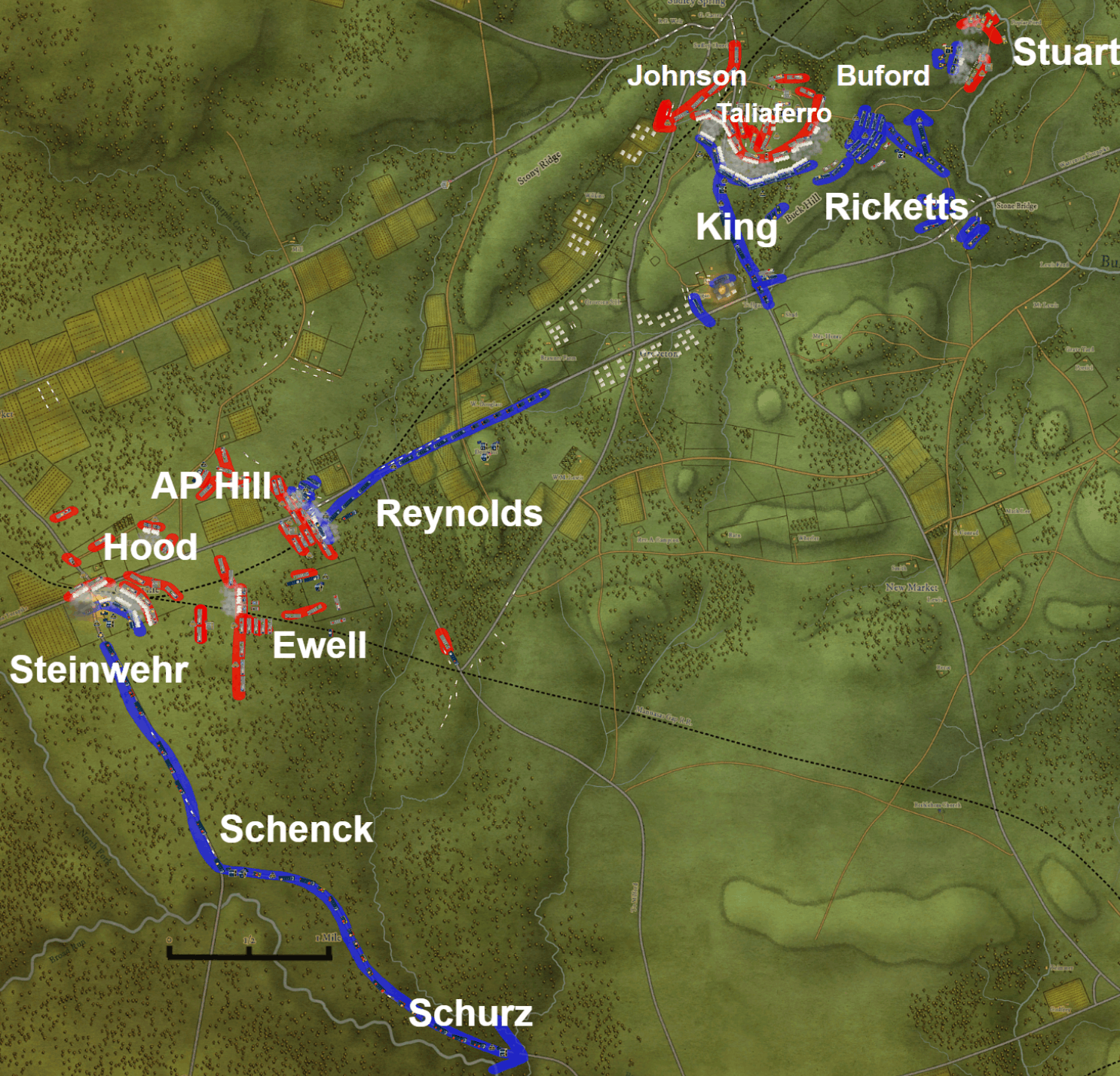
To be clear, my commanding did not “win” the battle. I kept myself open minded enough to perceive the evolving situation to not lose it by failing to send the message to the eastern Corps commander at one important moment. The players who contained the enemy in the north, the quick action of Hotron and Thanik, and the entire western Corps command who survived and moved south with no communication from me created the conditions for the win. By my not fixating on the northern fight, I kept from creating a problem.
Comparing the outcome of this scenario with the historical battle described in the research, this probably would not have been a particularly favorable result for Pope, although it would certainly have been better than the decisive defeat that ultimately led to McClellan’s return to command of the Union Army. While we were not defeated, neither did we aggressively destroy the Confederate army. Instead, the Confederates likely would have withdrawn from the field, much as Lee’s army did after Gettysburg.
Although this outcome would have represented a modest reversal of the First Battle of Bull Run, it is doubtful that Pope would have been celebrated as a hero in the North. The battle remained largely inconclusive. While the newspapers might have praised the Union for winning the field, Lincoln himself would probably have found such a result unsatisfactory.
Watching this same battle recently play out during the International Kriegsspiel Society’s Kriegsspiel Cup Championship, and then playing it twice more at Historicon, the lesson was clearer that being open to seeing the full disposition and location of the Confederate army was the key to achieving any form of Union victory. One example particularly stands out.
At Historicon, we played another version of the same scenario in an in-person Kriegsspiel, again run by Umpire James. The way we played was to command as one team at each map, with orders being sent to umpire controlled subordinate commanders. I served on the Union command team.
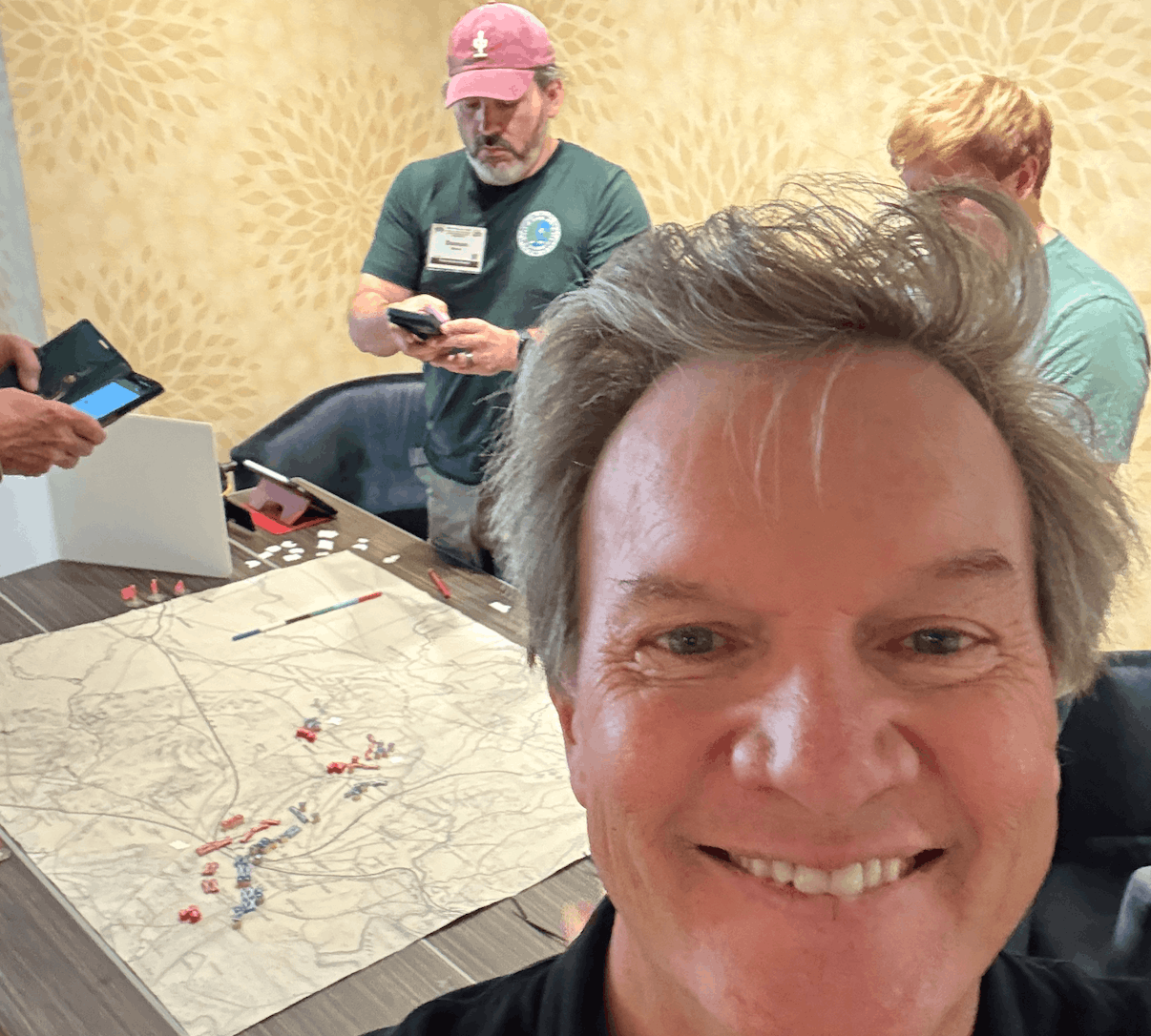
We had established a defensive line at Manassas and believed we had a force equal in size to the Confederate force attacking us. We became fixated on this belief and believed because we had been using the terrain to defend and wear down the attacking enemy, we had a local advantage in combat power. Based on that belief, the commander-in-chief ordered our brigades to attack.
In fact, the Confederates outnumbered us in the area by five brigades to four. We abandoned our stronger defensive positions and attacked a superior force, with the predictable result that we were driven back into Manassas. The retreat collapsed our defensive line and ultimately cost us the battle. Our misreading of the situation, combined with our fixation on the belief that we possessed local superiority, led us to make a decision that proved to be unsound.
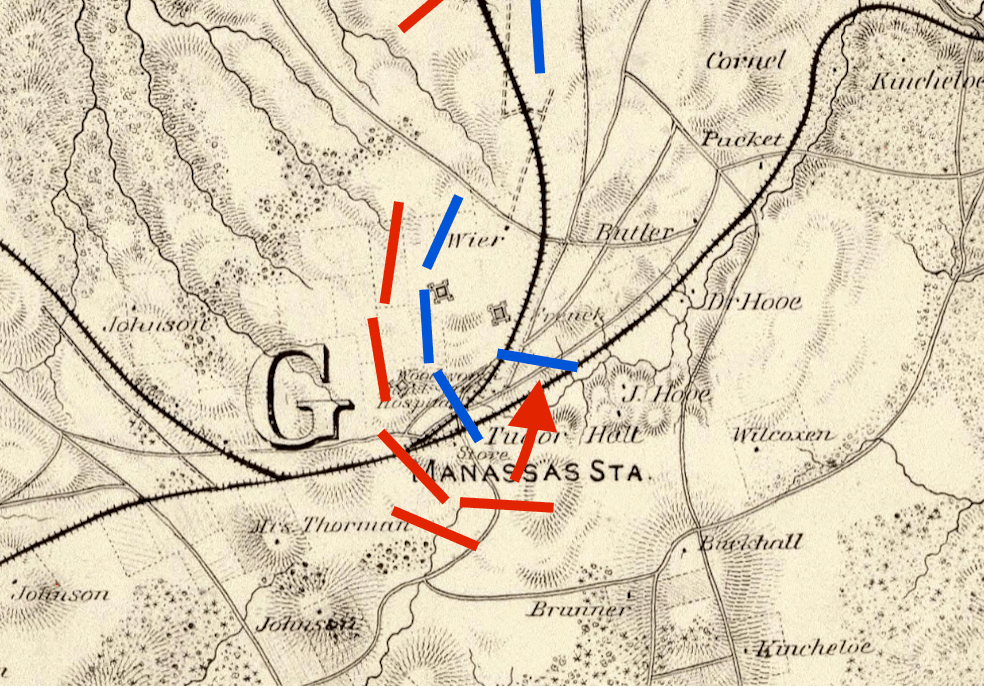
In the one scenario in which my team prevailed, we identified the location of the Confederate forces as a whole and reacted effectively. In the other games, the Union either never developed a clear picture of the Confederate army or fixated on a flawed view of the situation which resulted in Confederate victories. Our belief at the action around Manasses was the clearest example.
The lesson from a reading of history and multiple sessions playing slight variants of the 2nd Bull Run battle is that when a commander becomes fixated on a desired outcome and attempts to force events without being open to understanding the true situation, the result will be unfavorable.
A double-blind Kriegsspiel is the best way to explore your own tendency toward being fixated while commanding. There are several published games on the Bull Run battles that allow you to study the orders of battle, the terrain, and the road network in the area. These are excellent resources for understanding the battlefield and the relationships among the various command structures and force sizes.
What they cannot provide, however, is the imperfect information that tempts you to fixate. When all of the forces are visible, it is difficult to appreciate why Pope lost. It is the feeling of seeing a seemingly vulnerable enemy force in front of you and wanting to destroy it, while naturally discounting everything beyond that immediate opportunity, that a double-blind Kriegsspiel allows you to experience. You discover the temptation to become fixated because you feel it yourself as the situation emerges.
Second Bull Run is certainly not the only battle that offers this lesson. Any double-blind Kriegsspiel in which commanders operate with incomplete information allows participants to experience their own fixation and, more importantly, to practice recognizing and diffusing it before it leads to poor decisions and bad outcomes.
Thank you for visiting the Regiment of Strategy Gaming and riding with The Armchair Dragoons.
Rather than list a bunch of social media links, the easiest thing to do is to check out our LinkTree, which connects you to all of our various locales around the web.
You can also support The Armchair Dragoons through our Patreon, and find us at a variety of conventions and other events.
Feel free to talk back to us either in our discussion forum, or in the comments below.


Excellent writeup and analysis Paul! I’ve witnessed this repeatedly during military exercises as a commander focuses too much on their original plan or personal hunches. Times changes, and certainly equipment and tactics do, but human behavior seems to remain a constant.