
 by
by RockyMountainNavy, 6 April 2026
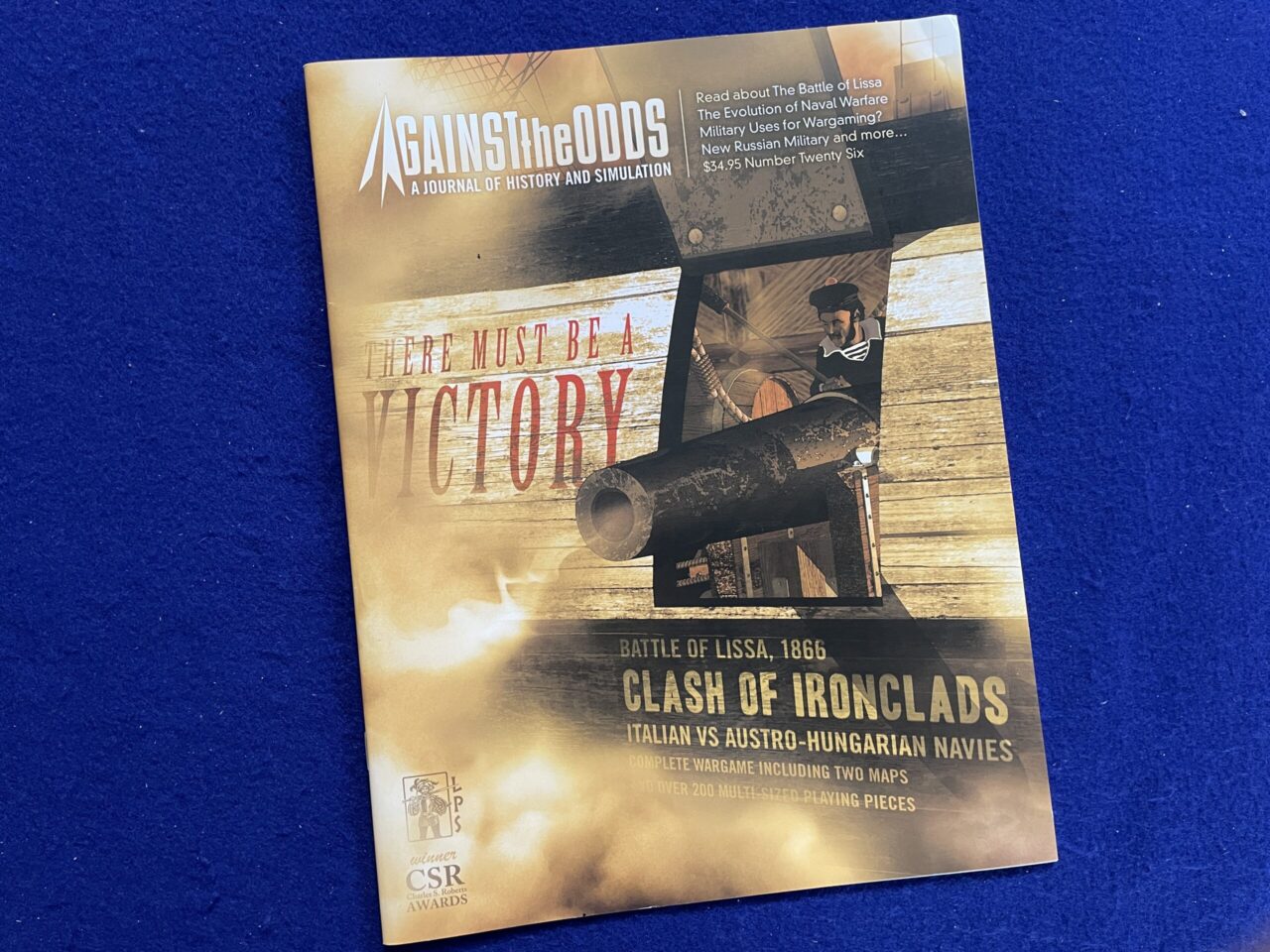
Last October at the 2025 The Armchair Dragoons Fall Assembly I picked up from the swap table the wargaming magazine Against the Odds Nr. 26 (July 2009) with the feature wargame There Must Be A Victory by designer Paul Rohrbaugh. There Must Be A Victory recreates the naval campaign in the Adriatic during the Seven Weeks War (June-July 1866) between Austria and Italy that culminated in the Battle of Lissa. There Must Be A Victory is played at two levels of war; an operational-level wargame focused on the Adriatic where fleet mobilization, blockade, and bombardment are keys to victory and a second, tactical-level wargame, where the ships of the Austrian and Italian navies face off against each other in fleet battles. The two-level wargame of There Must Be A Victory is not only a reasonably simple wargame but also powerfully shows the connections between politics, the operational (campaign) level of war, and tactical engagements.
click images to enlarge
Lissa by magazine
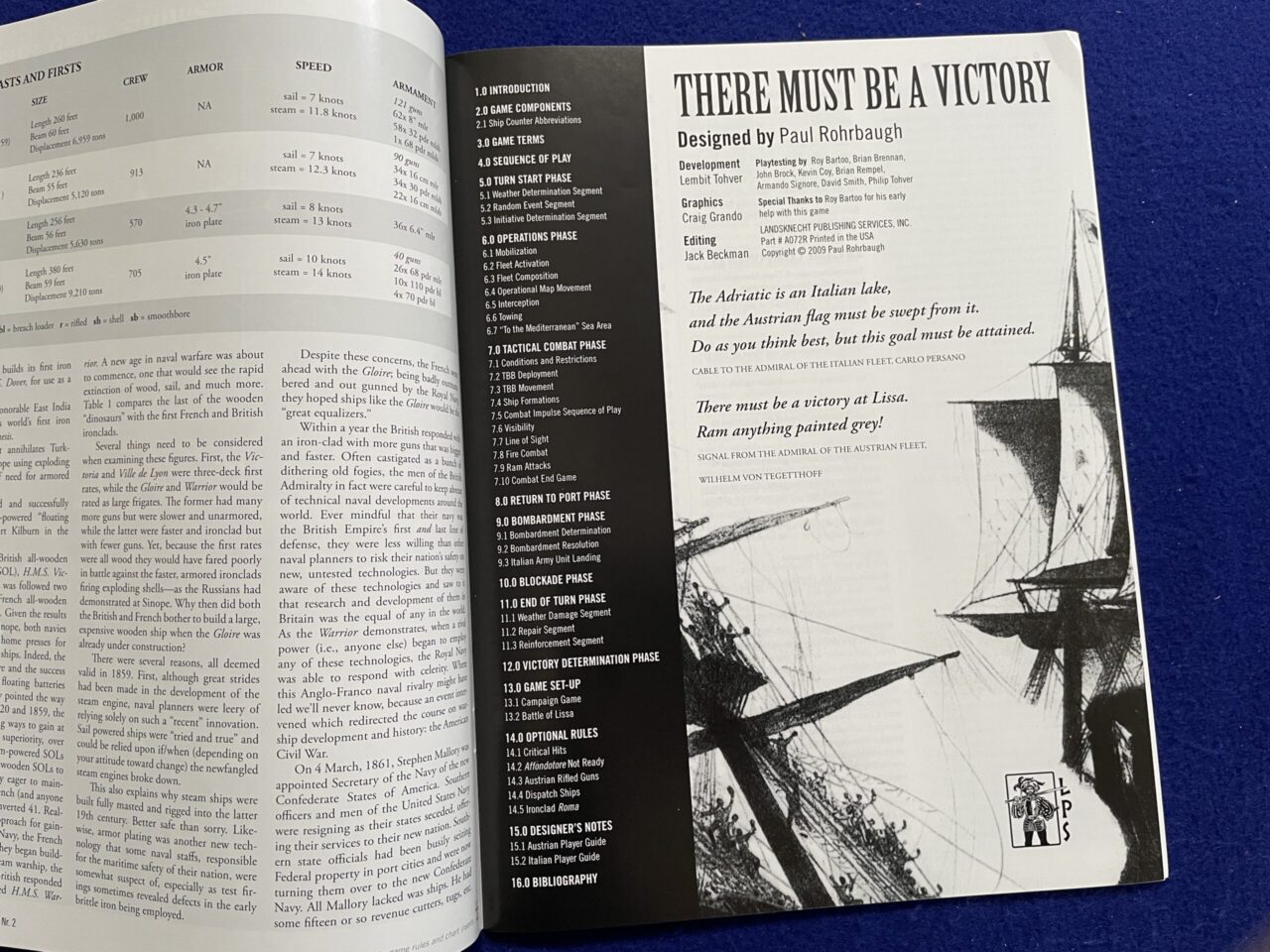
There Must Be A Victory is the feature wargame inside Against the Odds: A Journal of History and Simulation, Number 26 published in July, 2009. The magazine is 45 glossy pages with several articles related to the feature wargame and others focused on different topics. The rules for There Must Be A Victory are in a 12-page center insert of the magazine.
As befits a magazine wargame the game contents are not very complex:
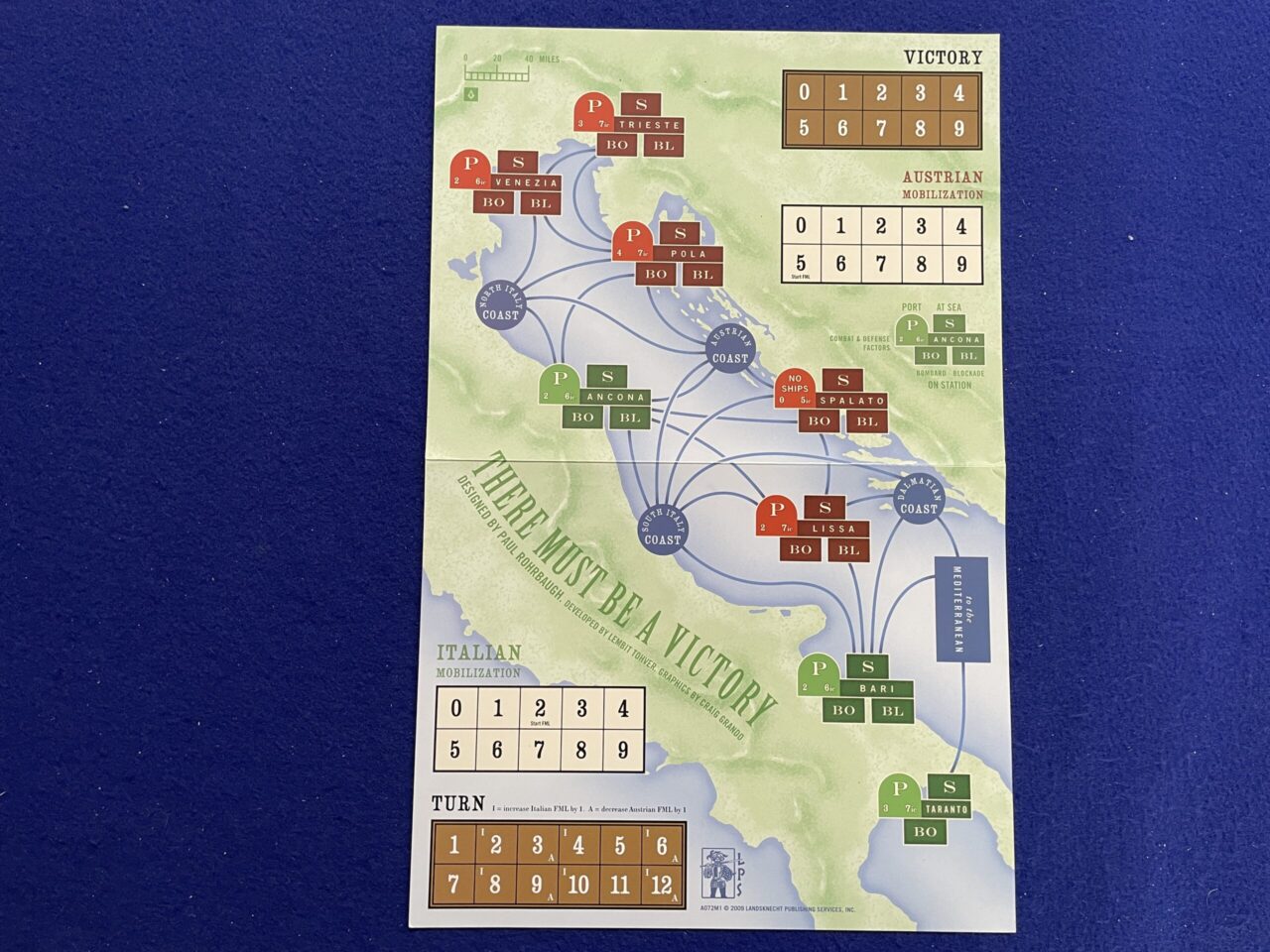
An 11” x 17” Operational map with tracks shows the Adriatic (and a bit beyond) using a point-to-point map scheme.
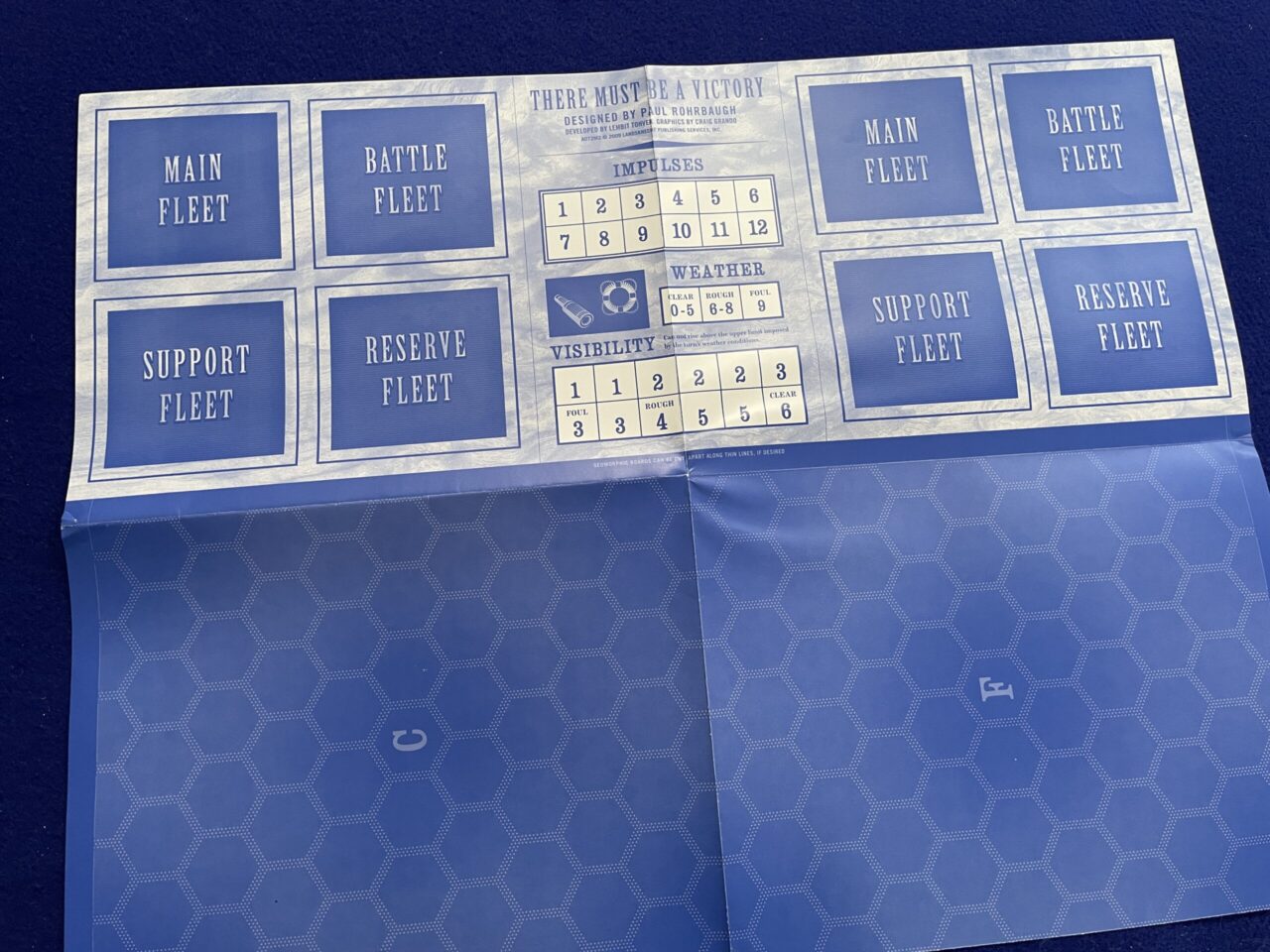
A 22” x 34” Tactical Battle Board with tracks and hexes for use in the Tactical Combat Phase.
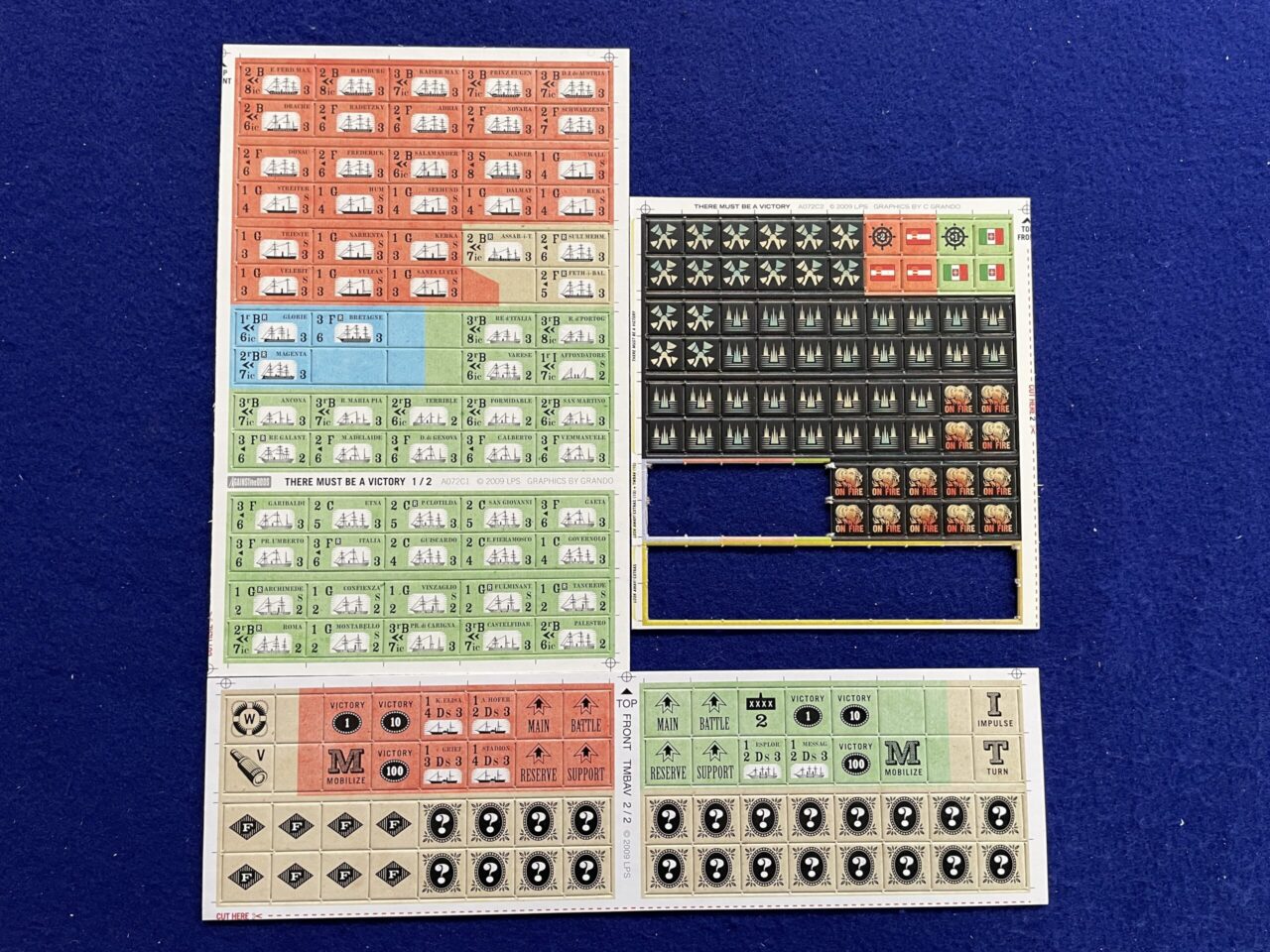
Counters are in three sizes: 70x 1.5” counters along with 64x 5/8” counters and 100x 1/2” counters are included (note that ~30 counters are for another game); counters for key leaders are used along with ships represented by individual counters
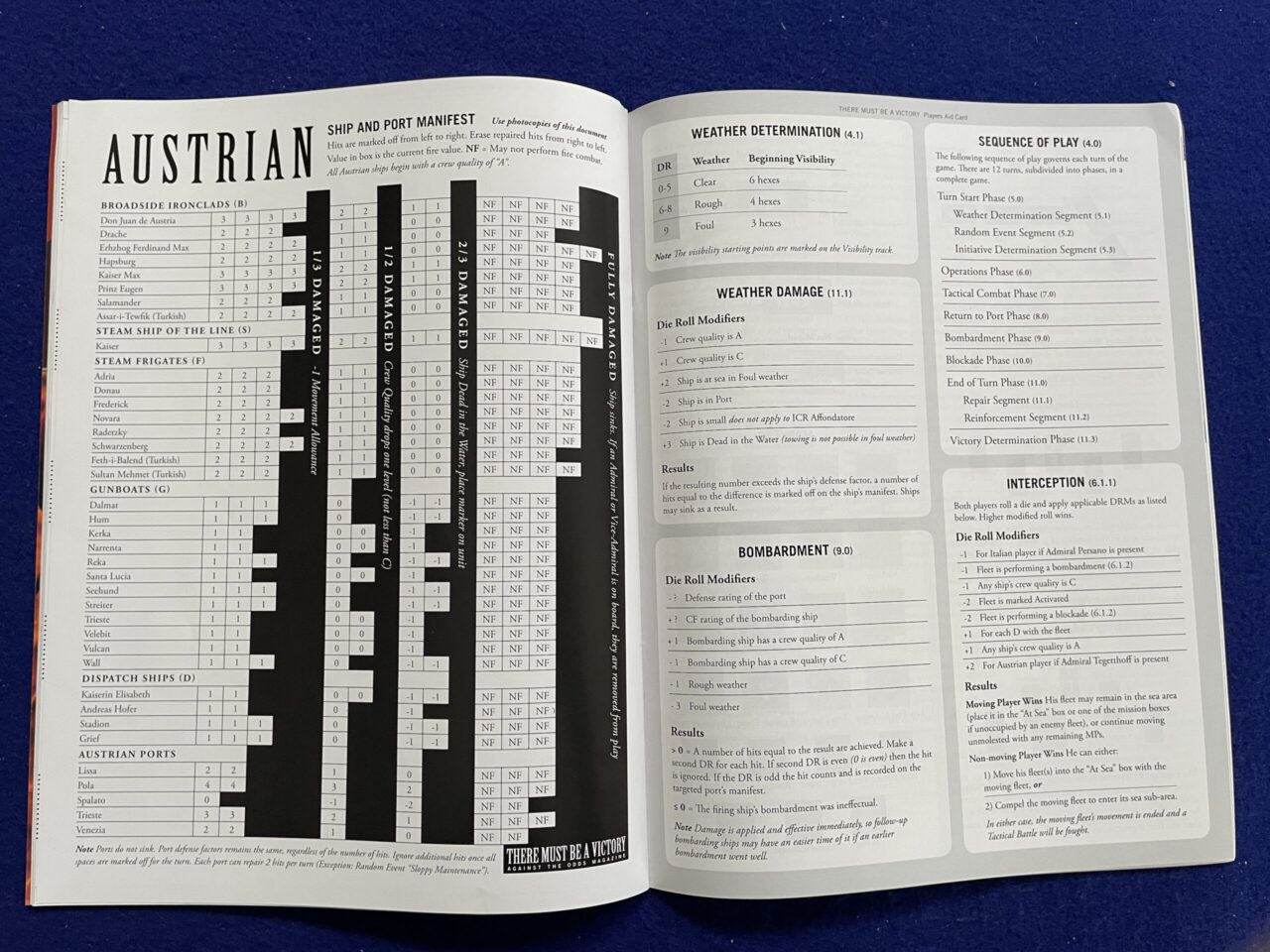
Two “Ship and Port Manifest” are in the center of the rulebook along with several pages of tables for players.
A single d10 is needed for play (the 0 is read as 0 and not 10).
The rules for There Must Be A Victory contains two scenarios; the full 12-turn Campaign Game and a more tactically-focused Battle of Lissa scenario.
One-sheet campaign
There Must Be A Victory is a war game simulation of the Adriatic naval campaign during the Seven Weeks War (June and July of 1866) between Austria and Italy. Austria would suffer a defeat on land against Italy’s ally, Prussia. The naval campaign in the Adriatic, however, was a brilliant success for the Austrian navy. The battle fought near the island of Lissa would be the first time fleets of ironclad warships engaged in battle on the high sea. (Rulebook, p. 2)
Broadly speaking, there are two sub-games in There Must Be A Victory. The first sub-game, played in the Operations Phase, recreates the naval campaign using the point-to-point Operational map and turns representing four days of activities. A second sub-game, played in the Tactical Combat Phase, is a 12-impulse naval battle between ships where each impulse represents about 10 minutes of time and each hex is 500 yards across.
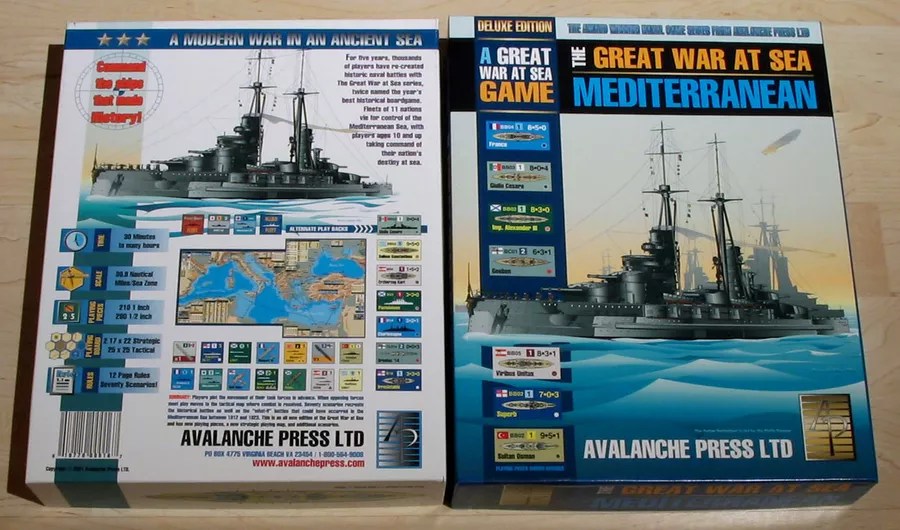
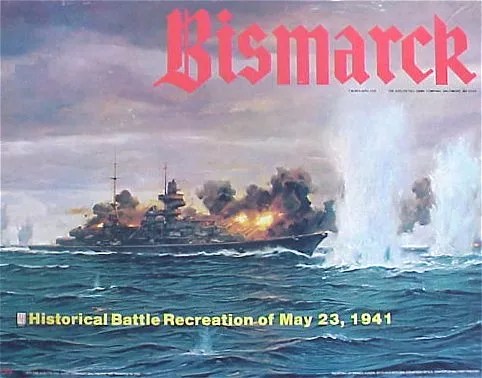
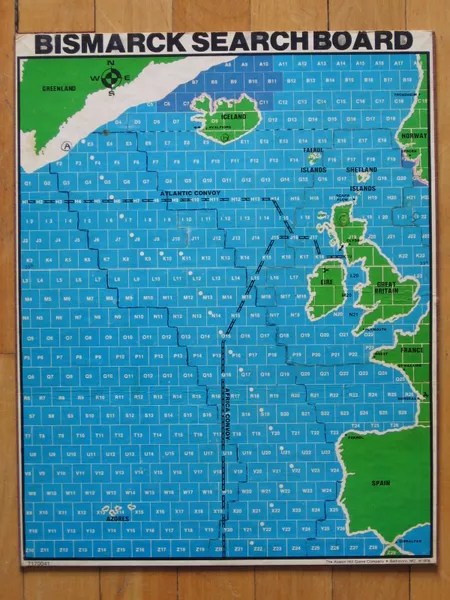
When I first perused There Must Be A Victory I expected the Operations Phase to cover the movement of fleets to contact in much the same manner operational movement is seen in classic naval wargames such as Bismarck 2nd Edition (Avalon Hill, 1978) or The Great War at Sea: Mediterranean (Avalanche Press, 1996). In those games an operational map is used to track movement of ships as they search out enemy fleets. The operational game of There Must Be A Victory is also used to depict the movement of fleets to contact…and much more.
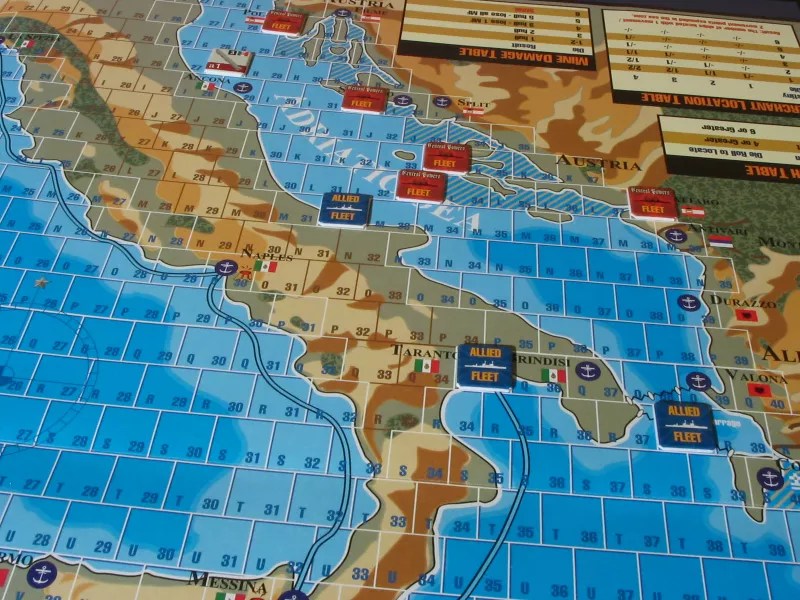
The operational level game of There Must Be A Victory is used for more than just moving fleets and assigning them missions as they sail towards battle. Most importantly, in the Operations Phase players alternate performing operational impulses to mobilize and activate fleets. This two-step process represents sorties of ships from port (Mobilization) and missions (Activation). Each nation has a starting Fleet Mobilization Level (FML) which, “simulates the political leadership’s willingness to risk its very expensive navy in battle” (Rulebook, p. 4).
For example, the Italians start the campaign with FML=2 whereas the Austrians start with FML=5. For a fleet in port to mobilize it must roll ≤ the current FML. The Command Rating for Italian Admirals is added to the die roll (harder to mobilize) whereas an Austrian Admiral’s Command Rating is subtracted (easier to mobilize). The Italian FML increases by 1 on even turns and the Austrian FML reduces by 1 every third turn. Random Events can alter the FML. Further, for every 10 Victory Points scored the FML increases by 1. Failed mobilization die rolls can be reattempted (up to two times for a total of three attempts) but at a cost paid in Victory Points.
Fleets that mobilize in There Must Be A Victory move from a Port to the associated At-Sea box. Fleets then get from one to three Activations—based on how many attempts it took to mobilize—in which the Fleet can move between Sea Areas or be assigned Bombard or Blockade missions at a port. When entering a Sea Area occupied by an enemy fleet, the moving player must pause to allow for an interception attempt. If the interception attempt fails the moving fleet can continue movement. If the interception attempt succeeds a Tactical Battle will be fought in the coming Tactical Combat Phase. Tactical combat is also triggered if opposing fleets both occupy a sea area at the end of an Activation Phase.
In the Operations phase of There Must Be A Victory, ships are arranged into fleets. Rule 6.3 Fleet Composition becomes very important at this stage as fleets are one of four types: Main Fleet (at least four warships), Battle Fleet (at least four warships of which at least one must be an ironclad), Support Fleet (at least four ships, mostly small ships but up to two ironclads can also be added), and Reserve Fleet. While this rule appears as extraneous rules fluff at first, fleets move and can be separately intercepted. Woe be the Admiral that fails to add an escort to a Support Fleet.
The goal of the Operations Phase in There Must Be A Victory is expressed as Victory Points. As expected, most Victory Points are earned in the Tactical Combat Phase and usually are awarded for hits on, or destruction of, enemy ships. More relevant to the Operations Phase, another set of Victory Points is also earned (or lost) from Random Events or with a failed mobilization or activation die roll. Significantly, Victory Points are also earned from blockades or commerce raiding, hits from bombardment of enemy ports, and landing of the Italian Army in various ports.
The second, operational-level set of Victory Points in There Must Be A Victory makes the Operations Phase much more than just a way to track movement of fleets across the Adriatic. With the ground war treated as off-map events, the Italian player is challenged to gain control of Austrian ports while the Austrian player looks to prevent bombardments and the landing of Italian armies. Yet, while the ground war is off-map, there are several random events related to the fortunes of the armies that drive fleet strategy. For example, the Austrian Random Event “Prussian Victory” postulates the Prussians win the Battle of Koniggratz which changes the Austrian mobilization level as the government looks to preserve the fleet. Or the Italian Random Event “Battle of Custozza” which has the Italian army defeated in that battle creating a political desire for the Italian Navy to do something; the in-game effect is to increase the Italian Fleet Mobilization Level for the turn making it easier to mobilize and activate fleets. The capture of the various political drivers of war and their impact on the activities of the fleet is an interesting twist on the “usual” operational level wargames of naval campaigns and adds a most interesting dynamic in There Must Be A Victory.
Ramming and ironclads
[Following the defeat of the Italian Army at Custozza, the Italian fleet under Admiral Persano sails in mid-July 1866 to attack Lissa and provide cover for a landing operation. The Austrian fleet, led by Rear Admiral von Tegetthof, sortied to oppose. Both fleets met 20 July 1866 in the first naval battle in the open ocean since Trafalgar. While ironclad ships proved—like they did in the American Civil War—mostly proof against gunfire of the day, ram bows prove effective. Thus, forward-firing guns and ram bows found influence into warship design for the next 30 years until major fleet battles of the Russo-Japanese War offered new lessons. (Derived from A History of War At Sea by Helmut Pemsel, Naval Institute Press, 1975, p. 93)]
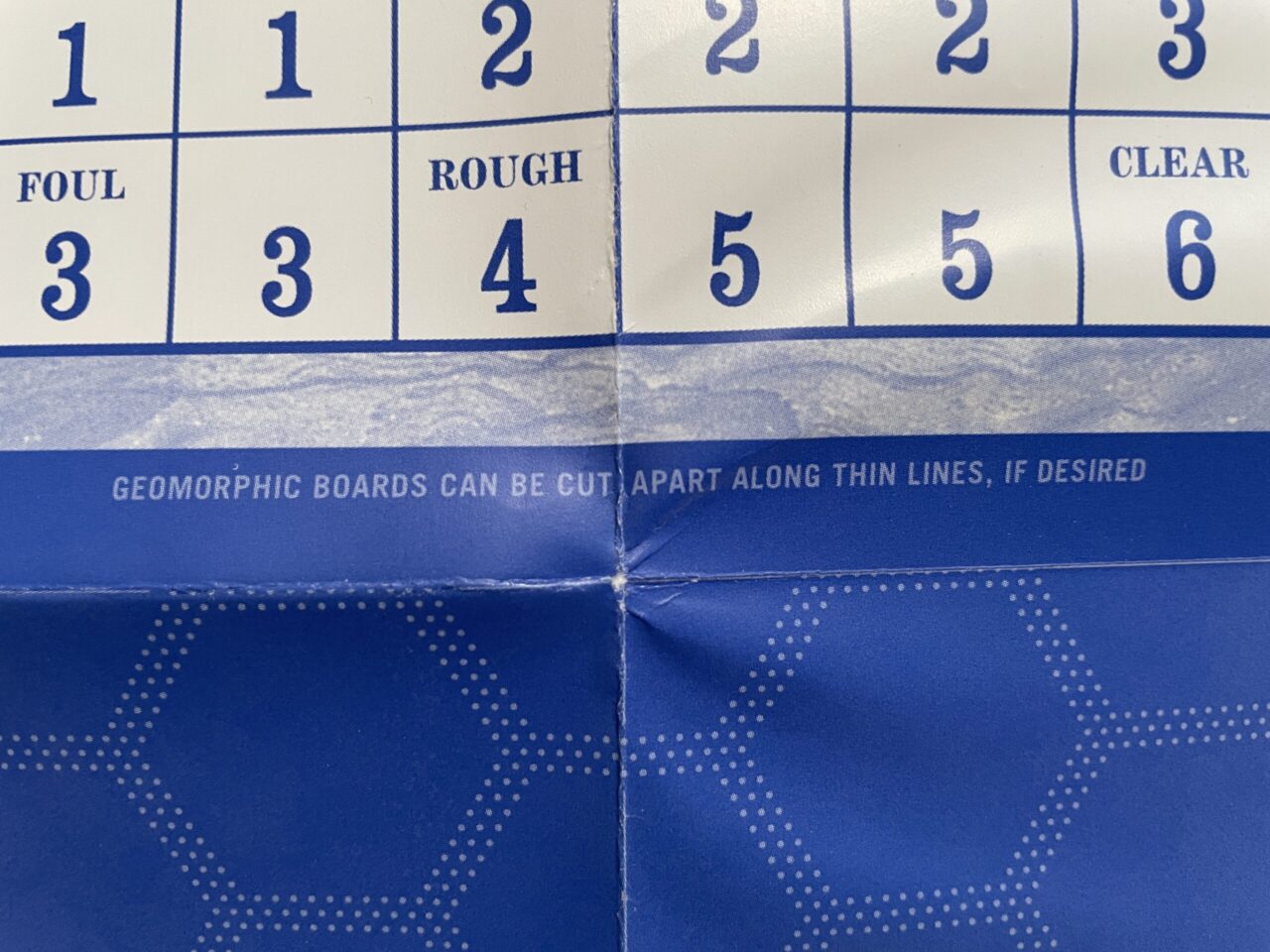
The second sub-game of There Must Be A Victory is found in the rules for the Tactical Combat Phase. In this phase, fleet warships, ideally arranged into formations with Admirals commanding them, fight across a set of six geomorphic Tactical Battle Boards. [The rules literally direct the players to cut the Tactical Battle Board into seven pieces: six geomorphic boards to create a “floating” game map and a seventh part with fleet holding boxes and other game tracks.]
The rules in the Tactical Combat Phase of There Must Be A Victory are pretty much as one expects in a tactical fleet combat game. Ships have several ratings: A Combat Factor (with or without rifled guns), a Crew Rating, a Ram Indicator if equipped as such, a Defense Factor with the “ironclad” rating if applicable, and a Movement Factor. Damage to ships is tracked on the Port and Ship Manifest player aid and shows the reduction in Combat and Movement Factors based on the number of hits. There are also rules for formations (7.4). [Important as forming a fleet into formations—a grouping of at least two ships—is useful as formations move and fire before individual ships.] Other rules include visibility (7.6), Line-of-Sight (7.7), and Fire Combat (7.8). Rule 7.9 Ram Attacks is a bit different and reflects the technology of rams on ships during this era. Optional rules (14.0) add Critical Hits (14.1) and other rules for differently equipped or available ships. Taken as a whole, the tactical battle rules in There Must Be A Victory are not very complex and lend themselves to somewhat quick resolution of battles. The time needed for resolving each battle is important as there can be one or more battles spawned in any given turn—and the game lasts 12 turns (48 days or, roughly, about a Seven Weeks War).
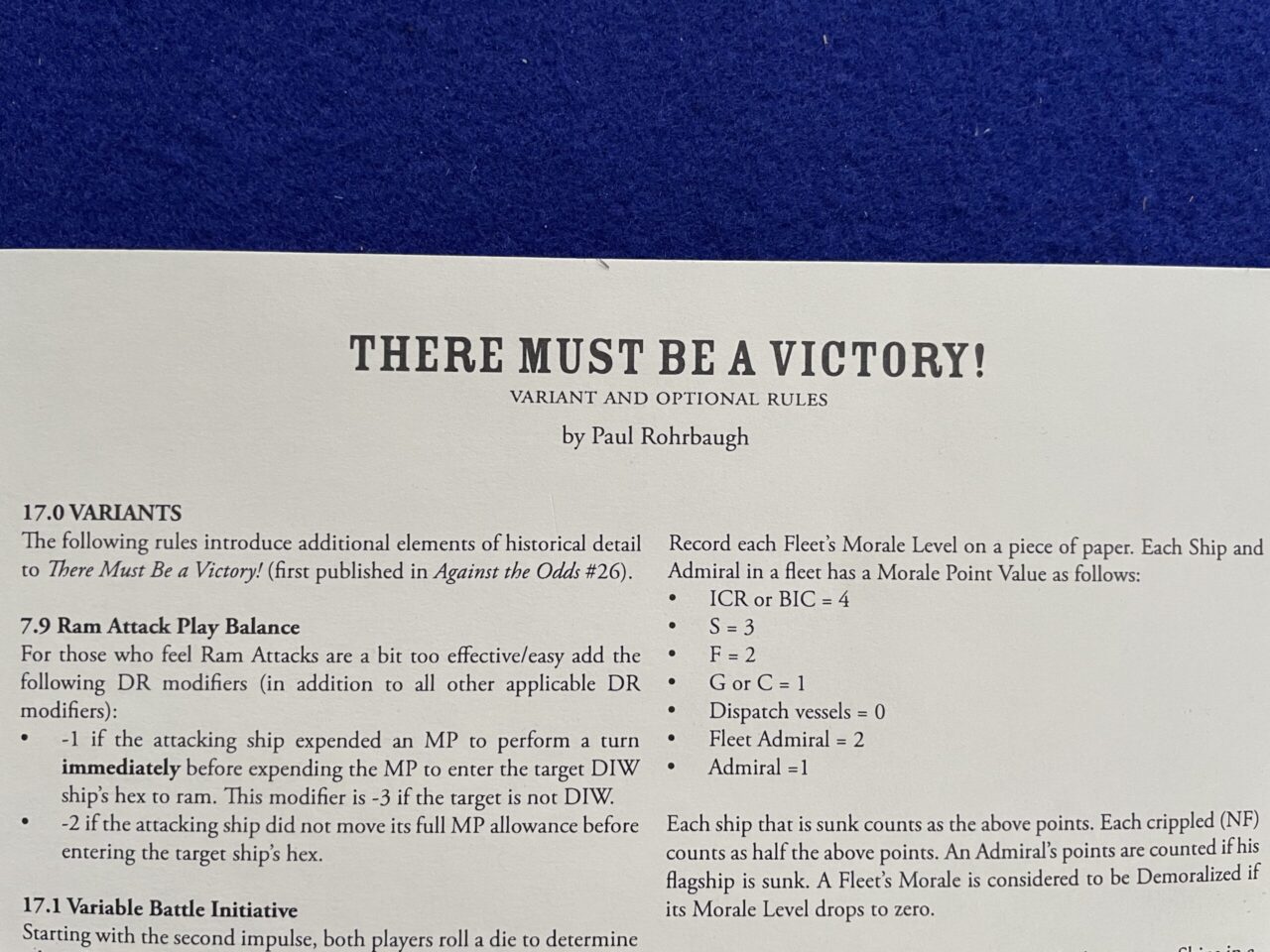
[Interestingly, in 2011 a set of “Variant and Optional Rules” for There Must Be A Victory! (now with an exclamation point) was released which adds three key optional rules that some critics contend are needed for play balance in Tactical Combat Phase battles. In particular, rule 7.9 Ram Attack Play Balance addresses critics who argue that Ram Attacks using the original Rules as Written are too effective or easy. Another optional rule is 17.1 Variable Battle Initiative which breaks the predictable rigid IGO-UGO sequencing in the original rules. Rule 17.1.1 allows for activated formations or ships to move-fire or fire-move unlike the original move-fire sequencing. Personally, I rather enjoy the optional rule for Fleet Morale (17.3) which reflects the will to fight of a fleet.]
Seapower and the state -or- Rohrbaugh channels Mahan
In the Designer’s Notes to There Must Be A Victory, Paul Rohrbaugh writes:
Some naval games lack two aspects of play that are important to me personally. One is the necessity to relate what is happening to the war on land, and how those leading the fleets attempt to influence the course of military events. Why fleets put to sea, and the reasons battles occur, are often dictated by what is happening ashore, and this was especially true regarding the naval campaign of the Seven Weeks War. (Rulebook, p. 12)
Paul’s comment reflects the heart of There Must Be A Victory which is, perhaps surprisingly to some, best reflected in the Operations Phase and not the Tactical Combat Phase of the game. For myself, I picked up There Must Be A Victory with the (admittedly low) expectation that there would be something to learn from the simulation of the Battle of Lissa. What I discovered, however, is that There Must Be A Victory is more a political battle over a kinetic conflict. In the Operations Phase, the players are challenged by political constraints or demands to do something—and sometimes even nothing. When playing, if the players cannot hear a little voice in their head that is channeling government cries for “There must be a victory” then they indeed missed the point of the operational game. The reflection of political demands in a wargame vice the usual plain-vanilla “military missions or objectives” is a very welcome change that makes even a low-complexity title such as There Must Be A Victory that much more interesting.
‘Punking your wargame afterwards
Totally not necessary for play, my copy of There Must Be A Victory also includes the one-page “’It Must Be Verne!’ Steampunk Rules for There Must Be A Victory!” on the reverse side of the “Variant and Optional Rules” from 2011.
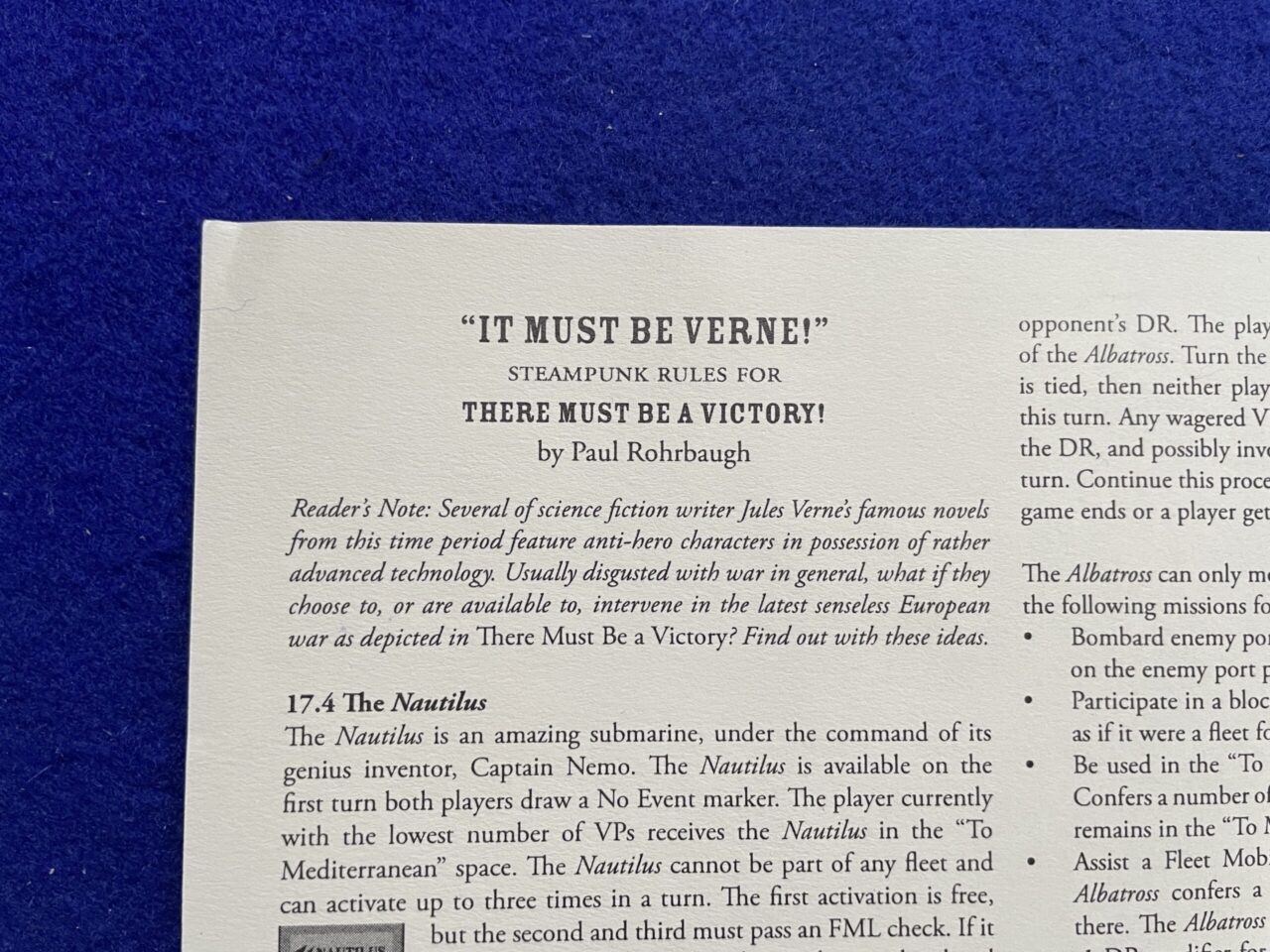
This steampunk variant adds rules for the submarine Nautilus from Jules Verne’s Victorian-era science-fiction novel Twenty-Thousand Leagues Under the Sea first published in 1869. The second steampunk rule adds the Albatross, the flying ship of Robur the Conqueror taken from Jules Verne’s 1886 novel of the same name. Both rules, absolutely unnecessary for playing There Must Be A Victory, are fun add-ons that almost certainly will make players grin and laugh during play. [Alas, counters apparently came available in Issue Nr. 32; guess I must make due with some homemade ones.]


[As an interesting aside, did you know that -SPOILER ALERT- Captain Nemo is actually Professor James Moriarty, the arch-nemesis of Sherlock Holmes? You did not? Apparently you fell for the Disney propaganda from their 1954 movie instead of reading source materials. To get the “real” story one needs to read, “The Secret History of Captain Nemo” by Rick Lai found in Myths for the Modern Age edited by Win Scott Eckert (MonkeyBrain Books, 2005). The story documents a member of the Wold Newton Universe which also includes yet another person that often is cited as myth. I strongly encourage all to read the real story of Tarzan as recorded in Tarzan Alive: A Definitive Biography of Lord Greystoke by Philip José Farmer.]


“Engage the enemy more closely”
When I first picked up There Must Be A Victory at the Fall Assembly I totally expected the game to be another run-of-the-mill tactical naval battler.
Boy, was I wrong.
The real “wargame” in There Must Be A Victory is the Operations Phase. Before one can get to a tactical battle one needs to mobilize and activate. That “Mobilize-Activate” game is the real heart of There Must Be A Victory. It is also, perhaps, the most easily overlooked part of the game design. I sense that most players likely just want to speed through the Operations Phase in order to get to the tactical battles. That is too bad as the politically driven commitment to mobilization (shown by the FML) is what will make or break a fleet. The political operational game was totally unexpected which made my discovery of the underlying drivers behind the Operations Phase that much more entertaining to learn and then put into play.
To conclude, to whomever the fellow Dragoon is that placed There Must Be A Victory on the swap table I owe you a great, “Thank you!” For others, if There Must Be A Victory ever crosses your gaming table I strongly encourage you to take a real moment and look at the operational-level game and the political statements it is making. Oh yeah…enjoy the tactical shooty-bang-bang ship battle too!
You can chat about this game in the Modern World section of our discussion forums
Thank you for visiting the Regiment of Strategy Gaming and riding with The Armchair Dragoons.
Rather than list a bunch of social media links, the easiest thing to do is to check out our LinkTree, which connects you to all of our various locales around the web.
You can also support The Armchair Dragoons through our Patreon, and find us at a variety of conventions and other events.
Feel free to talk back to us either in our discussion forum, or in the comments below.

