
 by
by Bill Simoni, 06 April 2026
Unconditional Surrender! Western Campaigns (USWC) is a scaled-down sequel to 2014’s Unconditional Surrender! (USE)1. Whereas USE put up to three players in charge of the entire European and Mediterranean Theaters, this version zooms into (surprise!) the western fronts. It also strips out some of the more complex or time-consuming mechanics. So, is it a worthy title its own right, or just a pale imitation? The simple answer is “both”.
What’s In The Box?
GMT did not scrimp on game materials for USWC at all. Inside you’ll find:
- a 28-page rulebook, which includes a helpful page explaining the differences with USE.
- a 20-page playbook with nine scenarios
- a 32-page guidebook covering how to learn the game and designer notes
- two four-page player aids which cover the order of play sequence and all the tables needed to play
- a game-information display
- one countersheet
- five maps, some of which are two-sided – each scenario has its own map


click images to enlarge
Of the nine scenarios in USWC, six are essentially the same as in USE. They have been adjusted for rules and countermix changes. Three of them are the “training scenarios” used to learn the rules of the game. Each is useful for either solo or joint play, but not really opposed, although each comes with suggested changes to make them more competitive. These scenarios are for 1, 2, and 5 turns respectively. Either the Axis player meets their objective and wins, or not.


The longest scenario2 is Italy 1943-44 which has variations covering 14 or 15 turns, depending on if you want to force the Italians to surrender yourself or start right after they capitulated. The rest of the scenarios are 8 turns or less. For comparison, the largest two USE scenarios are 42 and up to 60 turns.
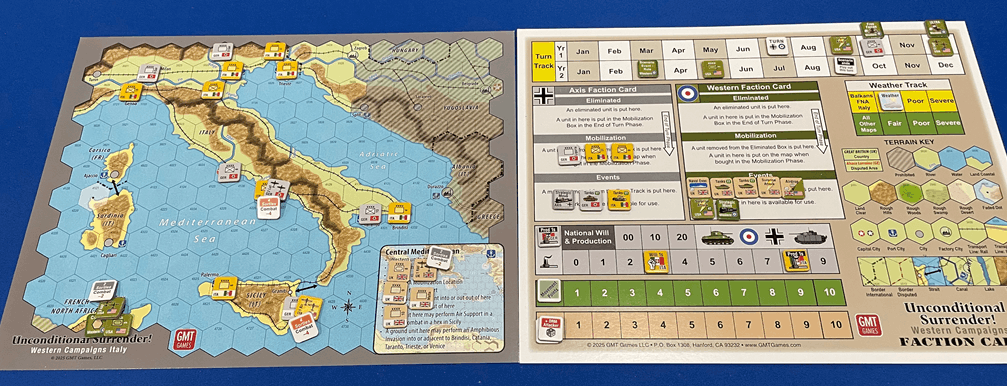
Gameplay Basics
Units are assigned movement points (MP) (eight for infantry, ten for armor) and are activated one at a time by the player. Movement is temporarily halted when entering a ZOC. The phasing player has three choices:
- end movement
- make a mobile attack, which costs MP as well, but if the defender retreats or is eliminated, the attacker advances since they’ve already paid. They may continue moving and make more mobile attacks.
- halt and mark the unit as making an assault attack (spending MP as above), which will occur later in the phase, at a time chosen by the attacker. The unit may not have made mobile attacks previously this activation. Up to three ground units can combine to make one assault attack.
Air units and other special markers can be used to support a combat by either side. This can result in air combat, which determines which side gets the positive drm for aerial support. Each air unit can only operate when it has fewer than six sorties. At least one sortie is applied every time the unit is used, but air combat can add more sorties for the losing side.
Both sides roll during combat, apply drms, and determine the result. The same table is used for both ground and air combat.

What’s Missing?
Compared to USE, USWC has removed several gameplay steps. While still present, the economics/production is stressed less and strategic warfare has been completely removed. There is no naval in this version, which especially added stress and excitement into keeping your units in supply. The abstract politics phase has also been removed. This made you decide to spend resources on swaying relationships across the map against paying for reinforcement units or special markers. Conditional events have fallen from a list of nine to a simple one (“country collapse” and “conquered country” have more or less been merged).
For me, what’s missing is the feel of the game being a mini-monster. USE took up your whole table, had a plethora of units, and could easily occupy a few days of playing time.
Final Verdict
Designer Sal Vasta has created a fun system; I really enjoy the gameplay. If you need a small, short, wide-scope game, USWC may very well be it. Had I not been introduced to USE first, I would absolutely love USWC. I prefer the whole enchilada of USE – bring on the several-day campaign with all three sides. Enjoy a beer, trash talking your buddies, and feel the expansiveness.
That being said, USWC is available now from GMT for an incredibly low $39, while USE is on the P500 for a reprint for $59 (normally $82). It is “In Art and Final Production” and as of press time, is projected to go to printing in the 2nd or 3rd quarter of 2026. My copy of USWC will probably end up being gifted away simply because I prefer playing the bigger game. But I would gladly play this if a friend was interested.
You can chat about this game in the Modern World section of our discussion forums
Thank you for visiting the Regiment of Strategy Gaming and riding with The Armchair Dragoons.
Rather than list a bunch of social media links, the easiest thing to do is to check out our LinkTree, which connects you to all of our various locales around the web.
You can also support The Armchair Dragoons through our Patreon, and find us at a variety of conventions and other events.
Feel free to talk back to us either in our discussion forum, or in the comments below.


