
 by
by RockyMountainNavy, 24 July 2026
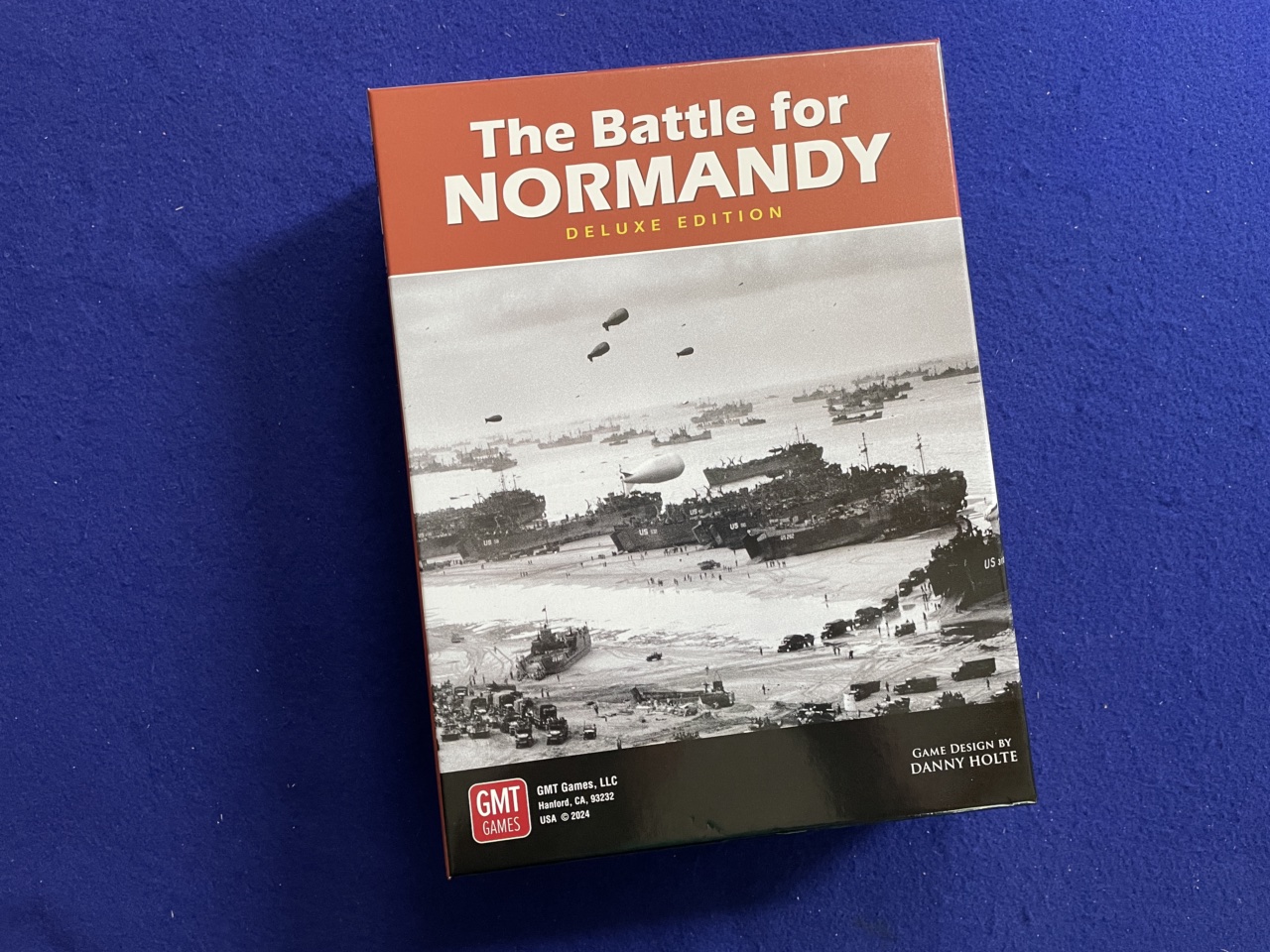
Thanks to the generosity of GMT Games, The Armchair Dragoons has been sitting on a courtesy copy of The Battle for Normandy, Deluxe Edition (Danny Holte, GMT Games, 2025) for quite a while now. Exercising his command authority (ha!), Regimental Commander Brant directed the game to my inbox with tasking to review. That is, literally, a monster-sized order.
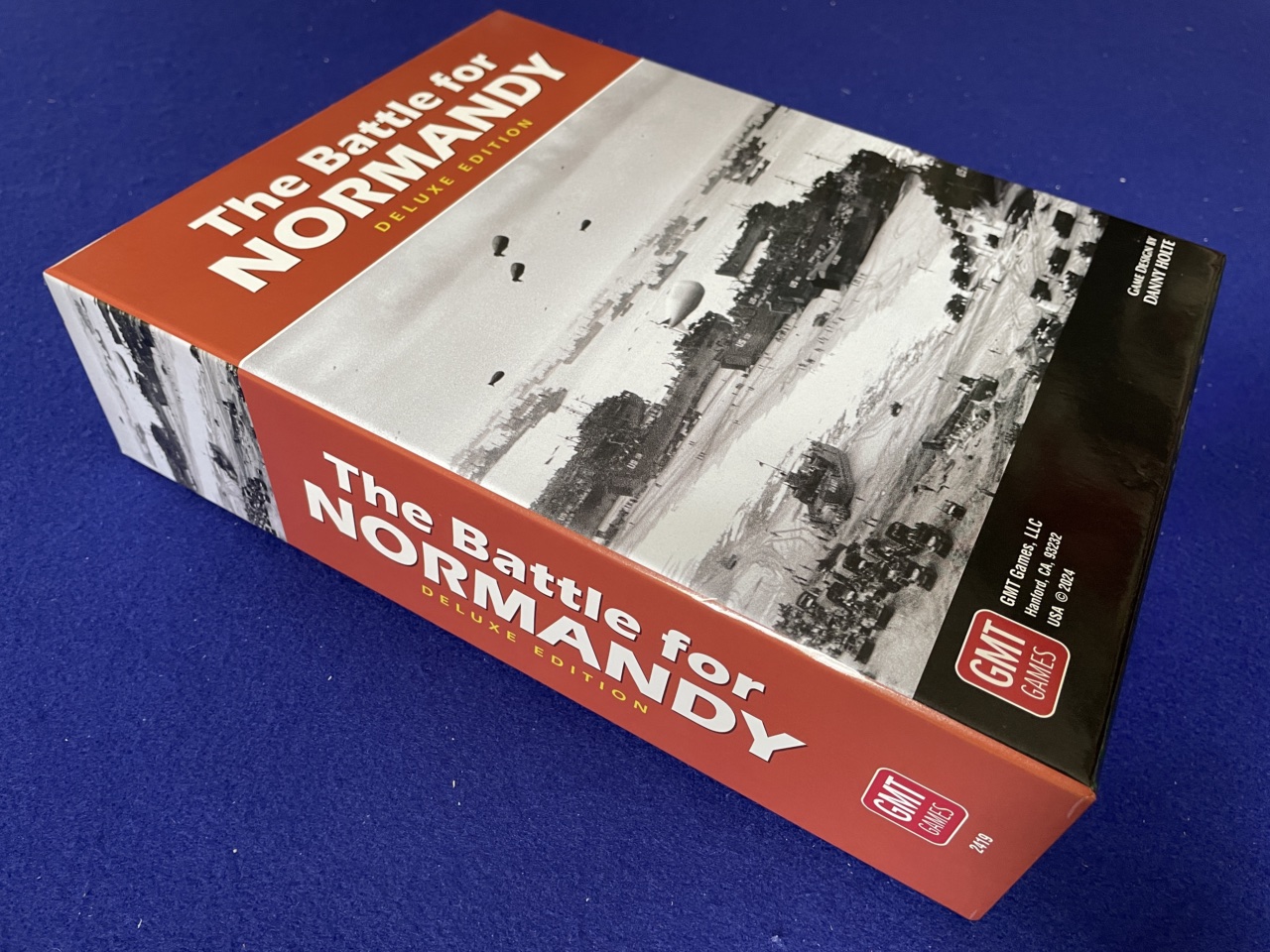
A Normandy monster
Designed by Danny Holte, The Battle for Normandy, Deluxe Edition (hereafter Normandy Deluxe) is the 2025 update of The Battle for Normandy published by GMT Games in 2009. While the term “monster wargame” does not have an agreed upon definition, I am confident that anybody looking at the ad copy for this Deluxe Edition will recognize it as such:
The Battle for Normandy, Deluxe Edition is a game that represents the climactic campaign in Normandy from D-Day, 6 June 1944 to the first week of August 1944 at primarily battalion level. Numerous scenarios are included to play out various smaller battles in Normandy. It is intended for two players or player teams.
Game Features:
Time Scale – 6 hours per turn
Map Scale – 1250 yards per hex
Unit Scale – Battalion or Company (GMT Games website)
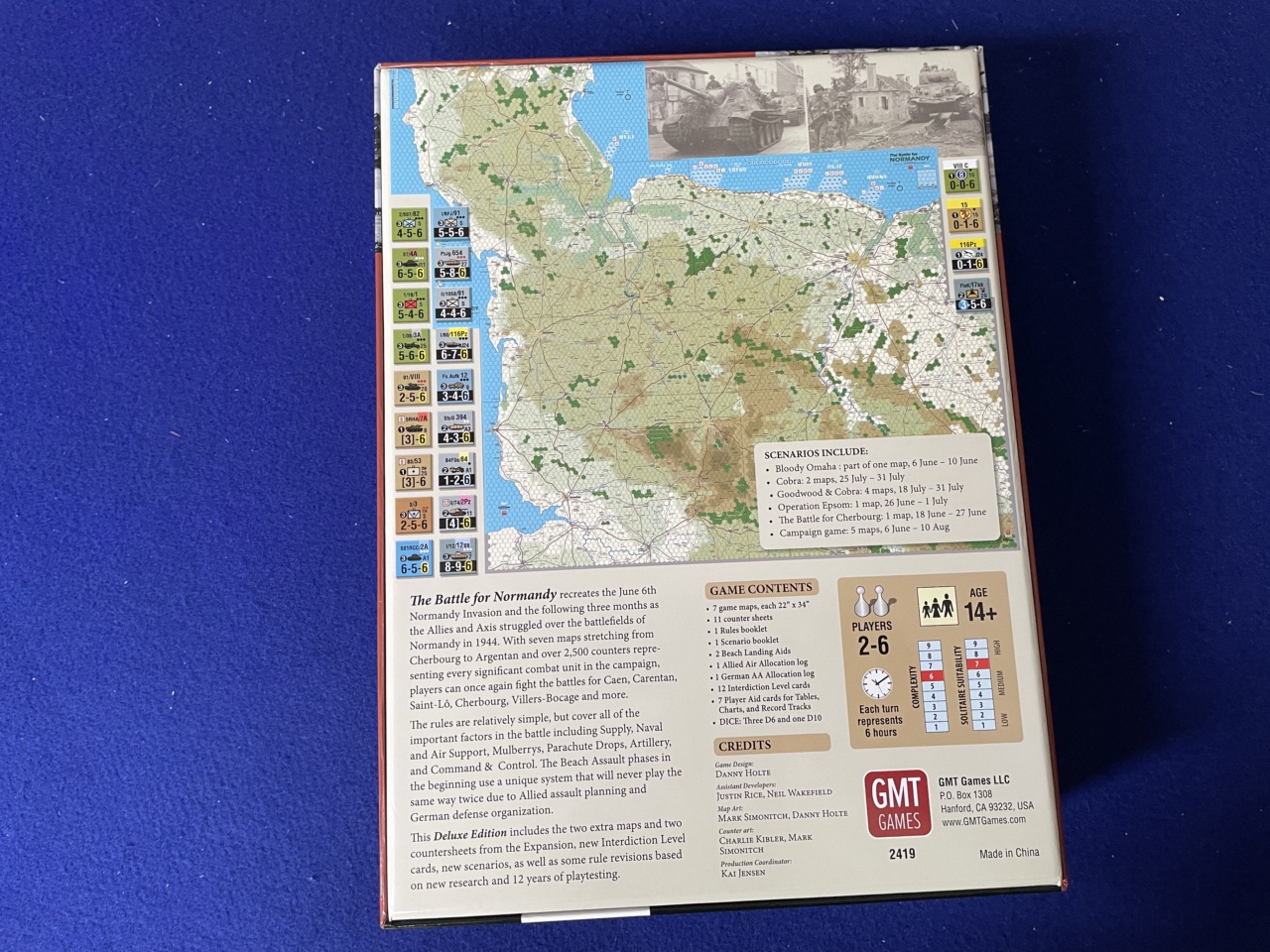
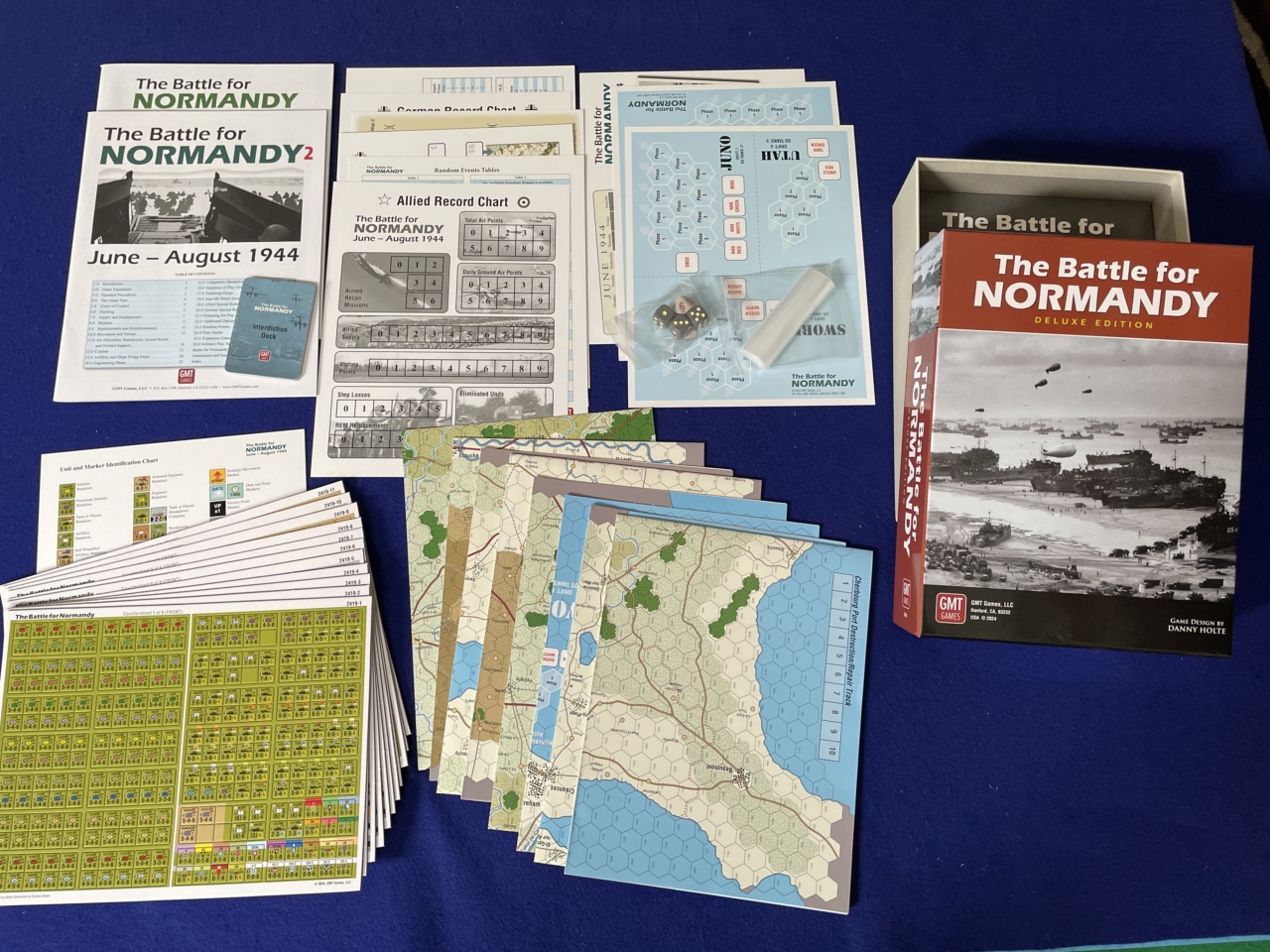
In terms of components, Normandy Deluxe has a rulebook, scenario book, numerous play aids, and nearly 3,000 unit counters and markers; a typical US Army infantry division is 10 counters!
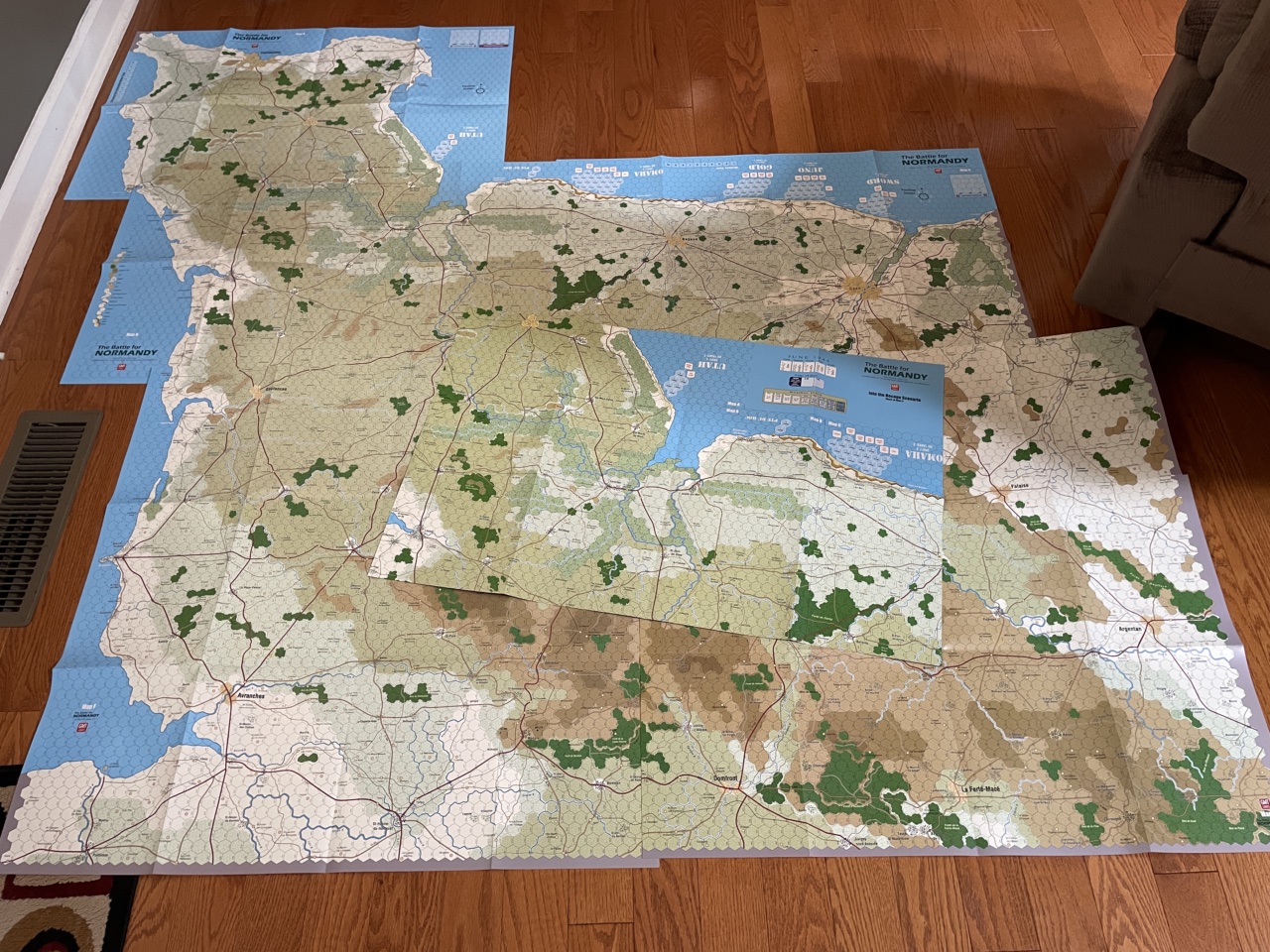
The five core maps, when fully laid out, need a playing area at least 6’x6’ and more like 7’x7’ or slightly larger to accommodate the maps plus numerous player aids.
Surprisingly, the rules in the 48 page rule book for Normandy Deluxe are not overly complex. It is as if the designer knew the scale of the game was already monstrous and wanted to not make a complex monstrosity of a rule book. The core rules are covered in about 27 double-column pages. Alas, the 6 June Invasion Turn (a “mini-monster” game played at company-scale) is literally a second wargame with its own set of rules—six of the 27 pages of core game rules in fact.
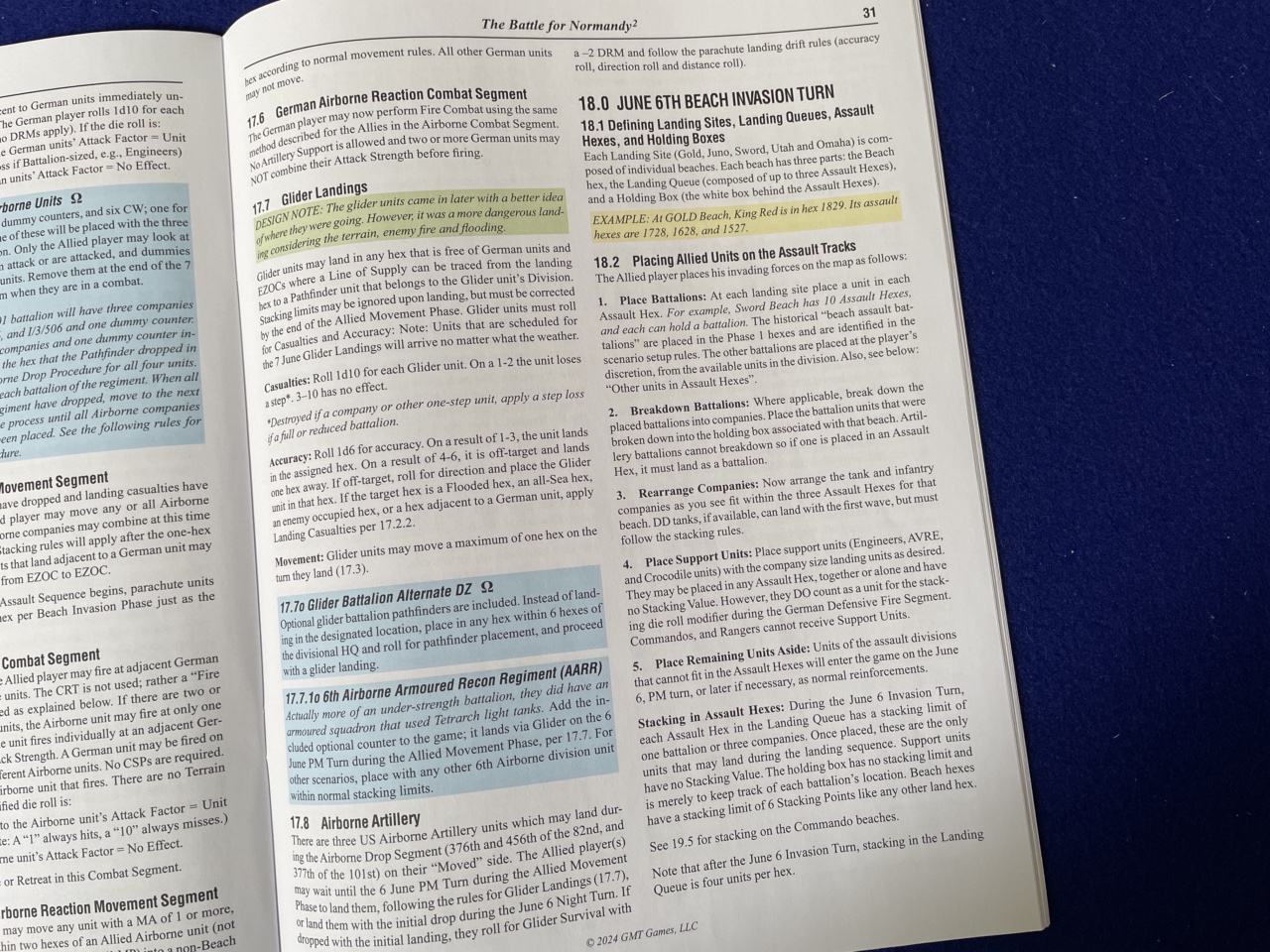
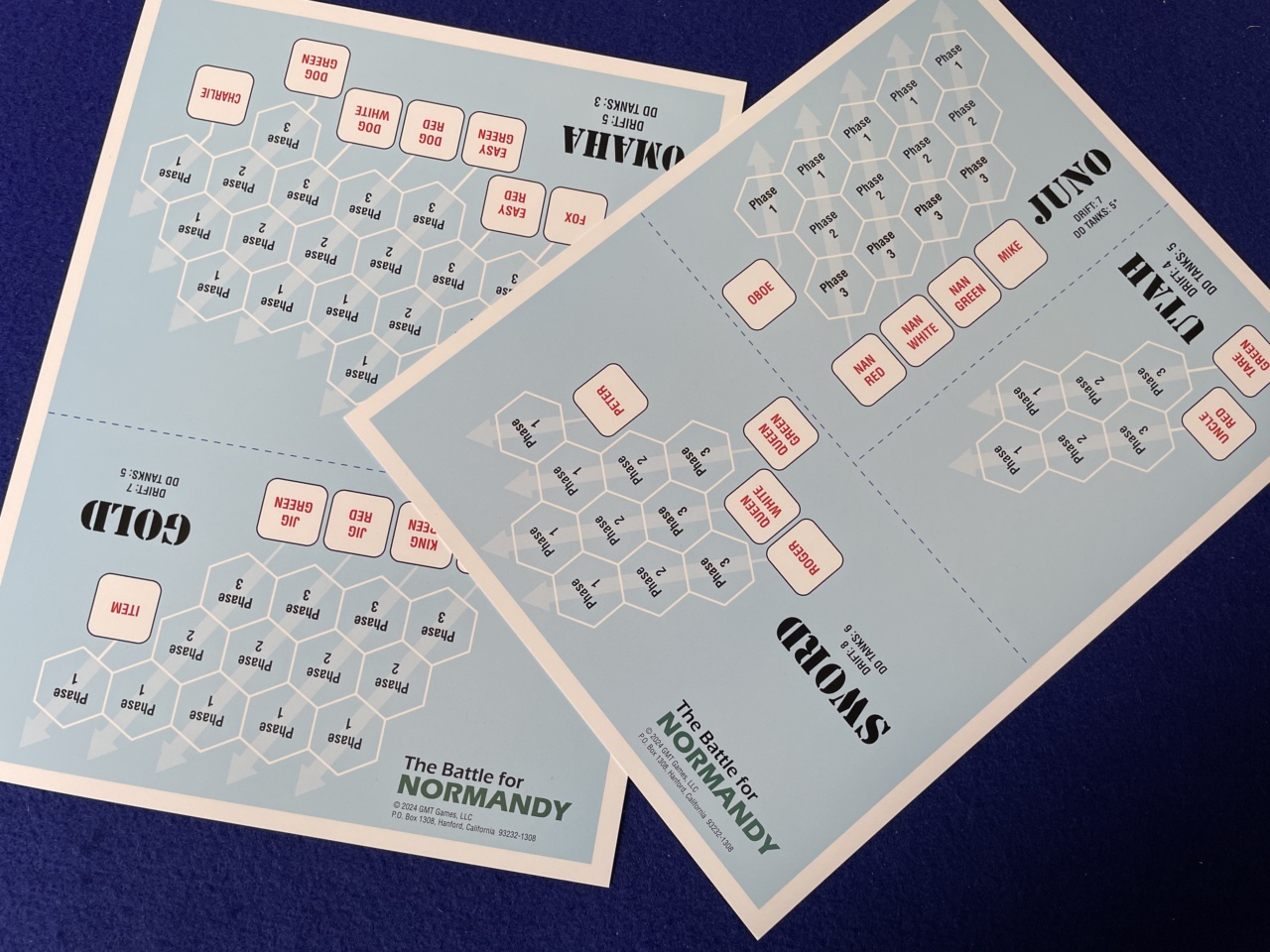
Even so, taken as a whole the game system for Normandy Deluxe is not that complicated. That said, this is not a game for the faint of heart. One needs a strong constitution to play Normandy Deluxe because every “day” is played out over three turns; an AM, PM, and Night turn. If you play “Scenario 7.0 The Battle for Normandy (Campaign Game)” that one can run from the 6 June AM turn to the 11 August PM turn making it “only” 200 turns played over five maps. There are shorter and smaller scenarios; one BoardGameGeek user recommended playing scenario “5.0 Operation Epsom” to learn the game as it uses part of Map C and is much shorter at only 18 turns.
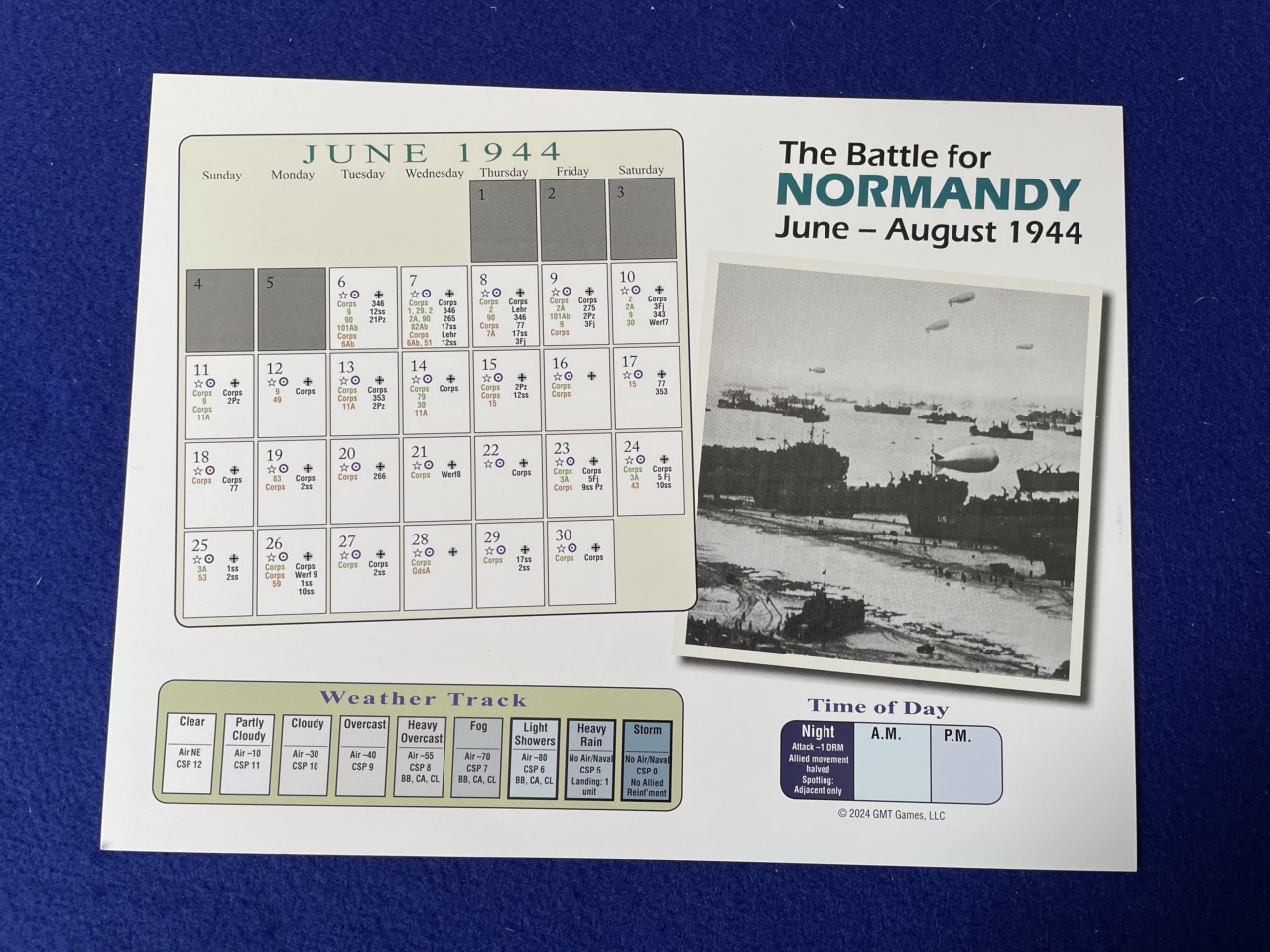
The sheer physical size of the wargame scoped to 6 hour turns played on hexes just over 1 km wide with units broken down by battalions (even companies in the case of invasion day) and yet running on rules and scenarios covered in some 40-odd pages makes Normandy Deluxe highly suitable for play by a wargaming group or club. Surprisingly (and most welcomed by me) GMT Games rates Normandy Deluxe as a “7” or “High” on their Solo Suitability scale (rated 1-9).
Solo deluxe and supply
I am not part of any gaming group that is willing to tackle Normandy Deluxe. My small domestic gaming group is in transition with one on station but with competing commitments and another in the area but not willing to commit to a game of the size or duration of Normandy Deluxe. This means I am left to explore Normandy Deluxe using a solo, smaller scenario option. While there are no specific solo rules in the Normandy Deluxe rule book, there are Solitaire Play Tables provided in rule 26.0 “to facilitate solitaire play.”
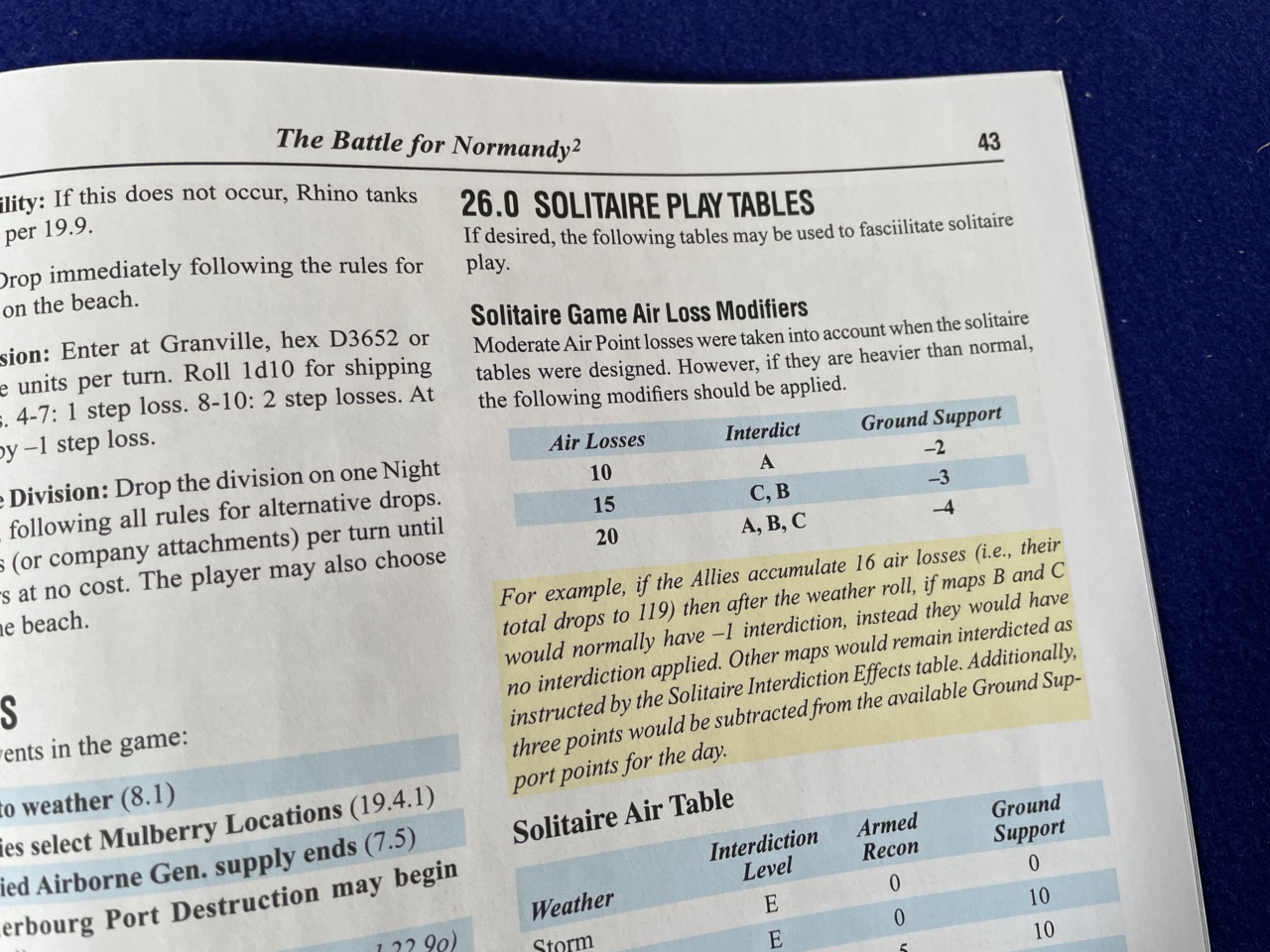
Using those tables, I chose to play “Scenario 13.0 Operation Totalize” that was originally part of The Battle for Normandy Expansion (2013) and is a one-map, 13 turn affair. The unit density in “Operation Totalize” is also not as extreme as Normandy Deluxe can be with each side starting with about 50 units on the map. The Victory Conditions are quite simple: “The Allied player wins if he gets one or more units into Falaise. Anything else is a German win. Do or die!” (Playbook, p. 54).
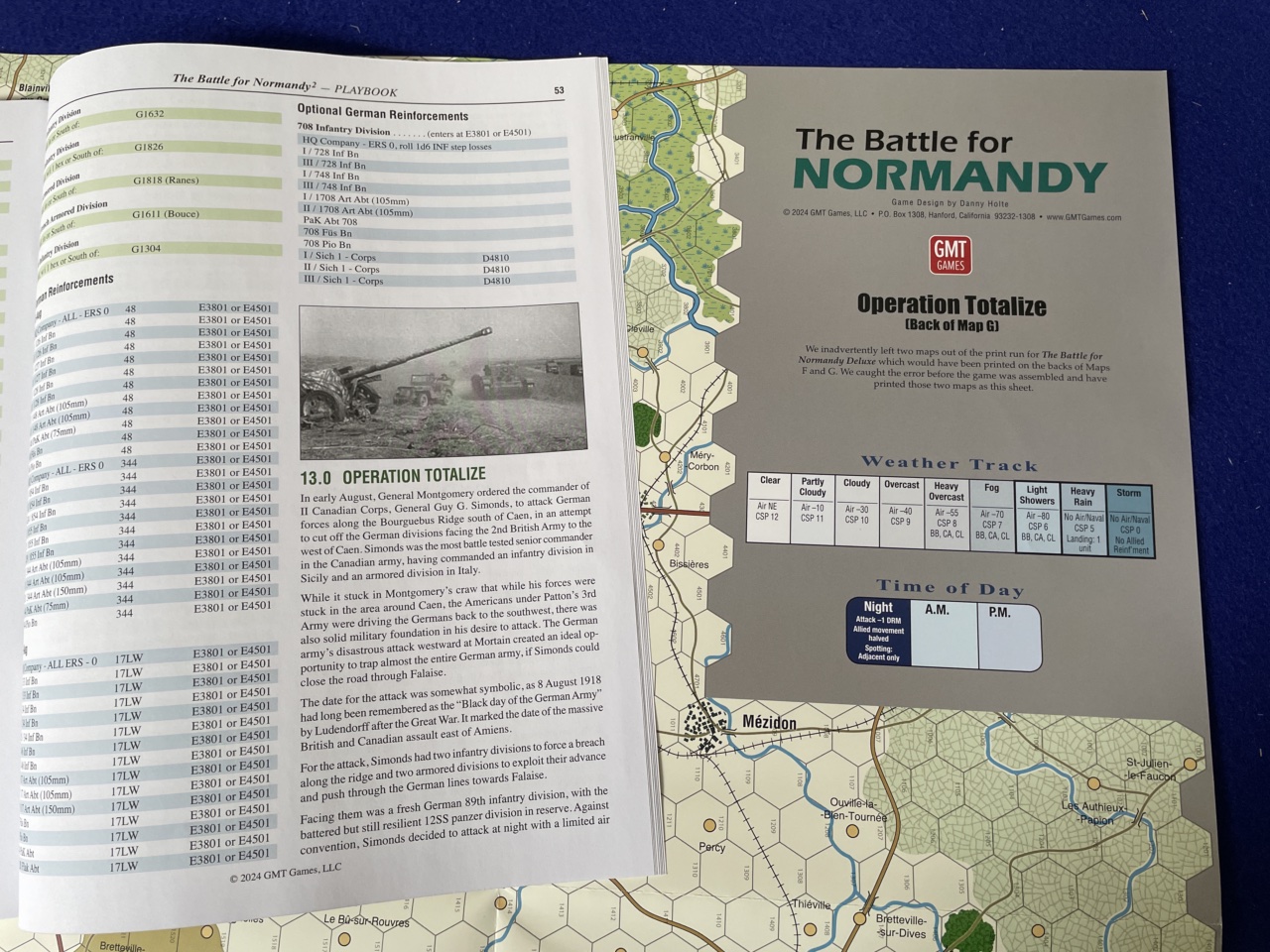
As “Operation Totalize” starts well after the invasion I did not get to experience rules “16.0 Sequence of Play Outline for the June 6th Turn,” “17.0 Paratroop Drops,” and “18.0 June 6th Beach Invasion Turn.” I did note the presence of rule “22.30 Battalion-level Unit Landings” which changes resolving the June 6th invasion from the company to battalion level.
In my plays of Normandy Deluxe the rule that stood out to me was “7.0 Supply and Headquarters.” At first blush this rule looks anything less than impressive; for units to operate at full effectiveness they must be in Supply. There are two types of Supply: General (checked at the beginning of Movement) and Combat (checked at beginning of Combat). Units trace Supply along Lines of Supply that are restricted in length (depending upon the Headquarters providing Supply) or Terrain.
While most Supply rules apply to both sides, the Allied player is further restricted by Combat Supply Points (CSPs). The Allied player begins the game with a certain number of CSP and gains additional CSP, “each day based on the Weather, scenario, the control of Cherbourg (20.4) and/or presence of a Mulberry Harbor (19.4)” (7.6.2 Combat Supply Points (CSPs)). Further, the “Allied player must spend CSP to conduct a Major Attack (7.6.3) or to use Artillery, Naval Gunfire, or Ground Support in combat. The Allied player may always attack from a single hex without spending a CSP as long as he does not use Artillery, Naval, or Air Support” (7.6.2). The Allied player can also spend a CSP for Defensive Artillery Fire, “to assist friendly units that are attacked during the German Player Turn” (7.6.3 CSP Cost). This simple rule, taking up just a bit more than one column of the rulebook, is truly the heart of Normandy Deluxe.
Whereas the German player need only maintain Lines of Supply to move or fight units, the Allied player must do so “on a budget.”

[In the “Operation Totalize” scenario the Allied player starts with 20 CSP and earns an additional 1d6+6 CSP daily. The Special Rules for the scenario also directs the use of optional rule “7.6.3o Graduated Allied Expenditure.” This rule replaces rule 7.6.3 which lists CSP cost of 0-3 in combat depending on the attack/defense type. In 7.6.3o, the CSP cost is dependent upon the number of hexes in combat and the amount of artillery or air support the Allied player wants to commit. For example, it is possible that if the Allied player is conducting a multi-hex attack with up to two (2) artillery units in support (2 CSP) and wants to add in Air Support (1 CSP) and then feels compelled to add two (2) more artillery support (1 CSP) that one single combat can be an expensive 4 CSP. that may not sound like much, but considering the Allied player might have only 56 CSP to spend during the entire scenario—if they roll a [6] at each Supply check. More realistically, the Allied player must be ready to have a budget of ~48 CSP and be ready to face having as little as 41 CSP over the course of the scenario. That translates into something like—maybe—10 Major Attacks and an equal number of Defensive Artillery Fires over the course of a three day, 13 turn scenario in which the Allied player MUST attack to advance. CHALLENGING!]
Other Normandy goodness
While my play of Normandy Deluxe highlighted the Supply rules, several others particularly stood out to me because they added real thematic flavor” to the game in exchange for low rules overhead:
- Although an optional rule, I see “10.2o Traffic Modifier in Bocage, Woods” as essential to play.
- “11.0 Air Allocation, Interdiction, Armed Recon and Ground Support” covers air combat in Normandy Deluxe using abstracted Air Points which are assigned various missions (Interdiction, Armed Recon, or Ground Support) but when doing so must face deadly German flak.
- “22.10 Allied Unit Quality” calls for units to roll to determine the Quality Die Roll Modifier (DRM) of the unit when in combat. Unit commanders can be “sacked” which possibly results in a new Quality DRM when the Headquarters returns. A Historical Alternative Variant provides historical Quality DRMs that can be used if desired.
As much as I enjoy the smaller scenarios in Normandy Deluxe, scenario “16.0 Operation Steinbock” stuck a sour cord with me. “Operation Steinbock” is a “Campaign Game Variant” that supposes the Germans did not waste their medium and heavy bombers in retaliatory attacks against England in early 1944. Instead, “Operation Steinbock” supposes the bombers were held and used in May 1944 for attacks on Southhampton and Portsmouth; that is, the Allied ports used to stage the invasion. The result is some units start the invasion with step-losses or even elimination. In some cases the arrival of Allied units at the Normandy beaches is delayed by as much as a day. The initial CSP allotment for the Allies is reduced and reinforcements also risk delays in arrival. Even later reinforcements face delays. While all that sounds reasonable, it chafes me that all those changes are forced upon player with no agency to alter or otherwise engage with them. I am not sure how to change the rules to make it work but giving the Allied player some power to decide on priority for follow-on waves and reinforcements would be more compatible with what I see as the spirit of wargaming. Then again, maybe keeping to ruthless simplification of game system for a 200 turn wargame is necessary. Who knows.
I see Normandy Deluxe as an above average wargame to play; that is, if you have the time to commit to it. Here I am talking not only about playing time [the jokester who lists 240 minutes on BGG should be booted from the site], but also the time it takes to sort nearly 3,000 counters. Or the time the dining room table (or floor) will be occupied with the game. Although the game can be played solo—and on fewer maps—the space and time commitment needed is perhaps more than many wargamers are willing to spend. Clearly this makes Normandy Deluxe more of an event wargame; i.e. an event for a weekend wargaming club or team.
Wargaming Apple Method
There almost certainly are critics out there who are going to point out that since I did not play the full 200-ish turn campaign any commentary I have on Normandy Deluxe is suspect. Yes, I am basing my assessment on experience extrapolated from smaller, shorter plays. I believe my shorter experiences are valid experiments with the larger system; in fact, I would argue that a focus on smaller scenarios actually showcases the grand potential of the Normandy Deluxe monster game. I eventually want to try the 6 June Invasion Turn rules just to see how they work but doing so almost certainly would delay delivery of my first impressions of Normandy Deluxe to Taskmaster Regimental Commander Brant by several weeks—if not forever— in an already busy summer of wargaming. Nonetheless, I stand behind my assessment as I sincerely believe the best way to play Normandy Deluxe, if a gaming group is not available, is by the “Wargaming Apple Method”—i.e. one bite-size scenario at a time.
LATE BREAKING NEWS
According to the 21 July GMT Games Newsletter, the price of The Battle for Normandy Deluxe Edition is slashed from $170 to $93, making this a much-more-affordable monster of a wargame.
You can chat about this game in the Modern World section of our discussion forums
Thank you for visiting the Regiment of Strategy Gaming and riding with The Armchair Dragoons.
Rather than list a bunch of social media links, the easiest thing to do is to check out our LinkTree, which connects you to all of our various locales around the web.
You can also support The Armchair Dragoons through our Patreon, and find us at a variety of conventions and other events.
Feel free to talk back to us either in our discussion forum, or in the comments below.


