
 by
by RockyMountainNavy, 8 December 2025
Race you to the Moon! That is the premise behind One Giant Leap: The 1960’s US/USSR Space Race boardgame designed by Paul Rohrbaugh, with game graphics by Bruce Yearian, and published by High Flying Dice Games in 2025. One Giant Leap is an excellent racing game that hits all the right thematic notes of the “Space Race”; that is, once you get through a bit of a challenging rulebook.
This is how GPT-4omini describes the Space Race:
The US/USSR space race began with the Soviet Union’s launch of Sputnik 1 on October 4, 1957, the first artificial satellite, which marked a significant technological achievement and heightened Cold War tensions. This event prompted the United States to accelerate its space program, leading to the establishment of NASA in 1958. Over the following years, the race intensified with milestones such as the first human in space, Yuri Gagarin in 1961, and the US’s Mercury and Gemini programs, which advanced human spaceflight capabilities. The rivalry culminated in the historic Apollo 11 mission, which successfully landed Neil Armstrong and Buzz Aldrin on the Moon on July 20, 1969, marking a decisive victory for the United States and a significant achievement in human exploration. (Duck.ai with prompt, “Describe the US/USSR space race from the launch of Sputnik to the Apollo 11 Moon landing in one paragraph” executed on 6 Dec 2025)
One Giant Leap leans heavily into the theme of the Space Race. The High Flying Dice Games website explains the game mechanically and thematically this way:
One Giant Leap is a moderate complexity simulation game of the race between the USA and USSR (Soviet Union) to be the first nation to have a manned space craft land safely on the moon and return to earth. Players use card play to determine how many activations and assets they can utilize to develop their rockets, equipment, infrastructure and crews. Events, both fortuitous and adverse, will also occur that affect one or both players during the course of the game.
The space programs of the USA and USSR inspired a global audience and inspired scientific and technological innovations at paces not normally seen in peacetime. These endeavors united people across the planet, giving many the first look at our fragile planet in space, and allowing all to wonder at what humans could accomplish. The “space race” of the 1960s offered tantalizing glimpses of what humanity could do despite tremendous challenges, cultural and political differences, and in the face of tragedy as well as triumph. I hope all who play One Giant Leap learn and enjoy! (HFDG web site)
One Giant Leap is—mechanically—a resource-limited racing game. Players need to build their space program and ‘race’ through multiple missions in a quest to be the first to land on the Moon.
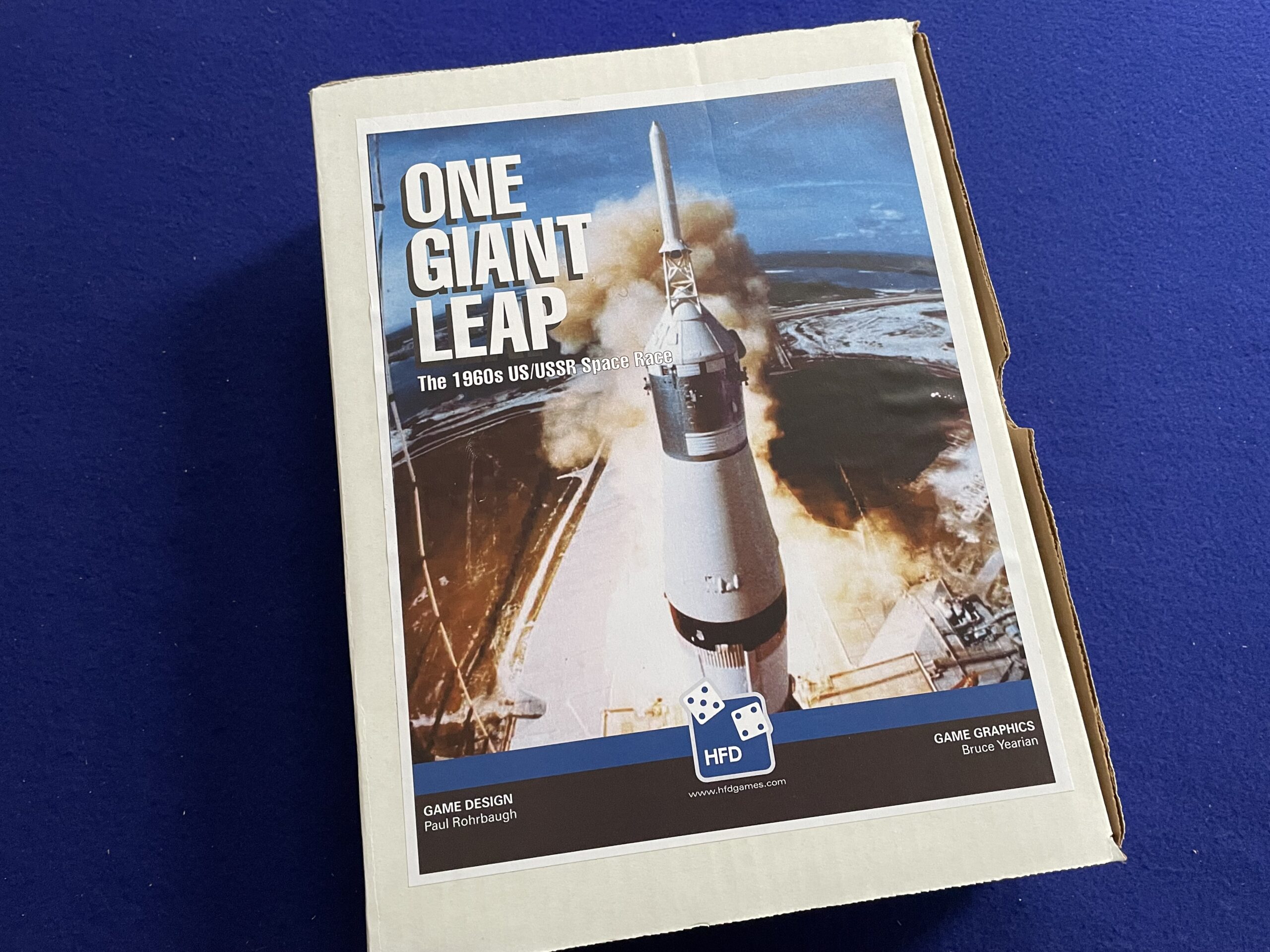
Components
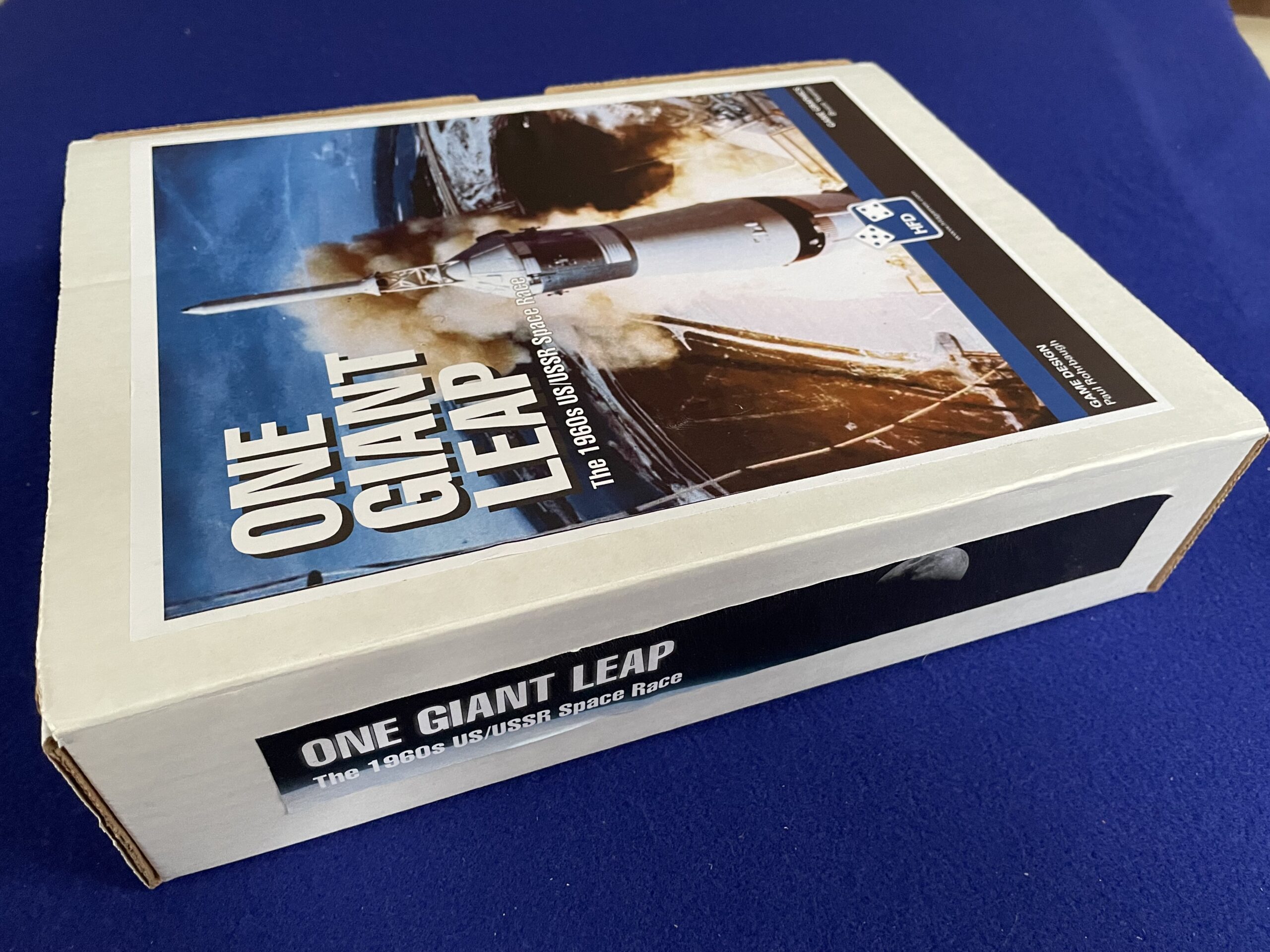
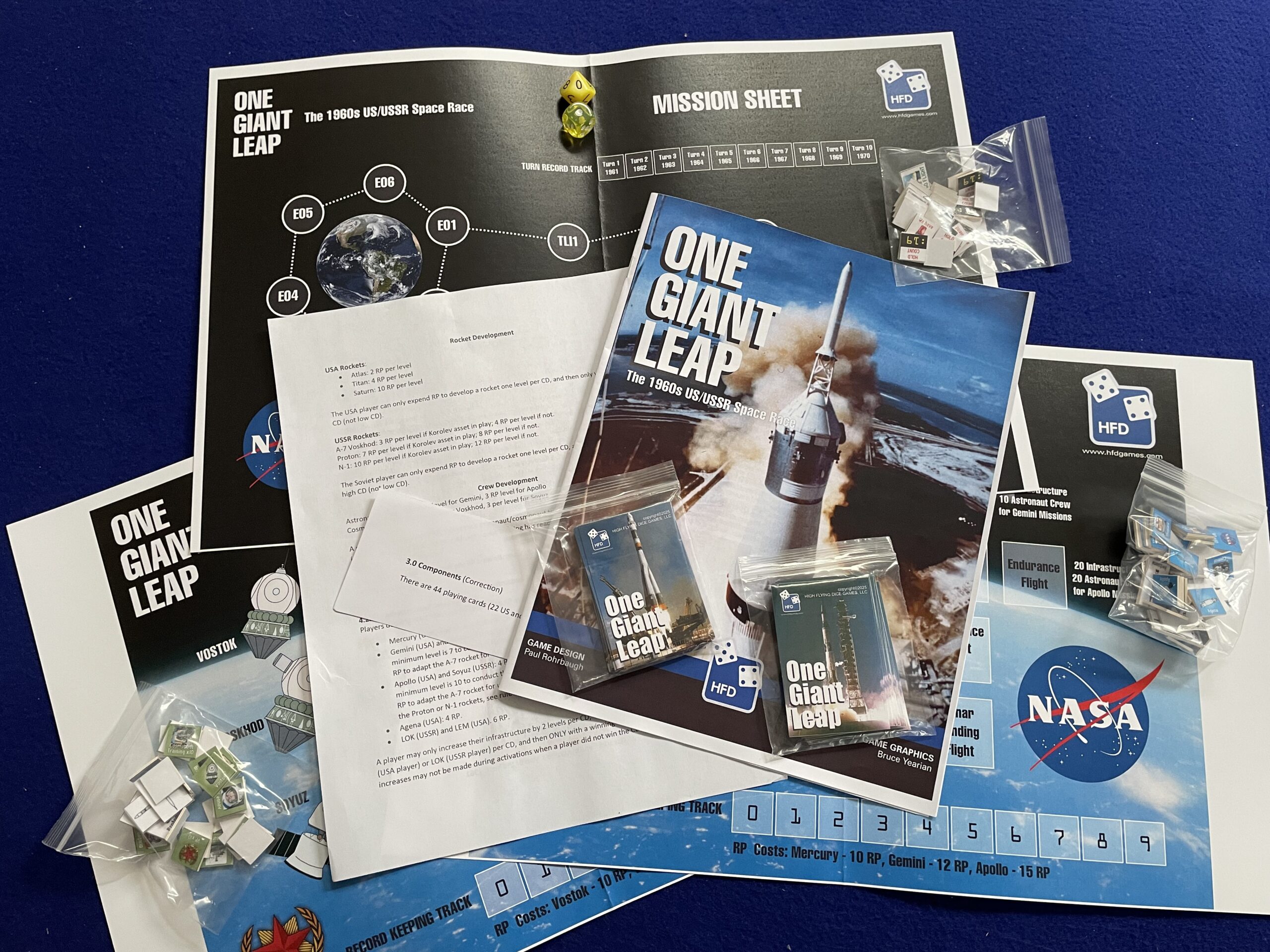
High Flying Dice Games (HFDG) is the imprint used by designer Paul Rohrbaugh to publish his games. In terms of production quality, I think of HFDG as a commercial desktop publisher; that is, a publisher that prints games that otherwise only be available as do-it-yourself print-and-play. In the case of One Giant Leap the components start with a very simple, plain, white box (perhaps deeper than need be) with glued on cover, backing, and box edges.
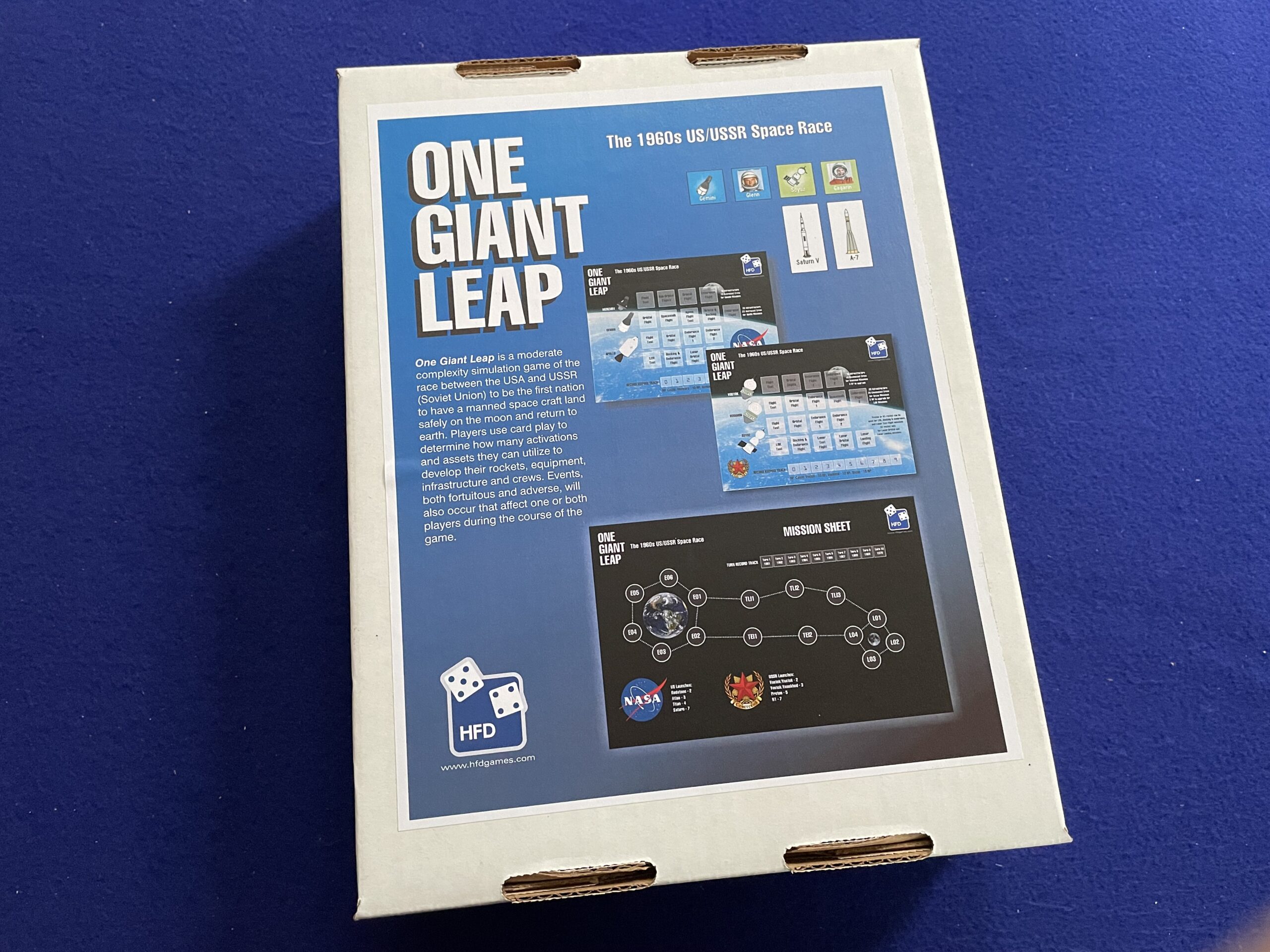
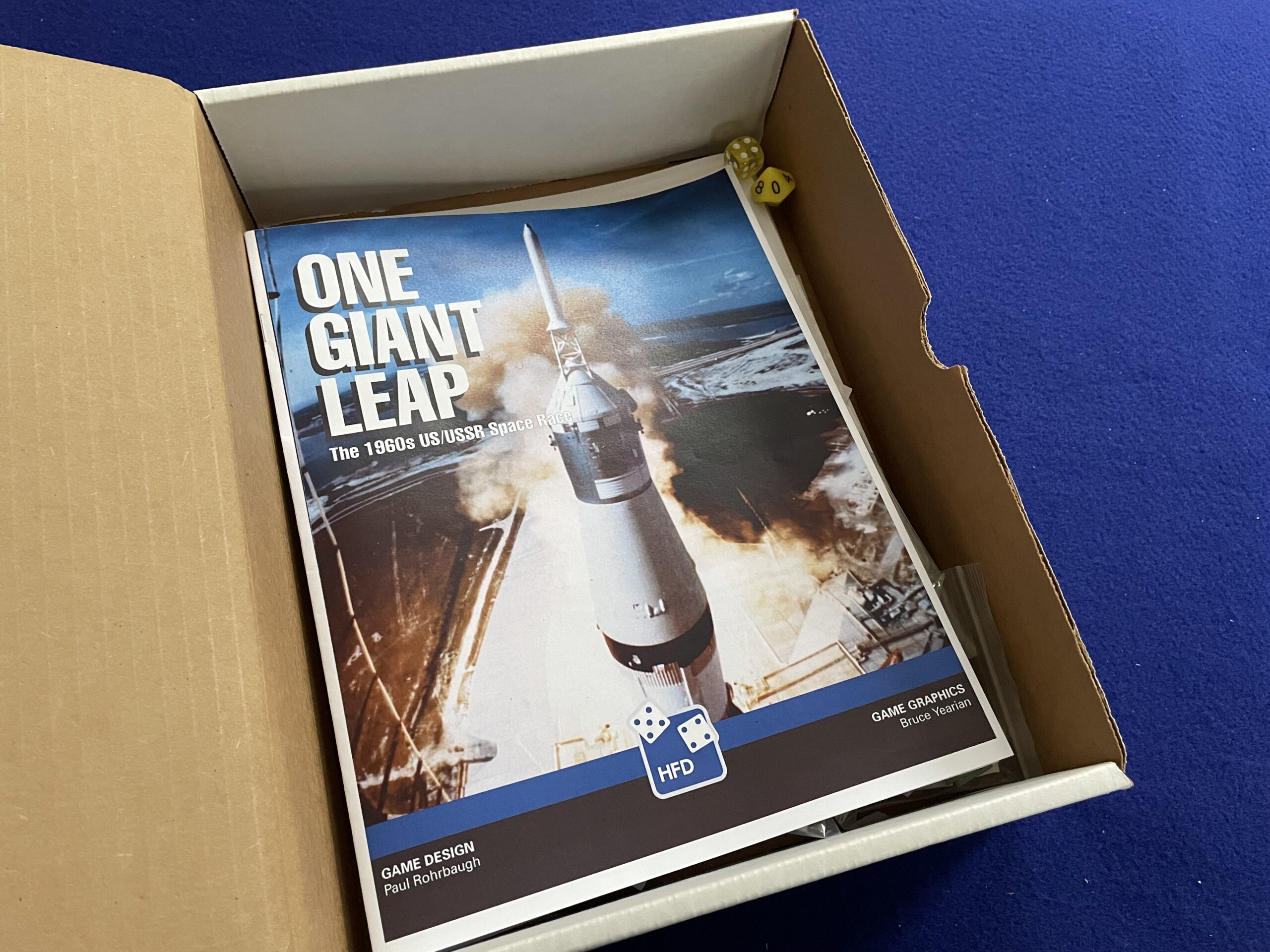
The three 11”x17” game mats on One Giant Leap are laser printed on slightly heavier cardstock. There is a large gutter area on the player mats—they almost certainly would look better with a bit of the edge trimmed off. Small player cards are likewise on similar cardstock while the 9/16” counters are on a lightweight (but still sturdy) chipboard material. Written matter is an 12-page saddle-stapled, standard page-sized, rulebook along with a separate paper sheet that serves as a two-sided player aid. Sure, one could print this game themself but for somebody like myself—not the arts & crafts type—having it premade is very welcome.
Setting Up for Play
After skimming the rulebook, which goes quickly given the rules of play are covered in only seven pages, I set up my first game of One Giant Leap. Or at least I tried. The rulebook for One Giant Leap does not include a specific rule (or guide) for setting up the game which lead to confusion on my part.
The first set-up problem I encountered was that I was unclear on what counters were markers and what counters were assets. I ended up having to closely parse the listing in 4.4.1 Tempting Fate Assets and Liabilities to determine which are which. One must also pay close attention to both 4.4.1 and the scenario setups to determine which Assets start in play and which are held aside to enter later.
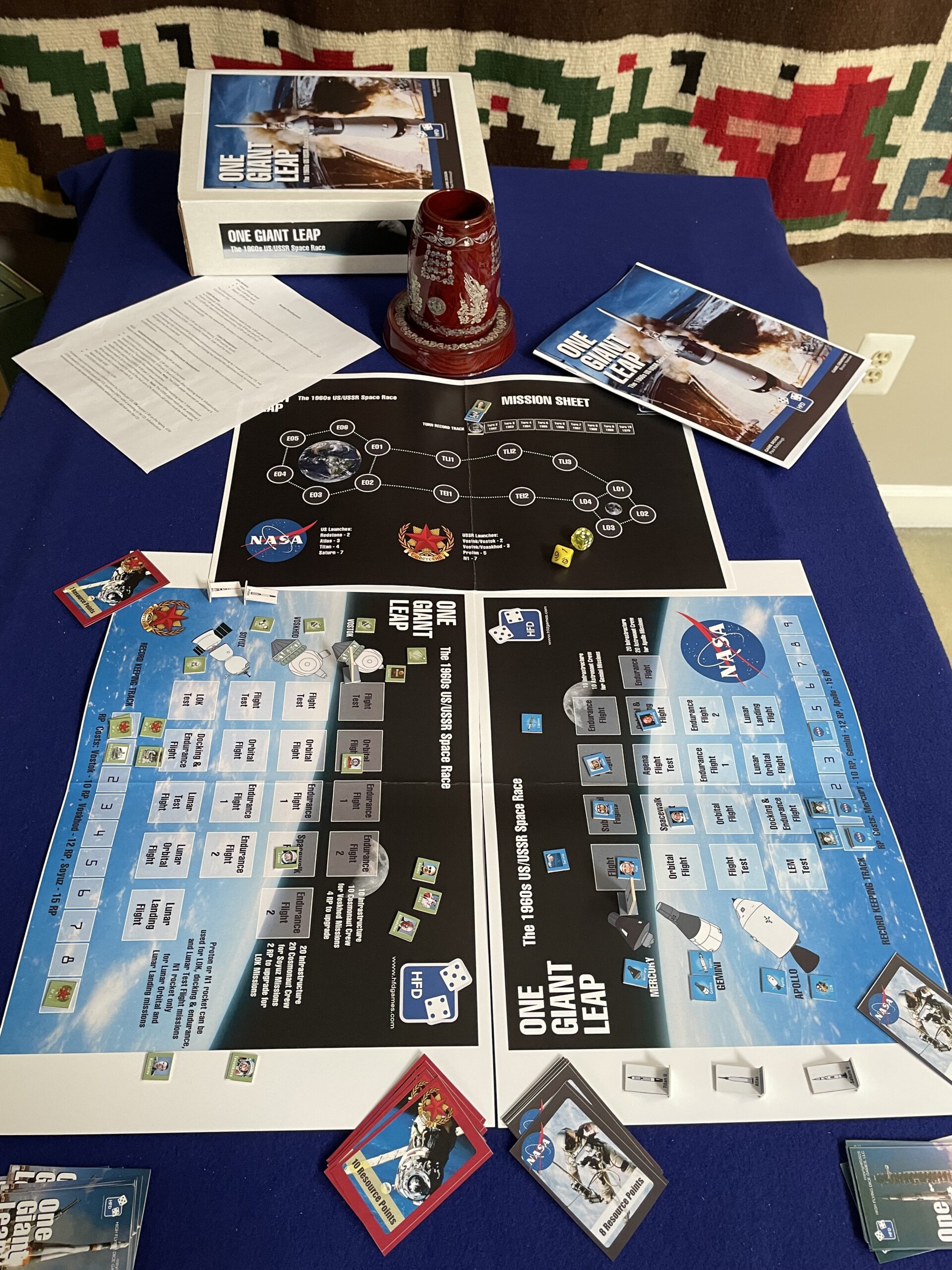
Once I figured out what counters are what and which ones start in play the next problem I encountered was Rocket Development. The different scenarios (rule 6.0) proscribe which rockets are available and what development levels other rockets are at but it takes a close reading of the second paragraph of rule 4.2.1 Rocket Development to understand that as rockets are developed they are placed (and progress) along the Record Keeping Track on the player sheet before moving to the Mission tracking portion of the same sheet. I am confident that my problems were avoidable given some sort of set-up guide.
[Future editions may also consider the addition of tracks for rocket or equipment development given the necessary RP to move a level—for example, 10 RP for each level of Apollo—usually is not spent is a single action and for now needs to be tracked on a separate piece of paper. The Records Keeping Track itself gets quite crowded in game play with Resource Points, Victory Points, Infrastructure, Astronaut/Cosmonaut, Rockets, and Equipment levels all tracked on that single line of boxes.]
Play
The goal of each player in One Giant Leap is to build a cadre of Astronauts, Infrastructure, Rockets and other flight articles to conduct missions progressing towards a moon landing. There are four scenarios in the rulebook; the “Early Steps Scenario” covers 1961 to 1963 (3 Turns) while the “Formative Hurdles Scenario” covers 1964 to 1966 (again, three turns or three years). The “One Giant Leap Scenario”, unsurprisingly, covers 1967 to 1970 (four turns for four years). The campaign game is suitably titled the “Because They Are Hard Campaign Game” that challenges players to play 10 years of the space race.
The mechanics of playing a turn of One Giant Leap is straight-forward; each player shuffles their deck then starts drawing cards. Most cards have a Resource Point (RP) score that are expended on activities (developing new rockets/equipment, training crew, developing infrastructure, and launching rockets). Certain cards (Tempting Fate) cause Random Events or trigger the draw of Assets which usually have a game effect. When the right number of Tempting Fate cards are drawn the turn (one year) ends.
While playing One Giant Leap conceptually is not difficult, the current rulebook unfortunately is hard to understand at points. For example, the description of how Tempting Fate cards are played in 3.2 Operations Phase seems to me to be a bit different than that written in 4.3 Tempting Fate; of the two the later rule seems more clear to me but I read 3.2 first so my mind was already imprinted that way and needed to adjust thus creating a learning challenge.
The most confusing rule for me in One Giant Leap was 5.0 Missions. Part of my confusion was terminology; the rulebook used terms like “1 earth orbit space” which I had to translate to the “EO1”—I’m guessing that means “Earth Orbit 1″—space on the Mission Map. Some of my confusion came from just understanding rules that are related but not clearly so in the rulebook. For example, to move a capsule on the map requires spending RP but spending RP for movement is not listed as an activity under 4.1 Resource Points (RP).
Further, the actual number of spaces moved is based on a die roll (DR). The number of DR that a player can make in a turn is half of the RP of their card draw. It also took me several hot minutes to grok the connection in One Giant Leap between the mission blocks on the player sheet and movement on the Mission Map. For example; a Lunar Orbit Mission requires the right rocket to be fully developed (and any associated equipment readied) before Launch (see rule 5.1 Rocket Launch and player aid) and then spending RP to move through spaces EO1 to EO6 per 5.2 Mission Movement – Lunar Orbit Mission—which is different from other mission types.
After movement one must then follow the rules for 5.3 Mission Recovery and Success Determination using the player aid to determine the final outcome. Oh yeah, Assets can also influence or otherwise affect the outcomes. I concede the point that all the needed rules are in the rulebook—my desire is for the rulebook to more clearly explain the flow of the game. A set-up guide and consistent rules references and use of terminology almost certainly would reduce my challenges learning to play One Giant Leap.
Gaming space
One Giant Leap joins a (very) small number of boardgames in my collection that deal with the Space Race. I have two earlier Space Race boardgames, Tranquility Base (History in Action / Worthington Publishing, 2018) along with the Soviet Moon expansion as well as One Small Step (Academy Games, 2020). The former is a racing, set collection game whereas the latter is a double worker-placement game.


In terms of the difficulty in playing the game, I put One Giant Leap squarely between those two previously mentioned titles; mechanically it is slightly more difficult than Tranquility Base but far easier than One Small Step. In terms of building a narrative through play, however, One Giant Leap easily outshines the other two titles. The set-collection aspects of Tranquility Base generally feel like one is building a space program, but the sense of technical challenge is not as pronounced as in One Giant Leap. In the case of One Small Step, the worker-placement game mechanism creates a very bureaucratic, program-manager approach to the game that loses some of the thrill of mission achievement that One Giant Leap serves up with every launch, flight, and landing.
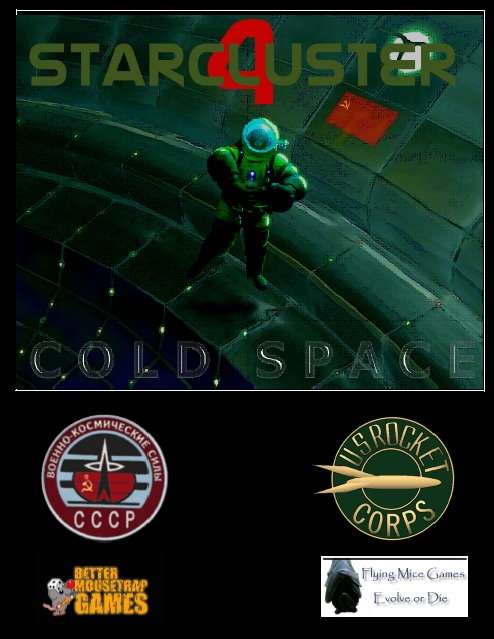
[Interestingly, my roleplaying game (RPG) collection also has several ‘Cold War in Space’ titles that, while not depicting the Space Race of the 1960’s, carries the events of One Giant Leap forward in time…sorta. The Cold Space RPG from Better Mousetrap Games (2005) uses a setting which, “…covers the years 1949 to 1989, after Swiss scientists discovered a faster than light drive and antigravity using obscure physics principles. The Soviets quickly stole the idea, and the race for the stars was on!” Do not let mentions of “faster than light drive and antigravity” scare you away—the game is basically the Cold War in orbit. Unfortunately, Cold Space uses the Starcluster game engine which I am definitely not a fan of.
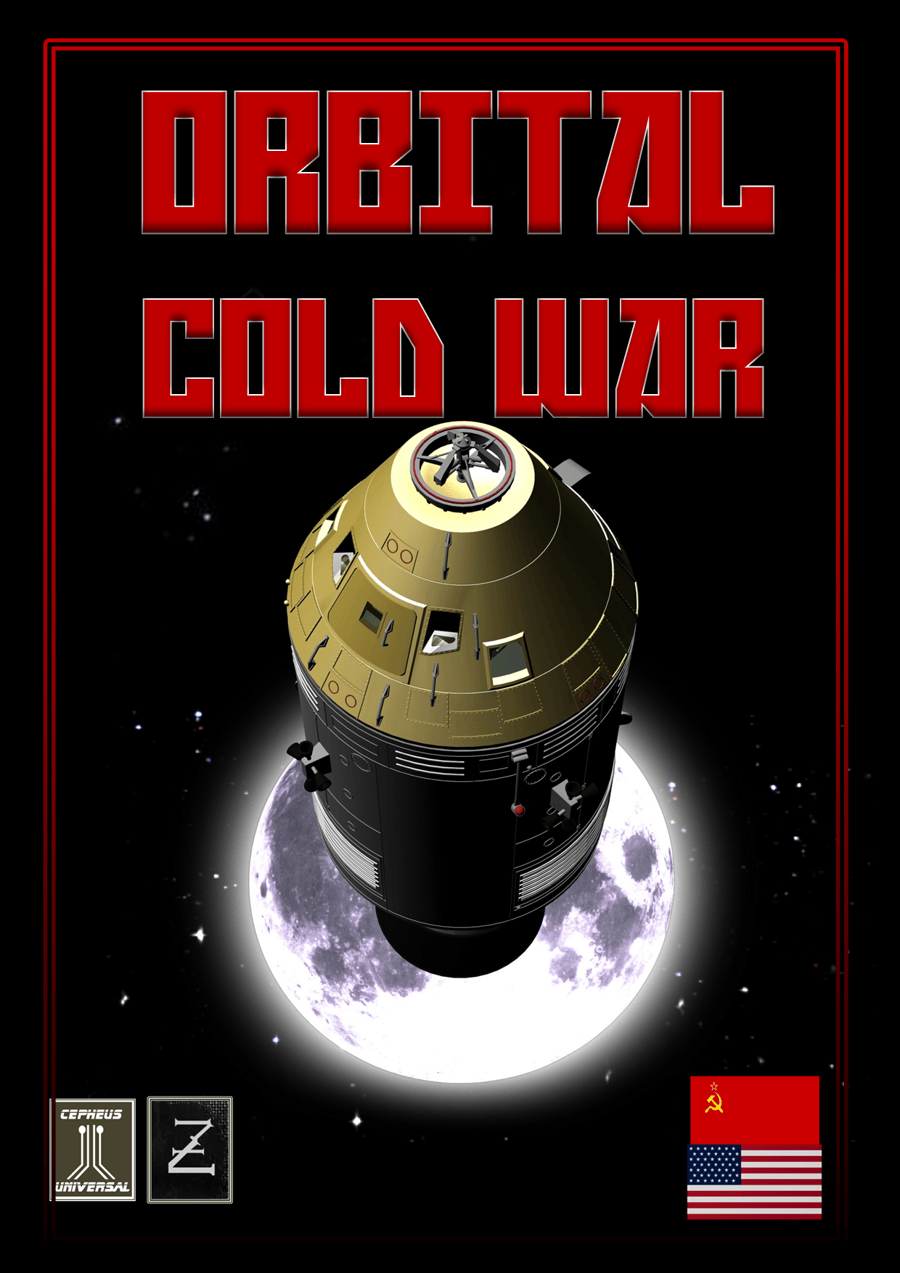
The second ‘Cold War in Orbit’-ish RPG I own is Orbital Cold War from Zozer Games released just this year. “Orbital Cold War depicts a world where the Space Race never ended and the Soviet Union never collapsed. It is 1990, and there are several hundred humans in orbit and on the Moon, manning stations, bases and outposts. Although there have been new technological innovations along the way, many of the reliable rocket and capsule designs of the ‘60s and ‘70s are still in use.” A part of me considered if One Giant Leap could serve as some sort of campaign framework for Orbital Cold War but aside from sharing Cold War and space themes the resource-racing design of One Giant Leap is not really compatible with the Cepheus Engine-driven adventuring of Orbital Cold War. Oh well… .]
“The Eagle has landed”
If you are still reading this review, by now you might assume I am going to talk next about how much I dislike One Giant Leap because it is too difficult to learn. On the contrary, once I figured out the rules I rather enjoyed playing One Giant Leap as it hits the narrative beats of the Space Race in the best ways. One Giant Leap is—admittedly—a resource-investment game where players need to spend Resource Points in a manner that quickly advances their space programs. There is also a fair element of risk involved; when is your investment “sufficient” as in did you invest enough to “take a chance” on mission success or do you spend more resources (and time) to create a better chance of success—or even assure it—but risk falling behind your opponent.
Indeed, while you are working to advance your space program one cannot help but to look across the table at your opponent and see where they are relative to you. In that respect, One Giant Leap is in some ways a game of dual solitaire with little real interaction between players. That said, player conflict in One Giant Leap comes not from hotly sabotaging your opponent’s space program but from the cold tension of the race. As it is, player-vs.-player conflict is not really needed—the racing aspects of One Giant Leap deliver sufficient tension from just trying to advance your own space program and reach the Moon first to keep you invested in the game.
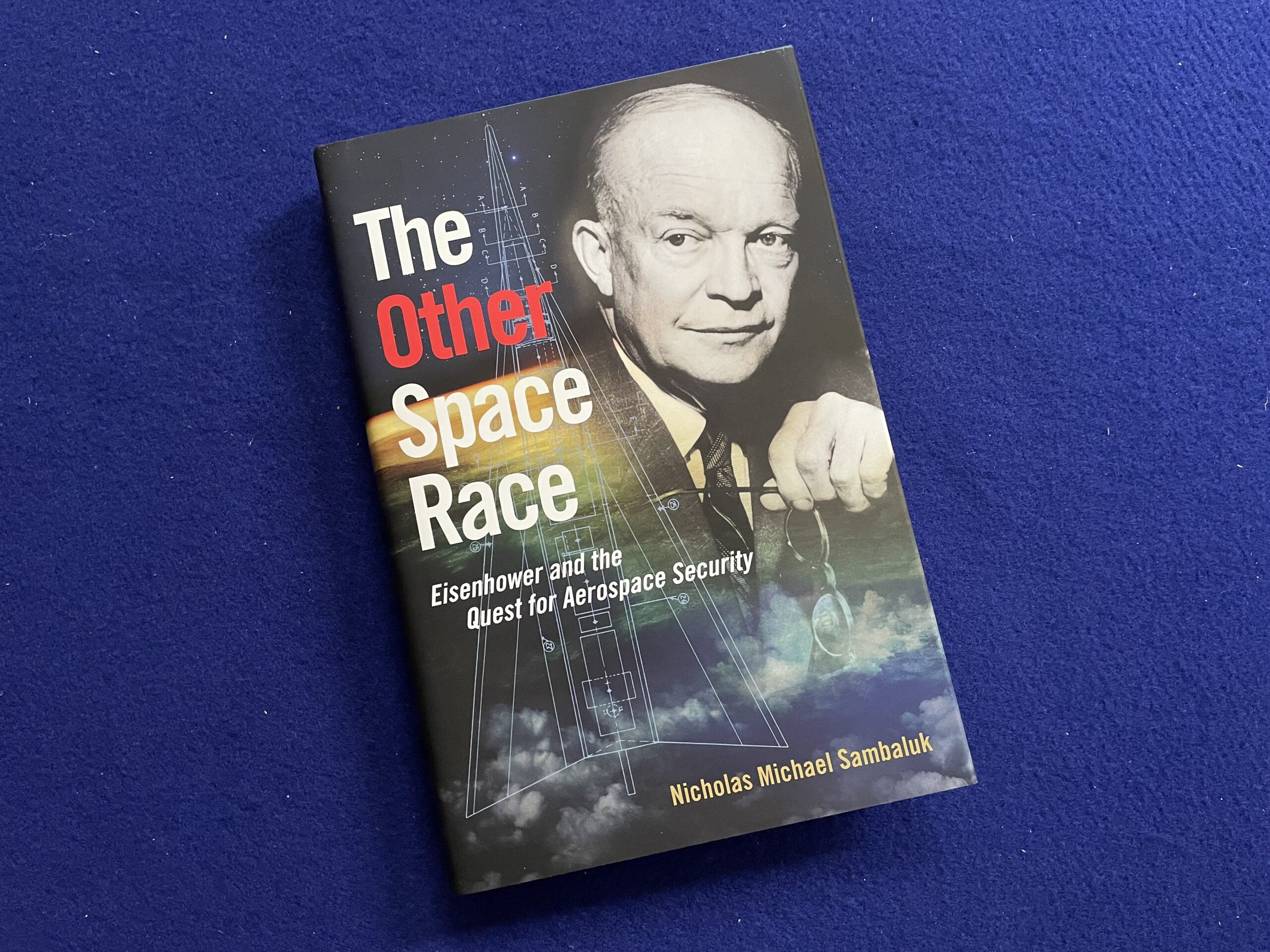 To read about the Space Race before the Space Race I recommend The Other Space Race: Eisenhower and the Quest for Aerospace Security by Nicholas Michael Sambaluk (Naval Institute Press, 2025) which relates the “space race” between 1954 and 1961 that took place not between the United States and the Soviet Union but within Washington, DC between advocates for “peaceful” and “armed” uses of space. The “peaceful” faction, led by then-President Dwight Eisenhower, sought to use space for peaceful purposes that supported deterrence such as satellite overflight and space-based surveillance. The “armed” faction, led by the United States Air Force, believed space was a new realm of combat and studied—and advocated for—the militarization of space with armed aerospace platforms and weapon systems to assure deterrence. Nearly 75 years later these same issues face the relatively new U.S. Space Force. (Photo by RMN)
You can chat about this game in the Modern World section of our discussion forums
Thank you for visiting the Regiment of Strategy Gaming and riding with The Armchair Dragoons.
Rather than list a bunch of social media links, the easiest thing to do is to check out our LinkTree, which connects you to all of our various locales around the web.
You can also support The Armchair Dragoons through our Patreon, and find us at a variety of conventions and other events.
Feel free to talk back to us either in our discussion forum, or in the comments below.


