
 by
by RockyMountainNavy, 13 June 2025
Moon Base Clavius is a print-n-play (PnP) wargame from Powercell Games first delivered through an early 2025 Kickstarter campaign for a mere $3. The game is now available on WargameVault for $9.95. For such a low price one likely has equally low expectations of the game. While this edition of Moon Base Clavius is an inexpensive PnP, understanding—and to a certain degree simply accepting—the rules and complexity of the game illustrates why this little title keeps dusting up the soles of wargamer’s moon boots every decade or so.

The Powercell Games 2025 Kickstarter edition of Moon Base Clavius is designed by Kerry Anderson. The campaign openly acknowledged that this most recent edition of Moon Base Clavius traces its lineage back to a 1982 version designed by the same Kerry Anderson but published by Task Force Games. As James Eisert wrote in the Kickstarter campaign:
This version includes reworkings by Anderson to address changes made by Task Force Games in the original release. Aside from updates to the advanced game, artwork, and layout, the basic game—faithful to Kerry’s original design—is already complete.

The reception to the original Task Force Games’ Moon Base Clavius was far from adoring as evidenced by a less-than-glowing review by one Tony Watson in Dragon Magazine #73 of in May 1983. I personally never owned this version of Moon Base Clavius (though I saw it in my FLGS Fascination Corner) and, given my younger age at the time, likely would have just played the game using the rules as written and savored the Cold War in Space theme.

Anderson published another version of the game, named simply Clavius, in 2014 from Anderson’s own Microgame Design Group. As Anderson described that edition:
Note that this is the original version of a game submitted to Task Force Games in [the] 1980s (the published game being a significant departure from what was submitted). In addition to the original game, an update to the design is provided, which includes rules for orbital ground support, rocket buses and oxygen requirements.

All of which is to say that the 2025 Kickstarter edition of Moon Base Clavius is essentially a slightly-updated PnP edition of the 2014 Clavius that is faithful to the designer’s intent but is not to be confused with the 1982 game with the same name—Moon Base Clavius—from Task Force Games that significantly altered the original design. Got it?
Clavius take three
The changes to this latest version of Moon Base Clavius are described by Anderson in a rather frank 9.0 Designer’s Notes:
This is the third edition of Moon Base Clavius…The first edition was a significant departure from the original design as the developer reversed the sequence of play and changed the combat system. This revised edition returns the game to its original form… .
With that said, Moon Base Clavius was a game designed in my youth and there are a number of things that are unrealistic considering the game’s scales – specifically the stacking and zone of control rules. On the other hand the original game was a real player – right to the end. So rather than redesign the game, I have chosen to republish the original game (with just a few adjustments). Play this game and I hope you will see its merits for yourself.
Paper(less) Moon
Moon Base Clavius is marketed by Powercell Games as “Macrogame #4”—a likely homage to the “Microgames” marketed by Task Force Games in the 1980s and Anderson’s own Microgame Design Group. The complete digital download is seven files with a cover, rules, charts, counters, and several different versions of the game map.

Moon Base Clavius takes place in a future 2035 where China’s People’s Liberation Army Aerospace Force (PLAAF), with the possible assistance of the Russian Space Forces (RSF), fights the First Lunar War against the United States Space Force (USSF).
The rulebook for Moon Base Clavius is a mere 11 double-column pages (with a blank page 12). That alone should tell you that the game is not very complex. In appearance the rules look like the older desktop publishing formats that smaller wargame publishers used in the 1980’s—but with a bit more color. Each turn represents four hours of time and units are platoons or batteries. The map uses hexes scaled at 27.5 km per side.


click images to enlarge into gallery
The rulebook for Moon Base Clavius actually has two sets of rules: the (unnamed) basic rules of play and Advanced Rules. The basic rules of play for Moon Base Clavius are covered in six pages. A turn in Moon Base Clavius is pretty much as one expects in a simple wargame: there is a Chinese Player Turn followed by the American Player Turn. Within each player turn there is a Movement and Combat Phase. The American player also adds a Militia Formation Phase after the first day of fighting. Artillery is covered under rules for “6.4 Nuclear Mortar Fire.” Other special rules (7.0) are:
- 7.1 Self Propelled Batteries.
- 7.2 Militia.
- 7.3 Laser Rifles.
- 7.4 Marine Landings.
- 7.5 Desperation Fire.
The four scenarios for Moon Base Clavius are “historical” in that the first three portray a single day of the conflict (“Day 1: The Chinese Drive,” “Day 2: The Siege of Clavius,” “Day 3: The Landing of the Marines”) and the fourth is “The Campaign Game.”
The Advanced Rules of Moon Base Clavius add just a few wrinkles on the basic game:
- An “Oxygen Check Phase” is added to each Player Turn.
- Zone of Control rules are modified.
- There are no stacking limits in the advanced game.
- Overrun rules are modified.
- Nuclear Mortar Fire bombardment rules are modified.
- Some new units are added to the scenarios.
Four new Advanced Rules are added to Moon Base Clavius. These are:
- 10.1 Orbital Ground Support.
- 10.2 Collateral Damage.
- 10.3 Oxygen.
- 10.4 Rocket Buses.
As Anderson writes in the Designer’s Notes for the Advanced Rules of Moon Base Clavius:
The advanced game rules for Moon Base Clavius bring the game into a somewhat more realistic environment. A certain amount of chrome has been added too. Players should feel free to add or exclude these rules as they desire (keeping in mind certain rules favor one side over another).
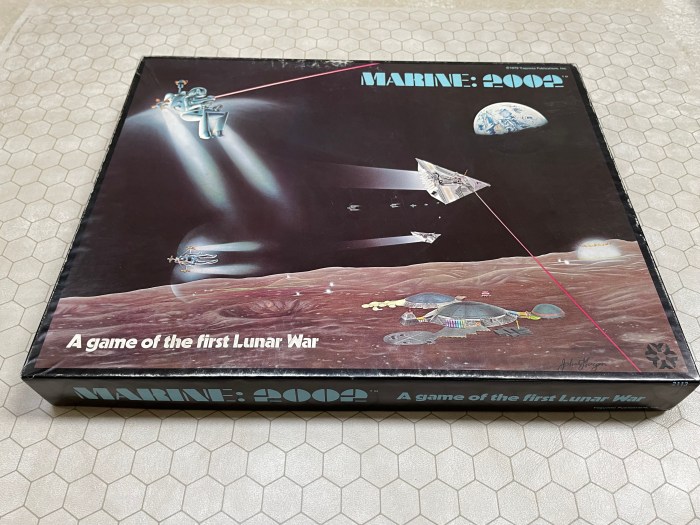
[Anderson’s “first” Lunar wargame – Marine: 2002 (Yaquinto Publishing, 1979)]
[Kerry Anderson’s first trip to the Moon actually took place in 1979 when Yaquinto Publishing printed Marine: 20021. Like Moon Base Clavius, Marine: 2002 also featured the “First Lunar War.” The major differences between the 1979 Marine: 2002 and the latest Moon Base Clavius are scale and complexity; Marine: 2002 uses turns representing 5 minutes and hexes only .5 km across with counters representing squads of 2-4 soldiers. Unlike the low rules complexity found in Moon Base Clavius, the rules for Marine: 2002 are much more fiddly (as in administrative markers needed to be manipulated in play) as well as far more tactically detailed with special rules for different movement modes that illustrate movement and combat across—and above—the surface of the Moon. For more fulsome thoughts on Marine: 2002 please see “#Wargame Wednesday — Moonraker in the Dust -or- Marine: 2002 – A game of the first Lunar War (Kerry Anderson, Yaquinto Publications, 1979)” at my personal blog.]
(Moon) dust in your eyes
As befits a simple “classic” wargame, learning how to play Moon Base Clavius—even with the Advanced Rules—is very easy. Anderson’s comments about the “unrealistic” basic game Zone of Control and stacking rules are easily seen—if one stops to think about it. The Advanced Rules, though touted as “more realistic,” maybe are so to hard sci-fi fans who like a more industrial vision of the future. Most wargamers will likely never think deeply about any “realism” in Moon Base Clavius and simply enjoy the easy-to-learn, quick-to-play, just-enough-wristage game in front of them.
Other wargamers, especially those who relish in experimenting with different tactics and strategies in play, will just as likely discover that the Advanced Rules of Moon Base Clavius—the more “realistic environment”—creates not a more complex game but a wholly different gaming experience. The basic game with Zones of Control and stacking limits but no oxygen rules seemingly leads to use of tactics that emphasize grand sweeping maneuvers across the dusty battlefield of the Moon. The Advanced Rules, however, with limitations placed on movement due to oxygen, seemingly leads to tactics that favor strongpoints or “island-hopping” across the surface of the Moon. That perhaps is the real appeal of Moon Base Clavius; a small change in simple rules creates a very different playing experience. The difference in the basic game and Advanced Rules of Moon Base Clavius is not rules complexity but the tactics and strategies required to play and win. Moon Base Clavius really is two different—both highly enjoyable—wargames.
Moon Base Clavius is a simple PnP wargame. It is also a great inexpensive way to play around with “boots on the moon.”
Thank you for visiting the Regiment of Strategy Gaming and riding with The Armchair Dragoons.
Rather than list a bunch of social media links, the easiest thing to do is to check out our LinkTree, which connects you to all of our various locales around the web.
You can also support The Armchair Dragoons through our Patreon, and find us at a variety of conventions and other events.
Feel free to talk back to us either in our discussion forum, or in the comments below.
Footnotes
- and featured in a previous #UnboxingDay here

