
 by
by RockyMountainNavy, 9 January 2026
In December last year, The Armchair Dragoons Regimental Commander Brant passed to me an article from the Journal of American Studies titled, “When You Say, ‘Thermonuclear War,’ I Think You Mean ‘the Call to Adventure’! The Twilight: 2000 Tabletop Role-Playing Game and the Postapocalyptic World’s Imaginary Spaces” by University of Edinburgh graduate Malcom Craig. Brant reasoned that with my past writing on Adventure Wargames I likely would find the article interesting. Brant was right; the article is interesting—and disappointing. Whereas I love to play Adventure Wargames for the pleasure of play, Malcom Craig attempts to show how Twilight: 2000 reflects the worst elements of society and nuclear anxieties as it is a “faulty…probe” of an alternate future-past resplendent with “fantasies of power, survival, and masculinity”—along with a hefty dose of angst over American Exceptionalism.
As a long time player of roleplaying games (RPGs) it is always pleasant to see the hobby find its way into “serious” academic studies. This is the abstract from “When You Say, ‘Thermonuclear War,’ I Think You Mean ‘the Call to Adventure’! The Twilight: 2000 Tabletop Role-Playing Game and the Postapocalyptic World’s Imaginary Spaces”:
Historians of the Cold War and the nuclear age have largely overlooked the existence of tabletop role-playing games (TTRPGs), while films, comics, novels, and television programmes that tackled the challenging imaginary, yet all-too-possible, wastes of a post-nuclear landscape have been abundantly analysed. As cultural products and tools through which to imagine other worlds, TTRPGs offer powerful insights into how, where, and why certain groups thought about the spectre of the nuclear age and how they dealt with this threat by gaming within make-believe postapocalyptic worlds. This article draws together several threads in its analysis of the American-designed and -produced Twilight: 2000 TTRPG’s historical significance. Through analysing Twilight: 2000 as a case study of how a TTRPG functions as a specific nuclear-cultural object in its own right, the article also locates this game as a part of a wider-reaching dystopian fantasy rooted in the massive everyday reality of atomic annihilation. Likewise, the game, its mechanics, setting, and artwork are analysed here as part of a distinctive Cold War culture that permitted participants to derive pleasure and affirmation from fictional “adventures” in the postapocalyptic environment. (Craig, p. 1)
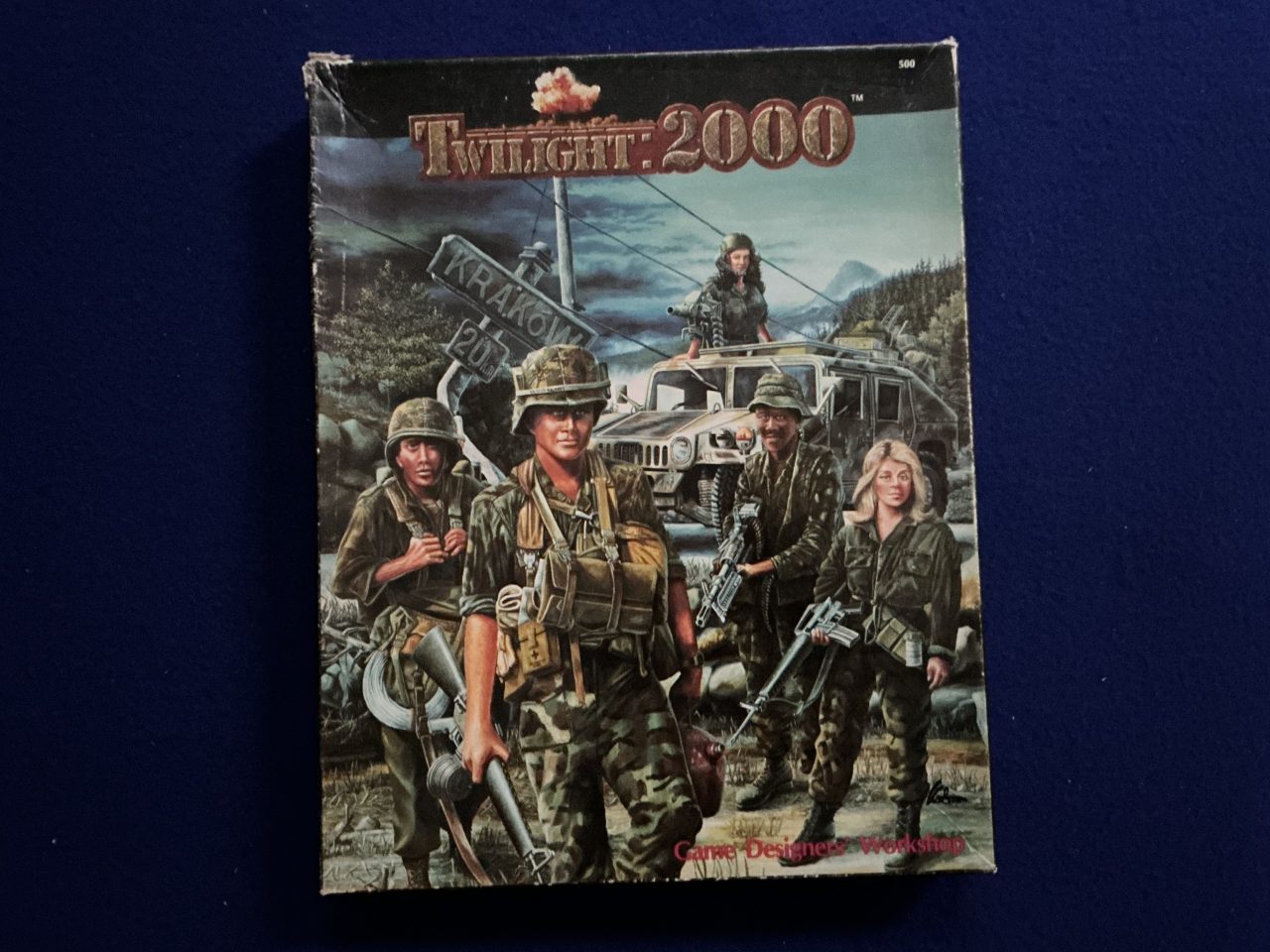
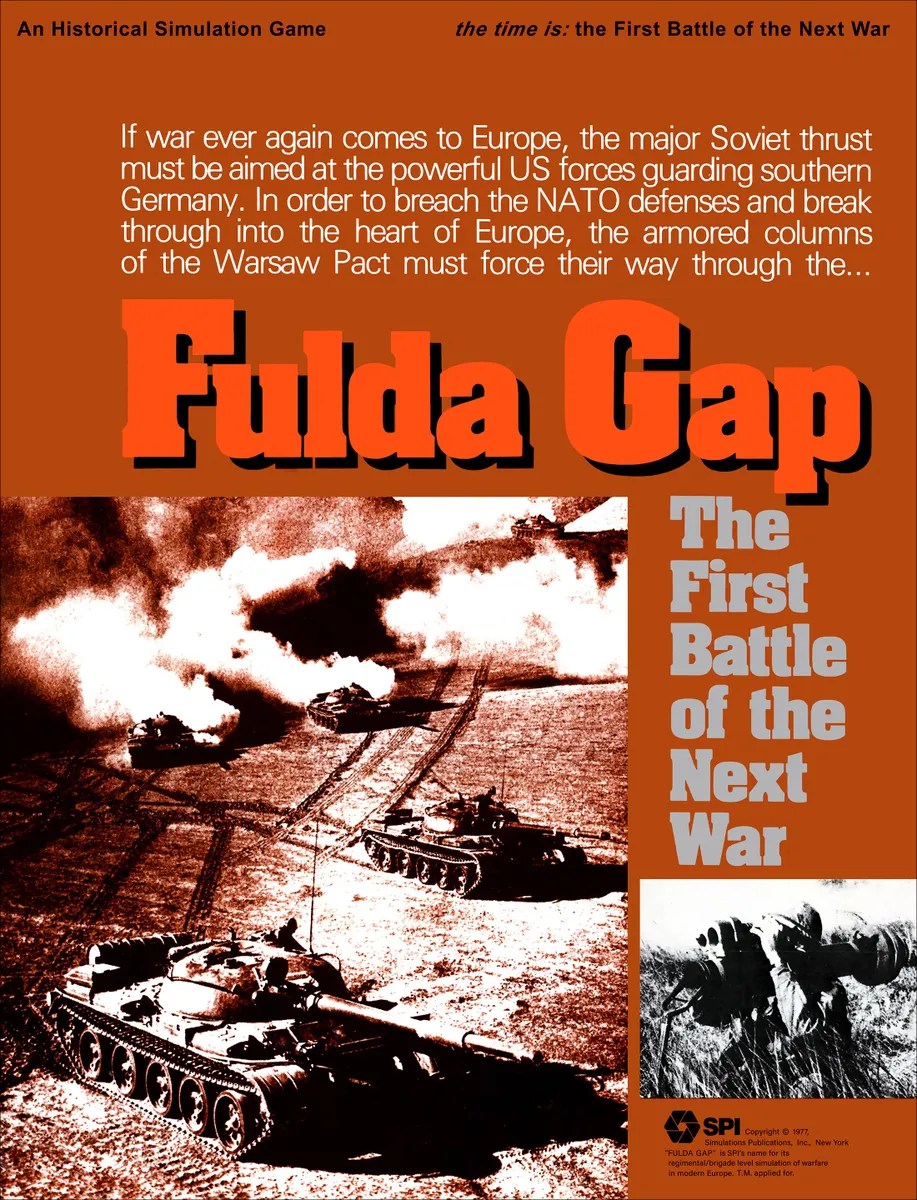
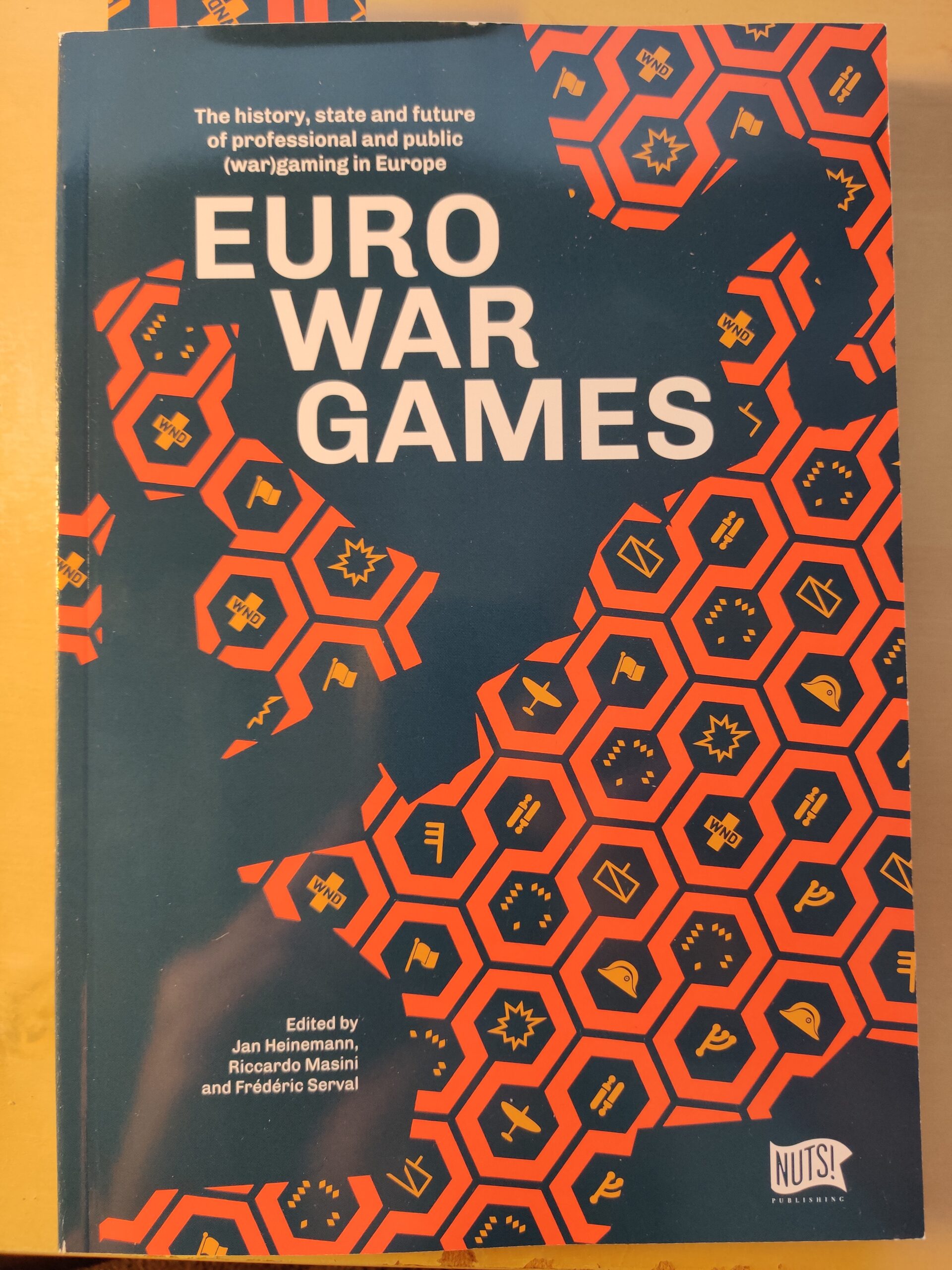
This article reminds me of other serious academic studies on the Cold War, nuclear weapons, and gaming. (See “Wargame History – An anti-nuclear wargame in Fulda Gap: The First Battle of the Next War (SPI, 1977)” ). This new article also comes at the subject from a European perspective which can be interesting. (See “An American Grognard Reading EuroWarGames: The History, State and Future of Professional and Public (War)gaming in Europe”). As we will see, however, I take issue with some of the accusations conclusions.
Why Twilight: 2000
Craig points to Twilight: 2000 1st Edition (Game Designers’ Workshop, 1984) as one of the most significant titles published in the genre of post-apocalyptic RPGs. This genre of RPGs was build around settings of post-nuclear conflict with war-torn worlds ravaged by disease, radiation, and societal breakdown. As Craig points out, “Military TTRPGs had appeared in the early 1980s, but titles such as Commando, Merc, Behind Enemy Lines, and Recon had failed to make a significant impact on the market” (Craig, p. 9). Craig discusses how the Game Designers’ Workshop (GDW) design team was uniquely suited to open up this new genre of RPG:
War games remained a major revenue stream for GDW, but as that market began to shrink in the early 1980s, the design team decided to focus more on TTRPGs, and particularly genres that they saw as underserved by other major players such as Tactical Studies Rules (TSR). GDW moved into the Cold War world at the end of 1984, with their third major TTRPG release: T: 2000, a game that contained a near-future take on nuclear-age perils. Set at the millennium’s turn, T: 2000 offered a gloomy vision of humanity’s future, a depopulated, war-torn world ravaged by disease, radiation, banditry, and starvation. Far from D&D’s fantastical worlds, this was the “real world” of nuclear Armageddon brought to the gaming table. T: 2000 was informed not only by the team’s military simulation and war-gaming backgrounds, but also by the military experience of members such as [Marc] Miller and frequent supplement writer Captain Thomas Mulkey, a former paratrooper and Vietnam veteran. Primarily written by [Frank] Chadwick, T: 2000 was the most successful postapocalypse and military RPG of its era, with Chadwick and the GDW team perceiving that gamers desired more military-focussed, hard-edged games than were then available. (Craig, p. 8)
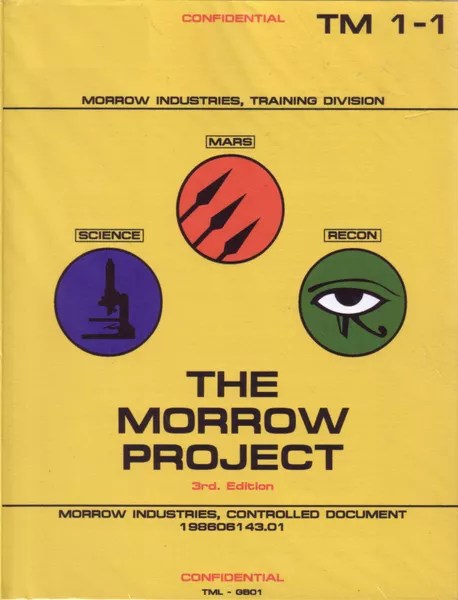
Craig asserts that earlier RPGs like Gamma World and The Morrow Project laid the groundwork for Twilight: 2000. “While Gamma World achieved a degree of popularity with fantasy gamers, neither The Morrow Project nor Aftermath! managed to carve out anything more than niche appeal“ (Craig, p. 9). The difference, Craig explains, was that Twilight: 2000 was considered far more realistic and the design adopted a much more militaristic approach. Craig mentions that part of the success of Twilight: 2000 was the strength of the designers who drew on their strong wargame design experience to provide a more “realistic” military gaming experience—compared to previous games.
Cold Twilight: 2000
Craig explains that Twilight: 2000, released in 1984, hit at the “right time” in Cold War culture. The game enabled players to play in a setting that was a reflection of their own fears of what the Cold War could become. In 1984 the general public recognized the heightened nuclear tensions of the day. Media, including the roleplaying game Twilight: 2000, played off this public anxiety by creating an outlet for players to explore potential futures and the consequences of nuclear war. Craig goes so far as to claim that Twilight: 2000 represents an “unofficial” narrative of the nuclear age, reflecting societal concerns and cultural responses…to a point. As Craig explains:
Significantly, T: 2000 did not present a “worst-case” scenario of total, global nuclear devastation. Although there were strategic and tactical exchanges over an extended period, the two superpowers refrained from an all-out, world-ending nuclear war. As the expanded background to the game presented in later supplements noted, “the effect was not to destroy humanity – only civilization.” (Craig, p. 10)
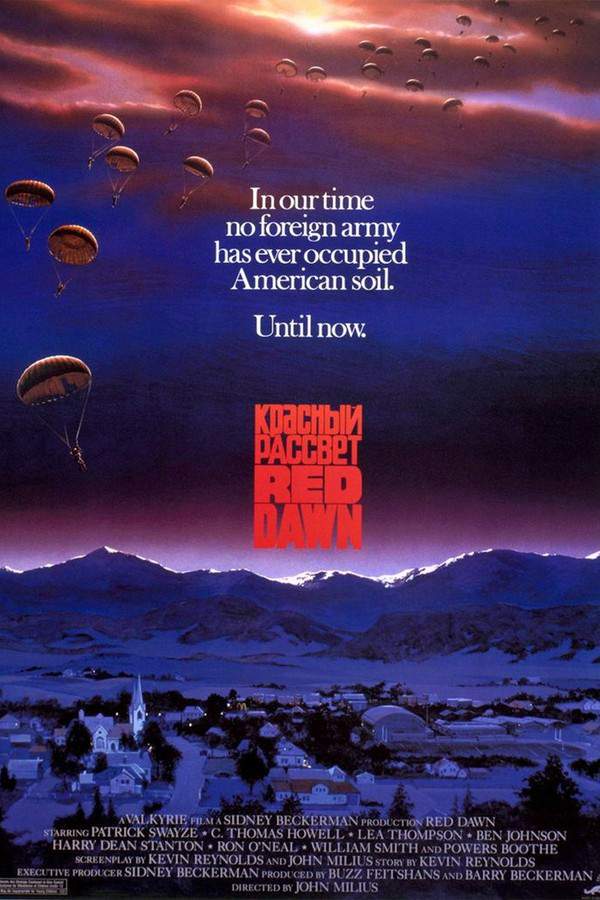
As a young American that came of age in the Reagan Years, Twilight: 2000 released in my last years of high school. For my wargaming and roleplaying group, well-steeped in Avalon Hill, SPI, and GDW wargames, and all-in on the Traveller roleplaying game from GDW, to not acquire and play Twilight: 2000 was never an option. Some of us saw it as the RPG version of the movie Red Dawn. Others related to it on a more personal level as some knew friends or family in the U.S. military stationed in Europe. To more than a few of us it was as much a survival guide as a roleplaying game. The D&D players amongst us also saw Twilight: 2000 for what it is: a dungeon crawl in a medieval setting but with M-16s. As a Traveller player I saw the familiar patron-mission adventure set-up, just in a mid-Tech world suffering the aftermath of a limited nuclear conflict.
Modern sensibilities
Though Twilight: 2000 was published in 1984, Craig cannot resist taking swipes at the lack of “modern sensibilities” in the game. Take, for example, the issue of sexism:
T: 2000 was (unsurprisingly) militaristic, masculine, and designed to appeal to those interested in weapons technology and survival in a harsh environment. Although the game text noted that characters could be either male or female, male pronouns were used throughout. One element in the basic boxed set where women were presented as having parity with male characters was in the first-person monologues narrated by a character named “Monk” that gave insights into the world. In the game’s paratext, female characters fought, laboured, and dealt with adversity with little differentiation between them and male characters. Overall, though, T: 2000 was a masculine space where female non-player characters were frequently damsels to be rescued from the appalling depredations of Eastern European others. (Craig, p. 10)
Ah…pronouns. Here is what what Twilight: 2000 1st Edition Play Manual actually says on the subject:
A NOTE ON GENDER
Characters may be either male or female, as illustrated by the examples in the rules. For readability, however, the rule themselves exclusively use male pronouns. Use of pronouns he, his, or him apply to all characters, regardless of gender. (Play Manual, p. 3)
Craig is pushing a very modern criticism of wargames and roleplaying games. That many wargamers were male is long recognized; wargame designers like Jim Dunnigan in his Wargame Handbook long ago noted that the majority of players were male (Dunnigan, p. 301). If Craig is that concerned about the portrayal of women in Twilight: 2000 then he certainly needs to avoid looking at other period RPGs. I recently was rereading a sourcebook for the FASA Star Trek: Role Playing Game where the topic of female characters and players came up:
No females may aspire to any position higher than department head in sciences, medicine, navigation/helm or communications, and no woman may hold a command or first officer position! (DESIGNERS’ NOTE: Don’t blame us — blame the Klingons! In the Empire, it is still a man’s galaxy…) Because of the restrictions applied to women in the Empire, it is quite permissible for a female player to have a male character! (The Klingons: A Sourcebook and Character Generation Supplement, FASA, 1983, p. 13)
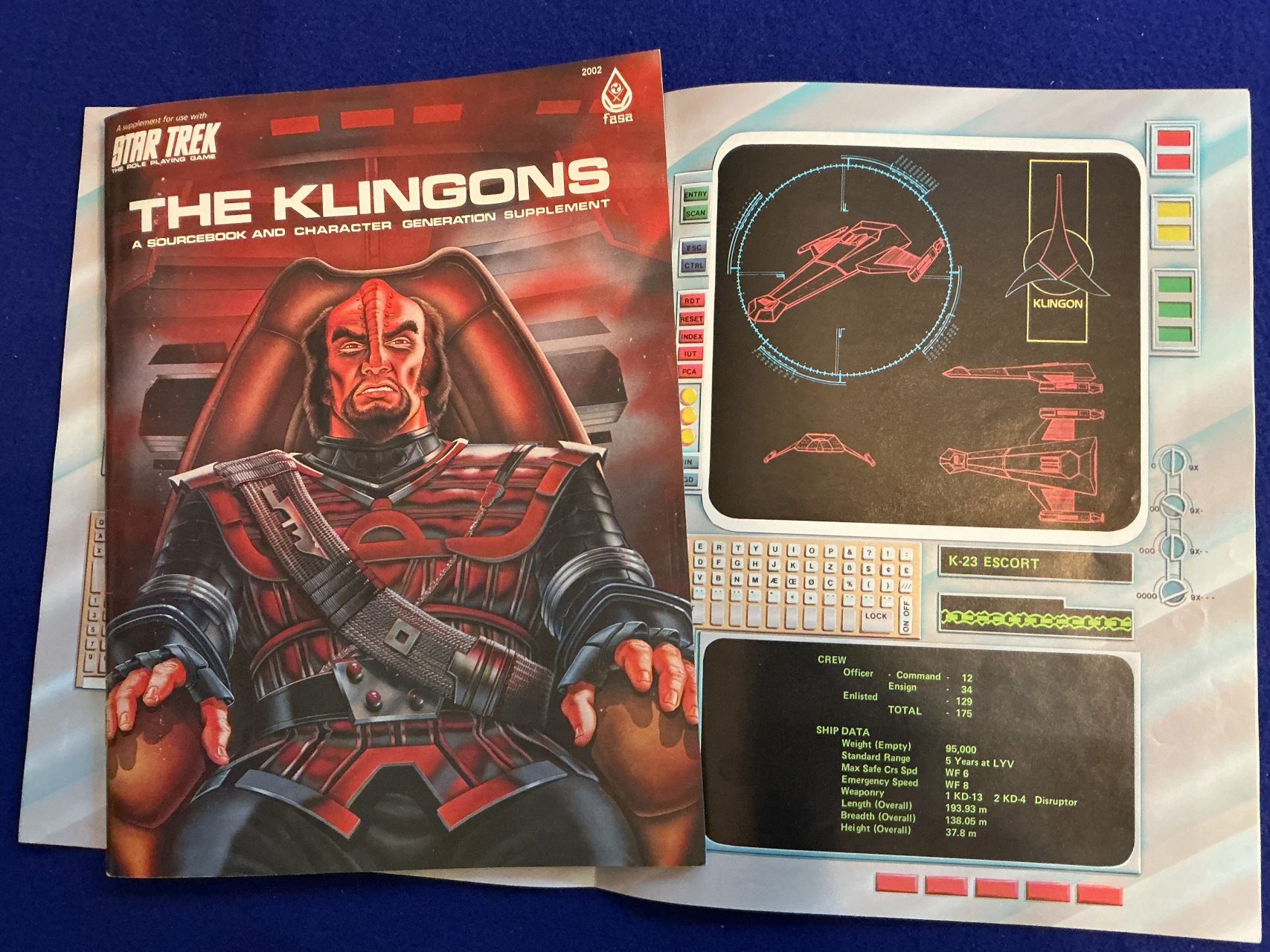
From this perspective, Twilight: 2000 was exceptional in that female players could play female characters, a progressive reality Craig plays down.
Craig, a European, also points out the American Exceptionalism expressed in the Twilight: 2000 setting:
T: 2000 parochially interpreted the apocalypse, presupposing the preeminence of American ideas, interests, and people. However, this is unsurprising from an American product created for a primarily American audience. The game text implicitly and explicitly assumed that players would choose US service personnel as their characters. The core assumption of almost all material published up to Going Home was that the player characters would be members of the US Army’s 5th Mechanized Division, on their own after a final organized battle in the area around the central Polish city of Kalisz. Most of the early “adventure” supplements opened with some variation of “The players are survivors of the US 5th Infantry Division (Mechanized), which was destroyed near the Polish city of Kalisz in mid-July of 2000.” Little background or mechanical support was given to players who might wish to play non-American or nonmilitary characters until much later in the game’s lifetime. Furthermore, the game’s “campaign arc” bent towards the United States. After the four initial adventure supplements, the focus moved towards what happened after the characters had “gone home” (to the United States). (Craig, pp. 10-11)
I do not know what version of Twilight: 2000 Craig played—or looked over—when writing his article but my copy of Twilight: 2000 1st Edition from 1983 “explicitly” states on page 7 of the Play Manual that players can choose their own Army, Nationality, and Native Language and the options are not just U.S. Army, American, English. The Players’ Chart Army/Nationality/Native Language List provides options for the U.S., British, Canadian, East German, West German, Danish, Polish, Hungarian, Czech, or Soviet armies with 14 non-Soviet Nationalities; the Soviet Nationalities List provides another 18 options. Using the same list players can choose from nearly 20 different languages.

Craig apparently also believes a RPG core book needs to have a complete setting. Twilight: 2000, however, was published in a different era. The boxed Twilight: 2000 set I bought (and still own) was amongst the more “complete” RPG settings of those days with a 24-page Play Manual, a 32-page Referee Manual, and an 8-page beginning adventure with two handouts. Add in the 8-page chart book and 12-page equipment book that is still a mere 82 pages of material. Even the “slim” Little Black Books of the Traveller RPG were 48-pages each. Twilight: 2000 was clearly intended from the beginning to be expandable with only the most basic of a setting provided in the box.
While Craig rightly points out the narrative arc of the supplements went towards the “go home” setting, text in the original Play Manual highlights the wide-open setting options of Twilight: 2000:
A BATTERED WORLD
Twilight: 2000 is a role-playing game dealing with survival in a war-ravaged world in the near future. Players take on the parts of soldiers cut off from home and attempting to survive in a hostile environment. Initially, characters represent survivors of the U.S. 5th Division (Mechanized), all but wiped out in central Poland. However, as the game progresses other characters from different nationalities and backgrounds may be added to the game.
The rules of the game allow players to chart their own courses. Since the members are of a military unit, they will be reasonably well-equipped and proficient at combat. They can attempt to befriend local civilians, and obtains the goods they need by trade or in return for assistance. They can become a guerrilla force, attacking Soviet and Polish bases and supply convoys, or become marauders attacking everyone with something of value, or head for one of the “free cities” that offer haven to any man or allegiance to no government. The choices are up to the players. (Play Manual, p. 2)
Even after player-characters in Twilight: 2000 “made it home” Craig continues his criticism of the setting:
Play groups who had their characters choose to “go home” and follow the published material therefore found those characters floating in a political continuum that encompassed military rule, civilian governance, and self-appointed racial puritans seeking to reestablish a white-supremacist society. T: 2000 took a stance on contemporary, domestic US issues. The written material clearly presented New America as an enemy to be defeated rather than a form of governance to be aspired to. However, the writers positioned civilian government as – for the (fictional) time’s requirements – something of an evil, bound to corruption and instability. In this situation Milgov and its attendant forces, structures, and hierarchies represented order, stability, and the possibility of future reconstruction. (Craig, p. 18)
At least Craig did not project the all-too-common stereotype that the “cities” are progressive liberals opposed to the “rural” conservatives.
Craig also points to the “unrealism” of Twilight: 2000:
In the boxed set, the text offered a high-level, stark, and emotionless description of nuclear confrontation. To use Carol Cohn’s memorable phrasing, it offered “sanitized abstractions of death and destruction.” Such abstractions were common throughout the Cold War space of American defence intellectuals, war planners, and senior commanders. The game thus replicated an overarching US national-security discourse that divested itself of the “emotional, the concrete, the particular, the human bodies and their vulnerability, human lives and their subjectivity – all of which are marked as feminine in the binary dichotomies of gender discourse.” While contemporaneous films such as The Day After and Threads vividly and viscerally portrayed the effects of nuclear war, T: 2000 downplayed its worst manifestations. (Craig, p. 11)
Craig’s criticism of the “sanitized abstractions of death and destruction” reminds me of Brian Train’s comments on Critical Game Design in the book Paper Time Machines: Critical Game Design and Historical Board Games. I acknowledge that RPGs and wargames are not the same but will assert that military RPGs and wargames are much more alike than many likely recognize. Train commented:
I do not believe it is possible to create a completely objective, all-encompassing, and neutral wargame, any more than I believe it is possible to create such a novel or film [or RPG?]. This is the limitation inherent in the creative process and in the decisions the creator must make during that process. But I think it is possible to create something that is simultaneously aware of its limitations and which nevertheless presents itself as informed about its subject matter, considered in its portrayal, and ultimately helpful in promoting knowledge and understanding of a conflict. Just how the player will receive and interpret this creative work is something beyond the designer’s control and responsibility. (Suckling, p. 38)
Critic Twilight: 2000
If one is to believe Craig’s research of contemporary commentary on Twilight: 2000 is an accurate reflection of the time, then the game was a flop. Craig draws heavily from British reviews of the game which—by his own admission—are not necessarily free of bias: “In British reviews, anti-Americanism – or at least a disdain for things American (an occasional feature of British reviews of US TTRPG products in this period) – reared its head.”
Craig’s criticisms, drawing heavily those negative British reviews in particular, centers first on the heroic quality of characters:
Any TTRPG’s mechanics, rules, or system are crucial to understanding the ludic quality of that game. For all its claims of realism, T: 2000’s combat system allowed player characters to act more like Colonel John Matrix or Major “Dutch” Schaefer from the near-contemporaneous Arnold Schwarzenegger movies Commando and Predator than a badly equipped squad fighting for survival in a radioactive wasteland. With slightly favourable dice rolls, characters could shrug off hits from weapons designed to take on armoured vehicles and carry on eliminating their enemies. The mechanics – and thus the “game” element – of T: 2000 presented themselves as aping the “real world” of the late Cold War military, just as the setting – and thus the space in which the collaborative fictions would be created – pretended towards a “realistic” depiction of future war. This provoked – to use computer games scholar Barry Atkins’s formulation – a tension “between the fidelity it [the game] displays towards the historical field, and the liberties that are taken with how a form of historical narrative may be constructed.”
On the topic of characters, I think Craig forgets that RPGs are a form of escapism. While there are some RPGs that have characters that are reflective of “common” people, most use the term “hero” to describe a character. I asked duck.ai what the definition of a hero is and this was the response:
A hero is generally defined as a person who is admired for their courage, outstanding achievements, or noble qualities. Heroes often demonstrate exceptional bravery, selflessness, and a willingness to act for the greater good, often at a personal cost.
Key Attributes of a Hero:
– Courage: Facing danger or adversity boldly.
– Selflessness: Putting the needs of others before their own.
– Integrity: Adhering to moral principles and values.
– Inspiration: Motivating others through their actions.
Heroes can be found in various contexts, including literature, mythology, history, and everyday life, and they often embody the ideals and values of their cultures. (duck.ai prompt: “What is the definition of a “hero”?
While Twilight: 2000 certainly tries to portray player-characters as “everyday” people the reality of RPG design is that characters should be the protagonist in the adventure and as such they need some degree of “buff” less they die or fail too fast. Some RPG systems are very upfront about the heroic qualities of characters. For example, The Expanse Roleplaying Game (Green Ronin, 2019) comes right out and states:
AGE System characters are defined by nine abilities. They’re scored on a numeric scale from -2 (quite poor) to 4 (truly outstanding. A score of 1 is considered average for Player Characters and other extraordinary people. 0 is average for everyday individuals, the sort of folks who avoid having adventures. [My emphasis] (The Expanse Roleplaying Game, p. 25)
Other RPG systems use the “Average Human” as an archetype to be built upon, such as that found in the GENESYS Core Rulebook (Fantasy Flight Games, 2017):
The average human archetype is our baseline for character creation, and portrays the most customizable example of a person. You should choose this archetype if yo prefer to play “generalist” characters, who are never terrible at anything. You should also close this archetype you have a very specific type of character in mind, since this archetype has the most customization options of the four choices. (GENESYS, p. 36)
It seems eminently sensible that in Twilight: 2000 that player-characters would be better than your average citizen given their military training. As for shrugging off damage? They be heroes…in an RPG…yes?
Craig also takes exception to Twilight: 2000’s claims of “realism:
This dichotomy sat at the heart of many period TTRPGs that attempted to balance the divergent systemic aims of “realism” and “playability.” “Realism” was – in the main – taken to reflect in-game outcomes that replicated the real world with a high degree of specificity and fidelity. Ambiguity and lack of precision were as much the enemy as “unrealistic” results. In T: 2000’s case, this meant the rules for simulating combat and attention to the narrow specifics of real-world firearms and their effects. “Playability” covered a wide range of things, but mostly stood for mechanics that were intuitive and quick to use, and that did not get in the adventure’s way. As with “realism,” “playability” was very much a moveable feast. One designer’s “playability” could – and did – diverge markedly from another’s. However, T: 2000’s claims of realism in the system, the setting, and the emergent fictions were undercut by the fact that the player characters were on the borderline of being olive-drab-clad superheroes in comparison to their non-player character foes. (Craig, p. 16)
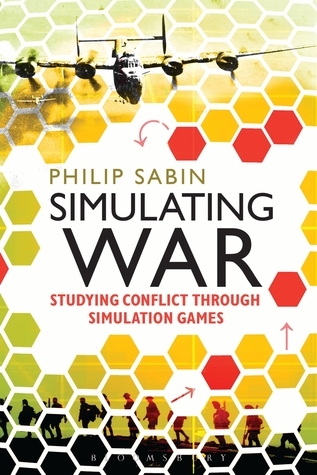
Without diving down that rabbit hole conundrum question of, “can a wargame ever be realistic” I recall the discussion of Accuracy vs. Simulation in Dr. Phil Sabin’s book Simulating War: Studying Conflict Through Simulation Games. Sabin’s comments may help us understand how Twilight: 2000, an RPG from a wargame publisher designed by wargamers, defined “realism”:
Why is it that recreational wargame designers are often at least as concerned as their professional counterparts to make their wargames ‘realistic,’ despite the unavoidable costs in terms of playability and research efforts required? The principle reason seems to be that (as I discussed in Chapter 1) wargames lie at the nexus of popular interest in military affairs, simulation and gaming. Hence, both designers and players are often more concerned with the ‘military simulation’ parts of the endeavor than the ‘game’ aspects for its own sake. (Sabin, p. 20)
It seems to me that Game Designers’ Workshop, with Twilight: 2000, was trying to add RPGs to the nexus already occupied by military affairs and wargames. GDW’s own “history” of the development of Twilight: 2000 all but makes that claim:
Initially, Frank Chadwick’s design concepts envisioned extreme environments with features of Mel Gibson’s Mad Max and Andre Norton’s Star Man’s Son. Unfortunately, such concepts were already common (and not especially successful) to the market place. The breakthrough came on a long drive back from Origins Game Convention (Dallas, 1983). In an overloaded rental van, Frank Chadwick, Loren Wiseman, Bill Keith [aka William H. Keith, Jr. who also writes under the pen name Ian Douglas], and Andrew Keith talked for hours about a modern military role-playing game which concentrated on equipment and realistic military situations, and by the end of the trip the concept for Twilight: 2000 was far enough along for specific design to begin in earnest (Players’ Guide to Twilight: 2000 (version 1.0), pp. 1,3).
In a final grand criticism, Craig points out the inaccurate portrayal of the psychological qualities of people in devastating conditions:
Moreover, in common with almost all other period TTRPGs, no systemic mechanism existed by which the psychological impact of violence, war, and devastation could influence the character beyond pure role-playing. “Coolness under fire” (CUF) was the system’s only psychological element, a measure of character experience, mental toughness, and ability to function in combat. Unlike physical wounding, CUF never decreased and only served to adjudicate a character’s reaction to combat. The mental resilience of characters to the post-apocalypse world’s brutalizing effects and its physical dangers was assumed unless players chose to incorporate psychological issues into their role-playing. No guidance existed in the game texts for such situations, and GM and players were left to extrapolate, should they choose to do so. (Craig, pp. 15-16)
Craig is quite correct that Twilight: 2000 was like other period RPGs and did not have a systematic mechanism to portray the psychological horrors of war. Then again, it is a ROLEPLAYING GAME. While there is no game mechanism for the psychological impact, the players are challenged by the game to THINK FOR THEMSELVES. As the Play Manual states: “The game will take on more interest if the players seriously attempt to make their characters ‘come alive’. When playing, they should keep in mind who their characters are and act accordingly” (Play Manual, p. 3).
[At the risk of being seen as too pedantic, in Twilight: 2000 1st Edition, Coolness Under Fire is not a “reaction to combat” nor was it seemingly intended to portray the psychological “sanity” of a character. Coolness Under Fire is a rating that, “determines…susceptibility to hesitation and panic” (Play Manual, p. 18). It is not used for any sort of Initiative determination; in fact, Twilight: 2000 has no Initiative rule. Instead, each character (or NPC) gets one Action in a Combat Round (5 seconds). Six Combat Rounds make a Combat Turn (30-seconds). Coolness Under Fire is a rating for how many Combat Rounds in a Combat Turn the player must hesitate—in effect take no Action. When a character is surprised there is a chance of Panic (better described as “shock paralysis”) which uses the Coolness Under Fire rating to again enforce hesitation time. The latest version of Twilight: 2000, the 4th Edition from Free League Publishing built on the Year Zero Engine, uses a classic Initiative system with Coolness Under Fire appearing only for Suppression which is a form of “shock paralysis” (Twilight: 2000 4th Edition, p. 67).]
Twilight: 2000’s place
In its first incarnation, Twilight: 2000 offered gamers a diagnostic probe into the future, however faulty that probe might have been. It was a future in which they could play out fantasies of power, survival, and masculinity. This TTRPG took the late Cold War nuclear standoff’s concrete reality and the apocalyptic fears that surrounded it, and repackaged it for the purposes of fun and adventure at the table. Such games thus constitute the ultimate analogue, collective example of the “pleasure culture of war” that saw such an expansion from 1945 onwards and deserve a far greater place in the American – and global – Cold War’s social and cultural histories. (Craig, p. 20)
The tone of Craig’s comments above are decidedly negative; a “faulty…probe,” playing out “fantasies,” and repackaged fears for “fun and adventure” all just to experience the “pleasure culture of war.”
More importantly, Craig misses that the key elements of the background setting of Twilight: 2000 is “change.” As the Introduction in the Referee Manual states:
The most important thing for a referee to remember, however, is that which sets Twilight: 2000 apart from other role-playing games: change. The world of Twilight: 2000 is constantly changing and adjusting to the effects of war. Most role-playing games are set in basically stable environments; the players may not be familiar with it when the game starts and may have to explore to map it, but once known it remains as it is. In Twilight: 2000, however, very few things will remain unchanged over the course of a campaign. A friendly village the players passed through two months earlier may be deserted ruins when they return. A well-equipped and disciplined military unit encountered at one point in the campaign may later again be encountered as a group of marauders, having murdered their officers and take to plunder and pillage as a way of life. Peaceful areas before may later become infested with hostile troops. And gradually, over the months and perhaps years of the game, the products of an industrialized civilization become more and more rare. Vehicles will wear out and become less common. Brass cartridge casing will begin to deteriorate after many reloading. Oil will become scarcer.
The only thing constant will be change. (Referee Manuel, p. 2)
I do not know if Craig ever played the original version of Twilight: 2000 in the original version. Craig makes it clear that he views playing Twilight: 2000 as an orgasm of toxic masculinity, violence and Americanism. While Craig tries to frame Twilight: 2000 as a reflection of the times it was published in, simply by looking at the original text I do not see that same negative world view. Instead, I believe Twilight: 2000 actually communicates a very hopeful view of life in a post-apocalyptic setting. It is also a setting that is very empowering for players. I point you to the final page of the Referee Manual and the penultimate and ultimate paragraphs of the text:
There is one question that this manual has not answered so far, but it will be one of the first your players ask, “what are we supposed to be doing?” The obvious, and correct answer is, “Staying alive.” It is correct, but it isn’t enough. The players need a long-range goal as well, which gives them a reason for wanting to stay alive. This is one they will have to supply themselves, to some extent, but as the referee you have a responsibility to help them along.
There is one very real pitfall involved in most long-range goals; if the players ever achieve the goal the game is over, but if they obviously can’t achieve the goal the game is pointless. The best answer is to help them arrive at a goal so long-range that it will take years to achieve, but once achieved can be replaced by other goals. If they do so on their own, don’t interfere. The characters are theirs to play. If they seem unable to come up with one, suggest the obvious one that American soldiers isolated in central Europe would pursue: going home. Not home to the Army in Germany, but really home, home to the United States. It’s not the sort of goal they are likely to achieve in a week, or a month, or even a year. But if they keep moving, gathering information, keep looking for ways, they may eventually find a way home. It may mean a march across half the world, though hostile territory and barren wilderness, and a final escape across the straits from Siberia to Alaska. It may mean a journey through the Middle East to North Africa and a leaky tramp steamer to the East Coast. Perhaps somewhere there are still a few planes flying capable of crossing the Atlantic. But somehow, somewhere, there is a way back. (Referee Manual, p. 31)
In more than a few ways I feel sorry for Malcolm Craig. I would offer to sit down and play a game of Twilight: 2000 with him but—based on his article—I fear he would be a poor player with an inability to engage with the theme and setting. Craig looks to me like one of those RPG players who wants to sit down and play in a fully defined setting with clear goals and objectives, is mechanically clean, and without violence or confrontation. He sees a setting but does not seek to understand the true themes underpinning it—he only sees what his particular worldview allows him to see. He can only see the mechanics of a game design; particularly a combat resolution system. He also comes across as a person without hope. Twilight: 2000 was never intended to be a “probe” into or a prediction of the future but a setting that was relatable; it played on the fears of the day. Twilight: 2000—by design—gives players agency to survive, not a license for violence. Twilight: 2000, though not written in the language of modern social progressives, did not relegate women to secondary roles like other designs did. In his rush to condemn Twilight: 2000 Craig misses the key underlying themes of the design: change and hope. Sorry, Malcolm, change and hope are more than, “simply part of a distinctive Cold War culture that permitted participants to derive pleasure and affirmation from fictional ‘adventures’” (Craig, p. 1); they are part and parcel of any worthy RPG. I certainly hope that players who engage in post-apocalyptic RPG play would take up the challenge of playing in an ever-changing, and thus challenging, environment led by the hope that they might be able to make their little corner of the world better—even as it falls apart around them. Today’s geeks seem to have no issue buying into the concept that, “Rebellions are run on hope.” Why not post-apocalyptic survival too?
Sources Referenced:
- Chadwick, Frank (1984) Twilight: 2000 (aka Twilight: 2000 1st Edition). Bloomington, Illinois: Game Designers’ Workshop.
- Craig, M. (2025). When You Say, “Thermonuclear War,” I Think You Mean “the Call to Adventure”! The Twilight: 2000 Tabletop Role-Playing Game and the Postapocalyptic World’s Imaginary Spaces. Journal of American Studies, 1–20. doi:10.1017/S0021875825000283
- Dunnigan, Jim (2000) Wargames Handbook, Third Edition: How to Play and Design Commercial and Professional Wargames. Lincoln, Nebraska: Writers Club Press.
- Härenstam, Tomas (2021) Twilight 2000: Roleplaying in the World War III That Never Was (aka Twilight: 200 4th Edition). Free League Publishing.
- Kenson, Steve (2019) The Expanse Roleplaying Game. Seattle, Washington: Green Ronin Publishing.
- Sabin, Phil (2014) Simulating War: Studying Conflict Through Simulation Games. London/New York: Bloomsbury Academic.
- Suckling, Maurice W. (2025) Paper Time Machines: Critical Game Design and Historical Board Games. New York, New York: Routledge.
- Stewart, Sam (2017) GENESYS Core Rulebook. Roseville, Minnesota: Fantasy Flight Games.
You can chat about this game in RPGs & Adventure Gaming of our discussion forums
Thank you for visiting the Regiment of Strategy Gaming and riding with The Armchair Dragoons.
Rather than list a bunch of social media links, the easiest thing to do is to check out our LinkTree, which connects you to all of our various locales around the web.
You can also support The Armchair Dragoons through our Patreon, and find us at a variety of conventions and other events.
Feel free to talk back to us either in our discussion forum, or in the comments below.



Hm, well chosen quote by Yours Truly (sometimes known as Lieutenant Obvious!).
But authors aren’t always so self-aware, and much has changed in the last 40 years.
I checked the references and he does cite Greg Costikyan, a designer who is not only very aware of what he is doing but also knows irony and satire, but only in connection with his Paranoia game.
He will eventually get around (well, he’d better get around) to looking at Costikyan’s RPG The Price of Freedom; that will give him something to chew on.
https://waynesbooks.games/2025/12/21/freedom-fighters-price-of-freedom-1986-red-dawn-roleplaying/
https://www.juhanapettersson.com/non-digital-better-dead-than-red/
He finishes his article saying he is compiling an oral history of people who played these games back in the 80s and is looking for contributors, as a proud American you should contact him and give him an earful!
As was pointed out to me by another today, Craig criticizes T2K for its US-centric outlook but seems to ignore Judge Dredd’s UK-centric setting (https://rpggeek.com/rpg/663/judge-dredd-the-role-playing-game-games-workshop), or FGU’s Aftermath! (https://rpggeek.com/rpg/729/aftermath) or SJG’s Car Wars (https://rpggeek.com/rpg/3872/car-wars) at all. Will be interesting to see if he digs into those settings and tells us if they fit his T2K conclusions…or not. So far nothing heard…
That article is so weird, especially given the author’s background in rpg design and interest in WWIII fiction.
The points about gender are not all that well taken. In, I think, 2015 when the first women graduated U.S. Army Ranger School, I posted something about how GDW in 1984 had imagined women going to Ranger school in the mid-1990s! Indeed, the game suggests the U.S. military at least ended gender segregation. I’m also a bit unclear where the author is getting the idea the (male) PCs are always rescuing (female) victim NPCs. So many of the adventure modules have the PCs helping out male NPCs.
I’m also wondering where the author got the idea that CivGov was the bad guys.
Also, he badly missed the thrust of the campaign arc as set forth in the adventure modules, which was to build a better world and set up the preconditions for humanity’s revival (which was explored in GDW’s subsequent rpg Traveller: 2300/2300AD).
I think the most interesting aspect of Twilight: 2000, though, is what the PCs do when they are on their own and have nobody telling them what to do.
On gender, I think the author wanted to make a point and forgot to check the ground truth assuming since this is such a niche topic nobody would notice. Like I wrote, the game is really about change and hope, two traits the author willfully ignores.
As a person who had just done his national service in the Dutch Army, and just started with this RPG hobby, Twilight 2000 was an eyeopener. Here was this game that was recreating, with a dark twist, all the things that had been drilled in me, during my 14 months of service. And then the equipment books! That was sort of a wet dream. All the neat things that had been promised us (the Dutch army went through a huge upgrade period in the early ’80’s) and with stats to play with them. And I could play as myself, basically! What was not to love. As I had no knowledge of D&D (we played OdM (dutch translation of DSA (Das Schwarze Auge/The Dark Eye), or RuneQuest (as we were more UK oriented then), I did not see any parallels, imagined or otherwise. And I also had the computer game. In which I was forever creating the most divers crews possible, to be prepared fo anything. And both the RPG and the computer game had settings that were (more or less) “around the corner”. The first campaign plays in Poland, just like the computer game. And a lot of different nationalities (and their armies) are mentioned and used.
So when reading the excerpts from the study I was more than a little puzzled. This is/was not the game I remembered. Although I now know that part of the world building is rather unrealistic, it made sense for me then. And I feel that is more or less what the researcher misses. It was a fantasy, for young adults of draft age, of what they thought they could, and would be doing when the war (which was, at that time, more a question of when than of if), would start. To talk about “setting it in it’s time” can be a lazy cop-out, or lead to a deeper understanding of what it is about. Seems to me that the researcher was not able to look (very far) beyond his own bias, and did not manage to do this. As an example of deconstructing text, in the here and now, it seems to be quite good though.
But then, I am now proud to call myself a Grognard, so this grumbling comes with the territory.
“This is/was not the game I remembered. Although I now know that part of the world building is rather unrealistic, it made sense for me then. And I feel that is more or less what the researcher misses. It was a fantasy, for young adults of draft age, of what they thought they could, and would be doing when the war (which was, at that time, more a question of when than of if), would start. To talk about “setting it in it’s time” can be a lazy cop-out, or lead to a deeper understanding of what it is about. Seems to me that the researcher was not able to look (very far) beyond his own bias, and did not manage to do this.”
I agree…the T2K the author talks about is not the T2K I see in front of me. I can see some of their points (gender, combat realism) but also see where the designers addressed the issue head on. I also sense the author doesn’t really understand realism in game design nor play balance.
Tell me you were a Dutch engineer and you were in Nijmegen in the summer of 1990 and I will buy the first 2 beers at lunch, sir.
Sorry, Hospik (medic) in 1981/1982