by
by Ian Brown, 9 March 2026
I’m not sure exactly when it dawned on me last year, but there came a point late in 2025 when I realized I’d made the mistake with wargaming conferences that I made when pre-ordering wargames: I signed up for everything, forgetting all the other ones I’d already signed up for, and then one day looked at my calendar and realized that all the bills would come due at once. But too late to back out now, right? So on the one hand, I wistfully kissed all my PTO for 2026 goodbye. On the other hand, when Regimental Commander Brant put out his call for writing topics in 2026 I could confidently tell him, “O captain my captain, when it comes to conference AARs, I got you covered. I might be selling a kidney for more PTO by December, but I got you, boo.”
Thankfully, the first conference I attended in 2026 required no travel, just an early morning. This was the Games of War conference, hosted as a hybrid event by the University of Gdańsk in partnership with the Magnus Ducatus Foundation, European Humanities University, and the Department of Computer Systems and Technologies of Simon Kuznets Kharkiv National University of Economics. I learned about the conference through my wargaming network on LinkedIn, and while I wasn’t previously familiar with it, when I dug into its goals and background it was right up my alley. 2026 would be the third iteration of this conference, and its guiding light was to examine games as avenues for exploring representations of war. The war in Ukraine was a special focus of the conference, to the extent that each year it was deliberately held on 24 February—the date Russia began its full-scale invasion of Ukraine in 2022.
Having previously attended an excellent wargaming conference held at the General Tadeusz Kościuszko Military University of Land Forces in Wrocław, Poland, in 2025, I fully expected that any conference at another Polish educational institution would be of a high caliber. The focus on the war in Ukraine also dovetailed with a personal goal of mine in game design which was to capture relevant lessons from the invasion in educational wargames for military audiences. I’d first done this while still on active duty, creating a Ukraine module for the prototype version of Littoral Commander. I continued this effort after I retired, heavily leveraging what I was seeing on the Ukrainian battlefield in my own game #Maneuver Warfare. So I registered for Games of War both as an attendee and offering to present my own design work on Ukraine if they’d have me. The conference organizers graciously accepted, and so at 4:00 am Eastern time, February 24, 2026, I opened my Teams app to dial into the conference, ready to talk but more ready to listen, and learn.

click most images to enlarge
The conference had a robust presentation program and so I won’t attempt to recreate each briefing as that would exceed the scope of this piece. Instead I’ll touch on the themes that wove their way throughout the day and then leave you with some food for thought.
Theme #1 – Gaming for Resilience and Defiance

It’s been 4 years since Putin’s forces crossed the borders of Russia and Belarus into Ukraine and so I’m confident that in those four years, you, dear readers, have seen myriad pictures of Ukrainians huddling in basements, subways, and bomb shelters while Shaheds and ballistic missiles turned their homes into rubble. As several presenters noted, Ukrainians have approached both the development and playing of games as mechanisms for sustaining a sense of “normality” under constant stress—and flipping a middle finger to Putin that there is at least some space they can enjoy that isn’t ruined by war. Mary Chikarkova and Yaraslau Kot noted in “War and Games” that despite the war, there has been growth in the Ukrainian ecosystem of games with more than 20,000 people working in the gaming industry and 80 companies working on game development. Unsurprisingly, most of these games are mobile games, easily played on handheld devices in bomb shelters during air raids. Many of these games blend humor with a spirit of national resistance—games about stealing Russian tanks were ubiquitous in the early years of the war, and the drone game e-Bayraktar is the world’s only game hosted on an official state app.
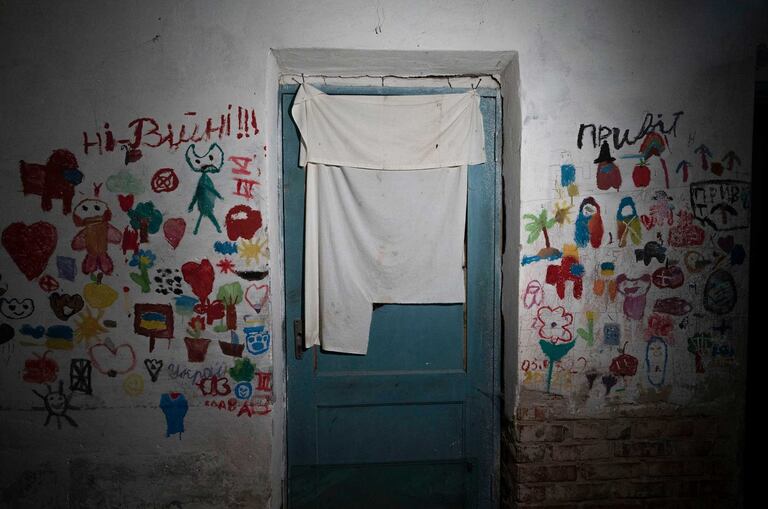
Volodymyr Volkivsky provided a unique glimpse into the world of game development during wartime in describing the creation of the game Uanamon in “The Story of One Indie.” On February 24, 2022, Volodymyr was a computer science teacher who instructed his own students in game design. Displaced as the invasion unfolded, he described the first two weeks of the war as life coming to a halt; and then he decided to stop waiting and start creating. It took time to find an artist for him to collaborate with, and by the time he found one, the Russian invaders had provided their own gruesome catalyst for the style they would use. In the village of Yahidne, Russian occupiers forced almost 400 townspeople into a cramped school basement for a month. In the basement, the villagers got sick, starved, lived in their own feces and urine, and died. On the basement walls they kept a calendar of their confinement, wrote the names of the dead—and a kindergarten teacher found crayons for her students to draw with. The colorful art those children left on the walls of Yahidne while living in darkness became the inspiration for Volodymyr’s game. Through the winter of 2022, enduring blackouts, freezing temperatures, and constant bombardment, Volodymyr and his team built a game universe for adventuring grounded in Ukrainian culture and folklore, and the memory of Yahidne underlying it all.
Theme #2 – Gaming to Prepare for War
This theme itself isn’t ground-breaking; after all the whole point of the original kriegsspiel was using a simulated environment to prepare military leaders for future military problems. But the war in Ukraine has compressed the timeline between playing war and fighting war in many ways. In “Games for Good, Games as Weapons, and Games as a Battle Zone,” Jari-Pekka Kaleva noted how trends like expanded drone warfare have been built on muscle memory first developed in operators by gaming, from user interfaces to game-style drone controllers to VR/XR/AR headsets for seeing what the drone sees. There’s also a gamification of military data; given the data stream provided by drones, commanders can collect real-time objective performance data on whether soldiers successfully complete their missions, rates of mission success and failure, who quickly gets their drone on-target and who takes an excessive amount of time. This feeds into a performance/rewards system not dissimilar to good in-game performance, the difference being that rather than unlocking a fun new item, it impacts military career tracks.
Jeffrey Taylor observed in “Historical Video Games as Anticipatory Systems” that this trend had historical echoes as well as implications for current and future military force training. The Olympics—the original one in ancient Greece—was simply a “sportification” of the skills needed by warriors for survival on ancient battlefields. The only difference was that those skills—the race, the accuracy or distance game, and close-in martial arts—weren’t employed lethally in the Olympics; but if you were good at an Olympic sport, that meant you could give someone else a bad day on a future battlefield. Taylor noted that while the modern Olympics still hosts sports featuring these ancient skills, the modern warrior requires skills in operating new machinery or equipment. And so, this is where a new generation of “sportification” has occurred, with U.S. military services slowly joining competitions like e-sports or drone racing because those are today’s martial skills.
And there remains a need to hone military skills even when one doesn’t have immediate access to a drone range or xBox controller. That’s where more conventional military wargames come into play, which was the topic of my own presentation “Teaching the Tryzub: Lessons from Ukraine in Military Educational Games.” I discussed both my #Maneuver Warfare card game and prototype Littoral Commander Ukraine module as examples of how that compression between preparing for and executing modern war can occur in the classroom. In both instances, while the audience of military students these games targeted weren’t necessarily about to step onto a battlefield the next day, by rapidly gamifying and implementing real-world battlefield trends in educational games system I could better prepare those students to face those trends should they be called to do so after graduation day.


Trend #3 – Gaming Information and Narrative
Games by their nature transmit information to their players; it’s how players make decisions about what to do next inside the game environment. Games of war—especially an ongoing war—take both the transmission of information, and the information content, to another level, and the implications of that are only now becoming understood. Jari-Pekka Kaleva recalled how online forums for the digital game World of Tanks became channels for exposing actual classified performance data on modern main battle tanks. It was only a couple of years ago that Air National Guardsman Jack Teixeira did something similar using the gaming app Discord. In both cases, classified data was shared literally “for the likes;” but these cases also highlight how the gamification of war blurs lines between worlds that used to be separate. Ukrainian drone operators have a game-like reward system for successful strikes; Teixeira had his own corrupted view of a reward system, but in both cases gaining attention from a wider audience base is and was the point.
The spillage of classified information on gaming platforms is, fortunately, not a common occurrence. But unclassified, or even historical, information can still be used for shaping effects in and around a battlefield as discussed by Iryna Somka in “Russian Propaganda in Video Games.” Iryna examined three “waves” of commercial games either developed directly by Russian companies, or in collaboration with them, to see how the Russian government used games as platforms for spreading regime-endorsed narratives. The first wave covered 1991-2014; unsurprisingly given the upheaval in post-Cold War Russia, games from that period didn’t have any specific messaging. The second wave encompassed 2014-2022, when Vladimir Putin—now firmly ensconced at the top of Russia’s hierarchy—could direct or encourage Russian game developers to include content favorable to his regime and supportive of his regime’s activities around the world. Games from this era took players to Chechnya, Donbas, or Syria, with similar narratives embedded regardless of the game environment. Russian soldiers were always the good guys—in some games there was no picking sides, players could only choose to be Russian—and Russia’s opponents unambiguously evil. Syrian Warfare, released in 2017, checked all of Putin’s desired propaganda boxes at the time: the presence of Russian forces in Syria was necessary and honorable, those fighting against the Assad regime were all terrorists, and players were rewarded for high levels of aggression (again echoing the bleeding-over of game rewards to actual battlefields discussed above).

Following Russia’s full-bore invasion of Ukraine in 2022, the third wave of games made Ukraine their central focus, and tightly wove together the threads of propaganda, disinformation, and preparing for actual war. Squad 22 Zov offers a campaign of “heroic deeds” for Russian soldiers to perform in Ukraine starting in 2014 and takes players to places like Mariupol and Avdiivka. The “Z” symbol that garnered international attention in early 2022 is prevalent throughout the game. The development company was supported through a Russian military fund and the game itself recommended by the Russian military as a basic tactical training tool for cadets.
Final Thoughts
Games of War was a meaty conference and there were many other presentations outside of the themes described above. In “Folklorized Neo-theologies and Neo-myths of the Ukrainian-Russian War,” Aliaksander Razhk offered a fascinating breakdown of how Russia and Ukraine as societies have adopted monikers for their adversaries—like “orc” and “troll”—with linguistic origins as diverse as J.R.R. Tolkien and Warhammer 40K. Jason Matthews offered a sober assessment of a topic that could easily be trivialized in “Wargaming Donald Trump.” He noted that there are, in fact, historical frameworks that can be used for idiosyncratic and norm-defying behavior. Serious game designers should apply their own sobriety in modeling such behavior because there’s actually very little on this earth that is truly “without precedent.” Hopefully the recordings of these, along with the presentations described above, will be posted soon by the conference organizers. (ed note: when they do, we’ll link them in the professional section in #TuesdayNewsday)
Two parting shots and then I’m done. First, despite the presenters’ enthusiasm in talking about their design and use of games, the “war” part of Games of War was ever-present. The briefer who was scheduled after me canceled his appearance at the last minute—he was an active-duty Ukrainian Marine and had been called out on a mission. During his opening remarks, the Dean of the Faculty of History at the University of Gdańsk—after warmly welcoming everyone—shared a quote from a Ukrainian who had presented two years prior at the inaugural conference. The quote was in memoriam, the original author consumed by the war as the war had consumed so many others. But it made abundantly clear why Ukraine resisted Russia with such tenacity:
“For two years, the Ukrainian people have shown resilience and courage against an enemy three times as large. They are showing miracles of bravery because they fight for their women and children, fight for the survival of their country as a whole. Right now it’s very hard, harder than it was at beginning, for various reasons: the size of the invader, mobilization possibilities, abandonment by Europe and the U.S., corruption before the war. Hard reality is setting in, one that threatens morale with despair. But this must not be allowed—we’re not fighting for the Donbas or the borders of 1991, but so that Kyiv and Lviv don’t become another Bakhmut or Avdiivka. We keep [the invader] from our homes, keep our women from being raped, our children from being slaves that in 5 years will be fighting NATO.
So find your own point to the fight, something that inspires you to keep fighting. It doesn’t matter how long it lasts, one month or ten years.”
At every wargaming convention there’s usually an empty chair or two for old grognards whose long years at the gaming table finally wore out. This was a stark reminder that there are places in the world where gamers don’t get the chance to grow into old grognards.
Second: the conference was conducted in English. While I don’t know specifically why, I suspect that it—like the conference in Wrocław last year—used English because it’s the working language of NATO. In years past this made perfect sense; after all, the biggest player in NATO was the United States, which had previously given significant materiel and other support to the war effort in Ukraine. Using English as a conference common tongue was a practical nod to the support American had provided.
Had.
While I appreciated Games of War being executed in my mother tongue, I frankly didn’t think I, or the mother country, deserved it. Back in Wrocław in 2025, I felt uncomfortable enjoying two days of wargaming in English when the government shutdown shit-show had forced the American keynote speakers to cancel their attendance at the last minute—which, to put it mildly, kind of screwed the conference organizers.
In 2026, sitting in the audience of Games of War with presenter after presenter—excepting a handful, none of them Americans—talking about the war in Ukraine, I was again uncomfortably conscious of the math for what that big ol’ English-speaking country had done the previous year. The math was this: U.S. military aid to Ukraine dropped 99% in 2025. Concurrently, 2025 saw a 31% increase in Ukrainian civilian casualties. If you paid attention through the winter of 2025-2026, you know that to offset his inability to make meaningful battlefield gains, Putin undertook his biggest effort yet to destroy Ukrainian electrical infrastructure and literally freeze the civilian population to death.
So I had mixed feelings as I listened to the day’s speakers accommodate the English language, knowing the price Ukrainian civilians had paid through a miserable year that ended in a cold, dark winter; knowing how little the big ol’ English-speaking homeland did about it; and knowing that concurrent to this conference illuminating the fight in Ukraine, the Pentagon suddenly had $500 billion it didn’t know how to spend.
I’m grateful for participating in Games of War and certainly appreciated that I could enjoy the whole conference in my native tongue. But it wasn’t an accommodation my demographic deserved.
Next year, I hope we do.
The views presented here are the author’s alone and do not represent the views of any entity or organization with which the author may be affiliated.
You can chat about this article in the Professional Wargaming section of our discussion forums
Thank you for visiting the Regiment of Strategy Gaming and riding with The Armchair Dragoons.
Rather than list a bunch of social media links, the easiest thing to do is to check out our LinkTree, which connects you to all of our various locales around the web.
You can also support The Armchair Dragoons through our Patreon, and find us at a variety of conventions and other events.
Feel free to talk back to us either in our discussion forum, or in the comments below.