
 by
by RockyMountainNavy, 2 March 2026
I am a grognard that remembers the “Great Magic Extinction Event”; that is, the time in the 1990’s after the collectible card game Magic: The Gathering released and almost killed the tabletop wargame industry. So to say I carried a grudge against collectible card games for a long time is a bit of an understatement. It took many years for me to accept that a collectible card game is a form of wargaming I can support. #Maneuver Warfare: The Card Game by Ian Brown from The Dietz Foundation (2025) is an excellent example of a wargame styled on the collectible card game model1 that not only I can accept, but one I also endorse for use by wargame practitioners as well as playing for enjoyment by hobby wargamers.
#Maneuver Warfare is unique in that it was originally designed by a wargame practitioner for training military members which then made the conversion to the commercial wargame sector. From a military training perspective, #Maneuver Warfare is designed to show the OODA Loop for decisions across a very modern multi-domain battlefield using the medium of a card game. Part of the goal was to ease of play; #Maneuver Warfare is playable in about 40 minutes and can be carried in a (large) cargo pocket or ruck sack backpack needing only a car hood small table to play on. Oh by the way, the fact it shows modern warfare in the most cerebral of ways guarantees to challenge players of all skill levels or experience.
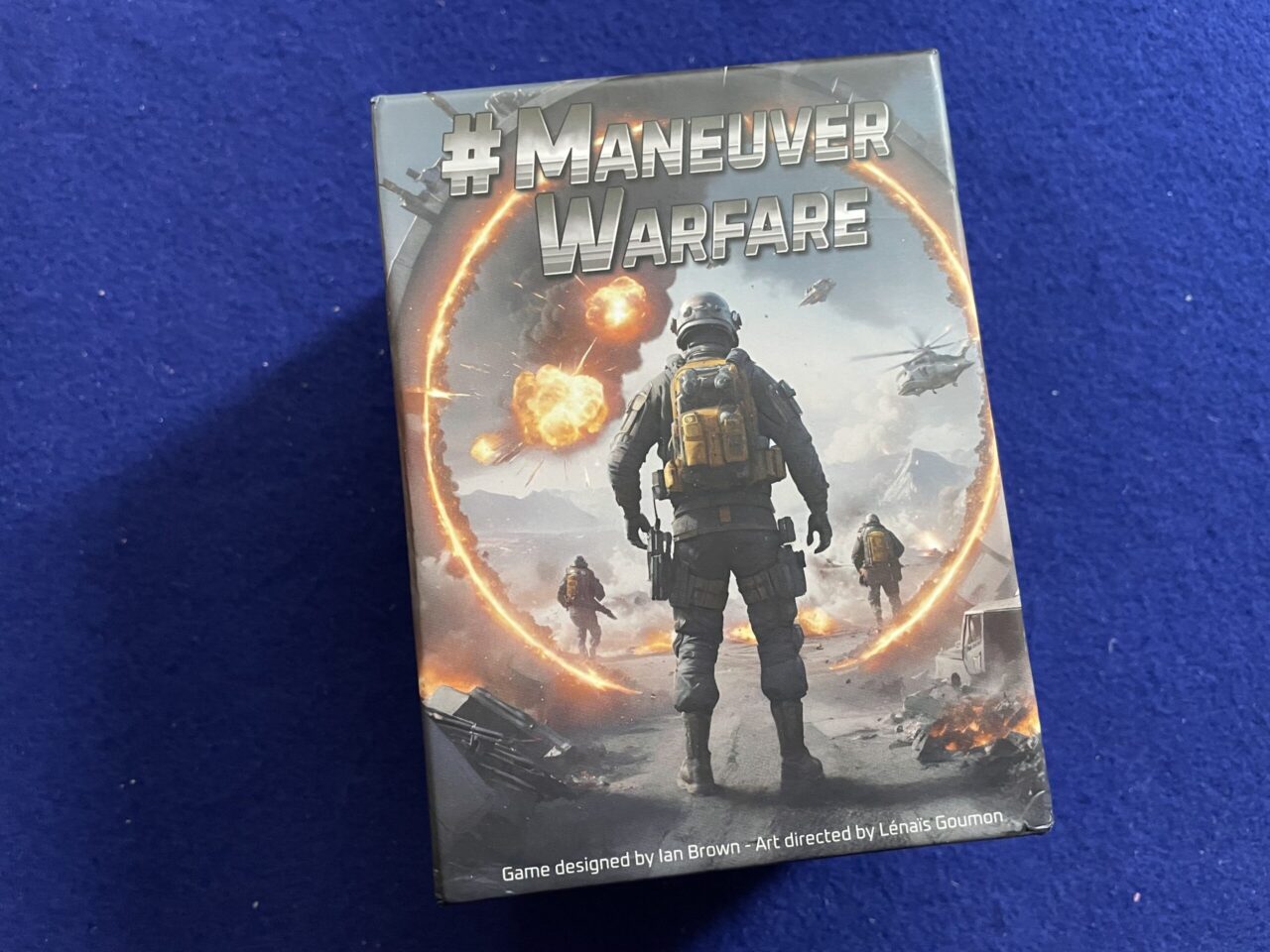
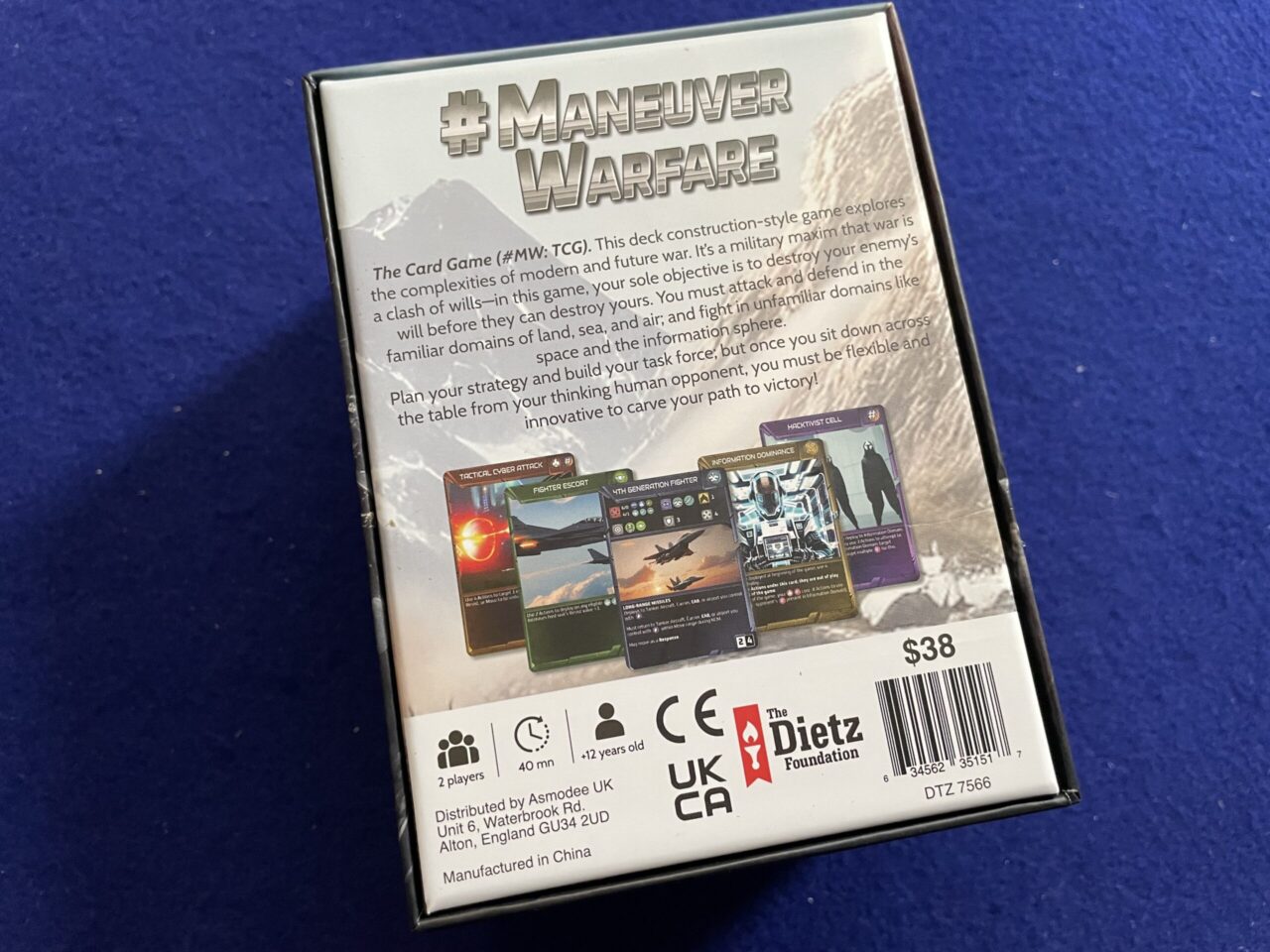
click images to enlarge
I first encountered #Maneuver Warfare in April 2023 at the small convention Circle DC in Washington, DC (next one in April 2026). I sat down with an out-of-uniform, then-US Marine Corps Major Ian Brown was playtesting a novel little card game. The early iteration of #Maneuver Warfare was a bit rough but there certainly was enough “there, there” to warrant continued development; which Ian did for the next two years before The Dietz Foundation published #Maneuver Warfare card game.
#Maneuver Warfare: The Card Game (#MW: TCG). This deck construction-style game explores the complexities of modern and future war. It’s a military maxim that war is a clash of wills—in this game, your sole objective is to destroy your enemy’s will before they can destroy yours. You must attack and defend in the familiar domains of land, sea, and air; and fight in unfamiliar domains like space and the information sphere.
Plan your strategy and build your task force; but once you sit down across the table from your thinking human opponent, you must be flexible and innovative to carve your path to victory! (Back of the box)
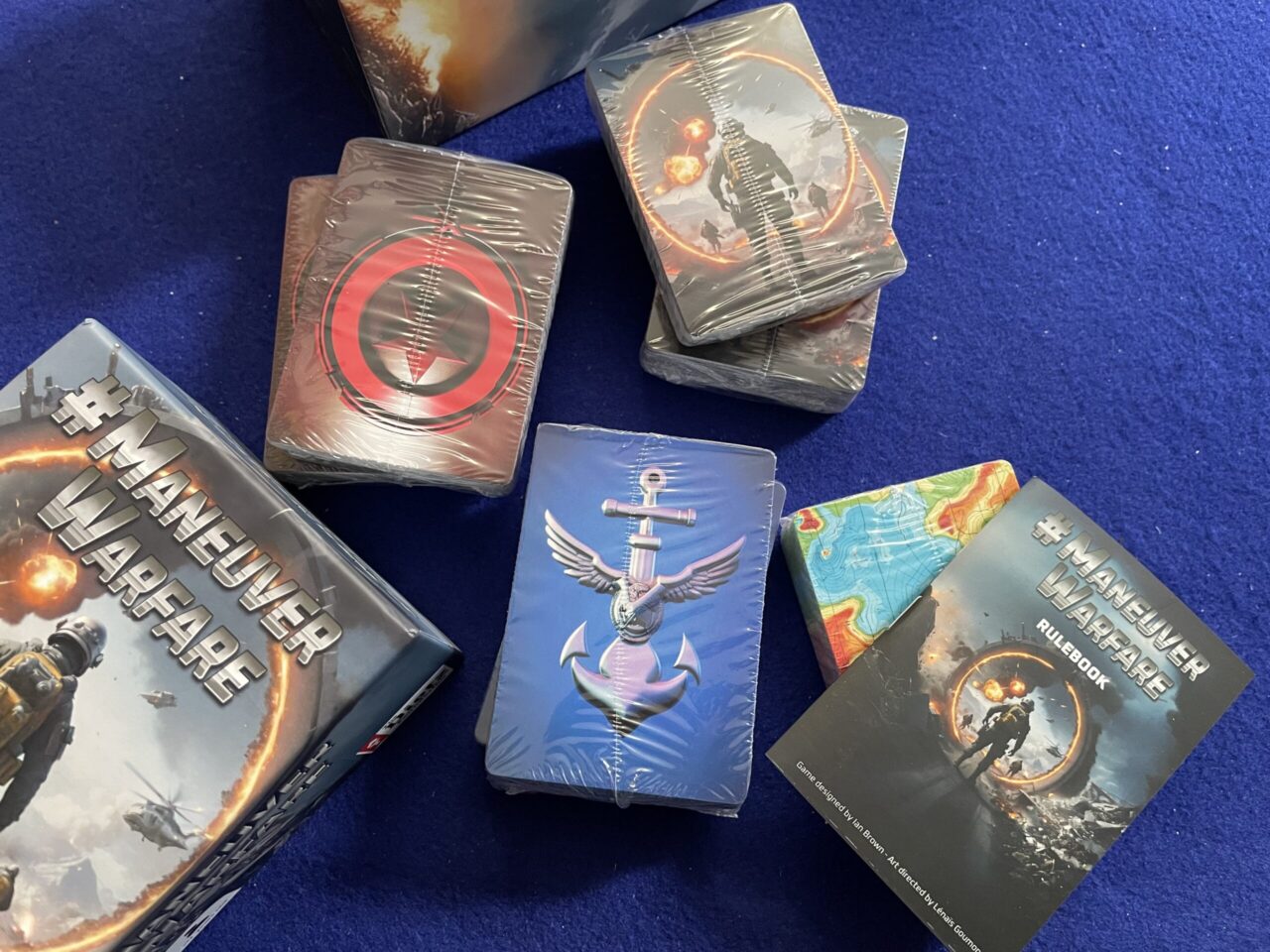
Ian openly discusses how the Star Wars Customizable Card Game was an inspiration for #Maneuver Warfare. That is not to say, however, that #Maneuver War is a clonetrooper of the original though you can see hints of the Old Republic in the later game:
[In Star Wars]…Each player selects their deck of 60 cards in secret. Cards are arrayed on a flat surface between the two players. Location cards are laid out first and then characters or ships are laid out at the locations. Additional types of cards can be placed on ships and characters, for example weapons and devices. The object of the game is to drain your opponent’s life force. Each card represents a unit of life force. Playing location cards allows you to draw additional life force into your hand. If a ship or character is destroyed in battle, the card goes to a lost pile; when all cards are in your lost pile you have lost the game. (Ian Brown interview with The Player’s Aid, October 2025)
In a full-up game of #Maneuver Warfare, players create a deck of 30 cards for their hand in secret. Location cards are then used to build the battlefield with two domains, Space and the Information Sphere, always present while the rest of the battlefield is a mix of air, land, and sea. Players play cards from their deck to put forces onto the board and fight them. In terms of game design and game mechanisms used #Maneuver Warfare does not, admittedly, appear so innovative.
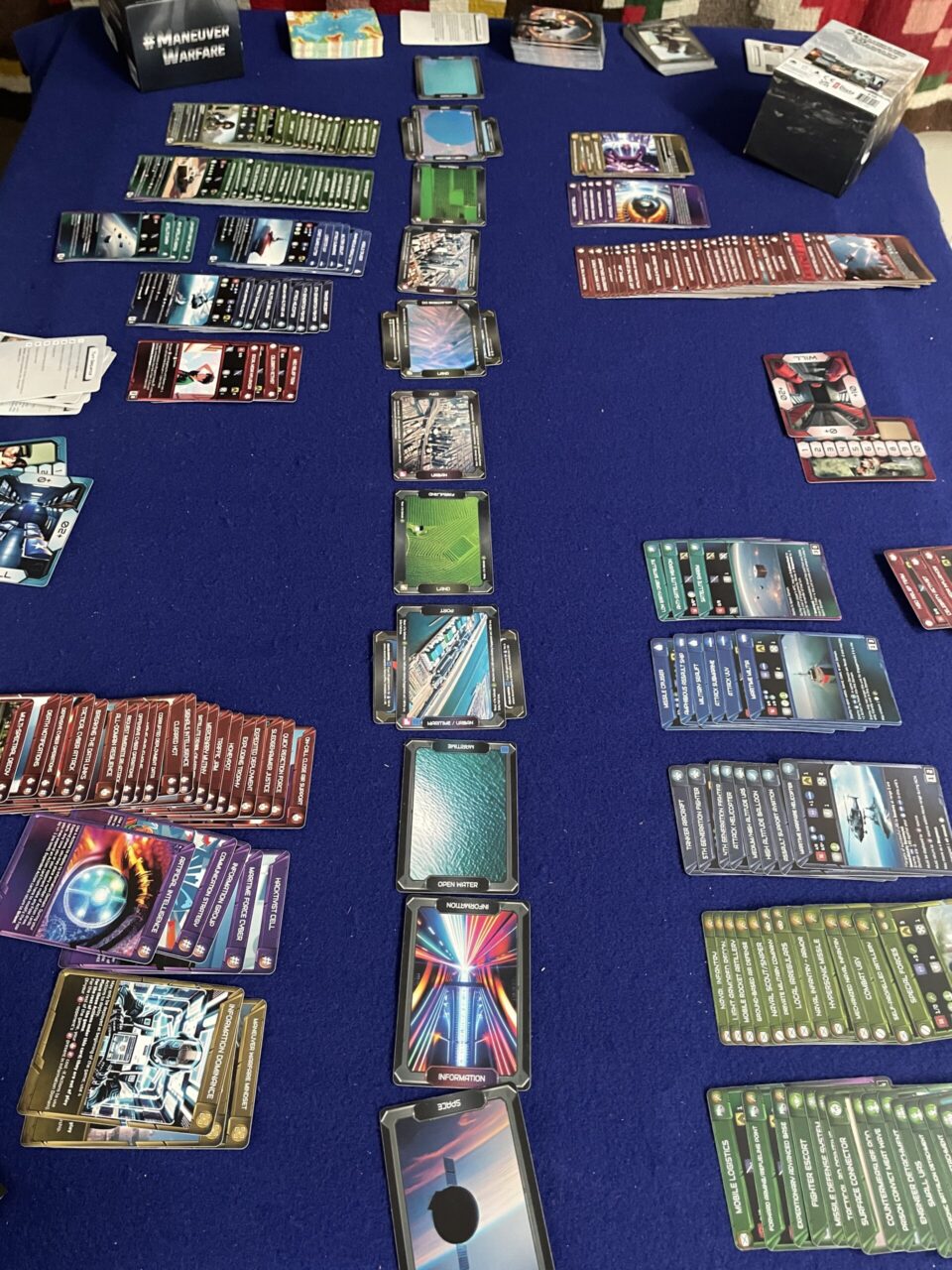
That is until one looks at how language and game mechanisms interact.
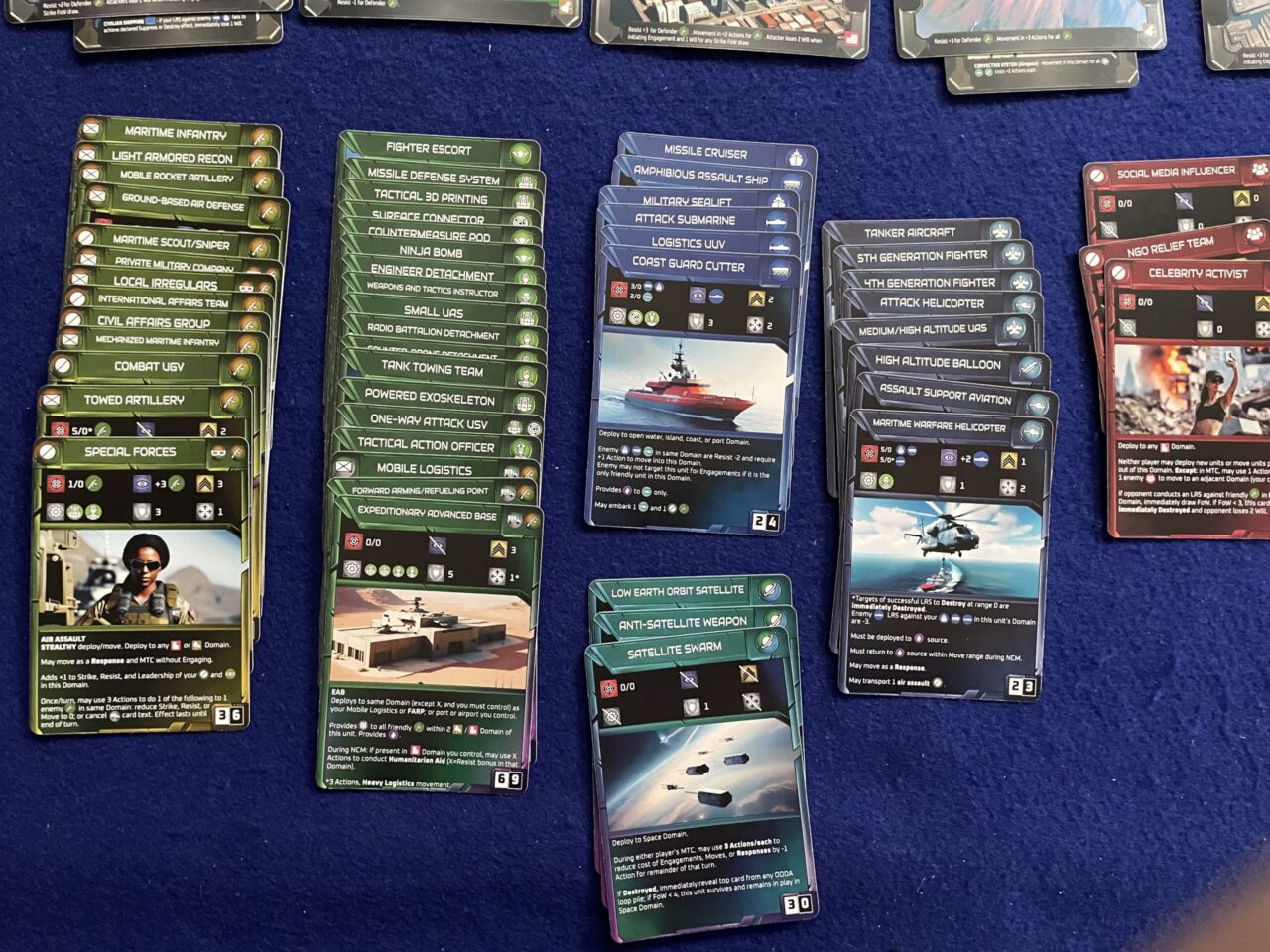
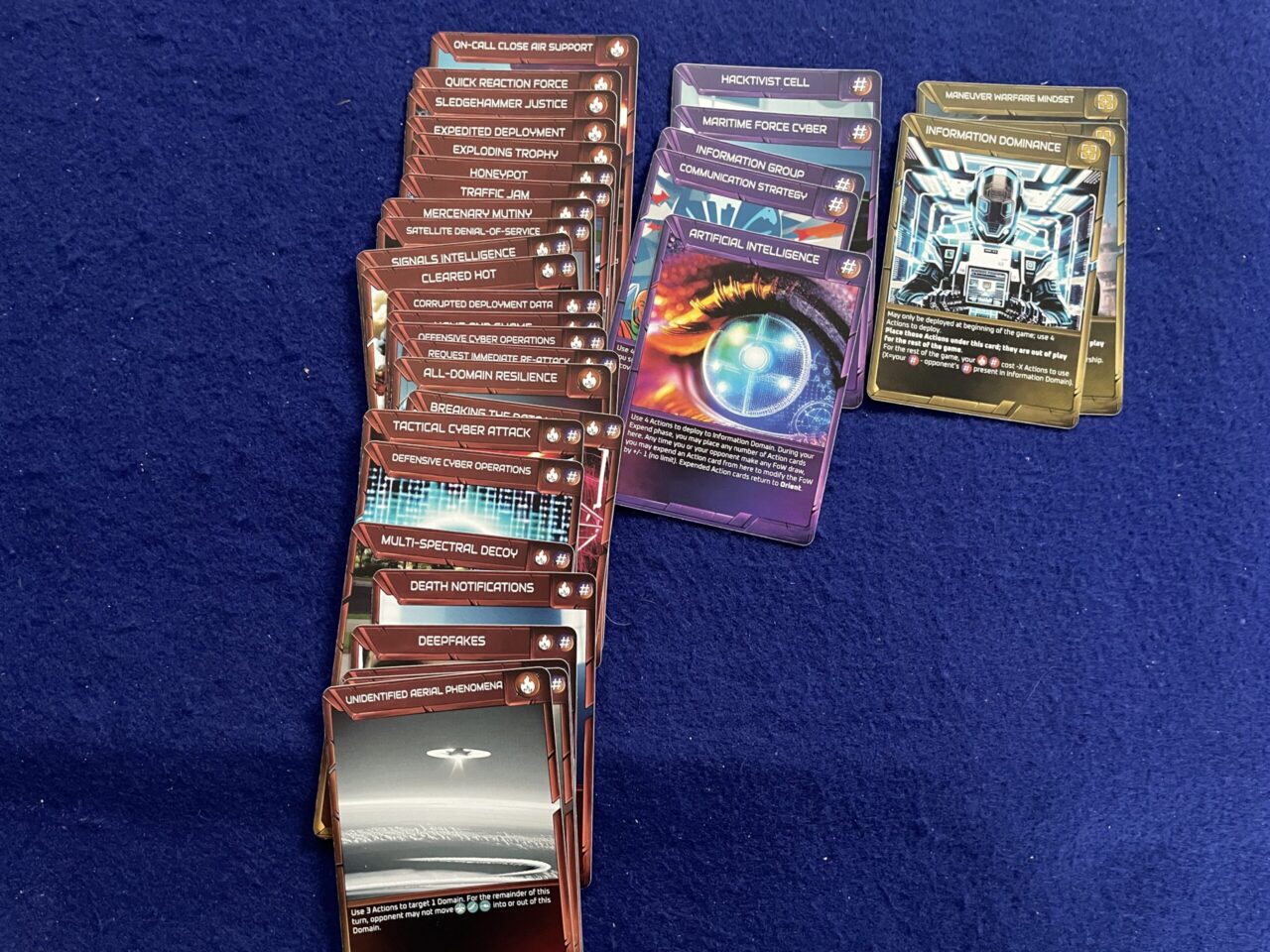
The first element of language that players of #Maneuver Warfare discover are the different cards.
- Maneuver cards are, in effect, the units in a player’s force. Most of these cards will be familiar to watchers of modern militaries as they are ships, aircraft, infantry, and the other kit of military forces. Maneuver cards deploy, move, and fight on the battlefield.
- There are Enabler cards which, much like in Littoral Commander, attach to unit cards. Enablers bring added capabilities like drones to units and provide much of the “chrome” to make the units feel “modern.”
- Friction cards in #Maneuver Warfare operate in many ways like Fate Cards do in the Villainous series of boardgames—they are used to disrupt or otherwise impede your opponent’s plan.
- Information cards can only deploy to the Information domain and represent not only the war in cyberspace but several of the actions in the realm of cognitive warfare.
- Focus cards reflect plans and other preparations before battle to (ideally) set the conditions for success.
#Maneuver Warfare draws from—and leans heavily into—the OODA Loop concept. Ian Brown is a deep student of Maneuver Warfare doctrine used by the US Marine Corps. So deep is his study that he wrote what is perhaps the book on the subject: A New Conception of War from Marine Corps University Press which talks about John Boyd and his OODA concept.

[Ian also draws the ire of the Marine Corps old guard which writes under the name Marine Corps Compass Points. Think of Compass Points as those few wargamer grognards that are committed to only hex & counter with a combat results table designs and who never play a wargame published after, say, 1977. No, I am not linking to them as I will not provide even that soft endorsement to a group that Ian is very outspoken against.]
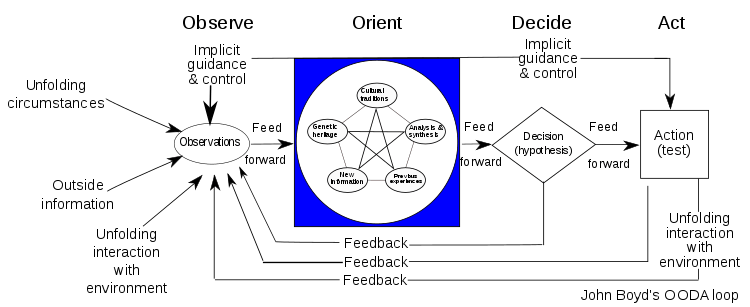
OODA stands for OBSERVE-ORIENT-DECIDE-ACT. Ian explained in a late 2025 interview with The Player’s Aid how “OODA” is used as the core game play mechanism in #Maneuver Warfare:
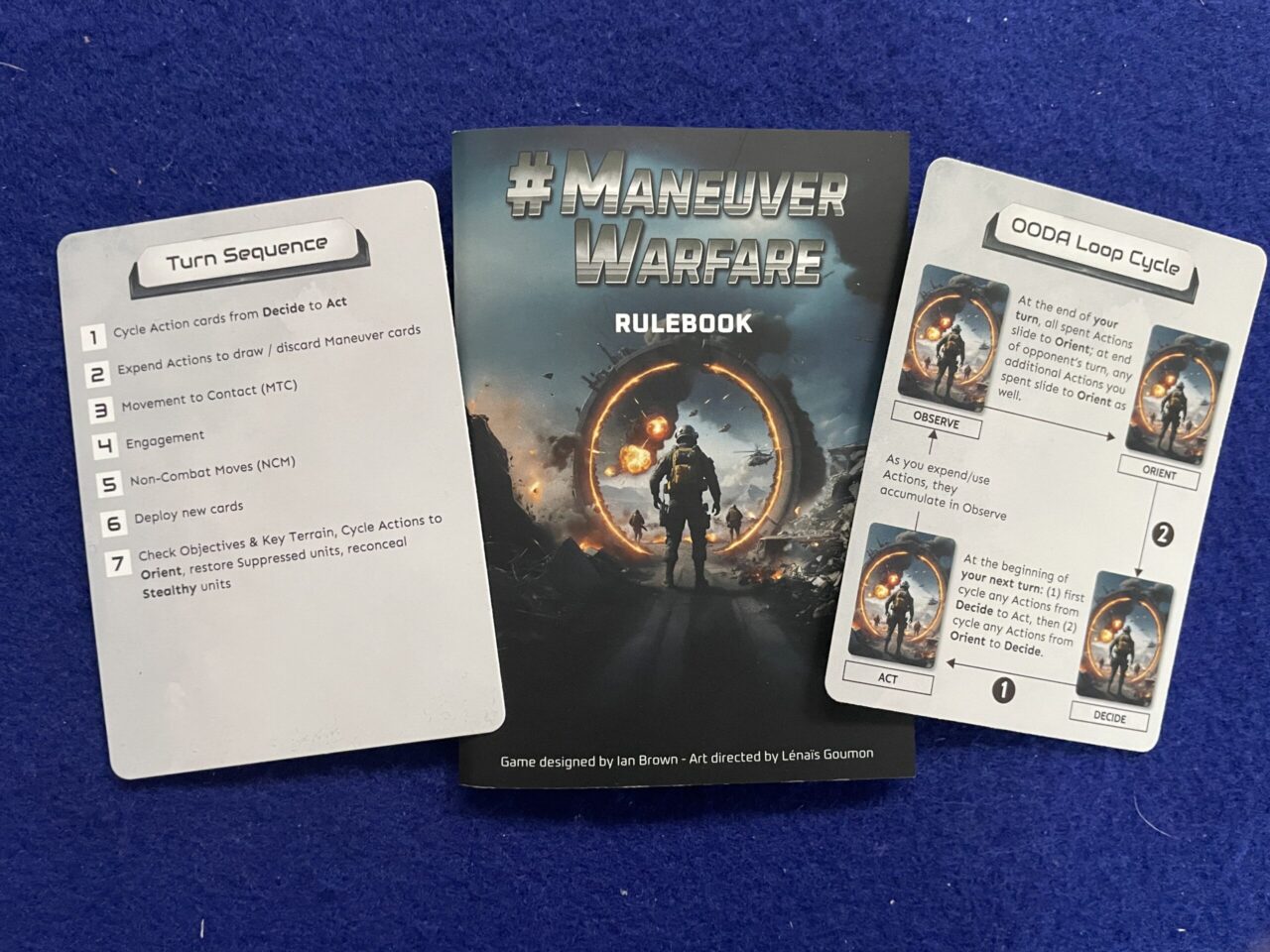
Now this is not a linear cycle and there are many different feed-forward and feedback mechanics that weave through the OODA Loop but for game purposes, I use the simplified linear cycle. At the start of the game, you can choose how many of your Action cards to have immediately available in an “Act” status, and how many in the “Decide” status as Actions that will come to you on your next turn. When you spend an Action card to do something, it moves forward in the cycle to “Observe;” you spent your Action, now you see what the result is. At the end of each player’s turn, any Action cards that were spent into “Observe” then slide into “Orientation.” My intent here was introducing a deliberate “pause” in the player’s ability to immediately regain their Actions, with the pause simulating the orientation assessment process between seeing the result of one’s acts and then deciding what to do next. It’s in this “pause” that a player can either negatively impact their opponent’s OODA Loop to simulate mental shock, or accelerate their own OODA Loop to simulate the mental resilience gained from good training, effective command and control, implicit communication, and trust between units. (The Player’s Aid, October 2025)
While on the surface the use of OODA in the card game sounds somewhat complex in #Maneuver Warfare the practical effect is that cards move between one of four ”places” in a player’s tableau; Many players probably never realize this is what is happening when they move cards from hand to action to discard and recycle in many card games; in #Maneuver Warfare the linkage between OODA and card movement is made explicit…
…and it works to make the game that much more immersive.
It took me a few reads of the rulebook and tutorial or regular games to realize that in #Manuever Warfare the OODA Loop is, effectively, the DAOO Loop. Cards coming to you next turn start in DECIDE. Current turn cards available are in ACT and once played (i.e. “discarded”) they move to OBSERVE. Part of the turn clean up is to move the cards in OBSERVE to ORIENT and those in ORIENT to DECIDE; they will be available in the future.

The OODA—or DAOO Loop—in #Maneuver Warfare challenges you to think…
…about the next turn (cards in DECIDE)…
…about the current turn (cards in ACT)…
…which units to place where (Movement to Contact which is part of OBSERVE)…
…how to deny, disrupt, degrade, or when necessary destroy them (Engagement which is part of OBSERVE)…
…moving cards that did not participate in conflict (Non-Combat Movement or, again, OBSERVE)…
…cards maybe coming back to you (cards in ORIENTATION)…
…all to wear away the Will of your opponent.
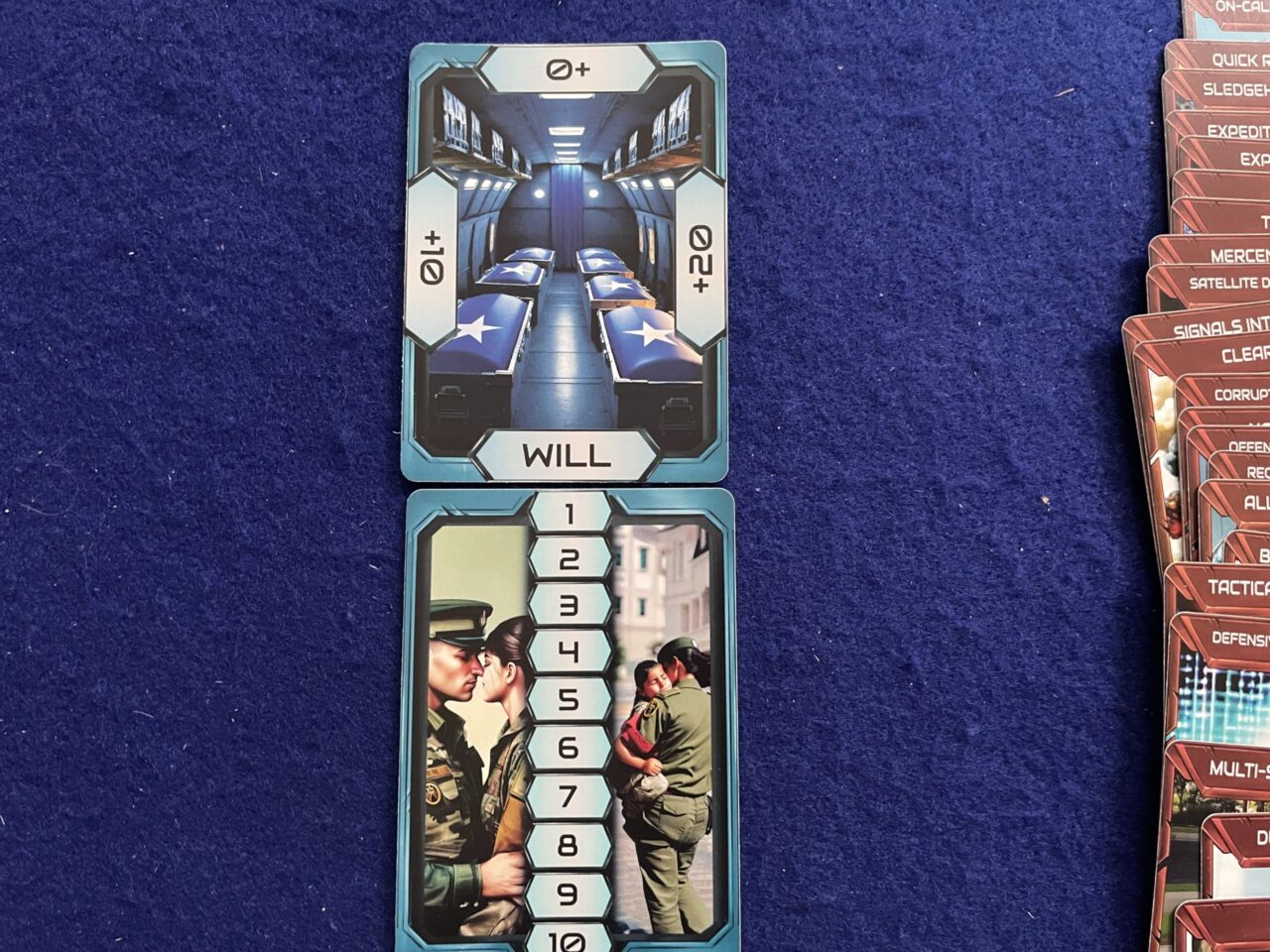
Using Will as a victory point measure in #Maneuver Warfare is a genius-level move. Many Friction cards add or subtract Will. My personal favorite Friction card, perhaps because it was played on me way back in that early playtest version from 2023, is “Death Notifications.” The text for the effect of the card reads:
Use 3 Actions to play at the end of the Engagement phase. Opponent loses 1 Will for each unit they lost in the Engagement Phase (2 Will each if Information Group in play). (Death Notifications card)
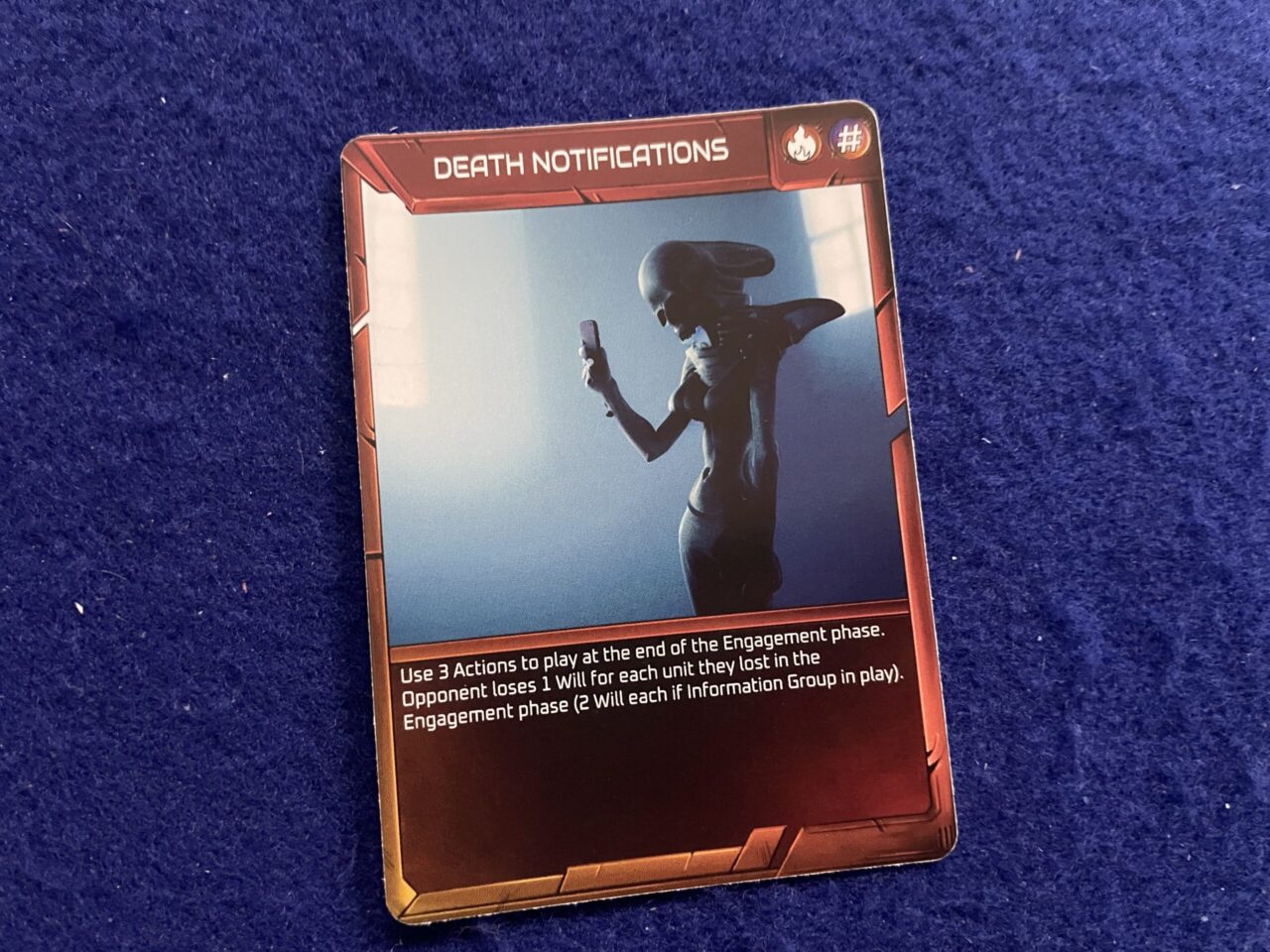
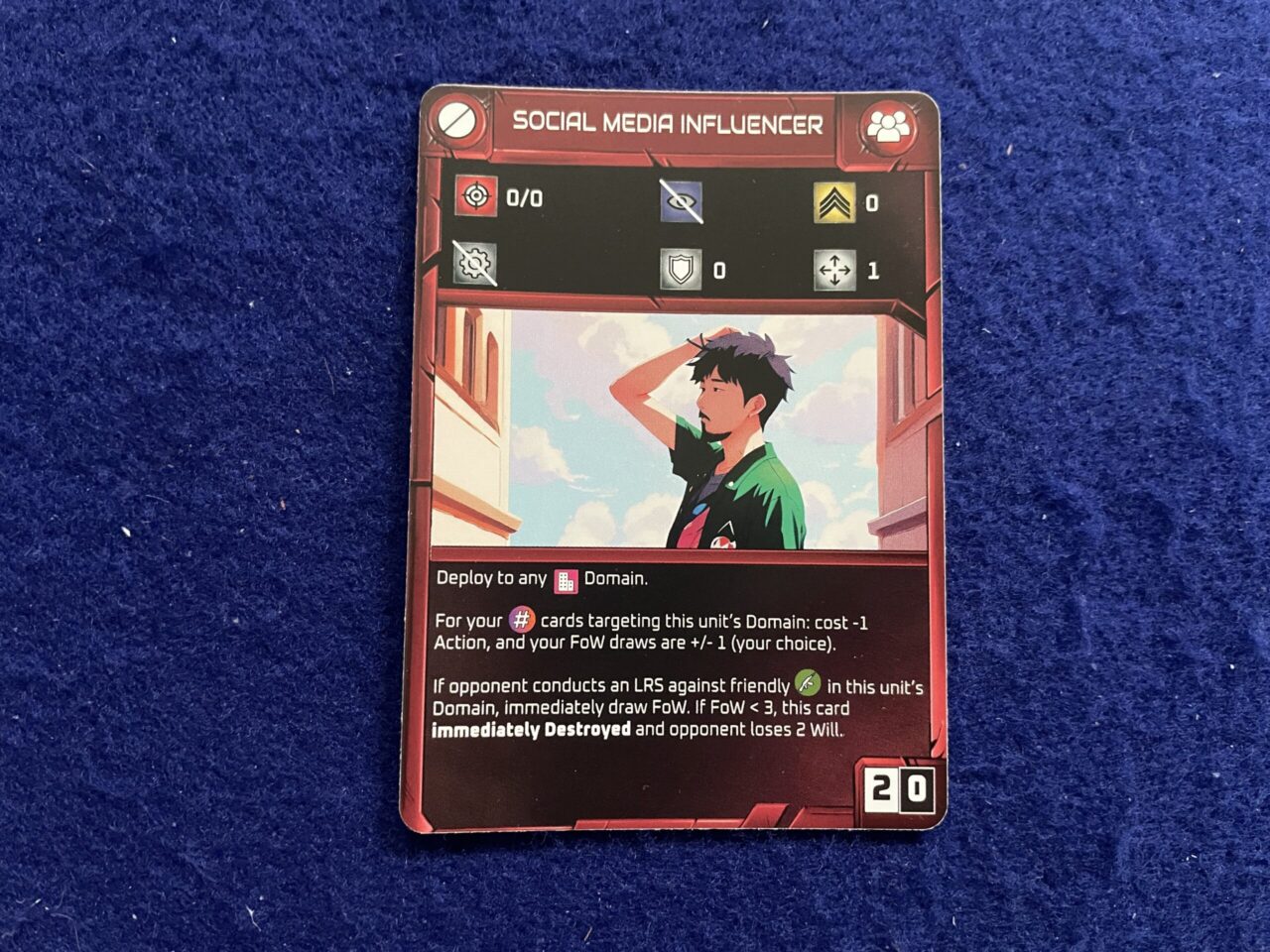
Or the “Social Media Influencer”—a type of unit deployable to the board which makes spending Information cards against that location cheaper for you but more expensive for your opponent—but if present during a Long Range Strike risks being killed and taking away opponent’s Will.
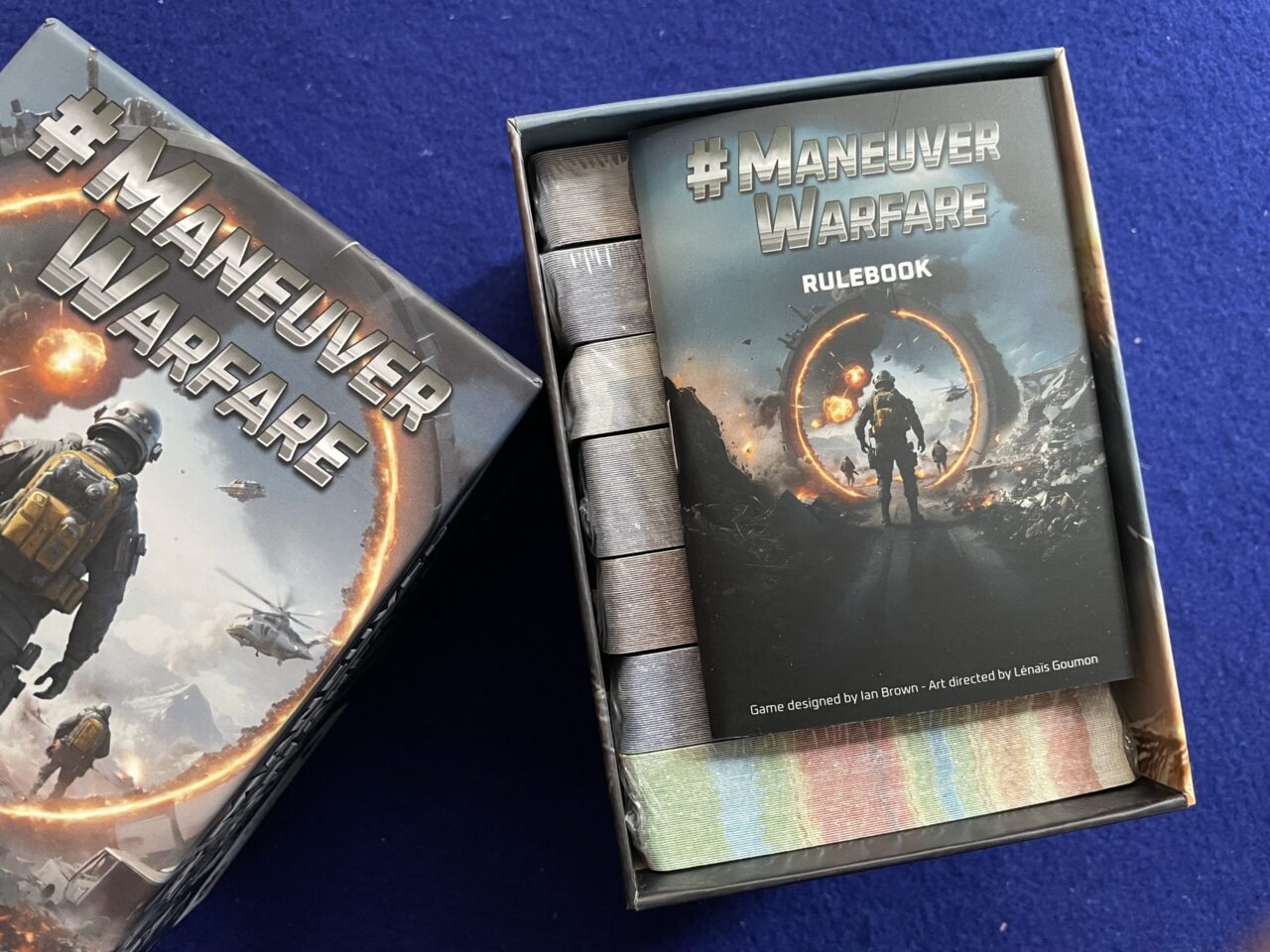
As much as I like #Maneuver Warfare it is not a perfect game. The rules, delivered in a small booklet, can be hard to read. The text on the cards is a bit smaller and less legible than these grognard eyes prefer. I wish there was a foldout paper tableau to help organize cards in the DAOO Loop (or maybe a neoprene mat version?).
Finally, there is the issue of AI art. Ian is very upfront about the use of AI art. For some people the use of AI art makes #Maneuver Warfare strictly off limits. I’m ok with that; you be you. My personal opinion is not that profound; while I hear the issues concerning AI versus human art I believe #Maneuver Warfare strikes a balance between AI art in support of theme and human graphics support. I also take note of Ian’s comments about AI art in support of rapid prototyping and design iteration. To hear Ian’s points see his presentation on “Oh, The Humanity: Generative AI Imagery in Game Design” for the Georgetown University Wargame Society (GUWS) seminar at this link.
[Relatedly, I read a social media post earlier today where a wargamer was lamenting the lack of variety in the photographs used for a wargame box cover. All I can say is that we wargamers must remember that wargame companies are (usually) profit driven and the use of an iconic photo in the public domain is far less expensive than paying for an original art piece or facing public backlash over the use of AI.]

#Maneuver Warfare is not a usual wargame. It is a wargame that is both useful for training by the wargame practitioner community as well as an enjoyable play for hobby wargamers. The unusual use of a deck-construction model that borrows heavily from collectible-card games2, paired with an insightful connection to the OODA Loop, creates a card game that is novel even in the midst of the many diverse wargame designs coming out today. It is also very thought-provoking; one must defeat the Will of your opponent and not necessarily just rack up the most kills. All that in a box that travels easily and a game that is easy to learn (though not the easiest to read without cheater glasses.)
You can chat about this game in the Modern World section of our discussion forums
Thank you for visiting the Regiment of Strategy Gaming and riding with The Armchair Dragoons.
Rather than list a bunch of social media links, the easiest thing to do is to check out our LinkTree, which connects you to all of our various locales around the web.
You can also support The Armchair Dragoons through our Patreon, and find us at a variety of conventions and other events.
Feel free to talk back to us either in our discussion forum, or in the comments below.
Footnotes
- BoardGameGeek defines a collectible card game, or CCG, as, “n. Abbreviation for Collectible Card Game. This type of game uses a basic rule structure and a large assortment of cards which each have characteristics that contradict or supplement the basic rules. Each player selects a number of cards that they own to create a deck which they use in the game. This allows players to predetermine their strategies. The game rules define how many cards must be used and how many copies of each single card are allowed. Cards are sold in “booster packs”. Packs contain a fixed number of cards and usually include one “rare” card, some “uncommon” cards, and the bulk of the pack contains “common” cards. Rare cards are generally more powerful or efficient than uncommons or commons, which can lead to the problem that the person who has spent the most money on cards wins. The original collectible card game was Magic: The Gathering. Its incredible success spawned dozens of copycat games. Some were good; many were awful. Other examples are Middle-earth, Pokemon and Netrunner.”
- ed note: styled more as a “living card game” since everything is in one box


+1 to everything you said!
The ideas are there, certainly.
However, the small print defeats me… I cannot read the cards or rules easily.
And the snug box makes it impossible to bag or band the different decks once you have broken the shrink on the cards.
But those are quibbles, it’s a great tool.
Brian, let me touch on your second point first – as a card gamer myself, my immediate instinct on opening a deck of gaming cards is to sleeve them, and you’re correct that a fully sleeved set of #Maneuver Warfare doesn’t fit back in the box. Here are a couple of workarounds I’ve used:
-a fellow gamer pointed me toward these thinner than normal sleeves: https://a.co/d/0ia0tDO5. I tested them and you can actually fit all the cards back into the game box with these sleeves (it’s tight and you need to spread some cards in a top layer, but they do fit).
-but I’m a Dragon Shield guy myself because I like the durability, so what I did was use these storage boxes for game decks I intended to play with: https://www.amazon.com/Ultra-Pro-Magic-Pokemon-YuGiOh/dp/B074DVF48M. These boxes can fit a 60 card player deck, plus the player aid cards, no problem. They can also fit the Domain/Domain Variable cards, though it’s snug. These boxes help get at one of my overall design goals which is PORTABLE, and also with the assumption that if you’re going to play a friend, you’re not bringing all the cards in the game, just your deck. So you can fit a player deck in these, take them with you wherever, while the remaining cards stay in the box at home.
Finding a balance between required text and readability was an ongoing battle, and I fully admit that my tolerance for text size may be different from others. Jim Dietz shared some of your skepticism on text size as prepared to move from prototype to actual production layouts; and all I can say is, I did market research comparing my card text sizes to other things out there like Pokemon and Yu-Gi-Oh…and #Maneuver Warfare’s definitely not the smallest text size out there. On some Pokemon cards I just have to take the word of my youngest for what it says on the bottom, cuz I sure as heck can’t see it.
Oh, I wasn’t even sleeving them, I put the different types of cards in small ziploc bags to make setting up the next game easier!
I’ll get a bigger boat, uh box.
And yes, I can’t play Android Netrunner or other games comfortably either, my eyes are just not up to it.
Could Dietz make a PDF of the rulebook available so people could print it out at a larger size?
Thanks for this game!
Absolutely, we’ve got a PDF up on BGG:
https://boardgamegeek.com/boardgame/456250/maneuver-warfare