
 by
by Peter Robbins, 21 May 2025
The Battle Of Rocroi was fought the morning of May 19th, 1643 on the border of Flanders and France near the walled town of Rocroi. It took place between the forces of France under the 21 year old Duke Of Enghien and the Spanish under seasoned general Francisco de Melo.
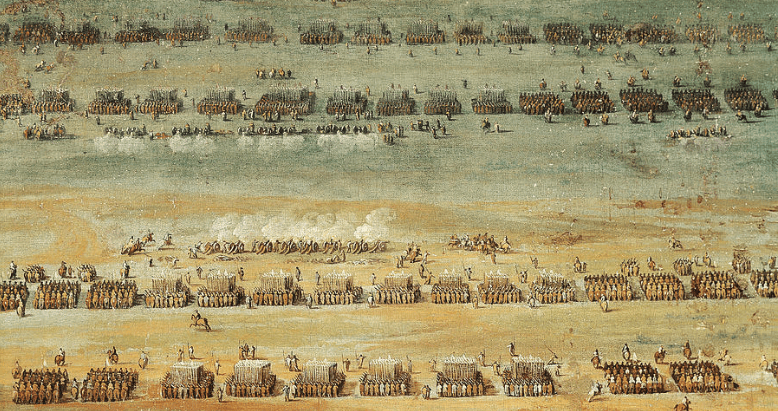
Rocroi is a wargamers dream in that, in theory at least, it was a relatively even match. As you can see in this force comparison, it was a pretty even-keeled affair.
Force Composition At Rocroi
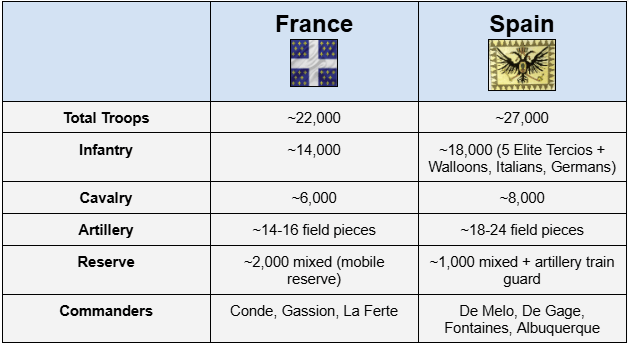
most images click to enlarge
Rocroi is one of those lesser known but “pivotal” battles in the development of military theory and practice over the centuries. Within the Thirty Years War, I’d place Rocroi up there with 1st Breitenfeld as providing the proving grounds for adjusted military tactics, doctrine as well as troop deployment and disposition. Overall it was the laboratory of fire and maneuver using more linear tactics against depth and strength of larger solidified formations of very well supported combined arms troops.
In fact, I’d say Rocroi was an extension of the lessons that the French learned by analysing the success of the Swedish King Gustav (Gustavus Adolphus) at that possibly more pivotal battle earlier in the northern front of the TYW. Many of the same issues found at Breitenfeld are the same at Rocroi, they just happen to be accomplished against the renowned Spanish Tercios and their supporting troops, so there was a certain historical gravitas that expanded from this particular battle as it echoed further in the halls of the historical retrospective.
Rocroi also depicts an untried young commander in the form of Duc D’Enghien vs a seasoned commander in the form of Francisco de Melo. Everyone loves hearing about a young whippersnapper in the form of an Alexander-esque upstart coming against a seasoned grizzled veteran, and doing one over on them. Hell, that explains the world’s infatuation with one Corsican upstart of note. I digress.
But what is found most prevalent at Rocroi is the hubris of a veteran Tercio general vs the cockiness of a young French commander, desperate for a pitched battle. Cockiness and dynamic tactical acumen wins the day in this specific battle, but it definitely was not guaranteed victory by any means. France got lucky in several parts of the battlefield, and Spain got unlucky and planned poorly.
Yes, Rocroi was a very important battle. It stopped Spain cold from waltzing through Flanders straight into Paris and the ramifications that would have brought about, but Spain does recover from the loss rather quickly and effectively. Was the Spanish Tercio proven less impactful than its previous successes would lead the commanders of the day to fear? To a degree, yes, but not conclusively, as many modern authors would now argue.
The Tercio was a force to be reckoned with. The Spanish Tercio in particular. You will see in the final phases of Rocroi why it was feared, even in their desperate painful death throw. But was it the death knell of the use of the Spanish Tercio, many now argue No.
“Rocroi had little strategic value but the attack assumed great political significance given Louis XIII’s death the day before. The new regime in France could not afford to start with a defeat.” (Watson, Peter – Thirty Years War)

Political Context & Immediate Causes
To frame Rocroi, let’s place it within its global conflict confines, which of course was the Thirty Years War (1618–1648), but more directly it was a part of the Franco-Spanish War (1635–1659) which extended beyond the edge of the Westphalian accords. The Thirty Years War was a massive, pan-European conflict (one could argue it was actually the first world war) initially sparked by religious tensions within the Holy Roman Empire (Catholic vs. Protestant), but quickly evolved into a broader dynastic and geopolitical struggle.
Although a Catholic nation, France (under Cardinal Richelieu) feared Habsburg encirclement and sought to check Habsburg power. In 1635, France declared war on Spain, directly entering the conflict. Thus began the Franco-Spanish War, a sub-theater of the Thirty Years’ War. The war pitted the Habsburgs (Spain and Austria) and their Catholic allies against various Protestant states and anti-Habsburg coalitions. Spain controlled the Spanish Netherlands (modern-day Belgium), using it as a base to threaten France from the north.The Spanish Army of Flanders was considered to be the most formidable military force in Europe at the time.
Louis XIII died on 14 May 1643, just five days before Rocroi. His son, Louis XIV, was only four years old. Power passed to Queen Anne of Austria as regent and Cardinal Mazarin, Richelieu’s successor, creating a brief moment of perceived weakness in French leadership.
Spain saw this French transition as an opportunity and launched an offensive into northern France from the Spanish Netherlands. The Spanish Army of Flanders, under Francisco de Melo, laid siege to Rocroi, a strategic fortress town near the border. The French army, commanded by the young Duke of Enghien (later known as the Great Condé), quickly mobilized to lift the siege.

Pre-Battle Maneuvering
| Phase | Dates | Spanish Movements | French Movements | Intelligence / Rationale |
|---|---|---|---|---|
| Initial Invasion | Early May 1643 | Melo leads Army Of Flanders into northern France; lays siege to Rocroi | Enghien remains in Reims with a modest force. | Spain believes the French are politically disorganized after the King’s death. They expect minimal resistance. |
| French Reaction | 13-16 May | Siege operations begin at Rocroi; artillery places. | Enghein gathers reinforcements and rapidly marches to Rocroi (~120km) | French scouts report the Spanish are committed to the siege, allowing for surprise. |
| Strategic Positioning | 17-18 May | Spanish secure high ground and fortify their siege camp. | Enghein flanks southwest, crossing woods and marshes to surprise the Spanish on flatter ground. | The French use local knowledge and speed to offset numerical inferiority. |
| Day Before Battle | 18 May | The Spanish detect the French army’s presence but underestimate their speed and preparedness. | Enghein’s army sets up camp just outside of artillery range, planning to attack at dawn. | French learn Spanish lines are overextended and Spanish cavalry is weak. |
| Battle | 19 May | Spanish deploy traditional tercio formations; center holds. | French execute a double envelopment: Enghein’s cavalry smash the Spanish right and left. | Superior tactical coordination and mobile cavalry give France the edge. |
Lay Of The Land
Below are a few quick screens showing the distance from Reims (where the French main body was originally encamped) to Rocroi (the walled town needing a broken siege). We also show the forested areas in the immediate vicinity of the stronghold. We will additionally show the lay of the land using WDS’s elevation markers in their Rocroi scenario, as it best depicts the tapered hills that both the Spanish and French hold ahead of the battle start.
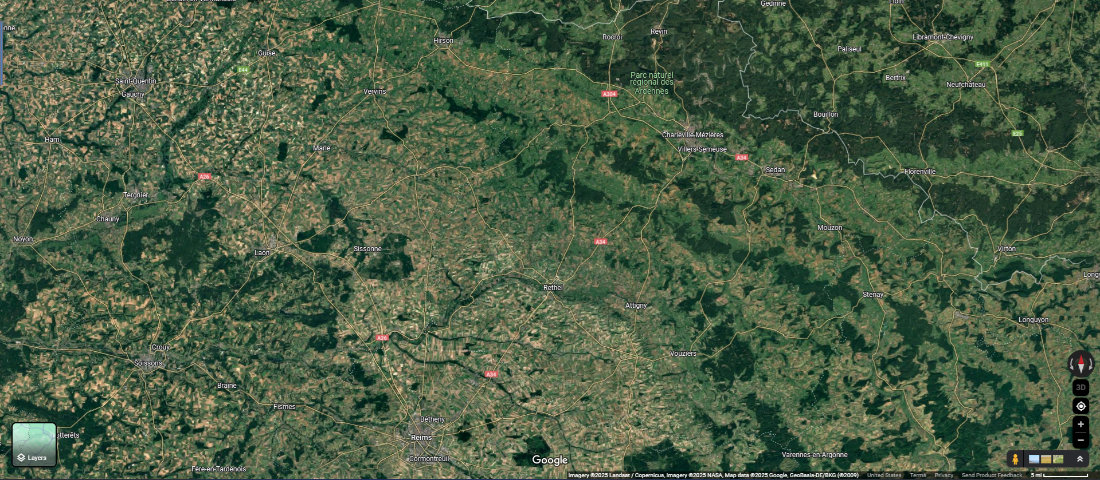
As stated in the previous table of pre-battle maneuvers, Enghein (the French commander) had to get from Reims to Rocroi as quickly as he could shove 22,000+ troops up that corridor. It was the timing and speed of the last portion through the gorge-like approach through the forested area to the south of Rocroi that was the iffy portion of that approach. As stated previously, it’s roughly 120 km from Reims to Rocroi, and he huffed it well with his loyal troops. Particularly impressive as he was not seasoned, and only 21 years of age.
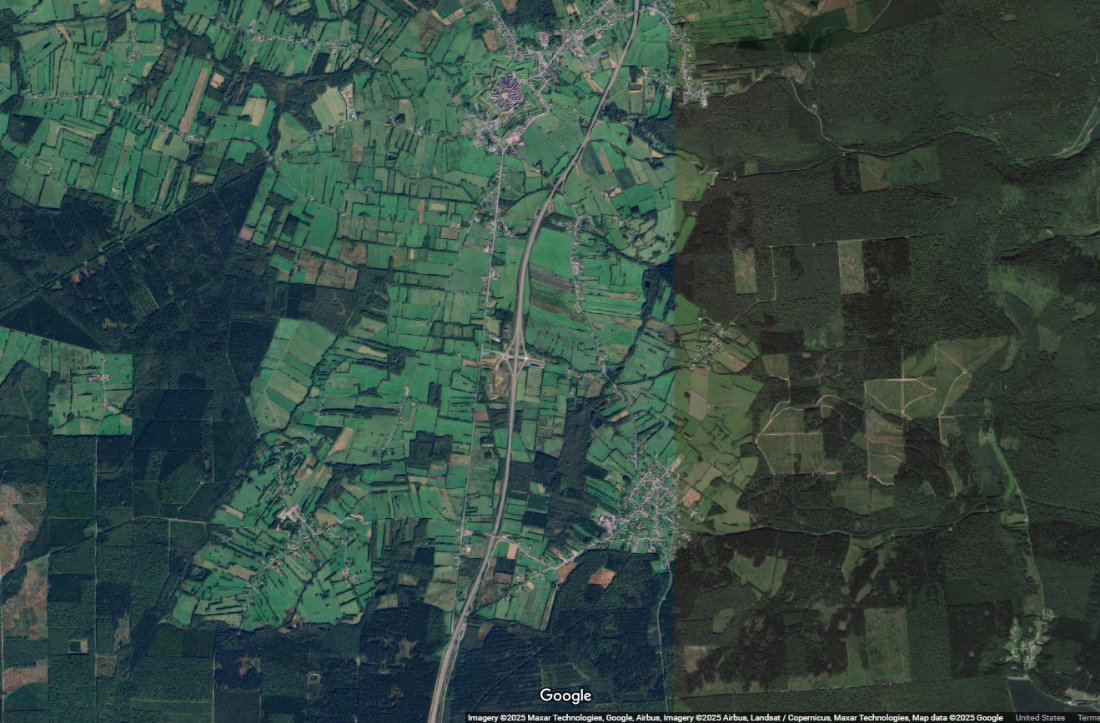
You can see how formidable the approach from the south was for a force of 22,000+ troops to get through unscathed. There has been much written about the What-If involved if Melo pushed against their advance well ahead of their being basically allowed to form up untouched for an entire evening. Perhaps Melo was attempting to “flex” in front of the French as a whole body of troops? Maybe he wanted to show his forces en masse to try and dissuade the French from attacking here in this place at all. Perhaps he was delaying to await his reinforcements from general Beck (about 9000 more troops were on the way*)? As FYI, Beck did make it to the area on the other side of the large forest to the east by 8 AM the morning of the battle.
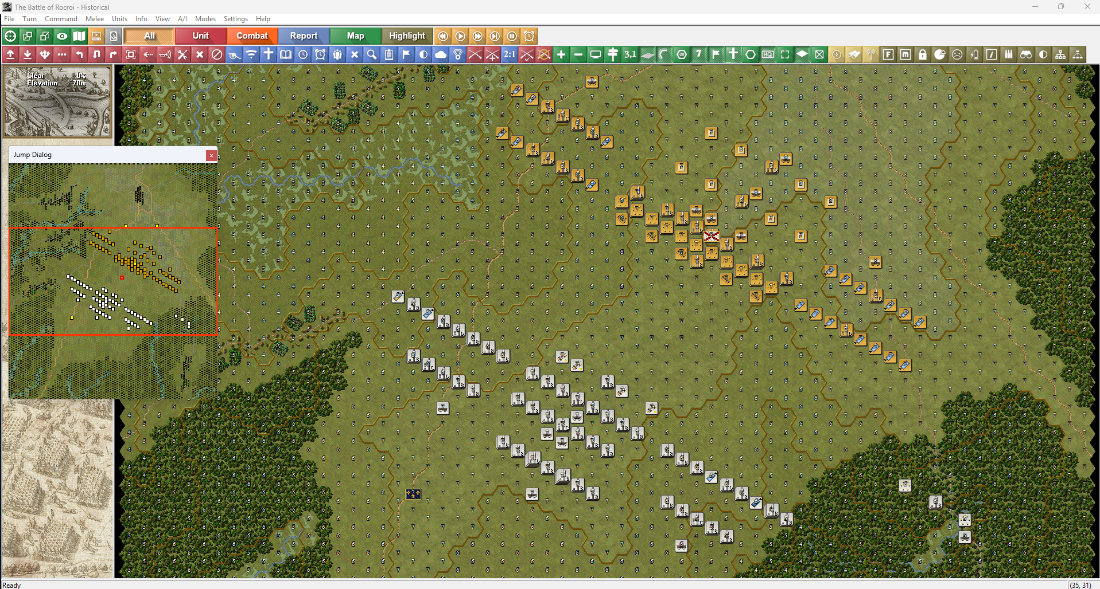
With both armies fully visible, French on bottom, Spanish on top, WDS’s Thirty Years War’s depiction of Rocroi has both armies on a 7 meter elevation area. With a dip to level 6 and 5 roughly in-between. This valley at most dips about 6 ft from the high points. The marshier zone in the north-west of the map dips down to 4 meter elevations. That is how other sources describe the area as well. Two naturally higher hill areas, with a very gentle dip in between. No major advantage, but definitely a better position for both armies than being in any of the valley areas. Some claim that Melo made a mistake in allowing the French to occupy the slightly higher elevations, and that he should have attacked with a scout force at a minimum to delay the French from taking the slightly higher ground.
Order Of Battle
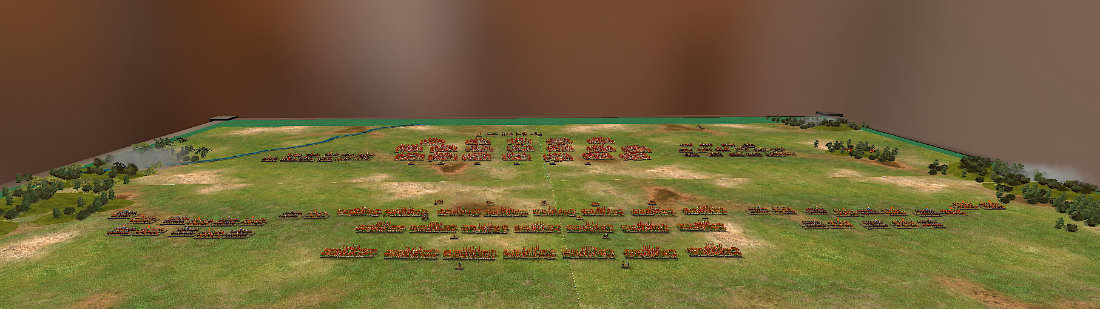
For a precise order of battle, see The Battle Of Rocroi 1643, written by Alberto Raul Esteban Ribas, published by Helion Books. For a general order of battle, see this wiki presentation of the troops present day of. Let’s also take a quick look at the divisional leader level via a jump into WDS’ Thirty Years War version of the Battle Of Rocroi.
French Commands Of Note

French Right, 1st Line, under Gassion

French Right, 2nd Line, commanded by attached overall commander Duc d’Enghein

French Center, under d’Espenan

French Reserve, under Sirot

French Left, under L’Hopital

French Left, 1st Line, under La Ferte
Spanish Commands Of Note

Spanish Right, cavalry under Isenburg

Spanish Center, Tercios primarily, under de Melo overall commander, and Fontaine

Spanish Left, cavalry under Albuquerque
The Battle : Hour By Hour
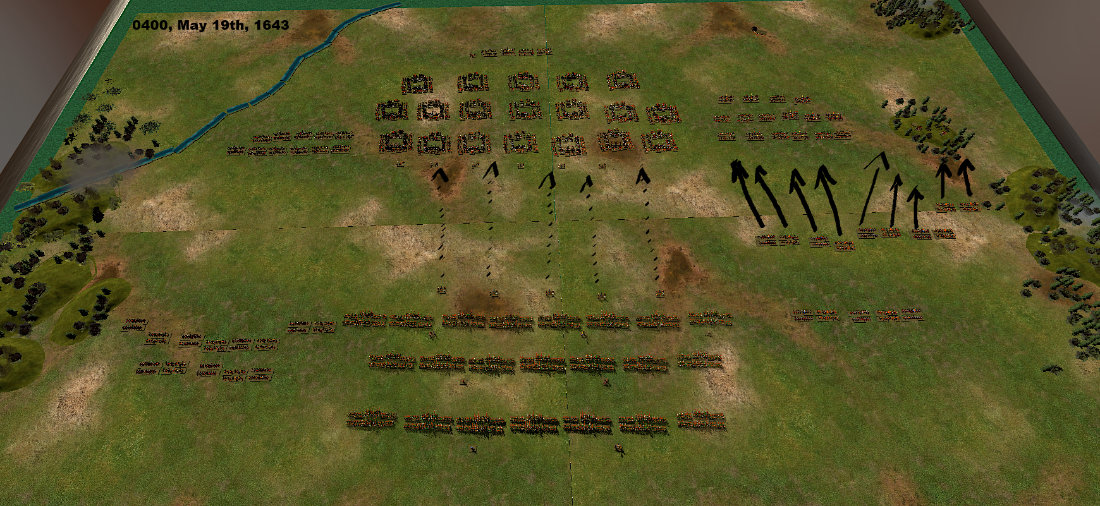
| Time | French Left / Spanish Right | Center | French Right / Spanish Left |
|---|---|---|---|
| 4:00 | Foggy; light French patrols, no major contact yet | Long-range artillery begins; Spanish tercios deployed | Cavalry probing in woods; initial skirmishes |
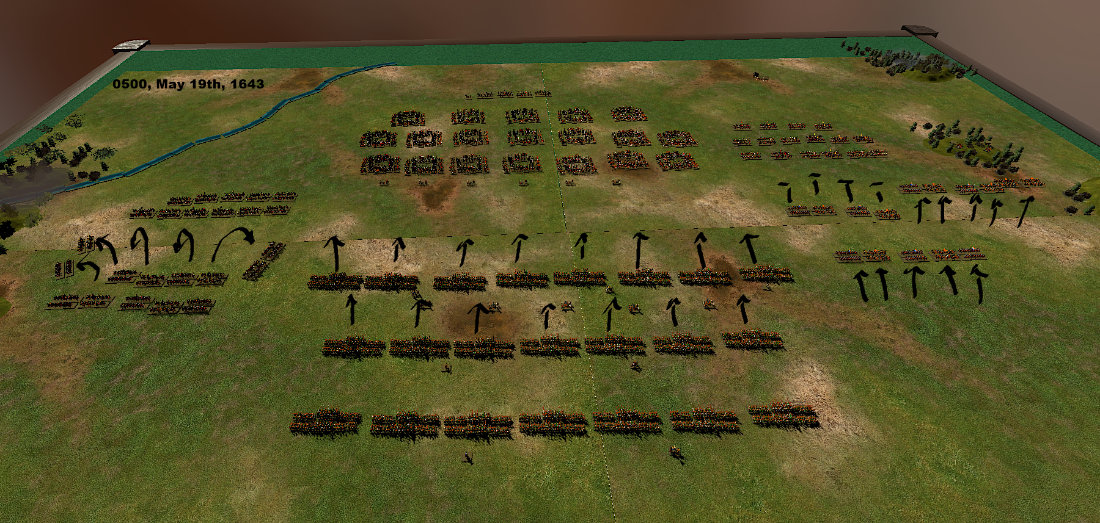
| Time | French Left / Spanish Right | Center | French Right / Spanish Left |
|---|---|---|---|
| 5:00 | Spanish right charges; French left pushed back | Frontal attacks by French infantry begin | French repulsed by disciplined Spanish volleys |
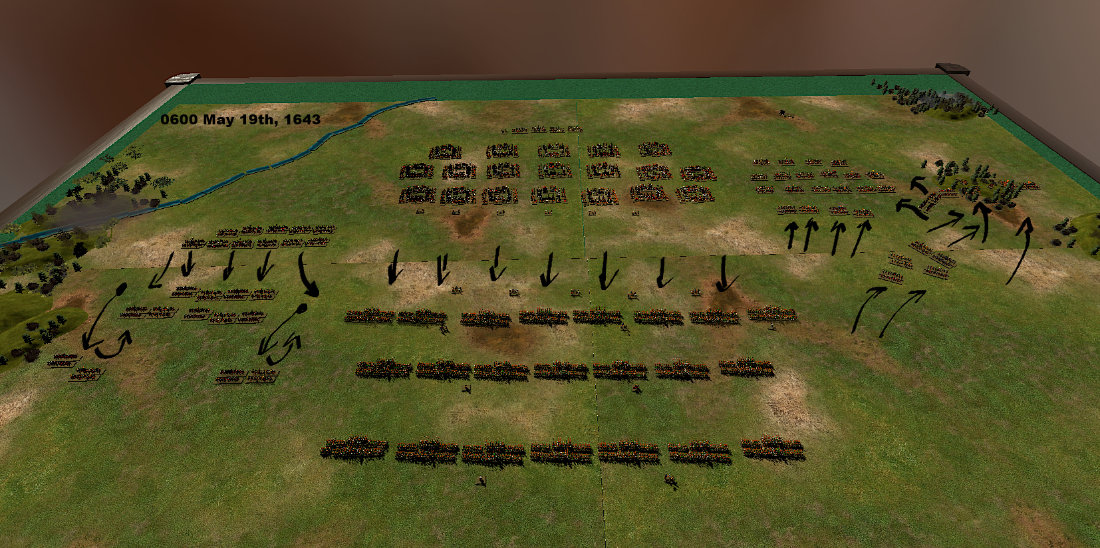
| Time | French Left / Spanish Right | Center | French Right / Spanish Left |
|---|---|---|---|
| 6:00 | French left crumbling; some units flee toward Rocroi | Tercios form solid squares, repel repeated French attacks | Gassion feints, shifts attack angle |
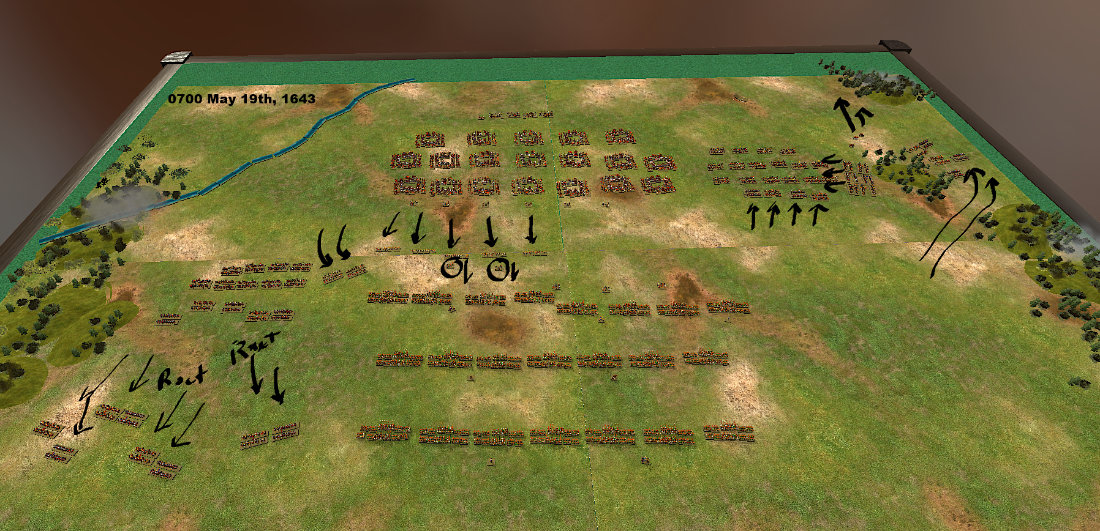
| Time | French Left / Spanish Right | Center | French Right / Spanish Left |
|---|---|---|---|
| 7:00 | Fontaines mortally wounded; Spanish cohesion falters | Spanish press forward, seeing French left collapse | Albuquerque fails to pivot toward French center |
Daylight breaks at 0700. The Spanish left gets slammed by a strong flank cavalry attack. Enghein begins to bring the 2nd line of the French right’s cavalry around the copse and forested area blocking the enemy line of sight to that maneuver. 0700 to 0800 is pivotal, as the Spanish do not take advantage of taking two batteries of French cannon, nor routing the French left cavalry almost entirely at this point in the battle. One strong push from the Spanish and Italian tercios, could have possibly collapsed the French center. Remember that the French already failed a frontal assault on the Spanish center, and were weak kneaded and wobbly at this point, disorder throughout the first line. Melo was nowhere to be found, as he’d gone off to help Albuquerque regain composure on the Spanish left. Author Pete Wilson claims, rightfully, that command and control was front and center as a reason that the Spanish lost this battle, and this was the pivotal decision point for the Spanish. They miss-stepped considerably due to lack of a command decision at this potential turning point.
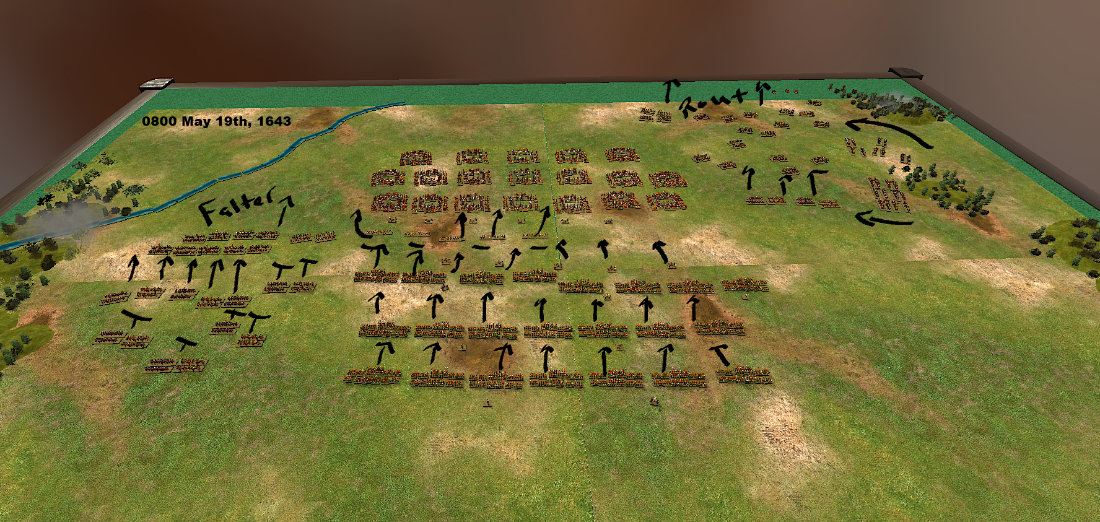
| Time | French Left / Spanish Right | Center | French Right / Spanish Left |
|---|---|---|---|
| 8:00 | French left stabilizing; Isenburg cavalry hesitates | French center vulnerable until Gassion turns inward | French cavalry breaks through; Spanish left in rout |
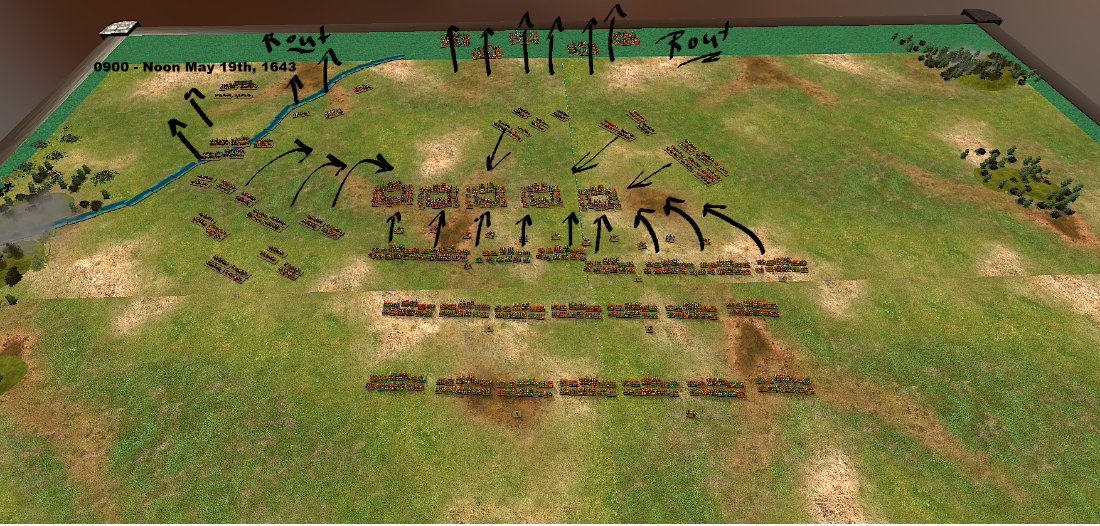
| Time | French Left / Spanish Right | Center | French Right / Spanish Left |
|---|---|---|---|
| 9:00 | French right links with La Ferté’s survivors | Tercios now pressured from three sides | Gassion moves to rear of Spanish center |
| 10:00 | Encirclement of Spanish center begins | Condé offers surrender to tercios; they refuse | Spanish right exposed to flank attack; cohesion failing |
| 11:00 | Envelopment completed; Gassion presses assault | Tercios shattered; De Gage killed; final charge ordered | Albuquerque’s cavalry flees; survivors scattered |
| Noon | Pursuit and cleanup operations begin | Remaining tercios surrender or are destroyed | French regain control of the entire battlefield |
At this point, both cavalry wings are fully routed, the Italian and German Tercios have fled, the Walloon and German tercios and lines have also fled the field. The five remaining Spanish Tercios remain strong in the center, but are eventually offered terms for surrender. While bringing those terms to the Spanish, the French commander was fired upon, and that caused the cannon, all of which were under French control now, to fire on the remaining Tercios, decimating them almost to annihilation. The 1st line of the French center also joined in attacking the Spanish anew.
All of the Spanish remaining troops had died or finally surrendered. It was a Total Victory for the French by Noon. Casualties (killed + wounded + prisoners) were to the tune of 7,300 for the Spanish and 4000 for the French.

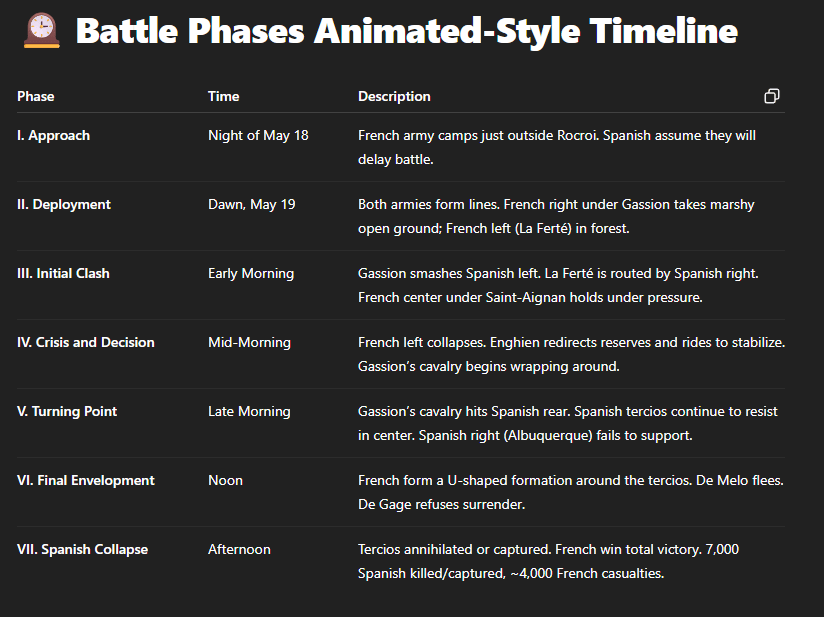
Below is a simpler ChatGPT summary of the battle in stages, as opposed to by hour.
Additionally, here is a good OODA loop analysis by ChatGPT of the disruption techniques that mattered most during the Battle Of Rocroi.
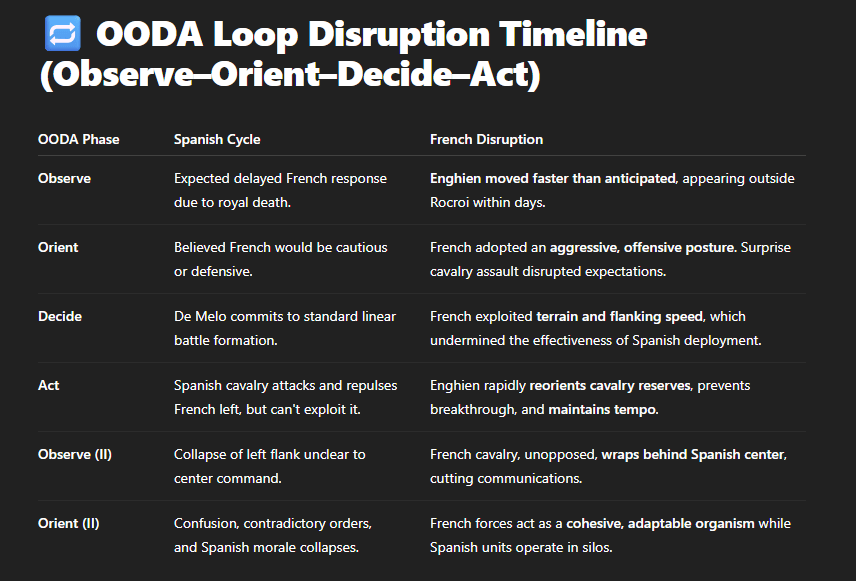
I think that Enghein, whether he knew it at the time or not, was particularly adept at battle tempo and extending his luck to best effect. I think ChatGPT was accurate in its assessments above.
I’ll end this section by showing a very well done summary of the battle by SPI in their boxed game Rocroi from 1978. Rule 22 is the Historical Notes section. This is one of the best single paragraph descriptions of the battle I’ve read while researching this article.

Aftermath & Battle Analysis

The main battle analysis points (all 11 pages+, a great read!) from The Battle Of Rocroi 1643 by Alberto Raul Esteban Ribas can be distilled into these ten categorical points.
- Melo’s Leadership Was Politically Driven and Operationally Flawed
Melo, appointed for loyalty rather than merit, mishandled the campaign due to poor preparation, indecisive leadership, and disregard for experienced advisors like Alburquerque and Beck. - Strategic Ambiguity Undermined Spanish Command Cohesion
Melo kept the campaign’s objective (siege vs. field battle) secret, leading to confusion, poor coordination, and internal discontent among senior officers. - Failure to Exploit Tactical Opportunities
Multiple chances to weaken or destroy the French (e.g., on May 18, seizing terrain, attacking exposed cavalry) were missed due to indecision or lack of coordination. - Ineffective Use of Spanish Cavalry
The Spanish cavalry was poorly deployed, underutilized for scouting or blocking, and lacked a clear command structure—contributing to French breakthroughs. - Passive and Fragmented Command During Battle
Melo acted more like a frontline officer than a general, failing to oversee the battlefield or issue timely reinforcements—especially when critical units (e.g., musketeers, Albuquerque’s cavalry) were under pressure. - Superior French Intelligence and Combined Arms Tactics
The French used detailed terrain knowledge and coordinated horse-foot attacks to great effect, overwhelming isolated Spanish units and capitalizing on gaps in enemy deployment. - d’Enghien’s Leadership Was Risky but Ultimately Successful
At only 21, d’Enghien disregarded veteran advice and took personal tactical risks. Though tactically unsound at times, his aggressive leadership paid off due to French discipline and adaptability. - Spanish Tercios Were Not Inferior, Just Mismanaged
The tercios fought bravely and effectively when engaged. Their failure was not due to tactical inferiority but to poor coordination and lack of cavalry or artillery support. - Post-Battle Repercussions for Spain Were Limited Strategically
Despite the defeat, Spain achieved its broader campaign goals, rebuilt quickly, and maintained pressure elsewhere (e.g., in Flanders and against the Dutch). - Long-Term Impact: Myth vs. Reality
Rocroi became a symbol of French ascendancy and Spanish decline, but this view oversimplifies the battle. French victory resulted more from leadership, coordination, and regimental reform than from tactical revolution.
Was Rocroi the end of the Spanish Tercio? I lean towards No similar to assessment by Julio Albi de le Cuesta:
“It is true, however, that they did not die out at Rocroi, and that they would still command respect from their adversaries until their final disappearance at the beginning of the 18th century: ‘It must be acknowledged that many excellent historians have made the great error of not clearly highlighting that these troops (those destroyed at Rocroi) were eventually replaced, and that those who succeeded them often fought admirably, although it seems certain that they were never as formidable as their predecessors.’ But this battle is an aesthetically opportune moment to bid them farewell, and this has been deemed so for years, regardless of the fact that History granted them half a century more of life and a few additional victories.” (p.299, De Pavia A Recroi, by Julio Albi de la Cuesta. Translated from original Spanish)
Spain’s hegemony did waver over the next century, but the combat power of the Spanish Tercio did not. Tactical and equipment improvements over the following half-century spelled its eventual demise, but Rocroi did not immediately kill the Spanish Tercio’s mythic power over Europe overnight. Not to discount the extreme importance of this battle, as Rocroi did indeed spell the political end of Spanish attempts to take large pieces of France outright. The total victory of Rocroi positioned France to be dominant for the next century; eventually leading to the withdrawal of Spain from Flanders as a whole.
Sources For Article
- The Battle Of Rocroi by Alberto Raul Esteban Ribas
- De Pavia A Rocroi, by Julio Albi de la Cuesta
- Battles That Changed The World, by Spencer C. Tucker
- Thirty Years War: Europe’s Tragedy by Pete Wilson
- The Thirty Years War 1618–1648 by John Pike
- The Thirty Years War by C.V. Wedgewood
Interested In Gaming This Battle? Try These Out
- WDS Thirty Years War (A Must Buy, Rocroi and many other battles included!)
- Pike & Shot: Campaigns (Covers Many Italian Wars, Thirty Years War and English Civil War Battles, Rocroi is provided!)
- Rocroi (single game or part of the four pack musket and pike series by SPI, circa 1978)
- Under the Lily Banners (part of the Musket & Pike Series by GMT Games, includes Rocroi)
Honorable Mentions – Miniatures Games
- Tilly’s Very Bad Day
- Close Fire And European Order XVII
- Pike & Shotte by Warlord Games
Honorable Mentions – Strategic Games
While not specific to the battle, these strategic games are absolutely worth noting. Each of these wargames include outstanding depictions of a portion of or the entirety of the Thirty Years War.
- El Planeta Rey (NAC Wargames)
- Europa Universalis IV and soon V! (by Paradox Interactive)
- Thirty Years War by AGEOD (Matrix Games)
- The Collapse: The Thirty Years War (Looking For Publisher Currently)
- Thirty Years War: Europe In Agony (by GMT Games)
- Holy Roman Empire (One Small Step), designed by Mark McLaughlin
- Total War: Shogun 2 has a Thirty Years War mod of note here. Worth checking out if you own TW:S2.

Thank you for visiting the Regiment of Strategy Gaming and riding with The Armchair Dragoons.
Rather than list a bunch of social media links, the easiest thing to do is to check out our LinkTree, which connects you to all of our various locales around the web.
You can also support The Armchair Dragoons through our Patreon, and find us at a variety of conventions and other events.
Feel free to talk back to us either in our discussion forum, or in the comments below


Hi Peter, nice article! A outstanding newer game which touches on Rocroi is The Planet King (El Rey Planeta) from NAC Wargames. It’s a solo (or co-op) simulation from the point of Philip IV and his Valido Olivares.
Thank you for that heads up. I will ask Brant to mention it with the Honorable Mentions we had listed. That is one I’d not run into yet. I will absolutely check it out. – Peter Robbins
Thank you Brant for editing in the mention of The Planet King. Looks like a great strategic level wargame of the same period of Rocroi.
Great article.