
 by
by Aaron Danis, 12 November 2025
The Battle for Cuito Cuanavale in Angola was the last large battle (really a series of battles) between the Soviet-backed Cuban expeditionary force in Angola and its People’s Movement for the Liberation of Angola (MPLA) allies, and the South Africa’s Defense Force (SADF) and the U.S.-backed National Union for the Total Independence of Angola (UNITA) at the end of the Cold War. Despite the large number of forces and resources committed by both sides, the result is widely considered a stalemate. Angola was the least well-known of three major U.S. – Soviet proxy wars in the 1980s, the other two being Afghanistan and Nicaragua.1
The Civil War for Angola began 50 years ago in November 1975, after the Portuguese colonial masters left the country and the country declared independence. Like many post-colonial and newly-independent countries in Africa, they were left ill-equipped to run themselves and independence usually devolved into tribal warfare centered around an alphabet soup of insurgent groups sometimes backed by the Soviet Union and the United States. Angola was no different.
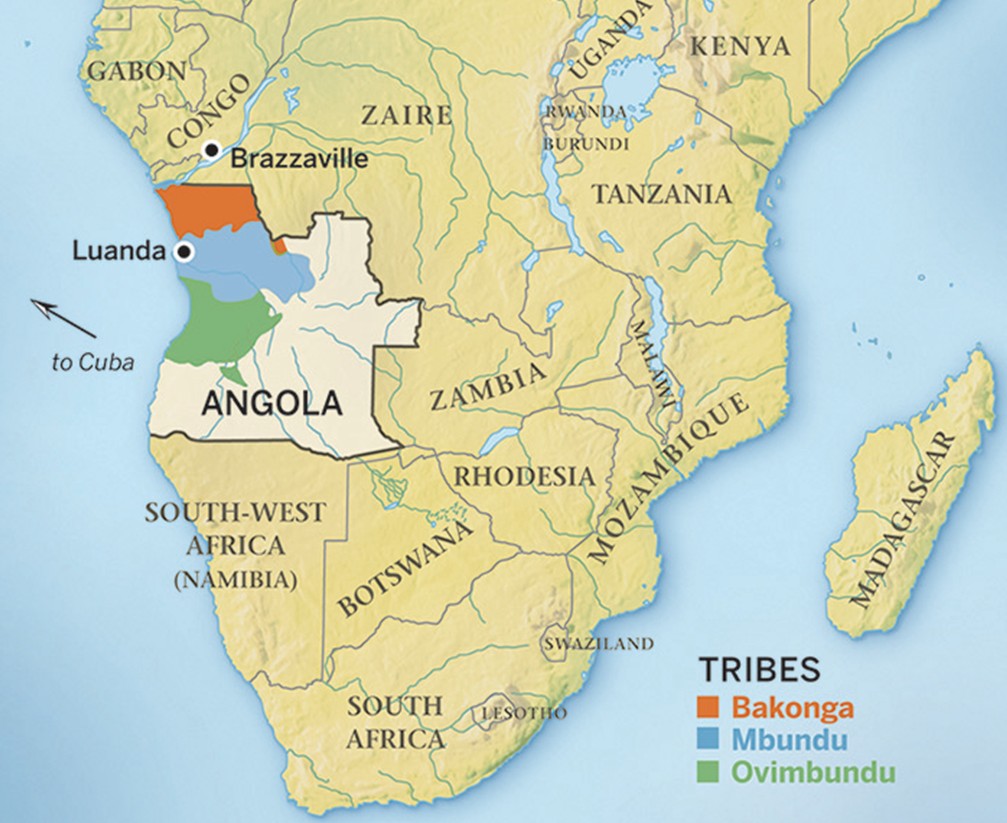
There were 3 insurgent factions. The oldest was the MPLA founded in 1956 and consisted largely of Mbundu tribesmen from north-central Angola who took up arms to oppose the Portuguese government. It was founded by members of the Portuguese Communist Party, with the backing of various Eastern-¬bloc countries. In 1957 the National Front for the Liberation of Angola (FNLA) was formed, mainly by the Bakongo of northern Angola and aided in part by the U.S. By 1961 an anticolonial war of resistance, initially driven by oppressed workers in the coffee and cotton fields, had broken out and was spreading quickly. In 1966 a third nationalist group emerged: the UNITA group consisted of the country’s largest ethnic group, the Ovimbundu tribe of central Angola, representing 37 percent of the population. It got some support from the United States and from apartheid South Africa. Each group had its own political agenda and goals and fought the Portuguese and each other as well. 2
click images to enlarge
In November 1975, the Portuguese gave Angola its independence after 13 years of fighting. After a tripartite agreement between the factions was reached, a short interlude of peace followed only to see it soon collapse. The MPLA’s armed wing, the Armed Forces for the Liberation of Angola (FAPLA), set up its own government in the Angolan capital of Luanda. The Soviet Union, Cuba, and other communist countries supported the leftist MPLA. By then the apartheid government of South Africa’s troops (the SADF), in support of UNITA, invaded from the south, while FNLA troops had received reinforcements from Zaire in the north. The United States, unwilling to allow a communist government to stand and eager to protect its petroleum interests, started covertly providing arms and advisers, to the FNLA and UNITA although that assistance would be on-again, off-again due to resistance in the U.S. Congress to participating in a fight that had anything to do with the SADF. The Angolan Civil War had begun.

Cuba, at the behest and with the support of the Soviet Union, initially sent advisors, then equipment and combat troops to support the MPLA/FAPLA. Castro fully and enthusiastically supported the war, sending roughly 377,000 troops over the next 25+ years3 and spent not only the Soviet aid he received, but Cuba’s money as well, which eventually damaged the Cuban economy. While not the only region where Castro supported Communist guerilla movements, Angola undoubtedly was the largest4. It cost Castro over 2,000 Cuban military and civilian combatants killed. Cuban forces were joined by over 11,000 Soviet advisors.5

The civil war ground on into the late 1980s, where, as already mentioned, it was the third tier of proxy war between the Soviets and the United States. U.S. support waxed and waned with Congressional interest, but UNITA held on with the unlikely support of the SADF. By 1987, the SADF and UNITA attempted a major push to defeat their combined foes around the city of Cuito Cuanavale, but after several months it ended in what most pundits assess as a stalemate. The SADF, a light, mobile force, ran into Cuban forces reinforced by dug-in armor and artillery and modern jets (for that era), which negated the SADF mobility advantage, and the SADF didn’t want to risk all of its airpower in the conflict. Both sides declared victory. Of note, this series of battles featured the largest clashes of armor on both sides, with SADF Olifant tanks allegedly destroying 94 Cuban/MPLA Soviet-made T-55 tanks for 3 Oliphants damaged (in a minefield)6. The number of T-55s claimed destroyed reportedly exceeded the number that were operational and available at the time, so the fog of war still wins.


In May 1988, the U.S. brokered a series of 12 peace talks attended by representatives from Cuba, South Africa, and the MPLA. By December 22, all parties met at the United Nations and signed the New York Peace Accords, implementing U.N. Resolution 435 as well as arranging South Africa’s and Cuba’s eventual withdrawal from Angola. Despite continued fighting, the last Cubans had left Angola by May 19917. A second civil war would break out in 1996 minus the proxy powers, and the MPLA would win that one by 2002.8
Want to game it out?
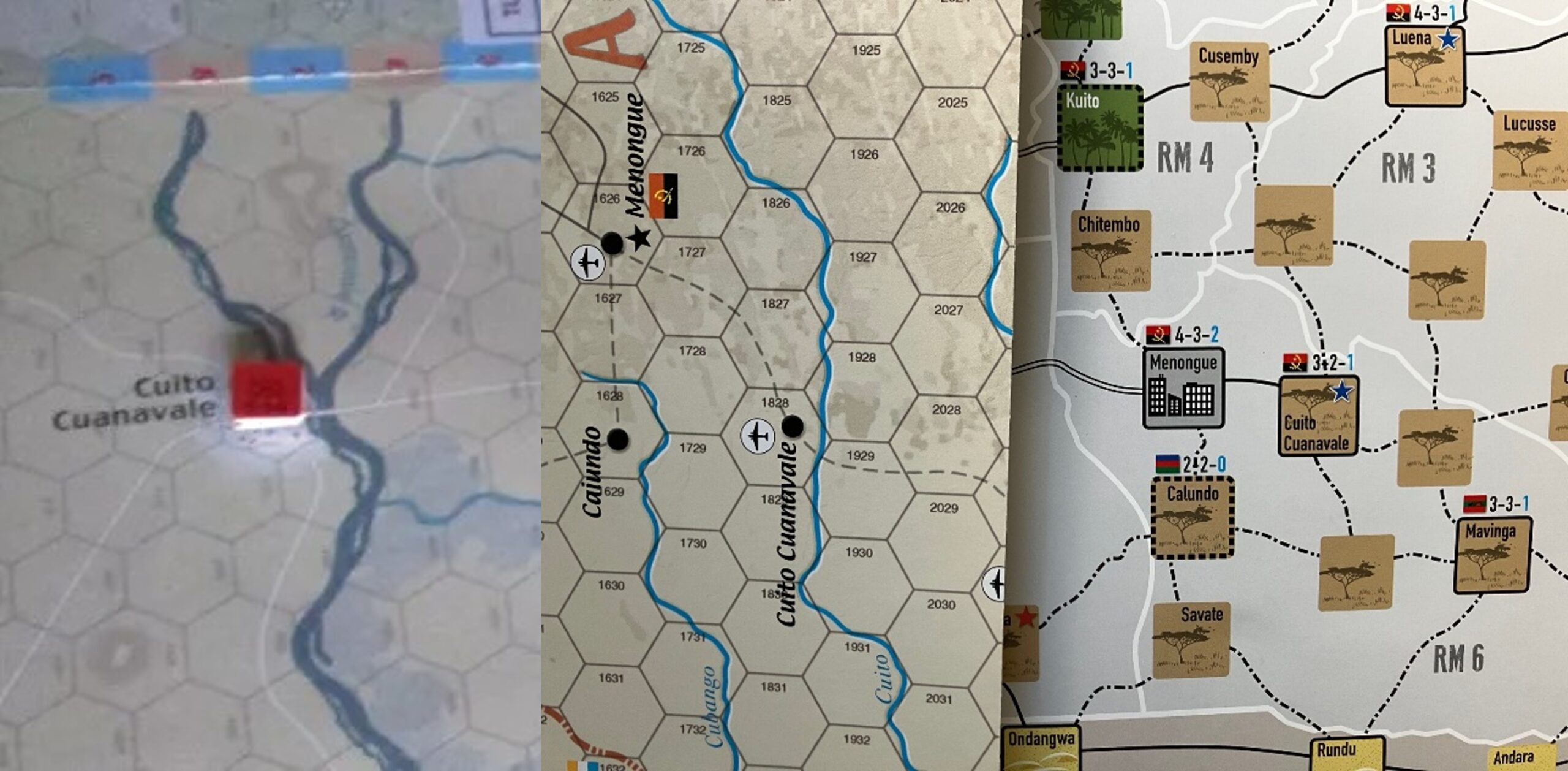
The primary option of the Cuito Cuanavale battle is in Strategy & Tactics (S&T) magazine #235 from 2006. There are 3 other Angola games that are at the operational level that cover the entire 1987-88 timeframe, two of which also are from Decision Games (DG) (see list below). The other is in the French magazine Vae Victus issue #154 from 2021. I own the Vae Victus and S&T #290 issues which both cover the same ground at the operational level. The 4th game is a Decision Games quick-play mini-game with only 40 counters that focuses on the broader border conflict with the SADF.9
Unfortunately, I don’t own S&T #235, which has two games designed by prodigious game designer Joe Miranda (he designed all 3 DG games on Angola). Both games in the issue are based on the popular and easy to learn Modern Battles system that traces its lineage to Simulations Publications, Inc. (SPI to us old-timers). One game is Budapest ’56, which is not of interest here. The other is Angola ’87, which covers the Cuito Cuanavale campaign. The map scale is 5 miles per hex, and the 9 game turns each represent a month of real time. Most of the units are battalion-sized, so you could call this a “grand tactical game.” Having not played it I cannot give you a firsthand review, but it did receive two positive reviews here (and here) on BoardGameGeek10.
 |
Angola 1987-1988 (2021) The last clash of the Cold War in Africa. |
 |
Angola: Cold War Struggle in Africa (2014) A simulation of the 1987-88 campaign in Angola during the Cold War. |
 |
Border War: Angola Raiders (2012) |
 |
Cold War Battles: Budapest ’56 & Angola ’87 (2006) |
Resources
There are several quality videos about the war available on YouTube. Here is a sample:
- Angola Forum 2018 – the 30th Anniversary of the Battle of Cuito Cuananavale (9 interviews)
- The 10-part Born to War series – Episode 9 is divided into 2 parts. The battle is episode 9 part 1.
- Battle of Cuito Cuanavale – 1987 (6:23) – from the South African perspective, claiming victory.
- ANGOLA THE WAR Documentary Teaser (7:44) – Long teaser to a full documentary that you can rent.
There are plenty of online and published resources for learning more about the War in Angola, with more memoirs being published all the time.
- Wilson Center Digital Archive, Cuba in South Africa: Cuban documents about Havana’s policy toward Southern Africa in the final fifteen years of the Cold War.
- War in Angola information portal – There are 4 parts to this website:
- The Basic part (HOME), where the Home page and this section about the site are included, as well as Contact Details, Web Statistics, and a new Site Search.
- The LIBRARY, where historical and reference information on everything relating to the war are kept, from Historical Accounts, Order of Battles, Galleries, Maps, Videos, Music and Songs, Weapons and Equipment, to the SADF’s Roll of Honor, SADF Unit Profiles on over 1,000 SADF units, SADF Medals and Decorations, and on every SADF Operation in SWA/Angola.
- The BATTLE ROOM, which essentially is the GAMING part of the site, and in which information from the LIBRARY is used to compile and create scenarios based on real battles which can be re-fought on the table-top in miniature.
- The COMMUNITY, which comprises of over 3,100 registered users with interests in matters relating to the war in Angola.
Books/Articles
- Ron Soodalter, “Over Where? Cuban Fighters in Angola’s Civil War,” Military History Quarterly, Spring 2016 e (Vol. 28, No. 3).
- Joseph Miranda, “Angola, Cold War Struggle in Africa,” Strategy & Tactics, #290, Jan – Feb 2015.
- Christopher C. Harmon, PhD, Warfare in Peacetime: Proxies and State Powers, Chapter 4: The United States and UNITA of Angola, Marine Corps University Press, 2023.
- Alexander Hill, “Review Essay: “We Carried Out Our [International] Duty!”: The Soviet Union, Cuito Cuanavale, and Wars of National Liberation in Southern Africa,” The Journal of Slavic Military Studies, 34(1), 139–158. (2021).
- Al J. Venter, Battle for Angola: The End of the Cold War in Africa c. 1975-89, Helion and Company; January 13, 2021.
- Stephen L. Weigert, Angola: A Modern Military History, Palgrave-MacMillan, 2011.
- Leopold Scholtz, The SADF and Cuito Cuanavale: A Tactical and Strategic Analysis, Delta Books, Johannesburg and Cape Town, 2020. Note: I could not get this book in time for this review, but I saw at least two complementary reviews of it online.

Thank you for visiting the Regiment of Strategy Gaming and riding with The Armchair Dragoons.
Rather than list a bunch of social media links, the easiest thing to do is to check out our LinkTree, which connects you to all of our various locales around the web.
You can also support The Armchair Dragoons through our Patreon, and find us at a variety of conventions and other events.
Feel free to talk back to us either in our discussion forum, or in the comments below.
Footnotes
- For an excellent (and free downloadable) book on these proxy conflicts, see Chapter 4: “The United States and UNITA of Angola,” in Christopher C. Harmon, PhD, Warfare in Peacetime: Proxies and State Powers, Marine Corps University Press, 2023. Dr. Harmon has chapters covering Nicaragua and Afghanistan as well.
- Ron Soodalter, “Over Where? Cuban Fighters in Angola’s Civil War,” Military History Quarterly, Spring 2016 e (Vol. 28, No. 3), pp. 38-40.
- Alexander Hill (2021) Review Essay: “We Carried Out Our [International] Duty!”: The Soviet Union, Cuito Cuanavale, and Wars of National Liberation in Southern Africa, The Journal of Slavic Military Studies, 34:1, p.144.
- Joseph Miranda, “Angola, Cold War Struggle in Africa,” Strategy & Tactics, #290, Jan – Feb 2015, pp. 6-8.
- Hill, Review Essay, p. 142.
- Key Military website, Dr. Dewald Venter, “A Clash of Armour,” (SADF view) 10 May 2021; James Kinnear, “A Clash of Armour II,” (Soviet view) 3 September 2021.
- Soodalter, “Over Where?”, pp. 36-37.
- See Chapter 5 in Stephen L. Weigert, Angola: A Modern Military History, Palgrave-MacMillan, 2011, pp. 105-175 on the second Angolan civil war.
- The SADF was involved in a number of conflicts at this time, to include against the People’s Liberation Army of Namibia (PLAN), which was the armed wing of the South-West Africa People’s Organisation (SWAPO), in northern Namibia and Southern Angola. Like I said, alphabet soup.
- ed note: I own this one and have played this one several times and there are definite differences in mobility & effectiveness of the units, but it can bog down into a linear slog if both players keep their lines tight


Sadly this is a poor article, misleading, and containing several factual errors. First of all it fails to put the clashes around Cuito in the proper context. It was not a SADF/UNITA offensive but the campaign started with a FAPLA multi-brigade offensive toward Mavinga. That in turn created the conditions for the SADF intervention. Not only the SADF smashed the offensive but started its own counteroffensive in the general direction of Cuito. Cuito was only the latest bit of the operation. The second main error is to overblown Cuban involvement in the action. It was primarily a FAPLA show with Cuban and Soviet advisors involved. Cuban forces intervened in the conflict not at Cuito but in the Cunene-Caleque area. There there was a direct clash between Cuban and SADF tanks. Also the bibliography missed two key volumes widely available in English: “The SADF in the Border War” and “The Battle of Cuito Cuanavale” both by Leopold Scholtz and published by Helion.
Hello “arrigov,”
Thank you for taking the time to read this summary and provide a comment. Remember, these articles are here primarily to set up discussion on what wargames are available on the topic. They are not meant to be a scholarly, peer-reviewed article. You will note I did include one of Scholtz’s books, but this also is not a comprehensive, analytic bibliography but instead attempting to provide a variety of sources. You are certainly welcome to write your own piece with citations and submit it for publication. Again, thanks for taking the time to read it and providing your opinion.
Best, Aaron
Got it, but… me being evil… several of the games included shows the whole campaign with various degree of success. Looking at the campaign as whole allows ot better evaluate both the importance of the battle and the eventual outcomes (it was not a stalemate because the South Africans and UNITA achieved their goals in the whole campaign, and it set the tone for the peace that preserved UNITA). The role of the Cubans in the article is indeed exaggerated. Looks like one of these Flames of War “history” part that are designed to selle a new miniature range (and conveniently overlook the dark parts of history). As for the games on the subject I am partial to Angola 87. While there are some issues, it is probably the best one. Angola 1987-198 has some very neat ideas, but does not work well due to its smaller size (it could have focused on the actual 1987-88 campaign with better granularity. The combat system is also a big let down. Also some of the historical assumptions are questionable (and the historical article in the magazine is extremely bad). Cold War Battles: Angola’87… It is based on the old SPI Modern Battles quad. You have to get used to the differential system and the combat results, but it is not bad.
Best,
Arrigo