by
by Zachary Grant, 25 June 2025
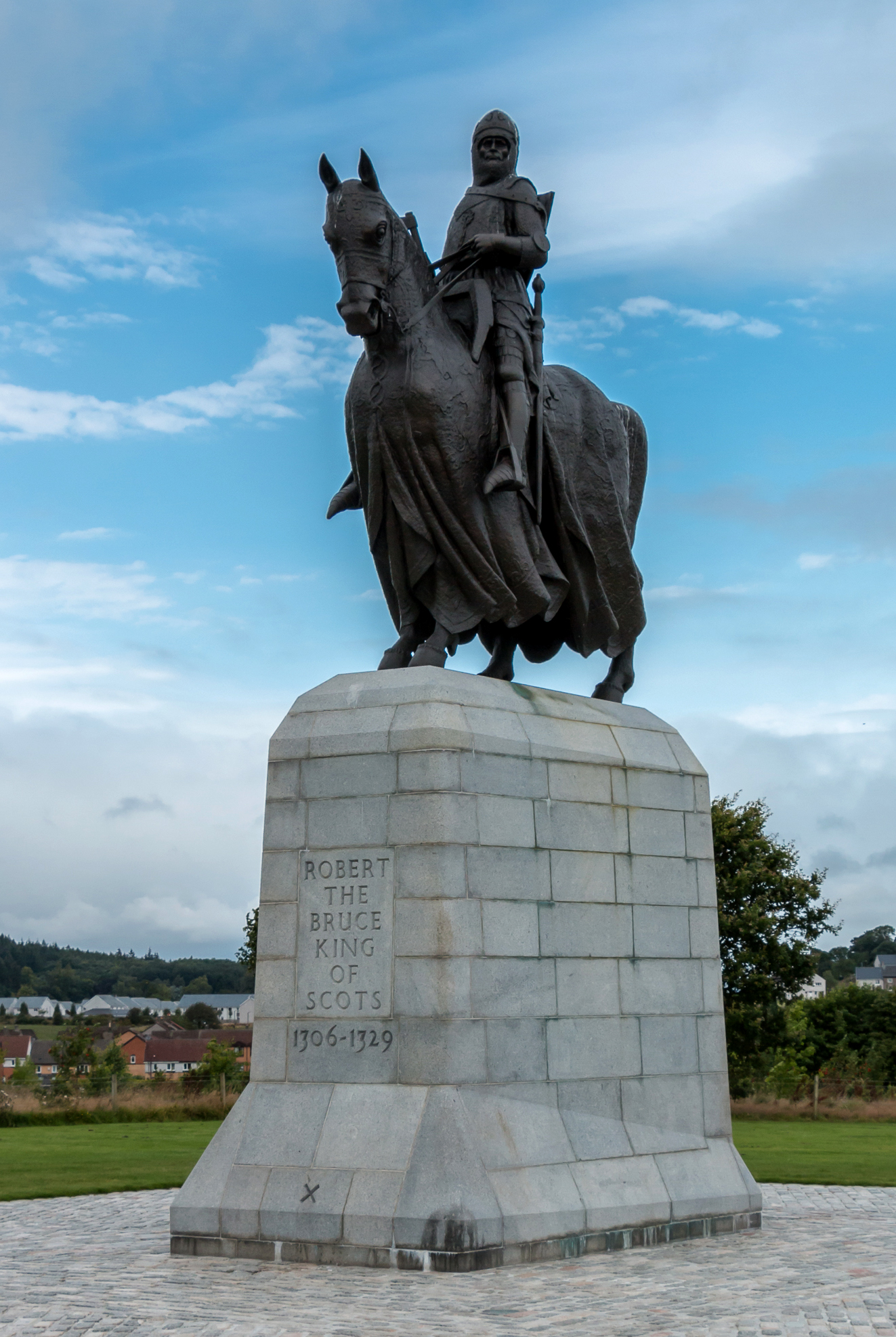
Scotland and England were at odds. England wanted to control Scotland and the Scots were fighting to gain their complete independence from the English. In 1314, Robert the Bruce, who at this point was recognized as King Robert I of Scotland, controlled most of Scotland except for five castles which the English still held (Tucker, 2010). Stirling Castle was one of the English controlled castles, commanded by Sir Philip Mowbray, which the Scottish forces had under siege. After negotiations, Robert the Bruce and Sir Mowbray agreed if Stirling was not rescued by June 24, Sir Mowbray would surrender to the Scots (Tucker, 2010).

click images to enlarge
King Edward II did not want to lose control of Stirling and assembled an army to attack the Scottish forces and relieve Mowbray. Although historians are not in complete agreement of the force size for each army, it is estimated the English had approximately 20,000 men, which included around 2,000 armored knights. The Scottish army had roughly 8,000 men which included about 500 light horsemen (Tucker, 2010).

The Battle
It needs to be noted that on June 23, Mowbray met Edward II and his army on their approach to Stirling castle and explained that technically Edward met the agreement of relieving Stirling. Mowbray also described the strong Scottish defensive positions and advised Edward to stop and not attack (Brown, 2008). There are many reasons why this didn’t happen. Younger leaders in the English army, like the earl of Gloucester, ignored the warning and continued forward. It is also possible that Edward didn’t want a victory based on “technically” meeting the terms of the relief agreement and instead wanted a more glorious victory in battle against Bruce (Brown, 2008).

The area the English were approaching was not conducive for an attack. The Scottish right flank was protected by woods and their left flank consisted of marshy terrain (Brown, 2008). The only good avenue of approach for the English army was along an old Roman road, which Bruce made very difficult for the English to use. He had large branches placed on the main way to Stirling castle, and he had large pits dug in the area to act as cavalry traps that were then covered to conceal their locations (Tucker, 2010).

June 23 consisted of small skirmishes. Edward II sent some cavalry to try to relieve Stirling; however, Robert saw this and ordered some of his men to prevent this relief party from reaching the castle. The Scottish used a formation called a schiltrom, (also spelt schiltron), against the cavalry.
“What is a schiltrom?” I hear you ask
It is a formation composed of men with pikes pointing out to form a defensive wall. This formation is very difficult for cavalry to defeat; however, they can be vulnerable to archers and to a combined arms attack of foot soldiers and cavalry (Brown, 2008). On this day, the English cavalry were not supported and the Scottish were able to defeat the English cavalry, preventing them from reaching Stirling castle.
On June 24, the main battle began. Because of the Scottish defensive preparations, the English attack was funneled into a small area. The English cavalry led the attack with the English infantry and archers behind them.

While advancing the English army became a disorganized mess, which the Scottish army took advantage of by counter attacking. As the Scottish army pressed their attack into the disrupted English formations, the English army began to falter and then route.

It is estimated the Scottish army killed approximately 700 English soldiers and kept about 500 to ransom back to the English (Tucker, 2010). By the end of the day, the battle was a resounding victory for Bruce and the Scottish army.

Other sources to learn more about the battle
- Bannockburn, 1314-2014 : Battle & legacy : Proceedings of the 2014 Stirling Conference edited by Michael Penman. – A collection of papers from the 2014 Stirling Conference on the 700th anniversary of the Battle of Bannockburn.
- Information about Robert the Bruce from the National Trust for Scotland
- BBC Radio 4: In Our Time episode about the Battle of Bannockburn
Interested in gaming the battle? Try one of these games
 |
Bannockburn 1314 (2012) published by Taktyka i Strategia in Poland. According to Board Gamegeek, this game includes an english translation of the rules and scenarios within the game. |
 |
Scotland Rising: Bannockburn 1314 (2014) published by Worthington Publishing, LLC. This game is part of Worthington’s PT-90 series, which means the game is designed to be played in about 90 minutes. There are only four pages of rules and four pages of designer notes, background information and examples of how to play the game. |
 |
Great Medieval Battles Bannockburn and Angorra (1999) published by Decision Games in S&T 197, May-June 1999. This is a reprint of Robert at Bannockburn (1979) published by SPI. It uses the Great Medieval Battles system. |
The three games above are from the Board Game Geek History: Wars of Scottish Independence list. This list includes games about many different battles and you might find a few more games about Bannockburn too.
I have Strategy & Tactics 197, so here are some additional photos and comments on this game.


The rules state that Robert at Bannockburn (1999) is a simulation. Not wanting to stir up the “are wargames simulations or games” debate, I think this is a fair description. This game doesn’t try to represent all the historical details of the battle. For example, the forested area that the Scottish used to protect their right flank is missing from the map, which is fine.
The Scottish schiltroms can be in either an open formation, represented by the double counter, or a closed formation, which uses a smaller single counter. The closed formations are better for melee; however, they suffer a greater chance of damage and might need to make a moral check when attacked by English archers. Another interesting feature of the schiltrom is it does not suffer a movement penalty in the marsh terrain hexes.

The Great Medieval Battle System looks interesting and something I’ll definitely try, now that I’ve learned more about this battle.
Sources:
- Brown, M. (2008). Bannockburn: The Scottish war and the British Isles 1307-1323.
Edinburgh University Press. - Tucker, S. C. (2010). Battles that changed history: An encyclopedia of world conflict.
ABC-CLIO.
Thank you for visiting the Regiment of Strategy Gaming and riding with The Armchair Dragoons.
Rather than list a bunch of social media links, the easiest thing to do is to check out our LinkTree, which connects you to all of our various locales around the web.
You can also support The Armchair Dragoons through our Patreon, and find us at a variety of conventions and other events.
Feel free to talk back to us either in our discussion forum, or in the comments below.


.jpg)