
 by
by Michael Eckenfels, 26 June 2025
Note to LucasArts: thanks a million. It’s not like I didn’t have a slew of responsibilities already. I’ll spare the old and tired jokes involving not having enough time to eat or sleep or maintaining a healthy relationship with one’s better half. But thanks to you and Knights of the Old Republic (not to mention my colleague Allan Parent for recommending this title to me), I’ve lost all that, and am typing this on a 286 laptop in the shade of my new cardboard box. If you see me, drop some change in the cup.
The Star Wars franchise is as good as gold, which unfortunately did not translate well into gaming; many a gamer was led down the primrose path to utter disappointment. Strategy games such as Force Commander and Galactic Battlegrounds, to mention only two, bore the name “Star Wars” and yet fell flat on the gaming public for a variety of issues; to be fair, action games such as the classic X-Wing and Tie Fighter series did a lot for their genre. With LucasArts’ Knights of the Old Republic, however, we are treated to a splendid cinematographic role-playing game that is infinitely more entertaining than Episode I and II combined. One wonders, then, why the producers of this title were not allowed to write the script for Episode III and single-handedly save the trilogy franchise.
INTRODUCTION
A long time ago…yeah, yeah, yeah, we know all about that. Knights of the Old Republic begins in the same true Star Wars fashion with the tilted yellow text scrolling slowly past the screen. The time is 4,000 years before the events that unfold in Episode I. Two Jedi Knights, Malak and Revan, lead a Republic battle fleet against the Mandalorians, a race of fierce warriors that threaten to conquer the known galaxy. The Mandalorians are defeated, but Malak and Revan disappear into the hinterlands. Some fear they are missing and held as prisoners of the Mandalorians; others fear they are dead. A few years later, Revan and Malak appear at the head of a gigantic Sith fleet – the Siths being a group of sentient beings, including humans and Twi’leks among others – that are bent on their own dreams of conquest. The Sith’s numbers are staggering, and Revan and Malak have somehow become Dark Jedi. The Republic faces a serious threat from them; if nothing is done, they will surely conquer the galaxy.
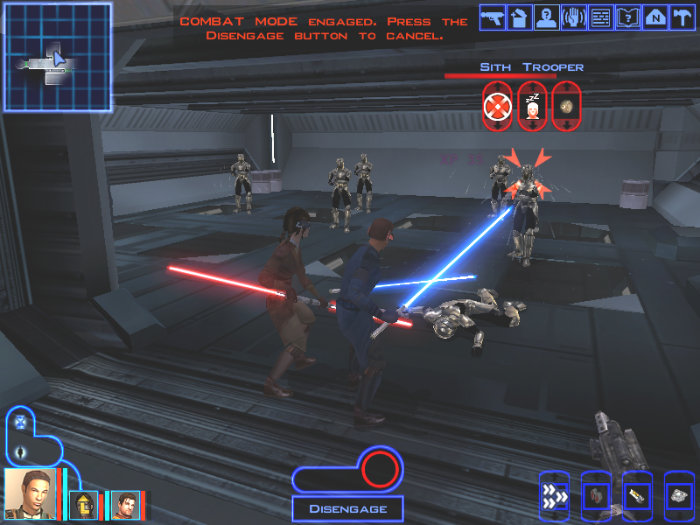
Nothing new there – big bad guys threaten to take over the galaxy and enslave everyone. After all, this was pretty much what the Rebellion fought against in Episodes IV through VI, except substitute “The Empire” for “The Sith.” And so, a jaded gamer says, “So what? What’s in it for number one?” Well, a gamer needs only to install this incredibly rich, detailed game and turn it on to have ‘number one’ enthralled. The storyline, plot twists, and characters are believable, react in perfectly interesting ways, and eventually the player will be sucked for a wild, long ride.
So what is the player’s role? No less than serving as a lynchpin in the destiny of the galaxy. But that’s pretty much all you’re getting out of me; otherwise I’d ruin the entire storyline.
PRESENTATION
Typical Star Wars fare, Knights of the Old Republic deals with the mood and setting of Star Wars to a gamer in much the same awe-inspiring way that movie audiences experienced the first movie back in the summer of 1977. Fantastic scenery abounds; amazing technology is everywhere; there are many alien races to interact with and dozens of shops that buy and sell goods; and most of all, a plotline that never ever bores once, despite the game taking nearly 80 hours to finish. For fifty bucks, that’s a heck of a deal.

Since Star Wars transcends age groups – I was eight when Episode IV was first released, but even to this day know of ten-year-olds that love the original movies – anyone with a love of this genre (and a relatively decent PC) is going to enjoy this game tremendously.
PLOT
On #TBT, we bring you the occasional classic article – an older review or analysis piece we wanted to rescue
The player’s destiny begins as a Soldier, Scout, or Scoundrel. The choices are somewhat limited, but represent a spectrum of abilities. Soldiers are better at combat, Scoundrels are better at stealth and breaking into things, and Scouts are balanced between the two. What’s the best course to take? Good question, because this game sports just as much need for stealth and hacking as it does for combat, although combat skills are an absolute necessity for survival.
Once a character is generated, the player is inserted immediately into action. The ship they are on is attacked by the Sith, and their roommate wakes them up in warning. From there, a good if out-of-character tutorial blossoms. The roommate shows the character how to open items, equip items, and do some other basic tasks, including opening doors. Later, he shows you how to engage in combat as boarding parties are encountered. It’s a great way to learn the system but made it difficult to get immersed; try doing that when the player’s character asks, “How do you open objects?” and the other character’s answer is “To open an object, move your mouse cursor over the item until it turns into a hand, then left-click to open it.” Once the tutorial stage is set – which does not last longer than this first level – things become much improved.
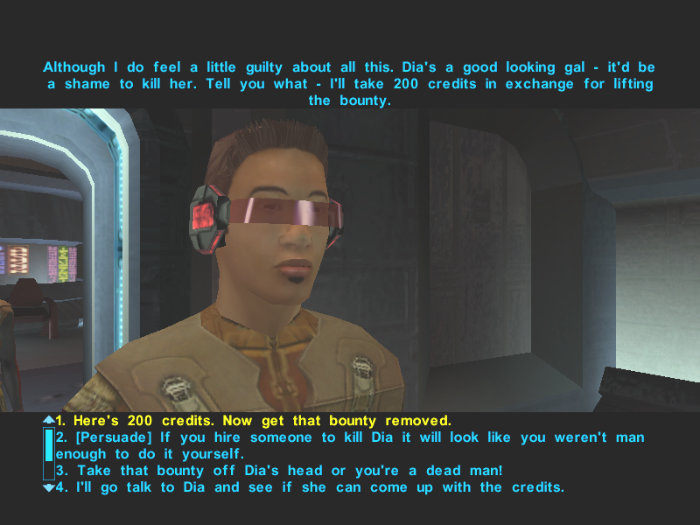
Trying to explain more of this game’s plot would ruin things for would-be buyers. Suffice it to say that your character’s history is a bit muddy, but seemingly not a mystery (such as a trite “losing memory” plot device). Instead, the character – once they escape the doomed ship they’re on – crash lands on the planet Taris, a clone of Corsucant’s in that it is covered from pole to pole by sprawling skyscrapers, complete with layers. The deeper one travels, the more dangerous it is. The character will of course visit all three levels of this planet, depending on side quests, but nevertheless they – as well as the player – are slowly drawn into an intricate web of a plot that involves the character eventually training to be a Jedi Knight. More significantly, the game allows the player to choose a path – Light or Dark. Decisions the player makes affects the game in significant ways; choosing to be a nice guy (or gal) will almost certainly earn Light Side Points, while being a bad guy will earn Dark Side Points. This affects the player’s later abilities to use the Force; Dark Side powers, for instance, are easier to wield than Light Side powers if the character is more disposed to being the next Darth Vader.
For my first game, I played a squeaky-clean Jedi Knight. And when the experience was over at the end, as the final shot quick-wiped and the familiar Star Wars movie-ending theme music came up, a chill went down my spine and a smile spread across my face. Evoking an emotional response? How the heck did that happen? This is a PC game, for crying out loud, not a real-life endeavor. And yet, given the sheer depth and scope of this product, it is impossible to not be drawn into it, to not delve into the myriad plethora of possible relationships that can be built on, and most of all to not eventually have some kind of stake in the outcome of the game. After having played it for so long – my game took nearly 60 hours, but I know a few colleagues that have taken upwards of 70 or more – how can it not happen? I felt like I actually accomplished something and brought good to the galaxy. Okay, sure, it was just my PC, but the imagination swells easily when contemplating this title.
Case in point: I went back to one save game and tried a nasty approach to a problem that I otherwise won over through caring and kindness. The other character (who shall remain nameless to protect my shame) knelt down and my character stepped up, ignited their dual lightsabers, and cut them down in cold blood. It felt vicious, twisted, and dark; it did not settle at all well with me. But that was what the game offers; there’s a very thin line between the Light and Dark apparently, and the player’s character is constantly given chances to be a bad guy – conversely, if evil, they are offered ample opportunities to turn to the Light. For the most part, the choices a player makes may not affect the overall scope of things, but they will affect the personal relationships that are fostered with the other nine NPC’s that come along. It makes for an experience perfectly unique among the usual PC role-playing games.

INSTALLATION AND TECHNICAL ISSUES
This game is huge1 , requiring 4 GB (with a “G”) of space to install on. But it delivers on every single kilobyte, so it is space well allocated. Otherwise the game’s requirements are not overwhelmingly high.
I only had one problem near the end of the game: while in one village, I eliminated an enemy guard in a room then clicked on a ‘wicker basket’ to see if any goodies were inside. The camera view went nuts and within a few seconds, when it finally calmed back down, I found my character back in the corner of the room…behind a low-lying bench that blocked him from reaching the rest of the room. The bench was perhaps a foot high, but in a game that utilizes no Jump key or command (except using the Force Jump power in combat, but that’s only in combat), it may as well have been a mile high. I was stuck and hadn’t saved in twenty minutes, so I had to exit and re-do from that last save point. Needless to say, when I went into that room next time I ignored the wicker basket. I never experienced a similar problem, though. When I tried to duplicate it, the problem did not occur again.
DOCUMENTATION AND TUTORIALS
The biggest and best way to get a user’s attention is to use color in the software’s documentation: it is eye catching and inviting. The docs for this game are not only in color but also produced on a more sturdy paper stock, almost like plastic laminate but much more malleable than stiff slides. It is also set with a very nice compact spiral binding, making it very easy to display any page in the manual for quick and easy reference. The documentation must have set this project back by a tidy sum, but in my opinion the industry needs to take note and do all documentation in such a manner.
The tutorial was briefly mentioned above; the only complaint I had was that it was not very immersive, but that’s impossible to avoid in order to get the player quickly acquainted with the controls and methods involved. Suffice it to say that the tutorial is perfect in that it is short, clean, and hits on all important methods needed to get a gamer’s feet wet. As all tutorials should, this one makes no attempt to supplant the manual but serves as a guide to make the player aware that if they want more, they need to refer to the documentation.
GRAPHICS AND SOUND
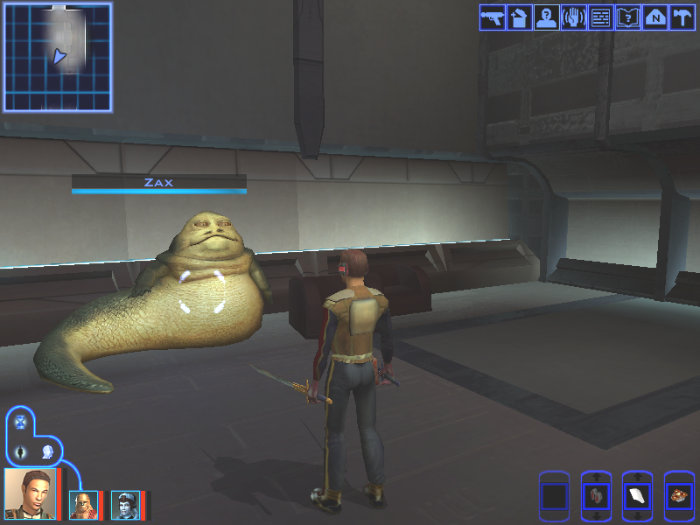
Here we go…what part of this game could I possibly say has bad graphics? None of it does. I think this is not just from how the game portrays itself, with vibrant colors, splendid shadow effects, and reflections, but also from the cinematography used in the cutscenes, and also in the level design. Few stones were left unturned, although there are a couple of laughable moments that act as a minor tripwire in an otherwise perfect experience.
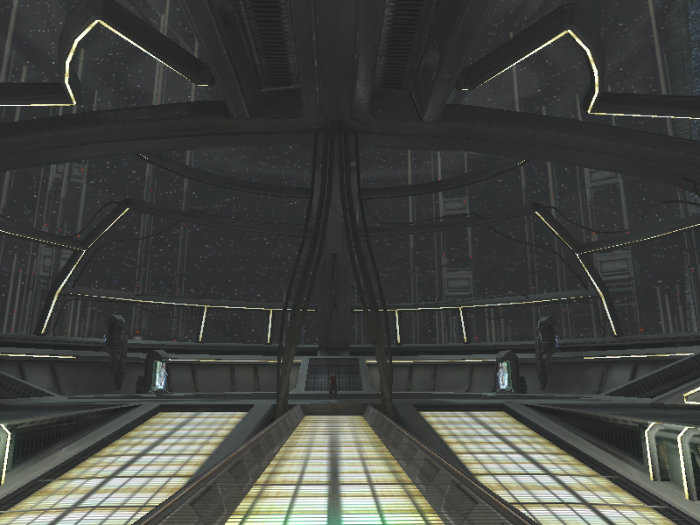
The most glaring of these is a space station. I won’t mention where it is orbiting to save the reader from having any of their potential experience ruined, but it will be easily recognizable. The station looks like it was poorly cut out and pasted into the background, which is almost jaw-dropping in its poor quality considering up to this point it’s been nothing but first-class visuals.
The lines are delivered well; in fact, it’s not a stretch to say the voice actors do more service to the Star Wars universe than certain wooden actors and actresses do in certain movies. But I digress; I am not a movie critic. Suffice it to say that the quality of the voice acting exceeds what could be garnered simply from reading the text during cutscenes; this does not mean I don’t like the text – on the contrary. The writing in this game is second to none, and the voice acting brings it to life.
BioWare’s work on the sounds shines further when wielding weaponry; lightsabers sizzle and crackle with energy just as they do in the movies, and blasters have the same sharp, rich punctuation of sound that most of us are all too familiar with. The cinematic quality of this game is enhanced greatly thorough the excellent sound work and is completely enjoyable, especially with a subwoofer and multi-speaker setup.

GAME INTERFACE
Controls are very simple: the game is mouse-driven when it comes to panning and interacting with objects, but keyboard-driven (using the ubiquitous W-A-D-S keys) when it comes to moving. Players move their character around using the keys and point the mouse cursor at things to interact with; if it’s a person, a little head appears and another click will start a conversation (or a short comment from the target). Clicking on objects searches them or interacts with them in other meaningful ways. Nothing new here, really, and it’s a clean system with the exception that I seemed to have to click twice on everything – once didn’t do anything, but always on the second try the character would run up to the object to interact with it. It was mildly annoying, especially if the cursor was bumped off the object between the first and second clicks.

Combat is driven completely at the point of a mouse; click on an enemy and three options, looking something like a slot machine display, appear above them. The first one deals with attacks involving the currently-equipped weapons, the second with Force powers, and the final one deals with grenades and other things that go boom. Each character has a current attack and a mini-queue of up to three actions, so the player can stack up actions and watch the combat unfold. If no choices are selected, the character will execute a default, generic attack based on the weapons they’re holding.

Conversations, which are a thorough and fascinating part of the game, are menu driven. The people the player’s character talks to will voice their lines (an option exists to shut off the subtitles when the computer’s characters are speaking, making the game have more of a movie feel to it); when it comes time to reply, the camera will settle on the player’s character and give them a choice of options. Invariably, each encounter offers a peaceful or a nasty solution. Characters can be downright rude or Jedi-esque in their friendliness, or take a path in between. The beauty of these dialogue trees lay in the fact that the computer’s characters react in perfectly believable ways, complete with facial expressions.


click images to enlarge
GAMEPLAY
The game can be likened to a dungeon-crawl, as the environment is split up into various areas complete with scripted encounters and specific locales. Within these locales are many objects and NPC’s to interact with. Overall the player is going to go through a somewhat linear plot, at least until they can procure a ship. At that point, the player may choose what planet they want to visit next, opening up their options tremendously.
As mentioned before, there’s quite a bit of combat, but there are options for peacefully settling disputes that can sometimes net as many, if not more, experience points than from going postal. Light Side-minded characters will know what paths they need to stay on in order to remain aloof and non-emotional; on the other hand, those seeking to become the next Sith Lord will see their path as well. Being abusive usually results in a fight.

Getting through these fights can sometimes be very difficult. When the game pauses automatically before combat, the enemies that are spotted are not always aware of your player’s presence. This is quite useful considering that some enemies like to group themselves together in a nice, tight, fragable group. Tossing a grenade in their midst is easy, as the AI-controlled baddies don’t react until after the grenade goes boom. By then, it could be too late for them already.
Judicious use of offensive weaponry is another choice that should be made relatively early. By the endgame it’s possible to have a character that is well-versed in both melee and ranged weapons, but early on it’s necessary to make a choice in order to become proficient in one thing. Personally, I despise melee weapons in games that feature lots of ranged weapon attacks; however, I could not resist using two vibroswords in my first game, then graduating to two lightsabers. I think it was a much more satisfying experience to go through the game with nothing but melee weapons and grenades for my main character, than simply standing off and trading shots (usually inaccurate ones).

There is a difficulty level that is managed through the Options selection of the Main Menu; it is set to a default ‘Normal’ level at the beginning of the game. At that level, the game is challenging enough for a new player. The higher levels provide more of a challenge to someone who has already played through the game, or a new player that likes pain. Regardless of the level chosen, it is wise to remain well-stocked on medpacks for healing and other items (such as combat stims) to help keep the characters going.
Now on to the worst part of the game. Yes, it does have a worst part, but this is completely my opinion. There are a couple of puzzles in the game that make life difficult; personally, I despise puzzles, simply because they tend to act like a trip wire in an otherwise purely enjoyable game. Fortunately there are not many of these, and for gamers like me out there, there are walkthroughs aplenty on the Internet that navigate player’s through them. I only had to do that with one puzzle, which had me pulling my hair out; the others take a little bit of time but eventually can be conquered. For me, nothing takes oomph out of a game more than coming across a brain teaser in a game otherwise not populated with a lot of them.
Fortunately, these puzzles are not always of the “fit block x into hole y’ varieties; on at least two memorable occasions the budding Jedi I controlled was faced with a situation that required a need for criminalistics-like (criminalistics? Criminalistics: the collection and examination of the physical evidence of a crime) ability in order to solve a crime or two. These are done very well to the point that they are easy to figure out if one pays good attention to what is going on and leaves no stone unturned. I actually enjoyed those puzzles, but honestly whether they are completed or not does not impact the game, except through getting experience points.
GAME MECHANICS
Knights of the Old Republic uses the d20 system for combat and other skill resolutions (essentially a player’s applicable attribute or skill plus a twenty-sided die “roll” must exceed the difficulty class of the task; for example, hacking a low-level dust-infested computer on Tatooine may mean a difficulty class of 7, so the player’s Computer Use skill plus a twenty-sided die roll must exceed 7 in order to succeed). Appropriately, these die-roll conventions are removed from the player’s view and only success or failure is reported. Characters are also imbued with Feats, which are essentially class abilities and may be improved from one to three levels before maxing out. These feats range from two-handed weapon proficiency (very awesome when wielding two lightsabers, an experience I highly recommend) to body toughness and repair abilities. These feats improve the character’s Attributes or Skills by imbibing a bonus on the appropriate action. The entire d20 experience is very smooth and character generation takes minutes. The player may spend more time deciding on a character portrait than actually figuring out their abilities.
ARTIFICIAL INTELLIGENCE (AI)
This equates to how the game controls its enemies, as well as the other characters in the player’s party. While the player can switch at any time to control any one of the three maximum members of their party, this still means two are computer-controlled.
The enemy troops are quite smart. If facing enemy soldiers, such as Sith Troopers or mercenaries, expect grenades to come flying. Dark Jedi and other Force-using enemies can be expected to attempt to immobilize or strike down the characters of the party. These Force-using folks seem to really enjoy using Shock (a lightning-like attack), Horror (which essentially freezes the target in place), or Force Push (which does what it says, pushing the target back and knocking them on their nerf region). Of these, Force Push is the most annoying attack to endure, as it takes time to get back up and get back into the fray, especially when using melee weapons.
click images to enlarge
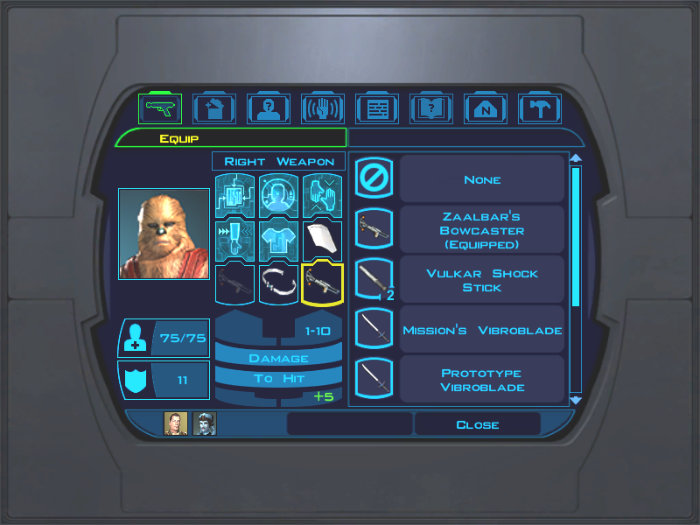
Friendly characters – namely the other two in the player’s party – use what they’re equipped with. The player does have full control over what weapons they yield, and these other two characters will never utilize another weapon unless the player goes into their Character Screen and specifically changes it. Nor will these characters use grenades if they have them; switching to them and ordering them to chuck them is the only way to get these into play. However, Force-sensitive characters in the party WILL use Force powers. Sometimes another Jedi in my party would use a Stasis Field Force power on the enemies I was charging (this power freezes not only the target but those around them as well), making them easy pickings. The timing was always good in combat.
However, they will not use Heal or other healing items on their own, not even in combat. This can be severely annoying, but the game’s pause ability makes up for a lot of this. Another issue I had was that it seemed my companions seemed slow on the uptake when it came to actually getting involved in combat. Given the round-driven system, my controlled character and the enemy would always seem to exchange a round of pleasantries, sometimes two, before the AI-controlled friendlies in my party decided to wake up and smell the blaster fire. That caused some harrowing situations in some of the bigger battles. Since the game automatically pauses when combat begins, it’s a wise idea to go ahead and hop to the other characters and set actions for them to avoid this little problem.

EDITORS, EXPANSIONS, AND REPLAY VALUE
Unfortunately, besides the 1.02 patch, there are no editors or expansions planned at this time. However, there have been numerous rumors on the Internet and in a few well-known magazine publications regarding talks directed at the development of a Knights of the Old Republic 2. Further information could not be attained, but given the high sales this title has enjoyed, there’s no doubt that eventually such a product will see the light of day.
As for replay value, there’s a ton of it. The game takes a very long time to play just as a good-guy Jedi; turning around and playing it as a wannabe Dark Lord of the Sith essentially means double the time playing (although likely the second time through the gamer will click faster through some of the more familiar dialogues). So, given that this game takes about 60-80 hours to complete, saying that 140 hours – at minimum – is not a long stretch at all; it would be more if the player goes through all the dialogue word-for-word.
MULTI-PLAYER GAMING
Sadly, no, but if a gamer is seeking interactivity with other people online, try Star Wars: Galaxies. This is a purely solo effort for one player. Interest abounds, though, in the combat system of this game; it would be fascinating to see if a Neverwinter Nights-type of game, where players can build up their own scenarios and run other players through them, ever sees the…err…Light.
SUMMARY
It’s been a very long time since I’ve experienced anything on par with the original Star Wars movies – to the point of being moved, fascinated, overwhelmed, and riveted all at once. While good games such as Dark Forces and Jedi Knight 2: Jedi Outcast did justice to the series, little things like Episode I and II have caused consternation among fans of the genre, and subpar games like Force Commander et al have hurt the genre in general on the PC.
Knights of the Old Republic is everything a good game should be – deep, involved, long, and the kind of game that makes me want to come back for more; playing for eight to twelve hours straight just because it becomes a physical impossibility to stop. Star Wars has a new and rewarding experience awaiting not just fans of the genre but anyone who loves great sci-fi.

SCREENSHOT GALLERY
Thank you for visiting the Regiment of Strategy Gaming and riding with The Armchair Dragoons.
Rather than list a bunch of social media links, the easiest thing to do is to check out our LinkTree, which connects you to all of our various locales around the web.
You can also support The Armchair Dragoons through our Patreon, and find us at a variety of conventions and other events.
Feel free to talk back to us either in our discussion forum, or in the comments below.

