
 by
by RockyMountainNavy, 24 July 2025
“New meat! You dudes gonna love the Nam.” (Unnamed soldier, Platoon)
Looking at the box for Purple Haze by designer Bernard Grzybowski and published in 2024 by Phalanx Co. Ltd in the United Kingdom, one almost certainly would categorize it as just another wargame. That, however, is not how Phalanx describes it:
Purple Haze is an immersive story-creation Tactical level Campaign wargame for 1 to 4 players that drops you into the heart of darkness: Vietnam, 1967. You lead a squad of U.S. Marines through the dense jungles, flooded rice paddies, and straw-thatched villages of a war-torn country. Gut-wrenching choices will determine the fate of you and your mission, showing if you have what it takes to survive.
It is in part a story-creation game, in part a Tactical level wargame, and in part a Campaign game. Your decisions determine the story. Your tactics decide the outcome of life and death firefights. Your men will suffer. Some won’t make it home. Those that do will get wiser, get tougher. The goal: Complete the mission, and get out alive. (Publisher’s blurb)
As interesting as what Purple Haze calls itself, perhaps more interesting in what it does not call itself. A major game mechanism the ad material fails to mention is that Purple Haze is a cooperative game. That is not a minor omission for when you put it all together you will discover that Purple Haze is a cooperative, story creation, skirmish-scale adventure game within a multi-mission campaign system featuring players playing personalized characters. That is what I usually call an Adventure Wargame which I identify as a wargame usually played at skirmish scale that has roleplaying game (RPG) elements. Purple Haze, however, changes the balance between wargame and RPG in a manner that is not so much as played but must be “experienced.”
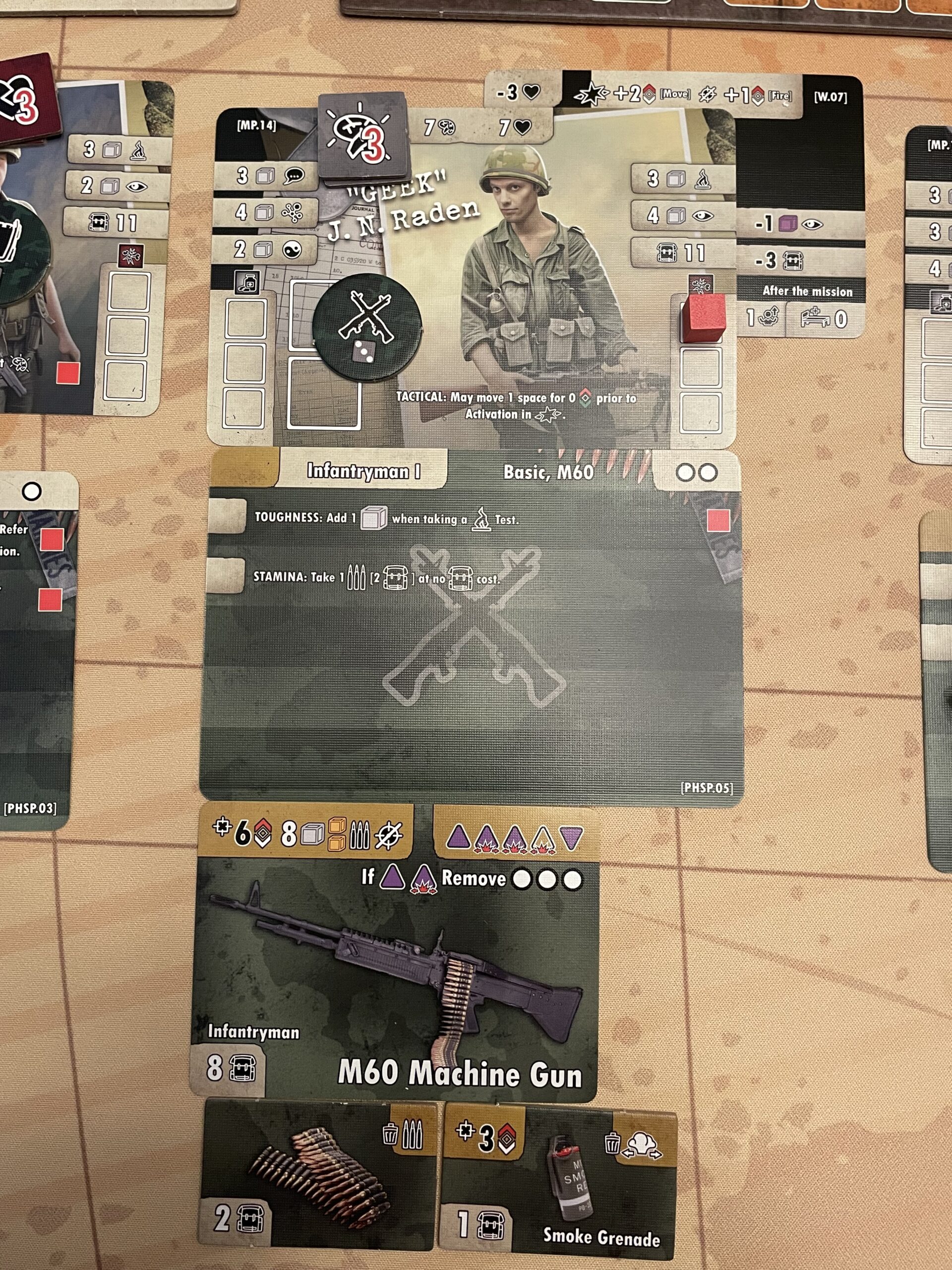
As described above, in Purple Haze you have a squad of six individual Marines defined in somewhat RPG terms that embark on a series of missions (“adventures”) that often feature combat. In my experience, most Adventure Wargames I previously encountered such as Commando (SPI, 1979) or Firepower (Avalon Hill, 1984) or more recently Five Parsecs from Home – Solo Adventure Wargaming, Third Edition (Modiphius, 2021), Mutant Year Zero: Zone Wars (Free League Publishing, 2024) or Forgotten Ruin: The Adventure Wargame (Modiphius 2025) mechanically play very much as a skirmish-scale wargame but with characters broadly described in RPG terms. Purple Haze, on the other hand, leans far into the narrative of the adventure and is more RPG-like in game mechanisms; this certainly is not your Grandpappy’s Panzer Pusher!
“Boy, what you waiting for? Ain’t gonna bite you.” (Sgt. Barnes, Platoon)
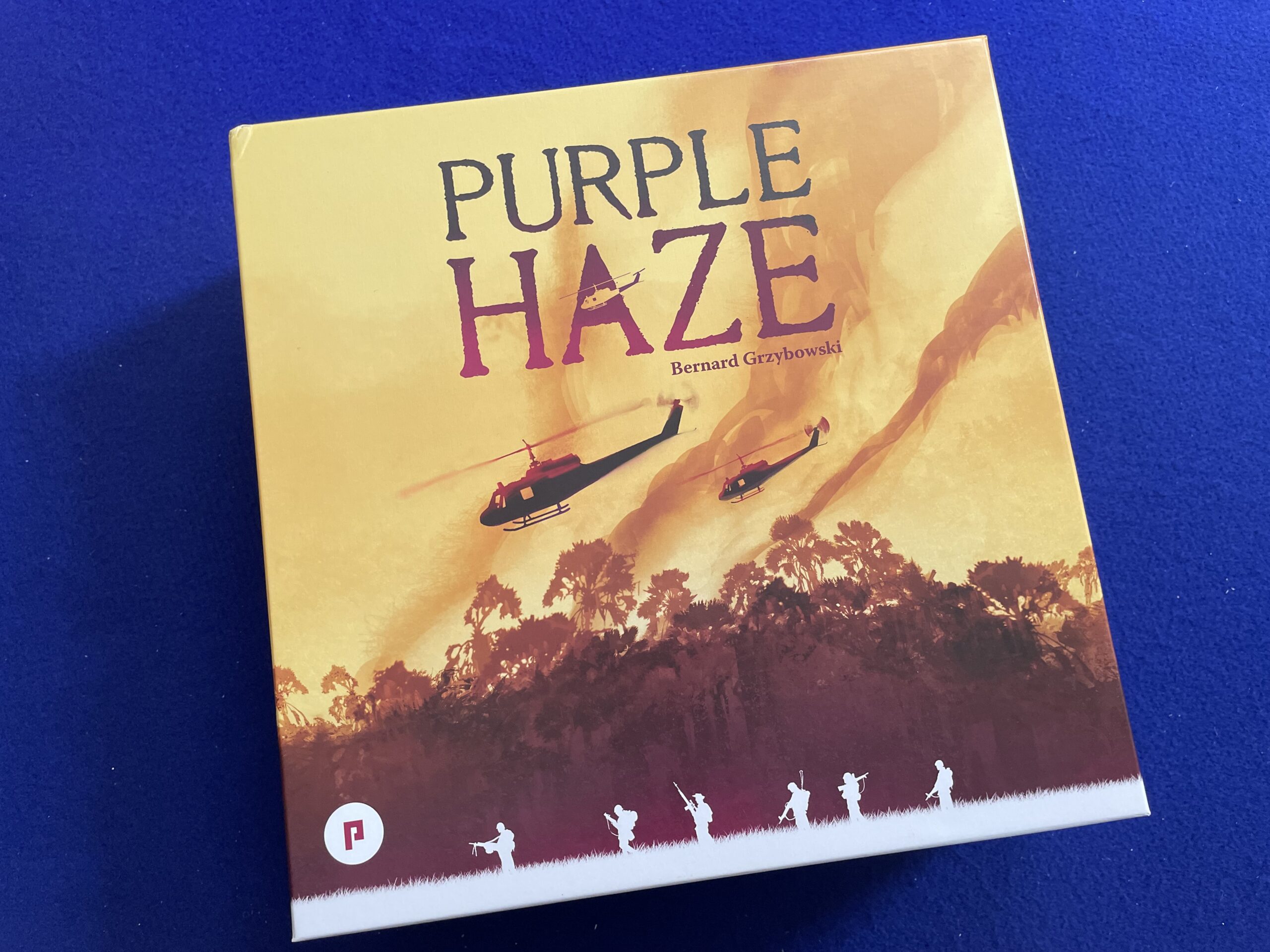
For even the most die-hard of grognards looking at the physical box for Purple Haze can be intimidating. Not the art, mind you, but the sheer size of the package. The box for Purple Haze is very big and very Eurogame-like looking much like a ginormous wooden block measuring 11.5″ x 11.75″ x 4″ and weighing in at nearly six (6) pounds.
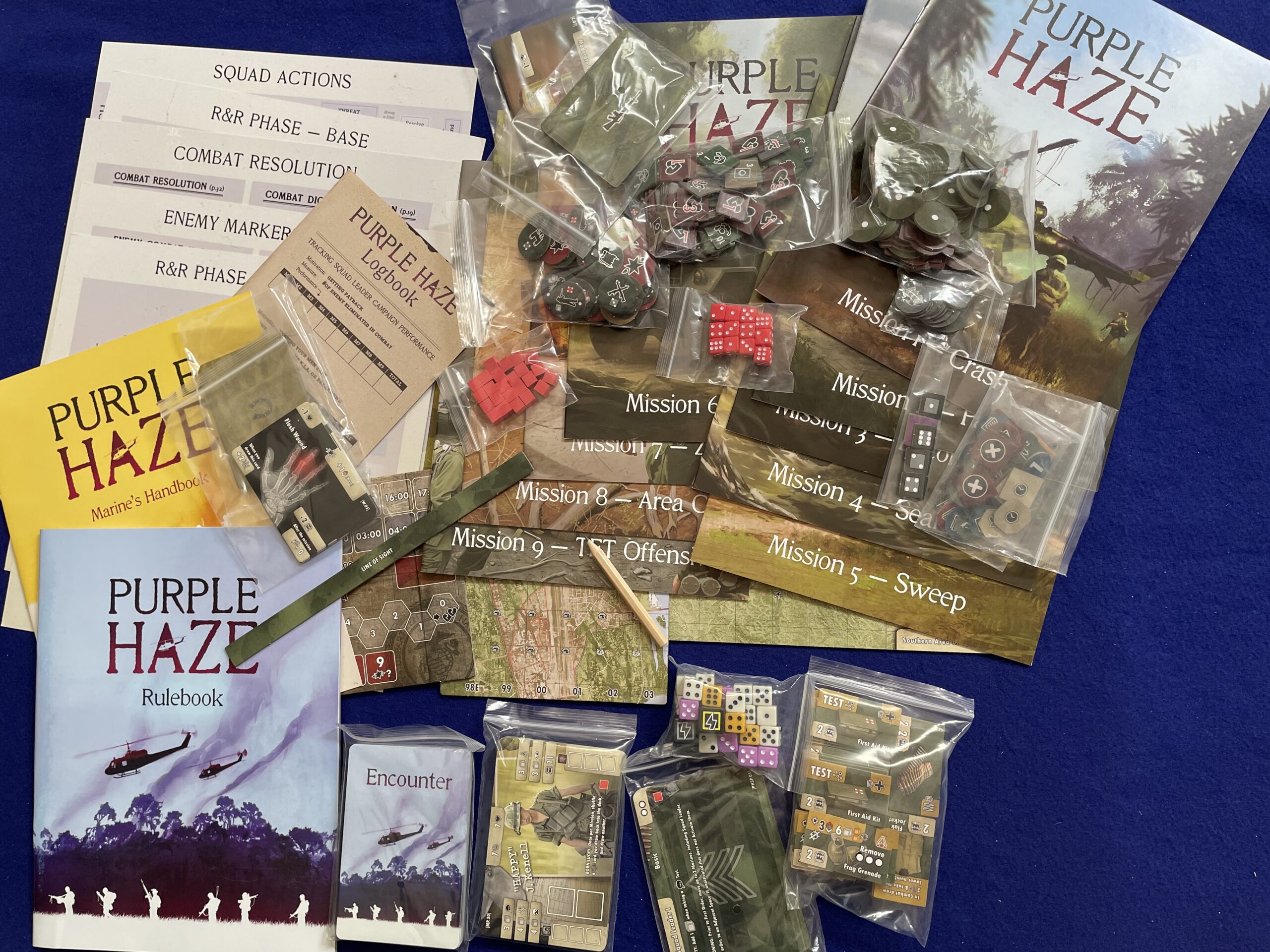
Much of the weight in the Purple Haze box comes from the many cardboard components, decks of cards, dice, and multiple rulebooks. My copy came to me (very) gently used with components bagged so I cannot tell you how many sheets of cardboard originally shipped.
Even if playing solo, players are going to need a fairly large table to accommodate Purple Haze. Having the whole crew over for a play? You need to book the dining room table…and maybe think about adding a table leaf for the day.
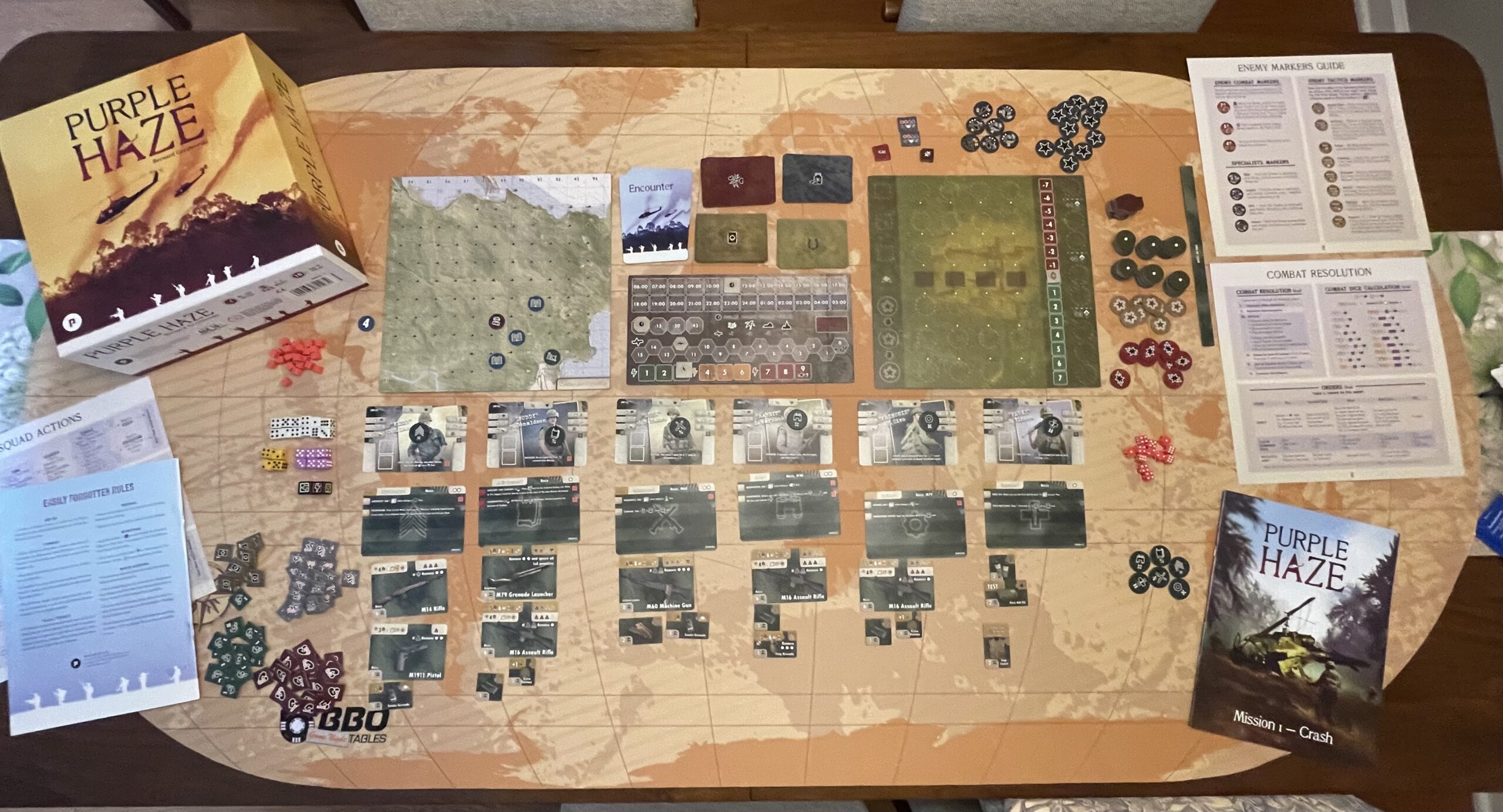
While individual scenarios missions can be played in roughly 90 minutes the publisher claims the entire nine-mission campaign of Purple Haze is playable in 720 minutes. That’s 12 hours for the math-challenged amongst us, which presents its own challenge in turn. Given Purple Haze is a table hog and there are many components and set up prep time is absolutely required for every mission (and between missions) the question becomes: Does one dedicate a group, table, and time to working through multiple missions or do you turn this into a weekly or monthly campaign with multiple setup/tear down requirements? Players who are in an RPG group often face the same questions and may be at an advantage in coming up with an answer vice grognards who face the same issues but often on a smaller scale.
The size of Purple Haze, from components to table space to set up to play time might scare some gamers off. That is why my copy came to me the way it did; the original buyer could not get their gaming group to face what outwardly appears to be a “heavy cardboard” boardgame. That is too bad for them but, of course, good for me. If one gets past the physical intimidation and starts reading the rulebook—and eventually playing—they will almost certainly discover a very interesting…experience.
“It’s scary, ’cause nobody tells me how to do anything ’cause I’m new.” (Chris Taylor, Platoon)
Amongst the 11 books or booklets in Purple Haze, two are for rules with the other nine for Missions (aka scenarios). One of the two rule books is the Marine’s Handbook:
This Marine’s Handbook is a supplement to the main Rulebook. It provides additional supporting information to understand how to play Purple Haze, and background resources for players interested in learning more about the subject matter. (Marine’s Handbook, cover)
Although labeling itself as a supplement, the Marine’s Handbook is actually the starting place to learn the rules for playing Purple Haze. After acknowledging that the main Rulebook “is quite long” [I can see many grognards rolling their eyes when I tell then the main Rulebook is only 64 pages] the Handbook tells the reader:
If you don’t want to read it [main Rulebook], that’s fine. You can read this Guide. It is a primer to allow you to begin to play the game. However, a caveat. It is necessary that at least one person playing the game has read the main Rulebook, and you have it close to hand in order to reference situations or explanations not covered in this short guide.(Marine’s Handbook, Quick Start Guide, p. 2)
The short (7-page) Quick Start Guide in the Marine’s Handbook is essentially a condensed rules set for Purple Haze. Although it does not directly say so, the Quick Start Guide should be the first rules read for any player, be it new, old, or especially one that is going to facilitate the game. In that sense—using RPG terminology—the Marine’s Handbook is a “Players Guide” and the main Rulebook is the “Game Master’s Guide” for Purple Haze.
Both the Marine’s Handbook and main Rulebook for Purple Haze are written in a very conversational manner. The pages are colorful with plenty of graphics and examples of play. Frankly, the length of the main Rulebook for Purple Haze is a bit surprising to me. The Quick Start Guide claims that, “Purple Haze is a relatively simple game in terms of basic actions, but – being a sandbox-style game – it needs rules to cover unlikely edge cases. Furthermore, the combat is tactical with a range of decision points” (Quick Start Guide, p. 2).
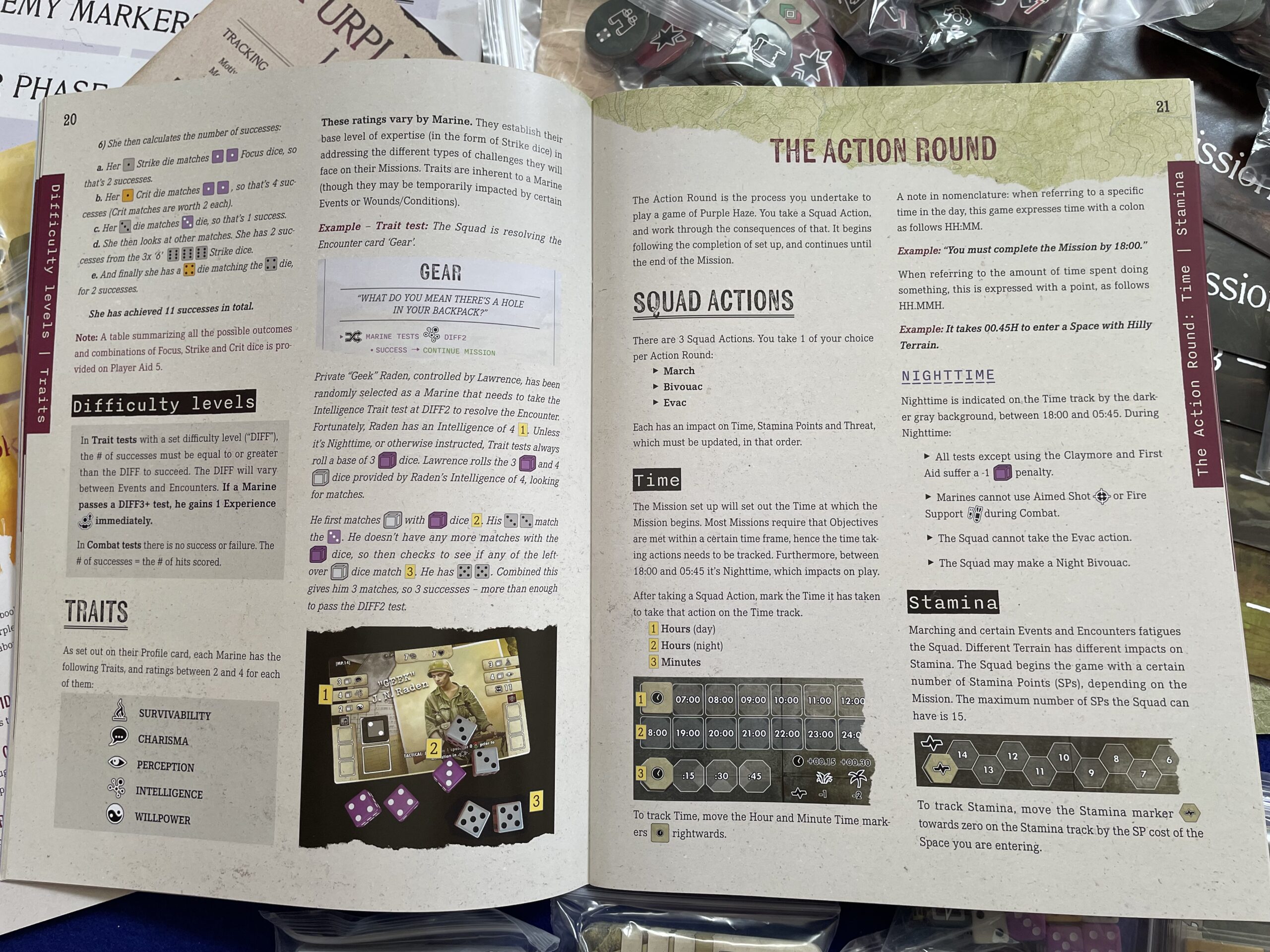
The main Rulebook for Purple Haze is long for the right reasons. A close examination of various chapters (“Parts”) of the Rulebook shows it delivers both rules and examples with an emphasis on use of supporting graphics. For example, the Combat chapter is 21 pages long but roughly 10 pages (i.e. nearly half) of those are used by the graphics, explanations of components, or examples of play.
“A lot of little firefights, ambushes. We drop a lot of bombs, then we walk through the jungle like ghosts in a landscape.” (Chris Taylor, Platoon)
I already mentioned that Purple Haze uses game mechanisms I more often associate with roleplaying games than wargames. To be more precise, Purple Haze creatively uses a variety of game mechanisms drawn mostly from RPGs or boardgames. There are no turns in Purple Haze but instead a series of Action Rounds. In every Action Round the Squad will take an action (March, Bivouac, or Evac). Each Action takes Time and may also use Stamina. The most basic Action Round, March, then calls for a Threat Test that then feeds into either an Event (if in an Event Space) or a possible Encounter if the Threat indicates. The other Actions—Bivouac and Evac—are variations on the March Action adding some steps or dropping others.
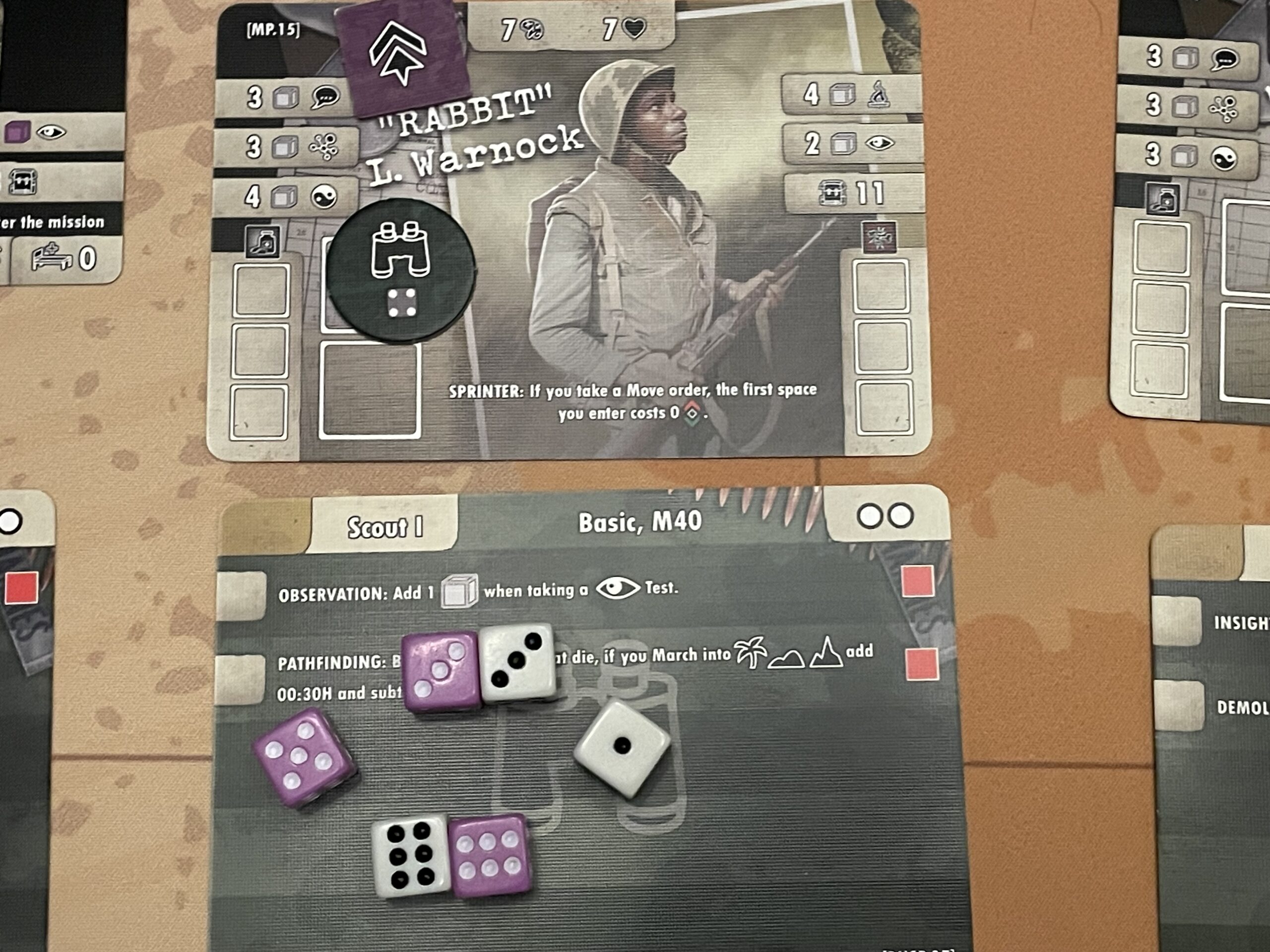
Events and Combat in Purple Haze are resolved using Trait or Combat Tests. A Trait or Combat Test is the real core game mechanism. A Trait/Combat Test is very much an RPG-like mechanism using a dice pool vice a combat odds table in so many wargames. To create the dice pool players take two or three purple Focus dice (3 if a Trait Test, 2 if a Combat Test), add in white Strike dice based on the Marine’s Trait and/or Weapon, and one might even add one or more orange Critical dice. The objective of a Test is to roll at least as many successes as the Difficulty. Yes, very RPG-like.
[In the example below, Rabbit is Point Man for the Squad. An Encounter calls for a Difficulty 2 (DIFF2) Perception test. The player will gather three Purple Focus dice (base for a Trait Test) then add two white Strike dice from Rabbit’s Perception Trait (the Eye to the right). Rabbit is carrying binoculars (not shown) which awards a bonus Strike die. No weapons are used and the Encounter does not direct any orange Critical die to be added. Rabbit rolls Purple [3, 5, 6] and White [1, 3, 6]. The Purple/White [3] rolls match as well as the pair of [6]; there are no other matches. The result is 2x Successes (each match is worth 1 Success) which meets the Difficulty rating. The Perception Test is passed and the Squad moves to the paragraph in the Mission Book noted for Success.]
“[To the radio] This is Two-Five, be advised. We’re moving out shortly. Out.” (Lt. Wolf, Platoon)
The most precious resource in Purple Haze is not your trusty M-16. It is not even your buddy on your flank or point. In Purple Haze the most precious commodity is…time.
Every Action in Purple Haze takes Time. Different terrain takes more time to cross. It takes even more time if you have Walking Wounded or if you are carrying a body bag with a buddy Killed in Action (KIA). Time works with Stamina (often called Endurance or something similar in roleplaying games) to create a palatable tension during every Mission. As a Squad you are always looking at the clock. Yes, we really need to Bivouac to recover Stamina but there simply is not enough time. We really should rest before dark as many attacks come at night but there is no time.
If you have ever played a Pandemic-series game or other titles like AuZtralia (Martin Wallace, ShilMil Games, 2018) that use a count-down timer of some sort (be it cards or a physical track) than Purple Haze will ring familiar to you. It is a great example of a game mechanism driving narrative—and very non-wargame like.
[Yes, yes, there are wargames out there that use “countdown”-like game mechanisms. Look no further than almost any 1944 Arnhem Bridge wargame. The mechanism exists in wargames but it certainly is not broadly used nor implemented in a manner like that seen in Purple Haze.]
“The village, which had stood for maybe 1,000 years, didn’t know we were coming that day. If they had, they would have run.” (Chris Taylor, Platoon)
Encounters in Purple Haze are the narrative, cooperative story-creation element of the game. In every area entered there is a chance of an Encounter or Combat. Encounters, when they occur, are resolved by drawing an Encounter card and simply executing the events noted. There usually is some sort of decision to be made and possibly a Test of some sort with Success or Failure driving the next narrative point.
The Encounter cards in Purple Haze usually call for the Squad players to work cooperatively and make decisions. Usually, but not always. In many ways the Encounters are a sort of “chose-your-own-adventure” where choices made often result in a Test and then some change in the game state.
Encounters, especially in early missions of Purple Haze, do not always seem meaningful. It is clear in some cases that the Encounters are merely there to direct the game in a certain direction. All of which is to say that in Purple Haze players have agency, but sometimes within severe limits. More often than not the players seem to be “along for the ride” in an adventure that is highly (but not necessarily tightly) scripted.
In another seeming nod to roleplaying games, the time between Missions of the campaign in Purple Haze is also important—and impactful—to players. While the Bivouac Action allows for a degree of recovery during a Mission, in between Missions there is much needed Rest & Recuperation (R&R) or even hospitalization. This is also the time Squad members may change, for example to replace a member Killed in Action (KIA) or if a member experienced a breakdown.
[At this point I have to question the replayability of Purple Haze. Yes, the individual missions have many possible sequences of events but once the entire campaign is played what has been spoiled? Ok, let’s be honest. With a 12 hour campaign game just how many times will a play group get through the entire campaign. Once through it (if ever) what are the odds of the group doing it again?]
“Yo! Saddle up! Lock and load!” (Sgt. Barnes, Platoon)
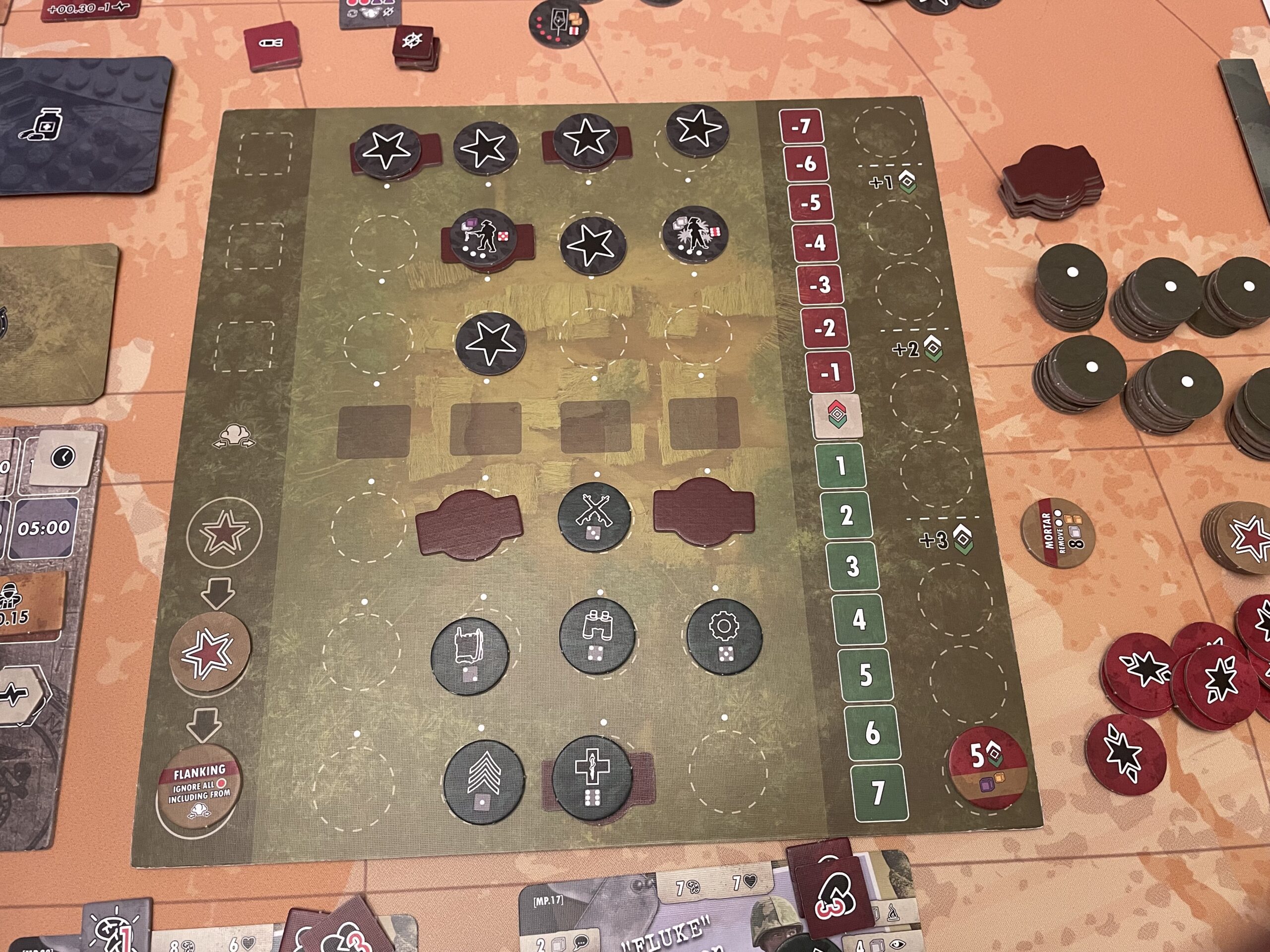
The rules for combat in Purple Haze are highly abstracted and quick-playing. For a game that touts itself as a “tactical-level campaign wargame” there is actually very little tactical in the combat resolution rules. This appears to be a deliberate choice by the game designers to focus on the story-creation aspects of play and not get bogged down by a detailed, time-consuming tactical combat sequence.
The combat rules work hard to create the aura of tactical combat with references to Cover, Line of Sight, and Tactics markers, but the reality is that combat in Purple Haze is highly abstract. Players will very likely find their firefights devolving into dashes for cover and using certain weapons to get Critical hit dice to knock away Cover so as to damage (wound) combatants faster. If you know nothing of infantry tactics in the Vietnam War era you are safe for little military knowledge is needed to fight in Purple Haze. Indeed, reading the three-page “Lesson 3 – Combat” entry in the Cherry Boot Camp portion of the Marine’s Handbook is overly sufficient.
Once again, the combat game mechanism in Purple Haze comes off as more RPG-like in detail than any sort of wargame. That is not to say it is an inappropriate focus; the need for a fast-playing combat system that advances the narrative—not a front line—is fully in keeping with the game design themes of Purple Haze.
Purple Haze can be played by 1-4 players. Playing solo does not call for any real changes in the rules but it certainly places much more burden on the single player. Given the Encounters and Mission entries are best revealed one line at a time not “reading ahead” is helpful. The enemy in combat is pretty much its own bot to begin with so fighting solo is not any different than a multiplayer cooperative engagement.
Interestingly, the main Rulebook for Purple Haze offers an optional rule named “Sapper mode.” In Sapper mode a player takes control of the enemy…and a bit more. Instead of drawing Encounter cards the deck instead becomes the Red Player’s hand to play as they see fit. Sapper markers (limit of 5) can be played to change a Test. The Red Player fully controls the enemy in combat to include deployment and combat decisions. Finally, the Red Player can also take over reading all the Event and Encounter text, becoming—as the rulebook says—”similar to a game master in a roleplaying game” (Rulebook, p. 55).
“Somebody once wrote, ‘Hell is the impossibility of reason.’ That’s what this place feels like.” (Chris Taylor, Platoon)
The side of the box for Purple Haze notes that the game is recommended for players ages 18 years old and up.
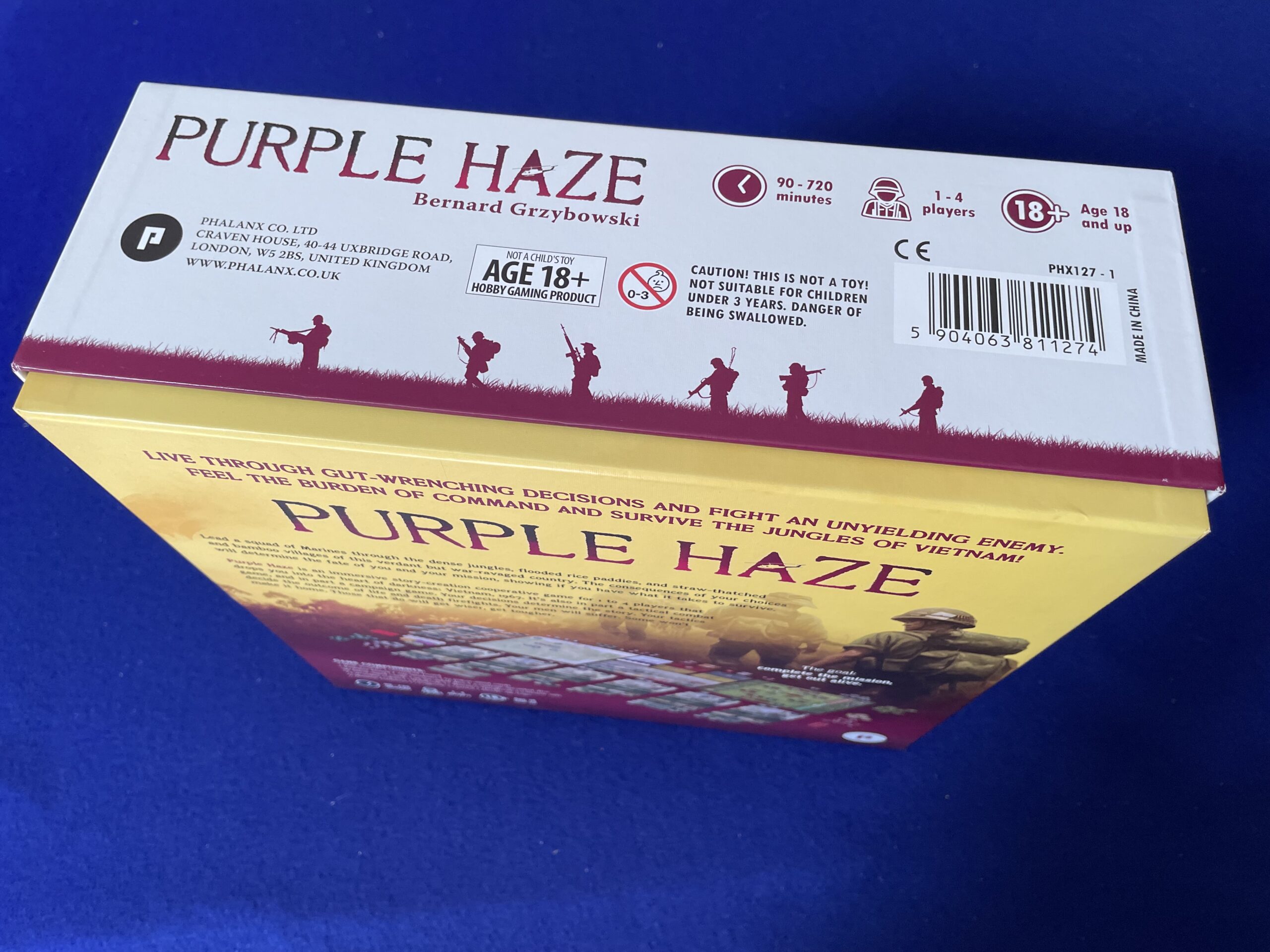
At first I thought the age limit for Purple Haze might be in deference to some EU rule intended to protect young impressionable minds from the horrors of military wargaming. The Design Notes, however, provides a different insight into the designer’s intent:
The script is written to capture how things might have been on the ground. Gritty, uncompromising, sometimes cruel. That said, even though this is an 18+ only game, we have avoided being excessively graphic, and make no reference to the sexual crimes that plagued the conflict. We do not feel a ‘game’ is the appropriate place to address such issues. (Design Notes, Rulebook, p. 57)
The age restriction for Purple Haze comes, as best I can tell, from a combination of theme and narrative. Thematically, Purple Haze certainly leans into the tragic stories of Vietnam. This is apparent from the manner the designers translated the resources (listed at the end of the Marine’s Handbook) into game mechanisms.
The narrative text in Purple Haze is, for the most part, written “in character” which to the designers means plenty of vulgar language and cursing. That is a choice; I hope the designers consciously made the decision to use such language as the story narrative sets the tone for the story the players are creating which, almost certainly, will take on that same narrative tone.
Given the tone presented, a campaign of Purple Haze is much closer in narrative tone to depictions seen in the movies Platoon (1986) or Full Metal Jacket (1987) than it is to a movie like We Were Soldiers (2002).
The narrative tone of Purple Haze is certainly the polar opposite to John Wayne’s The Green Berets (1968).
The designers admits in the Design Notes that Purple Haze is not a perfect representation of, but instead inspired by, Vietnam experiences. “Maybe one or two missions in an entire tour were as extreme as a standard Purple Haze Mission” (Rulebook, p. 56). Taken together with the wide range of outcomes from the Events and Encounters, the designers goes on to say:
As a consequence, the game is probably best enjoyed as an ‘experience.’ By all means, if you are so inclined, try to optimize your set up; undertake a rigorous analysis of which weapon provides the most fire power per Initiative and Load and equip your Squad accordingly. Playtesting has revealed there are more optimal set ups. But even the best Squads will come undone at some point, often through no fault of your own. That’s ‘Nam. (Rulebook, p. 56)
“I think now, looking back, we did not fight the enemy; we fought ourselves. And the enemy was in us.” (Chris Taylor, Platoon)
I started this piece by calling Purple Haze an “Adventure Wargame.” While the game approximately meets my basic criteria (“a wargame that uses RPG elements”) after exploring the game I am not as comfortable calling this title an Adventure Wargame as I was at the start. While Purple Haze is thematically about a war, the game mechanisms go so far towards Eurogame and roleplaying game design lineage that it is hard for me to call this a wargame even with my loosest definitions.
The designers comment that, “…the game is probably best enjoyed as an ‘experience'” is perhaps the best description of Purple Haze. This cooperative, immersive story-creation, tactical wargame is not “played” as much as it is “experienced.” That experience—a unique narrative exploration of the darker side of the Vietnam War—will not be for everybody. If you are a grognard looking for a tactical combat game set in Vietnam then Purple Haze is likely not for you. If your group is comfortable with highly abstract boardgames or roleplaying games and think you can handle a somewhat dark and grim wartime setting then Purple Haze should be considered. Be warned, however, that the time and space needed to play is considerable.
Sgt. Elias: What happened today was just the beginning. We’re gonna lose this war.
Chris Taylor: Come on. You really think so? Us?
Sgt. Elias: We been kicking other peoples a**es for so long, I figured it’s time we got ours kicked.(Platoon)
Thank you for visiting the Regiment of Strategy Gaming and riding with The Armchair Dragoons.
Rather than list a bunch of social media links, the easiest thing to do is to check out our LinkTree, which connects you to all of our various locales around the web.
You can also support The Armchair Dragoons through our Patreon, and find us at a variety of conventions and other events.
Feel free to talk back to us either in our discussion forum, or in the comments below.

