by
by Brant Guillory, 25 July 2025
Here at the Armchair Dragoons, we make it a point to address middle of the wargaming Venn Diagram where hobbyists and professionals overlap. Tools, processes, techniques, and even whole games are shared across those two communities1. Sebastian Bae’s Littoral Commander series was designed for the pros but enjoyed by hobbyists and the upcoming Battlegroup Clash games looked poised to do the same, building on the foundation laid by (among others) Firefight in the 70s. My original Warfighter series in the mid-00s was an attempt to do something similar, though with nowhere near the same level of success. Hobby games as diverse as the Holdfast series, the venerable Battle for Moscow, the topical A Distant Plain, and even ROOT, have all hit the table in recent PME courses.
Four Divergences
1. Granularity ≠ Realism
2. In-Game Logistics
3. Intel & Recon
4. Stretching Old Models
But while the physical form of the games (counters/blocks, maps, even dice) are outwardly similar, there are significant differences under the hood. In some cases, the purpose of the game is the key difference – training/learning is a very different context from playing for enjoyment, or personal enrichment when engaging with a topic. But that purpose can also result in some more manifest changes in the way the design of the game is executed.
There are four significant places where hobby wargaming’s overlap with professional considerations start to fray.
First, there is often a confusion granularity with realism. Hobby wargames will frequently advertise themselves as being “realistic” models of combat or some form of unit-&-force management when in fact, they are just tracking things to an unnecessarily level of granular detail. Tracking ammunition by the caliber of the round or tracking individual company of battalion commanders in a division- or corps-level game is an unnecessary level of detail, and unrealistic for the echelon at which the player is purporting to act. And that level of granularity is no more or less realistic than a game that abstracts it out. It provides a greater level of detail but does not add any significant level of realism, given that concerns at those lower echelons would be handled by intervening layers with command rather than the level of which will play is operating the game.

Now, the professionals have their own issues with the “granularity = realism” fallacy, but many professional wargames are also trying to incorporate a wider range of military staff sections (especially the loggies!). They also incorporate multiple echelons of players, which gives rise to higher degrees of specificity at lower echelons to roll up the chain for aggregation. In giving those multiple echelons an opportunity to exercise their reporting chains, higher levels of granularity is at least partially defensible. Nevertheless, it’s rare to come across a professional wargame under development where anyone suggests with a straight face “hey, we should take out some of that nit-noid detail to streamline the game!”
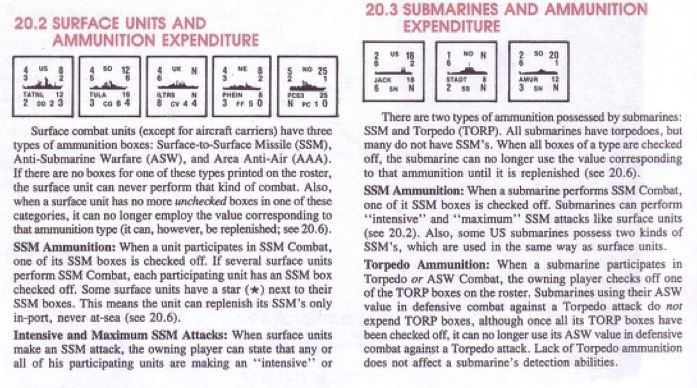
But where the levels of granularity & detail can plausibly enhance the realism of a professional game, what it enhances for the hobbyist is the bookkeeping.
Second, logistics are treated as a fairly blunt instrument (for a longer article on this, see this one).
Logistics tracking in wargames is frequently employed primarily as a limiting factor that serves as a check on what the player might try to do, so they would be unlikely to act in an unfettered manner, given the realities of food, fuel, and ammunition.
Some games abstract supply issues out to mere paths on a map, and assume a confident logistic staff would provide the supplies so long as a usable route is made available. Other games require the actual movement, and/or stockpiling of, hypothetical levels of supplies. Some games will break those supplies down into fuel & ammo, but rarely much deeper than that, lest they start to suffer from the granularity problem mentioned above.
However, almost no hobby wargames deal with vehicle maintenance recovery, broken vehicle repair & replacement during or between combat, or any particularly recognizable usage of medical and casualty evaluation procedures, or personnel replacements.
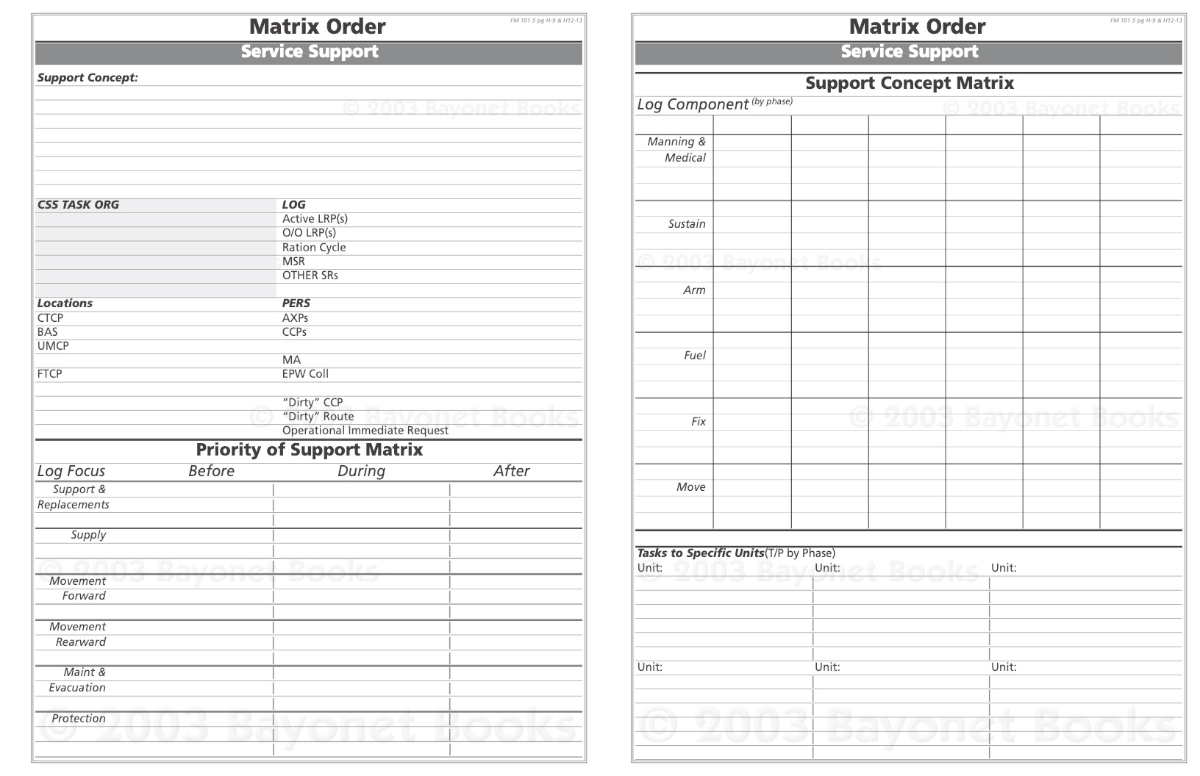
Logistics management for professionals involves a wide variety of routes, locations, rear area security, asset management, and external unit coordination, especially between battles rather than during them. Most hobby wargames just not equipped to operate in those time periods between all of the shooting. On the professional side, there is at least an expectation that the logistics missions will be planned, disseminated, and rehearsed. Given the presence of staff officers performing in those logistics roles, this is not unexpected. It is rare that those logistics actions — MEDEVAC, emergency resupply, between-battles maintenance & recovery, personnel replacements, etc — are gamed out in a “competitive” fashion where the outcome of those logistics tasks are dependent on the performance of the players in the wargame. But given the opportunity for the professionals to (at a minimum) train their planning processes, the incorporation of assets, and their presence on the map, will far exceed what’s to be found in a hobby wargame.
Third, hobby wargames very rarely get the recon-&-security fight correct. There are two main reasons for this.

The first one is that the enemy order of battle and force composition & disposition is known as soon as you open the box. While there may be some units on the countersheet left out for any particular scenario, players already know the maximum universe of possible options for their opponent simply by cracking the shrink wrap on the box. Therefore, much of the recon and counter-recon battle is made irrelevant because there’s no need to discover what forces the enemy has at their disposal. Your opponent isn’t ‘swapping in’ units from another game that were never present on the countersheet (ASL as the obvious universal exception here) and therefore the task of identifying your enemy force composition & disposition is already dramatically simplified.
Simply put: there’s no surprise regiment of Chechen ‘volunteers’ suddenly appearing in the assault on Izyum in Ukraine if they weren’t already in the box.
Second, much of the recon mission is built around attempting to identify and predict the enemy’s course of action. This often involves applying the enemy’s expected doctrinal performance to the existing map, and then trying to identify certain puzzle pieces on that map that allowed you to extrapolate the rest of his formation, direction, and disposition: the rest of the puzzle would appear. Moreover, using this template to develop the enemy’s most likely/most dangerous courses of action results in a valuable tool that the intel officer can provide to the commander — the ability to template both areas to observe (for indicators of differences in course of action) and to template probably engagement areas (based on commonalities in the courses of action).
Given that hobbyists are not bound by any sort of doctrinal employment, simply identifying particular assets at a certain place on the map is insufficient for trying to predict or extrapolate the rest of the enemy force. This AAR thread about Objective Nuremberg perfectly exemplifies this issue and is completely outside the doctrine, deployment timelines, and mission sets of the units in the discussion
First of all, he set up the U.S. Armored Cavalry regiment way up front. This resulted in him losing all three squadrons on turn one, which is why I normally don’t do it. The ACV squadrons are just too valuable to waste as speed bumps. I use German territorials for that.
Hobby wargamers are not focused on doctrinal deployment and employment of their forces, which negates the ability of the recon assets to find the edges of the puzzle, and the need to fill in the middle of it based on what we expect the resulting picture to be.
Finally, there is a growing trend among current hobby wargames to confuse modern-day operations with 1980s-era, Cold-War-Goes-Hot (CWGH) operations and treating them as simply an identical extended scenario.
As one professional wargamer / staff school instructor likes to point out: WW2 is as far from us as the US Civil War was from WW2, and 1985 is halfway back (40 years) to WW2 from today.
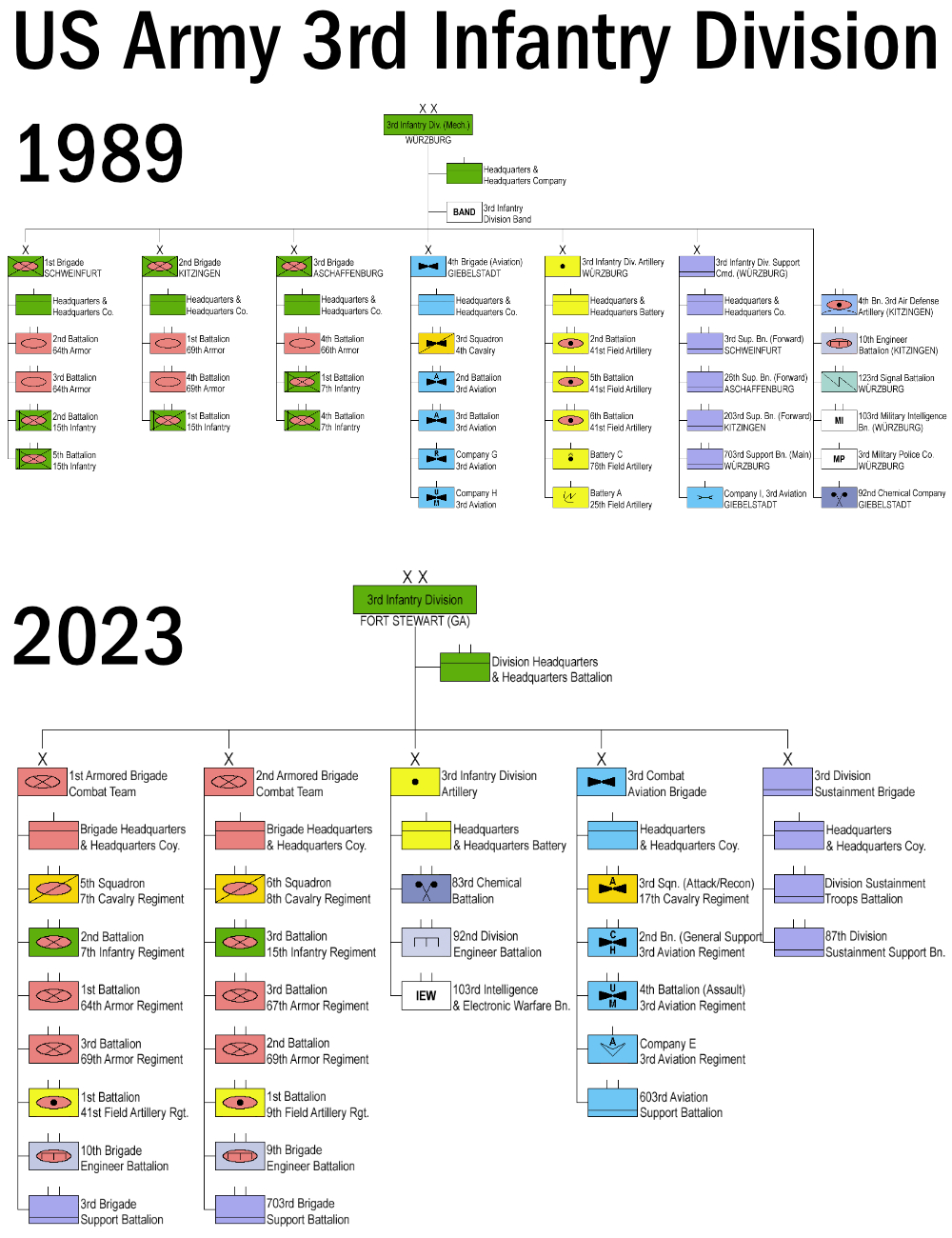
This poor interpretation likely comes down to a simple recognition of similar hardware. There were M1 tanks back in the 1980s and there are still M1 tanks today. So therefore, we obviously have the same scenario 40 years later. Similarly, the Russians had T72s and T80s back then, and still have some today, so therefore it’s just the same scenario!
This reinterpretation of CWGH wargames into the modern era ignores a variety of technological changes over time, from the original 105mm M1 “slicks” up through the 120mm M1A2 digitized tanks today. It also ignores all of the other C2 advancements in digital systems and information awareness that didn’t exist 40 years ago. It ignores all of the intervening developments around the globe in DOTMLPF2 functions that have fundamentally changed the way in which forces operate. It ignores higher echelon changes in orders of battle at the brigade and division levels, such as changes in recon units, engineer assets, and upgraded artillery. It also ignores a huge number of situational awareness assets such as loitering drones, ground surveillance, radar, EW capabilities, and the like, never mind cyber warfare, OSINT (especially from scrapable social media) and geo-located digital footprints.
From the 1980s, looking backwards 40 years brings us to the tail end of World War II and there is no one out there that would realistically make the claim that the army that fought at the end of World War II was comparable to the army of 1985. But we look at games from 1985 and because of the presence of some similar hardware, want to project those games 40 years into the future, even though we intuitively know that’s not a realistic comparison.
The pros have their own challenges in these regards, but for very different reasons. The first is one of classifications: who has access to the latest info, from where, with what level of detail, and to use for what purposes? Open-source intel can give players a lot of information to run with, but given the current-events, real-world battlefields that we’re seeing with their ever-changing tactics, techniques, and procedures (TTPs), there’s going to be classified data that is more ‘actionable’ for the pros that the hobbyists will never get, so the fall-back plan is a CWGH game with recognizable hardware in the countermix. The second issue here is that while the pros have an intuitive understanding that tomorrow’s wars are very unlikely to look like yesterday’s, there an acceptance that projecting “what’s next” is imperfect at best, and usually wildly bad.
So while the inroads made in the professional communities with the tools, techniques, processes, and (especially!) the craftsmanship of hobby wargames has accelerated in recent years, the adaptation of those tools, techniques, and processes are divergent from where hobby wargames find themselves. Attempting to retrofit those professional considerations back onto a hobby wargame might gain some cachet among a subset of hobbyists, the end result is a fundamental change in what’s being played and (more importantly) how. The flip side is also true: professional gamers have a wide variety of hobby games to use and adapt, but need to acknowledge their limitations and make peace with an imperfect model in an environment that conditioned to expect maximum data-overload into the underlying game engine.
there’s plenty of other discussion professional/practitioner discussion in our forums
and we have a dedicated thread for the Battle Lab columns, too
Thank you for visiting the Regiment of Strategy Gaming and riding with The Armchair Dragoons.
Rather than list a bunch of social media links, the easiest thing to do is to check out our LinkTree, which connects you to all of our various locales around the web.
You can also support The Armchair Dragoons through our Patreon, and find us at a variety of conventions and other events.
Feel free to talk back to us either in our discussion forum, or in the comments below.