
 by
by Brant Guillory, 16 June 2025
One Hour World War II is a good game. It’s not a particularly deep or complex game, and as an accurate representation of the scope of World War 2, I think it does leave a bit to be desired. But as a fun game to gather some players around a table and bang out a war? It’s great.
Introduction
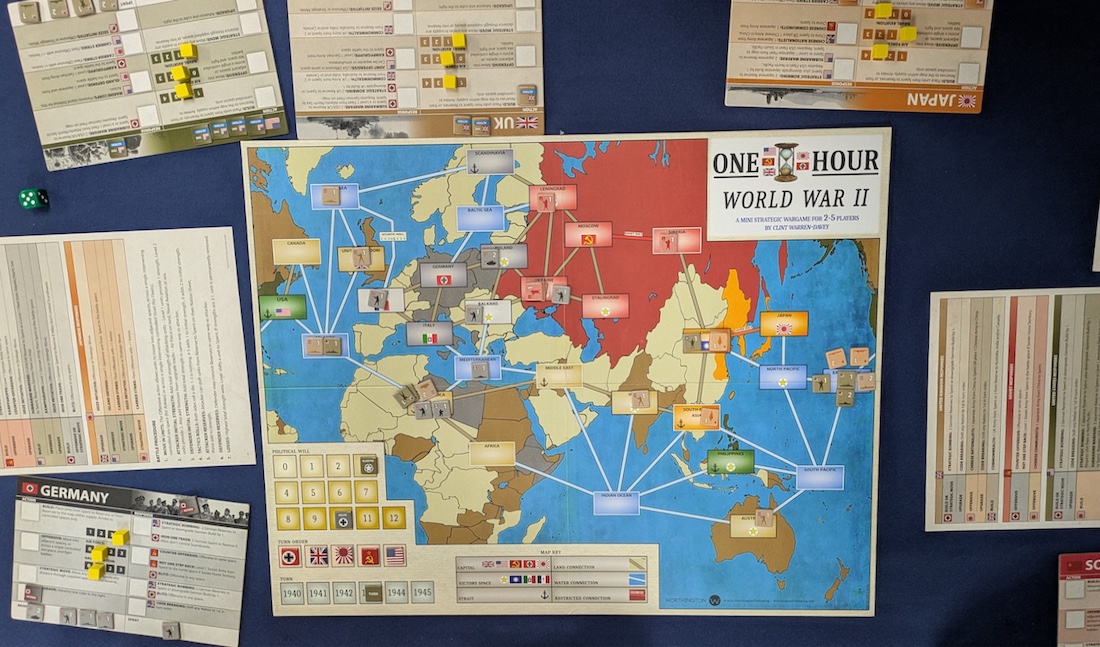
One Hour World War II bills itself as a quick-playing game (it’s right there in the name) that gives you the scope and scale of World War 2 with minimum overhead. In that, it is wildly successful. Units are “armies” and “fleets” and the scaling is such that the Italians only have one of each, and they’re both handled by the German player. It’s a point-to-point map with key locations that are reminiscent of Risk, but including certain ocean regions, as well as a few special rules (straits for naval passage, coastal defense, Soviet-only transit from the Urals to the Far East).
Overall, the map and unit scale intertwine nicely into a grand strategic game played at the national level, and set up to easily seat 5 players (US, UK, Soviets on the Allied side, and Germany & Japan for the Axis). Each turn covers a year of the war, starting in 1940 (so Poland already belongs to the Germans), and players take multiple actions within each of those years.
There are 5 players in the game, which means that the Italians, French, and Chinese are all controlled by the Germans, UK, and US, respectively. There are limitations to how those units are used, with the Chinese being especially constrained.
The game includes a mounted global map with a basic color scheme, and some on-map tracking of shared information (political will, turns/years). Each player has a mat that includes their specific action choices, as well as their off-map units not yet put into the game, and those “spent” and recovering from combat losses. Players may upgrade the outcomes of some of their actions, and these increased capabilities are also tracked on the player mats. There’s one sheet of counters with some basic silhouette artwork for the on-map units, and national insignia for their action chits. The game comes with dice, but it’s not like we don’t all have a mountain of d6’s laying around. All told, this one pretty easily fits on most dining room tables, and will fit 5 players around a normal 2-1/2 x 6 folding table, but with a few players stretching to move things on the map.
click images to enlarge
What you have is an elegant combination of strategic scale, national-level production/investment, some geographic-specific special cases on the map, and country-specific characteristics.
Action & Response
Ultimately, players are trying to reduce the political will of their opponents, primarily through the capture & holding of key locations on the map. Political will is the “scoreboard” that determines victory, and those points are scored based on points on the map. Both sides – all 5 players – need to get used to the idea that your political will is going to go down, mainly because there’s no way to bring it back up.
The core mechanic of the game is an action/response system in which players will use an action chit to choose which action they wish to play on their turn. Based on that choice, other player then have a menu of responses from which to choose, and a specific order in which those decisions get made. The order is important, too, as players have to anticipate what the subsequent players responses might be in order to preempt them.

Players have a limited number of action chits, and every action and response uses one of them, so part of the decision-making each turn includes planning what the player wants to accomplish, while holding space for possible responses-of-interest that might be preferable to the original ‘action’ plan at the start of the turn.
Players do not commit their action chits ahead of time; there’s no ‘scripting’ of your year as it starts. Moreover, some players (especially the US) gain action chits as the war unfolds, representing the shift to the wartime economy after the US joins.
The action/response system is quite clever, as it does two things simultaneously: it keeps everyone around the table engaged throughout the turn in case they have an opportunity for a response based on a player’s choice — allies can respond to each other’s actions, too! — and it provides a wide array of choices on the decision tree with minimal overhead, especially compared to something like a COIN game. While players choose their primary action in the order specified on the map (and this can be changed through player actions), the responses are selected in the order they are printed on the player card, which may exclude certain players altogether.

In addition to the action chits used for ‘standard’ actions, each player has a handful of special action chits that offer them a unique capability specific to their nation. You do not need to use these to play the game, but they do offer some interesting national flavor to the game, and the players to better embody the specific nations they’re commanding on the map.

The downside to these special actions is that they replace one of the other action chits you’d normally play that turn, so using one of them limits the number of other options you could choose. However, the ability of other players to respond to your special actions is severely limited, which can give you a bit of a masterstroke option with a well-timed special action chit that wreck havoc on an opponent with almost so ability to respond until their turn comes up.
Shooty-Bangy Stuff
Combat is not complex. Armies/fleets only have a value of 1-2, so the math is pretty basic. Attackers commit their forces, augmented by any features on their player mats (aviation is the main one). Defenders will then commit forces, again augmented by any player upgrades. There’s a “tactics roll” that can add another 1-2 points to each side, and after that tactics roll, the attacker, and then the defender (in that order) may commit units from their reserve (held off-map). There are some limitations based on the ability to trace supply, or allied armies reinforcing each other, but nothing overly complex. Crucially, the combat sequence gives the player the option to add forces to the battle after the randomization of the die roll, which itself is not a huge swing in the overall combat value.
The net effect is that players who plan their attacks with a large force differential in their favor, and keep a reasonable reserve force on hand, tend to win more battles. The game rewards good planning and conservation of force – as it should! The challenge is that setting up those favorable odds and retaining a meaningful reserve gets harder as the game rolls on. The limited random nature of combat can sometimes feel too deterministic, as something like a valiant defense of Wake Island would be difficult to replicate in this game. But then again, that valiant defense would be only one of several battles fought during the year across the vast expanse of the East Pacific space.

Ultimately, planning and executing combat breaks down to balancing the ability to win fights, especially by committing reserves held off-map on the player board, with the ability to take and hold key spaces on the map. There will never be enough units to hold the entire map, so don’t even try. However, you still need to hold key victory spaces, and units tied down occupying those boxes on the map are not available as reserves to reinforce combat being fought elsewhere.
Much like your committal of action chits, there’s a balance between proactivity and reactivity. To quote the famous “Everything I Need to Know I Learned From Playing Blue” MtG player’s guide from the mid-90s: Never tap out. If you can end the year with units in your reserve pool, you did OK.
So How Does A Turn Flow
At the start of the turn, the German player has 3 action chits. There’s a 2 strength army in Poland that could be used to either reinforce the fight in Ukraine, or take a shot at Leningrad. There is also an army in the Balkans that could be used to reinforce Ukraine as well. Although there are allied forces in North Africa, the Italian fleet in the Med has them bottled up for now. So the Germans need to choose between (1) offensive in Ukraine with a reinforcement, (2) an offensive in Leningrad, (3) a build option increase combat power, (4) or an upgrade to improve their air support . . . with only 3 action chits. And assuming they don’t use any of those chits for responses.

Now, the German player could open up the turn with an offensive in Ukraine, and immediately follow up with a “blitz” response for a second offensive. But in between, the Soviet player will get a chance to respond first, and commit an action chit to stifling the first offensive with either a counteroffensive, or “Not One Step Back”. If the German player chooses to move additional forces onto the map, or build some reserves before the fight, then that’s all three action chits spoken before the UK/US players have even made a move.
Now, the German player doesn’t get to use all 3 at once. The flow would be:
- Use an action to Build, to put some units on their mat as reserves for upcoming battles
- The other four players take their first moves of the turn, but the German player does not respond to any of them, to conserve the action chits
- German player conducts an offensive into Ukraine, and regardless of the Soviet response, chooses a “Blitz” response of his own to immediately conduct another offensive there and hit the Soviets twice.
- Other players continue to make their second / third moves, and the Germans are sucking it up because they’re out of action chits for responses.
The Full Scope of the War
As stated at the start of the review: “One Hour World War II is a good game” with the caveat that it depends on what you consider to be “good”.
 It’s a fun, lightweight game that easily scales up to 5 players and keeps them engaged throughout. It plays in a single session, and once the players are comfortable with the rules and are able to think ahead slightly for the action/response system, it does play within the “One Hour” in the title. For a new-player learning game, expect at least 2 hours.
One Hour World War II gives the players a feel of directing the grand strategy of their countries on a truly global scale, and leaving the details of the fleets, army groups, and even theater actions to the respective field commanders. And for a game of this scale and complexity, that’s a solid accomplishment.
Where One Hour World War II falls a bit short, however, is in trying to accurately recreate the complete scope and scale of everything that happened throughout the war. If players used their action chits to try to recreate the historical events of the war on a year-by-year basis, and just assumed the actual historical outcomes occurred on the map (the 1941 successes of the Germans in Russia, for instance) rather than rolling the dice, I’m not sure there are enough action chits to actually accomplish everything that actually unfolded historically.
This is particularly noticeable for the Japanese player early in the game. The Japanese have 2 action chits each year for the entire game (never goes up or down), which is nowhere near enough for their 1940-41 historical actions, which would include offensives in China, Southeast Asia, the Philippines, and at least one (if not both) of North and South Pacific in each of 1940 and ’41. That’s at least 4, sometimes 5, actions in a given year, for which the Japanese player gets 2 action chits/year.
So historically, the game does fall a bit short in attempting to recreate the history of the war, as it doesn’t give players the tools needed to fight the full scope of World War II. Moreover, since the game ends in 1945, there’s no real opportunity for the Axis player to drag things into an extra year in an attempt to sap Allied political will by extending the war to the point that some of the Allies might sue for peace under conditions that were “good enough”. If you get to 1945, and the Allies still have not pierced German territory, would the Germans still run up the white flag? Might the Russians claim Poland as “good enough” and just try to box in the Germans, especially if the French are happy being liberated and just want to get back to baguettes and wine?
As a game, there is also the issue of the consistent buildup in action chits for the US player, without even the possibility that they could be delayed or not implemented, that gives an air of inevitability that the should the Allied players just hold serve through 1943, then 1944—and especially 1945—will result in a tidal wave of green weenies spamming the map and over-running everything. While this is mostly historically accurate in the war production buildup in the US — where we were cranking out B-24s at roughly one every hour — the game assumes that the same buildup happened with zero hiccups, and that Pearl Harbor still happens in 1941 and ensures the US entry into the war in 1942.

There are two house rules that we’ve implemented that help mitigate both of these action chit issues, and either could be used independently of each other.
First, we changed things so that each player can use of their special action chits each turn/year in addition to the normal actions they have for the turn. Each of those chits only gets to be used once, so after the special action is played, it’s discarded. Additionally, each player only gets one special action per year.
This gives the Germans an extra action every year; it gives the Japanese an extra one in 4 of the 5 years. It also does not overload the Americans, as they only have 3 special actions. This change has definitely made the game feel like it’s a bit closer to the history.
The other change is mostly about game balance, where each year you roll a die for the US player’s action chit that would get added that year. On a roll of 5-6, push it back one year. This might result in the US player living on fewer actions in 1942, or even 1943, but then suddenly getting 3 more actions in 1944 and piling on. If you chose to implement this rule, however, you almost have to extend the game into 1946 (depending on the Axis situation).
Admittedly, both of those house rules cut into simplicity at the heart of One Hour World War II, which is one of the key selling points. They also both threaten to turn the game into Ninety Minute World War II, which doesn’t quite roll off the tongue the same way.
The Bottom Line . . . At The Bottom
It’s what we said up top, too: it’s a fun game.
There’s interplay between the Allies, especially with the US Lend-Lease option as a response to other Allied actions. The Axis players can do a lot of damage early, and without expending too many reserves, but get stretched quickly. There’s a push-and-pull even within each year, never mind from year-to-year. At first, some things might seem slightly out scale as strategic moves start zipping units across the map, but when you realize each turn is a full year, it clicks back into place.
But beyond the fun factor will be each player’s personal assessment of how “well” this game captures the historical actions & possibilities of World War II. Given the significant limitations of the number of action chits (not the action choices themselves), and the mathematical mismatch of actually recreating everything that happened historically within the constraints of the game, this one seems to lean more toward a World War II-themed Risk variant with some specific country flavo(u)r than a lightweight version of Axis Empires, or even Axis & Allies. It all comes down to what kind of game you want to play.
Thank you for visiting the Regiment of Strategy Gaming and riding with The Armchair Dragoons.
Rather than list a bunch of social media links, the easiest thing to do is to check out our LinkTree, which connects you to all of our various locales around the web.
You can also support The Armchair Dragoons through our Patreon, and find us at a variety of conventions and other events.
Feel free to talk back to us either in our discussion forum, or in the comments below.


