
 by
by Peter Robbins, 30 March 2026
Donbas ‘43 by WDS is an operational level hex and counter based computer wargame depicting the very important offensives that took place in tandem with Kursk as well as immediately following in the summer of 1943. This wargame covers the major actions of the Southwestern and Southern fronts of the Soviet troops during WW2 as they started to gain a strategic edge over their German counterparts. Stalingrad is a recent victory in the Soviet collective mind, and Kursk is well on its way to be an equally decisive action. First and foremost, the Southern Soviet army groups need to “fix” the Germans in the area so that they can not reinforce Operational Citadel near Kursk. Second, in the fully prepared Don Basin offensive, as July becomes August of 1943, the full tide of Soviet improved doctrine and capabilities emerges from the Don river and moves on towards the primary first target of the Dnieper to the west! Onward to victory! Or a shameful defeat? You get to help decide in Donbas ‘43.
What’s In The Box?!
I will start with my obligatory stitched together listing of all of the scenarios provided in the game.

click images to enlarge
I like how the scenarios are named with the full date followed by the index of that scenario for that day. Donbas ‘43 has one of the better organized lists of scenarios of any WDS game. It’s just very easy to determine what time-point in the overall set of offensives you are traipsing into as you attempt the challenge of finishing them all to completion. I dare you. Finish them all. It’s like a burrito competition to get a t-shirt, but in this case, no t-shirt, but an equally full belly of wargaming peace and tranquility for all.
You also get a plethora of guidance in the form of the following guides: Getting Started, User Manual, Designers Notes, Summary Info, and The Operational Art of 1943. All of which are greatly detailed in nature.

The combination of the Designer Notes and The Operational Art of 1943 guides are spectacular. I mean this sincerely when I say, these alone are worth the price of admission. I always consider WDS wargame titles to be some of the more educational wargames on the market, and Donbas ‘43 is no exception. There was a lot of effort put into researching this game, and it shows. Having done my own cursory bit of research on the topic, I did find a few books that bookend the time-frame a good bit, but it’s not as easy as you’d think to find material specific to the offensives depicted in this game.
These large trodding battles are oddly glossed over by English speaking historians, as an almost impending doom upon the shift from Stalingrad and the ill-fated Kursk as if to “hurry up and get on with” the impending crossing of the Dnieper. In reality it took months for Soviet successes to take full effect (and at devastating losses in some portions of the front). Maybe these battles are just overshadowed by the impact of Kursk and Stalingrad, which of course absolutely deserve a hallowed place in our history books.Sometimes equally if not more important offensives that took place in tandem are sometimes overlooked. Thankfully, WDS Donbas ‘43 does significant justice to covering a lesser covered region of the massive eastern front of ‘43..

We are all very lucky that WDS have also posted ALL of the documentation provided with the full game on their website! I’m always amazed how much WDS offer the public freely on their game websites. You fully get to see a transparent view of what you get in the game’s virtual box. They also tend to have at least one Demo for each of their game series. Apropos to this latest offering, there is a smaller Mius ‘43 game that is offered as a FREE DEMO of the Panzer Campaigns series, and that fits nicely in with Donbas ‘43’s very topic, as Mius was a subset of the overall Donbas operations of Summer of ‘43.

Along with all of that library of information and guidance, you receive a full on Order Of Battle Editor. The OOB editor allows you to hone down the OOB to a sensible size of available troops. This is particularly useful when you use the sub-map editor to take an area of the large Donbas map and depict a smaller front over a shorter period of time for your own custom built scenarios.

Above is the full Order Of Battle at the time of the July prelude near Izyum.
Below is that same Order Of Battle in-game for the Izyum Offensive scenario.

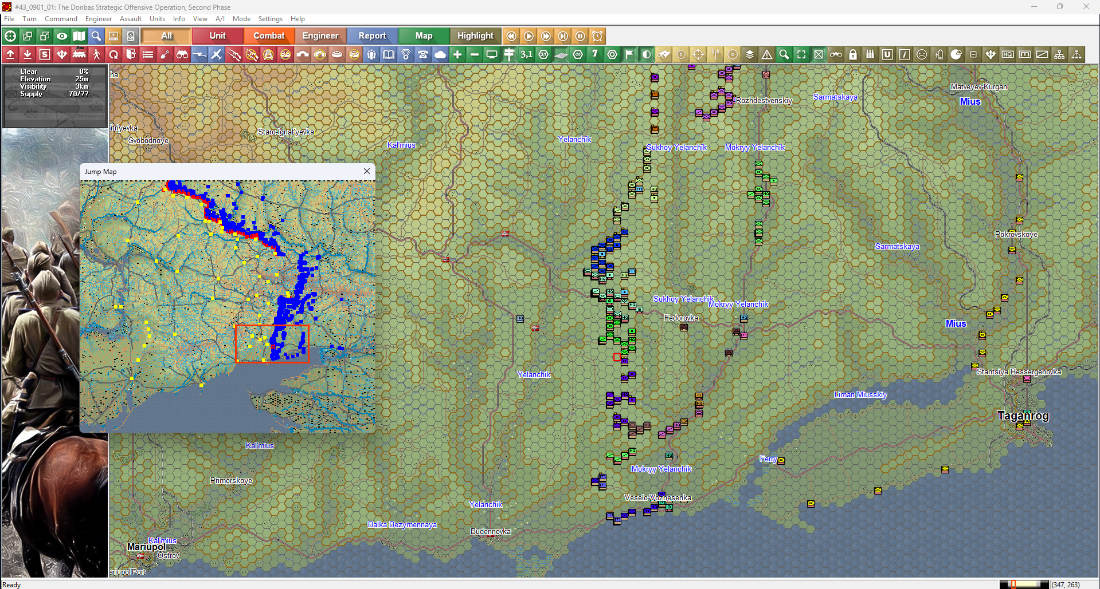
The jump map mechanism on the bottom left shows the extent of the front involved.
If you care to, you can use the sub-map editor to whittle down a map to the size you want for a smaller custom sized area for a new scenario of your own making, as shown below. This also happens to be just a way to take a really close look at the unadulterated beautifully rendered Donbas region designed by map maker Bill Peters; an amazing design.
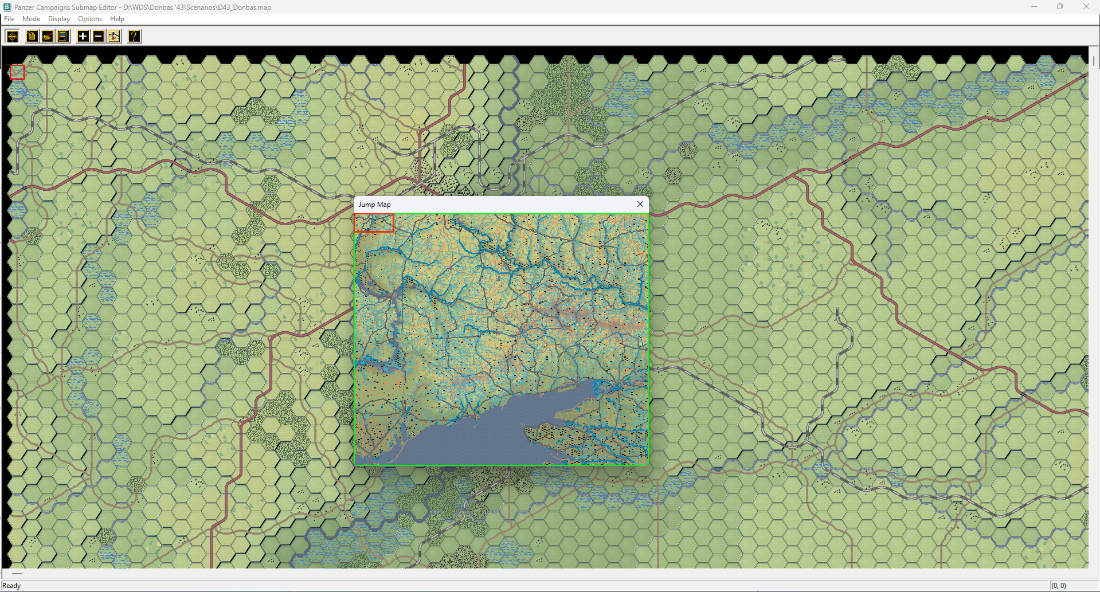
The full sized Donbas map shown above is an absolute work of art. Bravo! Very easy on the eyes.
Specs
- Game: Donbas ‘43
- Developer: WDS (See End Of Designer Notes For Full Credits)
- WDS Release: March 13th, 2026 on WDS Store
- Genre: Operational, Eastern Front, WW2.
- Scale: 1 hex = 1 km, 1 turn = 2 hours, battalion and company size units.
- Topic: Soviet Offensives from the Don to the Dnieper, Summer of 1943, South and Southwest Fronts.
Mechanics & Gameplay
The best resource to learn the mechanics of the overall game is of course the very well detailed User Manual, which stands as the series user manual for the Panzer Campaigns game engine. A tried, true, and well put together game engine it is. With this in mind, I will not regurgitate the whole manual. Read it for yourself on the website before purchasing the product. I will however give an overview of which controls you use most often in a given turn; in case you’ve not dived into the Panzer Campaigns series in particular (yet).
One thing I’ll call out positively mechanics-wise right away is, Thank The Lord Almighty, the Jump Map can remain up and still be clicked on. This is one feature I absolutely love about the latest iteration of the Panzer Campaign series, and it is very well needed for some of the larger scenarios! Click anywhere on the jump map, then keep it up in the corner. Voila, an instant teleport mechanism. Allows you to stay zoomed in to taste, and then still keep a wide-angle lens view of what is going on in each area of your front lines. I beg that this feature make its way into all of the WDS series, I digress.
The Basics
Let’s use the backdrop of the 12 turn scenario Guroravka (Noon, 17th of July 1943) to talk through the mechanics of WDS Donbas ‘43.This scenario is a corps level portion of the much larger army groups sized offensive around Izyum which takes place just beyond the Sivyerski Donets river. This is just a small slice of the Soviet advances IOT (in order to) “fix” in place as many German units in the Don area from coming to the aid of the ill-fated Kursk Offensive (Operation Citadel) as possible. While tactically the Izyum offensive was considered a failure, strategically, it accomplished its original intention of keeping reinforcements from reaching Kursk in time to save that very large German Offensive. So, did they win? I think the WDS folks would agree, yes. They delayed the inevitable need for a much more stable and supported Donbas front offensive in August, which ended up being more successful both tactically and strategically. Read the designer notes from this game for more on this overall topic.

I’ve added a quick image above showing the location of the Don River, as the battle around Guroravka took place amidst the major Don Basin as it’s generally called, shortened in most literature as the “Donbas” region of Ukraine; during WW2 it was part of Russia. We won’t get into who controls it now, they’ve been fighting over this exact area (AGAIN!) for years now.

The scenario description is above.
Below is the scenario area from Google Maps, with the satellite area turned on.

And below finally, is the game map itself on Turn 1.

For additional perspective of where this Corps level fight is raging amidst the much larger offensive, I’ve highlighted it below in its Army Group level equivalent scenario for July of 1943 below. The 4th Guards Corps is outlined in yellow on the main map, and the red rectangle on the Jump Map is the area depicted in the much smaller Guroravka scenario we are walking through for gameplay review sake.

And speaking of the ORBAT, here is the View / Show Organization info from the menu system.

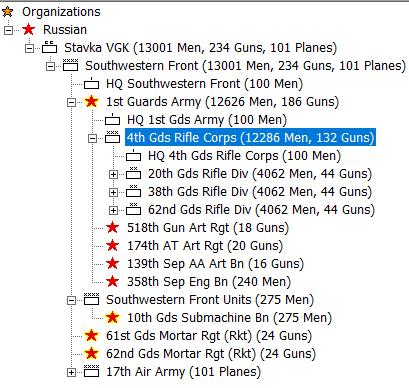
Typical Turn Checklist
 |
Check on which units are Disordered, Routed, or Recovered. Check via the Command Report button, or via Info/Command Report (ALT+K) |
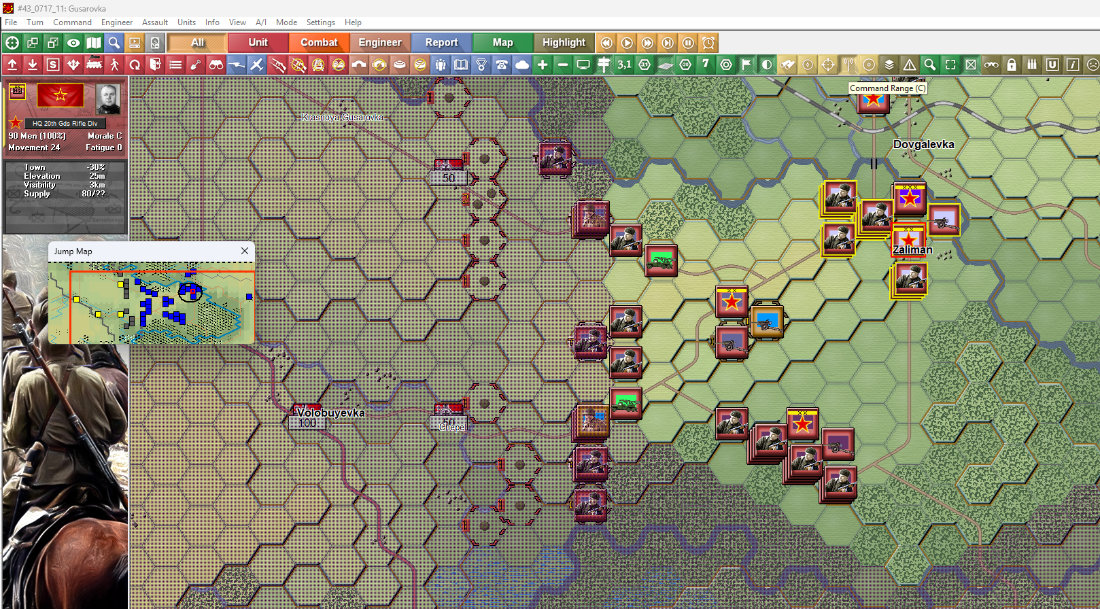 |
Re-highlight each organization by Division to check that commanders are within appropriate Command Radius of their troops. Use the View / Show Organization (ALT+Q). Use that org chart modal in combination with the Highlight Org (Q) and Command Range (C) buttons to check if you’ve kept unit cohesion and command within range to maintain C2 benefits offered on morale checks. |
 |
Make sure that every unit that you want to move has moved. Stay in move mode, and use the “N” hotkey to move to the next unit that still has movement points available. |
 |
Check that all Artillery has fired via the Artillery Dialog (Ctrl +B) Units with valid targets are bolded in the modal. |
 |
Check that all Air units have attacked and or performed recon duties by way of the Call Air Mission (Ctrl +A) button. |
 |
Make sure that every unit has fired if they are eligible to fire. Change to Fire Mode by way of toggling with the Move/Fire button. Then use the “N” hotkey to move to the next unit that can fire and has legitimate target/s |
| Check both what you can Spot (recheck visibility across the front line) and which of your own units are currently Spotted. | |
 |
Check what each of your front line units can see. Check for detection blind spots! Use the Visible Hexes (V) button. |
 |
Check which of your units are currently SEEN by the enemy. Take advantage of blind spots where available! Use the Spotted Units (O) button. |
| End the Turn once everything above checks out appropriately. Rinse, repeat, victory! | |
My Favorite Dialog (Artillery)

The artillery dialog is probably the most useful modal in the entire game. This was a brilliant addition to the feature set. No it was not added specific to this title, but it remains one of the best features of the WDS game engine to-date.
A couple small tips picked up from the Getting Started guide are below.

…and
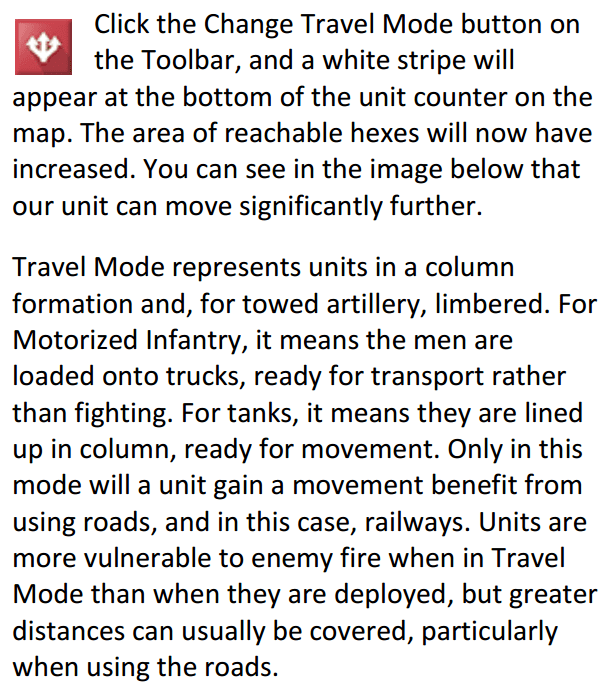
I honestly do not think I’ve been using the travel mode for infantry or armor units to a great degree in the Panzer Campaign series. Yes, I’m a dolt, and the above tidbit just breezed right over my thick skull apparently. I guess RTFM does help? Who knew?! Above my ignorance, the front line does not require too much in the way of extended maneuvering, unless you want to shift your main effort considerably; which does occasionally happen if you want to spook your AI or human opponent. I’ve also somehow in my Panzer Campaigns days gleaned right over that multi-fire tidbit as well! Bravo on that feature. That is a nice quality of life wargame improvement there. Again, small victories by WDS expanding the feature set of the overall game engine.
Major Actions Gallery
July 1943 Major Actions


August 1943 Major Actions



Final Thoughts & First Impressions
The old adage is, if it ain’t broke, don’t fix it. Somehow WDS embraces that, but then keeps surprising us wargaming enthusiasts with small innovations. Across the board, with every series offered by Wargame Design Studios, they’ve set a bar, and keep raising it. It’s actually inspirational.
They take pride in their work. That is rare sometimes in our society, so bravo WDS! At times when I take a good look through one of these WDS games I keep feeling like, why do I even need to review this? You just can not go wrong getting one of their wargames. WDS put out absolutely outstanding work and they continue to push themselves to provide top quality, well researched games, period, done, review over.
Donbas ‘43 is an outstanding addition to the Panzer Campaigns series of wargames, and you will do yourself a favor by picking it up. You are destined to learn something new about this southern brawl on the Eastern Front. This is the turning point. Donbas ‘43 is very enjoyable to play thru as a wargame, and as an educational experience.
Books Of Note


Thank you for visiting the Regiment of Strategy Gaming and riding with The Armchair Dragoons.
Rather than list a bunch of social media links, the easiest thing to do is to check out our LinkTree, which connects you to all of our various locales around the web.
You can also support The Armchair Dragoons through our Patreon, and find us at a variety of conventions and other events.
Feel free to talk back to us either in our discussion forum, or in the comments below.


