
 by
by Gregory Johnson, 28 September 2026
I am a newbie to the GBACW games system which is why I was interested in writing this article. The GBACW system was born from SPI’s Terrible Swift Sword game by Richard Berg. I am quite familiar with Terrible Swift Sword as I bought a copy when it first came out and played the heck out of it. To say that I enjoyed the game is an understatement as I currently own at least four copies of the original version of the game.
Three Days of Gettysburg Deluxe edition, or 3DoG as some affectionately call it, is the fifth version.
I have always been interested in trying Three Days of Gettysburg because I have heard such good things about the game system and play. However, I have shied away from jumping in due to hearing about the difficulty of learning the system. But now, GMT has developed the “Simple GBACW” rules set to help newbies like me get into the system without being overwhelmed by the rules.

click images to enlarge
What’s in the Box
- Six maps, four are double sided.
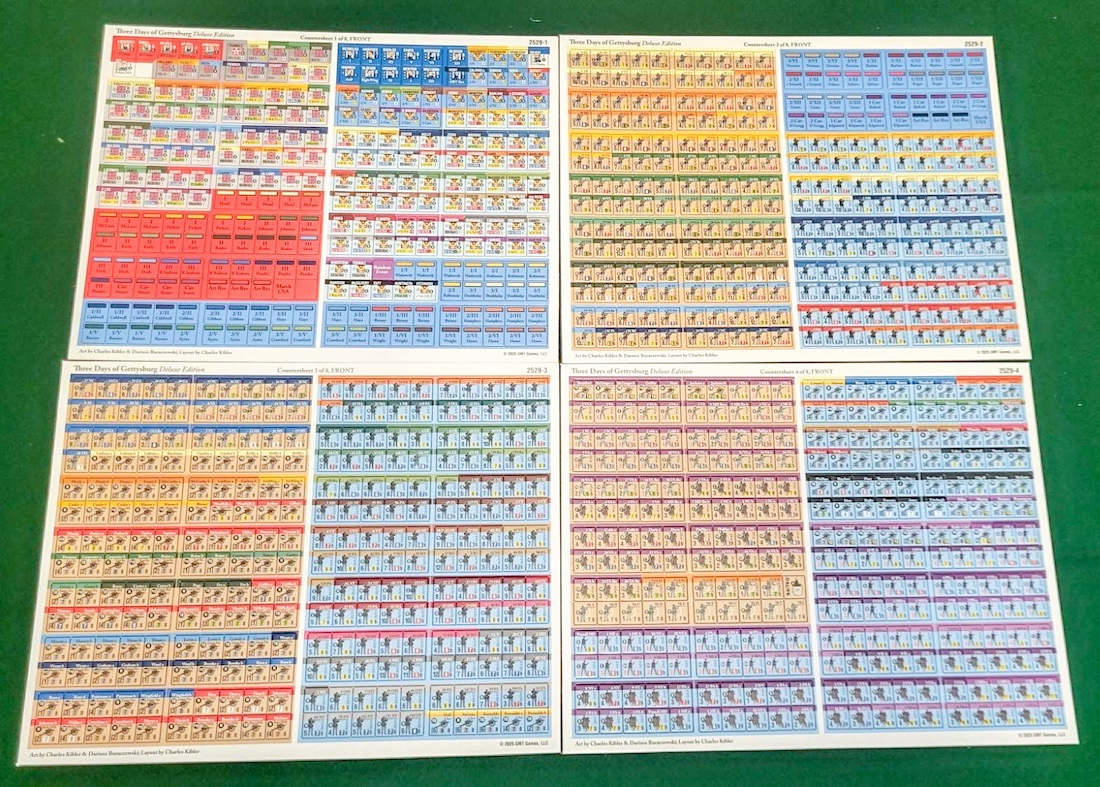
- Eight counter sheets
- Deluxe Edition Rules Manual
- Deluxe Edition Battle Manual
- Simple Version Rules Manual
- Simple Version Battle Manual
- GBACW Series Rule Book (2026 Edition)
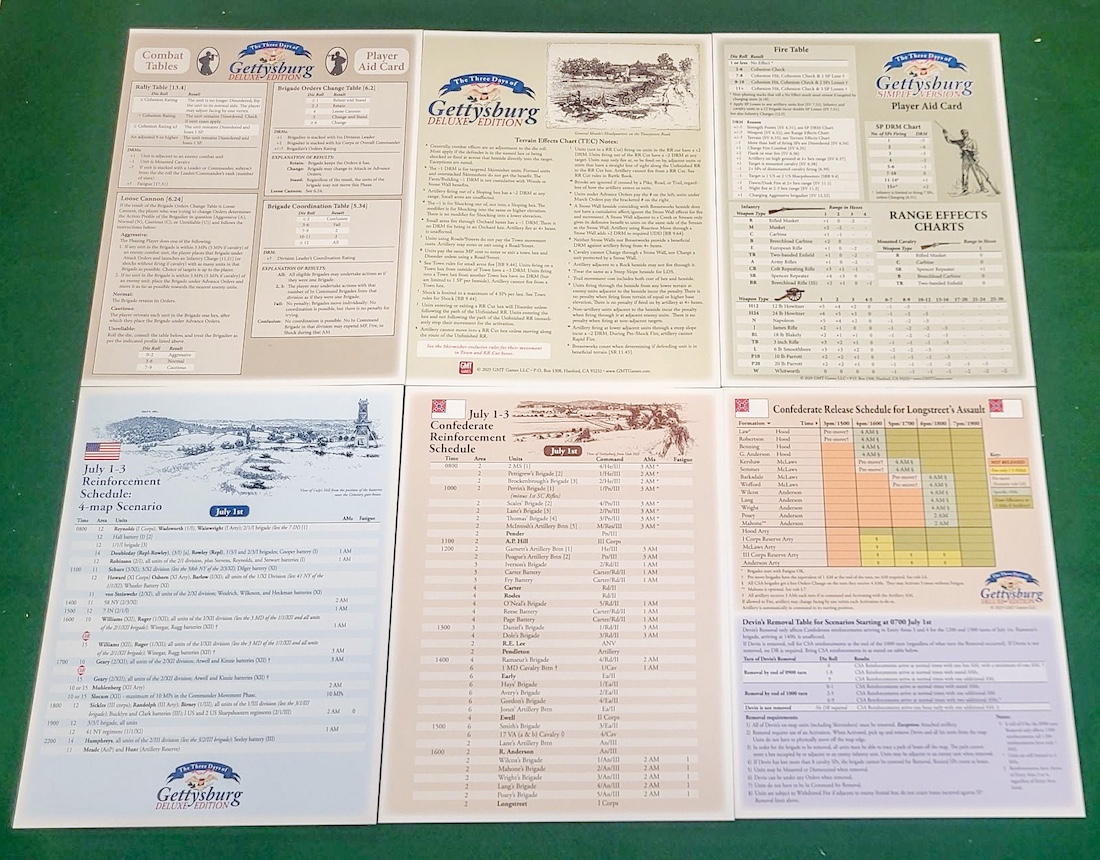
- Fourteen charts, tables, player’s aids
- Two ten-sided dice.
You can see the detailed game manifest here: Three Days of Gettysburg Deluxe Edition


Comparing the Two Versions
Let’s do an overview of both versions of the game through the Turn Sequence.
GBACW System
I) Initiative Segment – This determines which player will be first in choosing a unit to activate to start the game turn.
II) Orders Segment – The Orders Segment is broken out into six sections the outlines the command structure and functions available to each army. The GBACW Command System is a key component of the game which gives the player a feel for how overall command structure worked in ACW battles.
A) Determine Chain of Command Phase – GBACW has a four-tier command structure starting with Army Commanders, Corps Commanders, Division Commanders, and Brigade Commanders. Chain of Command is determined by using the command range listed on each leader counter. Chain of Command is important in that each leader has such as Initiative, Efficiency, Activation, and Orders which will influence how effective a unit is at accomplishing their orders for the turn.
B) Activation Efficiency Determination Phase – Each player randomly draws Efficiency Markers for corps they have on the map. The Efficiency Marker determines how many times the units in a corps may be activated in a turn.
C) Division Orders Phase – In GBACW units are given orders to execute on the battlefield. As the battle progresses, orders may need to be changed. This is done during this phase. A player that has a Chain of Command from his corps commander to brigade commanders can change unit orders and assign division artillery to brigade units.
Available Orders
March – Unit are restricted to movement functions only. They may not fire. The may not move into a hex that is within four hexes and in line of site of an enemy unit.
Advance Orders – A unit may move or fire, not both. However, the unit may not move adjacent to an enemy unit.
Attack Orders – A unit may move and/or fire. The unit’s movement allowance is halved, rounded up. The unit may move adjacent to an enemy unit instigating a Charge.
D) Reinforcement Orders Phase – Initial orders are assigned to units entering the game on that turn.
E) Reserve Placement Phase – Commands may be placed in reserve. Commands that are in Reserve may recover status during the Replacement/Recovery phase. While in reserve, a unit can recover its morale if they are disordered or routed. A unit can resupply its ammo and/or recover stragglers.
F) Engineering Phase – During this phase units can build breastwork defenses.
III) Activation Segment – This is where units perform their orders on the battlefield
A) Initiative Action Choice – The player that won the initiative for the turn will chose which of his units will have the first activation of the turn.
B) Activation Market Pool Placement – GBACW runs on an activation chit pull system. During this phase all the activation markers for each side are placed into an opaque container.
C) Activation – The player that won the initiative moves the unit they selected in the initiative phase. After that unit has completed its move. A chit is drawn from the Activation Marker Pool to determine the active command.
1) Change Order Phase – The player may attempt to change the orders of the activated unit using the Brigade Orders Change Table.
2) Brigade Coordination Phase – The player may attempt to activate all of the brigades of a division at once.
3) Action Phase – Each unit in an activated brigade may Move and/or Fire, or they may resupply ammo.
Walk through section B and C until all the activation markers have been chosen.
IV) End of Turn Segment
A) Commander Move Phase – All corps and overall commanders may move. They may only voluntarily move during this phase during the turn.
B) Replacement/Recovery Phase – During this phase, the player may do the following:
1) Replace leaders killed in combat.
2) Units in reserve status may recover morale, rally from routed status, regain fatigue, regain stragglers, and resupply ammo.
3) Remove any commands from reserve status and assign Advance or Attack orders to removed units.
4) Eliminate artillery with Abandoned 2 markers
5) Flip Abandoned 1 markers to Abandoned 2 markers.
6) Replace Construction markers with breastwork markers if construction finished.
C) Combat Effectiveness Phase – As units fight during a battle, their Combat Effectiveness decreases as casualties are taken and morale is lost. During this phase the player checks his brigades and divisions to determine their Combat Effectiveness.
Brigades – Brigades become Combat Ineffective if more than half of the brigade’s regiments are Eliminated, Collapsed, or Routed.
D) Turn Record Phase – Advance the game turn marker.
A full copy of the current version of the rules is downloadable from GMT — GBACW Series Rulebook

Simple GBACW System
I) Beginning of Turn Segment
A) Initiative Phase – Roll a die to determine which player has the initiative and will chose a unit to activate first in the game turn. This is the same as the GBACW Series Rules.
B) Command Phase – This section has been greatly simplified from the GBACW Series Rules.
1) Attach artillery to brigades
2) Assign and/or remove March or Reserve Orders.
3) Place an Out of Command marker on any leaders that are not within the command range. This will affect what commander modifiers are available to a unit during the game turn.
4) Place breastwork and construction markers.
C) Efficiency Phase – As in the GBACW Series Rules, players draw Efficiency Markers to determine how many activations the divisions of a corps will have that turn.
D) Activation Marker Pool Phase – All the activation markers are placed into an opaque container to be pulled during the game turn to determine the activation sequence of units.
II) Activation Segment
As with the GBACW series rules, activating units is done with a chit pull system except the unit that is chosen to active first by the winner of the initiative roll.
A) Movement and Rally Phase – Check the brigades in the activated formation to determine if any of the brigades are Out of Command. Each brigade may then move, change facing, rally, or do nothing.
Units that move or rally may not fire in the Fire Phase.
Brigades may be placed into Attack Posture during this phase. Attack Posture allows units to move at half speed and fire. A unit must be in Attack Posture to move adjacent to enemy units which is considered a Charge.
B) Approach Fire Phase – Each non-phasing artillery unit in Good Order may fire at one charging stack in either of its frontal hexes.
C) Fire Phase – Activated units place target markets on unit they wish to fire upon. Fire and Return Fire is then processed.
D) Attrition Phase – Strength point markers are placed underneath brigade counters that suffered losses due to combat. If any a brigade incurs move than 7 or more strength point losses all the units of the brigade rout.
III) End of Turn Segment
A) Commander Movement – This is the same as the GBACW Series rules. Commander may voluntarily move during this phase.
B) Recovery Phase – The following housekeeping functions are done:
1) Replace leaders killed in combat.
2) Flip disordered unit in Reserve to Good Order.
3) Rally Routed units.
4) Determine Combat Ineffective Brigades and Division. This is handled just like in the GBACW Series rules. Brigades that have more than half of their units Routed or Eliminated are now Combat Ineffective.
C) End Phase
1) Adjust abandoned artillery units
2) Continue or complete breastworks construction.
3) Advance the Turn Marker.
In comparing the two Turn Sequences, the Simple GBACW rules streamline the Command and Activation sections the most. The chit pull system stays the same. Orders and Combat are streamlined. The Simple GBACW System still has most of the battlefield flavor as the GBACW Series Rules with just a lower learning curve.
Battle Books and Scenario Books
The Battle Book for each version of the system outlines advanced and special rules that can be added to the base game system for more historical flavor.
The Scenario Books provide a number of scenarios from single map to full four map campaign options. Even if you don’t have the gaming space for the full campaign game, you can still enjoy playing the smaller one or two map scenarios.

In Closing
I am a big fan of the original Terrible Swift Sword game from SPI to the extent that I have four complete copies in my collection. I am extremely looking forward to getting into Three Days of Gettysburg Deluxe Edition with my little gaming group to see how far the system has developed over the years from its original structure. For those that are interested but still have some apprehension about the game being too difficult, just take your time and start with the Simple Rules first. Slowly walk through a turn to get the feel of how things work. If you get stuck learning the rules, there are numerous venues to help learn the rules and watch playthroughs.
We’ll have more coming from this one in the future!
I recommend these YouTube channels for assistance in learning the GBACW system:
You can chat about this game in the Age of Gunpowder section of our discussion forums
Thank you for visiting the Regiment of Strategy Gaming and riding with The Armchair Dragoons.
Rather than list a bunch of social media links, the easiest thing to do is to check out our LinkTree, which connects you to all of our various locales around the web.
You can also support The Armchair Dragoons through our Patreon, and find us at a variety of conventions and other events.
Feel free to talk back to us either in our discussion forum, or in the comments below.


