
 by
by Scott Parrino, 10 July 2025
I am admittedly a late-comer to traditional tabletop role-playing games – it wasn’t until late 2019 that I decided to take the plunge by getting Dungeons & Dragons starter set Lost Mines of Phandelver to dip my toes. D&D Fifth Edition was and still is a popular TTRPG that captures the zeitgeist of when people say “I play role-playing games,” the first thought goes to D&D. I was able to round up a few friends and start the adventure off in the basement of our host, then the kitchen of my home, and then eventually online via a multitude of media when the Covid Pandemic struck and kept us separated physically for a few months. Eventually we named ourselves the “One-Half Dirty Dozen”. We were hungry for more adventures after the end of the Phandelver fiasco, and we then explored a homebrew adventure of my own on an island off the Sword Coast of the Forgotten Realms.
Over the course of five years, my 6 adventurers and I as their DM relentlessly pursued goblins into traps, lost friends to last stands against the agents of the spider queen Lolth, and eventually ended our homebrew with a large final battle against a king bent on immortality with his necromancer co-conspirator. We were satiated and content with the ending, each character going their separate ways to help their respective groups at home, high-leveled and powerful.
D&D for what it is worth, suffers from a bloat of higher-level characters and enemies that draws out combat into multi-hour and sometimes even multi-session events.
We did a variety of one-shots while we figured out what to do next. D&D for what it is worth, suffers from a bloat of higher-level characters and enemies that draws out combat into multi-hour and sometimes even multi-session events. Too many abilities and triggers, insane health pools, and so much to keep track of that it led to a lot of players losing focus while myself and a PC would go through what felt like rules lawyering RPG. My group and I tried a variety of tips and tricks to speed things along: rolling damage dice with the attack rolls, simplifying health pools, a brick to throw at the next player in the turn order to get their attention (it was a soft brick, don’t write me a letter about it).
So I did a bit of research – what did my players like, what do they not like, what is our goal each campaign, each session? What it boiled down to was faster combat with actual danger, magic that is simple, but also terrifying, and perhaps a setting where travel and roleplaying are encouraged but is also a gameplay mechanic.
Enter Forbidden Lands, a TTRPG by Free League Publishing (or Fria Ligan in their native tongue of Swedish).
If my introduction to this article was too much, allow me to reason with you – I wanted to give you a background of what I am about and what led my group and I to switch over to Forbidden Lands (FL for short now) for our new campaign. I’ll explain a bit about the game itself, and then I’ll lead you into how our Session Zero started and how it will segue into the official start of our campaign in the dangerous and mysterious setting of the Forbidden Lands.
What Is Forbidden Lands?
Forbidden Lands like any other TTRPG utilizes dice as a gameplay mechanic for roleplaying, exploration, and combat. Where D&D uses the popular twenty-sided D20 die for rolls, FL utilizes the six-sided D6 with a dice pool for the above. Players total up their stat numbers in the relevant attributes and skills and roll the appropriate amount of D6 in hopes of getting a six on any rolled die for a success. If the players fail to roll a success, there are ways to gain a successful result at the risk of injury, or even death. FL encourages a “failing forward” story progression where needed, and it was something that we had to use a few times during our initial start.
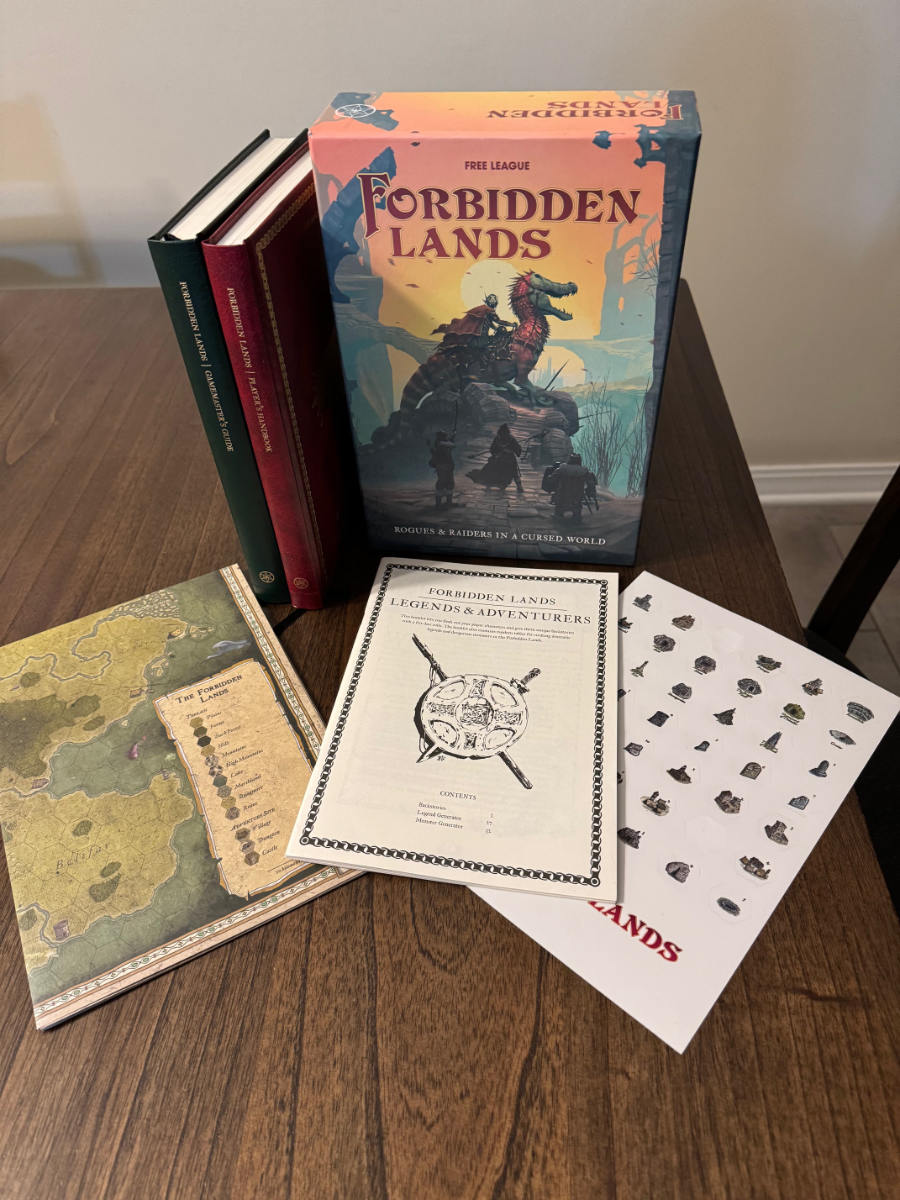
click images to enlarge • full unboxing gallery here
The setting of the Forbidden Lands is this: over a thousand years ago, humans came to the land in search of a better life since their original homeland had faced destruction. The dwarves, elves, halflings, goblins, et al had already been occupying the land already, and while the gods split the land to give all the kin their own land, the humans were hungry for expansion. Wars were fought, land was carved up, and then without warning a deadly mist descended upon the land, known as the Blood Mist. The Blood Mist would come out at night and devour any being not in their “home” – stripping flesh and skin from bones and leaving a bloody mess. For three hundred years this mist reigned the land, leading to extreme isolation and in a lot of cases, the destruction of towns, cities, castles and other settlements. As suddenly as the Blood Mist arrived, one day it rose in the morning and did not come back again. This is where the adventure starts, an immense amount of land to adventure through to find treasure, explore what is left of the land, and perhaps find out what caused the Blood Mist to come and go.
My players thought the setting was perfect – something to motivate them to explore and also something they can roleplay when they run into NPCs and monsters. They were also interested in the inherent danger that the land presents, an adventurer’s life lasts only as long as their luck and cunning, their experience and their wits, and knowing when is the right time to turn heel and get out of danger.
Forbidden Lands does not play around when it comes to the danger of combat and mishaps – a character’s attributes do not increase once the character is created, no matter how much they “level up”. A knight clad in armor and a helmet that has seen a dozen battles can still be taken down by an unfortunate roll of dice. While death may not end that character, they can get a serious enough wound that retires them – a lost limb, blinded, or severe internal injuries that require a long time to heal. In extreme cases an unlucky injury roll could be an arrow through the helmet and into the head – immediate death.
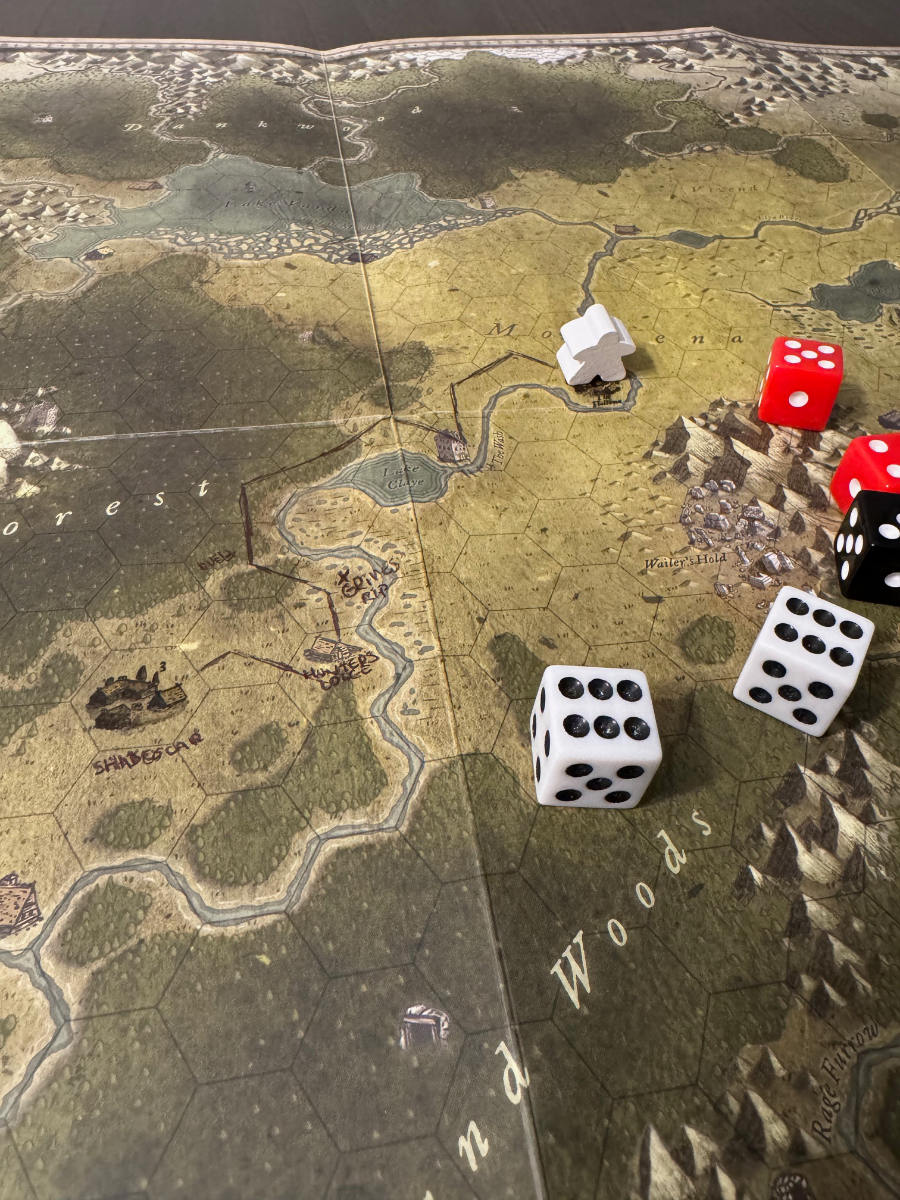
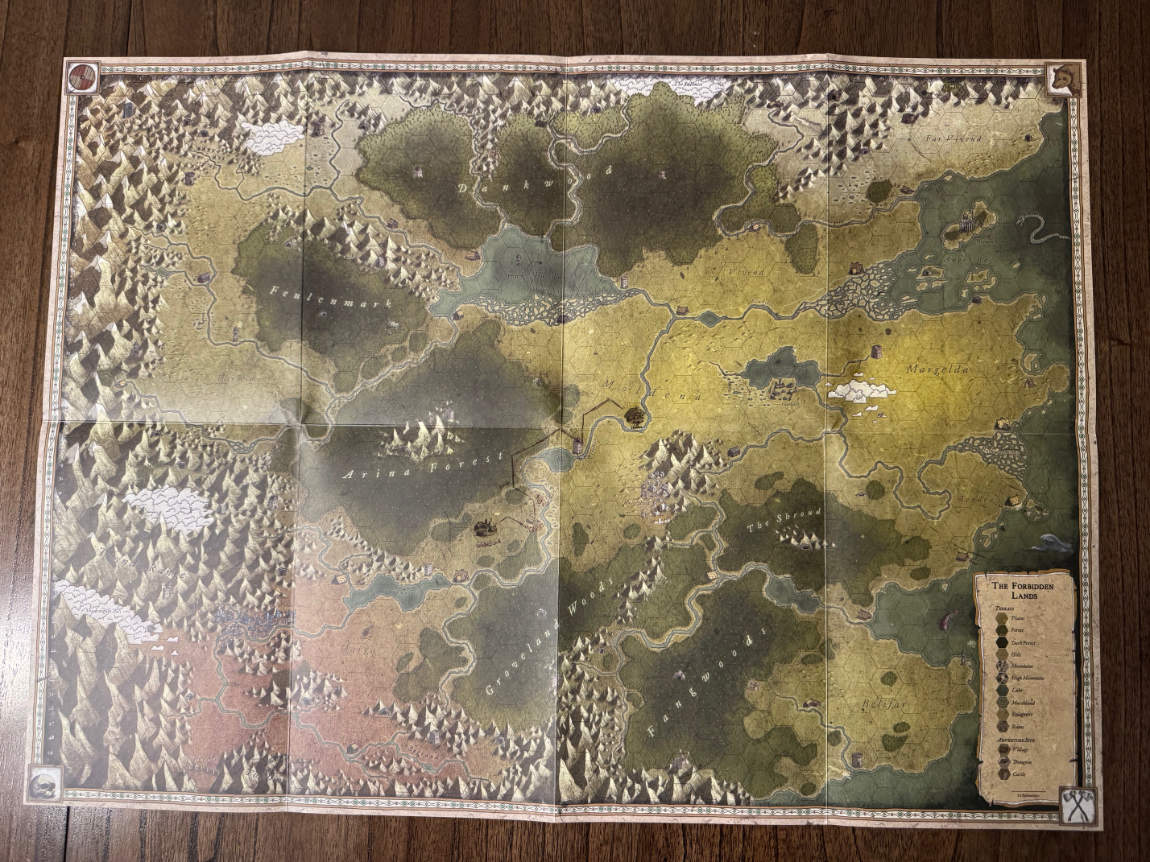
Forbidden Lands isn’t just all about combat – players will hexcrawl through the land to their destination, discovering points of interest (set by the DM), towns, dungeons, and settlements along the way. Forbidden Lands comes with a detailed color hex map with the absolute minimum of pre-made locations as it is up to the players and the DM to use the included sticker set to either place down markers where certain locales are. The sticker set even comes with tombstones to put down when a player’s character ultimately meets their maker, and Free League did think ahead: the map is double-sided so that you can either run two campaigns with two separate groups, or complete one and restart into another. It’s entirely possible that certain castles and locations will be in completely different locations between the same campaign amongst other groups. In short – Forbidden Lands gives you a sandbox to tell yours or their story. As I’ll get into detail about the adventure, I’ll get into the gameplay mechanics and how they affected outcomes.
The Session Zero
As I said at the start, I have six players in my group, plus myself as the DM. Finding time for all seven of us to occupy the same space at the same time is a herculean task, not to mention the dreaded text of “something came up, I can’t make it tonight” that can somehow lead a cascade of the other players saying the same thing, or reducing the player count to a low level that makes it difficult to continue a campaign. Our unofficial rule is that we need at least three players for it to count as a session, plus the DM – any less then it turns into either a one-shot of something else or some social time with a fun game (we have been giving Heroes of Barcadia a whirl with some beloved success).
Our first Session Zero we were able to get four players – a great start! Character creation in Forbidden Lands is simple to do if you are familiar with D&D’s character creation system on a character sheet. There is no rolling of dice for stats as that is all handled by the player’s selection of kin (race), profession, and age. Yes, age is a factor! Younger means you’re healthier, but are less experienced to get started on your skills and talents. Older is the opposite end of the spectrum, but I do love the idea of “beware of an old man in a profession where men usually die young.”
A challenge arose when we all had to share the Player’s Handbook – Forbidden Lands is not widely-available on shelves where we are at, and at the time of this writing even the core set (which includes the GM Handbook, Player’s Handbook, map, stickers, and the Legends and Adventurers booklet) is not even in stock on Amazon. You can order the physical copies from Free League’s website, if it is in stock there. My players ultimately decided to take the DriveThruRPG route until physical copies are available. My players were able to create their characters with backstories in the span of about an hour and a half, with myself filling in the others on the setting, gameplay mechanics, and also assisting in character creation with others. It actually led to a lot of fun times of us sharing the book over each other’s shoulders, admiring the art work – it felt like we were all young teens that found some questionable magazines (we’re all in our 40’s now).
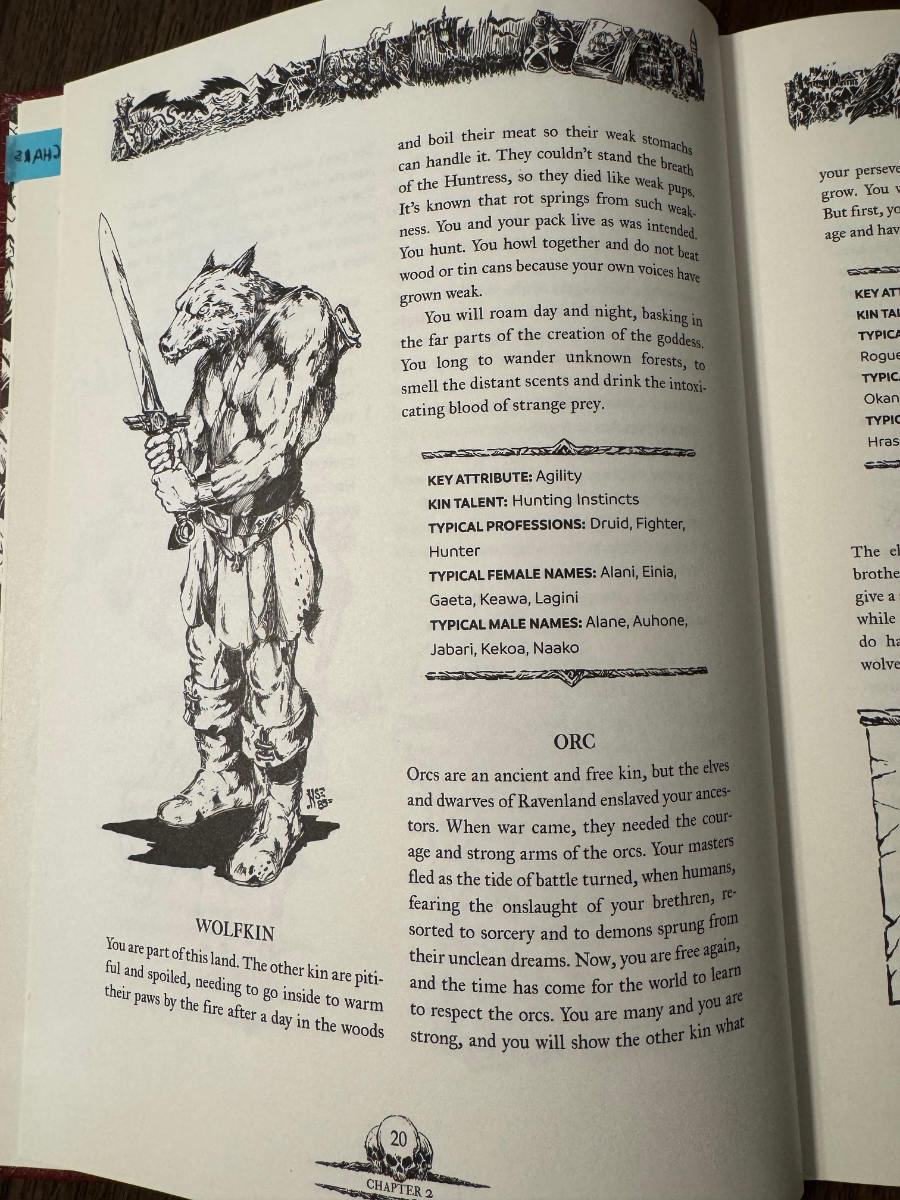
The party created their characters as such: two Wolfkin brothers, Remus, the older one is a Hunter and the younger Romulus is a Sorcerer. Their backstory is that the older brother works with surrounding towns to hunt game for meat, while the younger brother is tagging along after being kicked out of their clan for using his sorcery for less-than-savory ways of bringing back the dead.
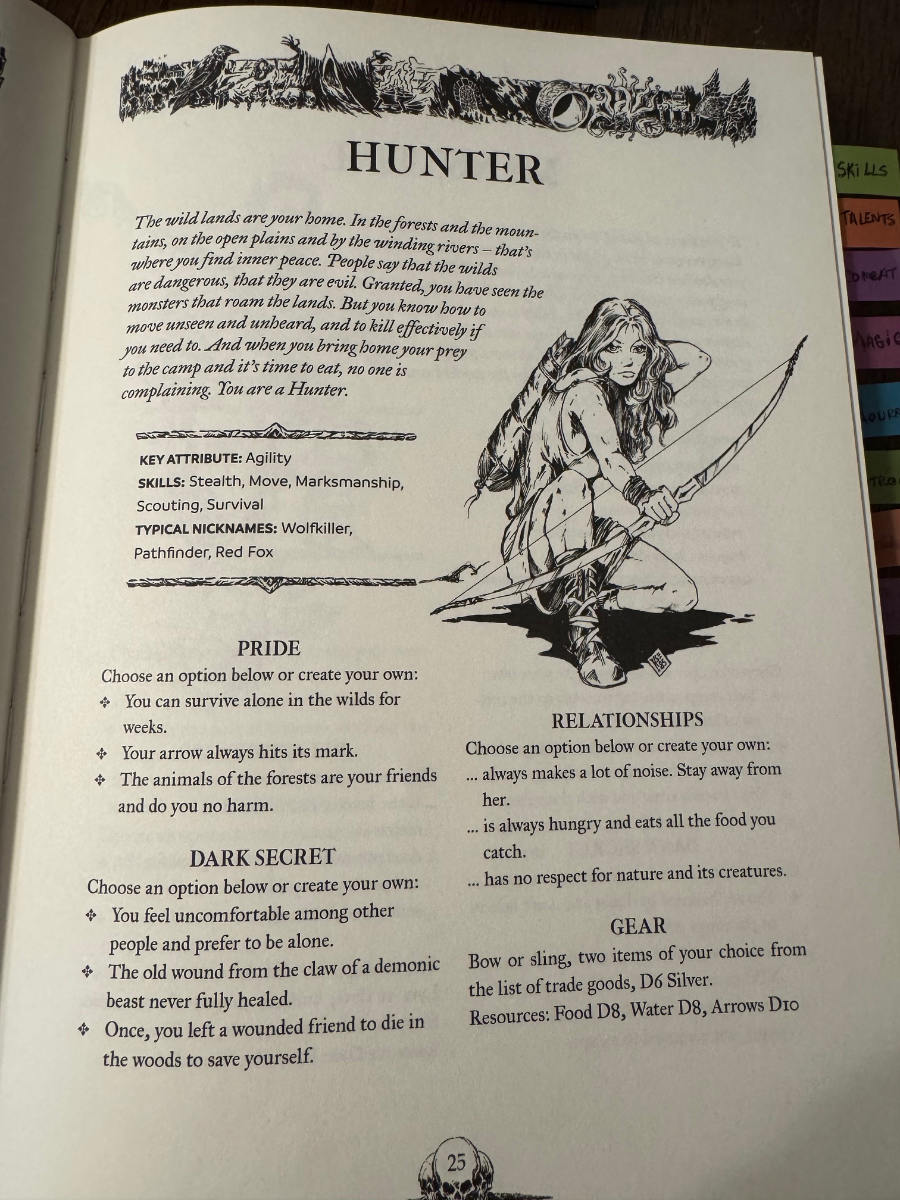
We also have a Dwarf Peddler named Ferric Masterson, that had left their homeland to loot and plunder, and a Halfling Rogue that goes by “Clean Willie” that wants to sell their services to clean chimneys and homes of their valuables. In our second meeting we had our fifth player able to join in and create their character – a Human Rider whose horse is somehow more intelligent than him. All the players were aware that they should flesh out their characters in roleplay, but not to be too attached due to the dangers of combat and exploration. Our sixth player, who is typically very busy, was just only recently able to get his character created during a separate meeting – an Elf Fighter!
Our campaign setting is as follows: It has been a year since the Blood Mist has risen, and the town of Shadescar is looking to find other settlements to re-establish contact with. The party was tasked with their first mission – go out to the northern Arina Forest to test to see if the Blood Mist is truly gone, and to also explore a known abandoned outpost that was made hundreds of years ago before the Mist arrived. The mayor of Shadescar had already known the Wolfkin brothers, and welcomed the addition of a Halfling to the group.
“I’m Going on an Adventure!” and Other Lines You Should Say More
The group decided to strike out on the trail to the north after stocking up on necessities like weapons, food, and water. Supplies in Forbidden Lands take up space and are also tracked in an abstract fashion. Players may want to carry a lot of items, but their personal packs could only carry eight standard items, including weapons. Want to lug around eight swords? Don’t cry when you’re out in the elements without a tent! Water and food are handled through rolling a relevant die of supply. Stocking up means you roll a larger die, like a D8 or a D10, with a D6 being the last of your potential consumables. Once a day when the players consume their food and water, the die is rolled – roll a 1 or a 2 and your consumable steps down to the next die size. Roll a 1 or a 2 on a D6 and you just munched your last hardtack (clack-clack) and quaffed the last gulp of water. This is also how your arrows and torches are tracked as well. My players like not having to do paper Excel sheets to track how many pieces of food are left.
Each time the party would travel into a hex, a roll was made by the leading player to “Lead the Way” to determine if their directional skills were up to par, with another party member rolling to keep an eye out for any danger with “Keep Watch”. The party without trouble made their way to the Arina Forest, stopping to make camp as the day drew darker and to a close. The passage of time in both the day and days of the week and month are tracked, as they pose their own challenges – in the summer you get more daytime to hike, in the autumn it is easier to forage for your food. Traveling in the winter means that the cold weather can put you down or starve your belly – both ways to leave a corpse without combat.
Remus the Wolfkin Hunter was the natural choice for leading the party into the forest, never rolling a failure to keep them on track, with his little brother Romulus and Willie the Halfling trading off every other hex. When time came to strike camp, Remus and Romulus utilized their tent and Willie found a good spot by a tree. During this time, the young Romulus decided to scope out the area around camp – and failed a pushed roll that got him lost. In Forbidden Lands, if you do not succeed (or succeed enough) on an initial roll, you can re-roll certain dice to hope for a success. Be warned – while you can keep success rolls, any result that is a 1 under the attribute dice are kept. On the re-roll, any additional successes contribute, but any resulting 1’s hurts your attributes. Your attributes are essentially your health – you have Strength, Agility, Wits, and Empathy – if any of these drop to zero you are Broken. Depending on what was knocked to zero impacts the type of Broken you are: Strength means you are knocked unconscious with a critical injury, Agility is collapsing from exhaustion, your loss of Wits renders paralyzed in fear or confusion, and your Empathy at zero means you suffer a mental breakdown in pity or despair.
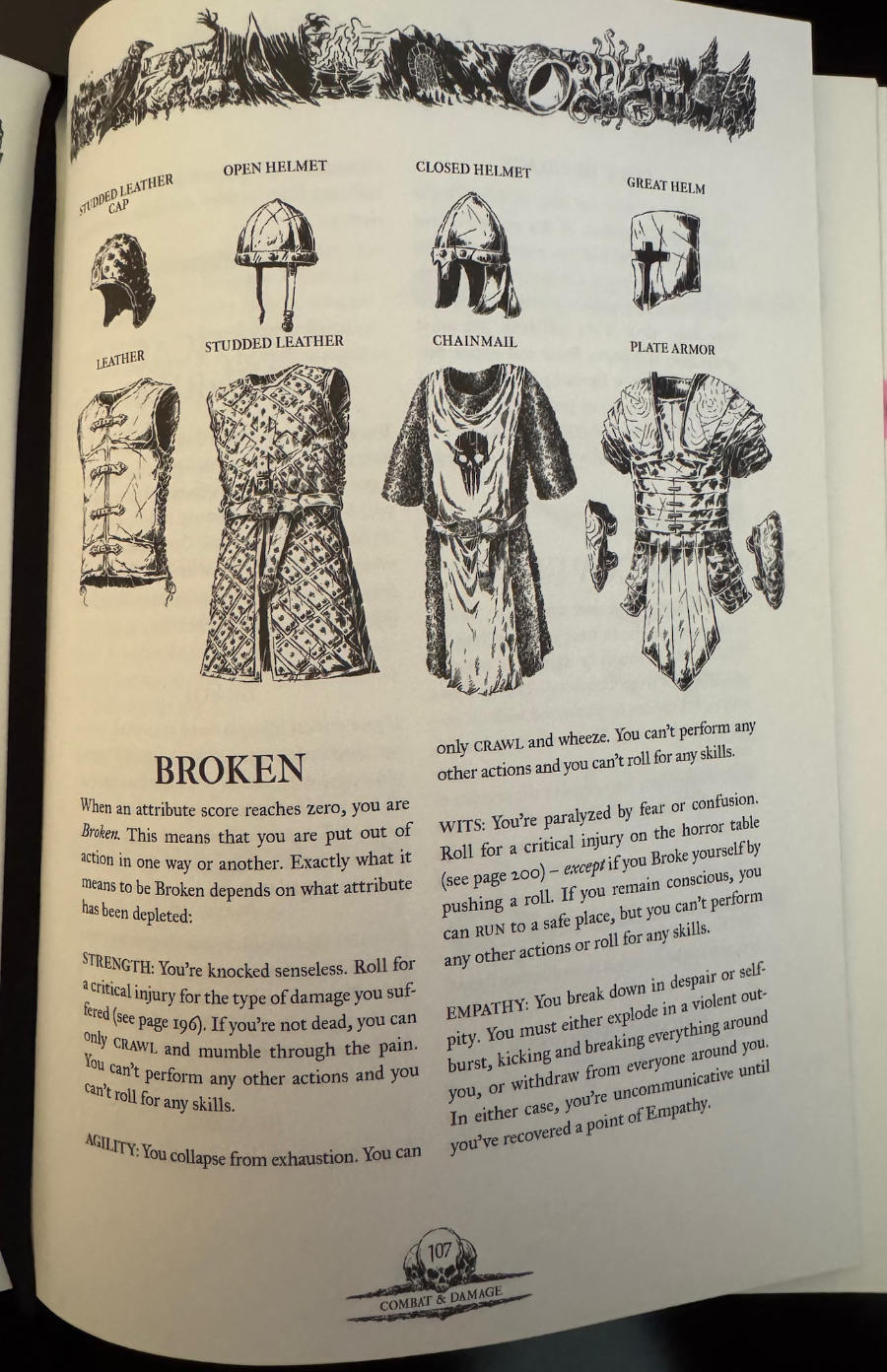
Poor Romulus suffered damage to their Wits during their little adventure, panicking upon getting lost after finding the old abandoned outpost. He eventually made it back to the camp, nearly losing out on some precious sleep that would affect his stats for the next day.
Once the sun came up, the party sat around the morning breakfast talking about their backgrounds and their plans for what to do when they got to the outpost. The general idea was to approach it cautiously, and expect a surprise or two.
Once this party arrived at the abandoned outpost, it was decided that the Halfling Rogue would sneak in, with the Wolfkin brothers just outside the two windows that were visible. It was here the party came upon the Dwarf Peddler Ferric Masterson, who was in the midst of thieving and checking out loot that he had found. It was a treasure chest that had been used by a Rust Brother – a member of a religious cult that was able to traverse the lands during the Blood Mist through their devotion to their god Rust and all it believes. Our fifth player taking on the Human Rider Ned rode up to the outpost and joined the group in their exploration of the outpost.
What we have been enjoying so far with the Forbidden Lands system is the need to roll a D20 for doing certain actions – for example searching a room isn’t necessarily a roll, but it is something that can be role-played out and has a time sink to it. Per the manual, rolling should be reserved for more important matters like combat and important story events. This has helped so far encourage more role-playing from my players without having to break it up with a dice roll to do some basic actions, comparing notes and abilities, etc.
A blocked-up door with stones and rocks were discovered, and a strength roll by Ferric (with some assistance) to get through it enough to discover a small barracks area that was at the time not in use, but was fresh enough for the players to know that they were most likely not alone in the outpost. With nothing of value found in the bedrolls, the party moved down the hallway to a locked door – and we all know the best lockpick is the one that is stored in the boot. The door was busted down with the party running into a pair of Rust Brothers in the process of getting a Death Knight to its feet – many the objective of a Rust Brother to bring back the dead to serve them. Finally, to combat!
The Wolfkin brothers hung back, with Remus taking up the bow and arrow and his little brother Romulus trying his hand at the magic system. Ned, Ferric, and Willie ventured forward to engage the Rust Brothers and Death Knight.
The players were on one side of the room with the Death Knight and the two Rust Brothers on the other, a classic standoff. The Dirty Half-Dozen up to this point in our RPG journeys were always keen to charge into battle and then ask questions later. However, this being the first combat of the game system, my players decided to feel it out. The Wolfkin brothers hung back, with Remus taking up the bow and arrow and his little brother Romulus trying his hand at the magic system. Ned, Ferric, and Willie ventured forward to engage the Rust Brothers and Death Knight. With Forbidden Lands, there is no “speed” of players, and distances are abstract – no need to worry if you’re 30 feet away or 35 feet away for particular spells or movements. In Forbidden Lands you’re dealing with ranges such as Arm’s Length (next to) or Near (a few steps away) up to Short (up to 25 meters away), Long (up to 100 meters away) or Distant (as far as the eye can see). Generally if you’re in the same room of standard size, everyone is in a Near Distance or Arm’s Length if close, with Short range being the next room over, etc.
There isn’t a “roll for initiative”, but instead players draw from a deck of cards of 1 – 10, lowest going first in the order and so on. Unfortunately I didn’t have my deck of cards with me this time, so we went to the usual D20 roll for initiative.
Actions in combat can take some getting used to, and luckily I had printed up some reference sheets for my players. In combat there are Slow Actions and there are Fast Actions. Players can either do one Slow and one Fast action, or two Fast actions on their turn.Your slow actions are typically the attacks (slash, stab, punch/kick/bite, and grapple) and your fast actions are either reactions in attacks or prepping for an attack (dodging, parrying, draw weapon, swing weapon, standing up, shoving, disarming, feinting, or retreating).
Rolling for attacks is simple enough: for example Ferric was interested in doing the classic stabby-stab-stab on a Rust Brother with his dagger. He rolled the amount of dice for his Strength attribute, his Melee skill, and his dagger’s Gear bonus. Rolling a 6 is a success, and any additional success rolled after that adds to the damage.
Back to the situation at hand – the Death Knight looked to do some work against the party using its longsword. As the GM you can choose to go off of a monster’s available weapons and abilities, or if you’re like me and want to embrace the dice telling the story, you can roll a D6 and let fate do it for you. A Death Knight is no easy foe to knock down, but for the “Session 0” and to help my players get into combat, it was nerfed to be a bit weaker (story goes is that the Rust Brothers were not the best at resurrecting the dead to full strength). Forbidden Lands does a great job in putting all the available info for a monster’s attack in its stats in regards to the abstract range, the amount of dice to roll, and any important damage to note. I found myself not needing to flip back and forth between too many pages to understand what was supposed to happen for its attacks.
Ned got unlucky and was in the path of the Death Knight’s longsword, but the fates of the die were with him and he avoided any serious amount of damage on the first swing. When there’s the very real chance of being cut down and dead within one round, combat feels extremely deadly and tense, but that is what we all signed up for!
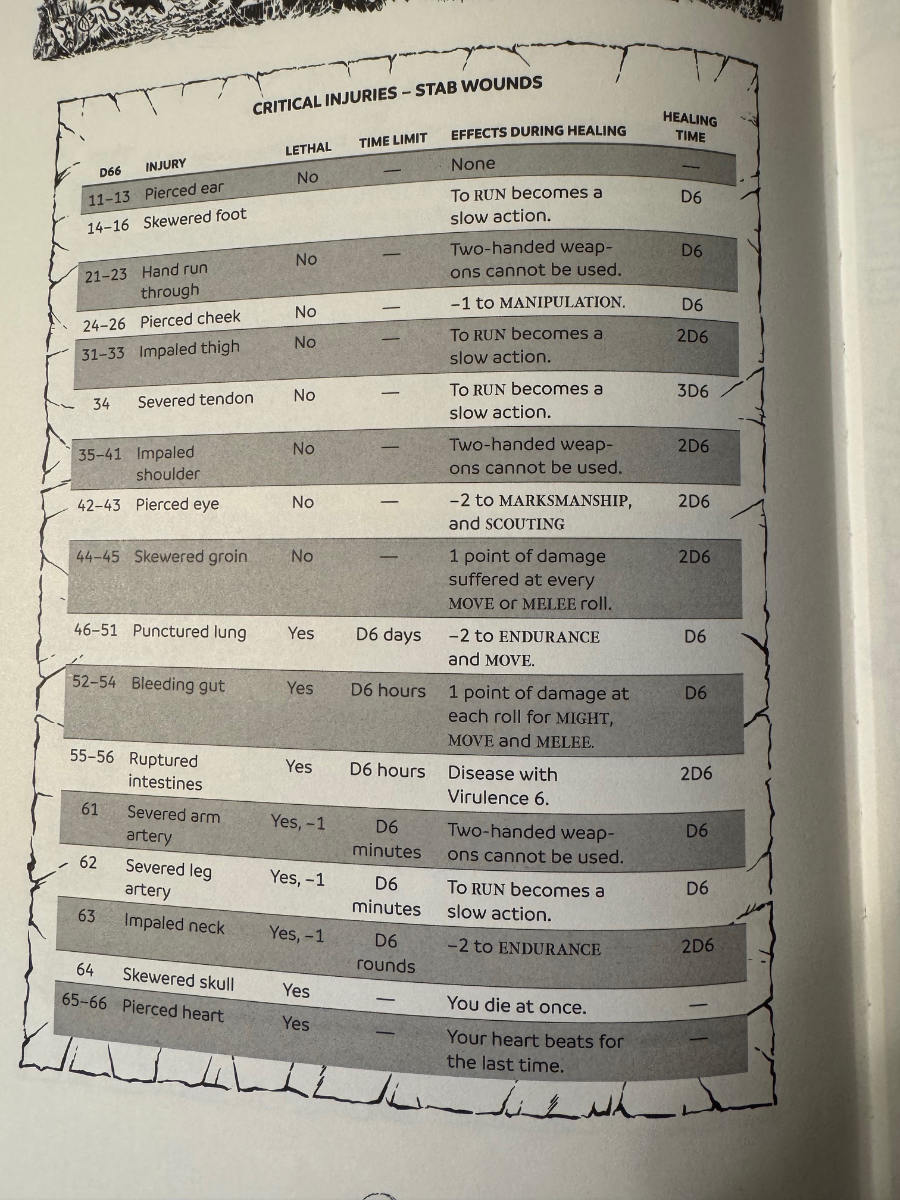
Romulus and Remus were able to wear down the Death Knight and a Rust Brother with their attacks – Remus with his trusty bow and arrow against the horrifying creature, and Romulus utilizing a magic attack called Chill of the Grave on the Rust Brother. Magic in Forbidden Lands exists more so of sorcerers passing down their wisdom rather than large schools of magic enrolling students, and so it is typically not a plentiful sight. Another reason is that magic itself can be dangerous and if a dice roll goes awry, a magic-user could see a mishap ranging from a backfire to as serious as being pulled into another dimension, an immediate “make a new character” moment. There are ways to safely cast the magic, but the allure is always going to be, “greater risk – greater results”.
The Death Knight was felled, but not without doing some damage to poor Ned. Luckily Ned was able to avoid being Broken – which could have led to more serious and sometimes permanent injuries. The remaining Rust Brother was cut down and left to die on the wooden floor as the players decided to skedaddle back home to warn the people at home that while the Blood Mist had indeed gone away, but left behind were dangers of a wild land that would be more than happy to feast on a folly of the unprepared and overconfident. Our session time had ended and it was getting late.
End with Criticism – For the Greater Good
Forbidden Lands encourages ending each session with the GM asking the players about what they liked and disliked, and what their plans are for the next session. This is a great way to see what went well between the GM and the players, and of course what didn’t. Not knowing that there’s a player or two not having a fun time can lead to burnout or sour moods after several sessions, and it’s best to find out from them directly. I wanted to be really upfront with my players this time around in this game system – it is a bit of a risk to change systems and hope that the players can also buy-in as well. Luckily, my players are great human beings – they are upfront with me as well, but also very understanding and flexible. Critiques over Forbidden Lands were just them still learning the system, and that it was rough not having easy access to materials in comparison to D&D. We had to share the only physical copy of the books around the table, while some players were utilizing their phones to read up on rules and abilities, which isn’t always convenient or easy. The praises were the unique setting and lore, the new dice system, and the fun of trying something new.
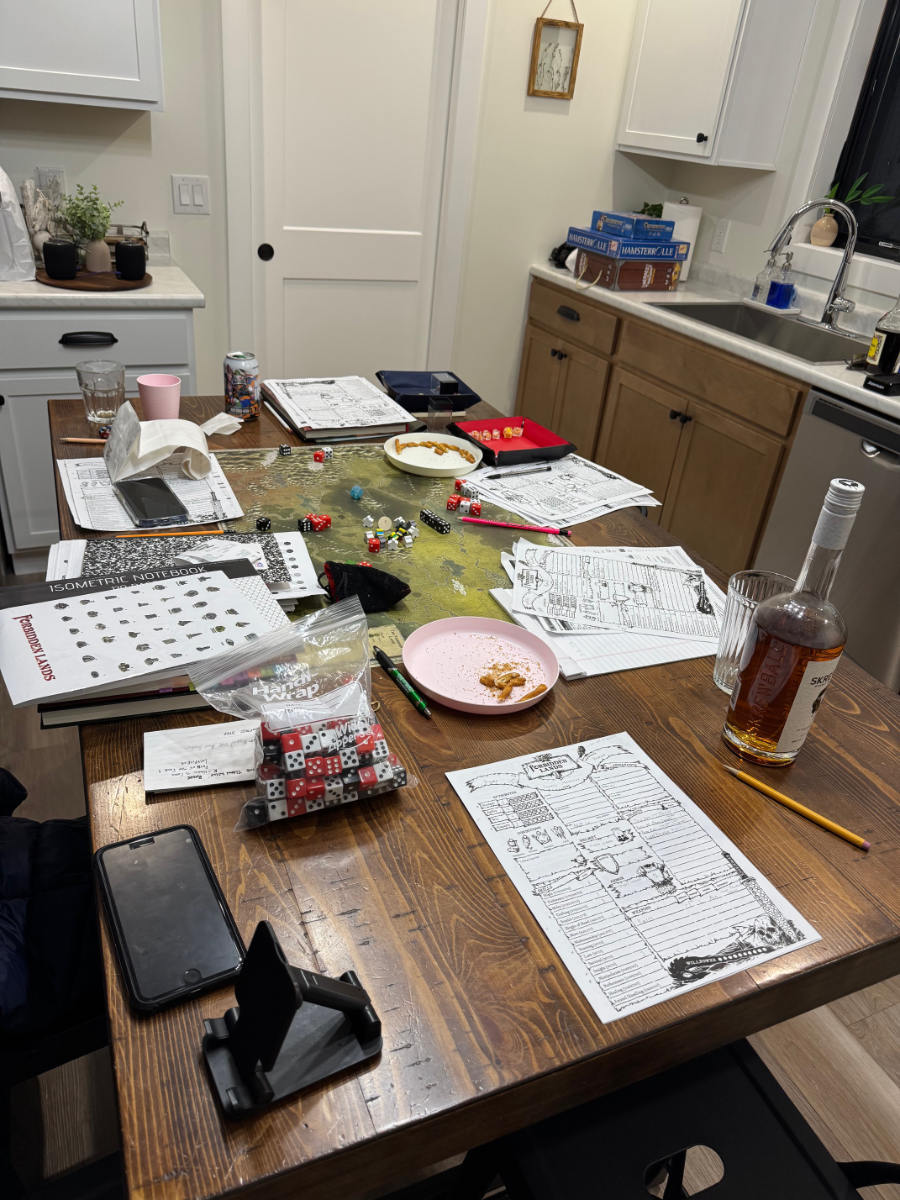
We agreed that this could be our new system for a while, and that we would do an official “campaign start” when we all met for our TTRPG Weekend Getaway (we call it the Stabbin’ Cabin) – they would all keep the same characters and we’d embrace where ever the dice and rolls takes us.
On my end as a GM, I found Forbidden Lands to be initially just much more of an easier dive into its lore and systems. I don’t want to knock D&D, as it is a well-known and well-established RPG that has either been the only system players will use or be the gateway into others. With Forbidden Lands not being largely mainstream, it gives you that sense of relief over delving into it without fear of not knowing all of its stories, characters, and locations. If I am learning something new about the world, my players are learning about it at the same time, and we all get to share a moment together at the table.
Would I recommend Forbidden Lands? Yes, but this is a game that you’d recommend to someone who is familiar with playing TTRPGs – a newcomer to the genre may find themselves overwhelmed vs with how D&D can easily get players and GMs started in playing and/or running a game. However, if you’ve got some TTRPG sessions under your belt, or if you’re a seasoned player looking for something different – you can’t go wrong with Forbidden Lands.
Thank you for visiting the Regiment of Strategy Gaming and riding with The Armchair Dragoons.
Rather than list a bunch of social media links, the easiest thing to do is to check out our LinkTree, which connects you to all of our various locales around the web.
You can also support The Armchair Dragoons through our Patreon, and find us at a variety of conventions and other events.
Feel free to talk back to us either in our discussion forum, or in the comments below.


