
 by
by Jerry Hall with Brian Train, 13 April 2026
The Moment a Battle Reveals Itself
In the early afternoon of June 14, 1800, during the Battle of Marengo, Napoleon Bonaparte faced what appeared to be disaster.
Austrian forces under General Melas had driven the French army backward for most of the day. French units were retreating, cohesion was fraying, and the initiative seemed firmly in Austrian hands.
Yet Napoleon was not attempting to control every engagement across the battlefield.
Instead, he was searching for something far more important: the decisive point.
As reports arrived from different sectors, Napoleon realized that the Austrian advance had stretched their formations. Their pursuit had opened a moment of vulnerability. At precisely that moment, the fresh division of General Desaix arrived on the field.
Napoleon immediately redirected these newly arrived troops into a counterattack.
The result was one of the most dramatic reversals of fortune in Napoleonic warfare. The Austrian army, believing victory already within reach, suddenly found itself collapsing under a sudden and concentrated French counterstroke.
Napoleon had not controlled every engagement that day.
But he had recognized where his attention mattered most.
The Illusion of Control
Many modern strategy games give players extraordinary power.
Every unit can be directed instantly. The entire battlefield is visible. Orders are executed precisely and without delay.
For the player, this level of control feels natural.
But for historical commanders it would have seemed miraculous.
Real battlefields were chaotic environments. Reports arrived slowly and often contained errors or did not arrive at all. Orders took time to travel and were sometimes misunderstood (or did not arrive at all). Events unfolded simultaneously across distances far too large for any individual to observe directly.
The most constrained resource in command was not manpower or firepower.
It was attention.
Commanders cannot observe everything, interpret everything, and act everywhere at once. They must continually decide where to look, where to intervene, and—perhaps most importantly—what to ignore.
Understanding this limitation reveals something fundamental about command.
At its core, command is the management of attention.
The Commander’s Dilemma
A battlefield is an immensely complex system.
Units maneuver. Morale fluctuates. Terrain shapes movement. The enemy acts independently. Subordinate commanders make decisions of their own.
Opportunities appear suddenly and vanish just as quickly.
Yet the commander possesses only one mind.
Even the most capable generals could not monitor every engagement or supervise every maneuver. Instead, they moved their attention deliberately across the battlefield, focusing on the areas where their presence could influence events most effectively, and in Napoleon’s case at Marengo, most decisively.
When Napoleon rode toward a threatened sector, his presence did more than provide observation.
It changed the battlefield.
Staff officers transmitted orders. Reserves shifted position. Subordinate commanders adjusted their actions.
The commander’s attention functioned like a spotlight.
Where it fell, decisions accelerated and resources concentrated.
Where it did not, events unfolded through impetus and local initiative…or inertia.
The art of command lies in choosing where to shine that light.
Coup d’Œil (koo-DOY) and the Perception of the Decisive Point
Long before modern theories of decision-making, military thinkers recognized that great commanders possessed a particular form of perception.
The French term coup d’œil—literally “stroke of the eye”—described the ability to grasp the decisive features of a battlefield “at a glance.”
Commanders such as Frederick the Great and Napoleon were said to possess this ability. Amid incomplete reports and shifting conditions, they could identify the point where action would have the greatest effect.
Coup d’œil was not simply intuition.
It was the disciplined ability to focus attention on what mattered most while filtering out distractions.
In modern terms, it represented an exceptional ability to orient within a complex situation.
Seen this way, coup d’œil forms a natural bridge between historical command practice and later theoretical models of decision-making.
Boyd and the Competition for Decision
In the twentieth century, American strategist John Boyd offered a framework that helps illuminate these dynamics.
Boyd’s famous OODA loop—Observe, Orient, Decide, Act—describes the cognitive cycle through which individuals and organizations respond to changing circumstances.
Boyd argued that conflict often becomes a competition between decision cycles. The side that can observe and orient more effectively gains the ability to shape events faster than its opponent.
Observation and orientation are fundamentally acts of attention.
A commander cannot observe everything, nor interpret every report. Attention determines which signals are noticed, which patterns are recognized, and ultimately which decisions are made.
If a commander’s attention is overwhelmed, misdirected, or fragmented, the decision cycle collapses. Information is missed, patterns are misunderstood, and actions come too late or at the wrong place.
From this perspective, command becomes less about issuing orders and more about directing limited attention through the decision process.
Kriegsspiel and the Problem of Command
In the early nineteenth century, the Prussian army adopted a remarkable tool for studying these realities: Kriegsspiel (“war game”).
Kriegsspiel did not assume perfect information or direct control of units.
Instead, it introduced an intermediary figure—the umpire—who interpreted the players’ orders and determined what actually occurred on the battlefield.
Players issued written orders as real commanders would. The umpire adjudicated those orders based on terrain, timing, and the reactions of opposing forces.
Information was imperfect. Reports could be delayed or incomplete.
This structure forced participants to confront the same constraints faced by real commanders.
They could not monitor everything.
They had to decide where to focus their attention.
The structure strongly resembles modern command post exercises, with Red, Blue, and White cells managing opposing forces and adjudication (often via a constructive simulation).
Kriegsspiel was not merely a game.
It was a structured exploration of decision-making under uncertainty.
Command-Focused Wargames
Wargame designers have occasionally attempted to capture this problem of command directly. Several designs have explored ways to represent the difficulty of directing large formations under uncertainty. My friend and fellow designer Brian Train has written about this challenge in several contexts, and his observations highlight how designers have grappled with the problem of command.
Command-Focused Wargames1
The following are some examples of wargame designs that have attempted to capture aspects of the commander’s attention and decision problem from various angles.
Attention and Action: War of the Ring (1977)
SPI had a big hit with its large-scale Tolkien property game War of the Ring (1977), which combined an individual quest type game (the Character Game) with an optional Campaign Game. 
The tension in the Lord of the Rings trilogy comes not only from the drama of armies confronting each other in great battles but also in the stealthy infiltration of the main characters into the enemy’s domain.
This could not have been done in game form with the perfect-information setup in most wargames of the time, so the designers Howard Barasch and Richard Berg came up with a handicap for the Dark Powers player, that of a limited number of “Shadow Points”. From the rules:
“Sauron cannot attend to everything at once. There are the Nazgul to direct, Saruman to watch, Denethor to debilitate, the Ringbearer to search for, the southern allies to keep in line, and his enemies to cope with. Thus the eye – the Dark Power Player – despite nearly unlimited potential power is limited in what can be accomplished at any one time. “
And so, the player receives a variable number of Shadow Points each turn.
There aren’t enough to do everything well, and so the Dark Power player must think quantitatively (since it’s a game) about how to divide their attention each turn between intelligence (moving Nazgul around to search for the Ringbearer) and operations (moving forces around at the cost of more points for a larger force, attacking, and defending at full strength).
Attention and Action: NATO Division Commander (1980)
SPI’s NATO Division Commander game (1980) explored the challenge of directing modern formations in a fluid operational environment.
This was one of the last titles on modern combat SPI would publish, and while it was released for the civilian market it was unabashedly intended for professional US Army use (I’ve always considered the Central Front series of games (Fifth Corps, Hof Gap, BAOR) to be a sort of cut-down version of this game.).
It is a large and complicated game, full of procedures that are not necessarily complex in themselves but there are a lot of instruments playing in this band at the same time, and so a lot to track simultaneously.

This in itself taxes the player’s attention, much as classic Kriegsspiel did.
Among its many sections of optional rules, the game system devotes a great amount of detail (measured by civilian wargame standards) to the division commander himself, and what the commander must do and attempt to do to keep the formation going.
The division commander is given three personal characteristics or abilities which enable him to exert a personal influence on the combat operations of his division: perception, organization, and command.
The quantitative level of each of these abilities can vary from 1 to 6. For further variation, players could also determine the levels of personal characteristics for each of their division commanders by using the randomized Personal Characteristics Table that would give you a Grant about as often as it would give you a McClellan.
Perception ability is the functional measurement of the commander’s “‘smarts,’’ his ability to grasp what’s going on around him. This is reflected in the game by enhanced operational intelligence and better quality SITREPs (SITuation REPorts) from the Controller (if playing the double-blind version that involves an umpire, surely one of the more challenging experiences a wargame player can have).
Organizational ability level is the functional measurement of his ability to utilize his resources to maximize their productivity. In the game, this means that the commander can increase the Staff Point Allowance of whatever headquarters of the division he is located with, main or subordinate: this is useful because Staff Points are necessary to get just about anything done in this game, from moving units and changing modes to ensuring ammunition and supplies keep moving.
Command ability is the functional measurement of the commander’s ability to use personal leadership (charisma) to elicit superior performance in combat from his officers and men. In the game, the commander can place himself with a brigade or regiment headquarters to give a favourable combat differential to all units of that formation or even embed himself with a battalion or company to give an even more intense benefit!
The division commander can only do so much in a given turn and can only do it well if he is well rested and able to focus. In the game, each turn the commander receives an amount of Action Points and these must be expended in order to conduct tactical or operational intelligence, move himself from place to place, and use any of his three abilities. The commander can push himself into doing more, but at the cost of greater levels of fatigue which make getting anything done harder, and may even incapacitate him completely.
Finally, as if this weren’t enough to occupy the commander’s mind, the game also includes a dimension of subordinate and battalion leadership. Each subordinate headquarters has a commander with a rating of -3 to +3, which hinders or helps combat operations by maneuver units and affects staff, artillery or ammunition supply coordination at division headquarters. A division commander may transfer these subordinate leaders around but largely has to contend with the hand of cads (snicker) he’s been dealt.
Attention and Time: Paddy Griffith’s Generalship Game (1980, 2008)
Napoleon is supposed to have said, “I may lose a battle, but I shall never lose a minute.” It’s true that timing is consequential in most things in life. Organizational friction, weather, and the enemy all have a vote as well but the one aspect that a commander has some discretion over is how to use their time, in order to block out focus their attention by observing and planning.
The late Paddy Griffith wrote a book Napoleonic Wargaming for Fun (1980, 2008) which included seven sets of rules for games to play in that period at various scales. 
The Generalship Game included in the book is a high-level one where the player assumes the role of an army commander running a campaign, with many subordinates and details to manage. Griffith wrote in his introduction:
“All this obviously imposed a terrific strain upon a commander and to do everything properly he really needed to be everywhere at once. As a generalization, we can therefore say that the good commander needed two main qualities. He needed the judgement and military knowledge to use his time to the best advantage, and to put high priorities on those things which were really important. And he needed the energy and personal force of character to get things done, once he had decided what things needed to be done.”
These three items are much the same as the qualities of the division commander cited in NATO Division Commander, of course.
The game is essentially a time management role playing game where the players must plan their day in half-hour increments, while the opponent who is doing the same.
They must allocate time between such things as gathering intelligence, writing orders for mobile units, writing letters to maintain and improve the line of communications, resting, moving themselves so as to inspect troops and supply points or conduct personal reconnaissance, etc..
They dare not let anything slide completely but they do have to set and respect priorities depending on what stage the campaign is at.
In the short rules Griffith lets the players play themselves, though certainly an umpire could dictate certain character advantages and deficiencies to a player for them to further role-play.
Attention and Time: Red November (2008), 91 DSSB Staff Game (2025)
Red November, a small, weird and whimsical cooperative game for 1-8 players about gnomes on an attack submarine where everything is going wrong may seem an unlikely source for inspiration, but hear me out.
 The sub is dealing with multiple simultaneous crises: the boat is descending and the water pressure increasing, the nuclear reactor is overheating, the nuclear missile launchers are pre-igniting, fires and water leaks are everywhere, there’s a giant Kraken looming nearby and there’s very little oxygen and vodka left.
Players must organize themselves to deal with these concurrent problems and deal with other smaller emergencies that emerge during the game; letting any one of them get out of hand will lose the submarine.
The game features an endless time-track where the next player to play is the one furthest behind on the track.
During their turn they may take as much time as they want to act and resolve problems, which does improve the odds of success but also prompts further emergencies (and ensures a longer wait until they next get a turn).
If the gnomes can keep alive long enough, rescue will arrive and the game is won.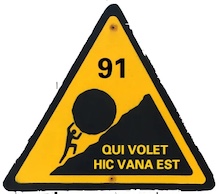
The concept of the endless time-track helped me in designing 91 DSSB Staff Game, a 3-player cooperative game on the hellish treadmill that is life in the fictional US 91st Division Sustainment Support Battalion. It shows that you can find inspiration anywhere!
The three players are leaders of staff sections (S-2, S-3 and SPO) in the Battalion who work together to prepare and send off supply convoys once per cycle of the battle rhythm to divisional Brigade Combat Teams on the “front line”.
This is also essentially a time management and planning game, with simple processes, roles and choices that put demands on the players as the situation continues to change and crises arise – and if they do not achieve their primary task of supplying the maneuver units, the overall situation will worsen quickly.
Most civilian-market wargames have detailed procedures for movement and combat, with the logistics processes handwaved away. For a long time I wanted to design a game that approached the inverse of this and presented players who for once were not battle commanders but still faced problems of inadequate resources, poor information, fatigue, accidents and constantly having to manage small crises… that is, how a commander must prioritize attention and effort.
The Missing Element in Many Wargames
Modern strategy games have become increasingly sophisticated.
They simulate logistics, terrain effects, and fog of war. Some introduce command delays or imperfect information.
Yet one resource often remains unlimited: the player’s attention.
Players can shift focus instantly across the battlefield and intervene wherever necessary.
No historical commander possessed such awareness.
The most significant challenge of command—the need to prioritize attention—largely disappears.
Without that constraint, the player becomes less like a commander and more like an omnipresent battlefield intelligence.
Rethinking Command in Wargame Design
If attention truly represents the most limited resource in command, wargame design might benefit from modeling it explicitly.
Instead of granting players unlimited awareness and control, a game could treat attention as a resource that must be allocated deliberately.
Where the player focuses attention, coordination improves and decisions accelerate.
Where attention is absent, units rely on standing orders and subordinate initiative.
The central challenge becomes the same one faced by historical commanders:
Where does my attention matter most?
The Art Behind the Science
War contains science.
Logistics, firepower, and terrain analysis can be studied systematically.
But command remains something more elusive.
It requires judgment under uncertainty.
It requires the ability to perceive patterns amid confusion and decide which events demand action.
This skill cannot be reduced entirely to formulas.
It remains an art.
And like many arts, it begins with perception—with the disciplined use of attention.
Conclusion: The Commander’s True Resource
Across centuries of military thought, a common theme emerges.
Coup d’œil described the ability to perceive decisive points in a complex battlefield.
Boyd’s OODA loop explained how commanders interpret information and act.
Kriegsspiel provided a structured environment for exploring decision-making under uncertainty.
Each points to the same underlying truth.
Commanders cannot control everything.
They must choose where to focus their attention.
Napoleon did not win the Battle of Marengo by directing every unit on the field. He won because, at the critical moment, he recognized where the decisive opportunity lay and concentrated his attention there.
In the end, the art of command may rest on a deceptively simple skill:
Knowing where to look — because that is where command itself will have effect.
The views expressed are those of the author and do not reflect the official policy or position of SAIC, the Department of Defense, or the U.S. Government.
Or, as Brian like to put it —
The views expressed are those of the author and might as well have been scribbled on birchbark and thrown to the wind, for he is beyond embarrassment, censure or even notice.
Thank you for visiting the Regiment of Strategy Gaming and riding with The Armchair Dragoons.
Rather than list a bunch of social media links, the easiest thing to do is to check out our LinkTree, which connects you to all of our various locales around the web.
You can also support The Armchair Dragoons through our Patreon, and find us at a variety of conventions and other events.
Feel free to talk back to us either in our discussion forum, or in the comments below.

Thank you for running this! But Jerry’s thoughts are far weightier than my flippant froth. -Brian
One of my recurring questions about wargame design, whatever the format, is ‘what decisions do you want the player to be making?’ We all understand, I expect, the wargame issue of the ‘helicopter’ general, who instantly moves from the role of CinC to command a battalion, brigade, division, corps or army at will – then levitates up and out of that situation and moves instantly across the battlefield to repeat the process. This happens especially in many rules sets for tabletop miniatures – I’ve been embarrassed more than once when I watched an opposing player take advantage of my expectation that as army commander I could expect subordinate levels of command to demonstrate some competence, to know how to deploy their brigade or battalion. It comes back to my opening question to the designer – what decisions do you want the player to be focusing on?
Well, your first question is also the first question the designer should ask themselves, and they had better have a good answer. There’s only so much you can ask a player to handle in a game or they will check out from boredom or feeling overwhelmed; in either case you’ve lost them. As for level of command, the common rule of thumb is “two down” of course… if you are running a division, you should be concerned with the component battalions and how they are supported. Too many games ask the player to handle too much, and even if you are asking not much for each decision you are both overwhelming them and also simplifying things to the point where you are just pushing too much cardboard around on a map.
Aloha Brian!
Indeed. Too many games end up being about micro-management to achieve CRT optimization 🙁
That has definitely changed for the better over the years, which is a good thing. But I think we as designers can keep improving, which is what I have been thinking a lot about lately.
Aloha Robert, and thank you, your comment gets to the heart of it. Too many games allow the player to become what you describe as the “helicopter general,” effectively collapsing multiple levels of command into a single omniscient perspective. That may create control, but it often removes the real challenge of command: deciding where to focus limited attention. The question is not simply what units can do, but what the commander can actually perceive, influence and prioritize under pressure.
I believe that is where judgment develops. I think your question, “what decisions do you want the player to be making?” is probably the most important design question in wargaming.
Aloha all! This has been a really thoughtful discussion, and it gets to a question I keep coming back to in both wargaming and command studies: what decisions are we actually asking the player/commander to make?
I increasingly think the most interesting games are not the ones where the player perfectly controls every unit, but the ones where they establish intent, shape conditions beforehand and then try to influence unfolding chaos with incomplete information, limited attention and imperfect control.
In real command, a commander rarely “plays every piece.” Much of the outcome is shaped before contact through organization, positioning, logistics, reconnaissance, timing, communication architectures, training, reserves and guidance to subordinates. Once the fight begins, the commander is often managing friction, preserving options, reallocating attention and adapting to conditions that are already in motion.
That is one reason I think the “helicopter general” problem is so important in design discussions. Omniscient control can unintentionally remove the very uncertainty, delegation and judgment that make command interesting in the first place.
For me, the ideal is not maximizing control, but modeling influence under uncertainty. The player should feel the tension between what they intended, what they know and what they can still realistically affect as the situation evolves.
Really appreciate all of your perspectives. These conversations are helping sharpen my own thinking quite a bit.