
 by
by Ian Brown, 13 August 2026
I’m sure you’ve all been feeling it—that twinge inside you that the universe is off-balance, that there is a void that needs filling. You feel it in the water. In the earth. You smell it in the air. Yes, it’s that tremor in the Force that comes roughly two months after a wargaming conference and you wonder when Ian is finally going to get off his @$$ and write something about it.
I could say that the weeks in and around Connections were possibly the worst travel planning I’ve done in my life, wherein I sling-shotted from Origins in Ohio to Connections in California to a Caribbean cruise, and all that travel made it hard to sit down and actually write. I could say that the opening line of Walter Kunkle’s report on Origins was a work of such literary brilliance that I was terrified anything I wrote afterward would be a faded star in comparison to the blazing glory of his pen. I could say that when I did find time to sit down and type, a tiny kaiju on my shoulder whispered in my ear: “you probably owe Sebastian something…for a project you made promises about when the world was young and Durin woke and walked alone…the spreadsheet calls you, motherf****r, go make some JCCs!”
I could say all of these things and they’d be true. Yet the thickest brick in the wall of my writer’s block was that I felt like Connections USA 2026 was an inflection point—it took me a while to find words for it, because parts of the underlying current were discomforting. The inflection spun around a simple idea: show me something new.
I go to wargaming conferences for fellowship with my tribe of nerds, yes, but more importantly to learn what is new in the profession. I want to absorb those new things for my own continued development, share them with my work colleagues, and bring them to bear for the benefit of the sponsors who trust us to leverage our wargaming expertise in the games we run for them. Show me something new brought me to Monterey in June.
And I did see some new things. But when I left—mulling the conference over along with similar events from Wrocław to Ottawa I’ve attended over the last year—the show me something new box in my brain felt only partially checked off. I’d not expected that response after attending the preeminent conclave of professional wargaming.
Thus this conference report will be, as much as anything else, my own stream of consciousness effort to find the words for why I left Monterey feeling the way I did—and perhaps more importantly, what to do about it. Show me something new isn’t the sole responsibility of a conveniently nebulous “someone else;” I own that too. So let’s explore and see what we find.
The Conference
The Naval Postgraduate School (NPS) in Monterey, California, hosted Connections USA 2026 from June 23-25, with the theme of “Wargaming Beyond Boundaries: Embracing Innovation.” While I didn’t exactly relish the coast-to-coast plane ride less than 24 hours after driving back to Virginia from Origins, I’ll never regret a trip to Cali. A piece of my heart will always belong there from the many years it was my Marine Corps home. This was my first time visiting NPS, however, where among other things I quickly learned that both the campus itself and my hotel were apparently part of a game by airline pilots to see how low they could fly over each without actually grazing their landing gear along the roof.
As it was my first time in town I also explored the environs around my hotel, wherein I learned new things like the bar at the Monterey Cookhouse has very generous pours during happy hour and anyone visiting should absolutely drop by to validate this for themselves. I also discovered that—how should I say this—even one of the world’s oldest industries (see below) can embrace innovation, although I did not personally explore what this new leadership brought to the table.

click images to enlarge
The conference opened with remarks from NPS’ president, Vice Admiral (ret.) Ann E. Rondeau, and she laid an encouraging foundation for the next three days with context on the many breakneck developments across both wargaming and the defense establishment as a whole—in particular the emergence and embrace of artificial intelligence (AI) tools. She noted that despite such acceleration, wargaming remained special for two reasons: it is deliberate, and more importantly it is human. I appreciated her reminding us of this. Ultimately wargaming captures the consequences of human decisions. Sure, technology—its adoption, its employment, and mitigations against it—can be part of those decisions, but until the day we find ourselves engaged in interstellar war against Cylons, technology in war starts with humans deciding to use it and ends with humans as the intended target.
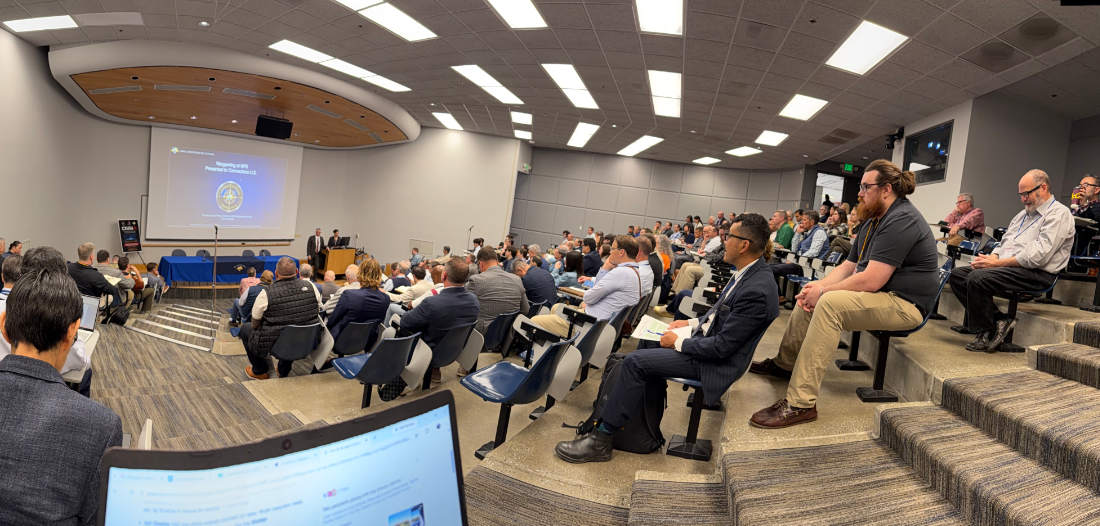
Show me something new is about more than widgets and this was a positive start, so let’s ride the “good stuff” train a little farther.
First off, some shameless self-promotion—although I’m the one writing this, so I kind of feel like I can promote what I want and if folks don’t like that, well, next time go to the conference yourself (note: Brant’s not paying for your plane tickets either). I attended Connections USA as part of a team from our collective employer, and it was with no small amount of pride that when I did the math, our crew delivered roughly one-fifth of all the content across three days. These presentations included:
- Tom Vielott on qualitative data capture and research and analysis methods
- Zack Rothschild with the preeminent Dr. Stephen Downes-Martin on how “malign” wargaming could support deception operations and strategic deterrence
- Our Fellow for Digital Wargaming Phil Pournelle on defining a skill progression pathway for new wargame designers as well as responsible use cases for AI integration in wargaming
- Phil and Zack and colleague Natalie Terlitsky joined Paul Vebber to discuss methods of wargaming future technology
- And because you all know I myself can’t shut up, I briefed wargame design for emerging crises, capturing lessons from Ukraine in educational games, and using solo games as data capture for qualitative analysis.
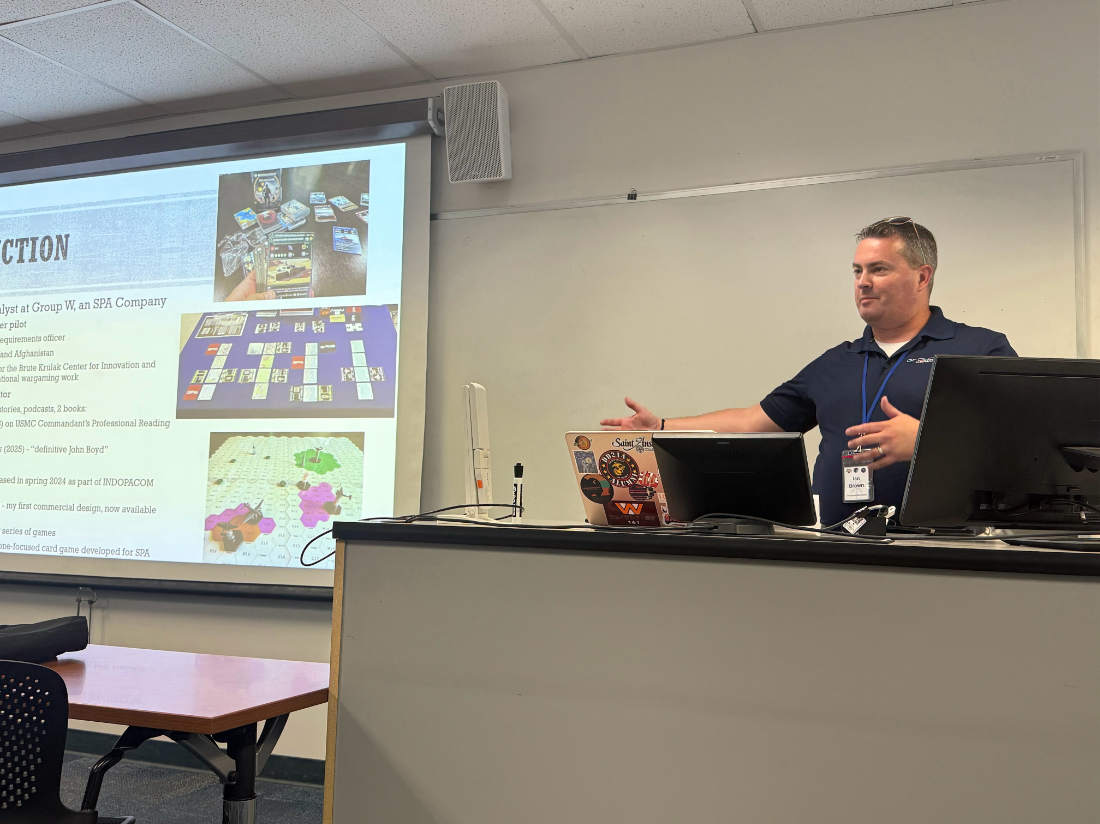
Not a bad crew to roll with and if you think this is impressive you should hear our water cooler conversations about stochasticity. We’re a fun group.
Of course there were excellent presentations beyond our immediate circle of nerds. Among the highlights were Dr. Mark Reith’s overview of using the Battlespace Next card game to teach insights about joint all-domain operations. This scratched a couple of my personal itches on both the utility of card-driven games along with his incorporation of John Boyd’s OODA loop in the cycle of developing student competency.
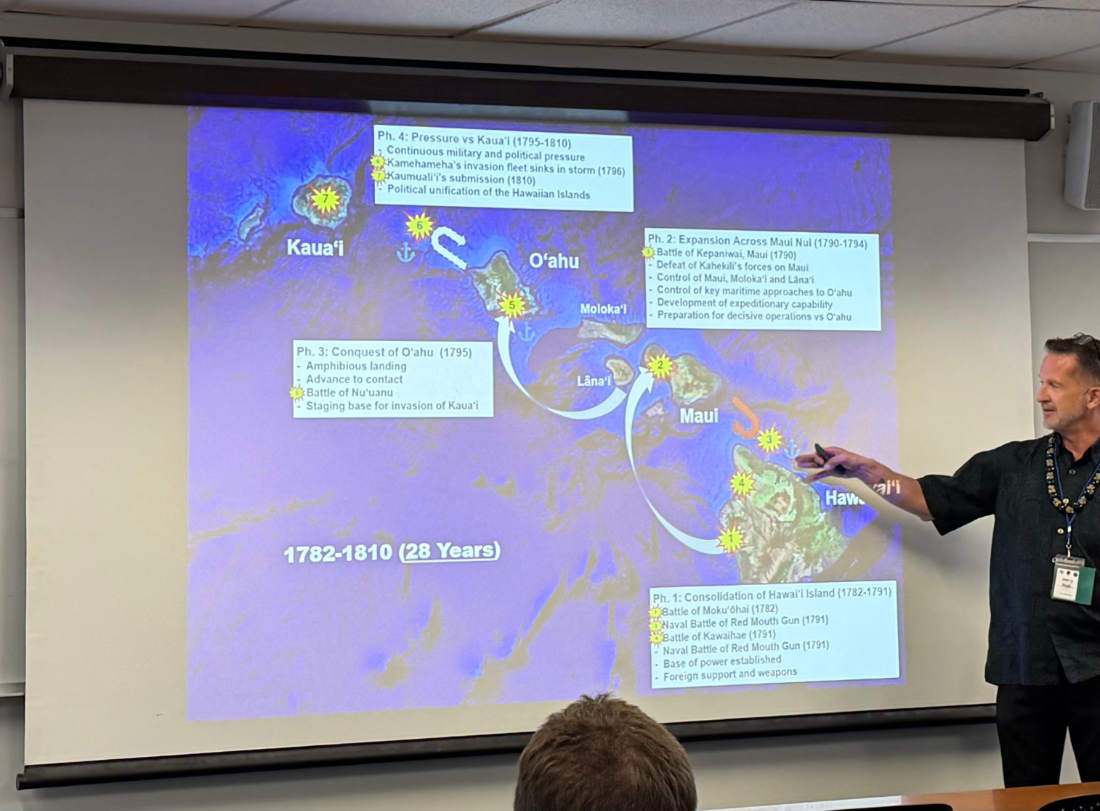
Jerry Hall played (forgive the pun) the “old is new again” card in discussing Kōnane. I’d not heard of it but it is an ancient Hawaiian strategy game of the same cultural significance to its people as chess or Go is to West and East. Jerry described how oral history paints a remarkable picture of Hawaiian monarchs using kōnane to both train their generals and conduct operational planning. The quality of the strategic thought inculcated in Hawaiian leaders was manifested, among other things, by King Kamehameha I’s years-long amphibious campaign to unite the islands as a single kingdom (an impressive military operation I’m ashamed to admit that, despite being a military history student and author myself, I was nevertheless unfamiliar with). Even the game pieces themselves reflect the inherently amphibious nature of Hawaiian existence, with its white pieces made of coral and black pieces made of volcanic rock.
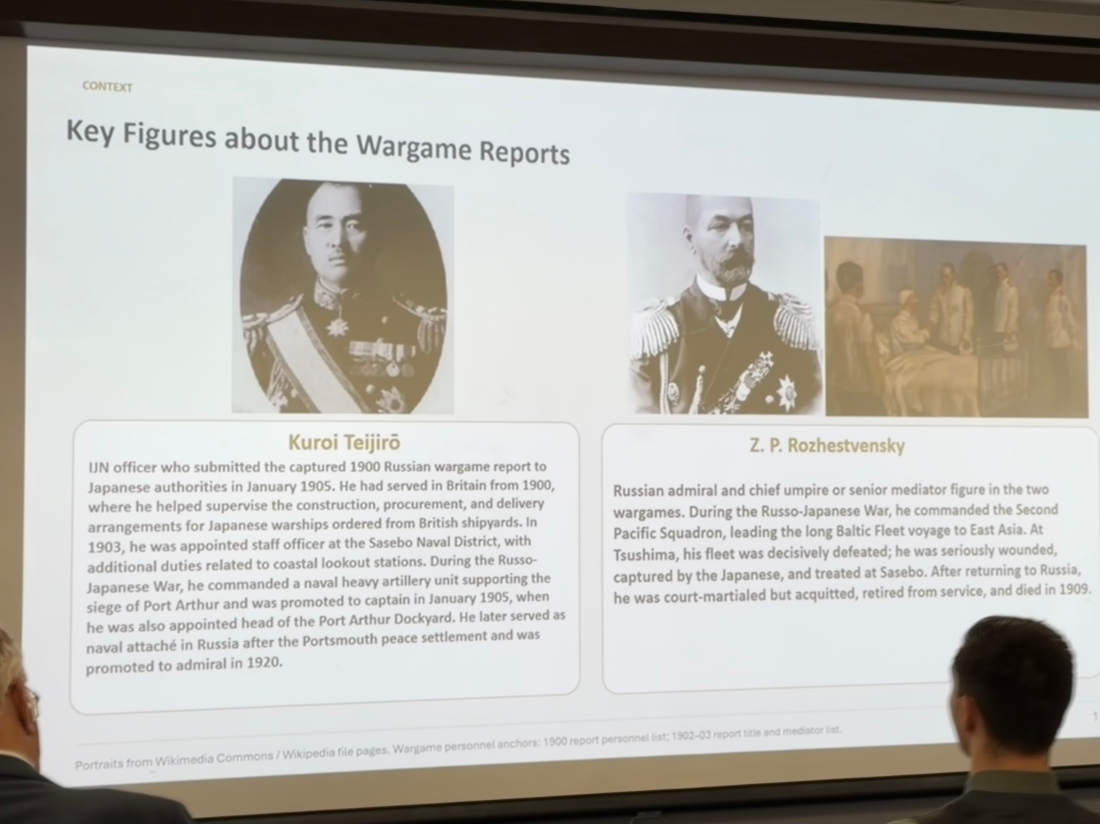
I’d also like to give special recognition to the delegation from the National Institute for Defense Studies (NIDS), a think tank under Japan’s Ministry of Defense—I think they brought as many people as our company did, and from much farther away. Definitely in the lane of show me something new, Dr. Hiroyasu Akutsu presented a fascinating analysis of a series of wargames conducted by Imperial Russian Navy staff at the turn of the 20th century. In three separate games—one unfortunately lost to the historical record but with documents on the other two surviving enough to assess the games’ logic and outcomes—Russian naval officers examined the problem of facing off against the Japanese navy in Russia’s Far East.
The games apparently did a solid job of identifying Russia’s centers of gravity, the probability of Japan using surprise and speed to gain the initiative—and then, in classic Russian fashion, one of the game series’ umpires believed Russian forces to be much more capable than they actually were, sailed his fleet halfway around the world, and had his entire force annihilated at the Battle of Tsushima in 1905. While the Russian wargames were another new nugget of history for me, Dr. Akutsu’s conclusion highlighted one of the oldest lessons of professional wargaming: games predict the problem far better than they predict the outcome of the war. And the Russian game umpire’s behavior underscored perhaps the second-oldest wargaming lesson: sponsors who dismiss uncomfortable findings have a hard time when operational reality comes calling.
That wasn’t my last interaction with the NIDS delegation. One of their officers devoted the Game Night to learning Shape Seize Secure, a “TDG in a box” card game that I designed for my company. It teaches players about employing unmanned and autonomous systems to help the human warfighter achieve their objectives.
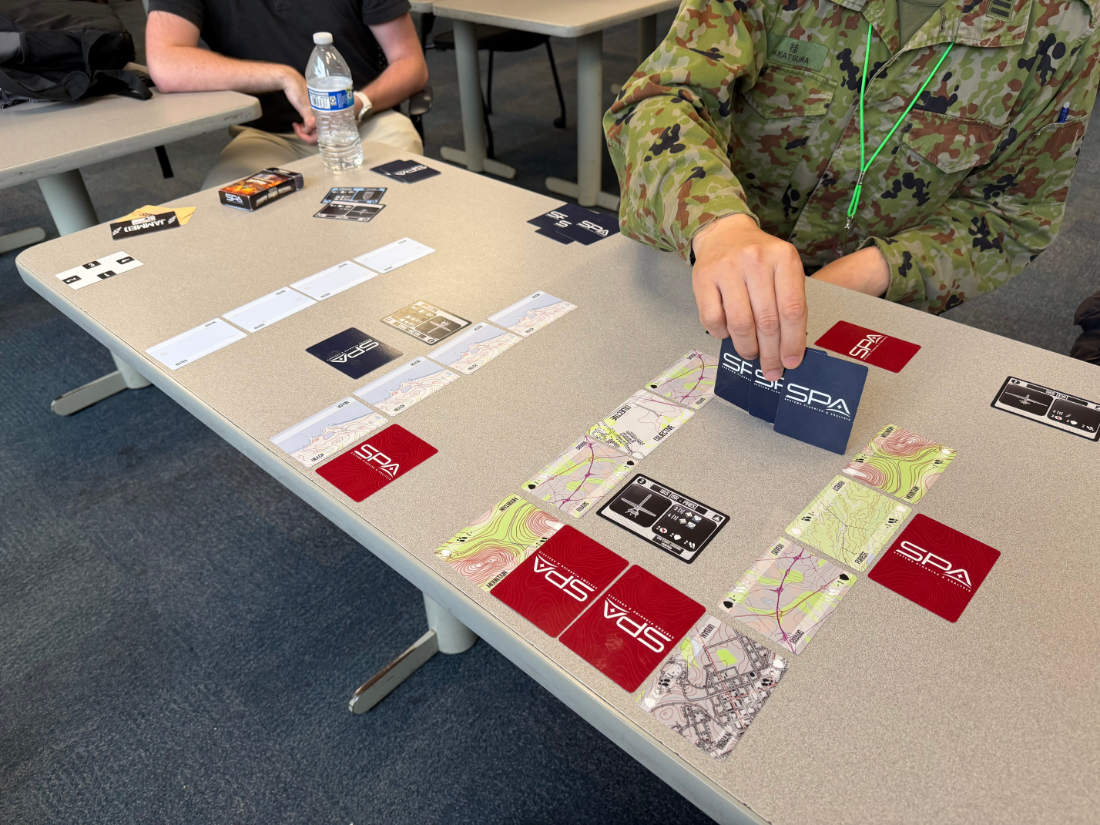
And what wargamer doesn’t like coming home with a new game? The NIDS team donated and raffled off two copies of the Japanese strategy game shogi, one of which I walked away with. Between that and winning Hunt for Blackbeard just a few days prior at the Armchair Dragoons Origins’ raffle, it had been a good couple of weeks for my game library.

Graduate Certificate
Now let’s shift to the event that was perhaps the fulcrum of my show me something new quandary, the inflection point made manifest. Although I knew it was coming for months—in part due to my hardwired inability to say “no” to Travis Reese the same way I can’t say “no” to Sebastian Bae—it was nevertheless tremendously exciting to listen to Travis brief the outcome of immeasurable heavy lifting he, Maegen Nix, and Nathaniel Ambler had undertaken: a fully accredited multi-week graduate certificate in wargaming offered under the School of Public and International Affairs at Virginia Tech.
This program offered something the absence of which had been lamented at previous Connections conferences and which I’d had innumerable energetic hallway discussions about with colleagues—an accredited, repeatable, and accessible onramp to professional wargaming. It didn’t depend on pre-existing linkages with the Defense Department or the guild-like recruitment pipeline of knowing a person who knows a guy who works for an obscure office that does some form of national security wargaming.
To be clear: there are valuable wargaming courses of instruction that existed before this, and I’ve been the beneficiary of several. I took the “Intro to Wargaming” course offered via distance education at Fort Leavenworth. I’ve taken the MORS wargaming certificate course, and several MORS courses beyond that. I know the Army War College has its own course up in Carlisle. The Virginia Tech certificate isn’t looking to displace those, but it opens a pathway to a much broader audience. The MORS courses skew towards those who already have grounding in the national defense/ORSA communities (it helps that those communities often pick up the tab for those who are part of those communities that attend). For the Army courses, “grounding” isn’t enough—you’ve got to be formally affiliated with the DoD to be able to attend.
The Virginia Tech certificate removes those narrow gateways and prerequisites. There’s a wide audience beyond the national security bubble of those interested in entering professional wargaming; now that bubble has a gate that’s not dependent on government service or six degrees of Kevin Bacon. I see this as the culmination of the work and desires of those who’ve been part of the professional wargaming discipline for a while in answering a vital question: where’s the next generation of wargamers coming from?
That’s the upswing of the fulcrum (uplift? Upshift? I’ll be honest, I’m a few bourbons in and currently have the instrumental of the Battle of Arrakeen from Dune 2 blasting beside me, so words are hard). My point is, the certificate program is a great thing pointing a way forward, a Golden Path if you will.
Inflection Point
So where’s the discomfort from this inflection point? This has been a dream of Connections USA since the first conference in 1993. Great. What’s to worry about?
To further torture the Dune metaphor, I see a risk. It’s the same risk that Paul Atreides and Leto II saw through their prescient vision of the alternatives to the Golden Path, a risk visible on the periphery of a conference aiming to go “beyond boundaries.” It’s the risk of staying inside those boundaries, of not moving into the future, of failing to embrace the energy and urgency that I saw coursing through the other wargaming events I’d attended over the last year.
As I said, my discomfort didn’t come specifically from the conference’s presentations—there were many excellent ones as I’ve noted above—but from its undercurrents, if one forced one’s self to acknowledge them. Again, this is stream of consciousness but I’ll do my best to explain.
The conference theme was aspirational, sure. It talked about looking to the future and not just looking, but pushing. Yet there was a divergence between aspiration and reality in several places. First: a new world requires a new generation and new ideas. But something struck me about the slate of presenters, cognizant as I was of slates from years past that I attended, so I looked back and—always dangerous for someone from a humanities background—did some math.
The percentage of new names on the agenda is shrinking, not growing. I ran some year-to-year comparisons going back to 2021. From Connections 2021 to 2022, 10 percent of previous presenters returned; 90 percent were new. Through 2023 and 2024, the number of returning presenters was about 19 percent. In 2025 and 2026, returning presenters grew to 25 percent of the agenda.
Now I don’t believe there’s a “right” percentage of returning presenters, or that we shouldn’t have core contributors in the community come back and continue to share their knowledge with the new generation. Indeed, I see that as an obligation of the previous generation and is something I try to live up to personally: share lessons learned with those who come after, so they can build on what you’ve done.
But that’s not the story the data tells. The story isn’t that there’s a consistent cadre of veterans returning to train the younglings; it’s that for several years running, the agenda has increased the numbers of those who’ve been there and done that, with new voices slowing but inexorably declining in number. That’s not a discipline that’s building the next generation; it’s one staying within the boundaries of the past and only listening to itself.
Second: an innovative discipline should crackle with energy and commitment, no matter how modest the circumstance. The “game lab” has been a recurring feature at Connections USA; these are lunchtime brainstorming sessions where attendees submit a question of interest to them prior to the conference. During the conference folks self-organize to fall in on the sessions that align with their own passions, and have a grassroots discussion that hopefully benefits the questioner and audience in equal measure. For my own part I came to Monterey still deeply impressed by the game lab I’d participated in at Connections North where we used an equivalent number of hours to Connections USA and…designed a damn game. We developed a game concept about Arctic security that I would’ve loved to spend more hours finalizing and then playing.
Unfortunately the contrast between game labs at Connections North and Connections USA couldn’t have been starker.
Unfortunately the contrast between game labs at Connections North and Connections USA couldn’t have been starker. I left the game lab in Ottawa regretting that we didn’t have more hours to actually build the design we’d conceptualized. In Monterey? I wished I could’ve gotten those hours back.
At Connections USA, two days running I showed up to a game lab room with several other people to discuss a question of interest…and the person who’d pitched the question didn’t bother to join us. Both days we gave a reasonable grace period in case that person was attending some other session that ran long. When it became clear that the questioner wasn’t coming, we did our best to generate our own discussion. But since the person who posed the question was absent, who knew whether we were exploring the avenues originally intended by the question? And what other genuinely productive game labs did we miss out on as we tried to create something from nothing in our room?
I’m not knocking the conference organizers for this—they collected game lab questions in good faith. But it says something about the “profession” when people can’t find the energy to show up for discussions they themselves proposed. That’s not a discipline crackling with energy and commitment. That’s a discipline grown complacent, with some members believing that others will do the work for them.
Third: it’s a dangerous world right now. Ukraine’s been fighting the largest land war in living memory for years. The United States has spent months emptying its magazines into Iran. China and North Korea have not been idle, each continuing to threaten their neighbors while playing their own part in nudging the wars in Iran and Ukraine toward one single tempest of violence. And as Connections North observed—politely but pointedly—old security guarantees aren’t the pillars of stability they used to be.
But I didn’t feel the urgency of this moment in Monterey the same way I did at other wargaming get-togethers.
But I didn’t feel the urgency of this moment in Monterey the same way I did at other wargaming get-togethers. Last year in Wrocław I talked about wargaming with serious people because not just for the Polish hosts, but for the attendees from several other European nations, there was a shadow only a few miles away cast by a neighbor that was actively murdering, raping, and destroying another neighbor. This spring when I participated in the “Games of War” conference hosted by the University of Gdańsk, presentations drove home the reality of active combat. This included the development story of a game whose creators spent their evenings dodging Russian ballistic missiles and whose artwork was inspired by the sketches of children trapped in a basement for months under Russian occupation. Hell, it was only two years ago that Connections USA hosted Wolfgang Hagerty, a former Marine who volunteered to fight in Ukraine and shared his insights from that experience with us. Wolfgang’s briefing was so impressive that our company invited him for a follow-on in-person session on drone tactics, and I interviewed him separately for two hours on a War on the Rocks podcast.
These conferences, and presenters like Wolfgang, sunk their teeth into the urgency of the moment. But there were no front-line insights at our conclave in Monterey. Our country had been plastering Iran for months, losing American lives in the process, and the closest a presentation got to the topic was an overview of a commercial game from 2014.
That’s not looking forward. That’s barely acknowledging the present.
Fourth and finally: Connections 2026 sought to go beyond boundaries and embrace the future. But—to slightly reword the closing commentary in my Connections North write-up—when all the attendees sat together for a group photo on the last day, I again wondered when our profession (at least the American branch of it) will finally bury the old stereotype of wargaming being primarily a bunch of old white dudes sitting around a table. Because, well…just do the math on the picture.
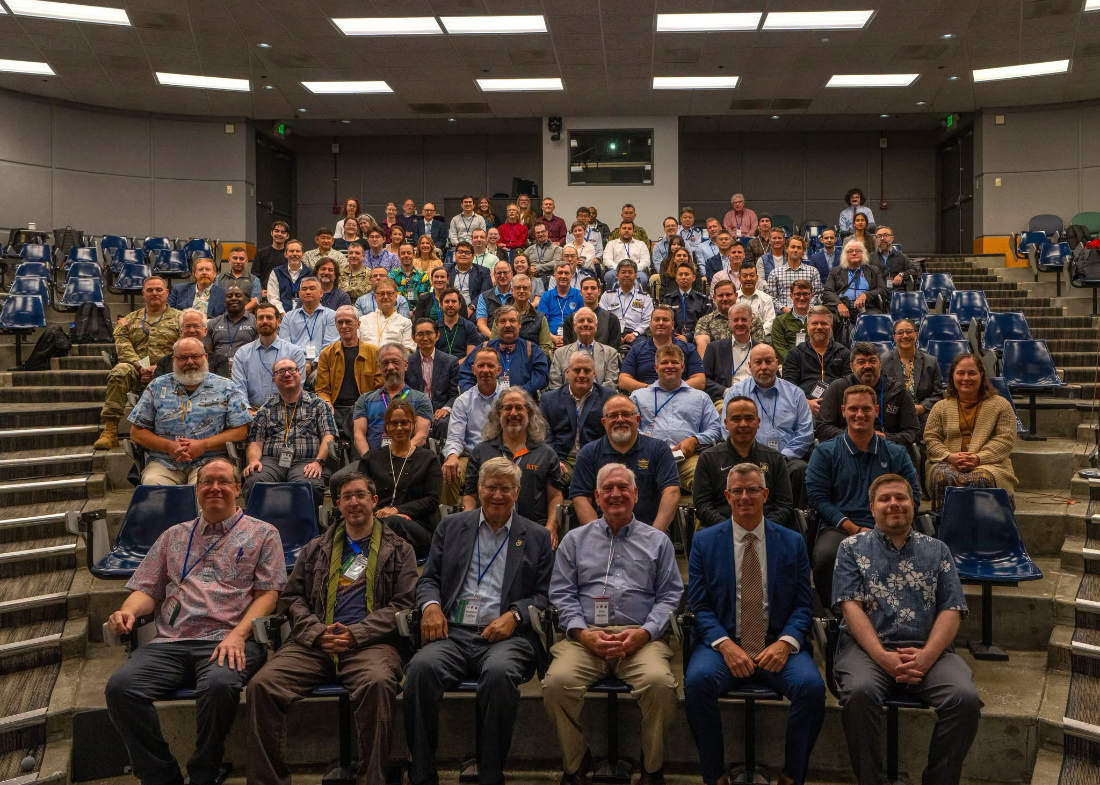
Look: I’ve made the effort to plug into as many different gaming events, government and civilian, domestic and international, as I can, so I know that the reality is more nuanced than the stereotype. I know that not everyone has the time or resources to make the trip to Monterey, that getting onto a military base further winnows the audience of attendees, and that government employees have had their wings clipped in myriad ways to include getting travel budgets zeroed out. There are a thousand reasons to explain why the people who showed up showed up, and why others didn’t or couldn’t.
But this is the preeminent conclave of professional wargaming. This is the conference that kick-started all the other conferences. We’re supposed to break boundaries and embrace the future. Yet look at that picture and ask: does this assemblage reflect the next generation of wargamers? Or is it previous generations looking back on themselves? Do we see urgency, or complacency? Is this a venue of the new…or a fair of the familiar where, each year, the percentage of the familiar and the comfortable gets a little bit higher?
I don’t know the answers to these questions. I found it unsettling that they occurred to me at all. But as I said at the outset, this felt like an inflection point, the point on the graph where the curve changes in a new direction. The curve could go either way because the scale is not yet out of balance. And as I also said, I own this as much as anyone else. So to borrow an idea I heard from someone years ago during another historical inflection point, I choose to embrace tactical optimism. The curve can bend upward. It’s within our control.
Change Things Up
For starters, we need a wider array of dynamic events beyond PowerPoint presentations. I’ll be the first to take this for action. Next year I owe the Connections organizers something my team wanted to execute this year but didn’t get across the finish line: a game design “jam,” taking advantage of the multi-day format of Connections USA which offers opportunities beyond single-day conferences. There’s nothing like the feeling of taking a design you developed out into the world for others to experience. And there’s nothing quite so challenging to the neophyte wargamer as coming up with that first design. So let’s use the preeminent professional wargaming conclave as a chance for the next generation of wargamers to overcome that hurdle, in an environment where everyone is rooting for you to succeed and where you can tap into that cadre of experience.
As a corollary, I challenge others to take ownership of some other part of the conference beyond simply submitting an abstract. 2026 better be the last year when a new wargamer from GenNext might walk into a game lab room and discover that no one’s steering the ship. Maybe game lab questions need names attached to them to ensure ownership; maybe the lab format just isn’t working as intended and needs replacement by another lunchtime event.
Either way, the attendee population should offer more than simply submitting slides and then letting the handful of conference organizers do the other 95 percent of the work (oh, by the way, speaking of lethargy—as we were gently reminded after the opening remarks on day one, some of you presenters still hadn’t bothered to actually send your slides to the organizers. Is that the profession we want to show off to future wargamers? People so lazy they not only don’t show up to their own game labs but can’t even hit “send” on an email with slides attached?).
My promise to 2027 is a game design jam. Let’s hear from one or two more of you about adding other new features to the 2027 line-up.
Beyond that, I will take it as an objective—and I’ll push the rest of the professional wargaming community to do the same—to encourage someone in wargaming’s GenNext to submit an abstract for Connections 2027. Part of what draws new wargamers to the discipline is that they’ve already had some thoughts about how they can contribute, and they want to capitalize on those thoughts. So let’s take the step that’s good for the long-term health of the profession and put GenNext in the spotlight. Let’s have next year’s agenda get back to 80 or 90 percent new names rather than creep to 30 or 40 percent old ones.
While we’re at it, do the homework to find a “someone” who can speak with the urgency of operational relevance. They exist. It might require a little extra homework to check the boxes of appropriate classification and/or distribution. Do the f***ing work. It helps share knowledge in a timeframe that’s useful and sets the example for the generation we want to recruit, that they also need to do the hard work when their turn comes.
Now, a thought for those in the veteran generation who have control over resources, as well as responsibility for members of GenNext.
Spend the money to get the new generation to those events that will further their professional development. Each year brings new professional development opportunities, not just in the United States but globally. The Connections network of conferences is truly a worldwide phenomenon; send your people to them. There are NATO events, non-NATO but allied and partner military events, and non-military/non-government events that nevertheless expose newcomers to many different styles, mechanics, and audiences of wargaming. And then there are the courses that I already mentioned. Options abound.
Send your people to them. Jesus Christ, for the volume of funds that go unexecuted, for the contracts that were so well-executed that there’s an embarrassingly large amount of money left at the end of the period of performance, or for the cost of a little overhead, you can give GenNext invaluable exposure and experience to facets of wargaming they wouldn’t otherwise encounter in the schedule of a few work-related events a year. Your people shouldn’t have to contort hours on their time card or burn leave to attend professional development events.
Maybe that involves a difficult discussion with a sponsor or C-suite executive. If it does: so?
You got where you are by the grace and support of others who wanted you to have a future in the profession. Now it’s your turn. Either you care about the future or you don’t.
I’ve said this in past Dragoons pieces: the implacable grind of time is taking the Founding Fathers of wargaming from us. Sometimes I get the sense that parts of the middling generation haven’t accepted that reality, but that reality is here and its attrition is inexorable. And the inflection point of Connections 2026 is a microcosm of that attrition.
So for us in the middling generation: if you haven’t done this already, it’s time to look at yourself in the mirror, give yourself the best disappointed teenage daughter side-eye, and tell that reflection: “hey motherf***er, show me something new.”
See you all in 2027.1
You can chat about this article in the Professional Wargaming section of our discussion forums
Thank you for visiting the Regiment of Strategy Gaming and riding with The Armchair Dragoons.
Rather than list a bunch of social media links, the easiest thing to do is to check out our LinkTree, which connects you to all of our various locales around the web.
You can also support The Armchair Dragoons through our Patreon, and find us at a variety of conventions and other events.
Feel free to talk back to us either in our discussion forum, or in the comments below.


Thank you Ian for a great piece, and thank you for undertaking to attend all the conferences you possibly could this year, including Connections-North.
This was the first time I can remember of a Connections at NPS; maybe it’s the first time ever.
I wish I had gone, because for once it would not have involved jet lag!
But for reasons alluded to in Ottawa and which have become ever clearer since, I’m not crossing that border.
I hope you’ll have a game jam event in 2029, I will gleefully participate!
Brian, thanks for your comments, and Connections North was definitely worth the trip this year, hope I can get back next year! And I understand your travel situation, which now has gone from bad to worse in the last 2 days just when I was thinking it couldn’t get more wretched. I’ll see what momentum I can get in the game jam department in the meantime.
Ian, great writeup, much better than my two-part monstrosity from last year (I focused a lot on the games that were previewed): https://armchairdragoons.com/cnx2025-2/. Thanks for calling out the issue of “sameness” in these events. Last year I was heartened by what I perceived to be as an increasing number of younger attendees (and a couple of presenters), but its hard to tell if it carried over this year by looking at the group photo (I think I see younger faces hiding in the back). I just got back from the inaugural Army PME event in Carlisle, and it was relatively low-energy, but they did focus on their theme of assessing wargames for Professional Military Education. It was not advertised as a design-fest, although there were show-and-tells on new games (my write-up is forthcoming on that). I hope the Army organizers are as good at collecting and posting the presentations for posting later as Stephen Downes-Martin has been for Connections.
Indeed—the repository of Connections presentations is a great resource and I’m glad Stephen continues to update it and make it available. The Army event looked intriguing but work took priority, though we were still represented well by Phil Pournelle.
This piece has generated some good self-reflection behind the scenes; I hope we can carry it into the light, and see what changes can be affected in time for next year.