
 by
by Ian Brown, 11 May 2026
I’ve wanted to attend Connections North for many years, both to broaden my horizons in the wider world of professional wargaming and as an excuse to visit friends and family in the country I was raised in. Unfortunately the timing didn’t work out until this year. But it was worth the wait, because circumstances drove the conference organizers to focus on a very timely theme: (War)gaming Canadian Security in an Era of Strategic Uncertainty.
And fair warning readers, I’m going to opine here (all thoughts and opinions my own, as usual) as I tend to in my writings for Armchair Dragoons, and start my opining by noting that the main source of Canada’s uncertain security environment is: us.
Oh, the conference convening materials highlighted numerous strategic challenges facing Canada these days: the fourth year of Russia’s invasion of Ukraine and the attendant destruction of the post-Cold War security framework, continued bullying and malign activity by China, and a war/not-war against Iran that was two weeks old by the time Connections North opened its doors on March 14. But given that I was born and raised in Canada, still have friends and relatives there, and thus follow both Canadian domestic issues and US-Canada relations more closely than the average American, I was quite cognizant that the biggest international upheaval Canada was grappling with came south of the world’s longest undefended border. From ripping up trade agreements to implying that the 158 Canadian soldiers who died in Afghanistan weren’t really doing anything dangerous on the front lines to territorial fulminations about a 51st state that would fit right into a speech from Putin—Canada has spent the last 18 months looking south and wondering what the f***, exactly, was going on down here.
To paraphrase my daughter’s artistic muse, I went to Connections North wondering if I should introduce myself with, “hi, I’m the problem, it’s me.” That proved unnecessary, but while largely (politely) left unspoken, the notion was nevertheless an undercurrent in the day’s discussion that followed.


click images to enlarge
Let me first note that for anyone interested in the full slide decks and list of presenters at Connections North, you should consult the thorough post-conference report shared by conference organizer Rex Brynen at PAXSims. Second, let me also thank Rex for arranging a morning snowstorm to greet out-of-town conference attendees. Of course, being Canada, the snow had absolutely zero impact on the timeline. The Ottawa environs shrugged off a foot of snow that would have cancelled school in northern Virginia for a month and left its denizens giving wheelbarrows of cash to that one neighbor who happens to have a snowblower.

As with the wider network of Connections wargaming conferences, Connections North has a rotating venue and this year it was held in the elegant National Capital Region Officers’ Mess in downtown Ottawa. The Mess echoed the Commonwealth roots of the Canadian military, right down to the collection of unit memorabilia in the basement highlighting the Canadian army’s historical accomplishments.


Rex opened the proceedings by noting that just down the road from this year’s conference location was a throwback to a previous era of Canadian strategic uncertainty: the Rideau Canal. Now a UNESCO World Heritage Site and popular for boating in the summer and skating in the winter, the Canal was nevertheless born from war and fear of Canada’s southern neighbor. Following the War of 1812 and American efforts to interdict British lines of supply and communication along the St. Lawrence River and Great Lakes, the British government commissioned the canal (with Napoleon’s vanquisher, the Duke of Wellington, endorsing the project). It would provide an alternate route for moving troops and military supplies should the United States, in any future conflict, again attempt to sever the St. Lawrence. The Rideau Canal was a legacy of an era when the two largest countries in North America had not always been friends, and of the decades’ long effort it took for them to become so.
The day’s first panel focused on “Wargaming Methodology,” with Katherine Banko of Defence Research and Development Canada chairing the discussion and presentations given by Sub-Lieutenant Luke Brannigan (Royal Canadian Navy), Philippe Beaulieu-Broussard and Kassie Miedema (Archipelago of Design), and Jon Jeffrey (Canadian Joint Warfare Centre). Sub-Lieutenant Brannigan presented his efforts at HMCS Venture to expose new naval officers to basic maritime concepts using a naval kriegspiel game borrowed from the Royal Norwegian Navy.
The presenters from Archipelago of Design – a Canadian non-profit organization – provided an overview of several of their game models through which they educate clients in three areas. The first is “futures thinking,” placing games in a distant future timeframe so that players have to develop new pathways for solving problems while breaking free of their own present-day biases. The second is “stealth learning,” which disrupts old ideas and biases without making the players look, well, stupid. The final area is “co-designing,” which involves the end user in the entire design process to ensure that the game’s final design achieves the desired intent for the customer.
Canada Paratus forced that collaboration by saturating all health care systems with an immediate demand signal. Putting representatives from all the provincial systems in a room together revealed that—since virtually all provincial systems are already at or over 100% capacity for bed spaces—the provinces would need to radically scale up information-sharing and triaging of incoming military casualties.
Finally, Jon Jeffrey offered a fascinating synopsis of an interagency game called Canada Paratus, which explored how Canada would deal with an influx of mass casualties from large scale combat operations across their various provincial medical systems. For those unfamiliar with the contours of the Canadian health care system, there is no overarching federal governing body; provinces run their own systems, and forcing functions for cross-system cooperation don’t generally exist. Canada Paratus forced that collaboration by saturating all health care systems with an immediate demand signal. Putting representatives from all the provincial systems in a room together revealed that—since virtually all provincial systems are already at or over 100% capacity for bed spaces—the provinces would need to radically scale up information-sharing and triaging of incoming military casualties. They had to create processes for identifying excess capacity in vital areas like intensive care units and burn units, balance patient treatment needs with the ability to place patients close to their homes, manage the flow of patients from the combat theater back to the homeland—and failures in these decisions directly affected patient mortality rates.
The next panel focused on “Gaming Emerging Challenges,” and was chaired by Madeline Johnson of the Canada Revenue Agency. Rex Brynen (McGill University), David Redpath (Canadian Joint Warfare Centre), Ben Taylor (Colcestrian Consulting), and Ed Farren (Fight Club International) joined as panelists. David Redpath—a gentleman who’s always worth listening to, even in disagreement—led off with a wargaming taxonomy review of previous Canadian wargames, highlighting the value and purposes of various game frameworks and how players can glean insights from them. He then asked the pointed question: if we (at the Canadian Joint Warfare Center) did all these great wargames to generate useful insights…why didn’t anyone care?
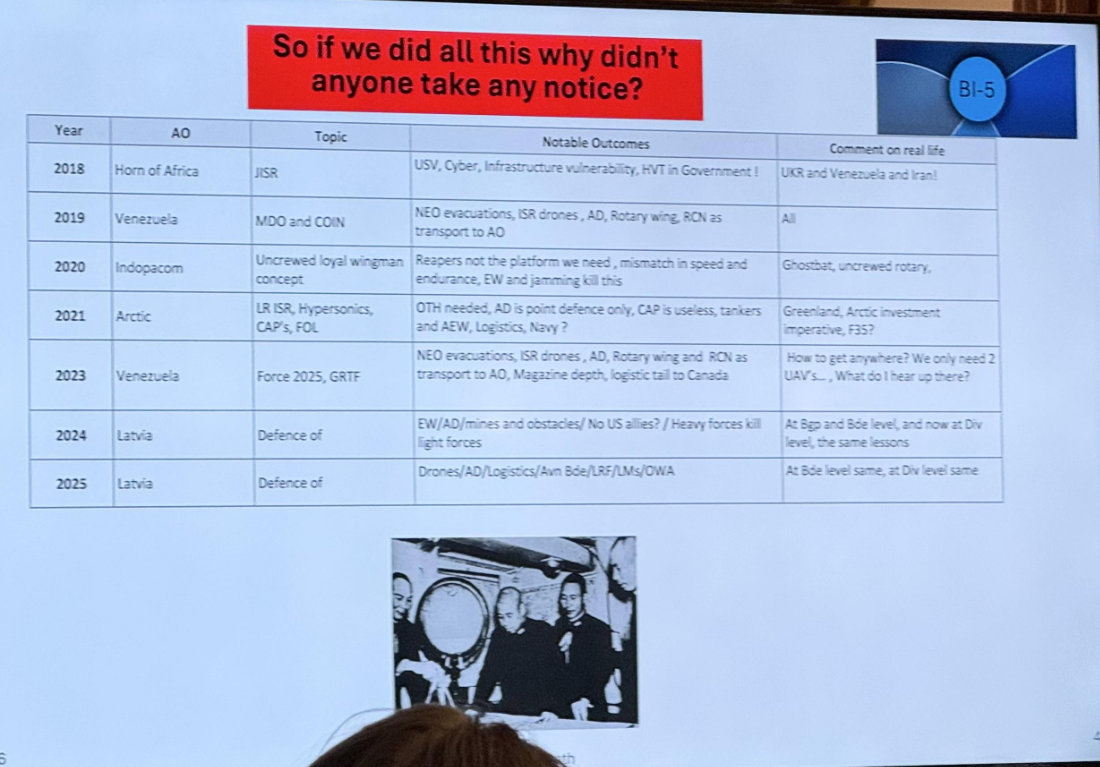
This delves into one of the most frustrating wargaming pathologies, which is that great lessons don’t matter if they aren’t effectively transmitted to the people who need them most. David noted a common bit of hand-wringing from clients who burst into the room and cry, in effect, that the world is changing and so we need a wargame to figure out how to handle it. David’s point was: no, the world only seems like it’s rapidly changing because you weren’t paying attention, whereas professional wargamers have looked at many of these “changes” years ahead of time in well-constructed, well-executed, well-analyzed wargames.
The shortfall came from what one of my colleagues characterized as “lessons observed versus lessons learned;” in David’s opinion, there wasn’t an adequate forcing function that got the insights from these great wargames into the right hands. His proposal was creating for Canada a dedicated and well-resourced wargaming center that could do just that (and while I’m certainly biased, I nevertheless took pride in his recommendation that the Canadian national security enterprise take a look at how the United States Marine Corps—particularly Marine Corps University—has applied real resources to precisely this problem).
David also had some challenging comments about information operations as “unlimited range, zero effect” efforts that aren’t ultimately a military problem. This is one of those areas where I’d disagree with him but love to have a deeper conversation, given how modern wargames increasingly build in some sort of information environment for players to interact with.
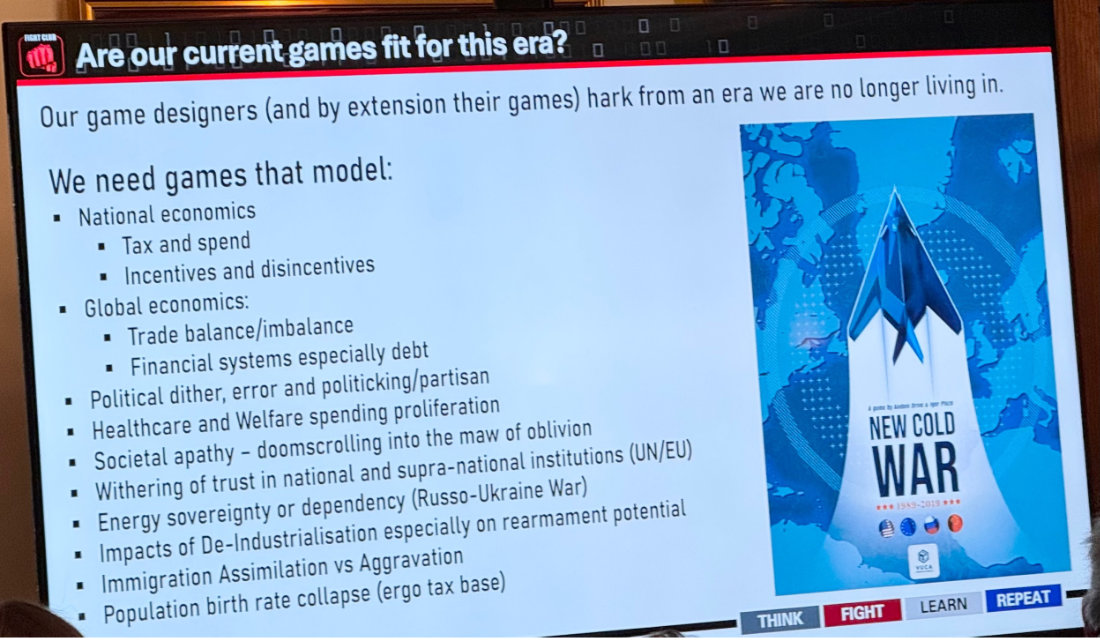
Ed Farren’s follow-on presentation paired well with David’s by asking a question related to “what if you ran a wargame and nobody listened?” Ed’s question was—what if we’re gaming entirely the wrong topics? Ed reviewed the things that are most commonly wargamed: familiar or comfortable scenarios like Russia invading the Baltics for the millionth time; other military problems with short timeframes and known data sets; predictable inputs; known factions or personas; use of popular game systems. Ultimately, we wargame the things that are highly repeatable, where it’s easy to source sponsors and players, and where—selfishly or not—outcomes drive the defense sector where the money is.
But: are those the games that really matter? Because to get to the point where Russia’s invading the Baltics, or China’s blockading Taiwan, or, maybe, perhaps, a war that was supposed to be short and sharp has gone longer than expected and you’re running out of missiles to boot, a whole lot of other things need to fail. Ed’s argument was that game designers and sponsors often game “too far down the river” and should spend more effort gaming out the diseases rather than the symptoms once the disease reaches its terminal phase.
And what is the disease? It’s not exactly a secret. There are a number of societal dysfunctions that have crept into—or in some cases, been invited in with open arms—our “societal organism,” and everything from whether or not to wear a mask during COVID to apathy about warning signs that Russia was actually going to invade Ukraine are downstream from these dysfunctions.
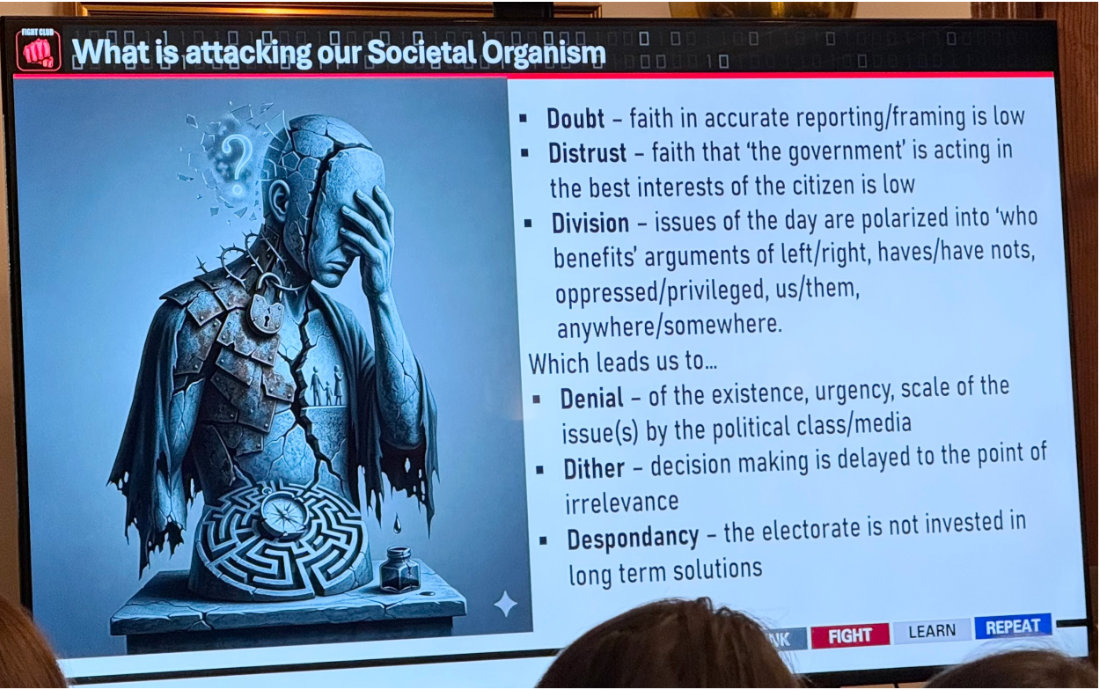
So Ed argued that game designers and sponsors need to stop gaming an era we no longer live in and do more gaming on the admittedly hard problems of those things that happen outside periods of crisis—because gaming the crisis but not the lead-up is deciding to amputate rather than regularly go to the doctor.
Rex Brynen closed out the panel by revisiting the theme of wargaming Canadian security in an era of strategic uncertainty. He noted that some of these security challenges—naked Russian aggression, Chinese malign influence and exploitation of smaller countries—are not new and have been wargamed exhaustively. Other challenges, such as AI proliferation, disruptions caused by social media and other electronic platforms, and climate change, haven’t been gamed as much but still get some attention and a correlating opportunity to gain insights.
However, Rex noted that there’s a separate set of emergent challenges that haven’t been wargamed but whose trend lines deserve attention from Canadian security professionals. And this circled back to the “what the f*** is going on down there” question I mentioned earlier, because these particular challenges all relate to radical shifts in America’s own security posture and priorities: the cohesion of NATO, the reliability of Article V guarantees (the article which, readers may recall, has only been invoked once, in response to the 9/11 attacks on the United States), predatory economic and trade policies, and even threats against the territorial integrity of allies and partners.
“Hi, I’m the problem, it’s me.”
There it was. Did it f***ing suck to hear that? Yeah, it did. Was it an unjust assessment of the situation? No, it wasn’t, and what made it most painful to hear was my own knowledge—again, from my background, I’m probably more attuned to this history than the average American—of how often Canada has been there for the United States in its darkest hours. A few digressions to make the point:
There was the time in February, 1942, shortly after the U.S. entered World War II and began supporting Atlantic convoys, that the USS Truxtun and USS Pollux shipwrecked in a storm on Newfoundland’s Burin peninsula—where, incidentally, my grandmother grew up. 200 sailors died in the wrecks and the storm; but 186 lived because local Newfoundlanders risked their own lives to pull the survivors off the rocks and bring them into their homes for medical treatment. One survivor was Lanier Phillips, a Black sailor who received more kindness from the Newfoundlanders than he ever received from his fellow citizens in Georgia and who, inspired by the respect he received from the people who saved him, went on to become the first Black sonar technician in the U.S. Navy. When American sailors needed aid, Canada was there.
There was that event called 9/11. Among the things I remember from 9/11 was that within hours of the attacks, when the FAA closed American airspace for the first time in history and planes heading for American airports had to land anywhere they could, 250 trans-Atlantic flights diverted to Canada. 38 of those flights, with 7,000 passengers, diverted to the small town of Gander, Newfoundland, population 10,000. In one day, the town’s population doubled. With local hotels utterly overwhelmed by the influx, Gander residents welcomed the passengers into their homes, gave them food, and set up free phone banks so passengers could assure their loved ones that on that day of death, they were still alive. During America’s 21st century Pearl Harbor, Canada was there.
They followed us into Afghanistan because we asked, the only time NATO Article V has been invoked for collective defense. I remember the Canadian presence at Kandahar, where they installed a Tim Hortons donuts shop and a hockey rink. 158 Canadian soldiers died in Afghanistan because we asked them to. They patrolled, they sucked down sand, they fought, they got blown to shit just like American troops did. Canada was there.
There was that time only last year, when some folks were dancing back and forth across the U.S.-Canada border and joking about the 51st state, that California was engulfed in flames. Who sent its unique airborne fire-fighting capabilities to help quench the flames? Canada was there.
And after all that, here we were in Ottawa, with security professionals seriously considering how to wargame that very same neighbor next door whom they’d helped so many times before.
As it was none of these challenges had yet received the attention of a wargame, and Rex asked some hard questions as to why this was:
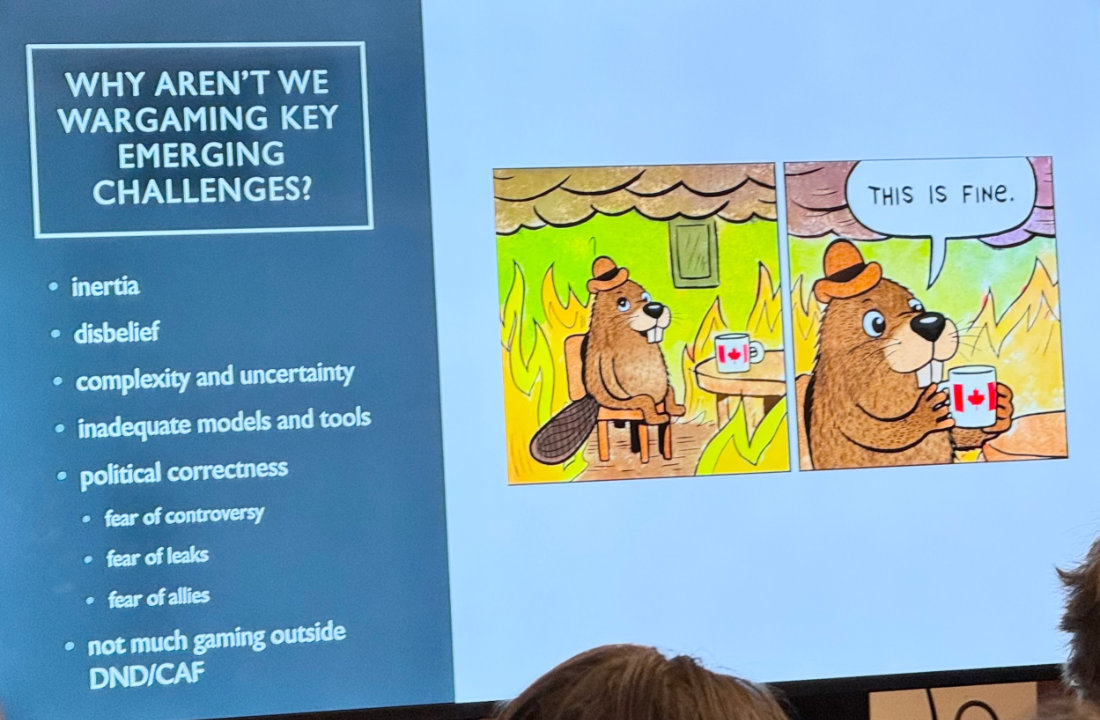
But refusing to think the unthinkable was no longer a luxury Canada could afford, and so Rex concluded with some proposals on how to effectively assess these challenges within wargaming frameworks:

That concluded the day’s panel presentations and we spent the afternoon doing one of those things that makes wargamers happy: designing and playing games. Conference attendees were split up into groups for a game lab, where we’d do rapid brainstorming on several specific Canadian security challenges: Arctic security, influence operations and societal resilience, and climate change and domestic emergency response.
I fell in with the team examining Arctic security, and we spent the next hour fleshing out a game featuring a Chinese auxiliary general intelligence (AGI) ship that became stuck in Canadian Arctic waters. Entitled “Fight, Flee, or Freeze,” our team developed a framework in which different security “clocks” were all counting down to outcomes that could be good or bad for the national security of the entities involved. Player factions included the local Canadian Indigenous peoples who first discovered the trapped AGI and who might be targets of Peoples’ Liberation Army Navy (PLAN) compellence; the PLAN crew of the AGI, racing to repair their vessel while weighing how to interact with the Indigenous peoples to avoid freezing to death in the High North; and the Canadian and Chinese governments deciding to how to handle the incident while protecting (or exploiting) the intelligence information aboard the AGI. Adding to the already significant challenges of operating in the High North, our game construct also had a “broken telephone” mechanic: each player faction was isolated in a separate room and information flow between them was affected by everything from limited communications infrastructure in the region to the impacts of severe weather on available networks.

So, which parts of Connections North stood out for me? It’s hard to pick because it was a fast-paced and densely packed itinerary, but here are my highlights:
- Canada Paratus: I found this game construct fascinating because the United States, in any future great power conflict, would face a similar problem in handling mass casualties. And to be blunt, I don’t believe any of the American Service branches have done the stubby pencil work to deal with a scenario where the number of casualties is vastly higher than what we faced in Iraq or Afghanistan; the threat makes the “golden hour” difficult or impossible to achieve; and the transfer of casualties from the front line back to the homeland is anything but uncontested.
- Ed Farren and wargaming the wrong topics: while I’m sure this particular pathology has been discussed in other venues, the weight of today’s moment makes it especially poignant. How many times in a wargame have we watched generals fuss over why a missile hit, or didn’t hit, its target, while strategic conditions deteriorate around them? How many times have we watched senior leaders get into a frenzy about conducting actions in all domains, at all times, in all places, believing that a critical mass of tactical frenzy will somehow translate into long-term gains? I don’t know how to kill a pathology that’s so prevalent but Ed’s point that wargamers should at least broach the notion with sponsors of gaming crisis prevention rather than hyper-tactics while the world burns is well-taken.
- ”Fight, Flee, or Freeze:” I gave our design from the game lab the highest endorsement I can offer: I’d have loved the chance to actually play it.
With that Connections North was over, although the fellowship continued well into the evening at Deacon Brodies Pub and while my memory is hazy, I think I may have signed up all of my American wargaming colleagues as guests on Lex Luciak’s Fight Club International podcast. I’m glad I finally got to attend this conference that’s been on my to-do list for so long, both for the opportunity to gain new perspectives on wargaming and to sustain those relationships that will hopefully still exist once the “what the f*** is going on down there” phase is over. Someone’s got to sustain them; and for their part, our Canadian counterparts remain willing to do so.
Postscript: one other thing jumped out at me about this conference. I know this language isn’t currently popular in some circles, but for this particular observation it fits: Connections North had one of the most diverse groups of attendees that I’d seen at a wargaming conference or convention in a long, long time.
I have a lot of wargaming soapboxes and one is the need to build the next generation of professional wargamers to ensure that we actually endure and grow as a profession. The first generation is leaving us due to the inexorable grind of time. The second generation is knuckling its way through the trenches, building and running games, and preserving the knowledge base of the tribe. But Gen Next is out there, and one of my deep fears is that we’re not doing enough to find them, teach them, and bring them into the profession.
This isn’t an universal indictment; there’s a committed group in that first and second generation who spend a lot of their own time outside the bounds of daily charge codes to share knowledge, offer opportunities, and pull in promising candidates from Gen Next. But the pathways remain narrow or ad hoc. And to be blunt, that soda straw is glaringly apparent where grognards gather. The saw about “wargaming” being a bunch of old white dudes? The number of wargaming gatherings I’ve been to where that was the rule rather than the exception are depressingly high.
That wasn’t the case here. The attendees at Connections North were young men and women of all backgrounds and disciplines, which means that the future of wargaming will benefit from—as my spirit animal John Boyd might put it—the wideband perspectives of Gen Next, rather than the narrowband inputs of a self-selected few who’ve only seen a small slice of human experience.
So Connections North, keep it up. Hi, you’re the answer, it’s you.
Author’s note: given how long it’s taken me to get Regimental Commander Brant this write-up it’s possible he regrets taking my offer to be roving conference correspondent this year. Still, my fees are low and there wasn’t exactly a long line of folks eager to visit Canada in the throes of winter. So thank you, Brant and dear readers, for your patience, and rest assured I found plenty of warmth in my whiskey glass during post-conference celebrations.
photos from Ian Brown and Merle Robinson
You can chat about this event in the Conventions & Clubs section of our discussion forums
Thank you for visiting the Regiment of Strategy Gaming and riding with The Armchair Dragoons.
Rather than list a bunch of social media links, the easiest thing to do is to check out our LinkTree, which connects you to all of our various locales around the web.
You can also support The Armchair Dragoons through our Patreon, and find us at a variety of conventions and other events.
Feel free to talk back to us either in our discussion forum, or in the comments below.


Ian, great write up. I am currently on an American Airlines flight on the way to Fort Leavenworth and by the miracle of free WiFi I am able to read this article. It makes me want to attend Connections North even more next year. My family, too, traces its roots back to Canada, so it’s a must for me to go. Best, Aaron