
 by
by Bill S, 5 June 2025
GMT has been steadily publishing entries in the Battles of the American Revolution (BoAR) series since 1998, with volume 11 having made the P500 cut. Multiple titles in the series have seen reprints, with six of the games being collected into two tri-packs. That tells me that the series has been a solid seller at the very least. For some reason it doesn’t get a ton of attention in the form of videos or articles. As an enthusiast for the series, this is my attempt to share why it is one of my favorite game series to play and teach.
I also joined Brant and Mike about the series on episode 7 of season 14 of Mentioned in Dispatches.

click some images to enlarge
Series History
GMT first published Volume I (Saratoga) in 1998 and has reprinted it twice, once in 2006 and as part of the first tri-pack in 2017. New titles have been coming out fairly regularly ever since. Tri-pack #2 started being shipped in May 2025. The battles range from the commonly known (Saratoga, Brandywine) to those I wish I’d known more about (Pensacola, Rhode Island, White Plains). Mark Miklos has designed all the games of the series, with assists from others on a couple of titles.
The first eight volumes of the series come with paper maps; starting with Rhode Island, the maps are mounted. The two tri-packs present cleaned-up versions of earlier originals, now with mounted maps. Tri-Pack #1 pulls together Volumes I-III (Saratoga, Brandywine, Guilford Courthouse/Eutaw Springs) while #2 consists of Volumes V, VII, and VIII (Monmouth, Germantown, and Newtown/Oriskany). You will note that the third volume in each tri-pack includes a second game. I presume that was because the main battle in the game is relatively smaller than the others.
| Volume | Year | Notables |
|---|---|---|
| I: Saratoga | 1998 | |
| II: Brandywine | 2000 | |
| III: Guilford | 2002 | Debut of Series rulebook |
| IV: Savannah | 2005 | Random event cards; siege |
| V: Monmouth | 2007 | Includes Molly Pitcher; extreme heat |
| VI: Pensacola | 2010 | Spanish and French vs British; siege; event cards |
| VII: Germantown | 2010 | |
| VIII: Newtown | 2013 | Indian special rules |
| Tri-Pack #1 | 2017 | Mounted maps from here on; Reprints Volumes I, II, and III |
| IX: Rhode Island | 2020 | Opportunity cards |
| X: White Plains | 2023 | Opportunity cards; 42-turn campaign game! |
| Tri-Pack #2 | 2025 | Reprints Volumes V, VII, and VIII |
| XI: Green Spring | TBD | Opportunity cards |
Looking ahead, Volume XI (Green Spring) is in the pipeline, as is the first entry of a spin-off series (Small BoAR), covering Cowpens. Small BoAR zooms in roughly 8x and will correspondingly have its rules changed to match the new scale. Cowpens is being designed by Bruno Sinigaglio and has “made the cut” on GMT’s P500 system.
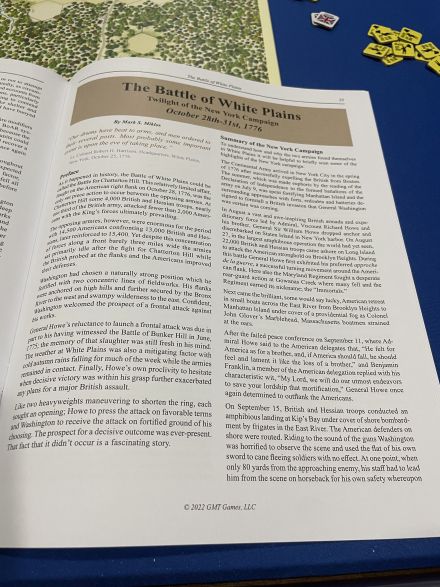
Each title has extensive developer’s notes (seven pages for The Battle of White Plains!) that are well worth taking the time to read and absorb. I have never failed to learn something from them. Each also includes a full Order of Battle as well.
All of the games have Vassal modules for online play vs. opponents. Just announced a couple of weeks ago, a Steam version of Saratoga will be released later this year that will have both opposed play with other people or against an AI for solo play.
Rules and Key Concepts
General
Rules are covered by a Series Rulebook and individualized exclusive rules for each title. Both are eminently manageable for casual wargamers to tackle – the current version of the series rules are 16 pages, but three of those are the front cover and player aids. Germantown (from Tri-Pack #2) has a representative set of exclusive rules, clocking in at 5 pages, which includes scenario set-up & victory conditions.
Units in the game represent British Regulars, Patriots, Hessians, Loyalists, Militias, and other minor sides. Unit types are leaders, infantry, dragoons, and artillery. Some infantry is light and/or equipped with rifles.

Sequence of Play
The sequence of play is straightforward; players roll for initiative then the winning player moves their units, rallies disrupted units, is subjected to defensive artillery fire, trades rifle fire with their opponent, then conducts close combat. The other side then walks through the same process. Initiative can be modified by the state of your army morale and any momentum chits assigned at game start or won through spectacular results in combat.

Of note, artillery is never an offensive weapon used on your turn; it is purely defensive and takes place during your opponent’s turn. Also, rifle units can fire during both your turn and your opponent’s.
Combat
Battle is a simple odds-based CRT, ranging from 1-3 to 4-1, with dice-roll modifiers (DRM) applied that incorporate unit morale, leaders present, participation of less-capable rifle/militia/cavalry, and attacking across unfavorable terrain.

The final DRM that has a mixed reception among the playing community is the tactics card play. Each side has a suite of 4-8 tactics they can play in any battle, depending on leader presence and whether flanking opportunities exist. Once each player secretly chooses a valid tactic, the choices are revealed and DRM applied; most are 0 or ±1, but the occasional ±2 result exists as well. Some see this process as breaking their flow in the game, but I really enjoy this aspect – we both know which tactics our sides can choose and what DRM will result from any given combination. Therefore, you know which tactic could give me the best DRM, so you try to mitigate that. But I know you know that, so I try to out maneuver you as the player. But you know I know that, and so on. You end up with a feeling that you personally had an opportunity to outplay your opponent and aren’t just relying completely on the luck of the die.

The other complicating factor about close combat is that it generally is a system where all adjacent units must attack and be attacked. The primary exceptions are artillery never attacks and rifle units are not required to do so, although they may with a DRM penalty.

Victory
So, how do you win? Each side has three paths to victory:
- Decisive: accomplish a gargantuan feat, possibly only achievable against an incompetent opponent
- Substantial: reduce the other army’s morale to 0
- Marginal: generally, achieve a VP differential or eliminate a certain amount of the opponent’s unit strength points. VP are awarded for unit losses, leader casualties, and occupation of key hexes, such as Guilford Courthouse or Freeman’s Farm.
Solo Suitability
The only impediment to playing the first three titles solo is the tactics card play. Thankfully, Joel Toppen created a solo tactics table in C3i magazine #22 (2010). It is freely available online and is now included as a player aid in Tri-Pack #2. It is easy to use; the only subjective decision the player needs to make is if the other side could plausibly withdraw, not that such a withdrawal is simply possible. After that, you only need to see if the side has a leader in place to impact the combat and if a flank is possible. A die roll (d6, d8, or d10) tells you the tactic that side uses.

Starting with Volume IV, additional card play has been added to most titles, where each side may have a hand of “opportunity cards” (or random events) that can be played as desired if/when certain conditions apply. While this impairs a true solo experience, it can be managed easily by a motivated player.
Comparing The Titles
The series does have a strong set of series rules, but the individual character of each battle does still shine through. Most of the game give minor optional rules, such as units to add/swap or movement restrictions to allow for repeated exploration. Multiple scenarios are usually included; some are smaller portions of the entire engagement, while some take on a “what if?” character.
To give the full flavor of what each game brings to the table (pun fully intended), I’ll be following this overview with a series of title-specific articles/AARs.
Final Thoughts
The Battle of the American Revolution series is a long lasting, well-developed design that has remained vibrant for more than 25 years. The system is easy to teach – at last year’s Armchair Dragoons Fall Assembly, I was GM for a game between two new players who completed a full campaign scenario in about three hours.
Most of the other American Revolution games I’ve seen and played are strategic (GMT’s Washington’s War and Liberty or Death) or operational (Hollandspiele’s Supply Lines of the American Revolution). If you’ve played any other tactical games you feel are comparable in scope or scale to BoAR, let me know in the comments.
I’ll be back soon with an overview and light AAR of the first entry in the series, Saratoga.
You can chat about this game in the Age of Gunpowder section of our discussion forums
Battles of the American Revolution Series
Mentioned in Dispatches Episode ~ Series Intro ~ Saratoga ~ Brandywine ~ Guilford Courthouse ~ Eutaw Springs ~ Savannah ~ Camden Event Podcast Episode
Saratoga Digital ~ First Impressions ~ Gaming vs The AI
Thank you for visiting the Regiment of Strategy Gaming and riding with The Armchair Dragoons.
Rather than list a bunch of social media links, the easiest thing to do is to check out our LinkTree, which connects you to all of our various locales around the web.
You can also support The Armchair Dragoons through our Patreon, and find us at a variety of conventions and other events.
Feel free to talk back to us either in our discussion forum, or in the comments below.


Thanks for this excellent overview. Which would be a good starting place for newbs?
Sorry I just saw this comment now. Saratoga is my go-to teaching game for those new to the system. It has the fewest game-specific rules to absorb and lets the core mechanics shine.