
 by
by Bill Simoni, 2 August 2026
Newtown brings a new player faction to the Battles of the American Revolution (BoAR) series. The American Patriots face off against the Indian player. Most of the Indian player’s units represent the Iroquois Confederacy, with a few Loyalist, Tory Milita, and British Regular units involved. New rules are implemented to give the look and feel of a different type of force in the field.
Newtown was originally published in 2013 and is included in 2025’s Battles of the American Revolution Tri-Pack II. It also includes the bonus game of Oriskany, which I will cover separately in the future.
This battle was either not taught in my schools or my memory fails me, but it represents the largely punitive campaign in 1779 against the Iroquois in the Pennsylvania and New York frontiers in response to the terror unleashed on American settlements. It’s sad to say that my first exposure to this wasn’t until playing Harold Buchanan’s Liberty or Death which modeled both sides of this action as part of the respective faction’s victory conditions. I grew up in Western Pennsylvania for crying out loud – this brutality from both sides was regional history. Newtown and BoAR series designer Mark Miklos takes us into New York as the Patriots attempt to protect their settlements, disrupt British supply lines, and retaliate for previous atrocities. To win decisively, the Patriot player must destroy the entirety of Newtown.
The first differences from other BoAR titles start before the game. A die roll awards one of ten minor benefits to the Indian player. Examples include one unit getting a +1 morale, +1 strength point, +1 to army morale, or the addition/upgrade of a unit. In the following play, the 8th Foot Platoon (British Regulars) was replaced with a battalion.

click images to enlarge
The Iroquois also randomly determine which unit has the “honor” condition. The tribe or clan currently with honor gets a +1 unit morale, but must be the lead unit in a close combat. Having an adverse combat result makes the unit lose the honor marker. If the honor marker is lost, it gets reassigned to a random tribe or clan at the end of the Indian player turn.
Indian movement and combat are different as well. During the Indian player’s turn, non-Indian units move first. Each tribe or clan has a marker in a draw cup, along with combat unit and zero to two Indian Resolve markers. The Indian players draws a chit, then moves the associated unit. If a resolve marker is drawn, all Indian units within LOS and range of an artillery unit must make a special morale check. Failure results in a four-hex retreat, which will continue each turn until the unit passes a morale check. Drawing the combat chit ends this movement phase. Rally, defensive artillery, rifle fire, and close combat then occur as normal. Finally, all Indian units that did not have their chit drawn may now move.
Newtown has two scenarios – the standard scenario lasts 12 turns and starts with most of the Patriot forces as reinforcements. The historical scenario starts at turn five and ends at turn 10. The play below is the standard scenario.
As with all the games in the BoAR series, there is a well-done Vassal module available.
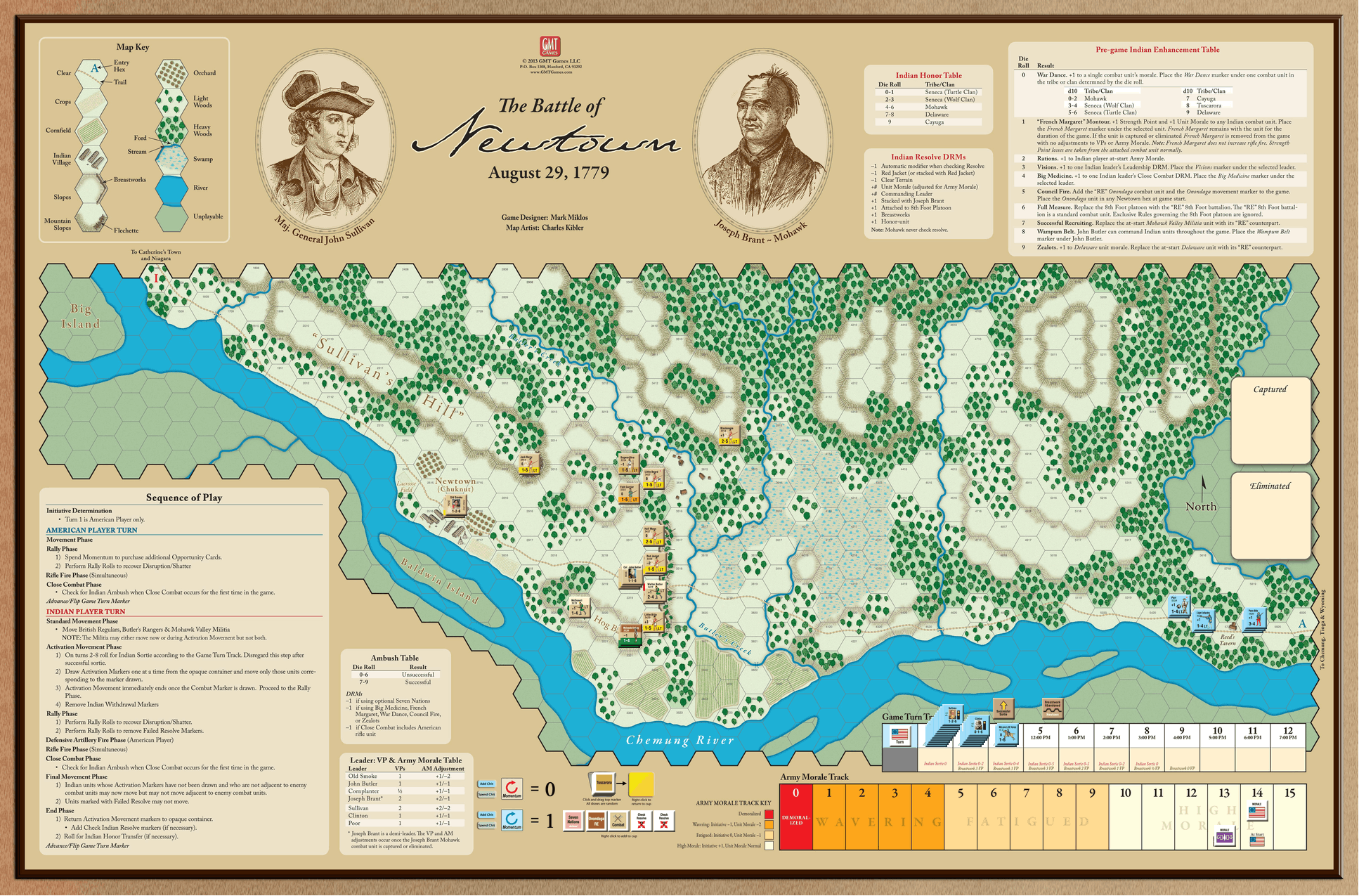
Gameplay
I used my lone unit allowed to roam the entire map to feint towards the Patriot cattle herd. This herd advances as fast as it can along the road. If I capture it, I get two points. My real goal was to reach hexes that gave me a second opportunity card for the game. The Patriots also started with one but could buy them each rally phase by expensing a momentum chit.
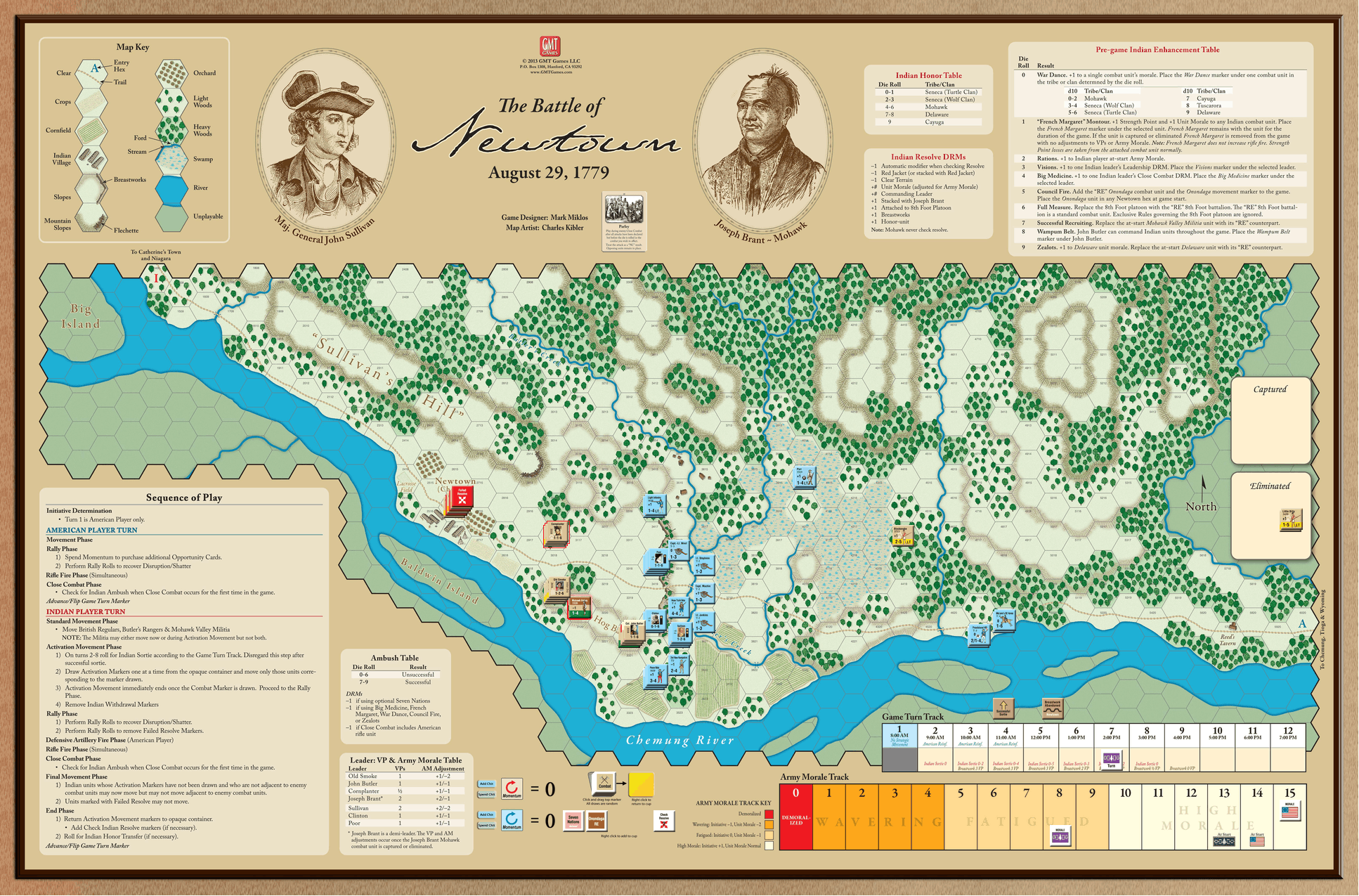
If you have followed this series, you may be well acquainted with my propensity to play poorly. Never fear, I shall not deprive you of that experience today either. After turn five, we more or less had a similar position to the start of the historical scenario, with the exception of my putting extra Indian units along the breastworks. I was bound and determined to not give up victory points by abandoning that position prior to turn 9. This was probably my biggest mistake.


Now that the forces were lined up across from each other, my Indians were subject to resolve checks at a random time during my turn. When that happened, I failed eight consecutive morale rolls. Oops. My strategy tip – don’t do that.

The Patriot player was able to smash through what was left of my line at the breastworks. Several of my units failed to recover from their resolve failure and kept retreating towards the map end. Since my opponent is a youngin and still works, I was able to dodge the pain of fighting this out to the bitter end. While we may come back to this and finish soon, I am comfortable in saying I am unlikely to come back from this debacle.
Final Thoughts
The worse I play the games in this series, the more I want to revisit them, and soon. Treating the Indians like a force to line up directly across from an organized Patriot force was unlikely to be successful and I should have realized that at the time.
The pre-game Indian enhancements aren’t major, but they do provide an interesting benefit, while the Indian activation process forces that player to rethink their approach. Honor and the other minor differences favoring the Indians should help a skilled player fight effectively for the win.
I enjoyed the game despite my awful play. As usual my priorities are to have fun with a friend, learn more or think deeper about the history the game represents, and then to win or at least threaten to. As the Sultan of Sweaty Ballads said, “Don’t be sad, ’cause two out of three ain’t bad!”
Next up: Oriskany
You can chat about this game in the Age of Gunpowder section of our discussion forums
Thank you for visiting the Regiment of Strategy Gaming and riding with The Armchair Dragoons.
Rather than list a bunch of social media links, the easiest thing to do is to check out our LinkTree, which connects you to all of our various locales around the web.
You can also support The Armchair Dragoons through our Patreon, and find us at a variety of conventions and other events.
Feel free to talk back to us either in our discussion forum, or in the comments below.


