
 by
by Zachary Grant, 14 July 2025
If you haven’t heard, Dana Lombardy, designer of many great wargames like Streets of Stalingrad and MacGowan & Lombardy’s The Great War, is taking orders for the 3rd edition of his NORAD game, published in volume 22 of Banzai magazine. Dana is taking orders only for the game, (rules in English), as volume 22 of Banzai magazine, published by Bonsai Games, is sold out. In addition to the small inventory of extra copies of the game that were printed for Banzai magazine, Dana is getting the print-ready artwork so he can reprint NORAD 3 – but not the magazine. This means Dana will soon have a US-based printer to produce extra copies of the game for as long as it is in demand.
RockyMountainNavy wrote about the newest version of NORAD for the Armchair Dragoons last September. If you are unfamiliar with NORAD, please continue reading! Dana graciously took the time to answer some questions about his game and share some of its history with us.
Before we chat about Norad, I’m curious to learn more about Simulations Design Corporation and your Conflict magazine. Why did you decide to start your own company and publication instead of trying to get published by Strategy & Tactics?
Dana: I was a subscriber to S&T for a few years before I even thought about starting my own military history magazine or publishing my game designs. I gradually came to think that too many of the S&T games seemed like cookie-cutter productions in order to get them out on their bi-monthly schedule. There are now 352 issues of S&T and 352 games (!) – many of them very similar hex-and-counter designs with die-cut unit counters using points for attack and defense, resolved by comparing these numbers on a Combat Results Table (CRT) using a six-sided die. Today’s wargames are much more diverse design-wise, but back in the 1970s, S&T’s ancient Roman battle looked very much like an S&T American Civil War battle or an S&T World War 2 battle or an S&T modern hypothetical Cold War scenario.

click images to enlarge
This method of wargame design made it easy for gamers to play an S&T game of any historical period, which as a business model was brilliant. However, I believed that nuances about evolving technologies and styles of warfare, national or cultural military doctrine differences between enemies and allies, etc., were being overlooked or ignored in order to make publishing deadlines. It also led to some strange and unrealistic situations such as a stack of infantry squads armed with only rifles and machine-guns adding up to sufficient combat points to knock out a heavy tank on the CRT – even though the infantry did not have even one anti-tank weapon or explosives that could destroy or disable that tank.


I wondered if there might be other gamers who felt, like me, that wargames could present more than just combat numbers and a generic CRT. One of my first published designs was Dunkerque-1940 in 1972 (the same year that Columbia Games released Quebec 1759: their first block game that used hidden units). My World War 2 design focused on what I believed to be the most exciting and controversial part of the German campaign against France: the breakthrough of the panzer divisions and the chaotic scramble by the British and French forces to try and stop or slow the Germans who were able to cut off a large number of Allied units and force their evacuation at Dunkerque. It also used hidden units (face-down) until your unit moved next to an enemy unit. S&T games seemed more chess-like where both players could see their opponent’s forces – I preferred fog-of-war reality. Like Tom Dalgliesh of Columbia Games, I chose a different path for my game designs compared to S&T.
What inspired you to make this game?
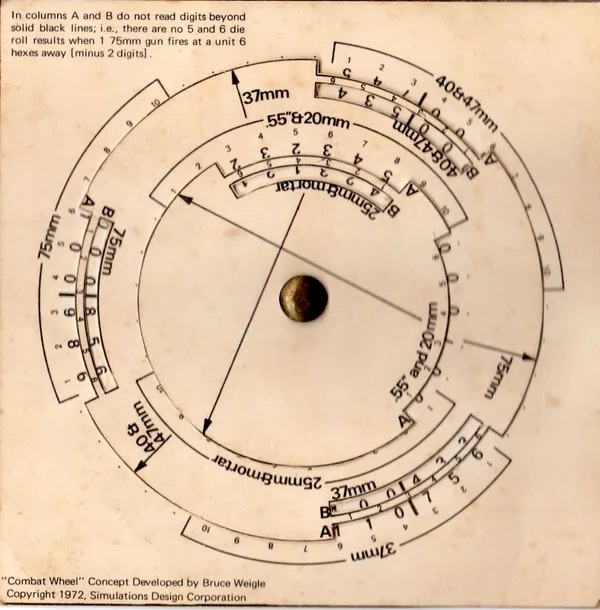
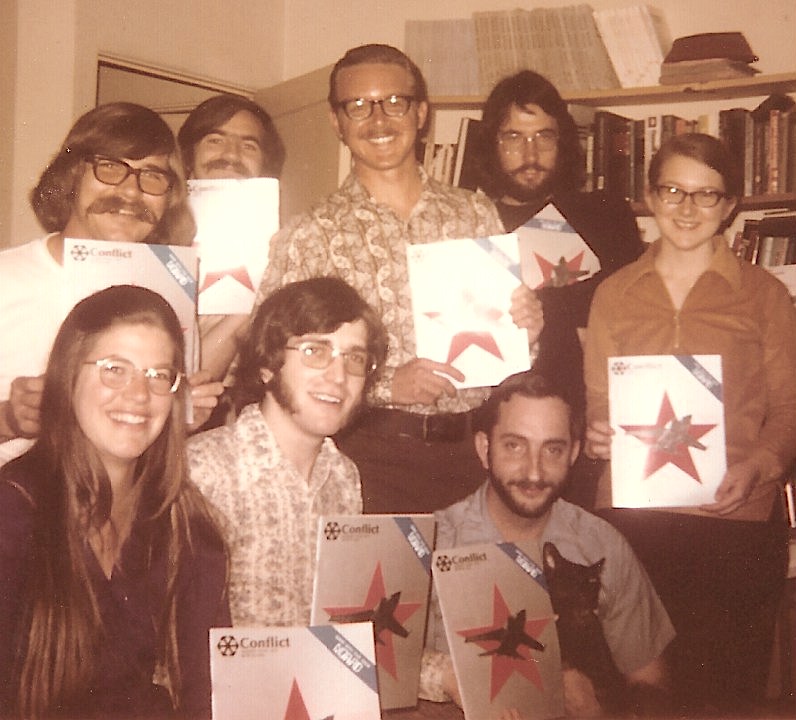
Dana: Despite my desire to make truly different wargames, the first issue of my Conflict magazine included a pretty standard looking hex-and-counter 1940 scenario of a Panzerblitz-like design – but with a very different CRT. A good friend from college created a “Combat Wheel” to resolve tank battles with miniatures and we introduced that in Conflict #1 instead of the more familiar Avalon Hill /S&T CRT. Conflict #3 had a paper-and-pencil time travel game – obviously very different than any S&T game – that some of the readers did not appreciate. “Give us a real wargame!” they demanded. It was only 11 years after the Cuban Missile Crisis and in 1962 it looked like we might get into a nuclear war with the Soviet Union. It made a huge impression on me – I was only 12 years old in 1962. The readers of Conflict wanted a more traditional wargame, but I still wanted to stand out from Avalon Hill and S&T-SPI. This was the inspiration for NORAD.

Can you please write about some of your game design choices for NORAD? For example, why did you select a polar projection instead of using hexes? Your designer notes describe why you didn’t use a CRT. Did you consider using a CRT at any point of your design process? In your original game, did you consider including the Soviet Union for the US player to attack?
Dana: Laying a hexagon pattern across the USA did not look right to me. As soon as I made the polar projection playtest map I knew that it would not only stand out from the crowded field of standard hex-based wargame maps, but it gave NORAD the “feel” of the battle area for a global nuclear war. As to not using a CRT, it seemed superfluous: either you hit the target with a nuclear weapon or it failed to destroy the city for whatever reason. I wanted a simple, fast-playing game and a CRT/dice would only add time and unnecessary complexity to the game.
I considered adding the USSR side and American bombers but that would have more than doubled the production time. I needed to get another issue of Conflict out as soon as possible. An expansion could always be added later. I just did not realize that expansion would take 52 years!
In your promotional video, you mentioned there will be new counter art. Who is the artist designing the new counters?
Dana: Gerard S. Koo is credited by BANZAI magazine as the map and counter artist for the NORAD 3 edition. Yasushi Nakaguro, the publisher of BANZAI, is credited for the design of PVO Strany – the USSR expansion. BANZAI magazine created and published the latest version (2024) of NORAD. I have no plans to do another edition of the game.
Do you know the story behind how Banzai magazine published NORAD? Do you have any insight into the changes they made, such as adding the Soviet Union to the map?
Dana: The only insights I have about BANZAI magazine’s NORAD 3 are the few months of email correspondence I had with Yasushi after he contacted me for permission to upgrade and expand upon my original game. I sent him everything I had collected over the years for NORAD, including really good ideas by people like Paul Rohrbaugh of High Flying Dice Games who worked on the 2020 version on NORAD that was never published. I cannot speak for Yasushi or Paul but I can say that I strongly approve of their improvements. It is an incredible honor for me to see one of my first designs reemerge and – more importantly – get played again!

Thank you for visiting the Regiment of Strategy Gaming and riding with The Armchair Dragoons.
Rather than list a bunch of social media links, the easiest thing to do is to check out our LinkTree, which connects you to all of our various locales around the web.
You can also support The Armchair Dragoons through our Patreon, and find us at a variety of conventions and other events.
Feel free to talk back to us either in our discussion forum, or in the comments below.


