
 by
Aaron Danis, 22 October 2026
The Armchair Dragoons editor in chief Brant Guillory tasked me with reaching out to long-time professional game designer Dr. Ed McGrady to get an update on his interview with Ed back in April for Connections Online, when Ed announced the creation of the Professional Gaming Society (PGS) within the Military Operations Research Society (MORS). I jumped at the chance because Ed is both a great designer and a great guy. He was nice enough to run a Matrix game on conflict in the Caribbean for my students last spring, and I hope to have him back soon.
The PGS has been up and running for 6 months now. How has the reception been? How are you getting the word out?
PGS’s membership has grown quite a bit as we have 1,100 members right now. Some are MORS transfers, some are new members, we welcome everyone. We are trying to get the word out through MORS, but also by doing stuff. We are rebranding everything PGS from MORS, but that is taking a while, and we are using MORS/PGS in a lot of media to ensure people understand who we are. We are also on the socials (Facebook, LinkedIn). We just did a PGS Wargaming Workshop where we debuted some of our new swag, and we are planning to getting dice with the logo on it. The new issue of the PGS journal is going to come out. Basically, we are not being shy about talking about the society.

Who is the target audience for PGS? What should they expect when they join?
The target audience for PGS are people involved or interested in professional gaming (wargaming). We welcome everyone but our content is oriented toward professional gamers, people who make a living putting on games for military, government, industry, and NGO clients. We are not a hobby wargaming group, but hobbyists are welcome to join and contribute. My main push is that PGS be a service-oriented society: to help people connect for employment and careers. We want to help start and advance your career in professional gaming.
 Much of what I personally do is orientated toward that. In addition, I’m also trying to establish professional gaming as an academic discipline (along with several other people), and having a dedicated professional society is part of that process. Ultimately, however, I’m not the leader, I’m the consigliere, the guy who works behind the scenes to try and make things happen. Paul Works is the society leader, and Jennifer Ferat is the CEO (she is also CEO of MORS). The real leaders are the members. If you want to stand out, if you want to do something in professional gaming, PGS provides a vehicle to do that.
How do the professional networking and development components work?
We sponsor several events that bring gamers together. Our annual workshops, the wargaming events at the national MORS Symposium, GameNation (an interactive vidcast with me and Betsy Joslyn), and the Community of Practice. We are also integrated with both Connections US and Connections Online. Each year at Connections US I try and organize an employer job fair/job opportunity, which seems to be gaining some traction. But that happens because I’m interested in it and make it happen. We are not going to be able to facilitate everything ourselves, the members have to take some initiative.
What is the status of the Journal of Wargaming? Will it remain a bi-annual publication? What kind of content are you looking for submissions?
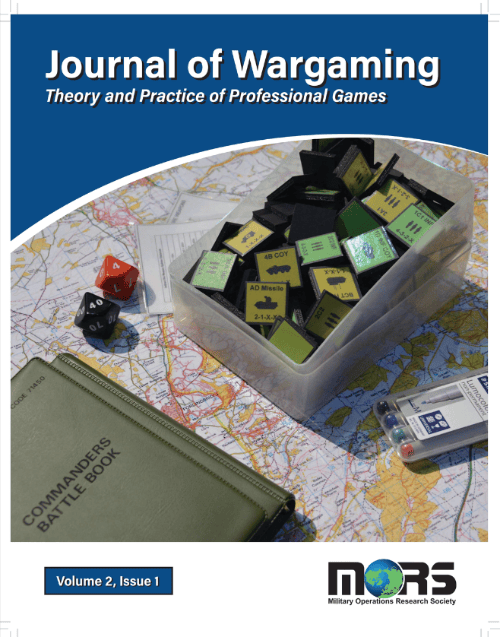
The Journal of Wargaming is about to come out with its third issue and, frankly, I was extremely pleased with the contributions. Until we take off and gain some altitude it will remain free to everyone. Eventually it may go to just PGS members, but not right now. The frequency of the journal depends on two things. The industry of the editors (me and John Curry) and the quality and volume of contributions. Right now we have enough bandwidth for a bit more frequently than once a year but not two a year. Truthfully editing a journal was more difficult than I thought it would be, so I don’t devote enough time to it to make it more frequent. Also, we don’t have enough contributions for a more frequent product anyway. If anyone out there wants to submit a paper the rules are: it must be about wargaming (believe it or not this cuts out the largest number of contributions, go figure), be well written and argued, and make some contribution to the profession (including game reports – the only problem that comes up is with papers that are exclusively focused on hobby/entertainment games). I’ve said that we want to publish all kinds of papers: philosophical (see issue #3), historical (we’ve had several), and conceptual. We are not just a technical Operations Research journal, MORS already has one of those.
MORS offers over a half-dozen wargame training certificates. How do these differ from new university wargame certificate programs like the one at Virginia Tech, which also partners with MORS? If someone asked you which program or courses to enroll in, what advice would you give them?
MORS actually offers two Continuing Education (CEP) credit certificates with Virginia Tech: General Wargame Design and Cyber Game Design. Both are 1-week courses with the General course being our most popular. We also offer many other professional development courses that do not provide certificates, including our new Space course (happening in November) and courses on Homeland Security Gaming, Tactical Wargaming, WMD Gaming, and Public Health Gaming. An advanced course is currently in development. It will cover topics like advanced technologies and go deeper into issues like adjudication. The rules for our courses is that we offer them and if we get more than 5 (students) enrolled they happen. That is our break-even number.
Our courses are continuing education courses, put on the way any professional society would put on training courses. They are short and designed for working professionals. The Virginia Tech certificate, which I am involved in but am not in charge of, provides a track of full-semester courses design for the students to progress toward an academic certificate from the School of Professional and International Affairs (SPIA) at Virginia Tech. Think of it as a “masters light” program while we are professional development/continuing education. It very much depends on how much time you have, and how much effort you want to devote to the degree program. This is what happens in other fields, for example in my field of Chemical Engineering the American Institute of Chemical Engineers has courses on designing distillation columns or process safety, but at the same time you can go to school and get a degree in Chemical Engineering where you study the theory of such things.

What’s the 5- and 10-year plan for the PGS look like? What are longer term goals and expectations?
To the extent that I have one, my plan for PGS is for it to be the facilitator of professional development within the field of professional gaming. This means bringing practitioners together to discuss best practices (Workshops, Journal), serving the needs of businesses working in this field, and connecting people looking for work with opportunities. My vision is that its all about service; how can the society serve its members. At the same time nothing will happen unless the society members become involved. I’m not going to do everything and my vision is only one possible vision for the society. I just happen to focus on service and connection.
Is there anything I didn’t ask about PGS that you would like to discuss?
What are longer term goals and expectations? Why should people get involved in the society? (I’ll ask that question). My response is that the society is a way for experienced game designers to “give back” to the next generation through transmitting knowledge, opening opportunities, and mentoring the next generation. That only happens if people see the society for what it is, a vehicle for them to do what they want to do in the community. If you think the community needs something. That someone should do whatever this thing is that is important to do, just give us a jingle and we will be happy to help support your efforts. The agenda for the society is your agenda. The door is open and you’ve got a lot of runway (to mix metaphors) so have at it.
Authors note: Ed hopes to have a PGS table at the next Connections US with their new swag if it’s held in the Washington, DC, area. If you want to submit an article to the Journal of Wargaming, he said if you get it to him in the next 3 months it has a good chance to make the 4th edition. If you want to join PGS, go here.
You can chat about this article in the Professional Wargaming section of our discussion forums
Thank you for visiting the Regiment of Strategy Gaming and riding with The Armchair Dragoons.
Rather than list a bunch of social media links, the easiest thing to do is to check out our LinkTree, which connects you to all of our various locales around the web.
You can also support The Armchair Dragoons through our Patreon, and find us at a variety of conventions and other events.
Feel free to talk back to us either in our discussion forum, or in the comments below.


