
 by
by RockyMountainNavy, 6 October 2025
When I play a wargame, I often end up studying the situation as much as playing it. As a result, I often face one of the endless arguments amongst wargamers—the question of realism in a wargame. Simply defining realism in a wargame is frustrating enough, but the question of realism becomes extremely complicated when the wargame is based on a historical situation that never happened such as the Cold War exploding into a Hot War. In this post I wade into the arguments over Seapower & The State by designer Stephen Newberg. After studying the game design, Designer’s Notes, and period threat estimates, I view naval warfare, as presented in Seapower & The State, as highly offensive—but not in the way many likely think reading that claim for the first time.
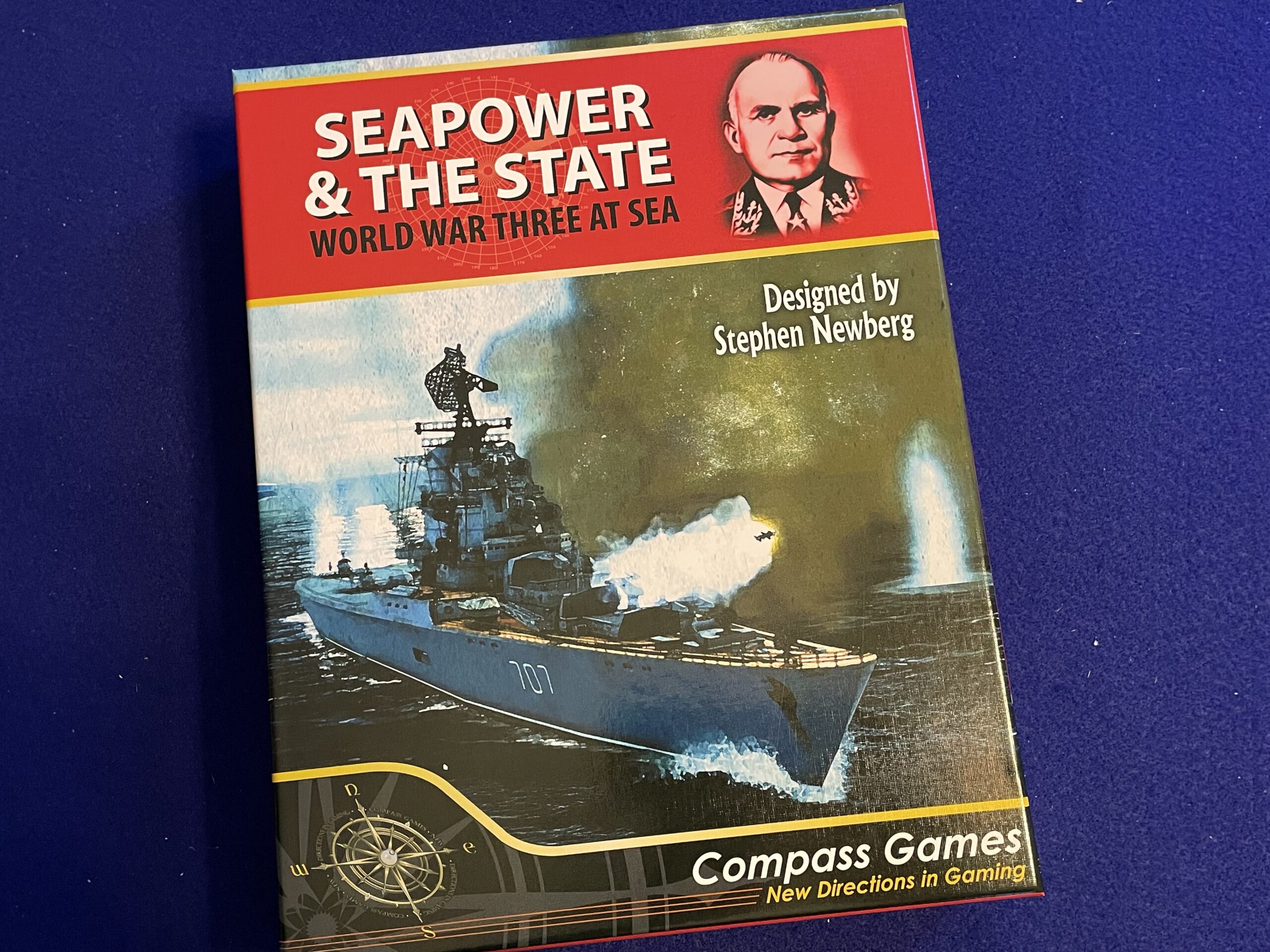
The recent release of Seapower & The State: World War Three at Sea by designer Stephen Newberg from Compass Games presents a World War III at sea circa the mid-1980’s into the mid-1990’s. Based on a title originally released in 1982, some wargamers contend that the game flat-out does not represent strategic naval warfare in the Cold War era. This led me to revisit the naval strategies of the United States and the Soviet Union in the early 1980’s to see if the latest edition of Seapower & The State does, or does not, portray strategic naval warfare in manner that is reflective of that time. My studies uncovered controversies over U.S. naval doctrine as well as changing interpretations of Soviet intent. Along the way I also considered the game’s rules for satellites, nuclear weapons, and the combat resolution model to see what, if anything, they said about the time period.
[Please note that all numbered rules references refer to the 2025 Compass Games edition of Seapower & The State unless otherwise noted.]
Cold World War at Sea
Strategic-scale wargames on naval combat in “World War III Gone Hot”-genre are very few. The only strategic-level, globally spanning, World War III naval treatment in my wargame collection was Seapower & The State: A Strategic Study Simulation of World War Three at Sea, 1984-1994 designed by Stephen Newberg and published by Simulations Canada in 1982. I say “was” because Compass Games printed a new edition, Seapower & The State: World War Three at Sea that delivered in September 2025.
The ad copy for the new Compass Games edition of Seapower & The State describes the game this way:
Seapower & The State is a strategic study of World War 3 at Sea. The game examines the worldwide state of naval affairs from 1984-1994 as related to major conflicts in this two-player simulation game of moderate complexity on the grand strategic scale. The viewpoint of the simulation is that of grand strategy and thus has the players acting as the overall commanders of the naval forces of the Eastern or Western alliances. Numerous scenarios are presented for various force levels for different time periods. Designed & developed by Stephen Newberg, this substantially upgraded 2nd edition includes all of the aspects of the original with more components and all-new artwork. (Compass Games webpage)
The reception by the wargaming community to the old edition of Seapower & The State is decidedly mixed. I, for one, like the original game as I wrote in a 2020 blog post. Although the new Compass Games edition is a “prettified” version using the same rules (with errata incorporated) and new graphics some wargamers nonetheless have a less-than-charitable opinion of the title.
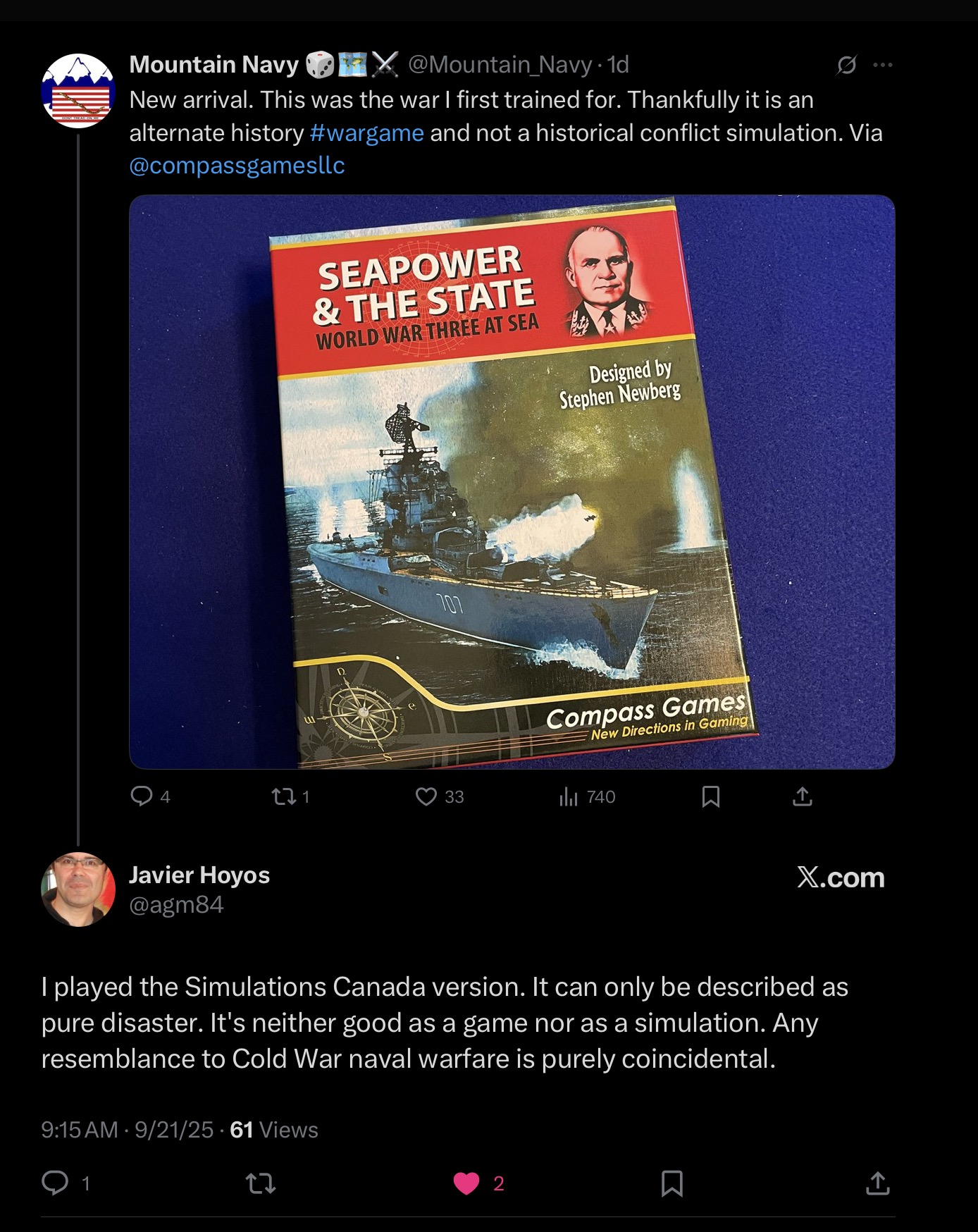
I am a strong believer in the need to understand a designer’s intent when studying (and playing) a boardgame or wargame. Too often I see games ridiculed by players because it is “not right.” [Case in point: see the “controversy” over Arcs from Leder Games.] My counterpoint is that, all too often, the reasons players seemingly dislike a game is not because a game is bad by design but instead it is not what they thought (demand?) it to be either thematically or in terms of game mechanisms employed. All of which makes reading the Designer’s Notes for a wargame that much more important as these are often the only place to divine a designer’s intent for a game.
Clash of doctrines
Designer Stephen Newberg in his Designer’s Notes for the latest edition of Seapower & The State (which appears to be a direct reprint of the 1982 text) writes:
I have been thinking about doing this game for so long I am unsure what to say about it. I wanted to show the strategic considerations of modern naval warfare and the clash of doctrines that has resulted in the different ways the participants have gone about resolving these considerations… . Hopefully Seapower & The State will allow you to examine these different viewpoints at their focus, potential major conflict. (21.0 Designer’s Notes)
Newberg provides several interesting tidbits of background for Seapower & The State in those few sentences. First, the game had been in design and development “for so long.” Given the first edition was published in 1982, I take that to mean the most likely time period for those design activities was the late 1970’s and early 1980’s. Second, Newberg talks of “strategic considerations” and a “clash of doctrines.” In essence, Newberg tells us that Seapower & The State is a strategic study comparing the doctrines of the U.S. Navy (and it allies) against the Soviet Navy (and its allies). Finally, Seapower & The State aims to compare those doctrines in the harshest of crucibles—a major war.
What Doctrine?
Having explained that Seapower & The State will portray clashing naval doctrines through the medium of a wargame, Newberg next explains his interpretation of how the U.S. Navy will operate:
The sea lanes are vital to the interests of the Western World. Just a look at the map when it is set up shows this very convincingly. The West has a far flung and well established base system and an enormous inventory of ships, submarines, and aircraft. At the heart of this combat system is the aircraft carrier for force projection and the ballistic missile submarine for nuclear war “deterrent.” Though the United States has by far the largest concentration of these forces in the Western world, its numerous allies also maintain major, and powerful, holdings. (21.0 Designer’s Notes)
The key phrases I hear Newberg share are: “sea lanes are vital,” the aircraft carrier for force projection,” and “the ballistic missile submarine for nuclear war.” Let’s see what the historical record and game design behind Seapower & The State says about each.
Americans on Their Heels
After consideration of how to score Victory Points in Seapower & The State—which I will go into more depth later—I assert that the Western player is very much on the defensive. The seemingly defensive focus of Seapower & The State is a very likely interpretation of the U.S. Navy strategy and doctrine in the aftermath of the Vietnam War. The strategic phrase of the time was a “one and one-half war” strategy that charged the U.S. Navy, “to be able to deal with the NATO war and a lesser contingency at the same time” (Powers, p. 104). In 1978 the expected employment of the U.S. Navy was described this way:
A NATO war would place great stress on US Naval forces. In such a war, they might be called upon to provide NATO ground forces with air support from carriers or to assist by landing Marines. To do either would require control of the sea and air space in the vicinity. If the war went on for weeks or months, extensive sea control would be required of NATO navies so that NATO armies and air forces engaged in Europe could be supplied by merchant shipping from North America. Any of these missions, moreover, might involve use of tactical nuclear weapons… . (Powers, p. 104)
While the U.S. Navy technically never called its strategy “defensive,” what started under Chief of Naval Operations Admiral Elmo Zumwalt (1970-1974) came to be known as “Sea Control.” Historian Ryan Peeks describes the rise of Sea Control thinking this way:
It was not lost on Zumwalt, a product of the surface Navy, that sea control was a critical function of the Navy’s surface vessels, while power projection was primarily the province of naval aviators flying from expensive aircraft carriers. Power projection was the major mission of the Navy during the Vietnam era, where carriers could launch airstrikes without risking reciprocal attack. Bolstering sea-control forces would improve the relatively weak standing of the surface navy in the fleet in the 1970s and signal a shift away from the frustration of the Vietnam War toward protecting Atlantic sea-lanes in the event of a Soviet War. (Peeks, p. 239)
The Carter administration that took office after the 1976 election was, according to Peeks, very hostile to the thought of a power-projection Navy. Peeks writes, “Secretary of Defense Harold Brown went so far as to say the Navy’s main wartime job was no longer sea control in a general sense, but merely the defense of the sea-lanes running between Norfolk and the English Channel, to facilitate a resupply of NATO forces . . . .” The U.S. Navy countered the Carter administration’s position by continuing to advocate for a more expensive fleet. Carter’s own Secretary of the Navy chartered “Sea Plan 2000” which stated, “forward strike operations may prove highly valuable in tying down large Soviet forces. . . . Forward naval operations can have a decisive effect on the outcome of a land war in Europe” (Peeks, p. 242). Sea Plan 2000 also had hooks for worldwide operations. Zumwalt and his successor, Admiral James L. Halloway III (1974-1978), both viewed presence as the main peacetime role of the Navy. The desire to keep two aircraft carriers on station in both the Mediterranean and Western Pacific demanded a larger fleet (Peeks, p. 241).
The battle between Sea Control and Power Projection in the U.S. Navy continued through the 1970’s and into the 1980’s. While the Carter administration stated the mission of the Navy was defensive, they still (reluctantly) financed technological advances for the fleet. Bureaucratic inertia is difficult to arrest and going into the 1970’s the designs on the drawing boards for the U.S. Navy included the Nimitz-class CVANs, the Tarawa-class LHAs, the Virginia-class DLGNs, the Spruance-class DDs, and the Los Angeles class SSNs. Zumwalt’s “High-Low” mix of ships called for Sea Control Ships (cancelled), Patrol Frigates (the Oliver Hazard Perry FFG7-class), LAMPS helicopters, and new networked satellite-based communications and surveillance systems (Jordan, p. 11). The 1970’s was also the decade where the Harpoon anti-ship cruise missile entered service with the Tomahawk soon to follow (Jordan, p. 15). A recognition in the 1970’s that the Soviet Navy possessed extremely long-range anti-ship cruise missiles that could be launched from sea or air platforms also led to the development of the F-14 Tomcat fighter and Ticonderoga-class cruisers with the AEGIS weapon system (Peeks, p. 243).
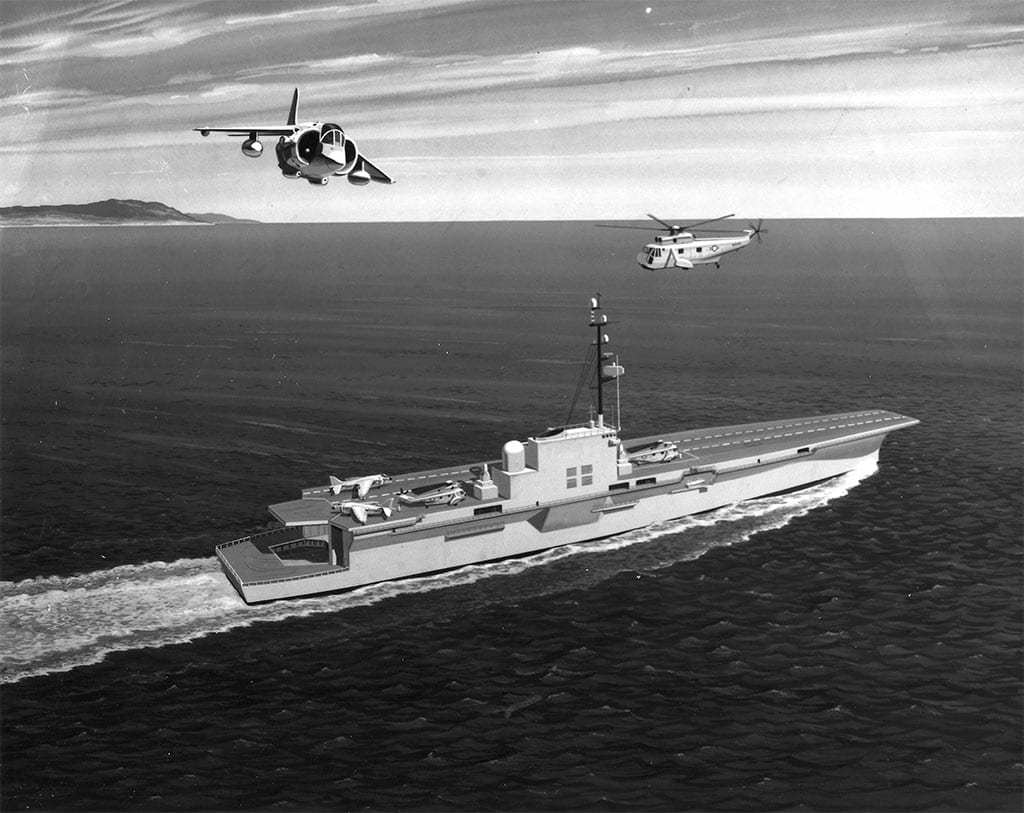
This was the U.S. Navy that President Reagan’s first Secretary of the Navy, John Lehman, inherited. Before Reagan’s election Lehman published a book in 1978 that supported a U.S. Navy centered on offensive (i.e. power projection) operations using a large carrier fleet. It was Lehman who inserted a plank into the Republican Party platform in 1980 calling for a the 600-ship Navy. Lehman’s 600-ship Navy, which included 15 aircraft carriers, was defended on the grounds that in order to deploy five carrier battle groups at all times (2x Mediterranean, 2x Western Pacific, and 1x Persian Gulf after the fall of the Shah of Iran) a ratio of 3:1 was needed (Peeks, pp. 244-245).
With this understanding of the doctrine of the U.S. Navy at the start of the 1980’s, the U.S. Navy presented to players in Seapower & The State is clearly one of contradictions. On one hand the mission of the Navy, as defined by earning Victory Points in the game, is clearly that of a defensive fleet protecting Sea Lines of Communications and strategic ballistic missile submarines. The U.S. Navy is, however, a very capable force for power projection—indeed, in the Designer’s Notes Newberg states, “At the heart of this combat system is the aircraft carrier for force projection and the ballistic missile submarine for nuclear war ‘deterrent’” (21.0 Designer’s Notes) The contradiction is seen not only through the number of fleet units but also the numerous aircraft carriers which do not have a clear sea control or SLOC protection role.
[While Newberg calls out, “the aircraft carrier for force protection,” the rules for Seapower & The State provides few option for an aircraft carrier—or for that matter any combatant—to project force. In the core game, the rule for Anti-Surface Combat (see 10.0 ANTI-SURFACE COMBAT) allows for targeting bases which can be destroyed (alas, for no Victory Point benefit). Optional rule 20.1 Anti-Base Combat adds an additional step in the Combat Sequence that replaces bases attacks in the usual Combat Sequence steps at each range. The most significant base rule, however, is 16.2 Bases Captured & Inoperative under the War Effects rules (see 16.0 WAR EFFECTS). Under tule 16.2, in Seapower & The State bases are captured or rendered inoperative depending on the status of shipping routes. If certain routes are interdicted then related bases may be lost. This may also lead to Western Allies surrendering; any Ally outside of Germany, Japan, Australia, or the United States will, “surrender if all the base hexes with the designation of their nationality have been captured or become inoperative due to interdiction” (my emphasis).]
Following the election of Ronald Reagan in 1980, the U.S. Navy saw dramatic growth, in no small part part due to the commitment to a 600-ship Navy that was found in the Republican Party platform:
The current Chief of Naval Operations has testified that, “We are trying to meet a three ocean requirement with a one-and-a-half ocean Navy.” Republicans pledge to reverse Mr. Carter’s dismantling of U.S. naval and Marine forces. We will restore our fleet to 600 ships at a rate equal to or exceeding that planned by President Ford. We will build more aircraft carriers, submarines, and amphibious ships. We will restore naval and Marine aircraft procurement to economical rates enabling rapid modernization of the current forces, and expansion to meet the requirements of additional aircraft carriers. (Republican Party Platform of 1980, adopted 15 July 1980.)

Naval strategist and seapower expert Sebastian Bruns in “Deterrence or Escalation? A Reappraisal of the 1980s Maritime Strategy” talks of the drivers behind the calls for a 600-ship Navy:
The buildup of the Soviet Navy under the leadership of Sergej Gorshkov included the development of numerous cruise-missile-carrying surface ships, a vast investment in more capable submarines, a modernization in naval aviation, and the deployment of the Fifth Eskandra task force to the Mediterranean Sea. This was a key driver in the American naval build up. (Bruns, p. 267)
[Norman Polmar in Guide to the Soviet Navy, Third Edition (1983) writes on the presence mission of the Soviet navy. Beginning in the 1960’s, Soviet naval forces began regular, even sustained, deployments in seas non-contiguous to the Soviet homeland in places such as the Mediterranean, Caribbean, Indian Ocean, and even the eastern Pacific (Polmar (1983), p. 39). Between Polmar and Bruns we clearly see the view of a worldwide Soviet Navy which is reflected in the global scale of Seapower & The State.]
Bruns goes on to discuss how this new Soviet Navy could be used in wartime and the U.S. Navy response:
Such a significant naval force appeared to underline the argument that in wartime, a Soviet fleet would attempt to wrestle choke point control from the West and attack the North Atlantic sea lines of communication. Unlike the [U.S.] Navy’s role in the Vietnam War, where it exercised a significant degree of sea control absent a peer competitor, and unlike the Carter administration’s early views of the service as a kind of maritime railroad service that would bring supplies to the Central European front, a new role emerged: to fend off a sea-control challenger with capable blue-water assets. The idea of this “Third Battle of the Atlantic” was much closer in imagination to its predecessors, fought the same waters during World War I and II, respectively. (Bruns, p. 269)
This power projection doctrinal conundrum for the U.S. Navy is not only apparent in Seapower & The State but also in the historical record. As a matter of fact, in 1982 both the U.S. Navy doctrine and the perception of the Soviet naval threat was changing. As Peeks writes:
Alongside new ideas and new technologies, the push for a more aggressive strategy was bolstered by new intelligence that gave high-quality information on the Soviet navy’s thought processes and doctrine. By the end of the 1970s, it was obvious, at least to those with appropriate clearances, that the Soviet navy’s focus was resolutely defensive. Not only could the U.S. Navy take on an offensive role in wartime, but it was also increasingly clear that very few Soviet vessels would attempt to cut Atlantic sea-lanes in the event of war. (Peeks, p. 243)
Interestingly, it was November 1982 when the first classified briefings on the new Maritime Strategy were presented by Vice Admiral Arthur Moreau, Deputy Chief of Naval Operations (Plans, Policy, and Operations or OP-06) to Secretary of the Navy John Lehman, Chief of Naval Operations Admiral James Watkins, and Marine Corps Commandant General Robert H. Barrow (Hattendorf and Swartz, p. 19). Simply put, Seapower & The State was released years before the Maritime Strategy and is not representative of that later vision. Instead, Seapower & The State is representative of the Sea Control strategy and doctrine of the post-Vietnam War era.
[I have my doubts Seapower & The State could be modified to reflect the Maritime Strategy of the late 1980’s. The game has the barest of game mechanisms for power projection and no amphibious operations at all. If one wanted to seize something like Iceland to open a pathway for Soviet bombers into the Atlantic there is no way to do so in the rules for Seapower & The State.]
Soviet Offense
In the Designer’s Notes for Seapower & The State, Newberg talks to the Soviet naval threat but is vague on his view of their doctrine:
The East for all intents and purposes is the Soviet Union. None of the committed Soviet allies have strategically significant naval forces. The Soviet Union must shoulder the entire naval mission herself. That she has done so in a credible manner in spite of numerous obstacles is very surprising and much of the credit doubtless goes to the tenure of Admiral Gorshkov as the head of the Soviet Navy. But the Admiral’s concept of the function of a naval force are not the same as those of their Western counterparts and the result is a force much more concentrated on submarines and aircraft for power projection and on even more submarines for “deterrent”; though from a Soviet view the term “deterrent” is meaningless. Soviet ballistic missile submarines are there to fight when needed, rather than to hopefully deter fighting. And running through both these tasks is a orientation towards combined arms supportive techniques that are very contrary to normal Western practice. (21.0 Designer’s Notes)
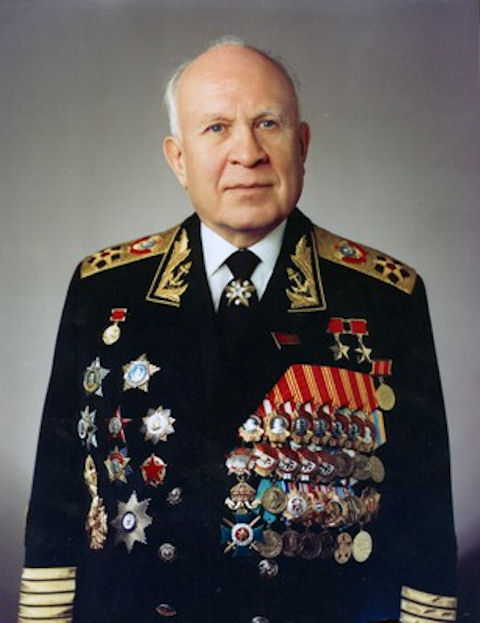
Though Newberg does not directly state what his view of Soviet naval doctrine is, by analyzing the rules for Victory Points in Seapower & The State we can gain some insight. My interpretation of Newberg’s rules for Victory Points (VP) indicates to me that he assessed the Soviet Navy had three main “missions”:
- Interdict Sea Lines of Communications (SLOCs): At the end of each turn the Eastern Player (Soviet) gains VP for Western (US and Allies) merchants and tankers lost; the Western player earns VP for keeping shipping routes open.
- Protect Ballistic Missile Submarines: Each player loses VP for lost strategic ballistic missile (SB) submarines; if the war ever escalates to a strategic nuclear exchange surviving SB are used to generate VP.
- Presence: The Soviet player loses VP for units leaving the Baltic Sea; the US player loses VP for exiting carriers or other units from the Mediterranean Sea. (see 17.0 VICTORY POINTS)
Note that players do not score Victory Points for destroying enemy units (aside from lost strategic ballistic missile submarines) or from destroying bases. Victory Points can also be gained/lost depending on the Level of Conflict, which will be discussed later.
A review of literature from around the time Seapower & The State was first published shows that Newberg’s unstated interpretation of Soviet naval doctrine likely drew on both official and popular viewpoints. The “official” viewpoint of the day is encapsulated in the 1978, third edition of a publication from the Chief of Naval Operations called Understanding Soviet Naval Developments. The theme of the third edition of Understanding Soviet Naval Developments was, “The Soviet Navy as Our Deep-Sea Antagonist.” Four public statements drawn from the 1978 assessment are illustrative of the manner the U.S. Navy portrayed the Soviet Naval threat at that time:
- “The Soviets are firm believers in the old adage that ‘the best defense is a good offense.’”
- The Soviet navy is focusing increasingly upon fighting a long conventional conflict with NATO, and is increasingly “challenging the United States in all aspects of maritime activity.”
- “The Soviets are employing their navy in much the same way as the United States and Great Britain, . . . . [and the Navy can now] perform most of the traditional functions of naval power in waters distant from the Soviet Union.”
- Interdicting NATO sea lines of communications (SLOCs) is “one of the most important of the Navy’s missions.” (Ford and Rosenberg, pp. 87-88)
The Soviet shift to a global blue water navy was exactly what Chief of Naval Operations Thomas B. Hayward told Congress in 1979; “in the past 15 years the Soviet Navy has steadily grown from a coastal defense force into a blue- water navy powerful enough to challenge the U.S. Navy in most major ocean areas of the world” (Cockburn, pp. 408-409).
The “popular” view of The Soviet Navy in the late 1970’s and going into the 1980’s is perhaps best described like that found in General Sir John Hackett’s novel The Third World War: August 1985. Though fictional, Hackett was the one of the first modern authors of Fictional Intelligence—FICINT—“the combination of fiction writing with intelligence to imagine future scenarios in ways grounded in reality.” Also called “Useful Fiction,” this genre of fiction saw renewed interest in 2015 with the publication of Ghost Fleet (SNS, p. 6).
In The Third World War, Hackett explained the mission of the Soviet Navy this way:
The Soviet Naval Staff, in planning the naval operations which would support ‘defensive action’ by the Warsaw pact, if that should prove necessary, were quite clear in their minds about what had to be done. The Soviet navy had to show that its contribution to the achievement of the Soviet Union’s political goals could be more than just concentrating upon the isolation of the north-west European battlefield, it could not only help the Red Army directly but also do much to weaken the commitment of the United States to Western Europe. The main tasks of the Soviet Navy, therefore, during the first ten days of hostilities [i.e. 2-3 turns of Seapower & The State], would be to:
- Maintain the Soviet Navy’s strategic nuclear forces intact and at readiness, whilst limiting as much as possible the damage which could result if NATO were to unleash strategic nuclear warfare or tactical nuclear warfare at sea.
- Help the ground and air forces to seize and keep open the Baltic Exits and Kiel Canal.
- Support the ground an air forces in the invasion of Norway from the north.
- Destroy as many as possible NATO warships, submarines and naval aircraft as possible, in the Arctic Ocean, Norwegian Sea, North Atlantic, North Sea, English Channel and Baltic. Outside these areas, in the Atlantic south of the Tropic of Cancer and elsewhere, NATO forces, or the forces of NATO member states, would only be engaged when hostile action seemed inevitable, or had already begun.
- Interdict all sea traffic between the United Kingdom and the Continent.
- Neutralize or destroy the North Sea oil and gas installations.
- Maintain freedom of movement for Soviet submarines in the Greenland-Iceland-UK gap, whilst denying this to NATO submarines.
- Prevent shipping, and especially military transports, from reaching NATO’s European ports.
- Get all Soviet and other Warsaw Pact ships, including fishing and research vessels, into friendly or neutral ports before their capture or destruction. (Hackett, pp. 225-226).
Hackett’s The Third World War in 1978 likely reflected Western assessments of the Soviet Okean-75 exercise in April 1975. Writing in 1982, Dr. Bruce W. Watson, both an active duty Navy officer and instructor at the Defense Intelligence School for the U.S. Defense Intelligence Agency, described Okean-75 as a worldwide coordinated exercise with participation from 220 ships, submarines, and naval units from all four Russian fleets. The ships were supported by Soviet aircraft that flew over 700 sorties from bases inside—and outside—of the Soviet Union. The strike phase of Okean-75 took place from 17-19 April 1975 and saw coordinated simulated strikes by ships and aircraft that focused on attacking enemy submarines, carrier task forces, major groupings of surface forces, and convoy formations. The strike phase culminated in a nuclear warfare exercise on 19 April that featured live submarine launched ballistic missile launches observed by Admiral Gorshkov and Defense Minister A. A. Grechko. (Watson, pp. 32-33) Watson concluded that, “Okean-75 is significant primarily as an indicator of Soviet naval accomplishments and future trends” (Watson, p. 35).

Dr. Watson’s 1982 assessment of Okean-75 includes several major points that are reflected in Seapower & The State:
- Distant Operations. “In the past, naval exercises had concentrated on a 1,500 nautical mile ‘defense perimeter’ around the Soviet Union. In Okean-75, however, many units operated well beyond that limit. This change apparently denotes an appreciation of changing Western naval capabilities and an understanding that hostile [i.e. Western] forces must be reduced before they can reach the primary Soviet defense zone” (Watson, p. 32).
- Ocean Surveillance. “The ocean surveillance capability demonstrated in Okean-75 reflects a further refinement of the Soviet’s technically advanced systems….The Soviets also launched several electronic, photographic, and radar reconnaissance satellites before and during the exercise….The two radar satellites were all-weather reconnaissance vehicles and may have been able to detect large surface craft or ships in convoy. When perfected, this system could provide a significant qualitative increase in Soviet surveillance” (Watson, p. 32).
- Globally Coordinated. “An important capability that became more apparent in Okean-75 than in Okean-70 was an ability to coordinate global operational activities, including reconnaissance and surface, submarine, and air attacks” (Watson, p. 32). Okean-75 built off Okean-70 where, “Soviet surface missile ships, missile -armed submarines, and aircraft are able to rapidly exchange targeting information and coordinate strikes against surface ship targets” (Watson, p. 29).
- Attacks on Shipping. ”A higher priority apparently was assigned to coordinated air and submarine attacks on enemy shipping. This shift in emphasis could portend a greater use of Soviet aircraft and submarines against such targets. Okean-75 proved, at least, that the Soviets have enough aircraft and submarines capable of effective interdiction and that their mission has been expanded to augment an already impressive interdiction capability on the part of surface combatants” (Watson, p. 33).
- Concern with U.S. Ballistic Missile Submarines. ”Since many aircraft equipped to locate and destroy submarines were involved in Okean-75 — apparently coordinated with surface antisubmarine units — it is clear that a prime area of interest was antisubmarine warfare. This emphasis certainly reflects a Soviet concern with the U.S. ballistic missile submarine threat and probably with Soviet antisubmarine inadequacies” (Watson, p. 33).
Popular views from think tanks also considered the growing size and capability of the Soviet Navy and sounded alarms. In 1978 one think tank author wrote:
In this area, of course, the naval balance between the two superpowers becomes particularly critical, and here too the Soviet power has been growing steadily relative to that of the United States. Ten years ago the Soviets had no missile-carrying cruisers; today they have 22. Ten years ago they had 12 missile-carrying destroyers and destroyer-like vessels; today they have more than 40. Ten years ago the Soviet Union had 45 nuclear-powered submarines; today they have more than 130. Finally, after a decade of determined ship-building effort, the Soviets have deployed their first true aircraft carrier and have under construction at least three more. Recent reports indicate that they are building a new giant submarine capable of carrying perhaps two dozen SLBMs [Submarine-Launched Ballistic Missiles]. So significant has the capability of the Soviet Navy become that the recently retired Chief of US Naval Operations, Admiral Elmo Zumwalt, today doubts whether the US Mediterranean fleet could successfully deal with its Soviet counterpart in the event of war in Europe. In an especially alarmist appraisal, General George Keegan, recently retired chief of Air Force Intelligence, asserts that in the event of war 75 percent of the free world’s surface fleets would be destroyed by Soviet forces, naval and air, within a matter of hours.
…
It is nonetheless clear that the Soviet position relative to that of the United States is substantially stronger than it was a decade ago. It is worth recalling that seapower is far more important to the US than the USSR. The United Stated depends on overseas sources for vital natural resources, particularly oil but also key minerals. Open sea lanes therefore become for the Untied States a vital national objective. In this context the threat both to naval and merchant ships implicit in the Soviet attack submarine force, their 300-plane land-based naval air arm (including at least 30 Backfires), and several dozen surface ships armed with cruise missiles assumes its proper perspective. The 75 United States submarines equipped for ASW [Anti-Submarine Warfare] would in the event of war be seeking to neutralize at least three times that number of Soviet submarines. The American capacity to escort merchant shipping across the Atlantic or around the Horn of Africa with surface-borne escort vessels is clearly limited.
…
Should the military trends outlined above long continue, the US will lose its ability to protect its vital interests abroad; ultimately doubts are certain to arise concerning the capacity of the United States to protect even its own security. (Dornan, Jr., p. 262)
[Several comments on the BoardGameGeek forum for Seapower & The State lament the huge stacks of counters at game start but assure readers that those stacks will not be a problem after the combats of game turns 1 and 2 attrit those stacks. It is as though their comments are channeling Keegan’s assertion that, “in the event of war 75 percent of the free world’s surface fleets would be destroyed by Soviet forces, naval and air, within a matter of hours.” Could that make the combat model in Seapower & The State a feature and not a bug? I also wonder if those complaining players are really using movement rule 6.31 Logistics that requires ships to enter port at least every other turn or find a valid—but limited—at-sea supply source.]
While the Soviet Navy lacked aircraft carriers going into the 1980’s—contrary to Dornan Jr. the Kiev-class was not a true aircraft carrier with their first one projected to come available no earlier than 1986-1989 according to Polmar in the 1983 Guide to the Soviet Navy Third Edition (Polmar (1983), p. 125)—the fleet was still credited with an “offensive” capacity. The Charlie I and Charlie II-class of nuclear propelled guided missile submarines (SSGN) of which 19 hulls were built completed between 1967 and 1982 (Polmar (1983), pp. 97-99) were assessed by some to execute an “offensive” mission like that assigned to U.S. Navy carrier attack squadrons. To execute this mission the Charlies only required off board cues from long-range maritime reconnaissance aircraft (Bonds, pp. 167-168).
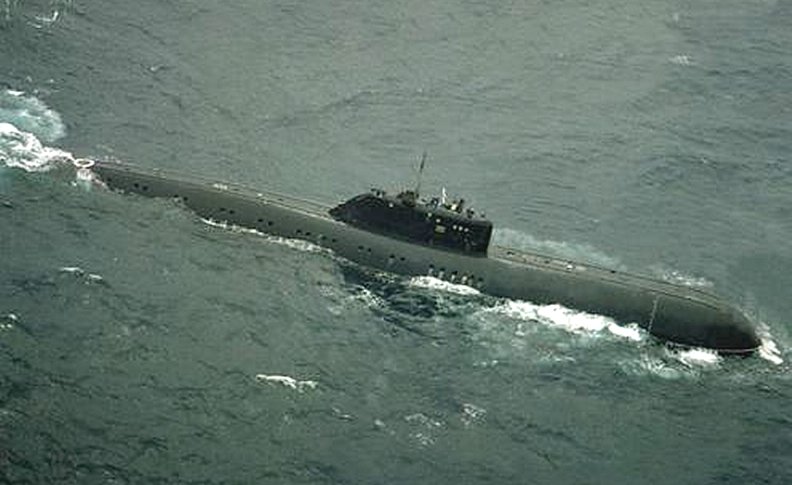
Put another way, in Seapower & The State the role of the Soviet Navy in a major war is offensive. To earn Victory Points in Seapower & The State the Soviet Navy must take to the offensive to cut Sea Lines of Communications. In Seapower & The State the Soviet Navy must go on the offensive to protect their strategic ballistic missile submarines. This Soviet offensive strategy in Seapower & The State is, moreover, a fairly accurate reflection of the Western understanding of Soviet naval doctrine in the late-1970’s and early-1980’s.
Sitting right with SATs
Seapower & The State is one of the only Cold War/modern genre wargames to incorporate space operations. Critics, some of who are actual rocket scientists, decry the highly inaccurate orbital dynamics modeled (or not) in the game. While the satellite ground tracks may not be “realistic,” satellite operations nonetheless form an important part of the game design for Seapower & The State. I strongly contend that the rules for satellites in Seapower & The State are still, over 40 years later, some of the best in naval wargaming—though admittedly not without some issues. In addition to unrealistic ground tracks for satellites, other complaints are the rules are not realistic when it comes to how different satellites operate and space launch capacity.
In Seapower & The State players have three different satellite types: Communication Satellites (CSATs), Reconnaissance Satellites (RSATs), and Anti-Satellites (ASATs) (see 14.0 SATELLITE OPERATIONS).
CSATs: CSATs are mostly used by the Soviet player who is subject to the Central Command rule which specifies that most units require making a die roll to target enemy units at A or B ranges (see 10.33 Central Command). This is reflective of the thinking of the day. Normal Polmar in Guide to the Soviet Navy, Third Edition (1983) states bluntly, “All Soviet naval operations are centrally controlled….” (Polmar (1983), p. 45). CSATs are also essential to Strategic Nuclear Combat where strategic ballistic missile submarines—for both players—score fewer Victory Points if not within a given range of a CSAT—a seeming reflection of a Nuclear Command, Control, and Communications (NC3) role. As Dr. Watson writes in his assessment of the Okean-75 exercise, “Published Soviet reports describing Okean-75 tell of the Navy Commander-in-Chief being able to communicate with major units anywhere in the the world almost instantly, knowing that an order had been executed by a ship ‘in a matter of minutes,’ having available in real time the status of air, surface, and underwater situations, including friendly and enemy orders of battle, and being able to monitor ‘how the [ship] commander conducts a search and judges the effectiveness of his actions’” (Watson, p. 30). Taken as a whole, the CSAT rules do not reflect the total mission set geostationary communications satellites perform in wartime but, for the purposes of Seapower & The State wargame, they do represent the most essential missions.

RSATs: RSATs affect the Localization rules. Localization of a target is a prerequisite for combat (see 7.0 LOCALIZATION). Given the rules that RSATs sit on “tracks” that seemingly depict a low Earth orbit (LEO) constellation, the RSAT appears to be based on the Soviet Radar Ocean Reconnaissance Satellite (RORSAT) that used active radar to detect ships. The mission of a RORSAT was public knowledge in 1982, regretfully because Cosmos 954, a nuclear-powered RORSAT, made an uncontrolled reentry in 1978 that spread radioactive debris over Northern Canada (Polmar (1983), p. 45). The RORSAT would later have a role in Tom Clancy’s novel Red Storm Rising:
“Tell me about their satellite reconnaissance,” Baker ordered.
“Admiral, they currently have one radar ocean reconnaissance satellite up—Kosmos 1801. It’s paired with Kosmos 1813, an electronic intelligence bird. 1801 is the nuclear-powered radar bird… .
…
“I’d expect Ivan has another of his radar satellites ready for immediate launch, probably a few more in the barn.” (Clancy, p.138)

The threat only gets greater later in the book:
It was complicated to do, but a Flash information request from the Commander Northern Fleet cut through most of the bureaucracy. One of the two real-time-capable Soviet reconnaissance satellites burned a quarter of its maneuvering fuel to alter its orbit and came low over Iceland two hours later. Minutes later, the last Soviet RORSAT was launched south from the Baikonor Cosmodrome, and its first revolution took it within radar range of Iceland. Four hours after Andreyev’s message, the Russian had a clear picture of what was arrayed against Iceland. (Clancy, pp. 568-569)
Seapower & The State allows players to take these Red Storm Rising-like actions…four years before the book was published.
ASATs: Though both sides in Seapower & The State are given ASATs the primary game design driver appears to be based on American concerns. Polmar in Guide to the Soviet Navy, Third Edition notes:
The anti-satellite program of the U.S. Department of Defense has Soviet ocean surveillance satellites as their primary target. According to a U.S. defense official, “The principal motivation for our ASAT [Anti-Satellite] program is to put us in a position to negate Soviet satellites that control Soviet weapon systems that could attack our fleet.” (Polmar (1983), p. 47)
Once again, we can turn to Clancy’s Red Storm Rising for an example:
LENINSK, KAZAKH S.S.R.
The loss of signal from the Kosmos 1801 satellite was recorded scant seconds after it was obliterated from the sky. It was no surprise to the Russian space experts, since 1801 had used up its maneuvering thrusters several days before, and had been an easy target. Another F-1M rocket booster was sitting on a launch pad of the Baikonur Kosmodrome Complex. An abbreviated launch sequence countdown would be under way inside of two hours—but from now on the ability of the Soviet Navy to locate convoys and fighting fleets would be in jeopardy. (Clancy, pp. 378-379)

The number of satellites available to each player in Seapower & The State is found in the Starting Satellites table on the game board. In every scenario the Eastern (Soviet) player has more CSATs, RSATs and ASATs available. To those of us in this age of Space X and an era of rapid launch and proliferated constellations this seems incredible; were the Russians really ahead of us in the Space Race of the 1980s? The answer is, yes. For example, take the number of space launches in 1980. The Soviet Union conducted 90 space launches in 1980; the United States…15.

General Sir John Hackett in The Third World War helpfully explains the disparity in the chapter, “The War in Inner Space”:
After the early scramble to catch up with the Soviet Union, when spurred into competition by the success of the Sputnik shots, the USA soon took the lead. Their vehicles and systems were demonstrably more capable, more reliable and more durable than those of the USSR. Out of that technological and engineering success came a difference in approach that was to be of fundamental strategic importance: the Americans invest their resources in complicated, long-life, multi-purpose craft designed to function in orbit for periods as long as a year. The Russians, under force majeure, went for frequent launchings of simple, single-purpose, short-life payloads. (Hackett, p. 257)
That is how you get a more robust—and realistic—Soviet space program in Seapower & The State.
Glowing in Seapower & The State
Nuclear weapons constitute an important element of the game design in Seapower & The State. Nuclear Weapons are covered in several rules. The core rules for the use of nuclear weapons is found in section 5.0 CONFLICT LEVEL DETERMINATION where the Conflict Intensity is chosen. The five levels of Conflict Intensity are:
- Level 1: No Active Combat.
- Level 2: Conventional Weapon Combat.
- Level 3: Conventional and Tactical Nuclear Weapon Combat.
- Level 4: Conventional, Tactical Nuclear, and Operational Nuclear Combat.
- Level 5: Strategic Nuclear Weapons Combat.
Norman Polmar in Guide to the Soviet Navy, Third Edition discusses tactical nuclear warfare by pointing out:
Writing in Krasnoyarsk Zvezda, the daily newspaper of the Ministry of Defense, a Soviet general officer in 1976 warned that a conventional conflict in Europe “carries with it the constant danger of being escalated into a nuclear war.” This appears to be the central theme of contemporary Soviet views on theater/tactical nuclear weapons: (1) war in Europe is the principle factor in Soviet nonstrategic planning, and (2) there is a distinct danger of escalation of conventional conflict to nuclear conflict. But the same article also implies that should a NATO conflict reach a nuclear phase, it need not necessarily reach an all-out, intercontinental nuclear exchange between the Soviet Union and the United States. (Polmar (1983), p. 44)
It may be a surprise to some readers today, but in the early 1980’s the U.S. military seriously believed that a future war likely would include tactical nuclear weapons use. Most focused on the use of tactical nuclear weapons in Europe where both the Active Defense doctrine of 1976 and the AirLand Battle doctrine that followed built upon the premise that the only way to enable smaller NATO formations to defend against large Soviet formations was to consider the use of “integrated tactical nuclear conventional response…as mandatory” (Griffin, p. 114).
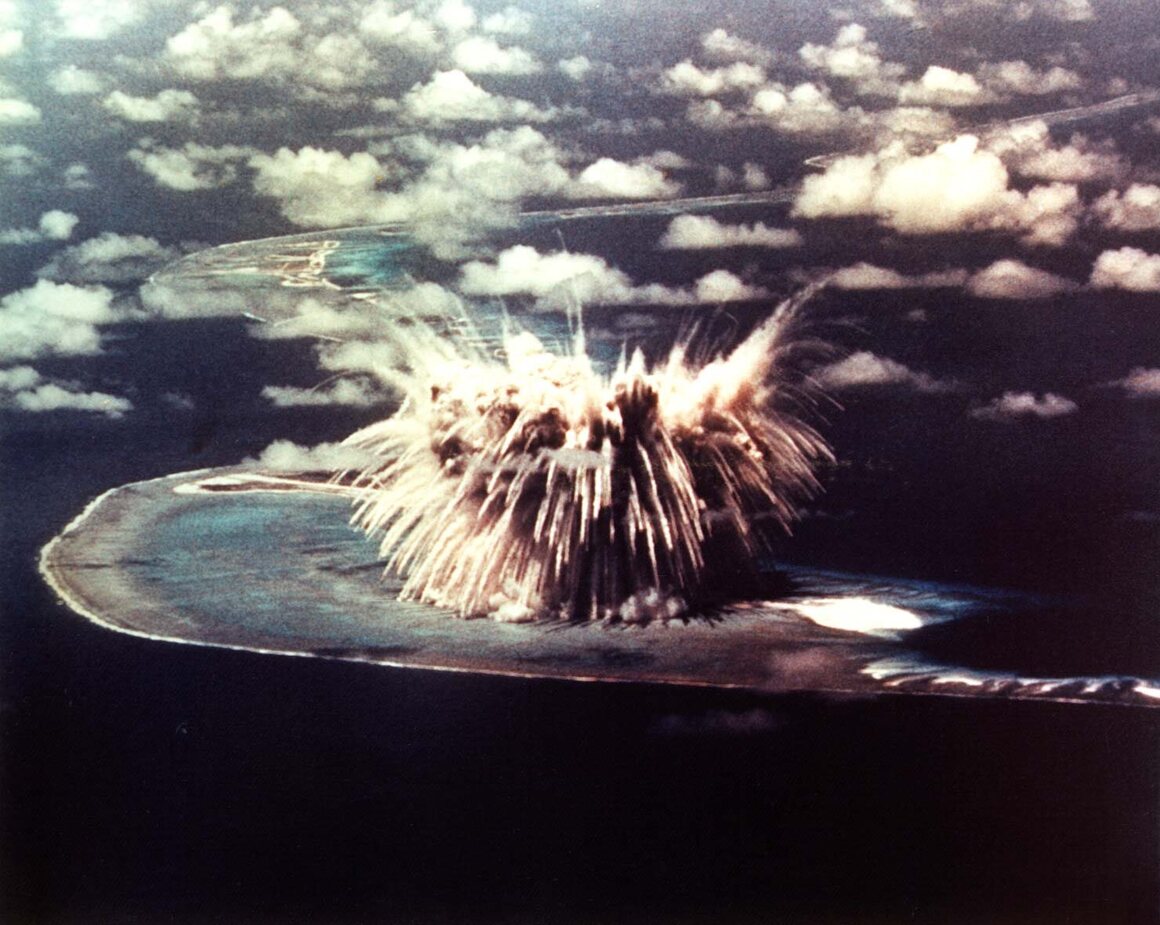
[Tactical nuclear weapons were eventually withdrawn from both the U.S. and Soviet navies in late-1991 after then-President Bush and Secretary Gorbachov reached an agreement to withdraw all tactical nuclear weapons at sea. See “Unilateral U.S. nuclear pullback in 1991 matched by rapid Soviet cuts” at the National Security Archives online.]
The rules for using tactical nuclear weapons at sea in Seapower & The State seem to be derived from thinking like that found in a few short paragraphs of Polmar’s Guide to the Soviet Navy, Third Edition:
Nuclear weapons appear to provide two major offensive advantages over conventional weapons in war at sea. First, whereas multiple hits with conventional weapons would be required to destroy a cruiser or carrier, a single nuclear weapon, of even small size, would suffice. Second, a defense against nuclear weapons would require a 100 percent effectiveness, since a single penetrating missile or “leaker” could destroy the target.
In the anti-air warfare role the nuclear weapon, from the Soviet perspective, would deter concentrated U.S. air attacks against ships, while in ASW operations a nuclear weapon could compensate for the target submarine’s area of uncertainty or the limited effectiveness of conventional weapons. Another consideration is the potential use of high-altitude bursts of nuclear weapons to create Electro-Magnetic Pulse (EMP) effects that could seriously degrade electronic and optical systems of ships and aircraft over large ocean areas. Underwater nuclear bursts could similarly degrade sonar effectiveness, creating a condition over certain acoustic frequencies known as “blue out.” Soviet writings demonstrate a familiarity with all of those aspects of nuclear weapons.
A final advantage of employing nuclear weapons is that a commander can use all of the weapons at his disposal, conventional as well as nuclear. The reverse is not so. A conventional-only attack denies a commander the use of a significant number of weapons—those with nuclear warheads. (Polmar (1983), p. 45)
The effects of nuclear weapons use at each conflict level in Seapower & The State are a near-identical reflection of Polmar’s commentary on Soviet viewpoints. If Level 3 Conventional and Tactical Nuclear Weapon Combat is chosen, the anti-surface (AS) combat value is multiplied by 5 for all range A, B, and C combats (see rule 5.33 Level 3). If Level 4 Conventional, Tactical Nuclear, and Operational Nuclear Combat is chosen, the player who bid that level loses 75 VP while both players suffer other extreme impacts:
- All non-base hexes containing 5 or more surface ships and/or submarines or containing 1 or more CV type units have all surface ships and submarines in the hex eliminated.
- All non-base hexes containing less than 5 surface ships and/or submarines must roll a die for each CL, CH, BG, and CG type unit in the hex and the unit is eliminated on a roll of 5 or 6.
- 3 out of every 4 or less aircraft of each specific member of each type are eliminated.
- 2 out of every 3 satellites of each type that have not been launched are eliminated.
- A number of systems cease to be operational for the rest of the game:
- All seabed sonar sites become inoperative.
- All Class 2 & Class 3 bases become inoperative.
- All Class 1 bases are considered to have been reduced to Class 3.
- The Panama and Suez Canals are closed.
- Mines may no longer be laid or cleared.
- For the Western player 1 out of every 2 merchants and tankers are eliminated.
- Certain sea routes are inoperative while other special routes open. (See rule 5.34 Level 4).
If a player bids Level 5 Strategic Nuclear Weapons Combat the game effectively ends but not before the strategic ballistic missile submarines (SB) do their thing. Players check to see what SB units with a range of 5 or more can reach targets; each target covered earns 2 VP. Level 5 conflict always ends the game (see rule 5.35 Level 5).
[I find it interesting and of note that while Level 3 Conflict allows usage of tactical nukes to enhance firepower it does so without any political (i.e. Victory Point) penalty. This seems to me to be an assessment by Newberg that politicians had already considered the use of tactical nuclear weapons at sea and simply saw it as expected.]
Intentional or not, from the game set up in Seapower & The State the Eastern player is immediately challenged to decide on Level 3 Conflict. In every scenario, hex 3417 starts occupied by a U.S. aircraft carrier (CV) sans escorts and a Soviet nuclear-powered attack submarine (SA). The Eastern Player Phase is first and, assuming the Soviet player does not move the submarine, it becomes eligible to attack in the AA & AS Combat Resolution Step of the Combat Segment. Per rule 7.34 Trailers the CV is automatically localized and a valid target because it started the first turn of a Level 2-5 conflict with an Eastern SA in the hex.
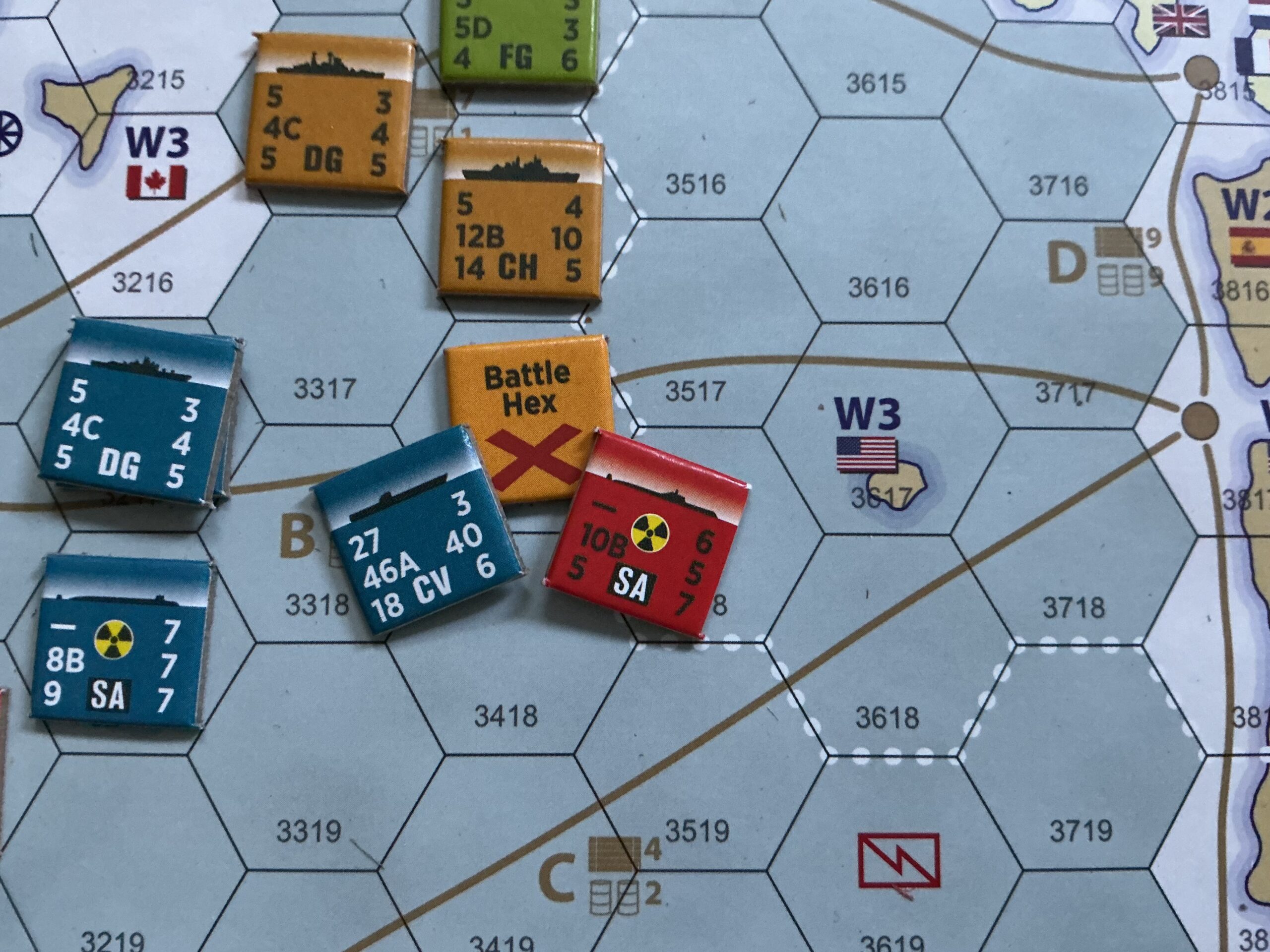
- If the chosen Conflict Level is 2 (Conventional Weapons Combat) the SA cannot sink the CV; the best attack the SA can muster is 10 AS factors plus 1d6 from which the CV subtracts is EW rating (3); the result is far less than the 40 attack factors needed to eliminate the CV.
- If the chosen Conflict Level is 3 (Conventional and Tactical Nuclear Weapons Combat) a Soviet attack turns deadly. At Level 3 Conflict the AS value of the SA is multiplied by 5 (total of 50). Even with the worse possible roll on a d6 the Eastern player brings 51 attack factors to bear against which the U.S. player—even with the best possible result of [6] and a d6—subtracts at best 9 factors (EW Rating + 1d6) leaving 42 attack factors. Those 42 attack factors are in excess of the 40 needed to sink the CV.
In Seapower & The State Newberg was trying, perhaps, to give us his version of the end of the 1965 movie The Bedford Incident (or as I call it, “Moby Dick…but with nukes”):
While the rules for nuclear war in Seapower & the State are extreme, they are somewhat reflective of the zeitgeist of the day. Going into the 1980s many Americans thought a nuclear war was going to be sudden and short. Books like Warday by Whitley Strieber and James Kunetka, published in 1984, described a version of strategic nuclear warfare at sea taking place on 28 October 1988—Warday:
“On Warday there were more than one thousand major combatant U.S. and Soviet ships at sea, of which 380 were submarines, 100 of them American and 280 Soviet. Of these craft, as far as we know, only the S. Shuvakov actually fired weapons, and this ship was responsible for the destruction of the United States Seventh and Third Fleets in the Pacific. In this case, a single submarine of the Typhoon class destroyed the most massive assemblage of capital ships in human history and took, in a few moments, over twenty thousand human lives, utilizing eleven SS-N-20 missiles, each deploying six warheads of four megatons each. The destruction of the American surface fleets was carried out by land-based weapons, except the Sixth Fleet in the Mediterranean, which was an operation of unknown nature, possibly involving the firing of a nuclear-armed SS-N-9 missile by a Nanuchka-class corvette, or an AS-43 fired by a TU22M bomber. All American operational aircraft carriers were destroyed within the first ten minutes of the war, including the four nuclear aircraft carriers and eight of the ten conventional carriers. Of the 190 other major combat vessels of the U.S. surface navy, 141 were destroyed or damage and later abandoned. With the destruction of the naval staff and all personnel records in Washington, the U.S. Navy ceased to be an operational fighting force on Warday.
“The Soviet surface navy was also rendered nonfunctional on Warday. Both carriers were destroyed, the Kiev in Motovskij Gulf along with approximately one hundred other ships in the immediate area. The Soviet Baltic Fleet attempted to escape into the North Sea, but it was repelled by NATO forces, primarily the U.K. and Danish antisubmarine forces, which were responsible for the confirmed destruction of eighty-two Soviet submarines of various classes, including numerous nuclear-powered types. The eight Typhoon class submarines in the Baltic did not sortie. Three of these have subsequently been destroyed by the Royal Navy, one has ceased to be operational, and the other four remain operational but the political situation in the Soviet area is too unstable to allow a determination of the present loyalties of the crews. These submarines are extremely dangerous and will be sunk. The Pacific Fleet at Vladivostok was destroyed by American action. Some Soviet ships were found disabled for lack of fuel by French relief forces entering Vietnam in 1989. The bulk of these ships were at Cam Ranh Bay and were scuttled by their crews. The Soviet units stranded in Aden were interned by the Royal Navy. These included the helicopter carrier Moskva, with a complement of eighteen KA-25 helicopters; three GW-ASW cruisers fully armed an lacking only fuel; twelve GW destroyers in the same condition, all of the Kildin class; four GW corvettes of the Tarantul class and three of the Nanuchka class; all four Matka-class hydrofoils, which had been posted down from Black Sea ports during the Syrian affair in 1987. The fleet replenishment vessel Berezina was intercepted in the Indian Ocean at this time, and has been refitted as HMS Triumph.” (Strieber and Kunetka, pp. 210-211)
Too bad Strieber and Kunetka did not use the 1982 edition of Seapower & The State to analyze their starting Soviet order of battle or they likely would have realized the Typhoon-class ballistic missile submarines do not start the war in the Baltic but rather in the North Fleet.
More seriously, I wonder if Newberg was channeling thoughts generated by another nuclear conflict wargame from the late 1970’s. On the question of whether a wargame a simulation or a fantasy, I am reminded of the Designer’s Notes in Ultimatum: A Game of Nuclear Confrontation by J. Michael Hemphill from Yaquinto Publications in 1979:
There is one final note to be made on the design on this game. Several hours were spent attempting to give the players some reason (moral, love of fellow man, nationalism) for avoiding nuclear war. The destruction of a nation of tens of millions of people weighs heavily on the minds of the leaders of both the Soviet Union and the United States. But in a game the players have no such weight balancing their decisions. It becomes an abstraction and the players easily forget what the game is simulating. More than any other game on the market, this can create problems in the simulation of reality. (Ultimatum, Designer’s Notes)
The reality of Seapower & The State is that, should the game escalate to all-out nuclear war like the inevitable outcome of a game of Ultimatum, one must question just what reality the game is simulating.
[While many point to movies like The Day After (1983) as a beacon of changing U.S. pubic attitudes towards nuclear war, to some viewers like President Ronald Reagan it provided a resolve to “do all we can to have a deterrent” in order to prevent a mass Soviet launch. Reagan would use the movie to advocate for his Strategic Defense Initiative—dubbed “Star Wars.” If there was a piece of fiction in the 1980s that changed American attitudes towards tactical nuclear war it was more likely Tom Clancy’s novel Red Storm Rising (1986). In Red Storm Rising, Clancy tapped into an emergent zeitgeist, that of “peace through strength.” To policymakers like Reagan and the wider American public, Red Storm Rising showed that a NATO victory was possible without resorting to nuclear weapons. Of course, that newly emergent zeitgeist came four years after Seapower & The State was published….(See Griffin, pp. 111-120)]
Abstracted combat
A common criticism of Seapower & The State that I read about is that the combat model is difficult to use and not realistic. The criticism I see broadly divides into three areas: combat ratings, localization, and the ranged combat resolution model.
Combat Ratings. With regards to combat ratings in Seapower & The State, the criticism I often see splits between components and data. Physically, ship and submarine unit counters in Seapower & The State are very busy, especially on counters only a half-inch in size in the original version and on only slightly larger 9/16” counters in the latest edition. I agree that the counters are hard for grognard eyes to see. In the original edition one had to “know” what each factor was whereas in the latest edition each player gets a player aid to help. Not a major improvement physically but certainly one that helps with information made available in an individual player’s tableau rather than buried in a shared rulebook. I also see criticism of the many ratings used to define a unit in Seapower & The State. This criticism is not without some merit. The (small) front face of a unit counter shows up to 10 different pieces of information with another three to five pieces of information on the back side. With each unit counter Newberg attempts to convey all the information needed to not only use the unit in play but also (for ships and submarines) the scenario set-up information.
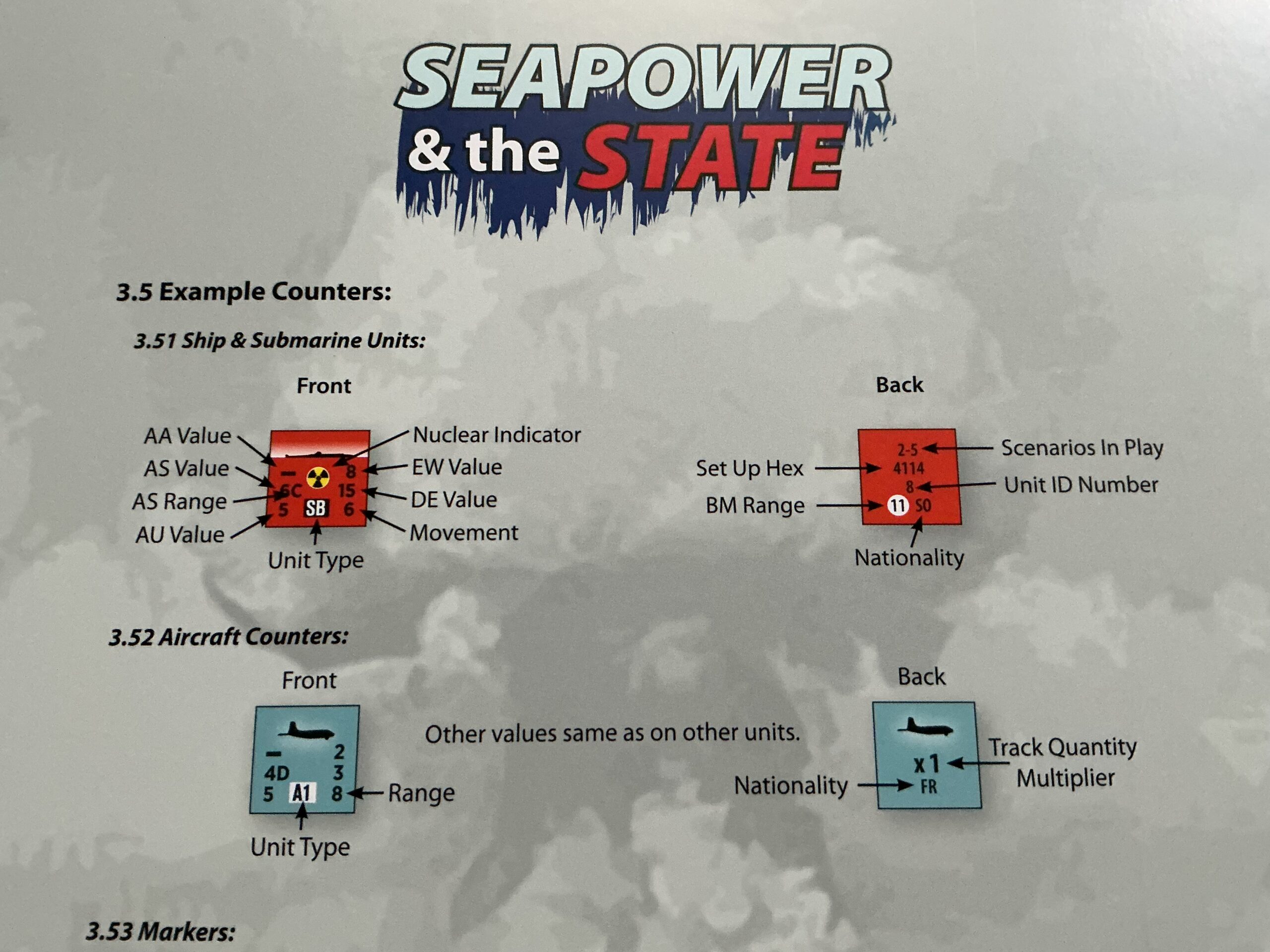
Newberg addressed the combat ratings concerns in the Designer’s Notes where he writes:
The very strategic level of the game requires numerous abstractions… . Large numbers of smaller ships, submarines & aircraft were built into the various base values since their use outside close waters seemed very unlikely. There will doubtless be many disagreements with the classification of various units and the values assigned to them. Aside from the data base used some of these are influenced by judgement of potential, and this is always subject to debate. If you find yourself in severe disagreement, change the values to suit you. I do feel however, on the basis of years of study, they are reasonably accurate. (21.0 Designer’s Notes)
[Setting aside questions on combat ratings for a moment, the order of battle in Seapower & The State is also reflective of the early 1980’s. The game offers five scenarios (see 19.3 Scenario Listing). The “1984″ scenario uses, “force levels dictated on actual historical building trends” which I take to mean 1982 numbers plus those program publicly announced for the next two years. The “1989” and “1994″ scenarios simply extrapolate those historical trend lines into the future. The “1989+” and “1994+” scenarios both, “postulates a major Western arms buildup starting in the early 1980’s is continued to 1989 [or 1994] and the Soviets as a result speed up their arms programs as much as possible.” It certainly appears that the “1984/1989/1994″ scenarios are conservative in their estimated build up whereas the “1989+/1994+” are likely reflective of the build-up to a 600-ship U.S. Navy and a projected Soviet response. Yet, while the order of battle may grow, Seapower & The State does not change how Victory Points are awarded; fleets grow in capability but strategy and doctrine remains stagnant.]
Localization. A second combat criticism I hear from some players of Seapower & The State concerns the rules for Localization. The criticism often is not aimed at the intent of the rule but the execution. Like most any wargame, Seapower & The State suffers from a “God’s-Eye” problem in that unit location information is visible on the game board. To get around this problem, “units of the phasing player may only attack surface ships and submarine units of the opposing player that have been localized, even though their general position on the map is known.” Most players seem to agree that such a rule is needed; how that rule is implemented, however, is the main issue.
The rule for Localization in the latest edition of Seapower & The State is presented in rule 7.2 Procedure which reads:
Total the EW [Electronic Warfare] values of the phasing units in the hex, adding in the EW benefits of RSATS or Seabed Sonar sites if appropriate, and the result of 1 die roll by the phasing player. Determine the non-phasing unit in the hex with the highest EW value and the non-phasing player rolls 1 die, adding the result to this value. Subtract the non-phasing player total from the phasing player total and divide the result by 2, dropping any fractions. If the result is negative, none of the non-phasing units have been localized. If it is positive, that number of non-phasing units have been localized. If more non-phasing units are present than have been localized, then those units with the lower EW values are considered to have been localized. In instances where one or more units of a number of units with equal EW value must be chosen, the non-phasing player determines which have been localized.
While the rule for Localization in the rulebook for Seapower & The State is complex as written, the latest edition has a “Formula Chart” on the game board that “simplifies” the process into four steps:
-
- Total applicable phasing EW values plus a die roll.
- Subtract highest applicable non-phasing EW plus a die roll.
- Divide by 2 (dropping fractions).
- Result is number of non-phasing EW units localized. Lowest-rated EW units are localized first and specific units of same EW value are localized at owning player’s choice.
I can understand and—to a degree—empathize with wargamers who like simple, direct, and well explained (written) game mechanisms. As a grognard who grew up in the hobby with classic combat-odds tables doing simple math is just part of the game so the “add-subtract-divide-compare” Localization model should not be too onerous. At least Newberg did not use an odds-driven Combat Results Table, eh? In these days of wargamers demanding “modern elegant game mechanisms” my opinion, however, appears to be unpopular.
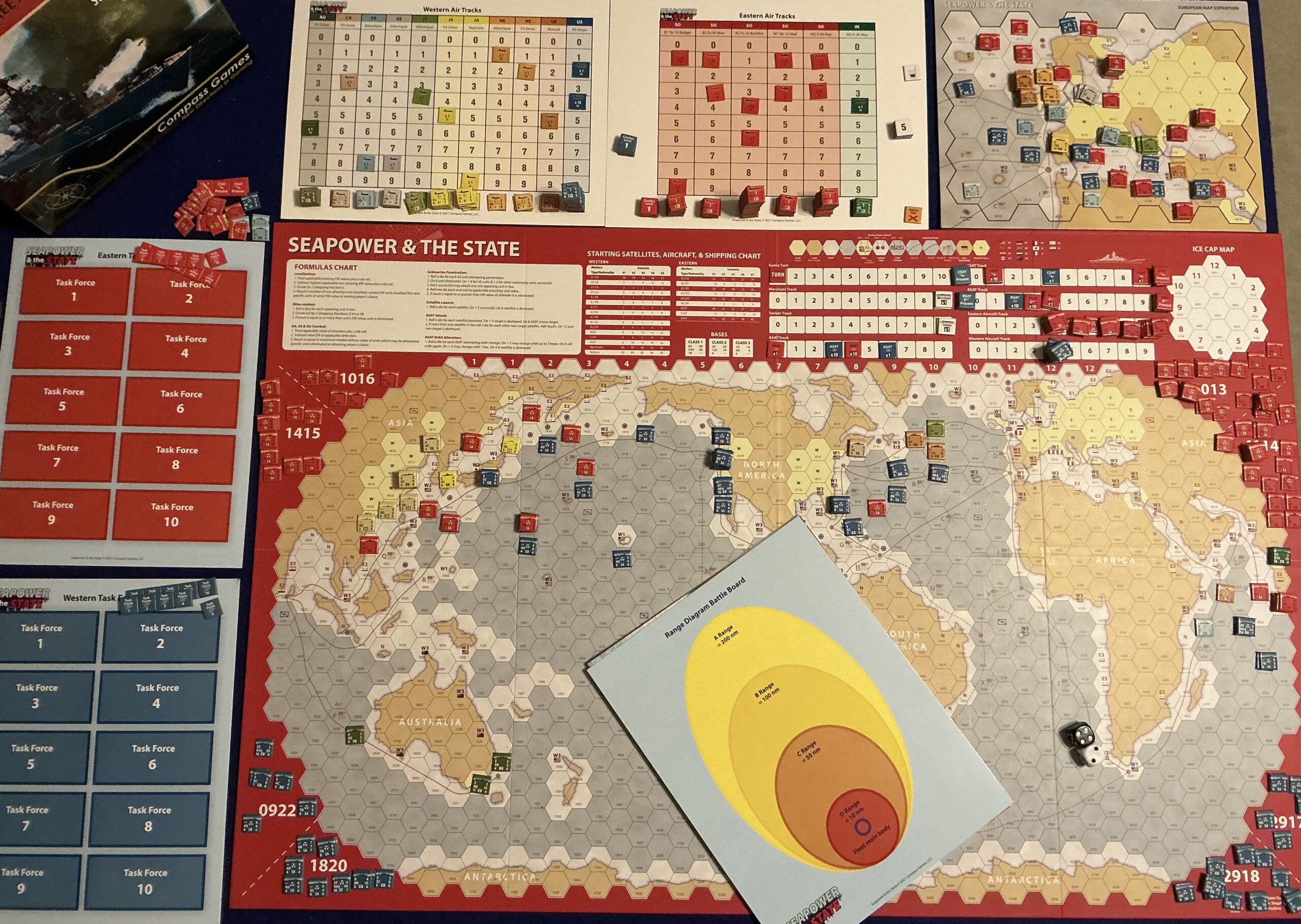
Ranged Combat Resolution. Each hex in Seapower & The State represents a huge area—900 km across. A single hex easily covers the range of most (all?) weapons systems in the game with the exception of strategic ballistic missiles. There are no stacking limits in Seapower & The State meaning a hex can get very crowded very quickly. The challenge to Newberg was how to design a combat resolution model that showed the advanced technology of the day yet was still quick-play—in a single hex.
Newberg’s choice for the combat model in Seapower & The State is in the Designer’s Notes: “The very strategic level of the game requires numerous abstractions, but to keep doctrine differences clear an upper operational level was retained for the purpose of the combat resolution system” (Designer’s Notes). He also seemingly eschews the classic “battle line” combat model used in War at Sea or Victory in the Pacific which commonly had each player line up shooters versus targets and roll dice down the line. While that may have worked with “Day Actions” using aircraft and “Night Actions” as it did in Victory in the Pacific that simple “long-short range” model of naval warfare is not sufficiently nuanced enough for Newberg to take advantage of all the data research that went into the unit database. Instead, Newberg uses what I term a “pulsed range-of-combat model.” This combat model uses a Battle Board and has four ranges labeled A through D in order of descending distance. Here is how rule 8.3 Range of rule 8.0 AA [Anti-Air] & AS [Anti-Surface] COMBAT SEQUENCE explains the core concept:
The range concept is central to AA and AS combat resolution in that certain weapons systems can only be applied so far away from the location of the firing platform. As AA and AS combat is resolved for each range, simulating the phasing units moving deeper into the area represented by the hex, more weapons of shorter range will be able to contribute. Similarly, as the phasing units move away from the non-phasing units units in the hex (if they break off combat before range “D”) the shorter range weapons will no longer play a part sooner. (8.3 Range)
Simply put, the “pulsed range-of-combat model” in Seapower & The State has players pass through zones to fight. Combat is resolved in rounds starting at Range A (longest) all the way down to Range D (closest). A unit with Range A capability can fight at Range A, Range B, Range C, and Range D if they so choose. A unit with Range C capability cannot attack in the Range A and Range B rounds. This process can get complicated thanks in part to rule 8.4 Breakaway where some units can move closer while others move away. Interestingly, the rules do not seem to allow you to maintain a range and fight, i.e. keep your carrier at Range A and pound away at a enemy surface grouping of Range C units. The use of the Battle Board in the new edition is most helpful in resolving combat; the original version did not have a Battle Board requiring players to duel it out on the table or make their own homemade version. Perhaps players of the new edition will be less challenged using the multiple ranges of combat model thanks to the graphical support of the Battle Board player aid.
It’s. A. Game.
In the book Admiral Gorshkov: The Man Who Challenged the U.S. Navy, Norman Polmar and co-authors Thomas A. Brooks and George E. Fedoroff attempt to compare the U.S. Navy and Gorshkov’s Soviet Navy. Their non-answer should be interesting to wargamers:
Thus, it is not possible to compare navies in a conventional “Which navy is better?” fashion. There were missions that the U.S. Navy was more capable of executing, and there were missions which the Soviet Navy was better. The real question to be asked is which navy was better at performing its own missions in the face of opposition from the other. This question is complex and really answerable only through war gaming and careful net assessment. Arguably, even these techniques would yield different answers depending on the assumptions made. (Polmar, et al. (2019), p. 205)
Seapower & the State is but one attempt to answer the question, “Which navy is better?” The assumptions, in this case, are those from designer Stephen Newberg and their interpretation of the public record as to the naval doctrine of the U.S. and Soviet navies. With the benefit of hindsight and 40 years of declassified records and open archives it is easy to say “that’s wrong” and criticize the wargame for being “unrealistic.”
Think tank author and NATO expert Magnus Nordenman in his book The New Battle for the Atlantic: Emerging Naval Competition with Russia in the Far North from 2019 writes about the lessons of the “Third Battle of the Atlantic;” that is, the Atlantic in the Cold War. One lesson Nordenman identifies is, “Be Careful What You Measure” which seems particularly pertinent to any assessment of Seapower & The State:
Effective strategies for controlling, or denying control of, the North Atlantic depend on accurate assessment of both sides’ intents, weaknesses, and strengths. This is not as easy as it seems. The late arrival of the effective convoy system during World War I had much to do with a widespread misreading of the statistics of how many ships were engaged in the resuply of Britain, which made the convoy concept seem impractical. The German submarine campaign during World War II may have been more effective if it had focused on attacking troop ships coming across the North Atlantic, which would have delayed and frustrated the American force buildup in the United Kingdom in preparation for the invasion of the European continent. Instead, the Germans used general tonnage sunk as the metric of success, giving German commanders little incentive to distinguish between the targets they pursued. The U.S. reassessment of Soviet naval strategy and capabilities in the late 1970s led to a wholesale reevaluation of U.S. strategy and to a new emphasis on operating in the far North Atlantic and the Barents Sea, rather than maintaining a barrier defense around the GIUK [Greenland-Iceland-United Kingdom] gap. (Nordenman, p. 73)
Instead of simply dismissing Seapower & The State as unrealistic by today’s understanding of history one should consider the wargame representative of a viewpoint in a moment of time. Jim Dunnigan in his Wargame Design Handbook writes that wargames are, “paper time machines” (Dunnigan, p. 1). Wargames like Seapower & The State enable players to play a wargame representing a slice of time. In the case of Seapower & The State that time period—regardless of what the scenarios are named—is the early 1980s. The game design is likewise based on information available at that time. I feel that criticism of Seapower & The State, especially those critics who decry it as “unrealistic,” do not fully understand the nuances of the many viewpoints of that period. In the case of Seapower & The State, I sense that often players are looking for the excitement of Clancy’s Red Storm Rising but instead get the more staid The Third World War from Hackett. After hearing so much about the Ronald Reagan’s Maritime Strategy with carriers striking the Kola Peninsula they instead get Jimmy Carter’s “railroad” navy guided by Elmo Zumwalt with a hint of John Lehman in the future. In Seapower & The State players have counters in hand that reflect the technological complexity of modern naval combat yet a combat system that seems simplistic; not to mention the presence of overpowering nuclear weapons in a game that all-too-often seems to end in mushroom clouds (but no counters showing such).
In all the arguments around realism in a wargame, too often the core reason for playing a game is forgotten. Newberg, in the last sentence of the Designer’s Notes for Seapower & The State remind us all the real reason we should be playing wargames: “Seapower & the State was intended for study as much as for enjoyment and I hope it provides you with both” (21.0 Designer’s Notes). I say do not let the former lack of “realism” deny you the latter fun of play.
Offensive Wargaming
Looking over the new 2025 edition of Seapower & The State I find a game that is very much of its time…of the original 1982 edition. When first published in 1982, Seapower & The State appeared just as a change in Western viewpoints of Soviet doctrine was shifting from offensive to defensive—at least to those with security clearances. With the benefit of hindsight today see can that open-source wargames like Seapower & The State—not privy to state secrets—presented players with one view of the world. This is not to say it was—or is—a wrong view; rather, the doctrines presented in Seapower & The State are highly representative of what open-source and popular culture portrayed as reality. Many wargamers, especially those in 2025, likely expect Seapower & The State to reflect the seminal Maritime Strategy of John Lehman—that did not go public until 1986 or four years after Seapower & The State was first published. The wargame Seapower & The State predates the Maritime Strategy and presents doctrinal views that preceded it. That is the reality of the game design of Seapower & The State—like it or not.
I happen to like it.
Bibliography
Bonds, Ray (Ed.) (1986) The Illustrated Directory of Modern Soviet Weapons: All the major conventional weapons used by the mighty Soviet armed forces. Arco Publishing.
Brooks, Rear Admiral Thomas A. “Commentary.” (1986) In James L. George (Ed.), The Soviet and Other Communist Navies: The View from the Mid-1980s (pp. 83-90). Center for Naval Analyses/Naval Institute Press.
Bruns, Sebastian. “Deterrence or Escalation? A Reappraisal of the 1980s Maritime Strategy.” (2025) In Evan Wilson and Paul Kennedy (Eds.), Planning for War at Sea: 400 Years of Great Power Competition (pp. 265-287). Naval Institute Press.
Clancy, Tom (1986) Red Storm Rising. Putnam.
Cockburn, Andrew (1983) The Threat: Inside the Soviet Military Machine. Vintage Books.
Crommelin, Jr., Quentin and Davis D. Sullivan (1983) Soviet Military Supremacy: The Untold Facts About the New Danger to America. Defense and Strategic Studies Program, University of Southern California.
Dornan, Jr., Dr. James E. “The War Machine Evaluated” (1978) In Roy Bonds (Ed.), The US War Machine: An illustrated encyclopedia of American military equipment and strategy (pp. 252-263). Salamander Books.
Dunnigan, James F. (2000) Wargames Handbook, Third Edition: How to Play and Design Commercial and Professional Wargames. Writers Club Press.
Fisher, Richard. “Soviet SLOC Interdiction.” (1986) In Bruce W. Watson and Susan M. Watson (Eds.), The Soviet Navy: Strengths and Limitations (pp. 162-167). Westview Press/Arms and Armour Press.
Ford, Christopher and David Rosenberg (2005) The Admiral’s Advantage: U.S. Navy Operational Intelligence in World War II and the Cold War. Naval Institute Press.
Gervasi, Tom (1986) The Myth of Soviet Military Supremacy. Harper & Row.
Griffin, Benjamin (2022) Reagan’s War Stories: A Cold War Presidency. Naval Institute Press.
Hackett, General Sir John (1978) The Third World War: August 1985. Macmillan.
Hattendorf, John B. and Peter M. Swartz. “U.S. Naval Strategy in the 1980’s” (2008). The Newport Papers. 33. https://digital-commons.usnwc.edu/newport-papers/21.
Hemphill, J. Michael (1979) Ultimatum: A Game of Nuclear Confrontation. Yaquinto Publications.
Herrick, Robert W. “Roles and Missions of the Soviet Navy: Historical Evolution, Current Priorities, and Future Prospects.” (1986) In James L. George (Ed.), The Soviet and Other Communist Navies: The View from the Mid-1980s (pp. 9-36). Center for Naval Analyses/Naval Institute Press.
Jordan, John (1982) An Illustrated Guide to the Modern US Navy: The world’s most advanced naval power. Arco Publishing.
McConnell, James M. “The Soviet Naval Mission Structure: Past, Present, and Future.” (1986) In James L. George (Ed.), The Soviet and Other Communist Navies: The View from the Mid-1980s (pp. 37-60). Center for Naval Analyses/Naval Institute Press.
MccGwire, Michael. “Contingency Plans for World War.” (1986) In James L. George (Ed.), The Soviet and Other Communist Navies: The View from the Mid-1980s (pp. 61-82). Center for Naval Analyses/Naval Institute Press.
Newberg, Stephen (1982) Seapower & The State: A Strategic Study Simulation of World War Three at Sea, 1984-1994. Simulations Canada.
Newberg, Stephen (2025) Seapower & The State: World War Three at Sea. Compass Games.
Nordenman, Magnus (2019) The New Battle of the Atlantic: Emerging Naval Competition with Russia in the Far North. Naval Institute Press.
Office of the Chief of Naval Operations (1985) Understanding Soviet Naval Developments, Fifth Edition, NAVSO P-3560 (REV 4/85). Department of the Navy.
Peeks, Ryan. “The Maritime Strategy’s ‘Missing Middle.’” (2025) In Evan Wilson and Paul Kennedy (Eds.), Planning for War at Sea: 400 Years of Great Power Competition (pp. 237-264). Naval Institute Press.
Polmar, Norman (1983) Guide to the Soviet Navy, Third Edition. Naval Institute Press.
Polmar, Norman, Thomas A. Brooks, and George E. Federoff (2019) Admiral Gorshkov: The Man Who Challenged the U.S. Navy. Naval Institute Press.
Powers, Bruce F. “The United States Navy” (1978) In Roy Bonds (Ed.), The US War Machine: An illustrated encyclopedia of American military equipment and strategy (pp. 102-117). Salamander Books.
“Republican Party Platform of 1980.” Republican Party Platform of 1980 | The American Presidency Project, July 15, 1980. https://www.presidency.ucsb.edu/documents/republican-party-platform-1980.
“Strategic News Service.” The Strategic News Service Global Report on Technology and Economy – Useful Fiction: A Conversation with Peter Singer, October 3, 2022. https://useful-fiction.com/wp-content/uploads/2022/11/SNS-2022-10-05.pdf.
Strieber, Whitley and James Kunetka (1984) Warday. Holt, Rinhart, and Winston.
Watson, Bruce W. (1982) Red Navy at Sea: Soviet Naval Operations on the High Seas, 1956-1980. Westview Press/Arms and Armour Press.

Feature image from “Red Storm Rising: Chapter 20 The Dance Of The Vampires (FINAL CUT)” by FIXEDIT via YouTube.
Thank you for visiting the Regiment of Strategy Gaming and riding with The Armchair Dragoons.
Rather than list a bunch of social media links, the easiest thing to do is to check out our LinkTree, which connects you to all of our various locales around the web.
You can also support The Armchair Dragoons through our Patreon, and find us at a variety of conventions and other events.
Feel free to talk back to us either in our discussion forum, or in the comments below.


Another impressive outing. RMN’s command of the sources is unmatched. His writing is equal to his ambition.
Excellent article! Thank you for such a detailed overview of the game.