
 by
by RockyMountainNavy, 22 June 2026
When does a roleplaying game become not a game for fun but a game for therapy? Kazmo Studio’s new roleplaying game, Outside the Wire, purposely challenges your moral compass. While I usually try to avoid roleplaying games that are designed to, “get in touch with my inner feelings” I am making an exception for Outside the Wire based on my experience with The Shepherd’s Transit Quick Start.
Outside the Wire (OTW) is a tactical sandbox tabletop RPG by Kazmo Studios about modern military operations, solo or group play, and decision-driven campaign consequences. The TTRPG focuses on high-risk operations, hard choices, and the consequences that follow. It blends tactical realism with narrative freedom, built for players and GMs who want meaningful agency inside a living, reactive world.
OTW is not about heroic fantasy. It’s about tension, uncertainty, and operating beyond support — where preparation, trust, and adaptability determine survival. (Kazmo Studios website)
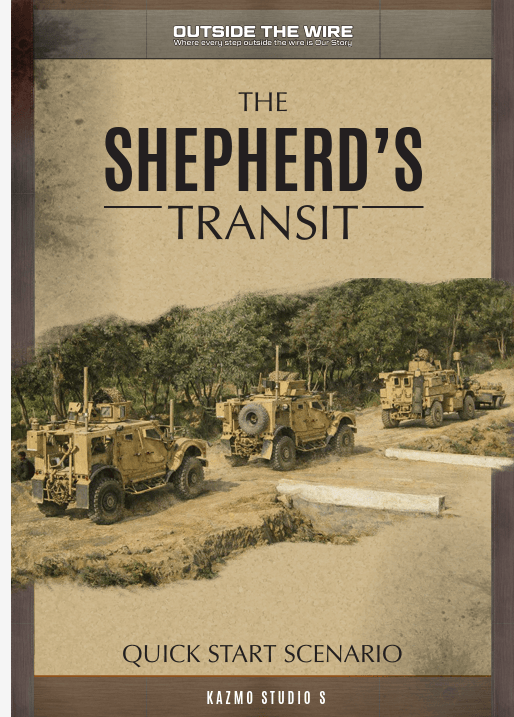
Reading the above my mind went straight to the other military roleplaying game (RPG) that I know so well, Twilight: 2000 from Free League Publishing. After downloading the free Quick Start, The Shepherd’s Transit, I was sure I knew what I was getting into. Looking at the designers biography I was reassured as I saw a kindred spirit:
Outside the Wire is engineered from a foundation of real-world military experience. Kazmo Studios was founded by Derek Roberson, a retired U.S. Marine with 35 years of service.
Derek’s military career spans decades of operations, including combat deployments to Desert Storm, Fallujah, and Marjeh, as well as MEU experience, alongside extensive service across Asia, Central America, and Africa.
After four decades of playing and participating in tabletop RPGs, Derek designed Outside the Wire to capture the tension of modern warfare that traditional games miss. The mechanics reflect the hard truths of the battlefield: intelligence is never perfect, violence has permanent consequences, and the most vital weapon a squad possesses is discipline. The links to gritty realism of Outside the Wire aren’t just a theme; it’s grounded in real experience.
This creative adventure started very much as an RPG based on his 80s love of TW2000, then pulling in pieces that allowed Campaign/Sandbox play from MERC, Recon, and Traveller. Lastly, he built in a Solo play option, to reflect his own experience gaming.
His first Traveller Character was named Kazmo – hence any reference you see about Kazmo Studios.

The more I read Outside the Wire and the quick start scenario, The Shepherd’s Transit, the more I came to realize that this game is very much unlike those previous RPGs I so love and cherish. Unlike…in a good way.
‘Quiet Success’
Thematicaly, Outside the Wire describes itself this way:
Themes & Tone
- Operational tension
Moral ambiguity
Scarcity and risk management
Trust under pressure
Strategic decision-making
The cost of success
Think: Grounded tactical drama meets emergent sandbox storytelling. (Kazmo Studios website)
From a more mechanical perspective, the beginning of The Shepherd’s Transit Quick Start flags that something is different:
WHAT THIS GAME IS
- A modern military role-playing game about decision-making under pressure
- A game where restraint is an active skill
- A campaign where consequences persist
- A system where quiet success matters (p. 2)
“This game is about pressure, not victory. You are not here to defeat the enemy. You are here to manage instability under constraint. Your authority is limited. Your information is incomplete” (p. 2)
As one likely expects in a military RPG, combat is, “fast, lethal, and consequential” (p. 2). Players are part of a military squad that are heavily armed but must exercise restraint. The game self-describes as, “Procedural and pressure-driven’ (p. 3). As The Basics relates:
Tension, pressure, and consequence. This is not a combat-optimization puzzle or a ‘clear the map’ game. The core theme is decision-making under extreme ambiguity, where restraint is an active skill and escalation creates future problems. (p. 3)
The Basics in The Shepherd’s Transit also repeats what one quickly realizes is a mantra for the game: “Quiet success is real success” (p. 2). The Quick Start scenario is a Route Security/VIP Escort mission. The Narrative Context for players ends with this note:
THE ‘QUIET SUCCESS’: Remind your players that if they manage to navigate the route, avoid civilian casualties, de-escalate, and extract the VIP without turning the MSR [Main Supply Route] into a warzone, they have achieved the ultimate victory. If nothing dramatic happens, they did their job. (p. 4)
Ops powered
Outside the Wire is powered by the 2d10 Operations System. The core game mechanism calls for rolling 2d10 +/- a Difficulty Modifier BELOW your Ability Score for a success. Ability scores are a combination of an Attribute (Strength, Agility, Combat Wisdom, and Combat Knowledge) and a Skill level. The die roll modifier is a standard difficulty ladder ranging from “Very Easy: -5” to “Formidable: +10” (p. 8).
The Shepherd’s Transit is designed to be played solo. Think of this game mechanism as the tactical-level of play. As the Kazmo Studios website proclaims, “Outside the Wire utilizes a revolutionary Mission Flowchart system that replaces the Game Master. Enemy Automata follow logical, tactical decision paths—if suppressed, they retreat; if cornered, they escalate.” The solo adventure The Shepherd’s Transit has a Game Progression Chart to step the squad through the mission. A solo variant is called the “Sunlight Clock & AI” which is designed to pressure players without the need for strict time tracking.
The tactical action in The Shepherd’s Transit takes place within a larger operational context. In the Outside the Wire game system that is called the Sandbox Campaign System. Here the gamemaster (GM) is called upon to, “manage a living ecosystem of pressure, politics, and violence” (p. 6). That ecosystem is shown using three tracks; Local Trust, Insurgent Activity, and Command Confidence. Different player decisions affect different tracks. For example, “Stop for civilians” has a +1 effect on the Local Trust track because the players are, “Validating local populace.” If they “Ignore civilians”, however, it moves the Local Trust track by -1 because they, “delegitimize presence” (p. 7).
The Kazmo Studios webpage describes the campaign game this way:
A dynamic deployment engine where the theater of war reacts to your command. This isn’t a linear storyline; it’s a living sandbox defined by consequence-driven play. Every choice leaves permanent fallout. Leveling a compound to save your squad today might cost you the intelligence network you need to survive tomorrow. Manage your logistics, monitor shifting regional stability, manage local force developments, and outlast an enemy that adapts to your tactics as the deployment clock relentlessly ticks down. (Kazmo Studios webpage)
In the longer run (beyond The Shepherd’s Transit Quick Start) the Sandbox campaign system leads to…a campaign:
While sessions are fun, Outside the Wire links tactical sessions into deployment campaigns. The standard deployment is 12 weeks, with intel, logistics, and tactical operations all linked together. A weekly battle rhythm drives campaign play.
The deployment goal is to stabilize the region by winning local trust, building local forces, and reducing the insurgent activities.
Players create characters, create their sandbox (fictional or real), and deploy! (Kazmo Studios webpage)
Shepherd’s way
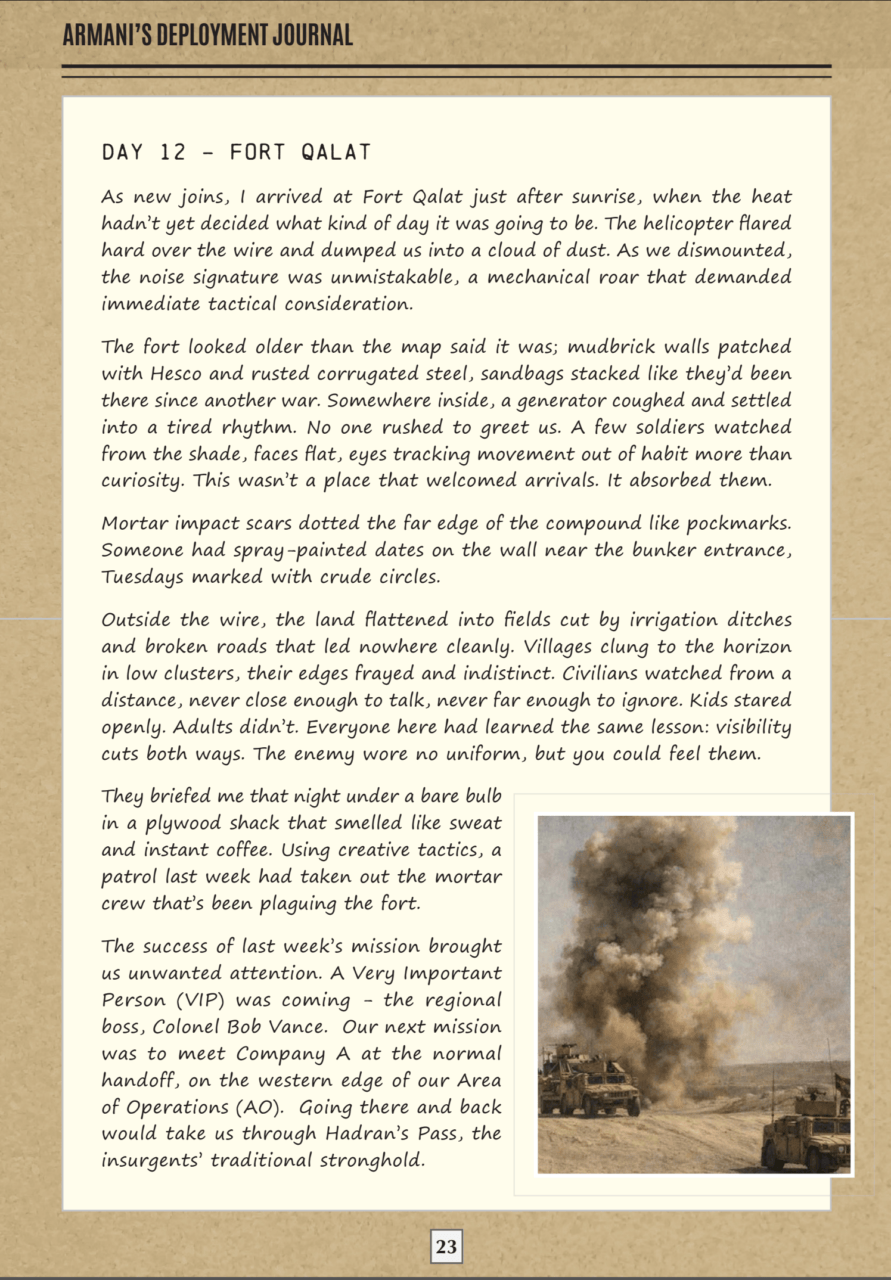
The Shepherd’s Transit Quick Start is a combination of rules (solo included), area background, and adventure/mission. The included mission takes place around a location known as Fort Qalat. This is clearly an Afghanistan setting. The sample mission is “Route Security/VIP Escort” which calls for a patrol to insert a sniper overwatch team, pick up a VIP, recover the sniper team, and return to base. A full pre-generated squad is provided. A solo player will take on the viewpoint of different squad members at different times depending on the situation. If you want to create your own character, Kazmo Studios offers an online Character Generation app.
The moral of the story…
Reading the post-mission debrief questions for The Shepherd’s Transit makes me wonder if this game started out as a training aid. [Redactions below are my own to preserve GM-only information.]
GM NOTES – WHY THIS WORKS
- The [redacted] dilemma is not a trap; it is a profound element of reality reflecting real world complexities.
- The mission can succeed and still feel wrong, underscoring the moral ambiguity of authentic military engagements.
- Quiet success is real success, highlighting the understated victories that often define true-life operations.
- Escalation solves today and ruins tomorrow, a truth supported by historical and contemporary conflicts.
- [Redacted] (p. 42)
Those notes lead into debrief questions for the player(s):
SAMPLE DEBRIEF QUESTIONS
- How did the decisions during the scenario reflect your personal values, and how might those decisions differ in a real-life context?
- What were the most challenging aspects of the mission, and how did your team address them?
- How do you think the presence of civilians in conflict zones affects military operations, and what parallels can your draw with real-world situations? (p. 42)
This is where it (finally) dawned on me that Outside the Wire is not a roleplaying game placing players into combat, but a roleplaying game that explores moral injury.
Some events that are very stressful or traumatic violate deeply held morals or values. These events can lead to moral injury. When you have moral injury, feelings such as guilt, shame, betrayal and anger are common. If you also have PTSD [Post Traumatic Stress Syndrome], symptoms may be more severe. (Moral Injury and PTSD, Department of Veterans Affairs (VA))
The VA page continues:
Who Might Be at Risk for Moral Injury?
Anyone who experiences a potentially morally injurious event may be at risk for moral injury. The event could be something a person actively takes part in, fails to prevent, or witnesses.
War and combat can put combatants into situations where they have experiences that go against the values they live by in civilian life. Examples of war events that may lead to moral injury include:
- Killing or harming others
- Making decisions that affect the survival of others
- Being unable to care for all who were harmed
- Freezing or failing to perform a duty during a dangerous or traumatic event (for example, falling asleep on patrol)
- Failing to report an event that violates rules
- Engaging in or witnessing acts of over-the-top violence
- Feeling nothing or excitement while causing harm or killing others
Outside the Wire an important RPG. Not only does this game focus less on shooting—and more on ‘Quiet Success’—but the designer also seems to be going to great pains to ensure that players understand and engage with in a serious manner with moral injury.
The real challenge from Outside the Wire is not deciding to play this game or not (you absolutely should) but to play it in the right setting with the right players. Although The Shepherd’s Transit outwardly looks like a convention game scenario I cannot trust that every player that walks up and sits down to play has the proper moral compass to engage with the themes underpinning Outside the Wire. Perhaps that is why Derek invested so much in the solo game rules. That makes playing Outside the Wire intensely personal and deeply introspective which in turn makes it one of the most important RPGs on the market today (and virtually guarantees it will be overlooked by the “named” awards regardless of how “progressive” they claim to be).
Outside the Wire is coming to Kickstarter in September (pre-launch page here). I will be supporting…will you?
[Feature image courtesy Kazmo Studios.]
Thank you for visiting the Regiment of Strategy Gaming and riding with The Armchair Dragoons.
Rather than list a bunch of social media links, the easiest thing to do is to check out our LinkTree, which connects you to all of our various locales around the web.
You can also support The Armchair Dragoons through our Patreon, and find us at a variety of conventions and other events.
Feel free to talk back to us either in our discussion forum, or in the comments below.


