
 by
by RockyMountainNavy, 30 July 2025
“Immerse yourself in the high-stakes world of emergency management with Emergency Operations Center. Step into the shoes of critical roles like the Fire Department, Police, Emergency Management, Public Health & Medical, Transportation, Utilities, and more. Together, you’ll tackle real-life challenges inspired by the 2012 Waldo Canyon Fire disaster.” (Emergency Operations Center (EOC), Kickstarter)
I remember the Waldo Canyon Fire. At that time (June 2012) I was a geo-bachelor on the East Coast of the U.S. with the family living in Colorado Springs. I anxiously watched the news reports and tracked the fire which, thankfully, did not directly threaten our house. It did, however, cause over 32,000 evacuations, the loss of 18,247 acres, the destruction of 347 homes, and two deaths. A year later in June 2013 another wildfire, this time in the Black Forest—and much closer to our house—destroyed over 500 homes, burned over 14,000 acres, and again tragically claimed two lives. So to say that I have a vested personal interest in wildfires in Colorado Springs is a bit of an understatement. So when I saw a Kickstarter campaign in November 2024 for Emergency Operations Center: Wildfire Mayhem I pledged my support.
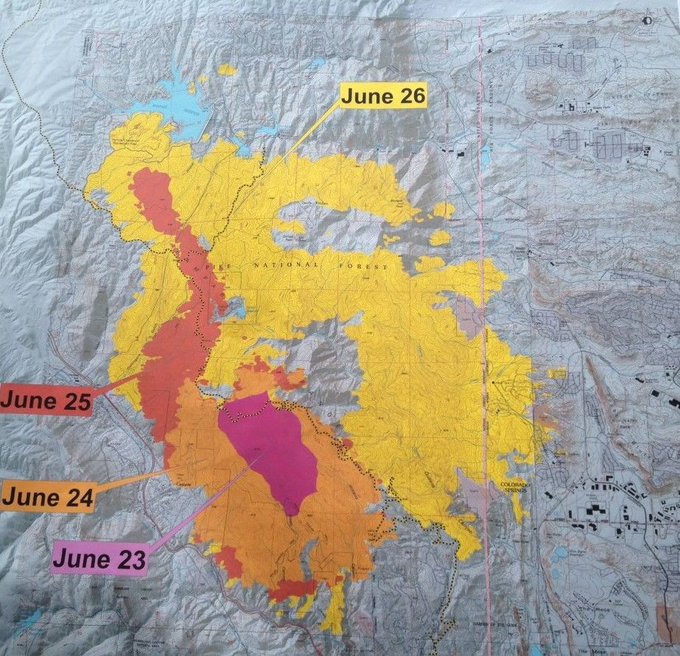
click images to enlarge

Delivered through Kickstarter in July 2025, Emergency Operations Center: Wildfire Mayhem touts itself as, “A Team-Based Disaster Response Strategy Game.” According other the designer’s LinkedIn page, Arthur J. Simental is a Career Certified Emergency Manager, Professor, Researcher, and Consultant who was previously a Volunteer Fire Fighter that deployed to numerous emergencies and disasters including the Waldo Canyon Fire. He has never before published a wargame. Simental, in the form of his company, Simental Industries, sponsors the website emdisastergaming.com to support their game.
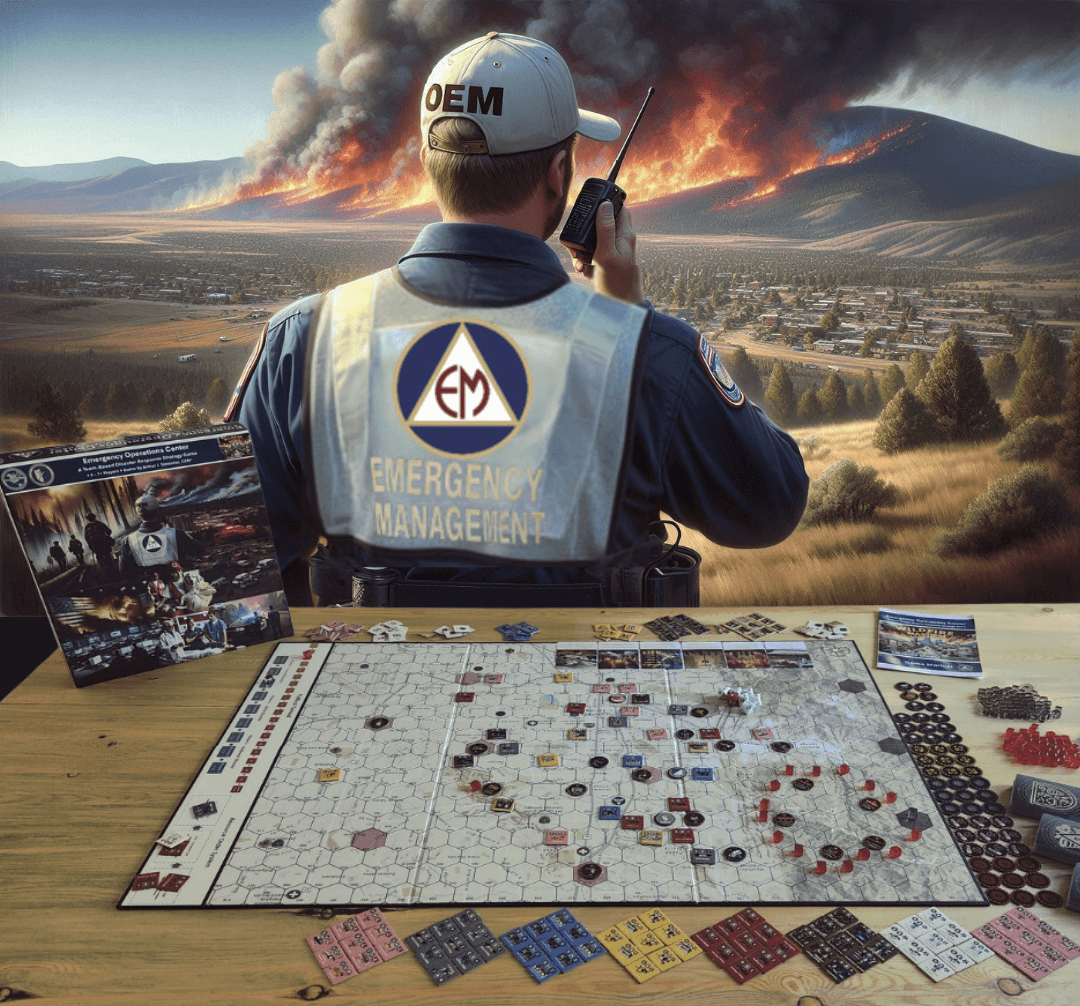
With Emergency Operations Center Simental embarked on a noble self-declared mission:
I created this game to help prepare and educate communities for future emergencies and disasters so they can learn in a creative way how disaster response works. I’ve also created this game so that First Responders, Emergency Managers, and Disaster Workers can use this as an opportunity for more immersive and engaging training and education. I hope to challenge them to critically think, strategize, communicate, cooperate, and better plan for disasters through this tabletop exercise. (EOC Kickstarter)
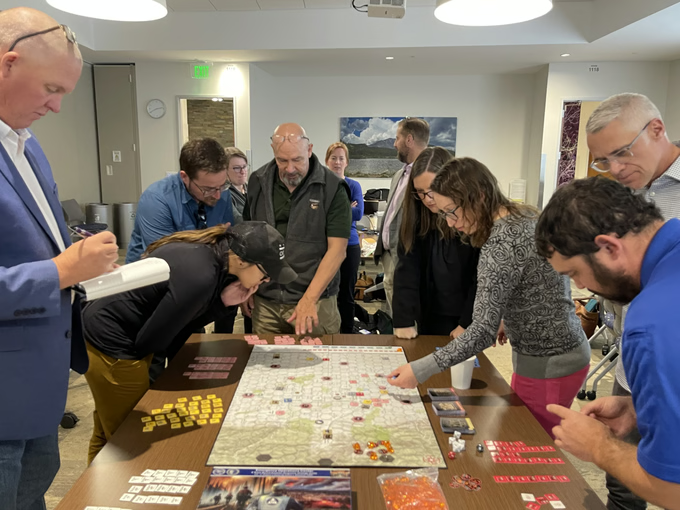
Simental chose to use a wargame to reach his objectives for reasons presented in the Kickstarter campaign:
Wargaming has been used famously by the military and defense community since the early 19th century as a way to prepare for and understand the impacts and consequences of war. This is a practice that I hope to adapt and am bringing for the first time to the homeland security & emergency management community in an affordable and readily available way so that we can better safeguard the nation, communities, and families across all mission areas – prevention, protection, mitigation, preparedness, response, and recovery to achieve readiness for disasters and ultimately resilience. (EOC Kickstarter)
What is a wargame?
The question of, “What is a wargame?” inevitably spawns endless, fruitless debates. Simental’s definition, delivered in the Preface of the Game Manual for Emergency Operations Center, is this:
Wargames simulate aspects of an environment at the tactical, operational, or strategic level, often for analytical or educational purposes. By nature, wargames are tools to explore human-decision making and the factors that influence those decisions through a series of actions and reactions. Wargames artificially simplify the complex and dynamic nature of a simulated environment to allow players to better understand one or more aspects of it. (Game Manual, Preface)
Note how Simental does not cite “entertainment” as a reason for the game instead talking of “educate,” “learn in a creative way,” “simulate aspects,” and “explore human-decision making.” Simental clearly designed Emergency Operations Center to educate using the medium of a wargame. In the Game Manual Preface, Simental describes how wargaming can help educate on disaster management:
Wargaming can also be applied to homeland security, emergency & disaster management to understand decision-making, policy, crisis and consequence management, and challenges with humanitarian response. Wargaming allows for deep immersion into problems far beyond traditional Tabletop exercises. The wargaming term for “traditional” tabletop exercise most commonly used in emergency management is BOGSTAT, “Bunch of Guys Sitting Around a Table” (AKA HSEEP [Homeland Security Exercise Evaluation Program] Tabletop Exercise). These are seminars and discussion-based events with little adjudication. This wargame is a Board/Map/Hex wargame where the physical representation of terrain and the movement of representative forces is along a hexagonal grid. Players interact with the board/map through units. (Game Manual, Preface)
From the definitions presented it is clear that, though a first-time (amateur?) wargame designer, Simental strives to be a wargame practitioner or what some call a ‘professional wargamer.’ When looking at Emergency Operations Center I feel it is important to judge the game from an “amateur goes pro” perspective, i.e. just how well does this first-time designer deliver on a game that is not necessarily for entertainment but instead intended for training and education.

Managing Mayhem
Emergency Management is all about being prepared. If you take the Federal Emergency Management Agency (FEMA) introductory course for Emergency Management, like my wife did for her job (meaning I also took the course to “support” her), one discovers that the Emergency Management planning process is basically the military Joint Planning process with the military terminology adjusted to “civ-speak.” A foundational tenet of Emergency Management is that when there is little pre-planning for an emergency the ability to improvise becomes exceedingly important. At the same time, even a modest level of preparedness makes a difference and enhances improvisation. Educating in support of that foundational tenet appears to be the underlying basis for Emergency Operations Center.

To help players (trainees?) learn more about Emergency Management, Emergency Operations Center combines a variety of game mechanisms. Some of the game mechanisms assembled are usually associated with hex & counter wargames but other game mechanisms go beyond that classic framework. Some game elements, such as a hex map and units which are described in terms of Strength-Defense-Movement factors, are admittedly very classic wargame-like. Emergency Operations Center, however, does not end there and employs several other game mechanisms that some might not automatically associate with wargames.
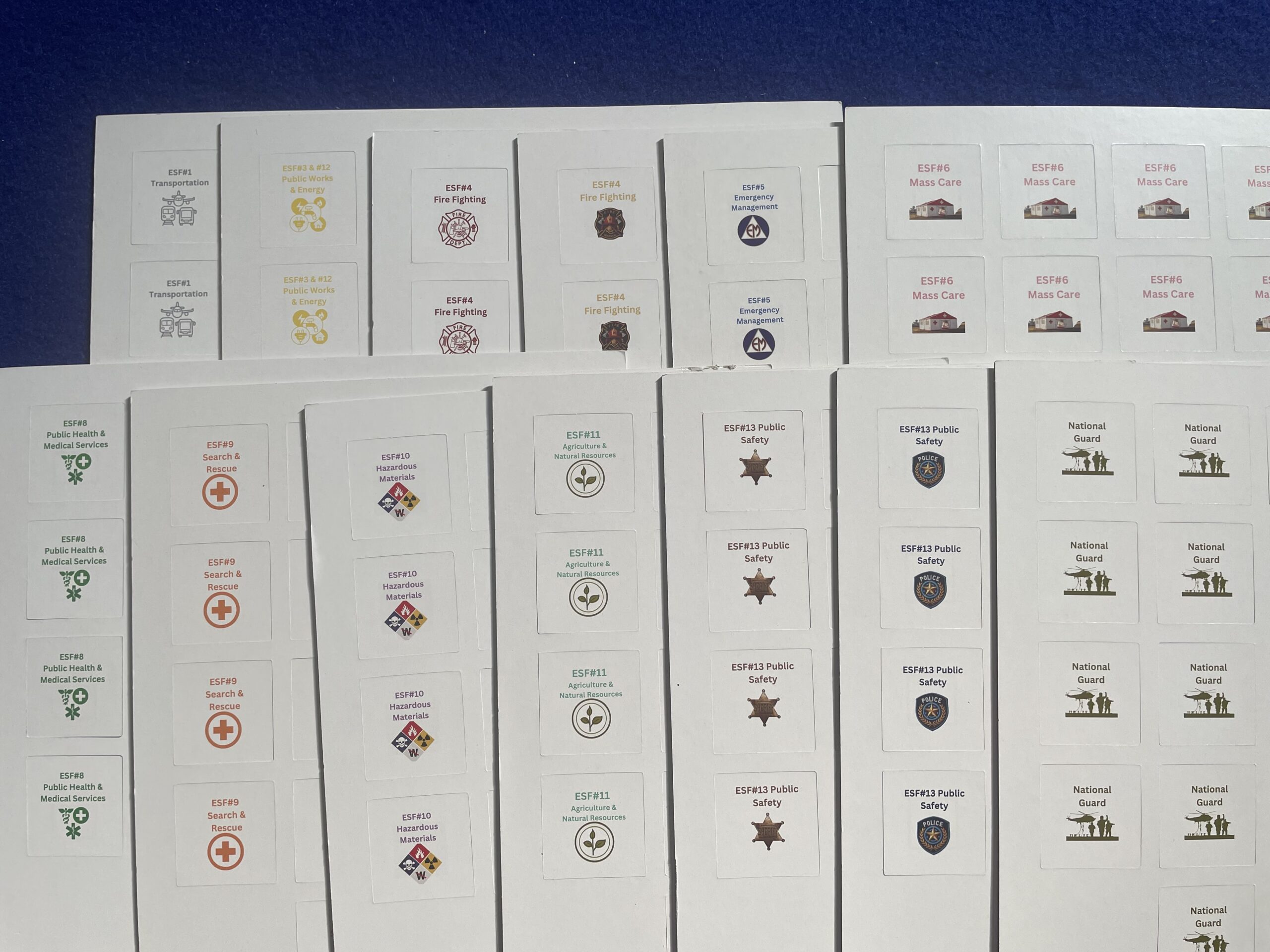
Players in Emergency Operations Center represent different stakeholders in a disaster to include Emergency Management, Public Safety, Fire Fighting, Public Health & Medical, Public Works & Energy, Mass Care, and Transportation. Emergency Operations Center can be played solo or by multiple player.
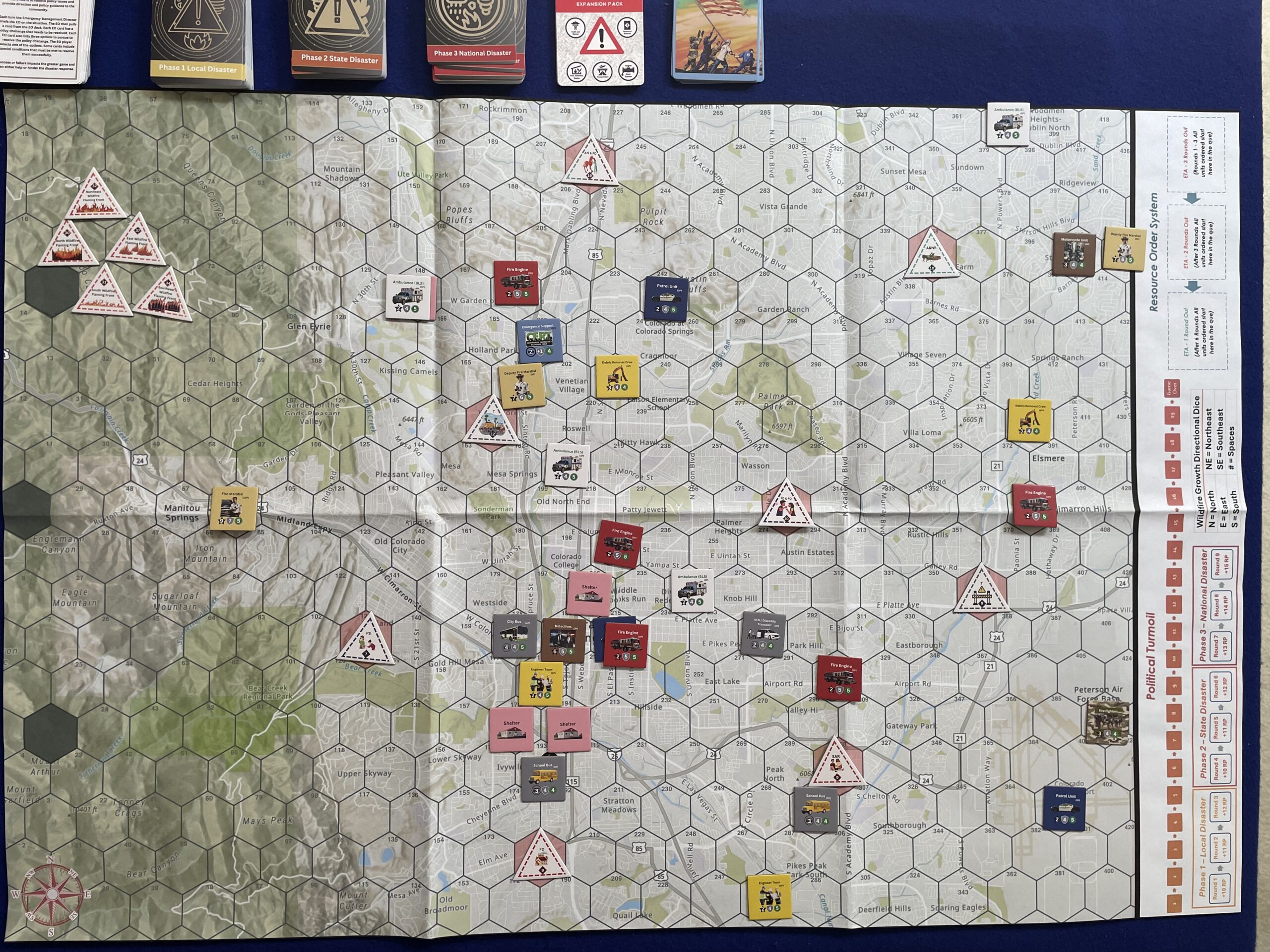
Every turn of Emergency Operations Center challenges players to “ORIENT, DECIDE, ACT”:
Players must orient and analyze the situation, develop a plan of action and decide what to do with their resources, and then implement that plan and act. Each round players take turns using their units to respond and react to the situation. Each unit the player has gets 1 movement and 1 action per turn. Action points are used to attempt to resolve crises on the board with player units by rolling the dice to overcome the crisis strength value. (EOC Kickstarter)

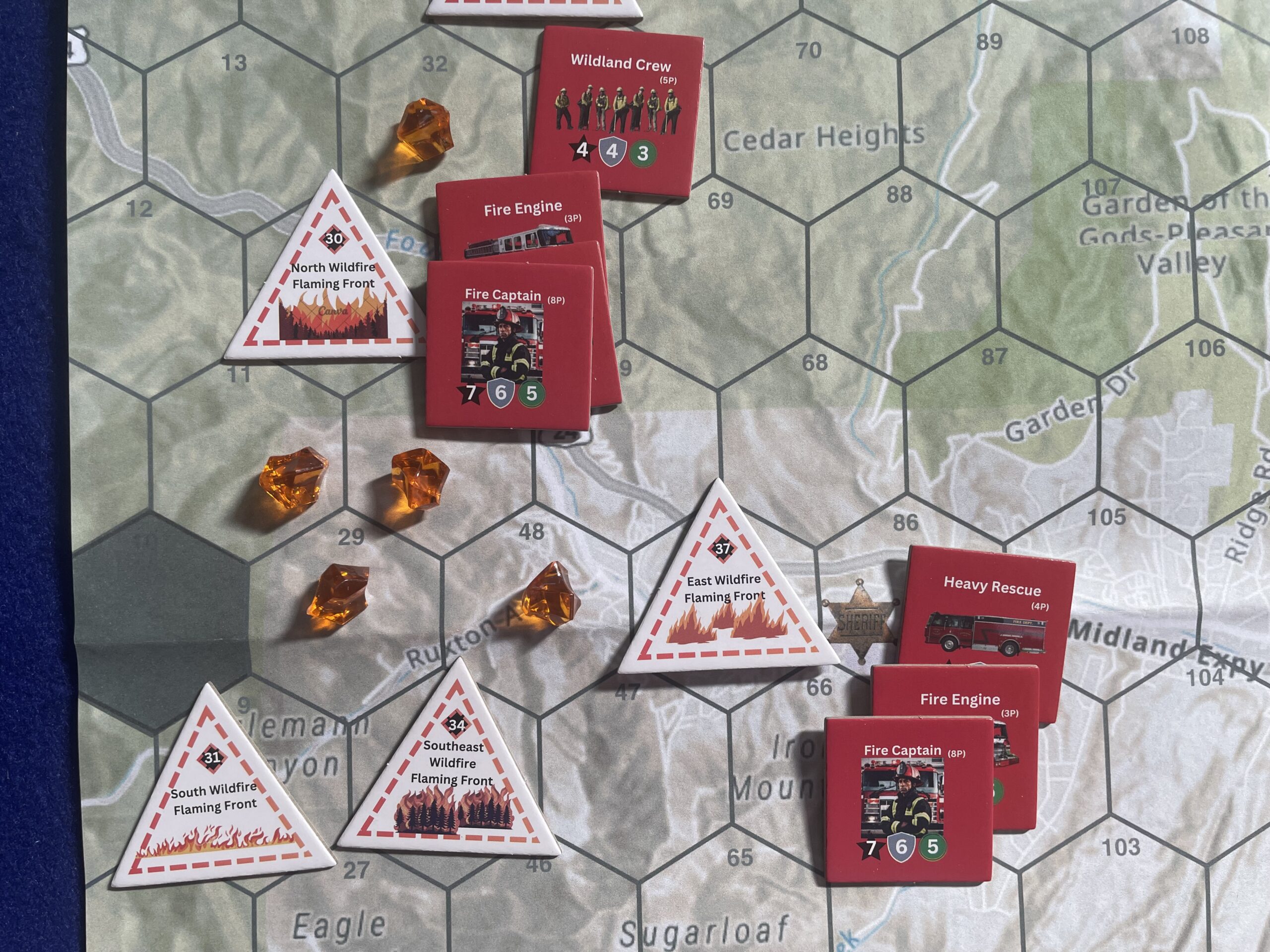
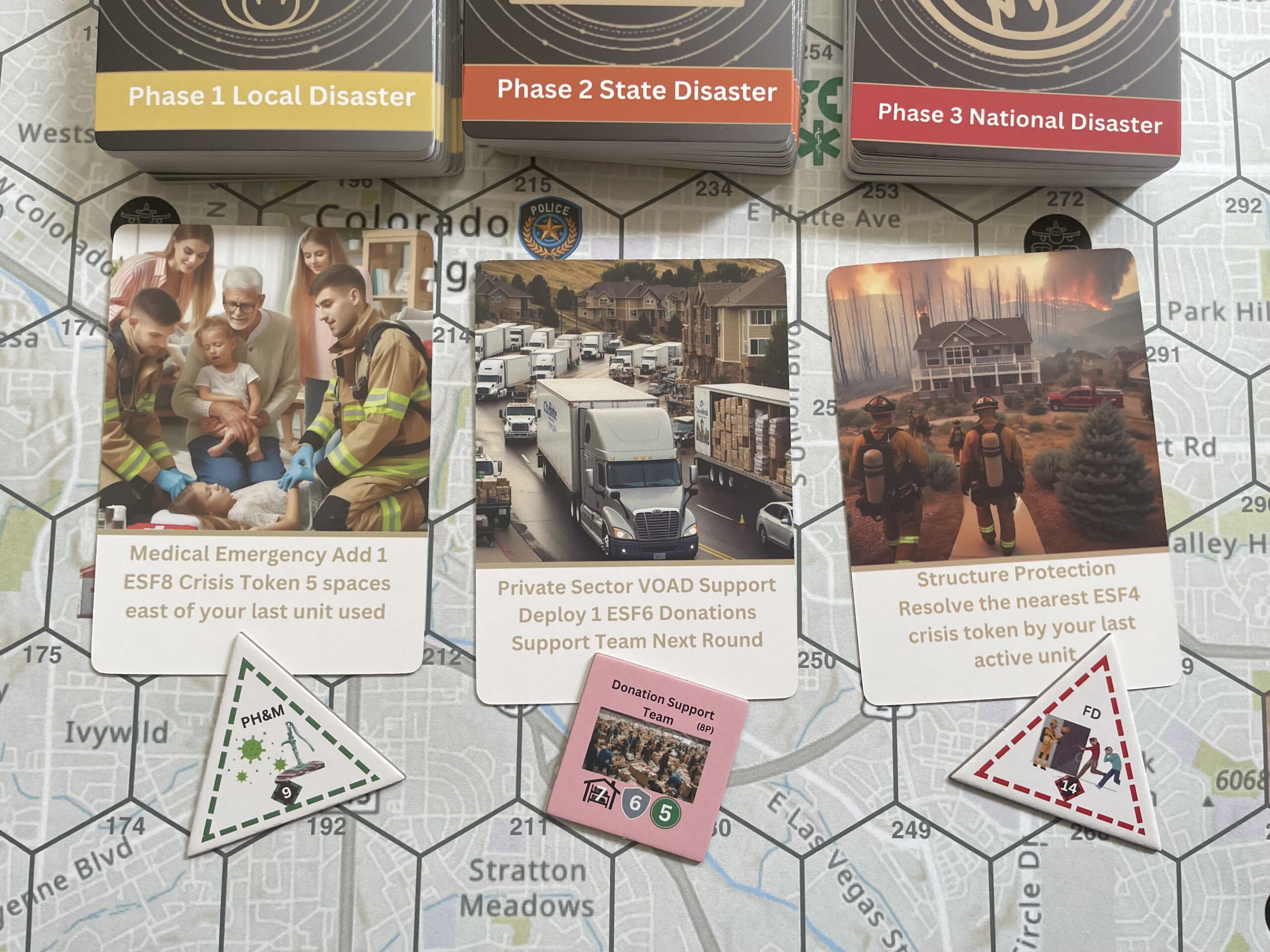
The disaster in Emergency Operations Center: Wildfire Mayhem is depicted in two forms; Wildfire Flaming Fronts and Crisis Tokens. Fighting the wildfire requires players to deal with the flanks of the fire to keep it from spreading. At the same time, there are other crisis across the area shown by Crisis Tokens. Responders must deal with the fire but often get are “called away” to deal with the other crises in the area.
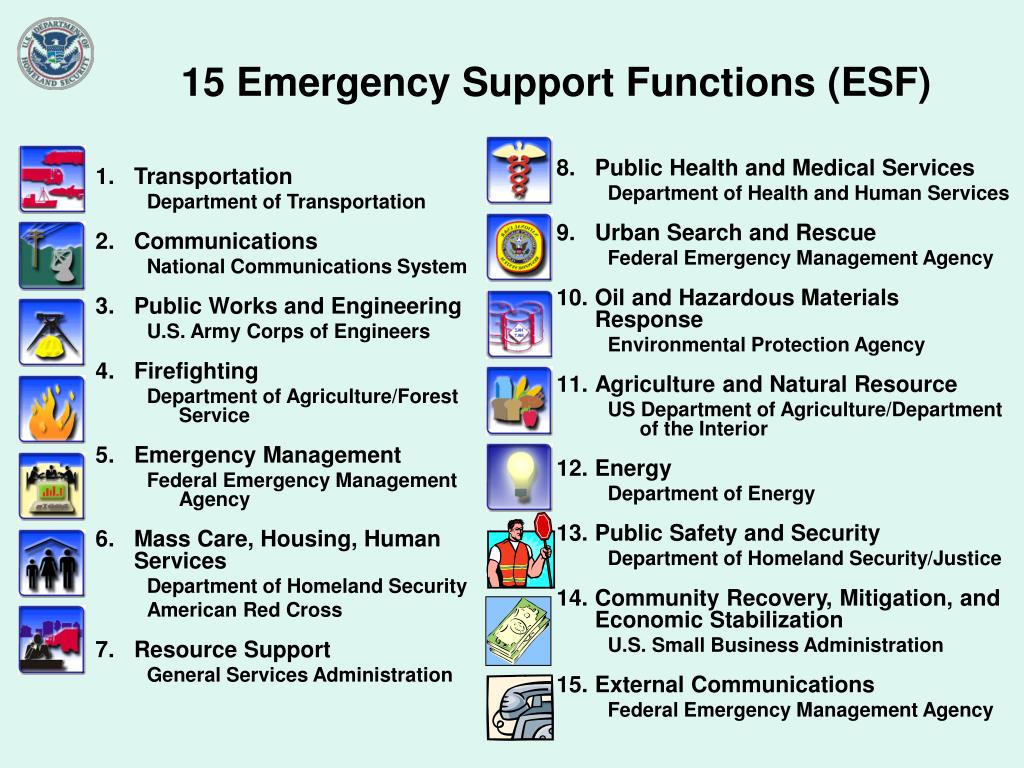
To deal with the wildfire or a Crisis Token not only must enough strength be brought to bear but the right type of Strength is required. Different Crisis Tokens are best handled by different “specialties” or units from particular agencies (in game terms the right mix of Emergency Support Functions – ESF). In more than a few cases a mix of ESF works best; i.e. a ‘combined arms’ approach. Units assigned to a Crisis that are not of the optimal ESF type only contribute half-strength. On top of those restrictions, a single Task Force is limited to a leader plus seven units which effectively serves as a ‘stacking limit’ in a hex which also neatly simulates limitations of command and control.
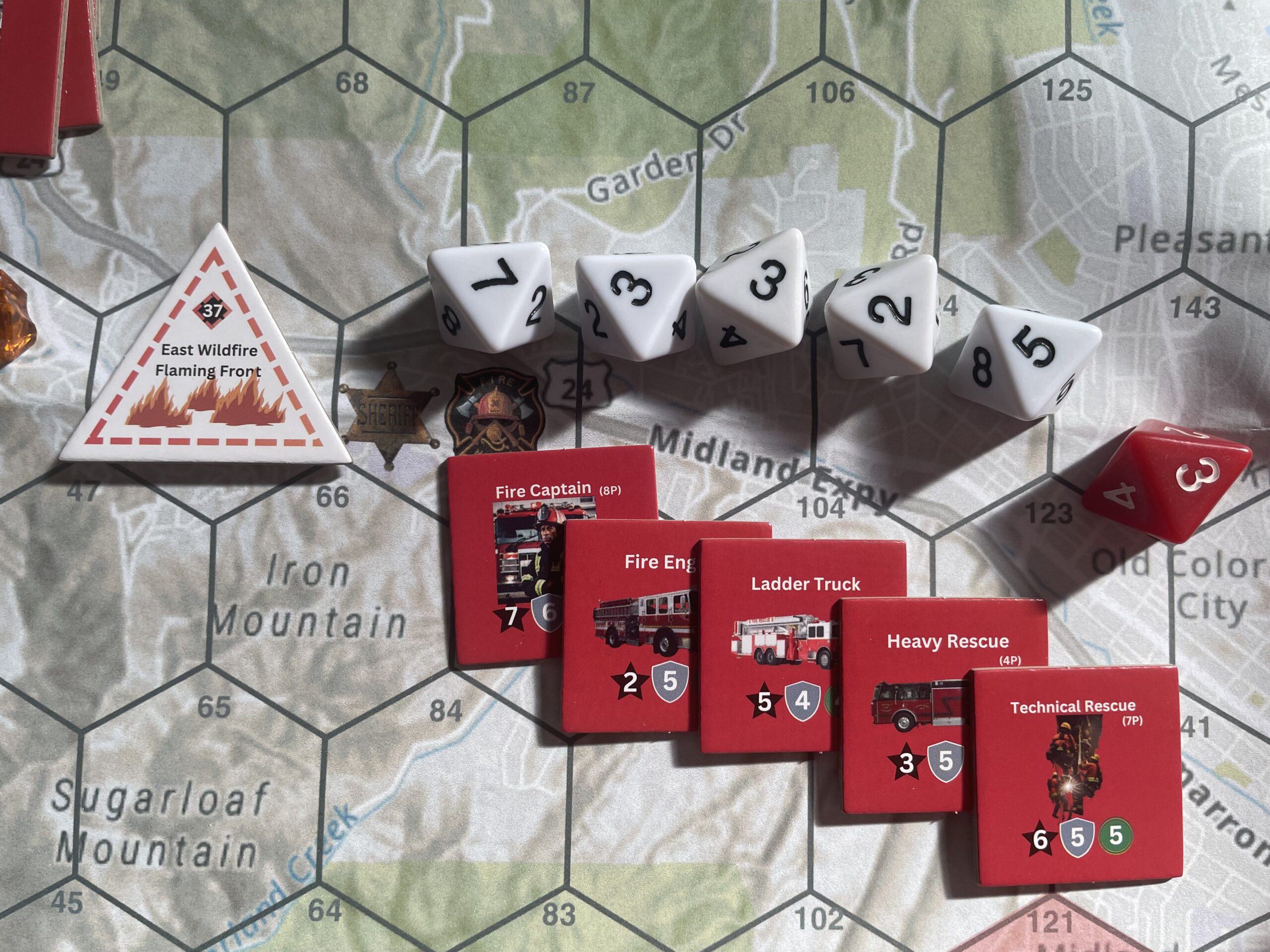
To “resolve” a crisis one needs to bring Units and/or Resources to bear. Each token has a Crisis Strength value. Resolving a Crisis Token uses a dice pool mechanism where players roll a white d8 for each Unit and adds the Strength points in the responder stack. The combined roll must exceed the Crisis Strength value to resolve the Crisis. For every Crisis roll, however, players must also roll a single red d8 that could result in your units being “exhausted” and out of action for the next turn.
Resources are an important element of Emergency Operations Center. Again, the Kickstarter page explains:
Players start the game with limited resources and overwhelming crises causing them to make tough decisions. The wildfire is all consuming and will destroy the community and crisis tokens —if not resolved quickly—can also devour player units if you’re not careful! Each loss raises political turmoil which represents the public’s trust and community leadership’s faith in you or your team’s ability to successfully manage the disaster. Too many losses and its game over! You must also prevent the fire from destroying key city locations… (EOC Kickstarter with a slight edit)
The resource rules in Emergency Operations Center are depicted in the game using a Support, Resource Ordering & Round Tracking game mechanism. Every turn the player in the Emergency Manager role gets Resource Points (RP) to spend on new units. Different units, of course, cost different RP. The time it takes for the units to arrive also changes; at the beginning of a disaster when most resources are local it takes three turns for reinforcements to arrive. By the late game, National-level Resources are available and new assets arrive the next round.

Having the right resource on hand is a vital part of planning and play of Emergency Operations Center. Different Crisis Tokens need specific resources to be used to resolve it. Level 1 Crisis Tokens can be dealt with by any type of unit but Level 2 Crisis Tokens often need the right combination of resources. Level 3, or Major Incident Crisis Tokens, not only require different combinations of units but often specific units to be assigned. Level 3 Crisis Tokens also require multiple resolve actions meaning they tie up many units and take time to resolve.
Buried in the description above is an important element of Emergency Operations Center that I enjoy: success keeps the pubic trust but failure risks losing political support. To win a game of Emergency Operations Center: Wildfire Mayhem the players must ensure the wildfire is completely resolved. There are, however, three other ways to lose:
-
- The wildfire overruns the Emergency Operations Center.
- The wildfire overruns a Mass Care Shelter.
- Political Turmoil reaches 20 on the political turmoil track.
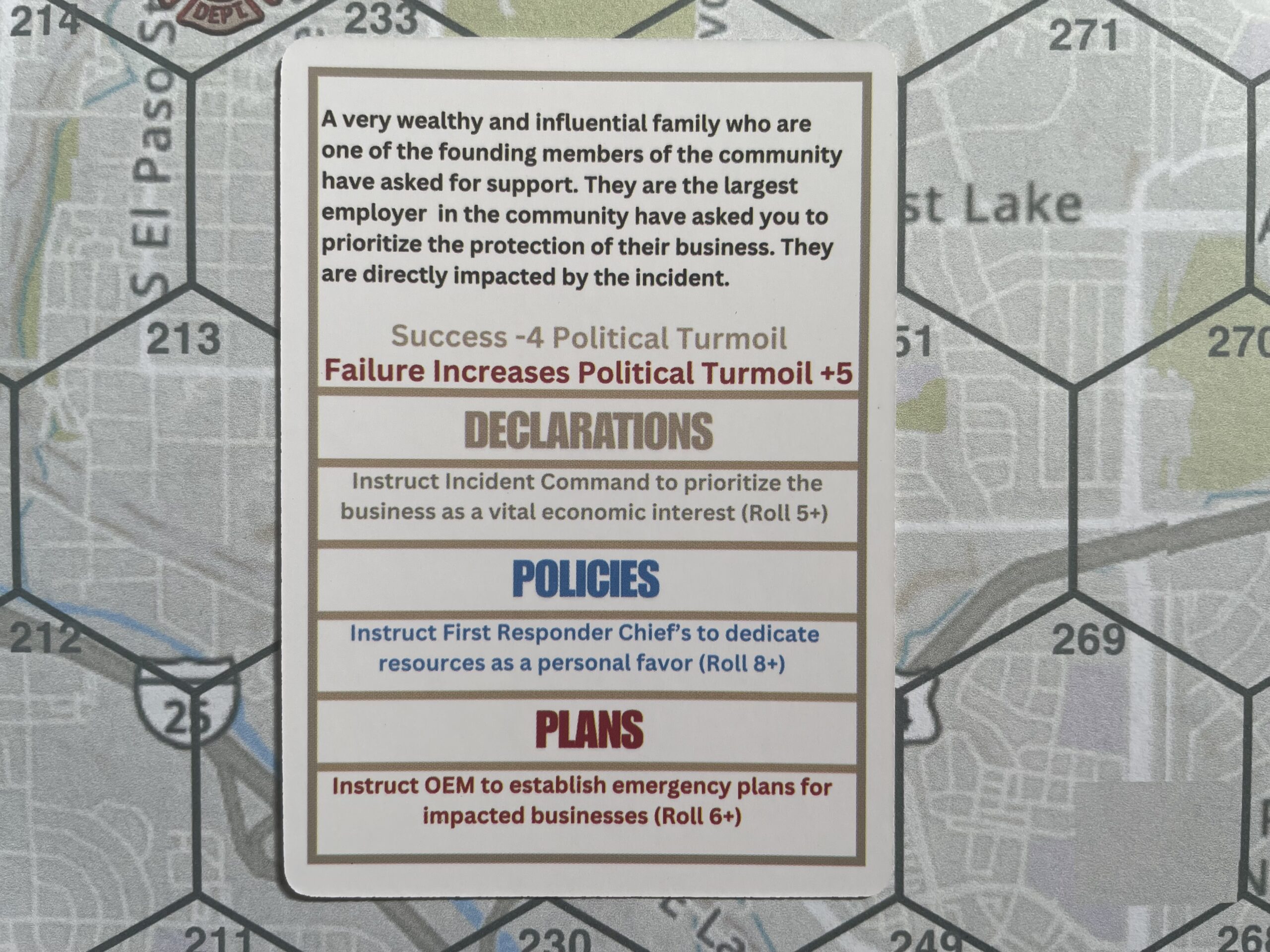
The Political Turmoil Track is a game element I certainly was not expecting to find in Emergency Operations Center: Wildfire Mayhem but once I realized it was there it seemed so intuitive to include it in the game. The chaos and, uh, mayhem of a major crisis brings out the best—and worst—in organizations and people. Different events such as mass evacuations drive up the Political Tension track while other events like a press briefing may reduce it. My Ultimate Edition pledge1 includes the Elected Official Card Game which adds background political challenges. Frankly, looking at the list of political challenges these may be the most “realistic” depictions in the game.
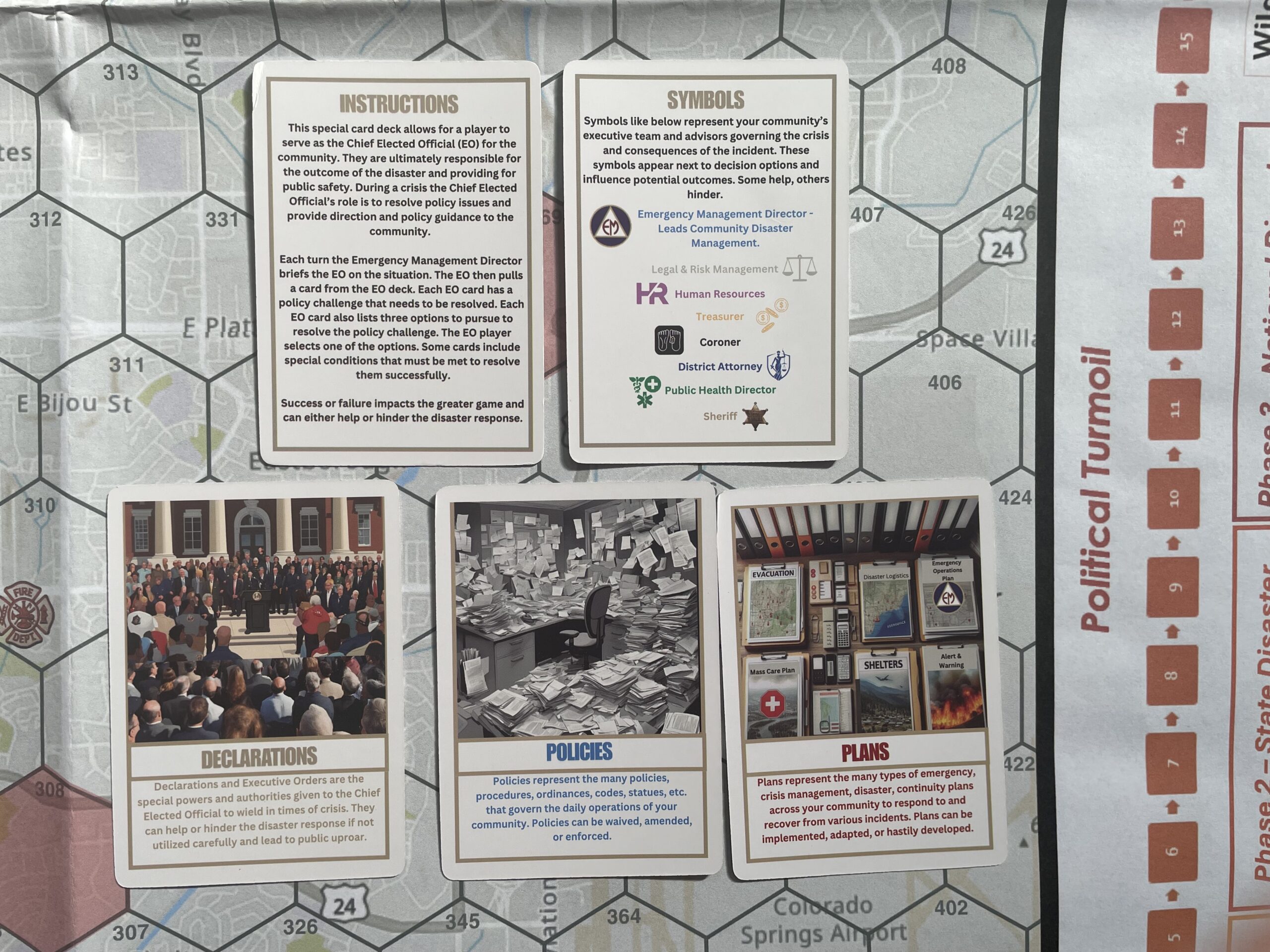
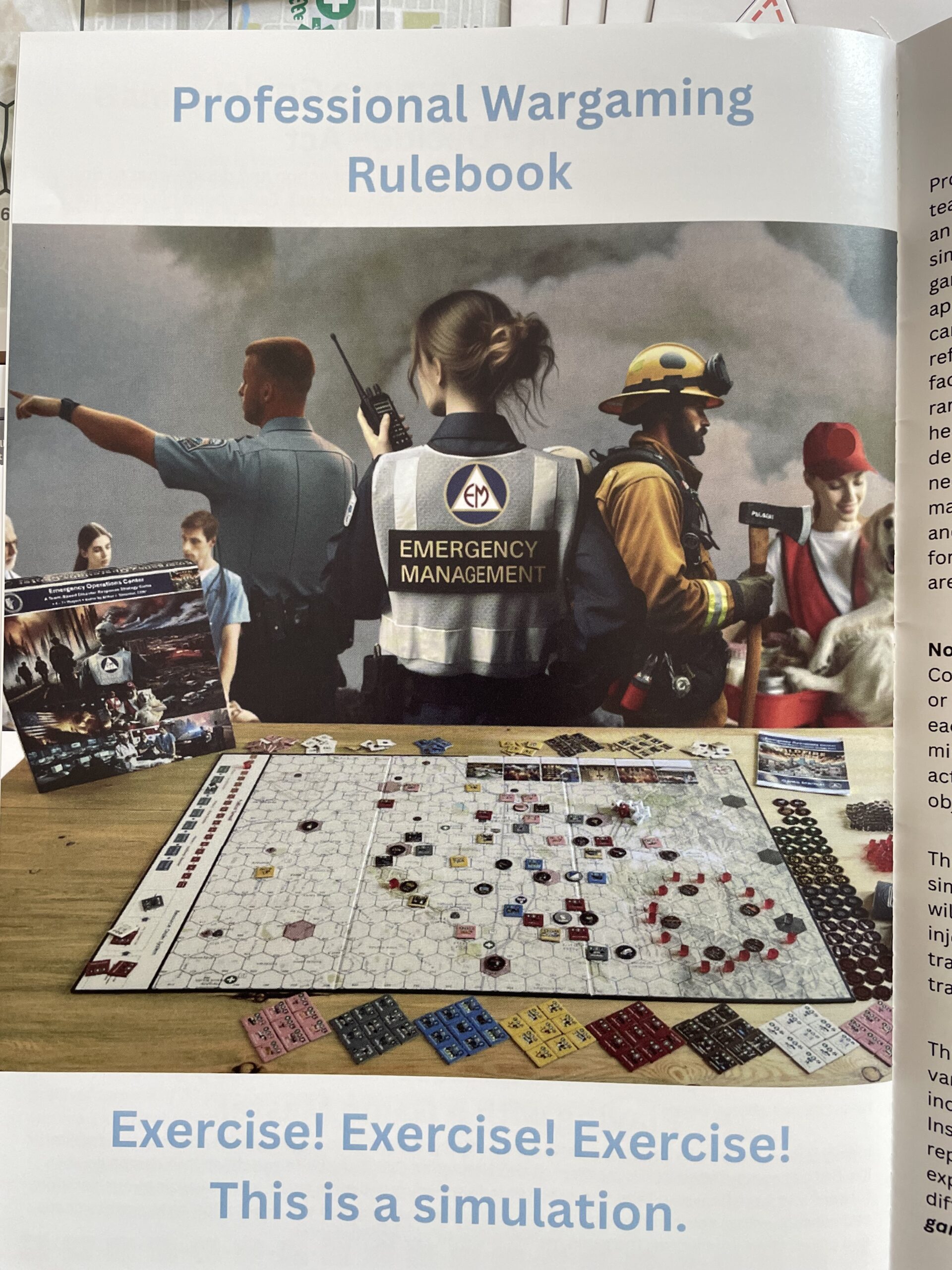
The rulebook for Emergency Operations Center also clearly shows the emphasis on eduction and training. After spending the first 12 pages explaining the rules of play the next three pages are devoted to a “Professional Wargaming Handbook.” In this Handbook are rules for:
-
- Professional Wargame Set-up – How to run Emergency Operations Center with a facilitator.
- ICS [Incident Command System] Training – Focused on Command or General Staff (as in incident workers) looking at planning cycles and tactical responses.
- Wargame TTX [Table Top Exercise] – Simulates the interface between an Incident Command Staff and the Emergency Operations Center or explore plans and policy.
Pro-am
Emergency Operations Center: Wildfire Mayhem is not a game without some issues. The major issues I have with the game revolve around the components.
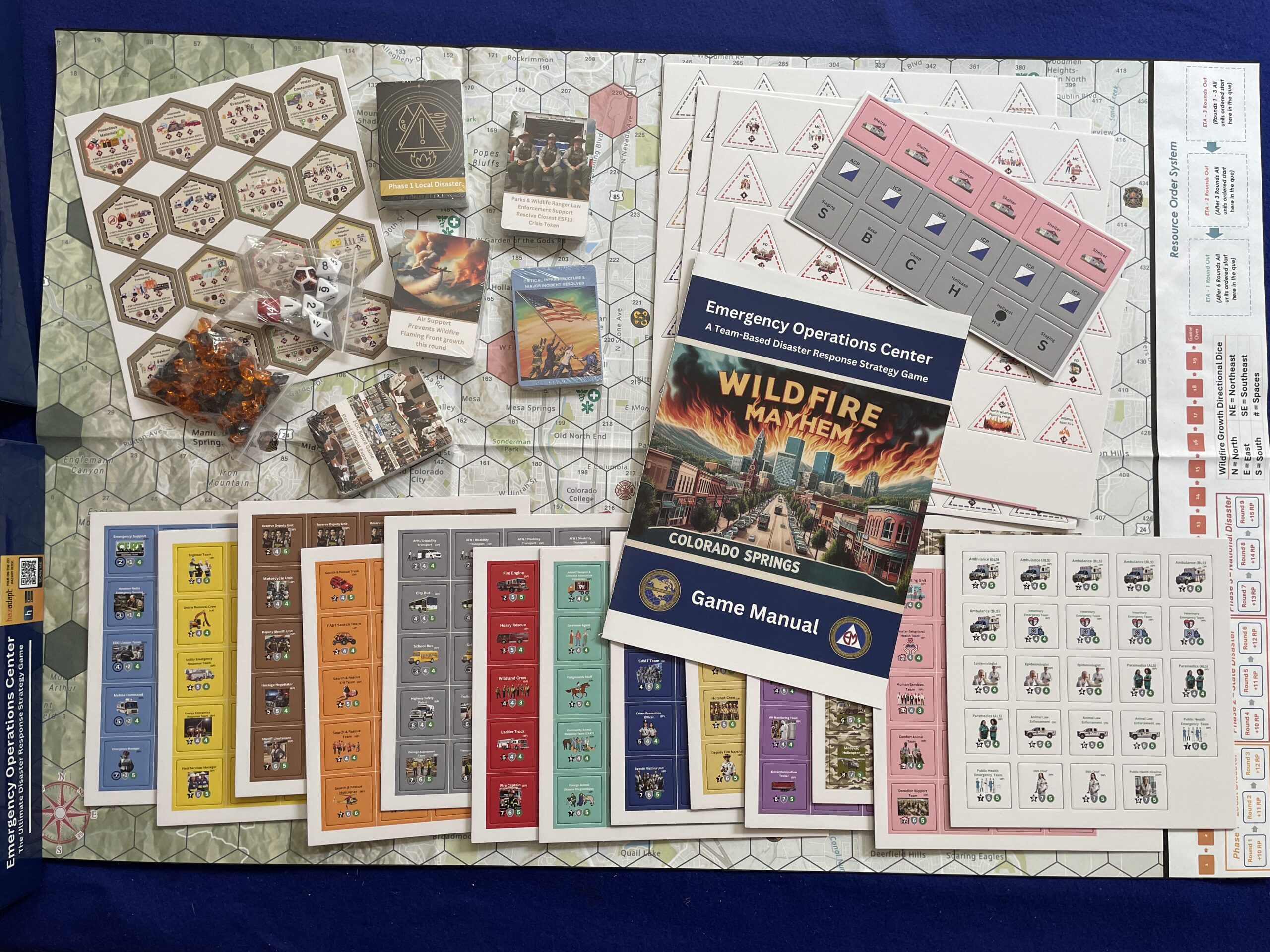
The first component challenge in Emergency Operations Center is the map. The map is printed on standard, if not a bit thin, paper. Avoiding damage to the map requires constant effort and attention. Fortunately I have large sheet protectors that the map can be inserted into that not only protect the map but to make it more durable. Simental sells a mounted mapboard if desired. They also make a digital file of the map available so that one can print their own copy—on better paper—if required.
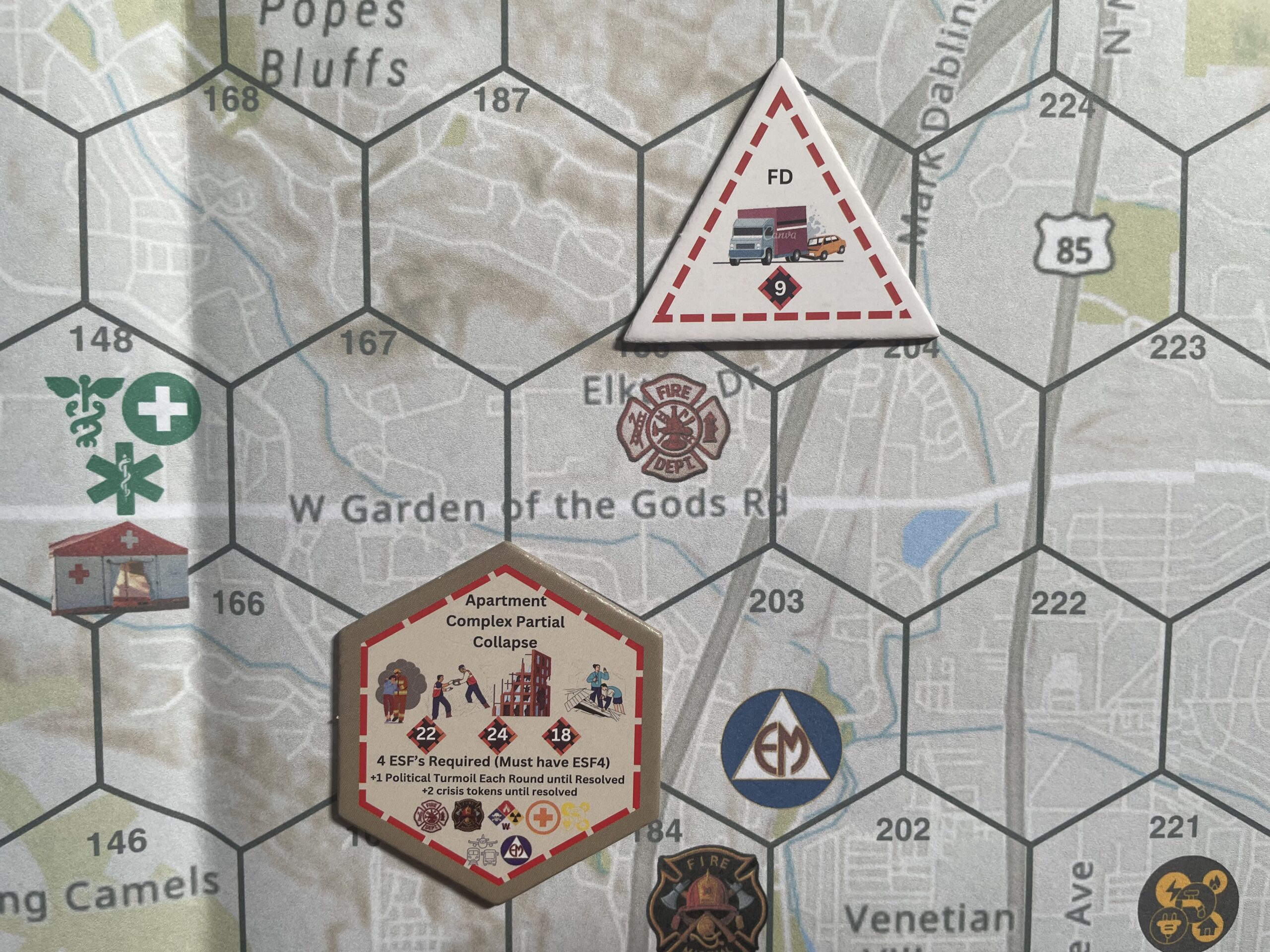
Second, the Crisis Tokens for Emergency Operations Center: Wildfire Mayhem are larger than the hexes of the map. A minor inconvenience but it can cause problems as units converge or neighboring hexes are occupied. The text on Crisis Tokens is already small (and crowded) so making the Tokens smaller is counter-productive. The issues with the Crisis Tokens are not a show-stopper event but it is a bit inconvenient.
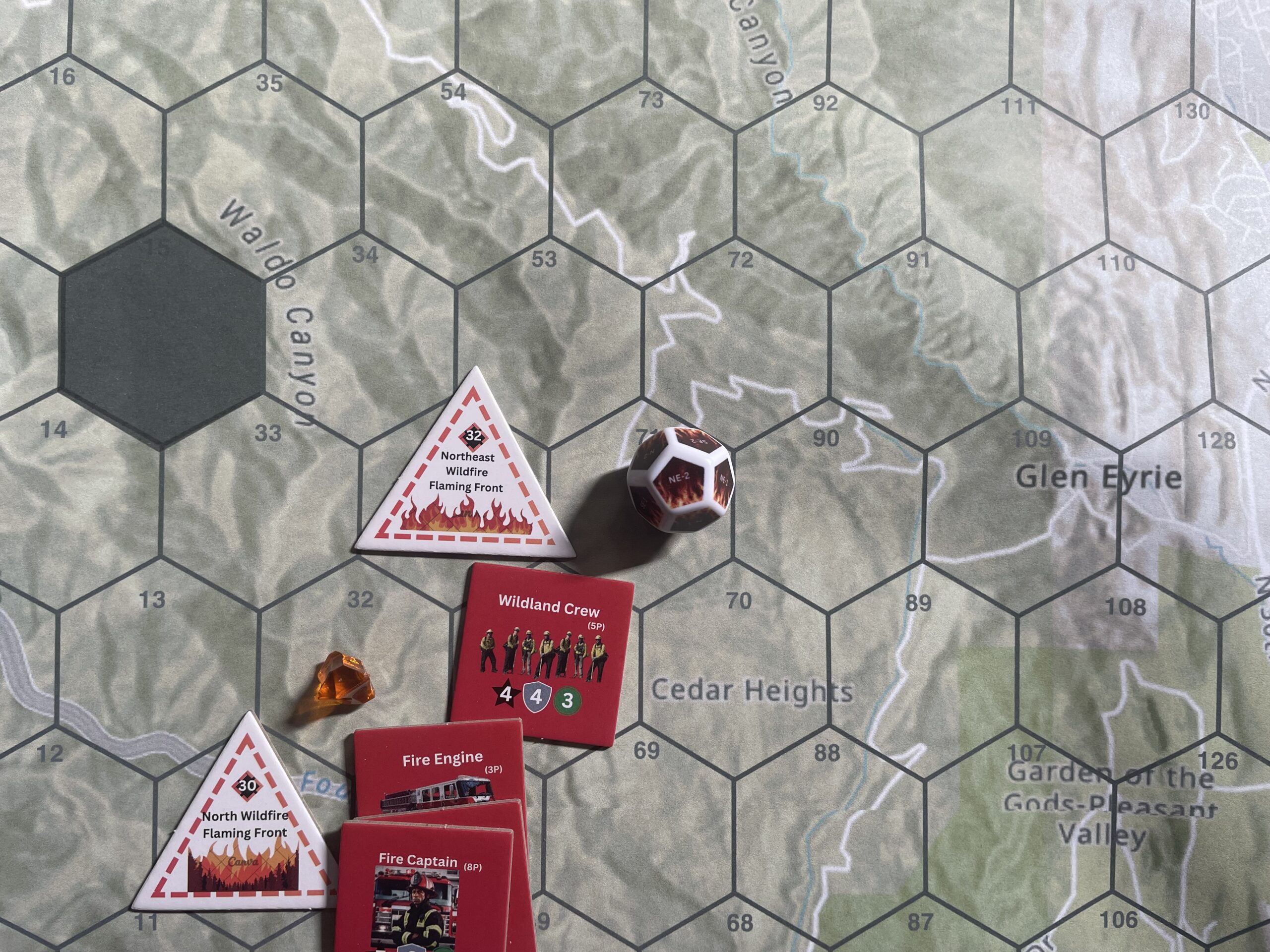
Third, the Wildfire Behavior die is extremely hard to read. Each side of the Wildfire Behavior die has a compass direction and number indicating which flank and by how many hexes the wildfire advances. The small yellow font and the flaming background make the die roll result very hard to see.
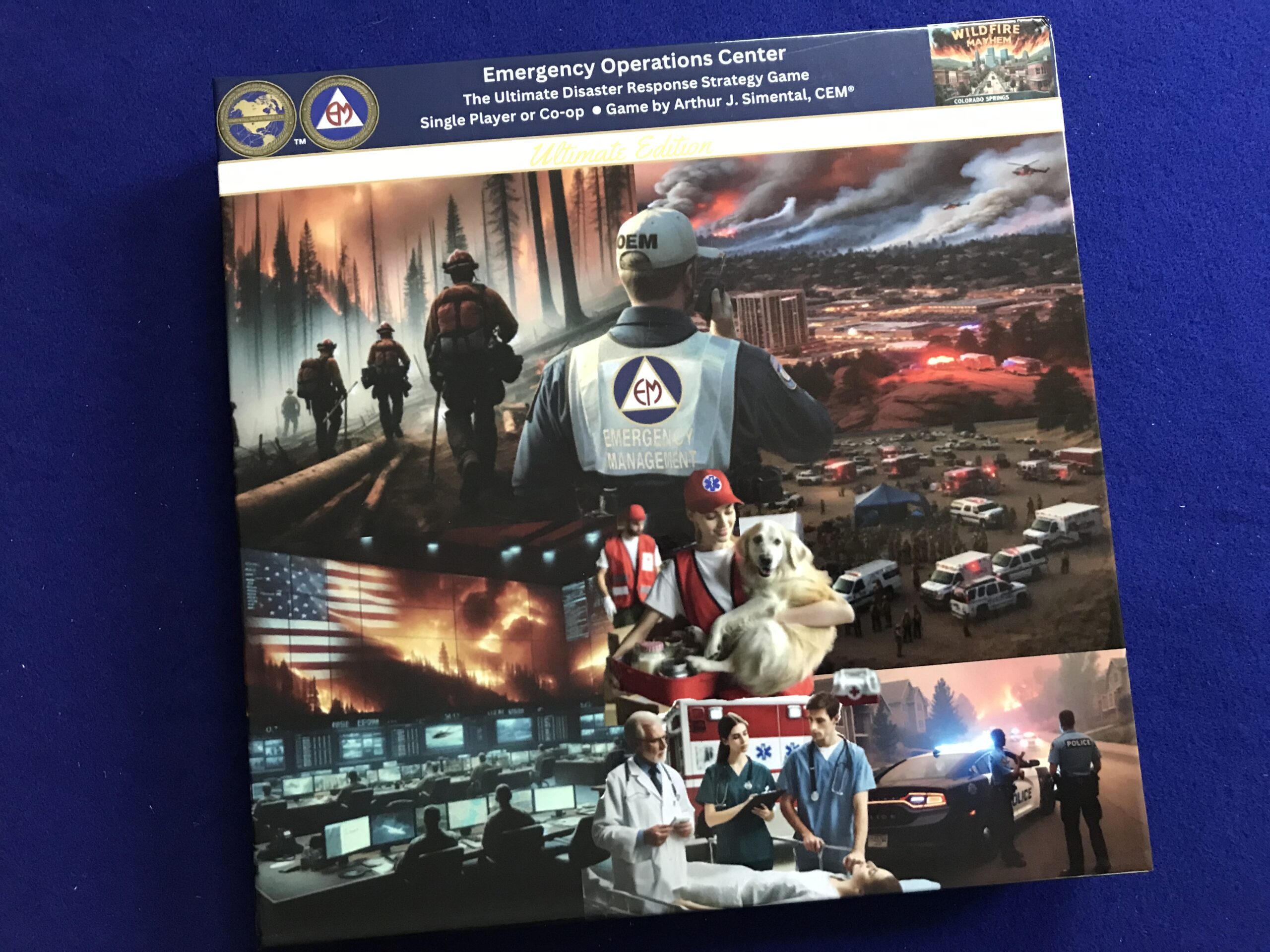
I almost listed the rulebook, aka Game Manual, for Emergency Operations Center as a major issue. That is until I reread the Kickstarter campaign Update #20 which stated:
Note: Your game manuals were made before this last upgrade so you’ll need to download the latest version of the game manual from the EM Disaster Gaming website (EOC Kickstarter Update #20)
The updated Game Manual (v5.1 at the time of writing) is a major improvement over the version shipped in the box for Emergency Operations Center. While the rules are better, they are still not without problems. Broadly speaking, the rules need to be further edited for improved clarity and precision. As they stand, the rules seem to be written by, and directed towards, players who are already familiar with the game or trained to be a game facilitator. A new player picking up the Game Manual for the first time likely will encounter questions in play. In many cases the answer to those questions can be figured out with a careful reading of the rules and by applying some common sense. While that can be done the rules should nonetheless be written in a way to minimize that condition. As it stands right now the rules need a bit more help.
Probie no more2
Many of us, at least in the generation I grew up, almost certainly went through a time in our young life that we wanted to be a firefighter. Emergency Operations Center: Wildfire Mayhem allows us, now adults, to indulge in that fantasy. Emergency Operations Center, however, loudly teaches that fighting a fire or responding to a disaster is not the realm of fantasy but instead requires real-world planning and resource management.
Although designer Arthur Simental did not design Emergency Operations Center for entertainment, the game is still fun to play. A great factor in making the game fun to play is the combination of classic wargame and other game mechanisms to simulate aspects of a disaster. In playing Emergency Operations Center I found many small details that use simple ways to simulate the chaos of a disaster. Once the Game Master/Emergency Operations Manager and players/Incident Staff figure out the basic flow of the game it moves along quickly and creates a logical narrative to challenge the players/training audience.
Emergency Operations Center can be played without resorting to taking FEMA Emergency Management courses—but doing so greatly helps. For a layperson who is not steeped in Emergency Management, Emergency Operations Center is an easy-to-learn, relatively quick to play, simulation of aspects of a disaster response. The aspect simulated focus on player decisions using an ‘Orient – Decide – Act’ approach. The players training audience is sure to come away from a game session training event with more practical knowledge of Emergency Management than that communicated through boring PowerPoint slides.
A bit to my surprise, the more I play Emergency Operations Center: Wildfire Mayhem the more the game grows on me. The game is not without issues; my complaints regarding components should not, however, be seen as a condemnation of the game in any manner. Emergency Operations Center is much better than some games I played in the wargame practitioner realm. In much the same way commercial wargame publishers say that, “a game is never finished, just delivered” (was that Jim Dunnigan?) wargame practitioners often say something to the effect of, “a game is never finished, just delivered to the sponsor.”
The core design of Emergency Operations Center is pretty solid; this is a diamond in the rough that has some polish though a bit more (improved components, further edited rules, etc.) would not hurt. I actually enjoy Emergency Operations Center: Wildfire Mayhem enough that I may try the Emergency Operations Center: Tactical Wargame Series – Incident Commander Hell’s Highway game. This “lite” version of Emergency Operations Center is for 1-4 players and playable in about 30 minutes.

Given I live in the DC area with some of the worst traffic in the country this game might just be more applicable to real life than I want to admit.

Bottom Line
First-time designer Arthur Simental delivers excellent training on Emergency Management using the medium of a wargame in Emergency Operations Center: Wildfire Mayhem. Simental uses this wargame to educate disaster responders on the different resources and planning required to respond to a rapidly evolving (devolving?) situation. Designed from the beginning to be a Team-based event, solo play is possible but misses many of the objectives of the game revolving around the need to collaborate with other agencies and the what and how they bring support and operate in a disaster. Although Emergency Operations Center: Wildfire Mayhem could benefit from improved components, the game even as-is accomplishes its education and training mission quite well while also demonstrating the power a wargame can bring to different, certainly non-kinetic combat, situations.
Thank you for visiting the Regiment of Strategy Gaming and riding with The Armchair Dragoons.
Rather than list a bunch of social media links, the easiest thing to do is to check out our LinkTree, which connects you to all of our various locales around the web.
You can also support The Armchair Dragoons through our Patreon, and find us at a variety of conventions and other events.
Feel free to talk back to us either in our discussion forum, or in the comments below.
Footnotes
- “Ultimate Edition” pledge includes the Standard Edition Base Game + Deluxe Fire & Police Expansion Pack + Search & Rescue, HazMat, and Agriculture & Natural Resources Expansion Pack + Elected Official Card Game.
- In my local area when a new firefighter completes their probationary period we often see on social media a “probie no more” posting.


