
 by
by RockyMountainNavy, 7 August 2025
Come along as I explore Battles of the American Revolution Tri-Pack II: Monmouth, Germantown, Newtown, the latest installment in GMT Games’ Battles of the American Revolution (BOAR) series of tactical battle wargames covering battles of…wait for it…the American Revolution. Tri-Pack II takes three of the current ten volumes in the BOAR series and packages them in a single box while also adding designer Joel Toppen’s Solitaire Tactics Methods expansion first printed in C3i Magazine #22 from RBM Publishing in 2019. The total package is an exceptional gaming value.
The three volumes complied into Battles of the American Revolution Tri-Pack II include:
- Battle of Monmouth, Volume V, designer Mark S. Miklos
- Battle of Germantown, Volume VII, designer Mark S. Miklos and Bill Madison
- Battle of Newtown (with bonus Battle of Oriskany), Volume VIII, designer Mark S. Miklos and Dan Hanle
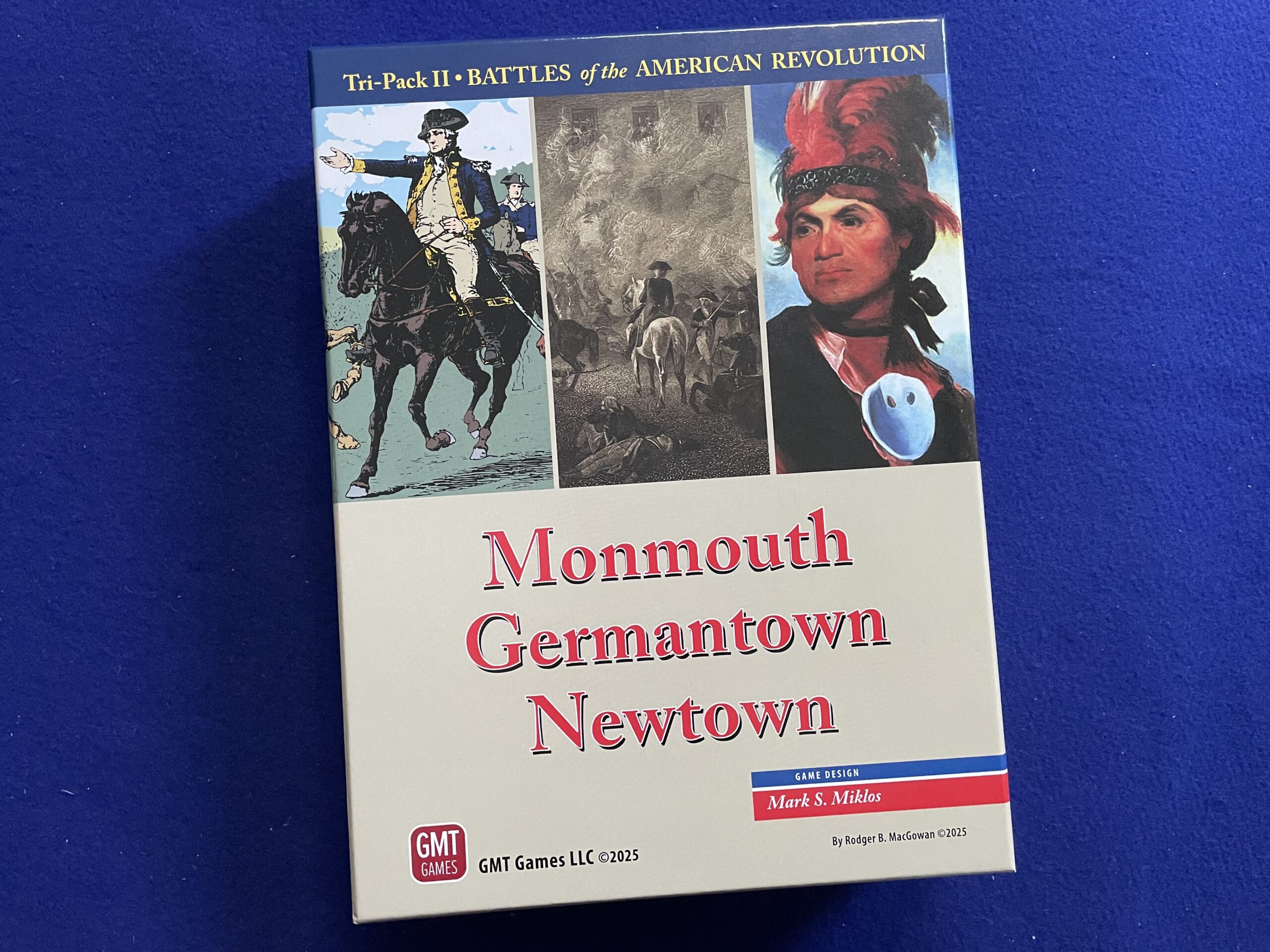
click most images to enlarge
While the design credit for several of the games in Tri-Pack II is shared the lead series designer for BOAR is Mark S. Miklos. The maps in every game are by Charles Kibler with Art Direction by the late Rodger B. McGowan. Counter art is by Rodger B. MacGowan, Mike Lemick, and Mark Simonitch.

As a series, individual BOAR titles are simultaneously easy to learn yet innovative. They are easy to learn in the sense that each game shares common scales, unit sizing, and core game mechanisms. Turns in BOAR are either Tactical (1 hour per turn) or Strategic (2 days per turn). Each hex on the map is 200 yards and Units are usually Battalions or Regiments. The battles in Tri-Pack II use two rulebooks; a Series Rulebook (Version: 2024 ships in the box) and an Exclusive Rulebook for each battle.
The Exclusive Rulebook for each battle in Tri-Pack II is where the true innovation in the game design is apparent. An Exclusive Rulebook not only delivers historical commentary and scenarios for each battle but, more importantly, introduces new or variant rules that change or modify the Standard Game to make each battle unique. The designer’s ability to invoke a different “setting” in each battle without breaking the Standard Game is the true design achievement.
GMT Games was kind enough to share a review copy of Battle of the American Revolution: Tri-Pack II with The Armchair Dragoons. In my commentary that follows I will first look at a mini “unboxing” of the game followed by a background on each battle. Next, I share my thoughts as I play each historical battle. Lastly, I share some concluding thoughts on Tri-Pack II.
Unpacking Tri-Pack II
The complete contents list of Tri-Pack II is slightly different than that listed on the back of the box. According to the GMT Games website the contents of Tri-Pack II include:
- Two Double-sided Mounted Map Boards
- 528 Full-color 5/8″ Unit Counters and Markers (198 for Monmouth, 198 for Germantown, 99 for Newtown, and 99 for Oriskany with some Markers shared between Newtown and Oriskany)
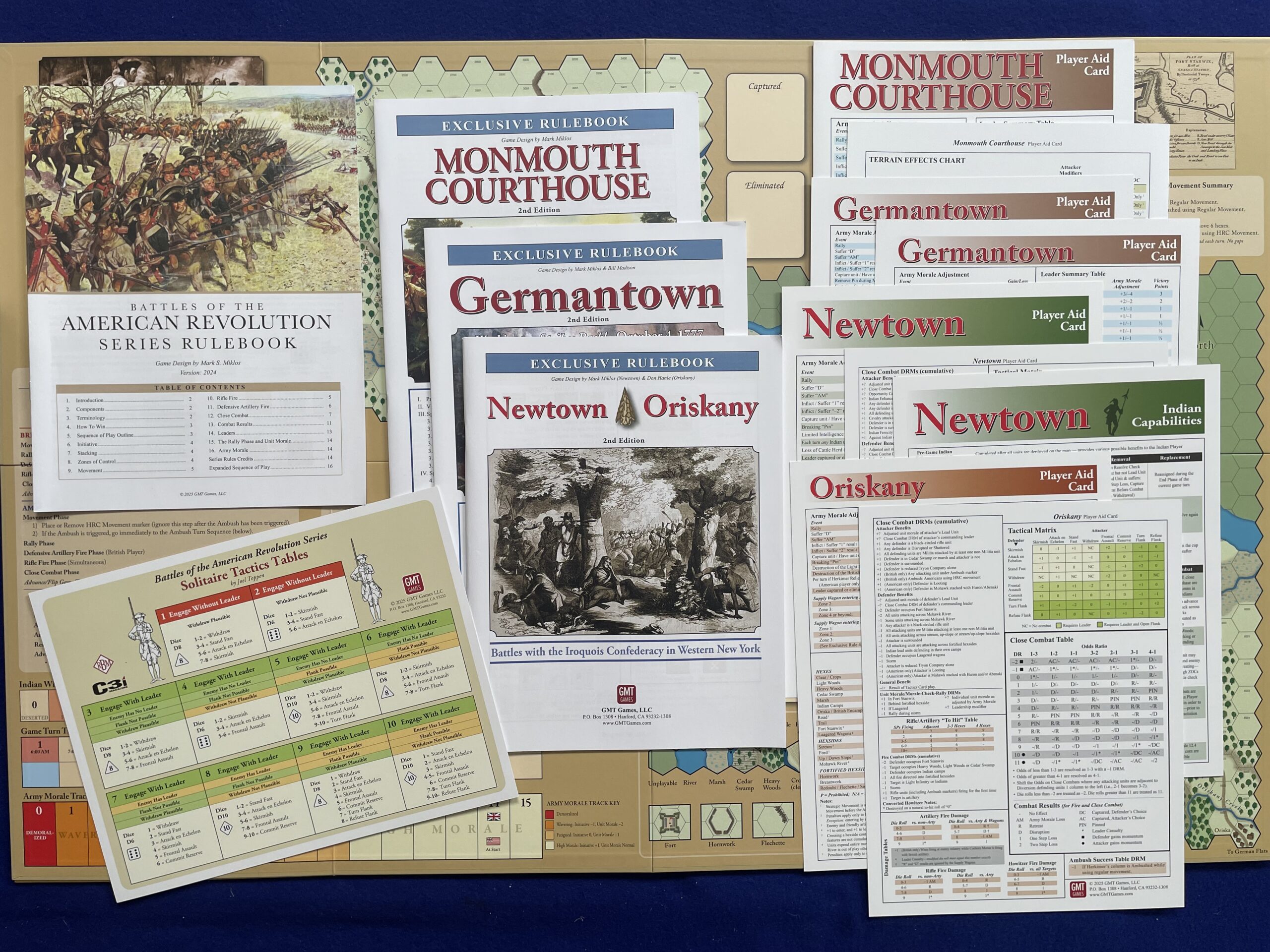
- One Battles of the American Revolution Series Rulebook (16 pages)
- One-each, Battle of Monmouth (24 pages), Battle of Germantown (16 pages), and Battles of Newtown & Oriskany (36 pages) Exclusive Rulebooks
- Two 11″ x 17″ Player Aid Cards (Battle of Monmouth)
- Seven 8.5″ x 11″ Player Aid Cards (2x Germantown, 2x Newtown, 2x Oriskany, 1x Newtown/Oriskany)
- One 8.5″ x 11″ Solitaire Tactics Card Player Aid (Rules on one side with Tables on other)
- 16 Tactics Cards
- 26 Opportunity Cards for Newtown
- Two 10-sided Dice (Blue and Red)
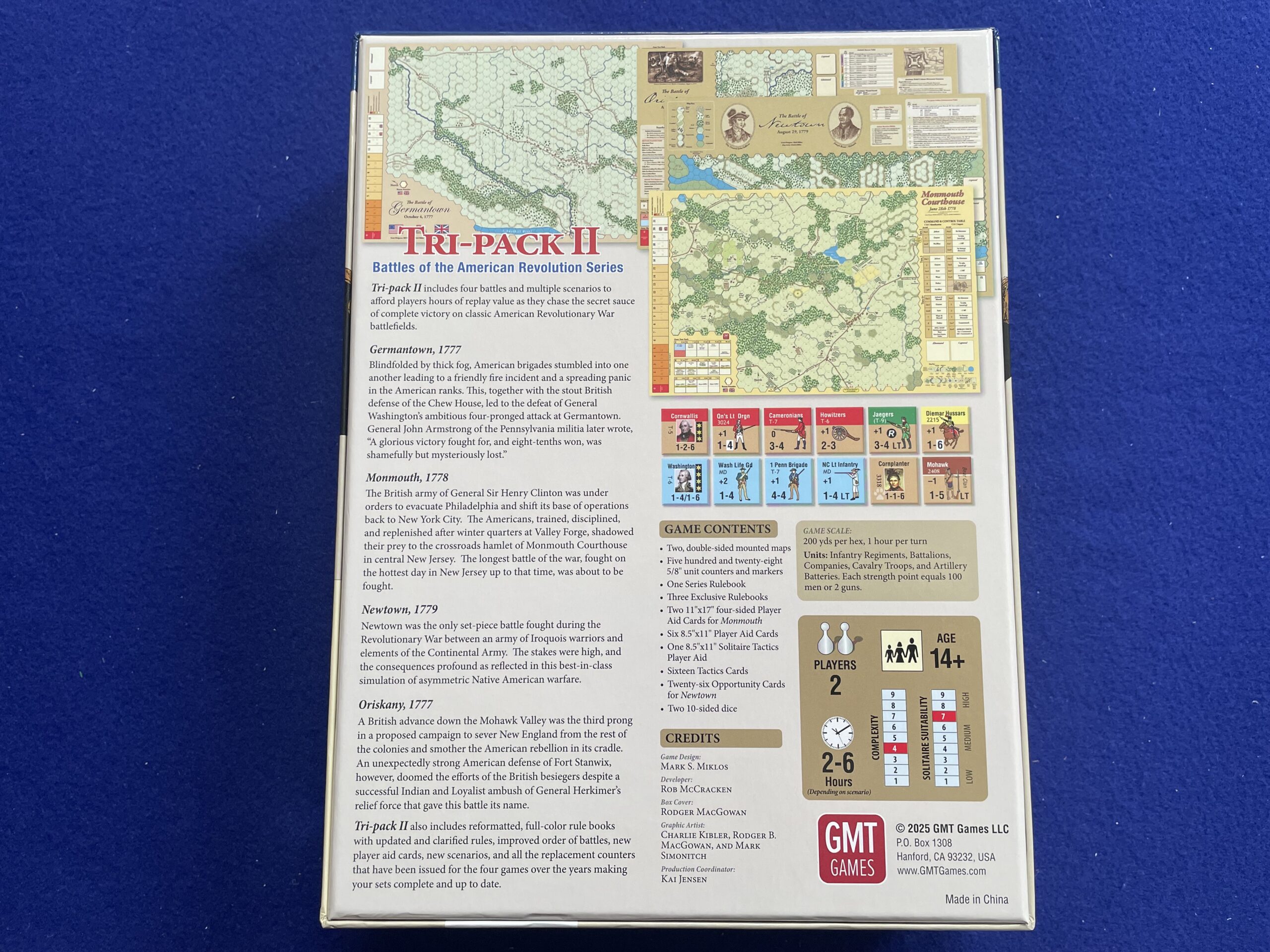
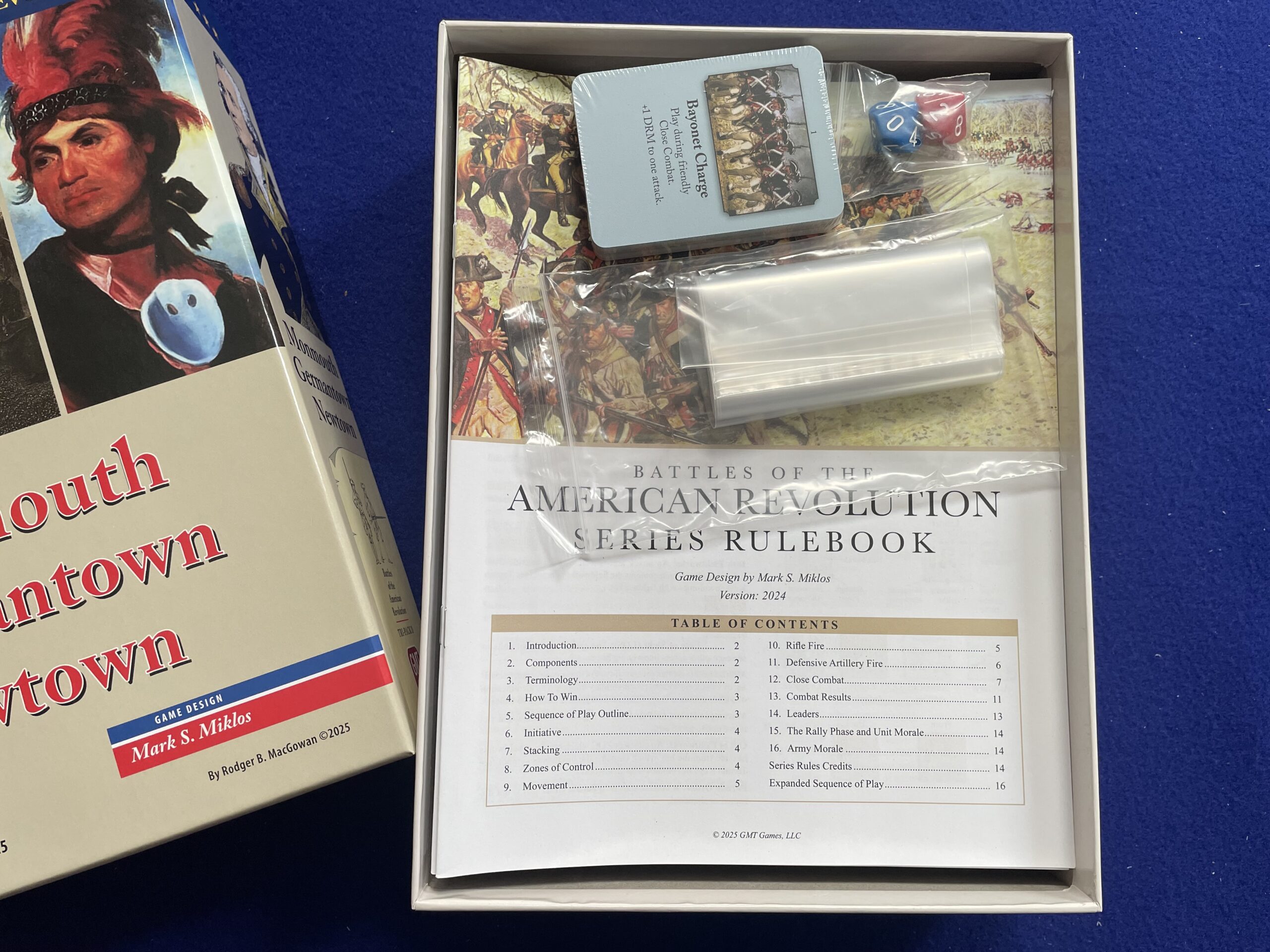
When first opening Tri-Pack II you cannot help but to notice the contents are packed to-the-top of the 3” deep box. Most of that depth is taken up by the two double-sided mounted game boards. So much space is taken up that I was not able to store my counter trays in the box after playing all the games.
While the contents list for Tri-Pack II appears impressive, laying it all out shows just how much product there really is in the box.
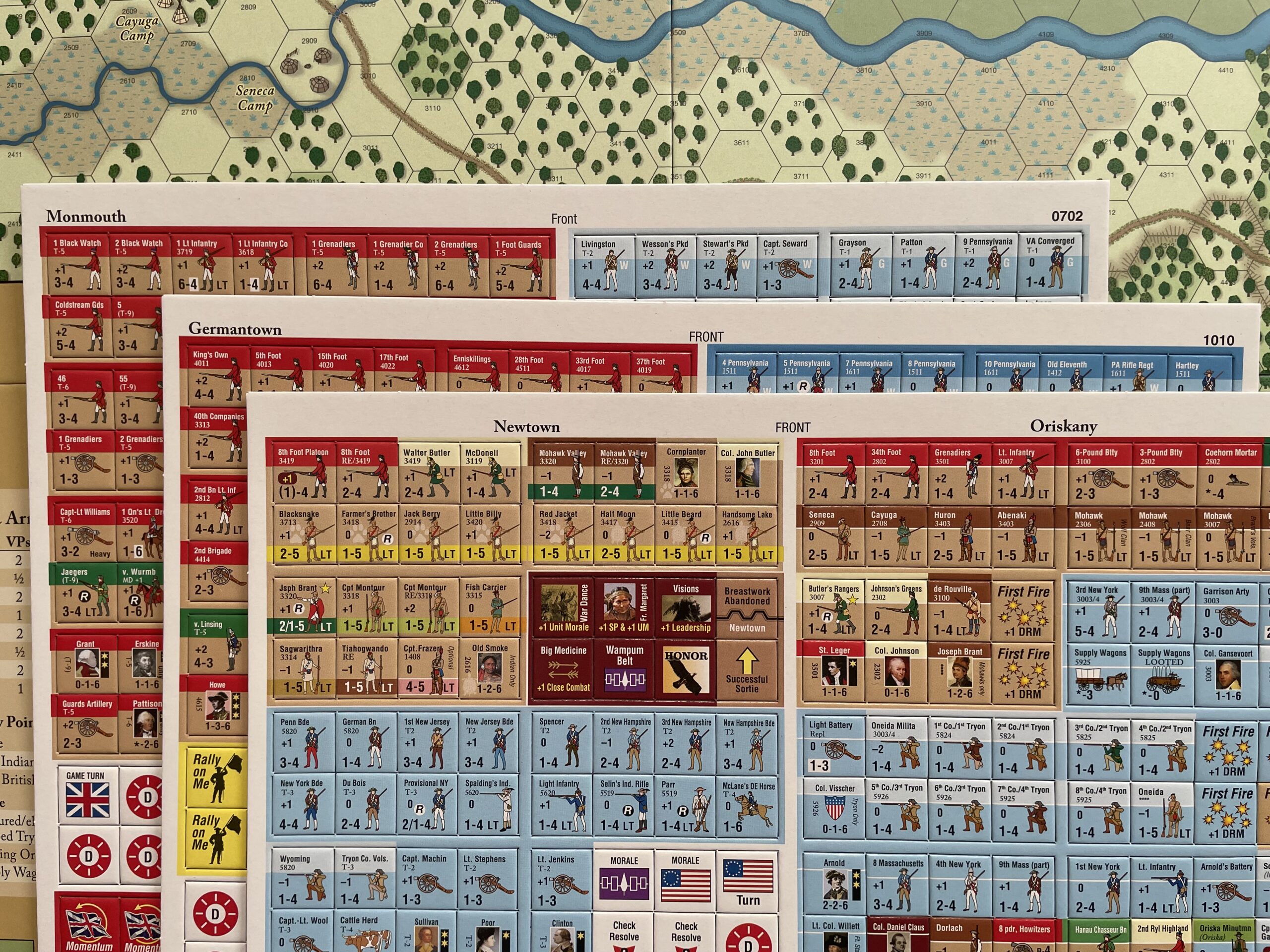
GMT Games maintains their high production quality standards with Tri-Pack II. The map boards are heavy, the counters are a nice thickness that punch out with almost no corner tufts, and the written content is cleanly laid out.
Series Rules
The core rules for every battle in the Battles of the American Revolution series are found in the 16-page Series Rulebook. The core game mechanisms are, taken as a whole, very classic wargame. (ed note: for more on the series, see Bill Simoni’s overview)
- The Sequence of Play is usually Move-Fire.
- Simple Stacking rules and Movement using Movement Points and a Terrain Effects Chart
- Zones of Control
- Odds-based combat mechanisms with logical die roll modifiers.
If there is one Standard Game mechanism that distinguishes BOAR from other American Revolution or Age of Reason wargames it is likely Army Morale. As the Design Note states, “battles were decided less often by inflicting overwhelming losses than by destroying the opponent’s will to fight” (Series Rulebook, p. 14). In BOAR Army Morale clearly represents the “Will to Fight” of the combatants. Woo to the player that does not pay attention to their Army Morale track.
As should be expected, after 10 volumes and a previous Tri-Pack, the series rules for BOAR are well refined, well written, and easy to learn.
Battle of Monmouth
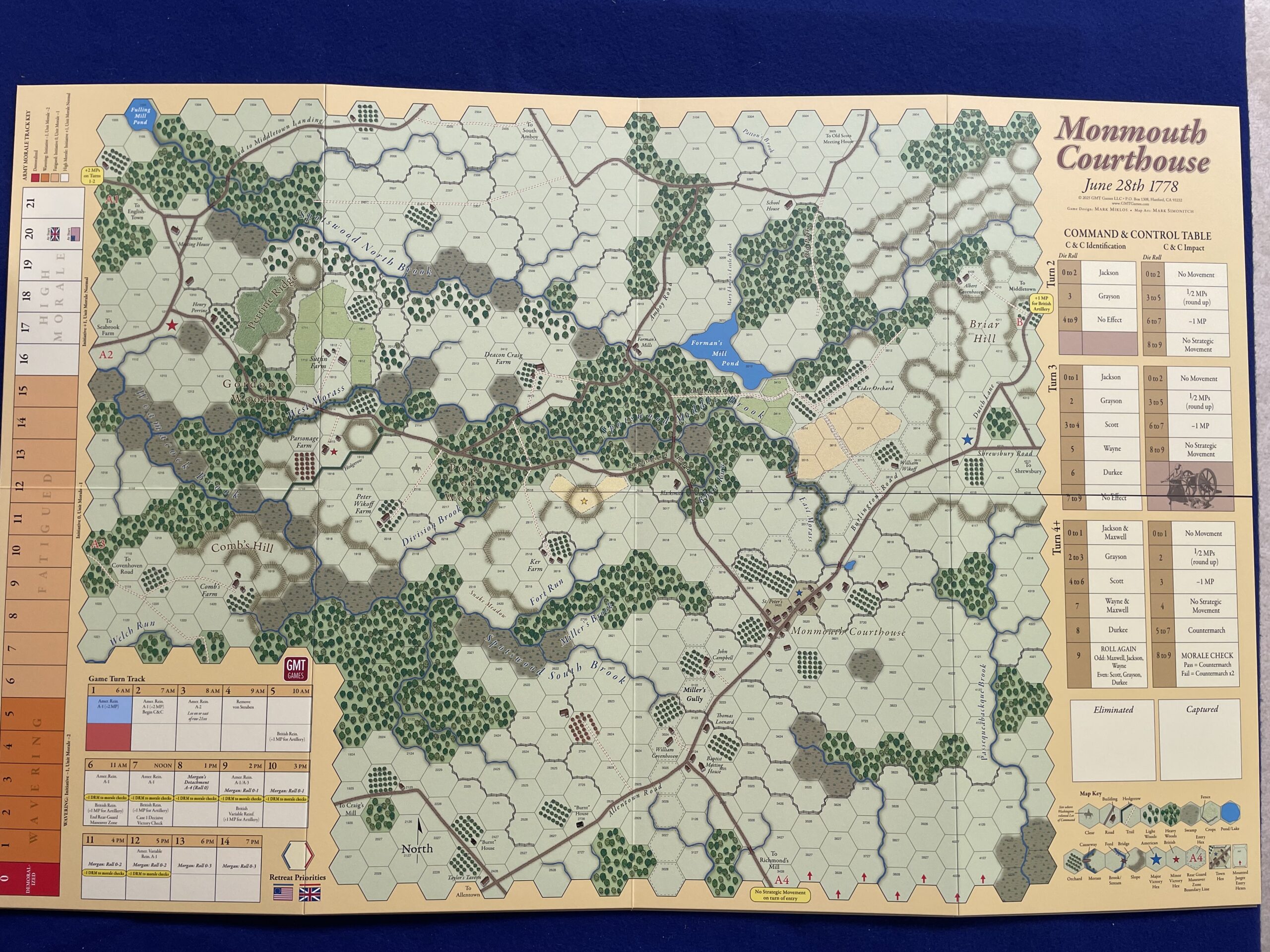
The Battle of Monmouth Courthouse was fought on 28 Jun 1778. As the GMT Games website for the Monmouth game in Tri-Pack II notes,
Monmouth, considered a “draw” by most historians, was not only the longest battle of the war; it was essentially the last major engagement fought in the North. Following the ensuing strategic stalemate, major operations shifted to the Southern theater. (GMT Games, Monmouth)
The Battle of Monmouth is also notable for the political situation around questions about General George Washington’s fitness to command. As Professor Edward Lender and historian Garry Wheeler Stone write in the Preface to Fatal Sunday: George Washington, the Monmouth Campaign, and the Politics of Battle (University of Oklahoma Press, 2016),
Thus, as the British planned their moves across New Jersey and as General Washington and his subordinates pondered their response, they did so amid open questions about the future conduct of the war, including is new international dimensions. There also were questions about the capabilities of patriot arms and, perhaps most significantly, the abilities of Washington himself. Indeed, as the Monmouth campaign opened, the general was something of an unknown quantity. Despite his flashes of brilliance at Trenton and Princeton and the regard may patriots had for his character and dedication, his performance as commander in chief was questionable. Some contemporaries could not forget the painful defeats around New York in 1776 or the bitter loss of Philadelphia in 1777. This was not record to support a reputation in arms, and as early as late 1776 there were doubts about Washington’s fitness to command. Among others, Adjunct General Jospeh Reed and, most notably, Major General Charles Lee, the army’s second-ranking officer groused indiscreetly (but reasonably) at Washington’s performance. Worse came the following year: The defeats around Philadelphia stood in bold relief against Major General Horation Gate’s victory at Saratoga, triggering unflattering (for Washington) comparisons between the two commanders. (Lender & Stone, pp. xiii-xiv)
The BOAR Battle of Monmouth is a large scenario taking up a full 14 turns (all day). To reflect the unique situations of this battle, the Exclusive Rules add seven Special Rules, four Special Units, and three smaller scenarios.
The Special Rules for Monmouth in Tri-Pack II are of particular interest. Given that the BOAR series focuses on the tactical situation, the politics of the battle are not up for play: Washington WILL relieve Lee. The behavior of the American forces in Lee’s Advance Corps, however, is not previously determined. Rule 3.3 Command & Control is used to show the breakdown of the Advance Corps and the many “countermarches” that occurred as units under Lee sometimes moved away from the battle. The challenges will continue until Washington relieves Lee.
Two other special rules in Monmouth for Tri-Pack II are notable. The extreme heat of the day is in Rule 3.2 Heat Game Turns and Rule 4.4 in Special Units is where you can find Molly Pitcher.
Battle of Germantown
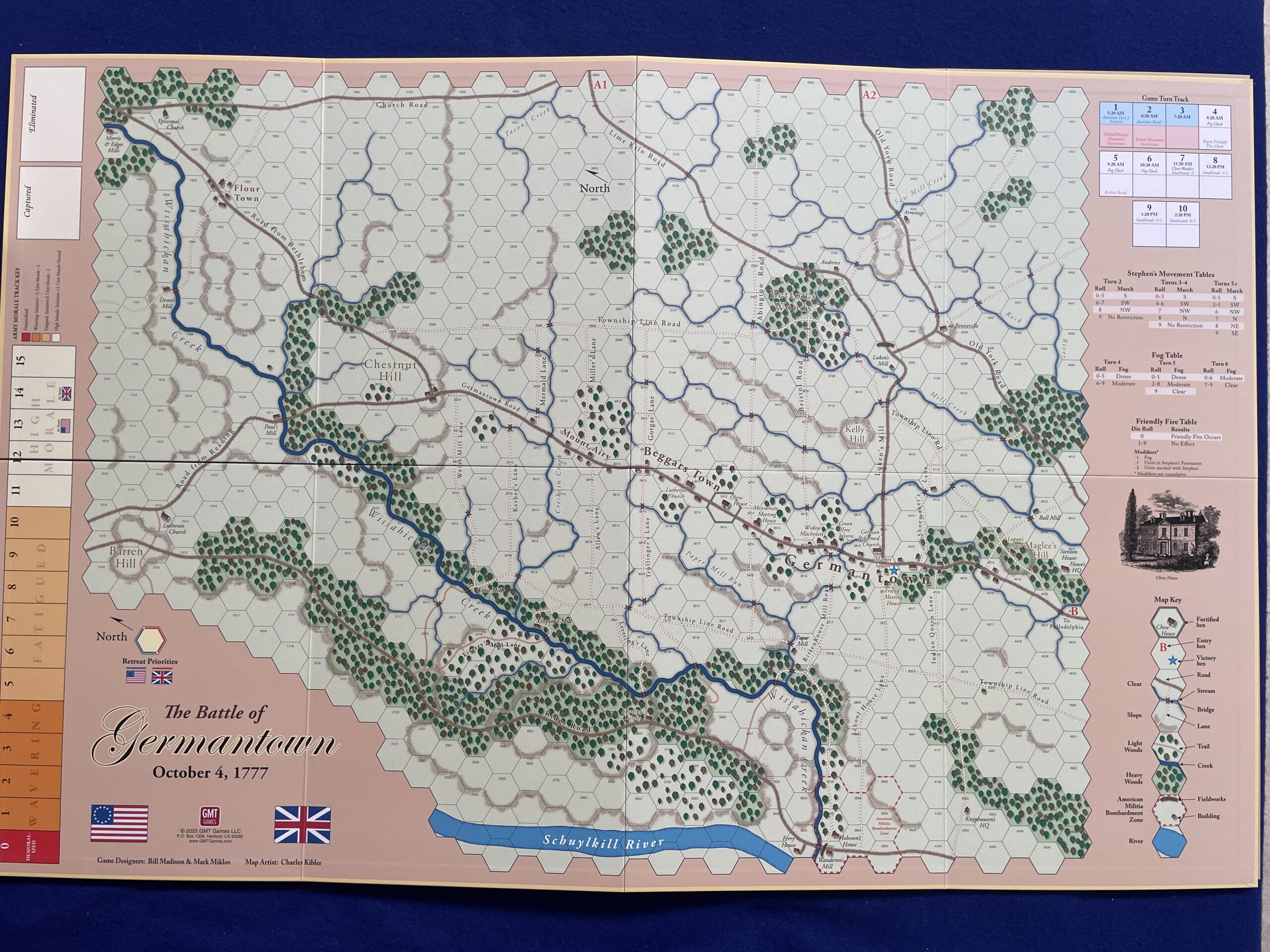
The Battle of Germantown was fought 4 Oct 1777. The battle makes a great “what-if” as the ad copy from GMT Games explains:
Alerted to Howe’s movement, Washington saw an opportunity to strike a blow against the British while he had numerical superiority. He developed a complicated attack plan which called for four converging columns to hit the British simultaneously before dawn. If the assault proceeded as planned the Americans would achieve a double envelopment that could prove decisive. (GMT Games, Germantown)
The Exclusive Rulebook for the Battle of Germantown is a mere 16-pages or a quarter-less than its Monmouth counterpart. The battle is depicted using a single, 10-turn scenario. The Special Rules of the most import for Germantown are the drunk Major General Stephens (3.2), the fog that made visibility on the battlefield almost nonexistent (3.9), and the fortified Chew House defended by the British that historically stymied the American advance (3.10).
Battle of Newtown
The Battle of Newtown and Battle of Oriskany share a single Exclusive Rulebook that carries the subtitle, “Battles with the Iroquois Confederacy in Western New York.” The exclusive rules for Newtown are 14 pages and include a single 12-turn scenario.
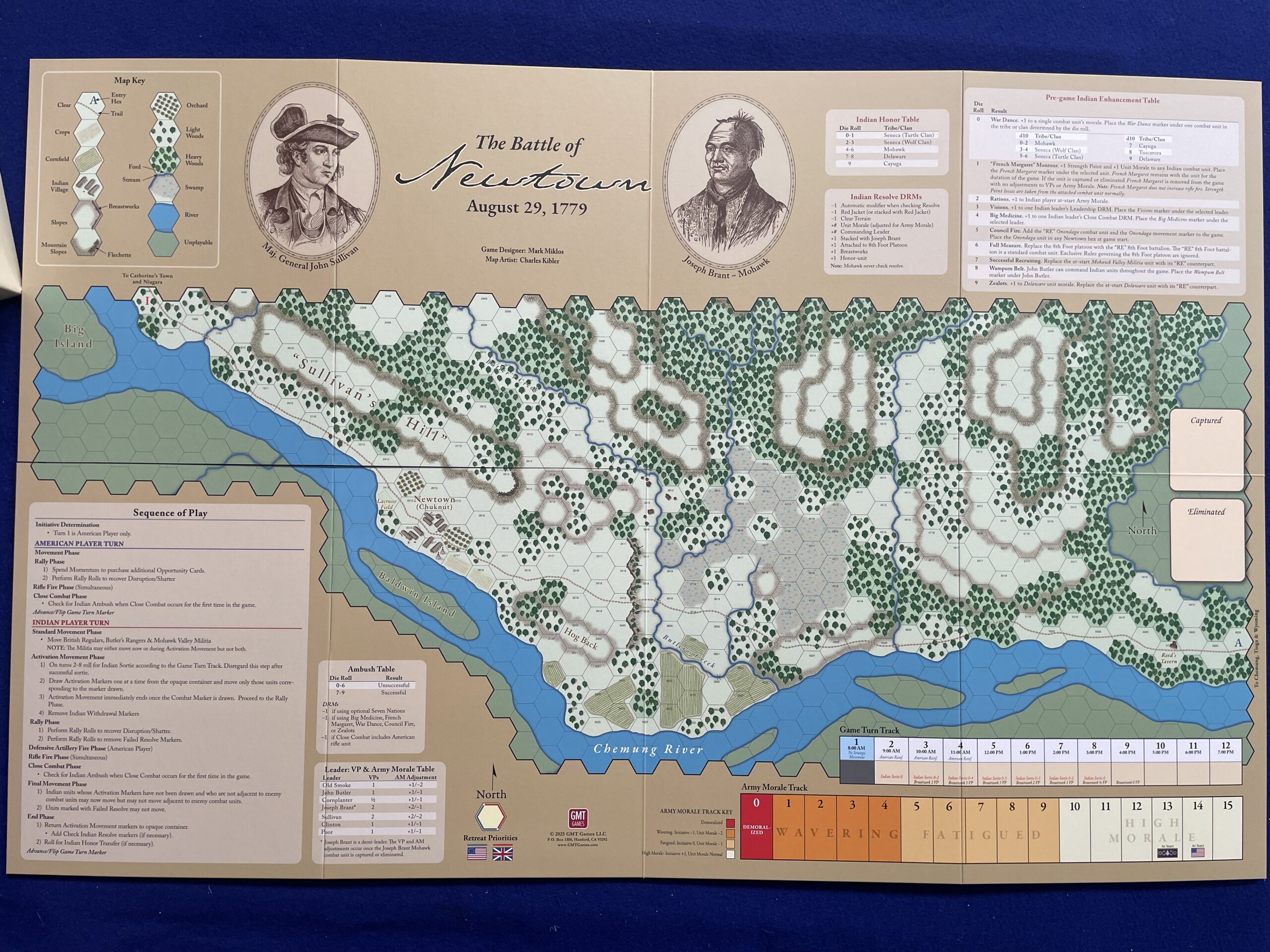
The Battle of Newtown, taking place on 29 August 1779, was the opening battle in the Sullivan-Clinton Campaign of 1779. As the Historical Summary tells us:
This campaign, undertaken to vanquish the Iroquois, was in response to frontier conditions in New York and Pennsylvania which had grown more and more acute during 1778. Britain’s Indian allies, principally the Seneca, Cayuga, Onadaga, and Mohawk, terrorized the frontier settlements. (Exclusive Rulebook, p. 11)
The Battle of Newtown does not see the traditional Americans vs. British combatants found in most volumes of the BOAR series. In Newtown the battle is between the Americans and Indians. The presence of the Iroquois at the Battle of Newtown demands a slew of new rules:
- When setting up Battle of Newtown in Tri-Pack II, the Indian player determines which tribe has Indian Honor (1.7). Pre-game Indian Enhancement (1.8) might give special capability to the Indian player.
- The Indian player uses a modified Sequence of Play for Newtown that utilizes a chit-pull game mechanism for Indian movement. The Indian player places tribe markers in a container with a Combat chit and pulls them to determine activation for movement. When the Combat chit is pulled movement ends and the turn moves on to Rally and eventually combat, after which tribes that have not moved are allowed to.
- The Newtown battle also uses a special deck of 12 Opportunity Cards for each player that can be played during a turn as specified on the cards.
The new Indian rules for Newtown in Tri-Pack II, though seemingly a major overhaul to the series rules, are well integrated and easy to use as the board for Newtown includes a tailored Sequence of Play for easy reference by all.
Battle of Oriskany
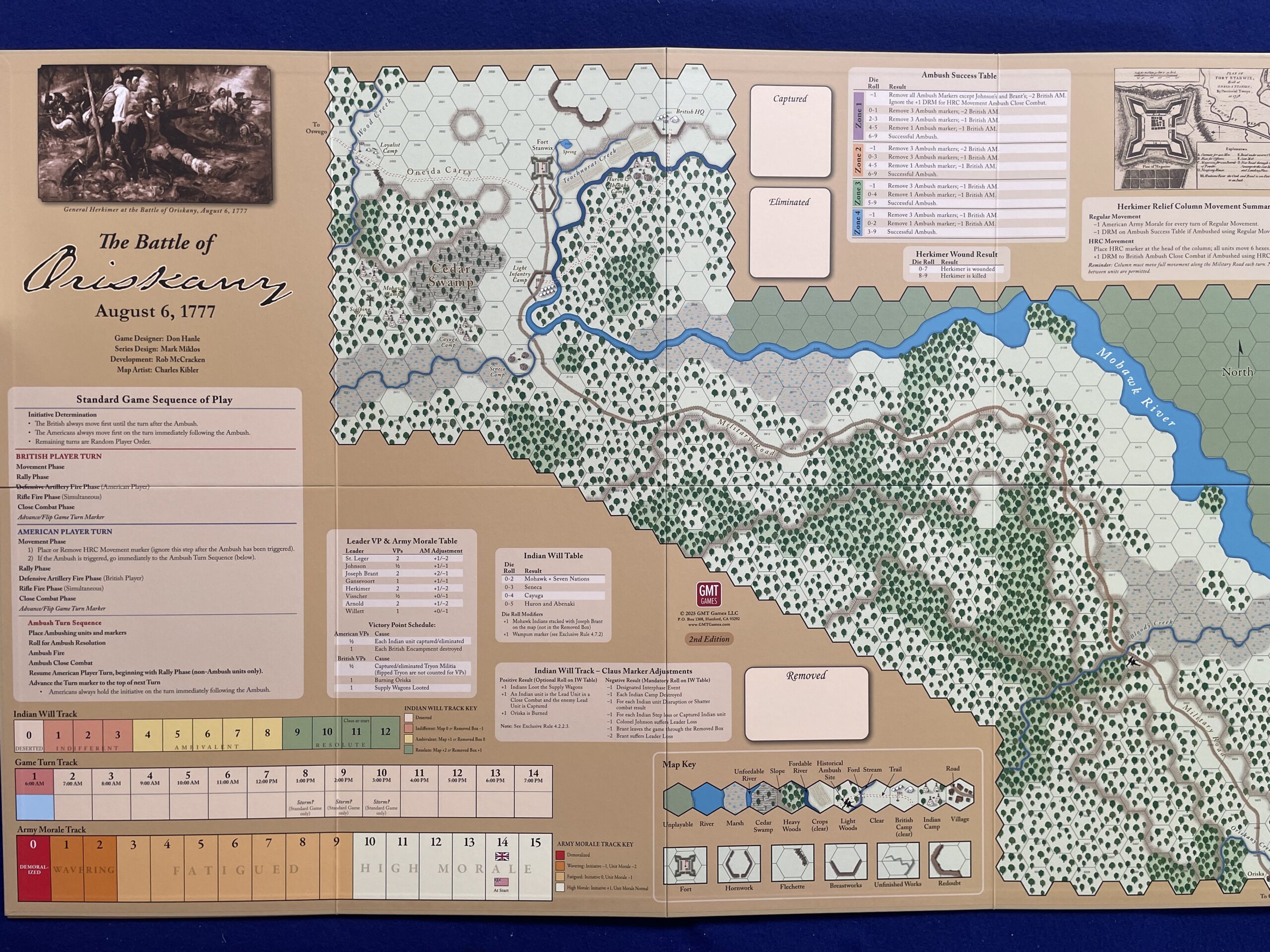
The Battle of Oriskany is the “bonus” game in Tri-Pack II as it is a second smaller game originally packaged with Newtown. The Battle of Oriskany, fought on 6 August 1777, is depicted using a 14-turn Standard Game with an additional “Arnold’s Column Scenario” that is another 14-turn scenario. Both Standard Game scenarios can be linked into a much longer 28 turn scenario (technically two scenarios as one plays the Standard Game first then “resets” for the Arnold’s Column Scenario with carry-over effects from the Standard Game).
The Battle of Oriskany was historically an ambush. Before the battle, the Americans refurbished Fort Stanwix and manned it with nearly 1,000 troops. When 800 British troops (and no siege artillery) under the command of St. Leger, augmented by nearly 1,000 Indian allies, arrived they realized they must place the fort under siege. St. Leger’s Indian allies were previously promised the opportunity to loot and raid and did not want to be part of a set-piece battle. The Americans were confident because General Herkimer formed a relief column in Oriska to bring reinforcements and supplies to Fort Stanwix. St. Leger was alerted to the movement of the relief column and sent forces to ambush, as shown in the Standard Game. This is the historical Battle of Oriskany. The Arnold’s Relief Column scenario is a what-if covering possible events on 24 August where St. Leger had Fort Stanwix under siege and Arnold’s relief column would have arrived on the battlefield. Historically, St. Leger’s Indian allies rebelled on 23 August which forced the lifting of the Fort Stanwix siege. But what if?
Much like the Newtown exclusive rules, the Exclusive Rulebook for Oriskany in Tri-Pack II focuses on Special Rules for ambush situation and the Indians. To reflect the dissatisfaction of the Indians an Indian Will track (1.7) is used alongside the usual Army Morale track for the British and Americans. The Sequence of Play sees the addition of an Ambush Phase (3.4) to depict the ambush. Of course, the siege of Fort Stanwix proceeds alongside the ambush with rules for the fort and field fortifications (3.5).
Play Experience
[To better experience Battles of the American Revolution Tri-Pack II I played the historical scenario from each title. Given my previous experience with BOAR Tri-Pack I my learning curve was not significant to start playing as I already possessed a basic understanding of the series rules. That said, when I play a series game I first spend some time reviewing the basic rules, often setting up the examples of play in the rulebook and working through them to ensure I remember correctly. For each battle I usually set up the game then pause to read the exclusive rules; the ability to reference the game board and look at the units involved helps to process the rules variations before starting play.]
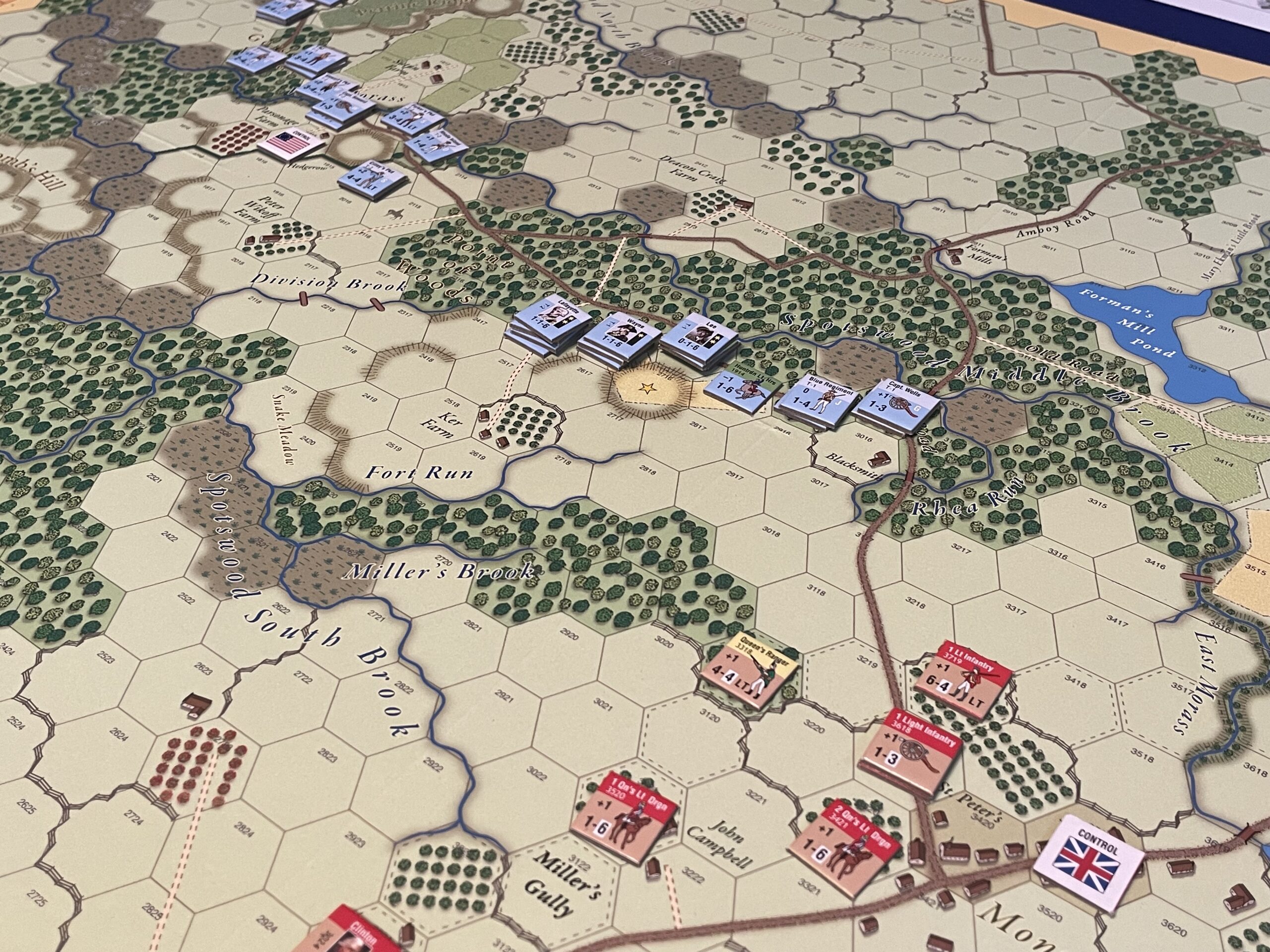
Monmouth. In my play of Monmouth, Lee’s Advance Corps quickly became disorganized and never was able to challenge the British Rear Guard. Once Washington arrived it still took several turns to reach Lee and relieve him. In the meantime, Cornwallis came forward and deployed for battle. The Americans fell back to establish a battle line while being harried by the British. The previous disarray prevented Washington from forming an effective defense and the game ended without the Americans in Monmouth and a British Marginal Victory.
Germantown. Ah…a good stand-up battle. All the Americans have to do is cross the board, move from column to line formation and march up to the British and fire away. Yeah…except Stephen is drunk and his Corps moves randomly and may trigger a Friendly Fire incident to Panic the army, Fog rolls in which means Defensive Artillery Fire that should be bombarding and softening up the British lines often cannot, and Chew House (a fortified hex) sits right in the middle of the American path of advance.
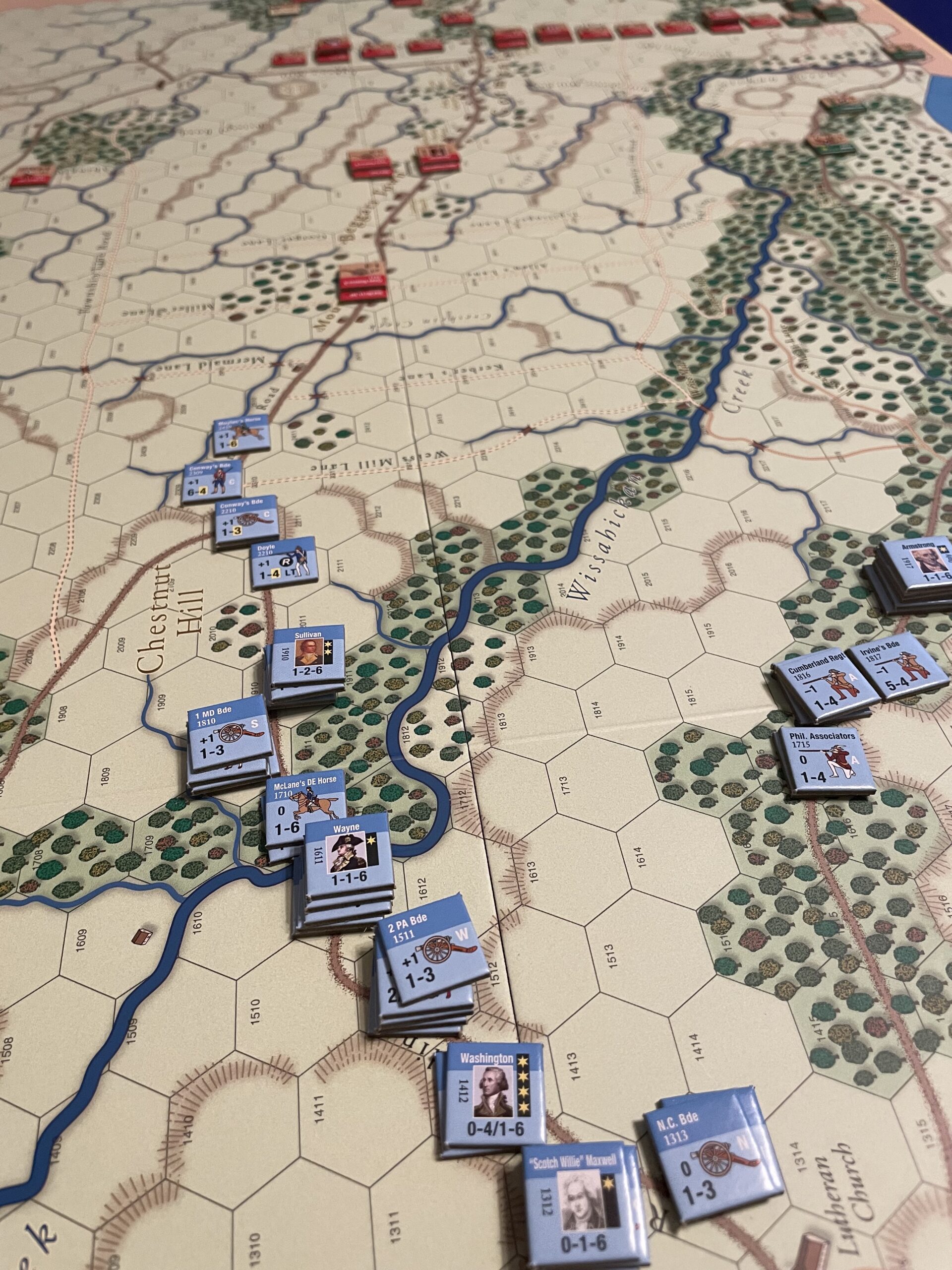
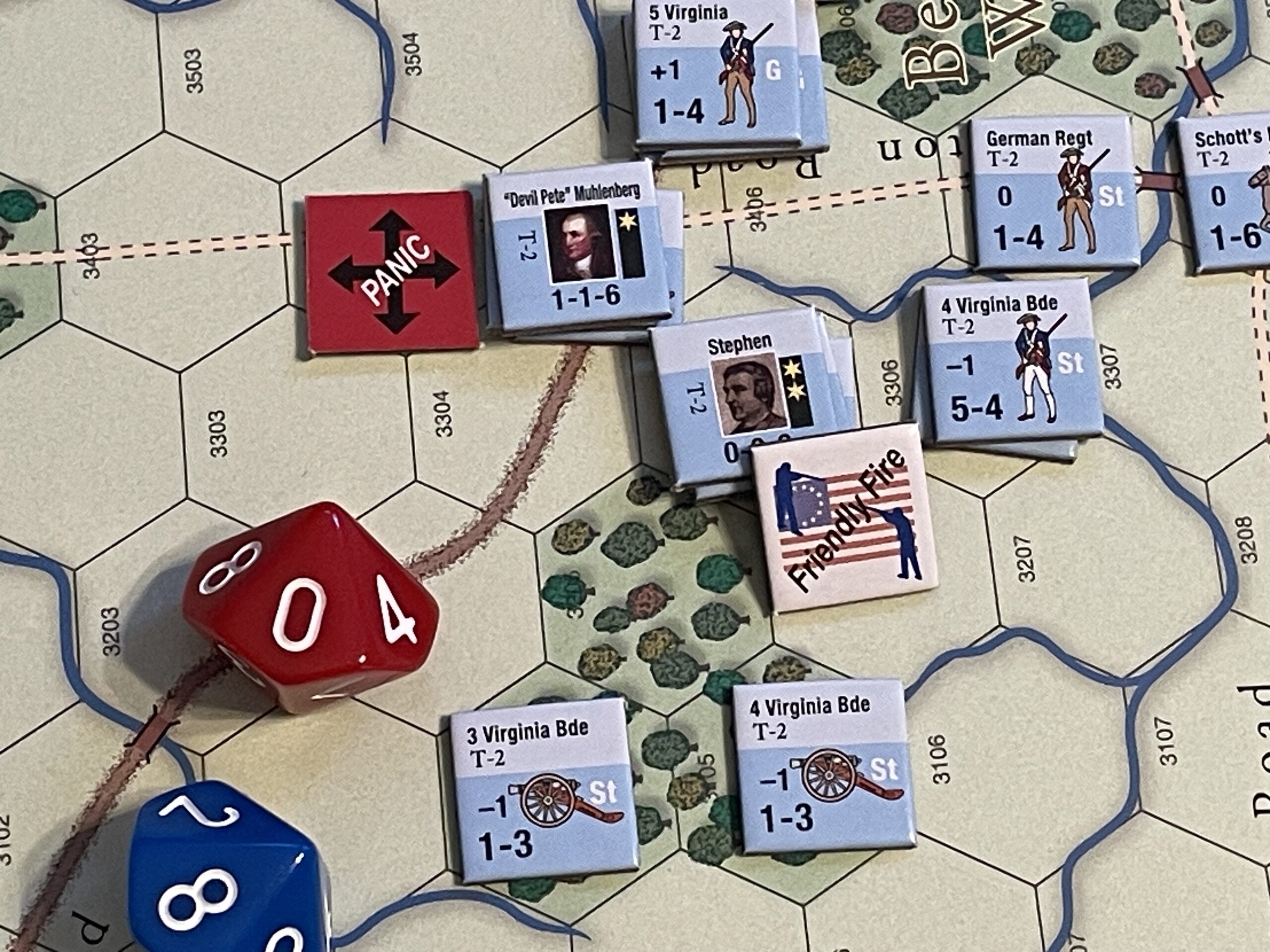
They say war is chaos and chaos best describes the American left in my play. Stephen’s Corps moved drunkenly about the battlefield and, sure enough, on Turn 4 they caused a Friendly Fire incident that incited Panic in most of Stephen’s Corps and a good number of units from Greene’s Corps too. In the middle, Washington chose to use the Fog to cover his advance as he divided his command to to move past Chew House. Once engaged, the fighting was fierce and this day it would be the Americans winning only a Marginal Victory by the slimmest of edges in Victory Points but with Chew House and Market Square remaining in British hands (barely).
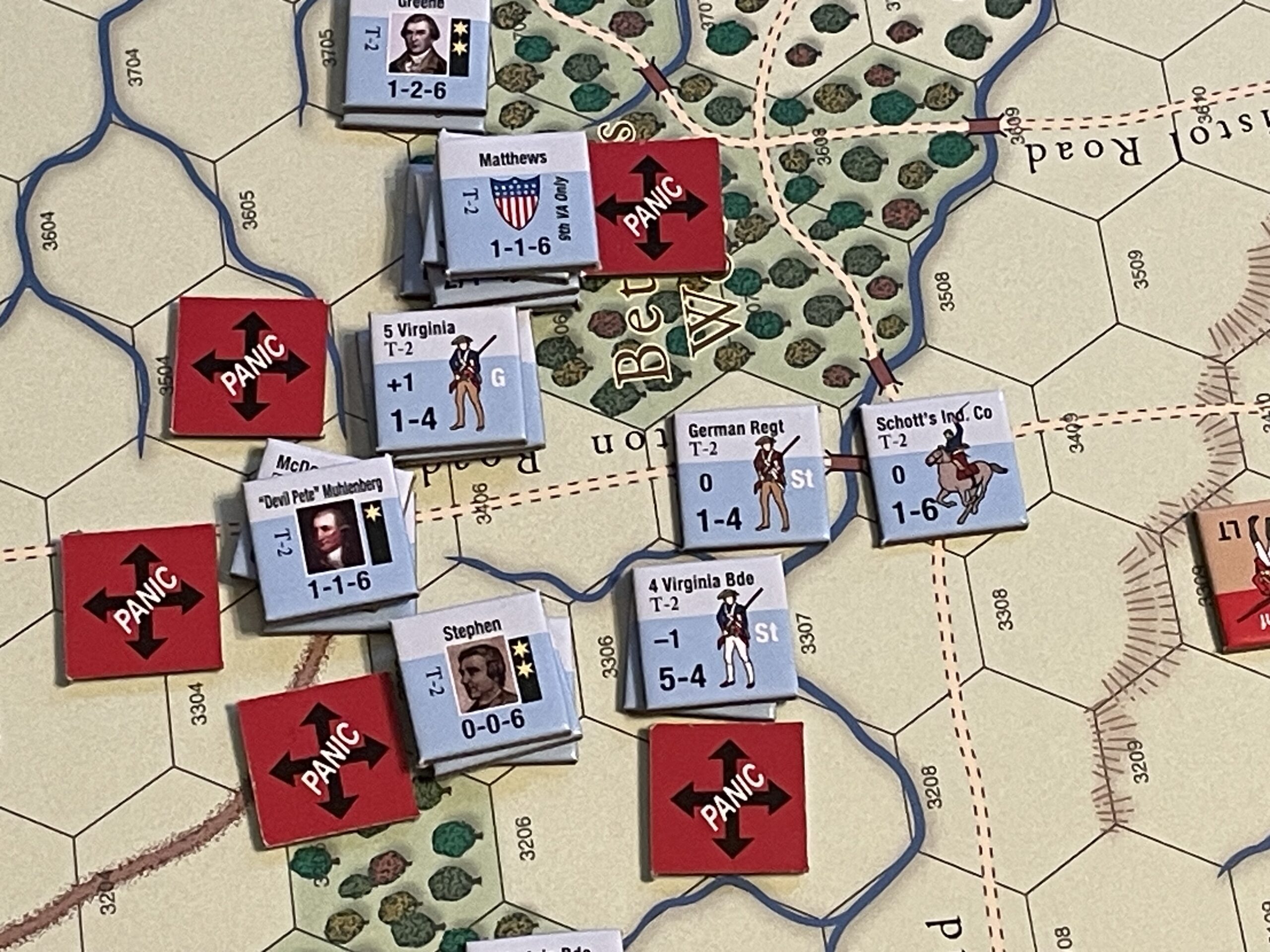
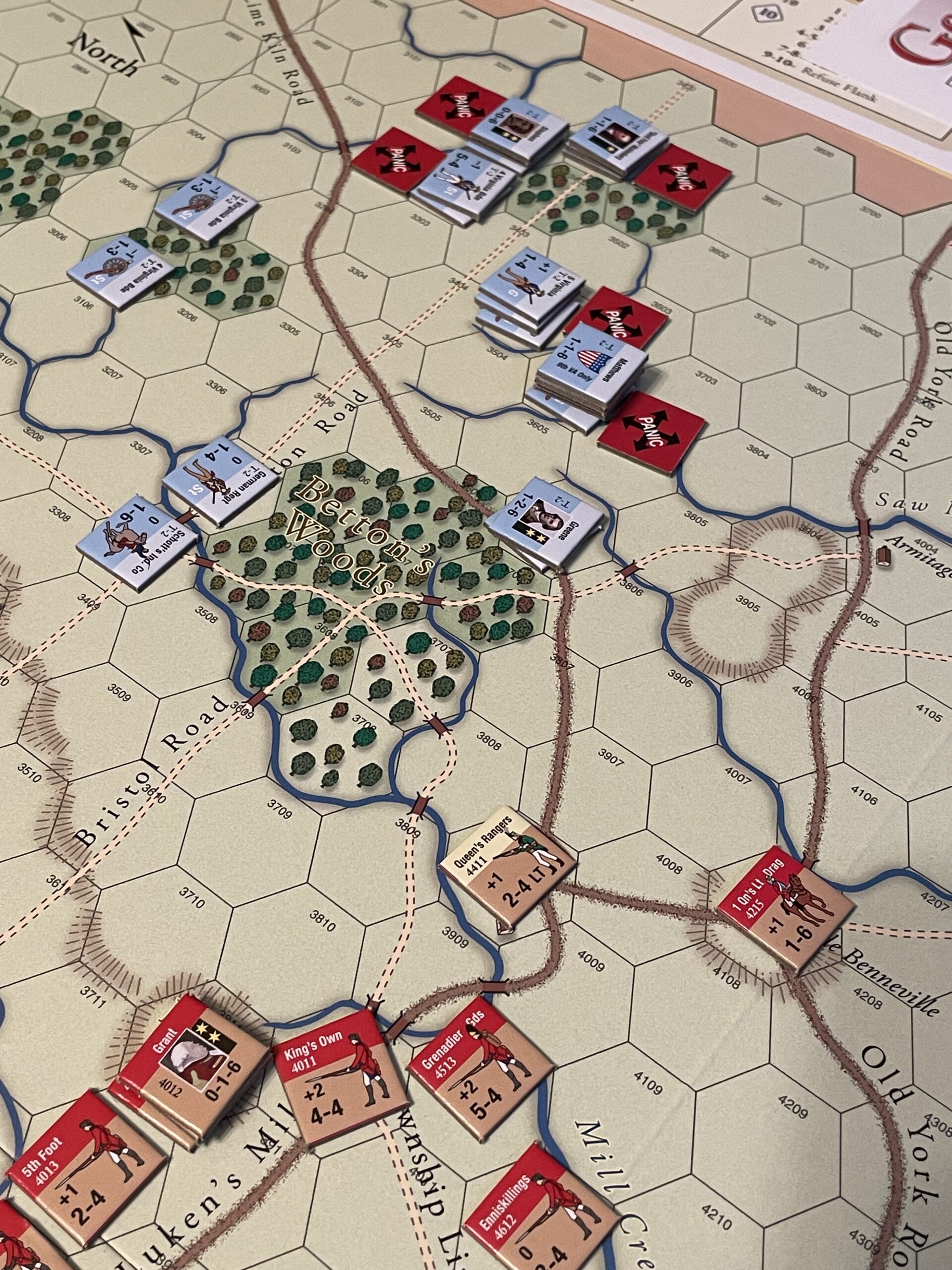
[Of note, I used the Solitaire Tactics Tables for my Germantown battle play. The Tables are not a Bot to replace a player; rather, when playing two-handed solo (as I often do), these Tables help choose the Tactics Cards used in Close Combat. My reaction? Well, there are times I would have chosen different tactics than what the Tables generated but at least the results were plausible, if not optimal. If nothing else using the Tables helps reinforce the value of Leaders in combat as the choices for units without Leaders is far more limited than the array of choices available when a Leader participates. Going forward I am comfortable enough playing two-handed solitaire that I do not think I will use the Tables in future games.]
Newtown. While the Indian units are plentiful the chit-pull game mechanism shows just how much difficulty they have working together. The Americans were able to breach the Breastworks and initial attempts to throw them back failed in large part because the Combat chit was often pulled before different Indian tribes could move to form a proper defense. Once the American artillery came up and started firing Indian Resolve proved to be fragile. In order for the Americans to win at least a Marginal Victory they need to score at least 6 Victory Points more than the Indians at the end of the game. Battles in this game tended to see lots of Retreat and Disruption results and few Step Losses meaning the Americans generated few VP and ended short of the required +6. This handed the Indian side a Marginal Victory.
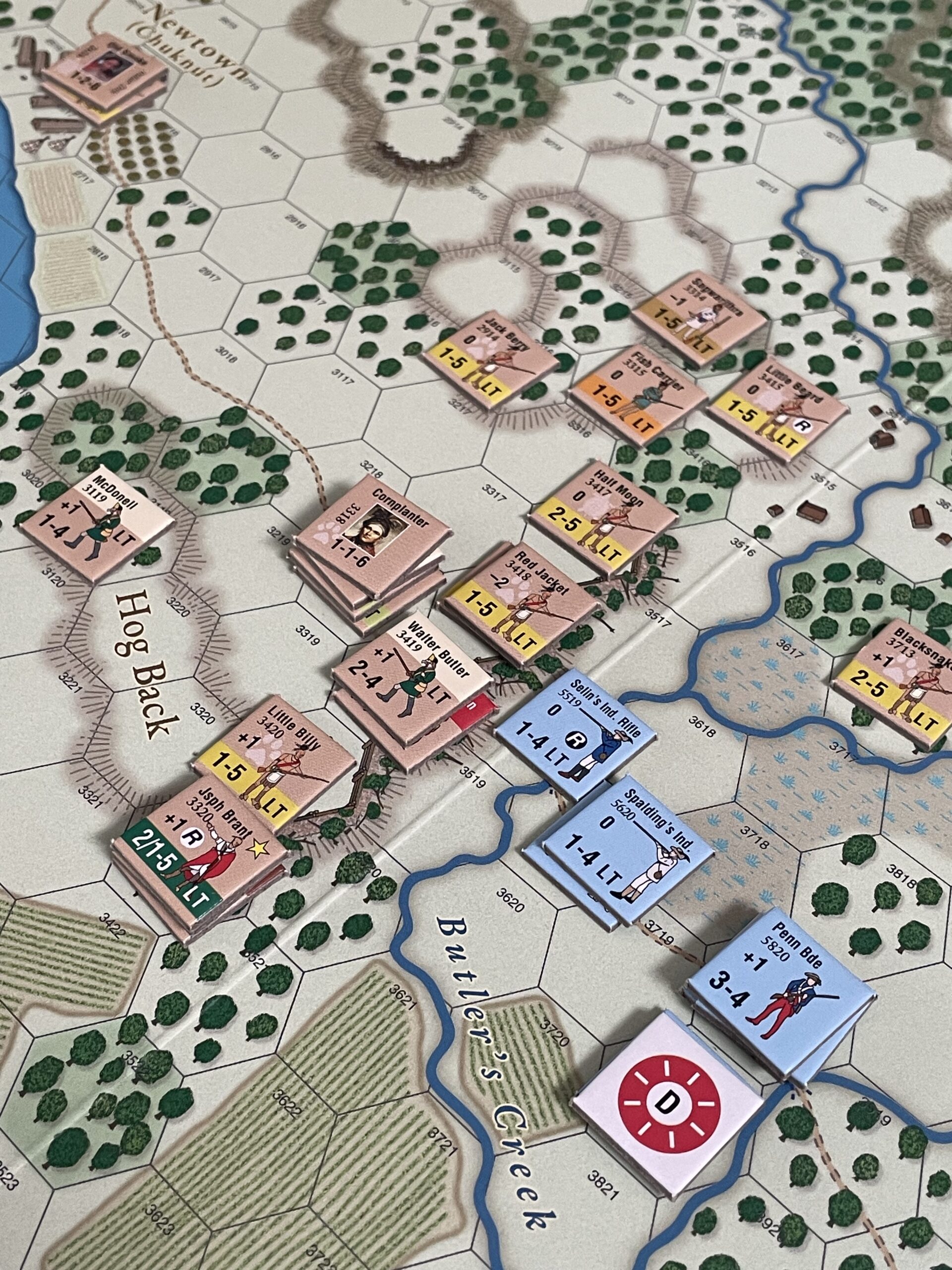
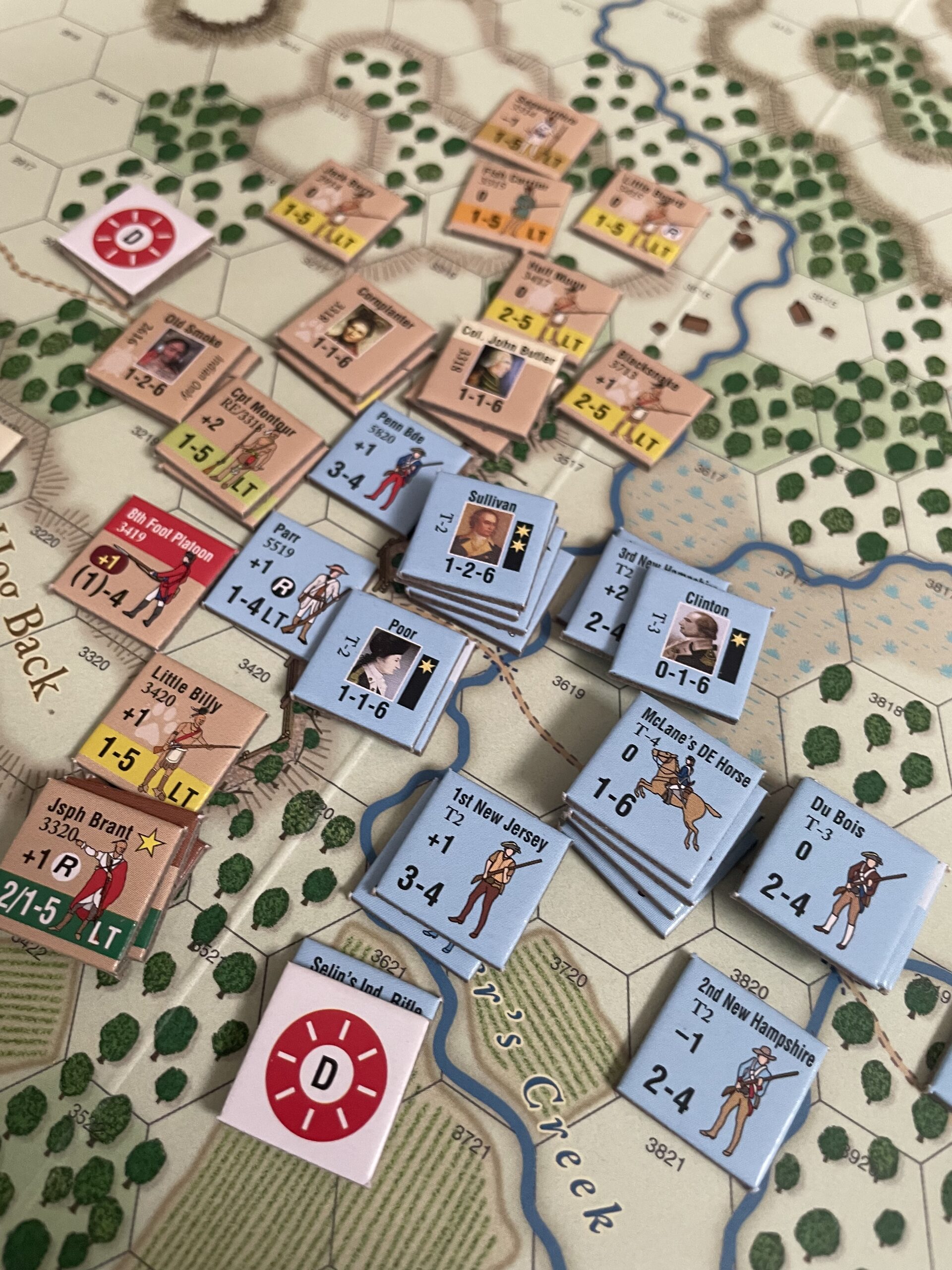
Oriskany. With Oriskany being the fourth title packaged in Tri-Pack II, and being the “extra” game, one might be tempted to think this is an easy, even throw-away battle scenario. For myself, I found playing Oriskany the most challenging of the four scenarios. Oriskany was challenging due in part to the many extra rules for different units. It seemed like almost every counter on the map was subject to some special rule. There were so many special rules that it slowed play as I constantly second-guessed myself and stopped play to reference the rules to make sure I was doing it right.
Oriskany is also the least solitary friendly of the battles in Tri-Pack II. It is kinda hard to plan a secret ambush against yourself. To help move my play experience along I selected the historical ambush site and played on.
Going into this play of Oriskany, I was tempted to replace the dice included in Tri-Pack II because the red British die seemed to roll average and the blue American die seemingly always rolled low. Not. This. Battle. The blue American die was blistering hot with lots of 8 or 9 results (the d10 is read 0-9). As a result, though the Ambush was sprung early the American were able to fight their way out quickly. At Fort Stanwix, the Garrison Artillery unit kept British and Indian units under fire while the British siege artillery was relatively ineffective.
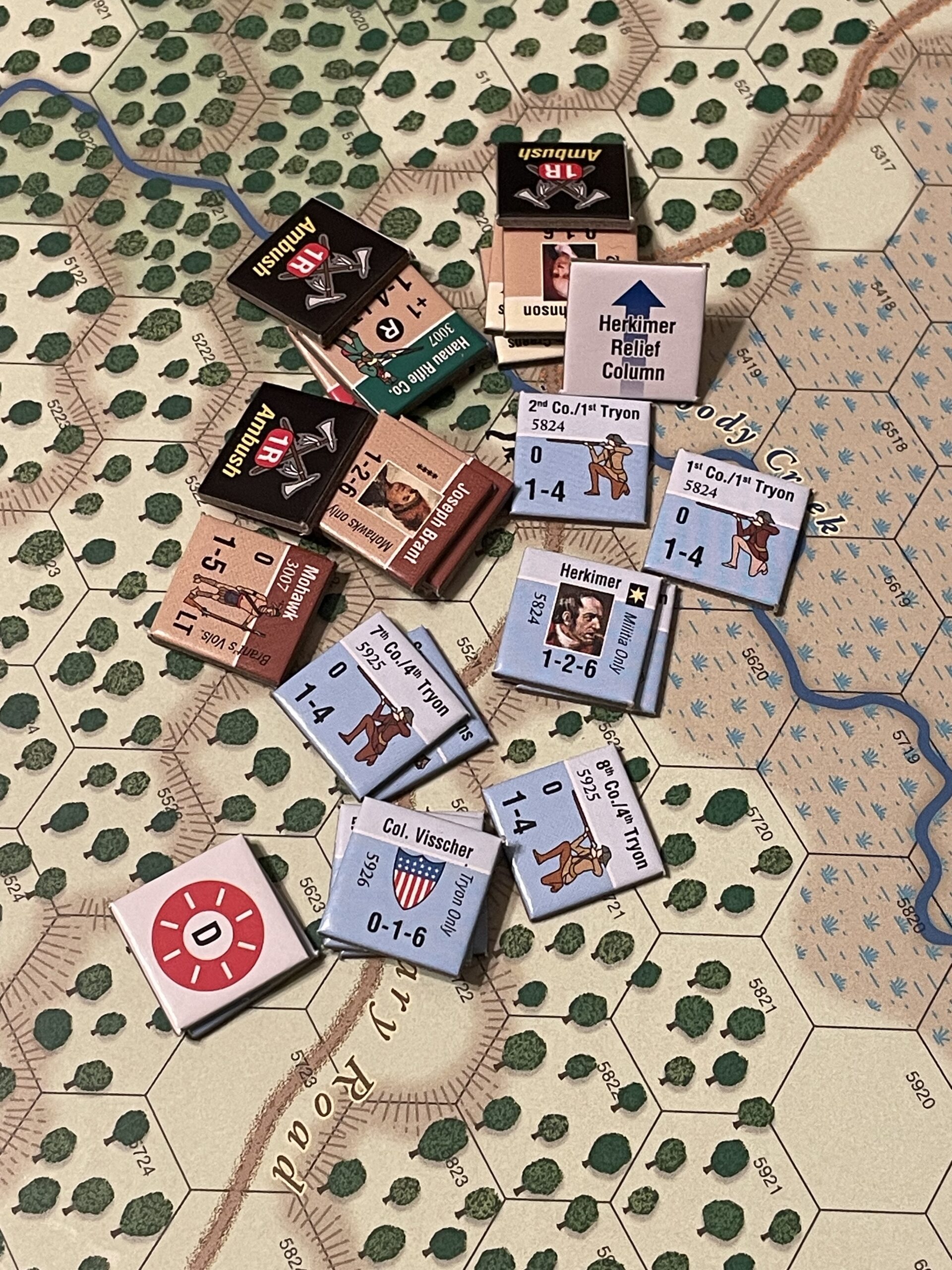
Then there was the Indian Will Track. Rule 4.2.2.2. specifies when checks are triggered by events including when an Indian unit is Disrupted, Shattered, suffers a Step Loss, or is Captured. Those events seemed to occur every turn which meant plenty of checks. Remember what I said about the red British die rolling average? Well, when it came to Indian Will checks the dice War Chiefs were not smiling which meant several tribes withdrew from the fighting.
At the end of this Battle of Oriskany (more properly the Relief of Fort Stanwix) the Supply Wagons reached the fort and the American even sallied forth to try and reach the British HQ hex. Having destroyed the Light Infantry Encampment earlier, the destruction of the HQ hex would have delivered a Decisive Victory; without the destruction of the HQ the Americans settled for a strong yet Marginal Victory.
Nothing BOAR-ing
As I stated at the top, Battles of the American Revolution Tri-Pack II: Monmouth, Germantown, Newtown is an exceptional value. Even if you pay the current GMT Games price of $79, you get four battles to choose from as well as several bonus battles or campaigns. Twenty dollars for a large map, a sheet of counters, and complete rules with player aids. These days try to buy a wargame for $20 retail and see what you actually get.
Most of the battles in Tri-Pack II are playable in an evening (two or three hours) thanks in great part to a well-refined set of Series rules that are easy to learn and apply at the table. Even with using Exclusive rules for each game, the cognitive load of each is manageable (though I admit the many rules exceptions in Oriskany demanded extra patience). In many ways that combination of factors makes Tri-Pack II an ideal candidate for a Game Night series or to be part of a gaming club collection. On any given day a group can pick up the box, choose a battle, and if at least one player is familiar with the system (if all are familiar with the Standard Rules so much the better) a complete game can be played in a reasonably timed session. For myself, between Tri-Pack II and Tri-Pack I (Guilford Courthouse, Saratoga, Brandywine, and bonus Eutaw Springs) I have many hours of enjoyable gaming to look forward to. I am proud to have Battles of the American Revolution Tri-Pack II: Monmouth, Germantown, Newtown in my game collection; it certainly deserves to be in yours too.
Thank you for visiting the Regiment of Strategy Gaming and riding with The Armchair Dragoons.
Rather than list a bunch of social media links, the easiest thing to do is to check out our LinkTree, which connects you to all of our various locales around the web.
You can also support The Armchair Dragoons through our Patreon, and find us at a variety of conventions and other events.
Feel free to talk back to us either in our discussion forum, or in the comments below.


