
 by
by Mike Colello, 2 June 2025
New from Lock ‘n Load Publishing, Glory & Empire: First Victories is the first entry in a new series of games focusing on grand tactical combat in the Napoleonic Era. A battalion level game, First Victories promises authentic Napoleonic warfare by focusing on the importance of leadership, morale, and maneuvering. The game overview from Lock ‘n Load’s website highlights the key points:
- Orders & Command Structure – Leaders issue commands that must be executed with realistic delays and constraints, reflecting the fog of war.
- Formations & Maneuvering – Infantry squares, line formations, and cavalry charges play a crucial role in engagements, requiring players to think strategically.
- Morale & Fatigue System – Units will break and falter under sustained pressure, making morale management just as vital as firepower.
- Combined Arms Tactics – Coordinate infantry, cavalry, and artillery for devastating battlefield effects, just as Napoleonic generals did.
- Scenario-Based Play – Relive historic battles with structured scenarios that challenge players to achieve key objectives while adapting to battlefield conditions.
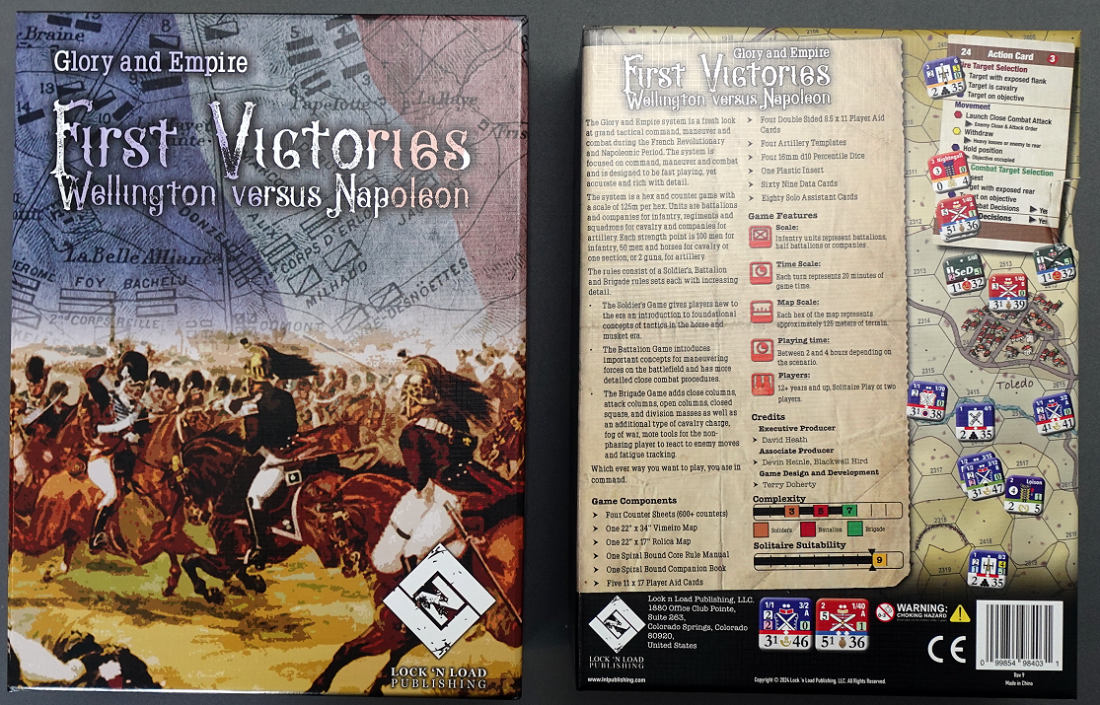
click images to enlarge
All of that AND fine Corinthian leather?
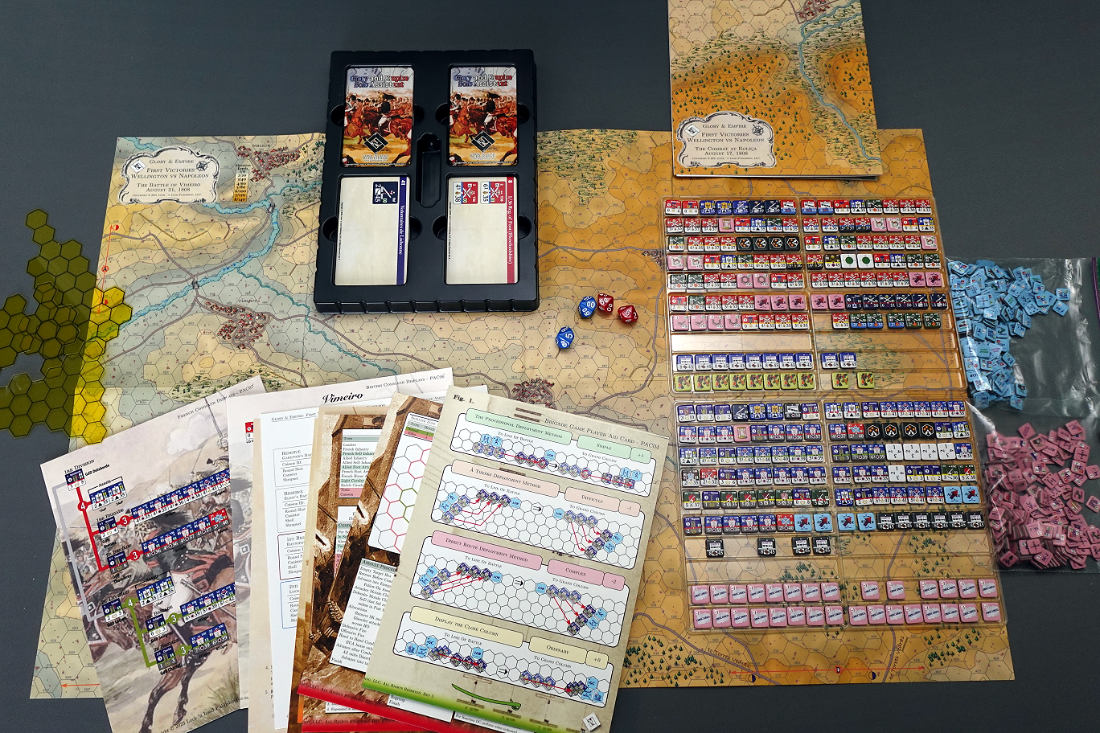
Okay, maybe I’m showing my age with that reference to a commercial from the 1970s and there is certainly no leather included in the First Victories game box, but there are plenty of other good things. Inside of the 3” deep box game box there are two nice looking game maps, one 22” x 34” Vimeiro map and the other a 22” x 17” Rolica map. The core rule book and companion book (containing the scenarios and the solo assistant) are also of high quality and are both spiral bound, a much-appreciated feature. There are four counter sheets totaling 600+ pre-rounded counters. A total of nine Player Aid Cards are also included, five of which are 11” x 17” and the other four are double sided 8.5” x 11”. Also present are four artillery templates, four d10 dice, sixty-nine data cards and eighty solo assistant cards. With the aid of the included plastic insert, all of these components fit nicely inside of the box.
Shallow end or deep end?
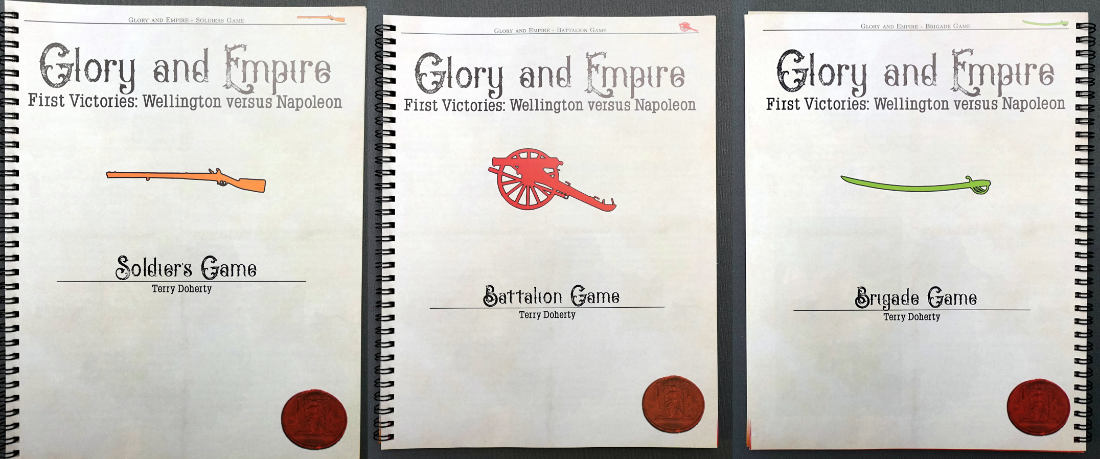
The rulebook is divided into three sections: the Soldier’s Game, the Battalion Game, and the Brigade Game.
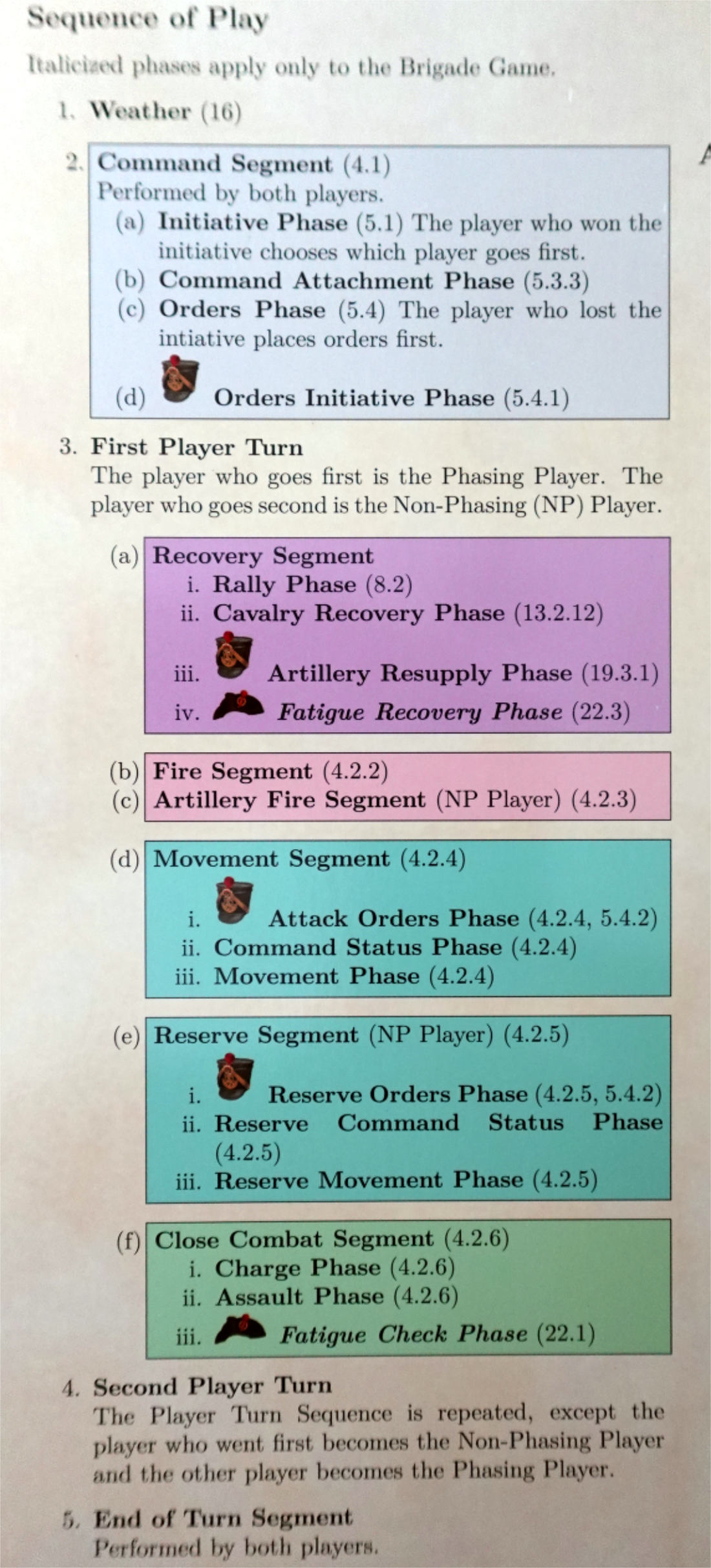
The Soldier’s Game contains the basic rules and introduces players to the concepts of Napoleonic warfare. The Battalion and Brigade games build upon these concepts by adding higher lever game mechanics, more detail, and optional rules. For each game, the Sequence of Play segments are the same, but the Battalion and Brigade games add some additional phases to some of the segments.
Each turn begins with the Weather Segment. The scenario rules will indicate what weather effects are in play which include time of day, smoke, and weather. Next is the Command Segment which is performed by both players. Initiative is determined in this segment and the player who wins the initiative gets to choose who goes first in the turn. This is important because the same modified die roll that determines who wins the initiative is also used by each player to consult the Orders Chart to determine how many orders they receive for the turn. Orders can be used as Attacks or as Reserve Orders. Reserve Orders allow units in command to move during the Reserve Segment of the opposing player’s turn.
Play then proceeds with the first player stepping through the rest of the segments in the Sequence of Play. In order, the segments are: Recovery, Fire, Movement, and Close Combat. After the first player finishes the sequences are repeated by the second player. Once the second player has finished the End of Turn Segment is conducted by both players and the turn ends.
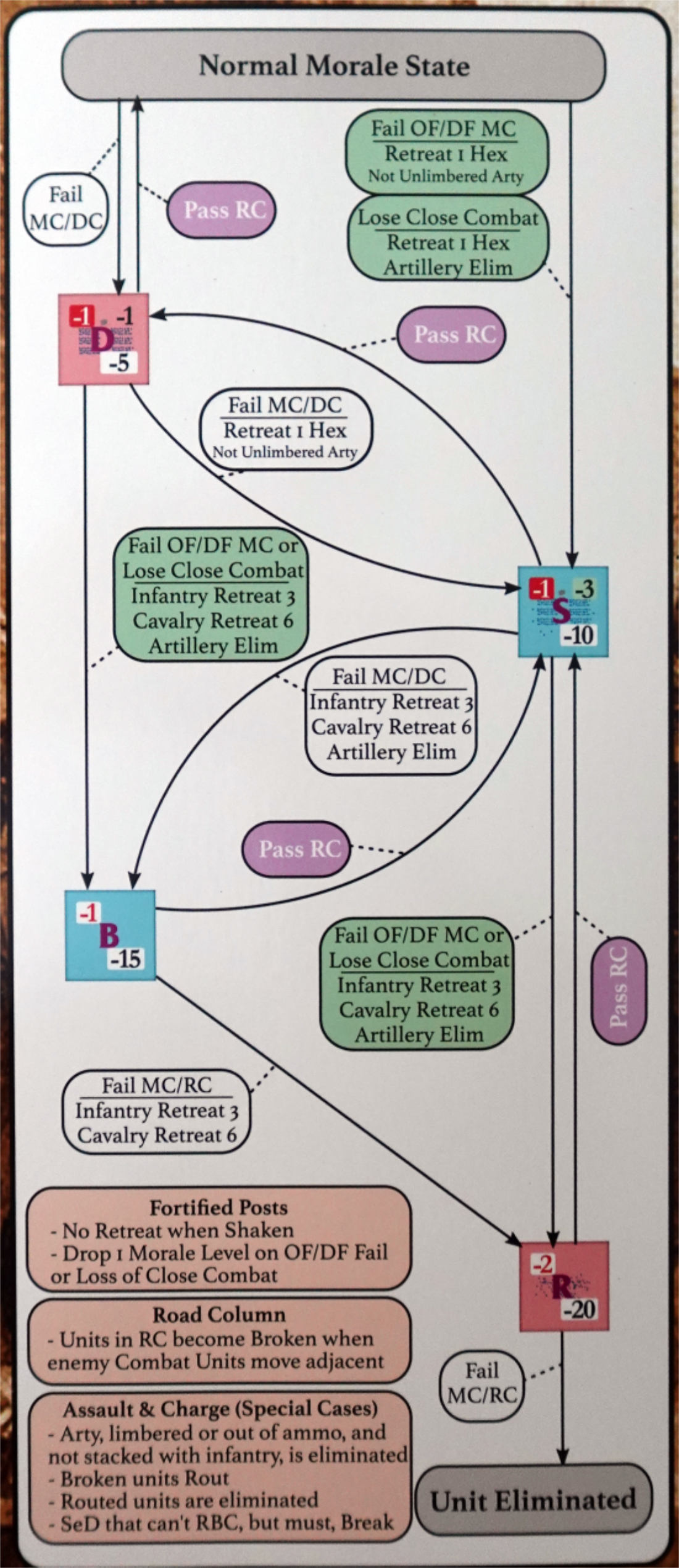
There are two types of combat in First Victories: Fire Combat, a voluntary ranged attack requiring Line of Sight, and Close Combat which is just like it sounds. Close Combat also includes Cold Steel Combat (basically using swords and bayonets) which can occur when cavalry units charge, during a Reaction charge, or when units assault fortified posts or Built-Up-Area hexes. Combat can cause step losses to units (each unit has four steps) but the more important effect is on the unit’s morale. Morale is extremely import in this series, so much so that there are five Morale States: Normal, Disordered, Shaken, Broken, and Routed. The included Morale State Diagram shows the number of bad things that happen as a unit loses morale.
Units and Formations
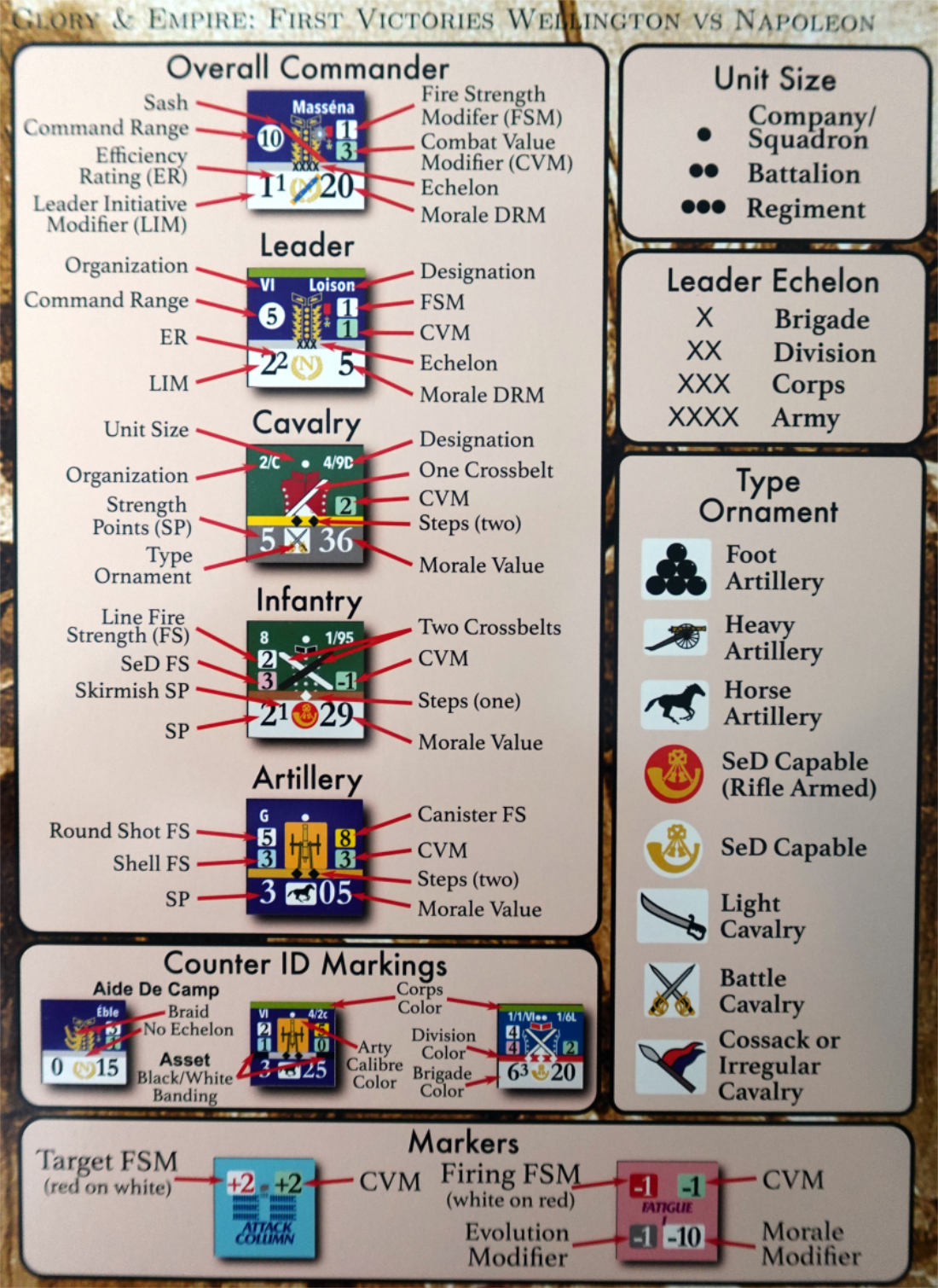
There are four basic types of units in the game: infantry, cavalry, artillery, and leaders.
Infantry can be of different sizes, indicated by dots above the unit symbol: one dot for a company, two for a battalion, and three for a regiment. Infantry has different Fire Strength values depending on their formation (Line, Column, Square, Skirmishers en Tirailleurs, Skirmishers en Débandade).
There are three main types of Cavalry: Light Cavalry, Battle Cavalry, and Irregular Cavalry. The cavalry unit’s primary weapon is shock and fear, mainly used in Charges.
Artillery also comes in three types: Artillery: Represented by an unlimbered cannon symbol when not marked with a Limbered Marker. There are three types: Light Foot Artillery, Heavy Foot Artillery, and Horse Artillery.
Leaders are distinct from Combat Units and do not have Strength Points. They provide a Morale Die Roll Modifier (DRM) to units stacked with them. There are different types of leader counters, including Overall Commanders (OC). Leader counters also have seniority and may have an Efficiency Rating (ER) and Leader Initiative Modifier (LIM) which affect command mechanics.
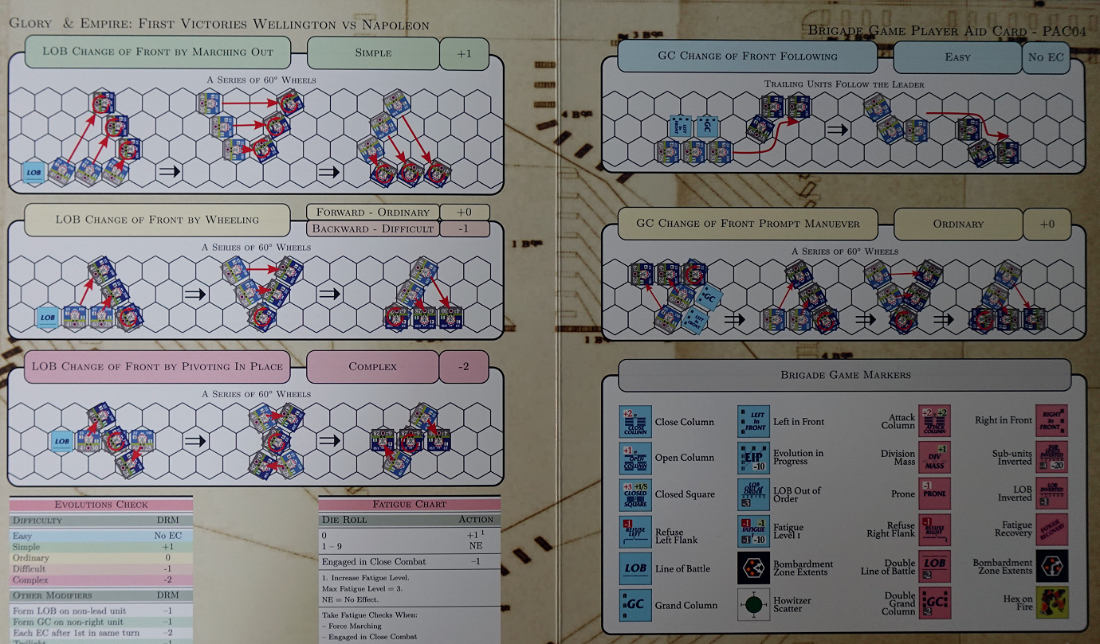
Units can adopt various types of formations which can affect their movement, combat capabilities, and morale. Formations can be restricted by the type of terrain a unit occupies. Units also have a specific facing determined by their formation, defining their front, flank, and rear hex sides. The types of formations available are: Column, Line, Road Column, Square, Skirmishers en Tirailleurs (SeT), Skirmishers en Débandade (SeD), and Prone.
Zones of Control, Line of Sight, and Terrain
Combat units exert a Zone of Control (ZOC) into their front hexes. ZOCs can be restricted by terrain and formation types. Units must stop when entering an enemy ZOC and can leave it by spending two movement points as the first action they take, as long as they do not move into another enemy ZOC.
Line of Sight (LOS) is traced from the center of the hexes and can be blocked by terrain and smoke. Clear LOS is required for various actions, including making a Fire Attack, declaring a Charge, attempting a Reaction Charge, and making a Reaction Formation Change.
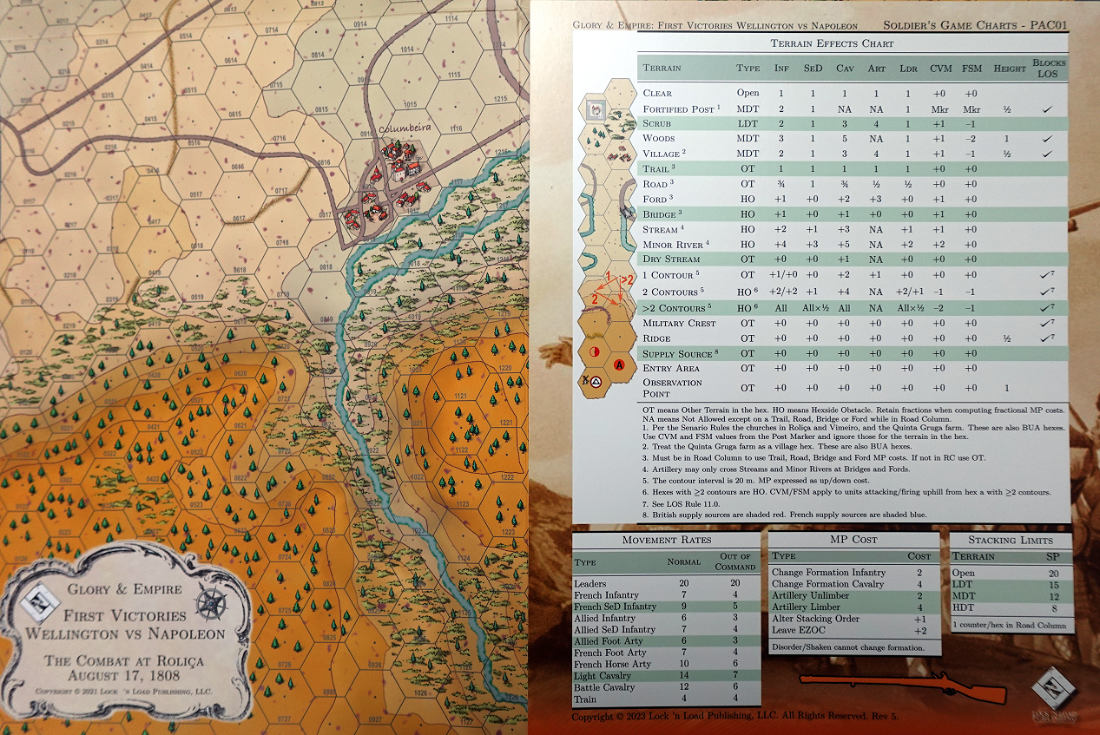
There are five classes of hex terrain in the game: Open, Light Density Terrain (LDT), Medium Density Terrain (MDT), High Density Terrain (HDT), and Impassible. The included Terrain Effects Chart provides information on each terrain type including movement cost, Fire Strength Modifiers (FSM), Combat Value Modifiers (CVM), and whether the terrain blocks LOS.
But Does It Napoleon?
The Glory and Empire system claims to provide a “detailed and immersive tactical wargame that brings early 19th-century warfare to life”. Does it succeed in that claim? I absolutely think it does. The command-and-control structure is there, simulating the flow of orders to subordinate units in command range. All of the formations are there and are extremely important to achieving success. Maneuvering is crucial in that you not only must get your units where you want them to go, but they must arrive there in good order. All of these elements in the system are detailed and tied together in such a way that you do feel like you are facing the challenges of 19th-century warfare.
Yes, Jim, It Does Have a Solo Assistant!
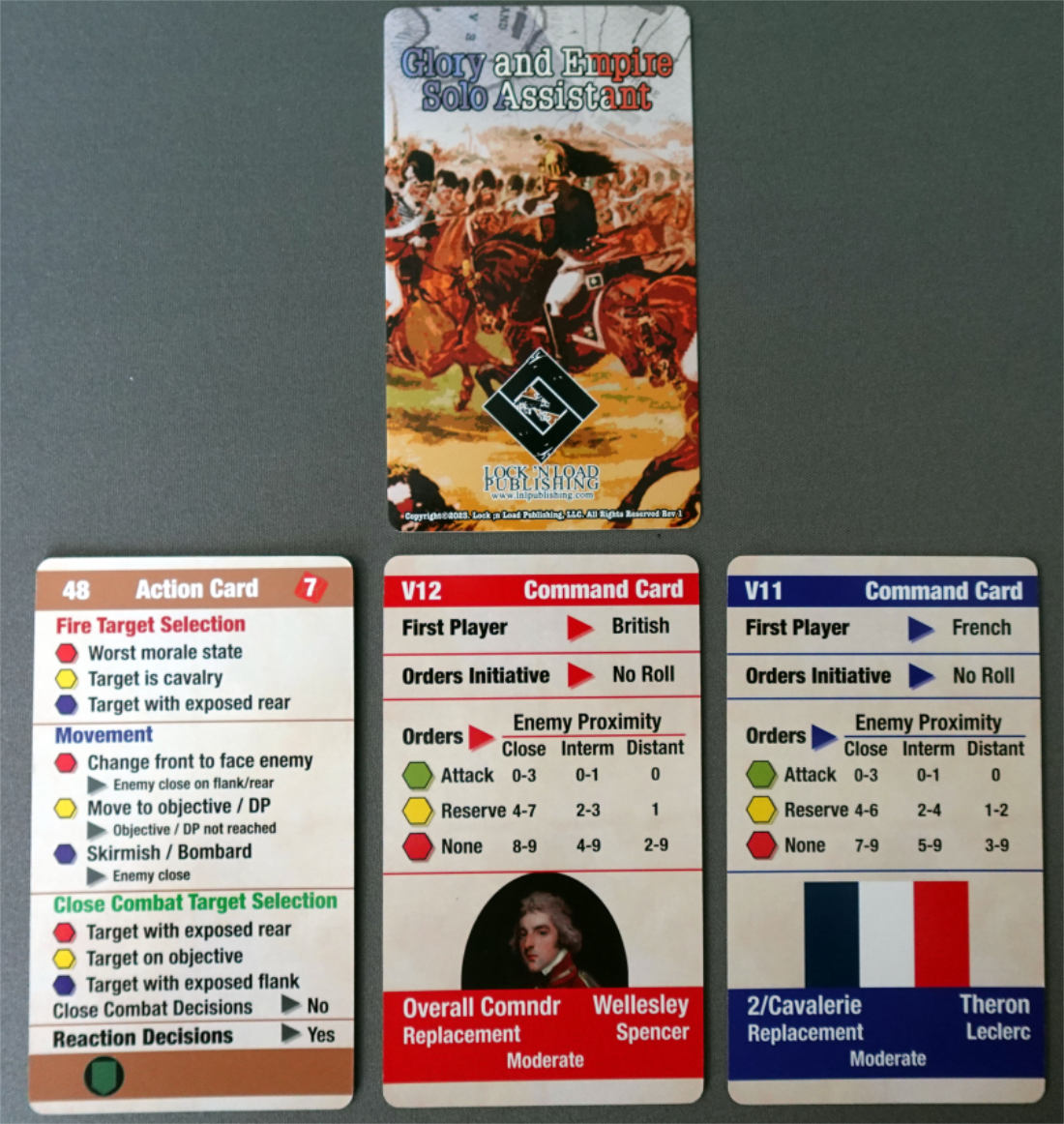
Glory and Empire includes a card driven solitaire system that integrates seamlessly with the rules. Unlike a lot of other games that provide only one or two solitaire only scenarios, the Solo Assistant in Glory and Empire works with any scenario and the player can choose either side. The system is card driven and utilizes two card decks: the Command Card deck and the Action Card deck. The Command Card deck determines what the non-player side does and which of its leaders receive orders for a particular turn. The Action Card deck determines how a leader and his units respond to orders, fire, move, conduct close combat, and reactions. The Solo Assistant comes with the standard “Judgement Call” recommendation- if you think a non-player generated move makes no sense you should override it with something that does. I haven’t spent a lot of time with the Solo Assistant (I do plan to!) but it does seem very good at what it is trying to do, that is, provide a challenging game.
Final Thoughts
Glory and Empire First Victories is the first game in a new series from Lock ‘n Load Publishing. As I mentioned above, the components are top notch and there is a lot provided in the 3” game box. I think this game delivers on its promise to provide grand tactical maneuvering on the battlefield in the Napoleonic era. I look forward to spending more time learning the system. I believe you could be happy just playing the base Soldier’s Game rules, but I suspect the “full flavor” of the system lies in the Brigade game. I expect this will be a popular game with many more future editions to come.
Thank you for visiting the Regiment of Strategy Gaming and riding with The Armchair Dragoons.
Rather than list a bunch of social media links, the easiest thing to do is to check out our LinkTree, which connects you to all of our various locales around the web.
You can also support The Armchair Dragoons through our Patreon, and find us at a variety of conventions and other events.
Feel free to talk back to us either in our discussion forum, or in the comments below.


