
 by
by MarcM, 8 September, 2025
Panzer Campaigns Poland ’39 from designer Mike Prucha and publisher Wargame Design Studio is the latest entry into the long-running Panzer Campaigns series. Covering the first shots of WWII and the invasion of Poland, it also marks the earliest entry of the digital wargame series.

click images to enlarge
The early WWII period has always been interesting to me, so I was happy to take a look at the copy of Poland ’39 that Wargame Design Studio provided. Here’s a look at what the new game brings to Panzer Campaigns series.
Poland ’39 Basics

Poland ’39 launched in May, with battles simulating Germany’s invasion of Poland in the west as well as the first few weeks of Russia’s invasion of eastern Poland. This scope of the topic requires a large map and the game delivers with the largest Panzer Campaigns map to date, a sprawling gameboard of over 950,000 hexes. That’s just under four times the size of the next largest map (Moscow ’42). It takes a while to scroll through – definitely get familiar with the Next Unit and Previous Unit buttons for the larger scenarios.
For those not familiar with the scale of the Panzer Campaigns games, a quick overview:
- Timeline: Games cover World War II operations from 1939 to 1945 (and beyond).
- Game Scale: Units are typically battalions and companies.
- Map Scale: Each hex is one kilometer across.
- Time Scale: Each turn is 2 hours.
The 32 games cover historical operations in Europe, Russia, Africa, and the Pacific, including “what if?” games Sealion ’40 and Japan ’46.
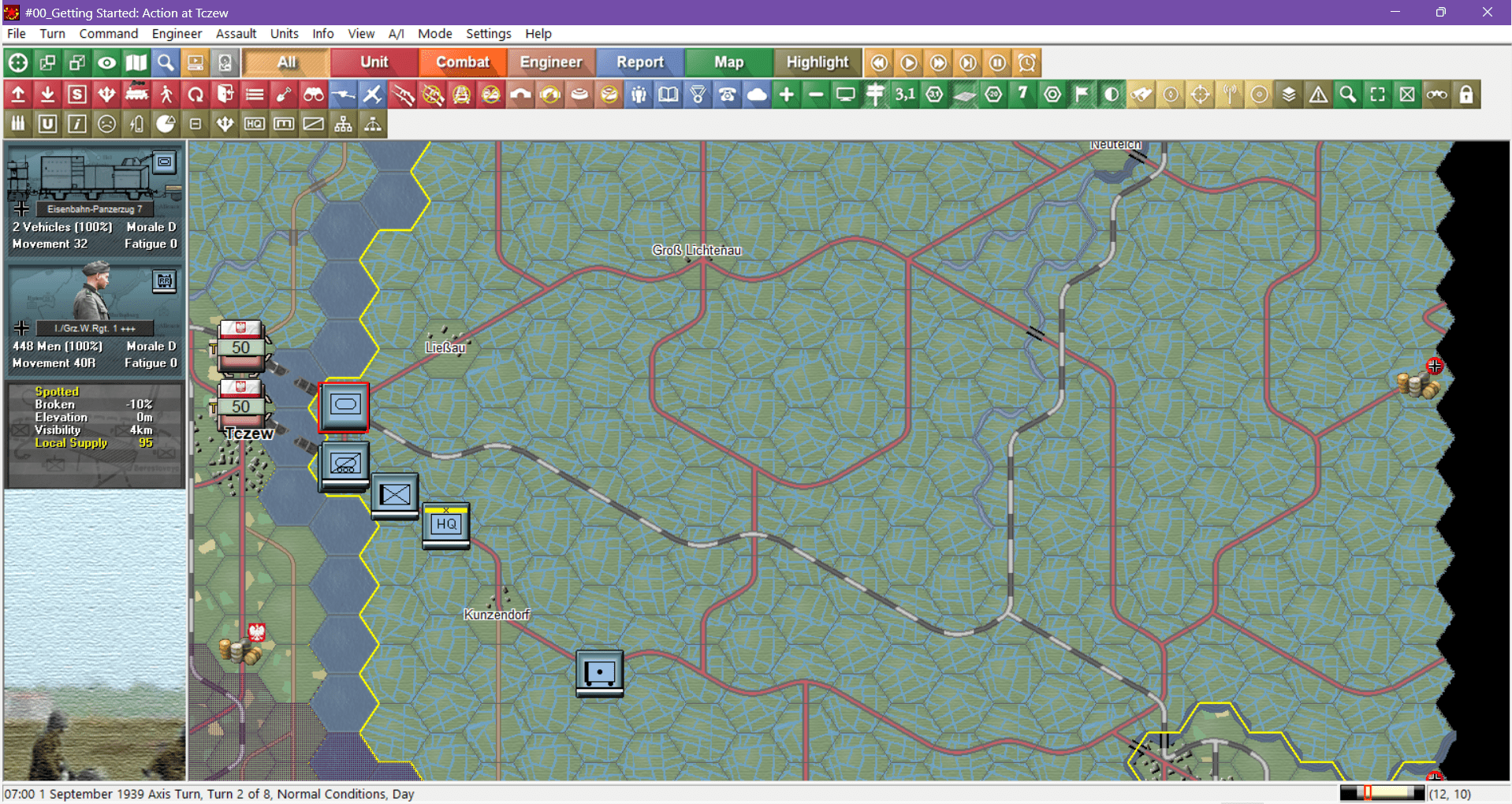
A standard feature of WDS games is a long list of scenarios, covering wide ranges of map sizes, turn lengths and unit density. Poland ’39 is no different, offering a total of 77 scenarios, including a Getting Started scenario and the campaign games. Like other games in the series, most have variations, in this case variations of 30 individual battles. Some of the variants simply balance the opponents differently to allow for solo play of either side, but others offer scenarios of different lengths or hypothetical alternatives to historical events.
The Scenarios

The Poland ’39 campaign is a good example, with 12 variations. There’s a 158-turn version that ends on September 16 and the full 348-turn campaign that ends on October 5 and includes the Soviet invasion of Poland. Other campaign variations include hypothetical situations such as:
- The Soviet invasion in the east doesn’t happen, freeing up Polish units.
- The Polish Army begins fully mobilized and has more units at the start of the war.
- There’s no Molotov-Ribbentrop Pact between Germany and Russia, so Russia enters as part of the Allied forces to confine Germany to the west.

Other scenarios cover battles from the campaign and range in length like 16, 24, 28, and 48 turns. Small scenarios use just a fraction of the map and a handful of units. These are good chances to get familiar with the gameplay if you haven’t tried Panzer Campaigns before.
Individual Poland ’39 scenarios include:
- Poland’s initial border defenses
- The German assault at Tomaszów Mazowiecki
- The Polish offensive at Bzura
- The Polish defense of Warsaw
Speaking of the scenarios, take a look at the Designer Notes. In addition to the situation setups as presented in the scenario window, the notes include a few strategy tips. They also make a handy reference for the scenario situation if you need a reminder of the setup during gameplay.
The Designer Notes also demonstrate the reasoning behind some of the timing and events in the game:
- The availability and placement of the Polish Marching Battalions
- Availability of the German battleship Schleswig-Holstein as a reinforcement, based on the territory Germany controls
- Polish reinforcements’ dependence on who controls certain locations
- Time limits to get Polish units to exit hexes and randomized Polish withdrawals, both representing surrender of fighters

While there’s obviously focus on the German invasion, Soviet units become available in scenarios after September 17, with the first scenario representing elements of the Red Army attempting to take Wilno. Two other scenarios, the Soviets’ disorganized attack on Grodno and the Polish Border Protection Corps attempt to take the Soviet-occupied village of Szack round out the Soviet scenarios.
Gameplay

Gameplay is standard for Panzer Campaigns games. If you’ve played the series, you know what to expect. If you’re starting Panzer Campaigns at this start of the war, here’s what to look forward to. As in a tabletop hex and counter wargame, each unit has limited movement points to use, primarily dividing them between movement and combat. Other actions consume points as well, such as digging in, loading or unloading transports, changing into and out of march formation or rail movement and more. Some units have specific functions. For example, engineers can damage or construct bridges and damage rail lines, while recon units can attempt to spot hidden enemy units and determine their strength.

Air units – reconnaissance and combat flights – are available, depending on the scenario, as are artillery strikes. Command range, supply, reinforcements, weather, day and night visibility, zones of control, and combat fatigue, are all modeled.

There’s a lot you can do. In fact, all the possibilities can be a bit intimidating, especially since some possibilities are determined by game conditions. But you can start small, the menu buttons are a big help, and thankfully the game engine enforces the conditions. If an action isn’t allowed, the status bar tells you why. There’s still a lot to remember, so you might want to start with the smaller scenarios with a few turns and a handful of units. The Getting Started scenario is, well, a good place to start. The accompanying step-by-step guide helps you understand the key functions of different units and when and why you might want to employ them.

And while you might not thoroughly read the entire 245-page manual (okay, some of the pages are credits of the individual games in the Panzer Campaigns series, but the rules are still impressively thorough), you definitely should at least skim it to get familiar with the depth and realism of the game. Again, there’s a lot you can do, and you’ll miss a lot of the game and a lot of the enjoyment if you’re not aware of all the possibilities.
Final Thoughts

Mike Prucha’s Poland ’39 is a welcome addition to the WDS Panzer Campaigns series. I like being able to try out the earliest technology of the war and seeing how you can fare with the underpowered and undermanned Polish forces adds an interesting prospect. Plus, just reading through the designer notes it’s impressive to realize how much research and effort Prucha put into making this game realistic.

As all of the Panzer Campaigns games, Poland ’39 includes impressive detail that lets you immerse yourself in the initial battles of WWII as deeply as you like. And if the campaign and larger battles are a bit overwhelming to you, that’s fine. There are plenty of scenarios that let you start small and increase your commitment as you learn all of the possibilities.
Thank you for visiting the Regiment of Strategy Gaming and riding with The Armchair Dragoons.
Rather than list a bunch of social media links, the easiest thing to do is to check out our LinkTree, which connects you to all of our various locales around the web.
You can also support The Armchair Dragoons through our Patreon, and find us at a variety of conventions and other events.
Feel free to talk back to us either in our discussion forum, or in the comments below.


They’re nice to look at, but Panzer Campaigns are unplayable.
Why? Unit scale, and all other scales related to it (map scale, time scale). All a person has to do is look at the map graphic, above, and ask themselves, “Do I really want to have to control hundreds of units on every turn?”
People who say that smaller scenarios are available are ignoring the point that buying a game on a certain campaign means people want to play the campaign, not just some small portion of it.
“Timeline: Games cover World War II operations from 1939 to 1945 (and beyond).
Game Scale: Units are typically battalions and companies.
Map Scale: Each hex is one kilometer across.
Time Scale: Each turn is 2 hours.”
Think about that: The operational level at the above scales is absurd.
Also, a 1990’s-era user interface, which was absurdly clunky then and remains so now.
Also, no PBEM security whatsoever. This means that not only are players expected to play months-long, or years-long, PBEM games, they’re expected to do so in full trust of their opponent. Yup, at just under 350 turns for the campaign, you’re talking years.
Also, ask yourselves whether a 350-turn campaign game at this scale was playtested in any meaningful way. It hasn’t, of course, that should be obvious. The insanely large scale muddles up any play-balance shortcomings in a longer campaign game, so the designers would not be too particularly concerned over the issue. It’s not even possible to have the computer play itself to try to get a rough idea, since one player always has to be human.
I used to own several Panzer Campaign titles, but sold all of them some years ago to hapless buyers on eBay.
I didn’t intend for this post to get this long, but hey, things have to be explained.
I hope you do realise that what you’ve put up above is NOT an objective description of WDS’s Panzer Campaigns. Your opinions about literally every aspect of these games are purely subjective…and, I’m afraid, you hold a minority opinion…
And of course you have deep knowledge of all the changes made by WDS since they bought the IP, based upon games you sold ‘some years ago’.
Nothing like showing support for one of the very few publishers in this genre…
Have any of the things I mentioned changed for the better? It’s a rhetorical question.
I know the absurd scale hasn’t changed (how could it?) and that’s the most fundamental, game breaking flaw.
As far as support, Tiller made several hundred dollers off me, a couple of decades ago. Yeah, I was one of the suckers. Nowadays, life’s too short to waste on crappy games. Readers should consider this a Public Service Announcement.
They had already made the gold version before John Tiller passed away. Looks Rob is still stuck on his former HPS copies, lol.
Funny gibberish.
Fair enough. Just a handful of subjective opinions. I happen to own ALL the titles published by WDS so far and I don’t subscribe to your statements at all… 😀
Oh and “The operational level at the above scales is absurd.” — The operational level at the above scales is really fun and engrossing to play.
Rob, here is my response:
Your criticism of the Panzer Campaigns series overlooks its core design philosophy, which is to provide a detailed, operational-level wargaming experience. The large scale, far from being a flaw, is a deliberate feature that allows for a comprehensive simulation of major World War II campaigns. While the game’s user interface may be a bit dated by modern standards, its functionality is powerful and efficient for seasoned wargamers, allowing for a high degree of control and flexibility. Furthermore, while long campaigns are a commitment, the games include numerous smaller scenarios that can be completed in a reasonable amount of time, offering players a variety of experiences without having to tackle a full-length campaign. The emphasis on historical accuracy and detailed modeling of unit attributes, supply, and fatigue is a major selling point for its target audience of dedicated wargamers, who value depth and realism over flashy graphics or simplified gameplay.
Actually, that wasn’t me, that was Gemini.
My response is ‘who cares what you think’? Just because you don’t want to play a game with thousands of units, doesn’t mean other people don’t want to. Just because you are bothered by a clunky interface, doesn’t mean that other people must be too.
If you don’t like WDS games, why are you here commenting on them? Don’t you have something more productive to do with your time?
Hello guys.
Yeah Rob… its just your opinion… i remember playing Moscow 1941… that was a big map and LOADS of units… and i would check every single one of them twice before pressing the “End turn” button !
If you dont like the game, dont play it! Choose one that suits you better.
And if you know how to play, if you can keep track of whats going on on the battlefiled, if you know how to use all the “in game” commands, it not that long-time to play… Or maybe you just cant play it because it is too much for you…