
 by
by Byron S, 21 January 2026
Fought by elements of the US Army, Marines and Army of Republic of Vietnam (ARVN) against the North Vietnamese Army (NVA) and Viet Cong (VC), the Battle for Huế, January 31 to March 2, 1968, stands as a seminal event of modern warfare.
Huế was the former imperial capital of Vietnam, and in 1968 was the third largest city in the south. It held enormous cultural and symbolic significance to the Vietnamese people. Geographically, Huế is located approximately five miles from the coast and is generally bi-sected by the Huong – or Perfume – river. On the north bank of the river lies the Citadel, a walled fortress that contained the royal palace and housing for about one half of Huế’s 130,000 inhabitants. Huế city south of the Huong river was newer and modern, and was the location of the commercial centre, government offices, cathedrals and a university. Two key military installations – the ARVN Mang Ca Garrison in the north and the MACV compound on the south- were only one and half-miles apart, but lay on opposite shores of the river, connected by a major road bridge. Route 1, the major north-south highway, passed through the city.
Strategically, the Battle for Huế was part of a country-wide offensive planned by the NVA and VC. North Vietnamese leadership believed that a combined attack by regular and guerilla forces would inspire the “oppressed” citizens of the south to rally and join the General Uprising against the “puppet” government of South Vietnam. For their part, US forces along with the ARVN allies – although partially informed by intelligence agencies – were surprised by the Tet attacks. Recent military actions and build-up of enemy forces had focused along key border regions. Leadership thought the main offensives would occur along key border regions, and specifically directed to the outpost at Khe Sanh. Sensitive to waning public support of the war, President Lyndon Johnson had been touting that the US was now seeing “light at the end of the tunnel” for the war in Vietnam, and ordered MACV General William Westmoreland to protect Khe Sanh at all costs: “I don’t want no damn Điện Biên Phủ”.
click images to enlarge
Operationally, the NVA and VC had been preparing Huế for the Tet offensive for months in advance. Constant infiltration along the roads and rivers had allowed the VC to place many fighters within the walls of Huế, identify military and civilian targets, and store caches of weapons. Their attacking force would eventually consist of approximately 10,000 NVA and VC troops. US forces within Huế consisted of a small garrison at the MACV compound and a local radio tower. The ARVN forces at the Mang Ca Garrison consisted of an HQ unit and a recon platoon. Both armies were well supported by friendly forces within only a few kilometers of the city.
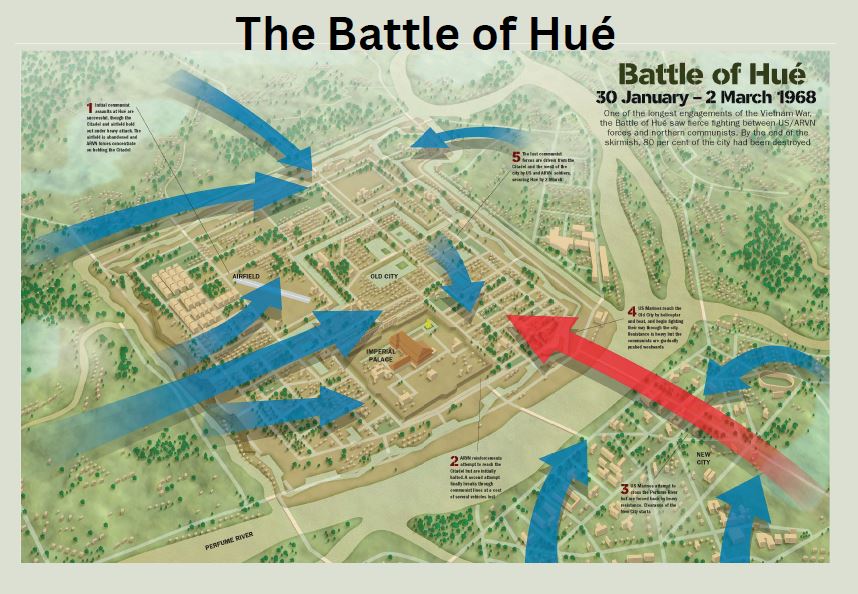
The PAVN-VC attack commenced in the early morning hours of January 31, 1968. VC commandos quickly overwhelmed key guard posts and gates, allowing core assault units into the citadel. A series of tough-fought engagements quickly followed. A highly trained ARVN Hac Bao recon unit fought back an attack to take a local airstrip; the small garrison at the ARVN HQ repulsed two major attacks; and a South Vietnamese Civil Guard / Regional Force (RF) unit prevented a PAVN sapper unit from destroying key bridges. Despite these small successes, PAVN and VC units were firmly positioned across the north section of the city by 04:00 AM.
At the same time across the river in the south portion of Huế, attacking PAVN-VC units met little resistance. After assaults on the MACV compound and comms station failed, the PAVN-VC kept the area under defensive over-watch. By dawn, all of the south city was under PAVN-VC control save for five small enclaves, stoutly defended by either US or ARVN troops.
By dawn, all of the south city was under PAVN-VC control save for five small enclaves, stoutly defended by either US or ARVN troops.
An urgent call for reinforcement by ARVN and American forces came immediately after the initial attacks. ARVN units located to the north-west, east and southwest moved to attack by approximately 04:30. A column of armored units including M-41Walker “Bulldog” tanks along with M113 armored personal carriers (APCs) moved theTam Thai cavalry camp south-east of Huế. The column met heavy PAVN resistance, and several vehicles were destroyed, and some of the M41 crews reportedly abandoned their undamaged tanks. An ARVN 3rd Regiment attacking from the southwest also suffered set-backs. Under-manned and under-supplied, the 3rd fought their way towards the walls of the citadel, but were finally forced to withdraw. Only a mixed force of airborne and cavalry units attacking from the northwest made any noticeable success, albeit at a heavy cost. By mid-day on February 1, they reached Mang Ca after having suffered over 130 casualties, and four of twelve APCs lost. By February 4th, ARVN forces began to retake portions of the Citadel, though back-and-forth counter-attacks would continue by both forces.
The first reinforcements for the besieged MACV compound came from elements of 1st and 5th Marine Regiments in Phú Bài. Like their ARVN allies, initial attacks into Huế were repulsed by blocking PAVN troops, due partially to unreliable intelligence and an under-estimation of enemy forces. Over the next few days, additional Marine attacks pushed through PAVN defenses and reinforced the MACV compound. By February 2nd, the effort to recapture the south portion of Huế was underway. PAVN forces had formed strong defensive positions within hardened built-up areas such as the central hospital, Treasury, and various government buildings. Fighting devolved into ugly house-to-house fighting, and heavy US weaponry, including the M48 Patton tanks and M50 Ontos, helped rout the enemy. By February 11, the south city was secure.
A joint US-ARVN counterattack to isolate Huế from PAVN reinforcement and to secure the Citadel would see even more difficult urban combat. Originally denied the use of heavy fire power – such as naval gunfire, air support, and artillery – in order to preserve the old city, the rules of engagement were lifted on February 14th. Intense urban combat where gains were made street-by-street, block-by-block continued in the following days, and the fighting between February 10 to February 20 was arguably some of the toughest, costliest fighting of the war. By February 21, most of the PAVN and VC forces originally committed to Huế were either killed, captured, or withdrawn. Small pockets of resistance continued to fight, but on February 25, ARVN forces reclaimed the Imperial Palace and hoisted the flag of South Vietnam. Mopping-up operations continued for several more days, and the last communist forces were finally cleared from the city by early March.
Casualties in the battle of Huế were among some of the highest for the US during the war. American forces suffered approximately 150 killed and over 800 wounded. South Vietnamese military casualties were around 400 killed and over 2,000 wounded. Communist losses are a matter of debate and will never be precisely known. PAVN leadership says over 2,000 were killed and 3000 wounded, while MACV cites over 5000 killed. The civilian population bore perhaps the heaviest burden. Almost 1000 civilians were killed as a result of fighting, and approximately 5000 were executed by the VC or went missing. Eighty percent of the city was destroyed, leaving over 100,000 homeless. The ancient Imperial City, with its palaces and temples, suffered extensive damage.
The Battle for Huế had important strategic and psychological implications. While the battle was a clear tactical victory for American and South Vietnamese forces, the surprise and ferocity of the communist attack – not to mention their ability to seize and hold a major city for nearly a month – came as a shock to the American public. For the communists, the battle served their larger strategic purpose of undermining American will to continue the war. Argueable, Huế – along with other key events of the Tet offensive including the attack on the American Embassy in Saigon – was a pivotal moment in turning U.S. public opinion against continued military involvement in Vietnam.
Want to Game It Out?
Gamers interested in studying aspects of the battle of Huế through gameplay have lots of choices.
Complete Games
 |
A Week in Hell [a solitaire board game]. (2010). Battles Magazine. |
 |
Block by Block. (2020). Modern War Magazine. |
 |
Battle for Huế [a solitaire board game]. (2020). Yaah Magazine |
 |
Huế. (1973). Mayfair Games. |
 |
Vietnam Battles: Huế and Pegasus. (1999). Decision Games |
 |
City of Confusion: The Battle for Huế, Tet 1968. (2012). High Flying Dice Games. |
Expansions / Modules / Scenarios
- ‘65: Huế City Extension. (2016). Flying Pig Games.
- Advanced Tobruk System (ATS): The Fight for Huế. (2016). Critical Hit.
- ASL Comp: The Fight for Huế, Apex of the Vietnam War. (2016). Critical Hit.
- Warfighter: Vietnam. Expansion #10. Huế Battle Pack (2024). DVG.
- Lock ‘n’ Load Tactical: Heroes of the Nam. (2015). Lock ‘n’ Load Publishing.
Also, a number of miniatures games – such as Force on Force, Charlie Don’t Surf, FNG, and Charlie Company – may support city fight scenarios.
Thank you for visiting the Regiment of Strategy Gaming and riding with The Armchair Dragoons.
Rather than list a bunch of social media links, the easiest thing to do is to check out our LinkTree, which connects you to all of our various locales around the web.
You can also support The Armchair Dragoons through our Patreon, and find us at a variety of conventions and other events.
Feel free to talk back to us either in our discussion forum, or in the comments below.


